
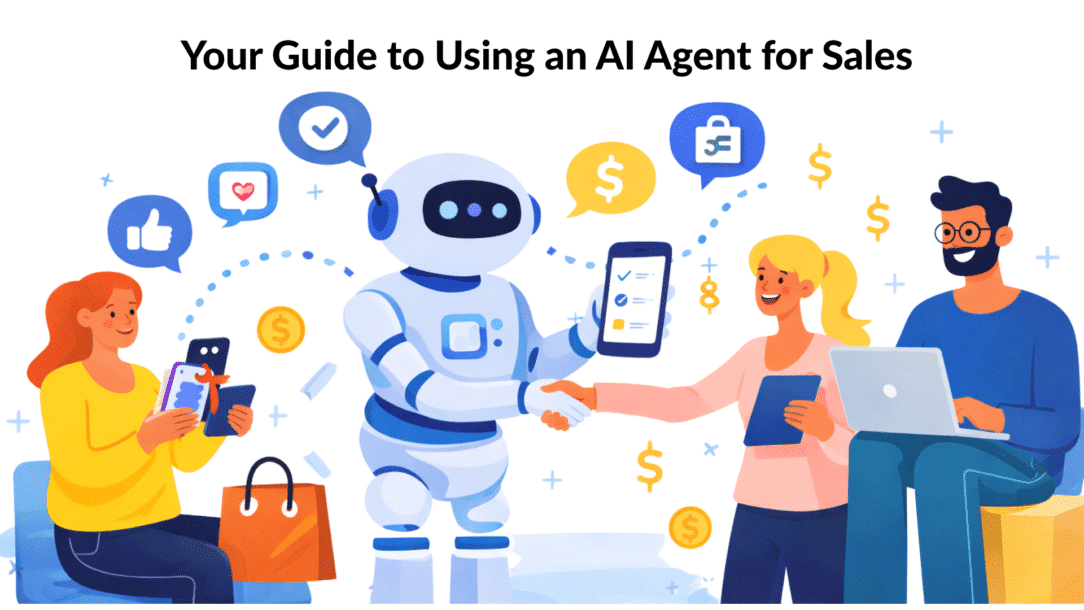
An AI agent for sales is a smart system that automates sales tasks like qualifying leads, answering customer questions, and guiding buyers. Think of it as your best salesperson—one who works 24/7, engages every single visitor with perfect recall, and offers personalized advice. It shifts your sales process from reactive and manual to proactive and intelligent.
What an AI Sales Agent Actually Does
Let’s cut through the jargon. At its core, an AI agent for sales is much more than a simple chatbot spitting out canned answers. It’s an autonomous system designed to handle specific, high-value tasks across your sales funnel. Its job is to pull potential customers into meaningful conversations that move them closer to a purchase.
Imagine a visitor lands on your e-commerce store. Instead of a generic “Can I help you?” pop-up, an AI agent starts a conversation based on their browsing behavior. It asks smart questions, figures out what they need, and recommends the right products in real-time. This is the leap from a basic script to a dynamic sales partner.
More Than Just a Chatbot
Simple chatbots follow rigid, pre-programmed paths. If a user asks something outside that script, the conversation dead-ends. An AI sales agent, on the other hand, is built for flexibility and action.
It operates with a clear goal, whether that’s qualifying a lead or recovering an abandoned cart. The real difference is its ability to:
- Proactively Engage Visitors: Instead of waiting, the agent can start conversations based on user actions, like lingering on a product page or adding an item to their cart.
- Understand Complex Queries: It uses Natural Language Processing (NLP) to decipher typos, slang, and nuanced questions, ensuring it gives accurate and helpful answers.
- Execute Multi-Step Tasks: It can qualify a lead, schedule a demo, and update your CRM—all within a single, seamless conversation.
An AI sales agent acts as a digital sales development representative (SDR) that never sleeps. It handles the repetitive, time-consuming tasks of prospecting and initial qualification, freeing your human team to focus on closing high-value deals. To understand this role better, you can explore the concept of an AI SDR Sales Sidekick.
This shift from a passive tool to an active sales partner is what’s fueling massive market growth.
The global AI chatbot market is valued at between $10-15 billion in 2025—a huge jump from $8.3 billion in 2024. Projections show it rocketing to $46-47 billion by 2029. This explosion underscores just how vital these tools have become for businesses looking to automate their sales engines.
To give you a clearer picture of this transformation, here’s how daily sales functions change with an AI agent.
Traditional Sales vs AI-Powered Sales
| Sales Function | Traditional Approach | AI Agent Approach |
|---|---|---|
| Lead Engagement | Manual outreach, reactive chat pop-ups. | Proactive, 24/7 engagement based on user behavior. |
| Lead Qualification | Human SDRs ask a list of scripted questions. | Automated, conversational qualification in real-time. |
| Scheduling Demos | Back-and-forth emails to find a suitable time. | Instant scheduling within the chat, synced to calendars. |
| Data Entry | Manually updating CRM records after each call. | Automatic CRM updates with conversation logs. |
| Customer Support | Tier-1 support handles repetitive questions. | Instantly answers common questions, freeing up humans. |
| Follow-Up | Manual reminders and follow-up emails. | Automated, personalized follow-ups for abandoned carts or leads. |
The difference is stark. AI agents don’t just speed things up; they fundamentally change how you engage with potential customers, making every interaction an opportunity. By learning to set up an effective bot for sales, you can build a system that nurtures relationships and drives revenue around the clock.
How an AI Agent Transforms Your Sales Funnel
An AI agent for sales doesn’t just speed things up—it completely redesigns your sales process. Forget manually chasing leads through a leaky funnel. Instead, you deploy an intelligent system that engages, qualifies, and converts potential customers at every stage, around the clock.
This isn’t a minor tweak. It’s a fundamental shift in how you move someone from a curious visitor to a paying customer. From the first touchpoint to the final sale, an AI agent acts as a persistent, personalized guide, ensuring no opportunity slips through the cracks.
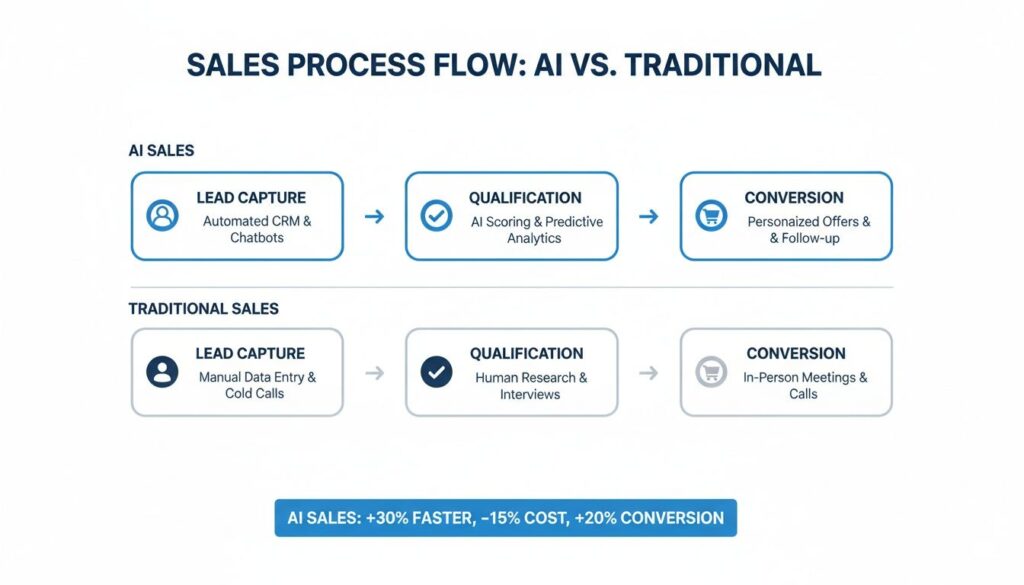
AI agent for Sales Process
This visual drives home the shift from a slow, manual process to a direct, automated flow where AI handles the heavy lifting instantly.
Top of Funnel: Engagement and Capture
At the top of the funnel (ToFu), the goal is to grab attention and capture leads. An AI agent for sales is a natural here, turning passive interest into active conversations.
Use Case Example: You’re running an Instagram ad campaign. Traditionally, a click leads to a website browse, and then the visitor leaves. Opportunity gone.
Now, let’s inject an AI agent:
- Instant DM Engagement: Your ad’s call-to-action is “Message Us.” The moment they send a DM, the AI agent responds, starting a conversation while their interest is at its peak.
- Lead Magnet Delivery: The agent offers a discount code or a free guide right in the chat. In exchange for their contact info, they get instant value. Lead captured.
- Initial Qualification: The agent asks a few simple questions, like, “Are you shopping for yourself or a gift?” This early data helps personalize the rest of their journey.
This proactive approach turns your social media channels into powerful, 24/7 lead generation machines.
Middle of Funnel: Nurturing and Qualification
The middle of the funnel (MoFu) is where prospects are weighing their options. An AI agent can deliver exactly what they need to move forward, building trust and showing value.
Use Case Example: Someone is interested in your online course and asks, “What modules are included?” or “Is there a money-back guarantee?” An AI agent can:
- Provide Instant, Detailed Answers: It pulls the curriculum, pricing, and testimonials from a knowledge base. No waiting.
- Identify High-Intent Buyers: If someone asks about payment plans, the agent flags these as strong buying signals.
- Seamless Human Handoff: For complex questions, the agent smoothly transfers the conversation to a human sales rep, complete with the full chat history for context.
This intelligent nurturing ensures every lead gets immediate attention. Companies that respond to leads within an hour are nearly seven times more likely to have meaningful conversations with decision-makers.
Bottom of Funnel: Conversion and Recovery
At the bottom of the funnel (BoFu), it’s all about closing the deal. An AI agent acts as that final, helpful nudge to get users across the finish line and recover sales that might have otherwise been lost.
Use Case Example: A user adds an item to their cart but gets distracted. Instead of that sale disappearing, the agent triggers a follow-up message in their DMs or on-site chat.
A smart agent can:
- Address common objections by asking, “Did you have a question about shipping?”
- Create urgency with a message like, “Your items are selling fast!”
- Offer a small, time-sensitive discount to seal the deal.
The financial impact is hard to ignore. AI sales agents are delivering incredible ROI, with some businesses seeing 148-200% returns and over $300,000 in yearly cost savings. Websites using AI chatbots see 23% higher conversion rates on average, and some brands report sales increases of 67% just by engaging customers at these key moments.
To really grasp the power of this shift, it’s worth digging into how agent copilot bots deliver AI business outcomes and reshape operations.
Proven Use Cases for E-commerce and DTC Brands
Theory is great, but let’s talk results. An AI agent for sales is a practical tool that drives real revenue and cuts down on manual work. For anyone running an e-commerce store, a coaching business, or selling digital products, these strategies can make a massive difference.
Let’s move beyond concepts and into the tactical playbook. Here are five high-impact use cases you can put into action right away to see real growth.
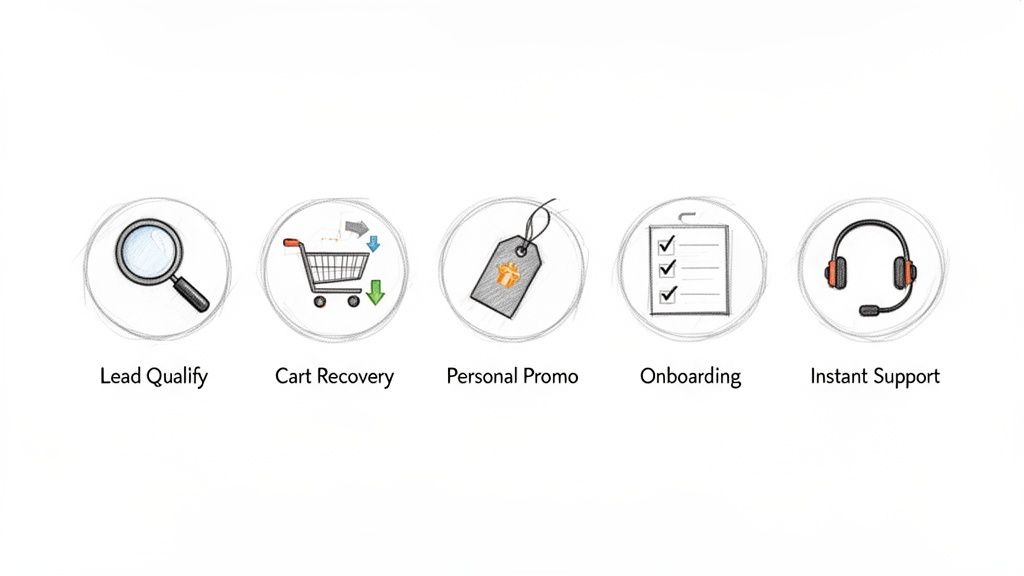
AI agent for Sales Functions
Each tactic targets a critical moment in the customer journey where smart automation makes all the difference.
1. Proactive Lead Qualification
Stop waiting for leads to fill out a form. An AI sales agent can qualify them through a natural, two-way conversation the second they show interest, turning your website or social media DMs into an active lead-gen machine.
Practical Example: A potential client for your coaching business lands on your services page. The AI agent immediately asks: “Hey there! Looking to scale your business? What’s your biggest challenge right now?” Based on their answer, the agent can send a relevant case study and book a discovery call right on your calendar.
2. Abandoned Cart Recovery Sequences
Nearly 70% of all online shopping carts are left behind. An AI agent can tackle this head-on with personalized recovery sequences through channels like Facebook Messenger or Instagram DMs, where open rates crush email.
A Simple Recovery Flow:
- Trigger: A shopper ditches their cart.
- Wait 1 Hour: The AI sends a quick message: “Hey [First Name]! Did something go wrong? The items in your cart are still available.”
- Wait 24 Hours: If they haven’t bought, a follow-up hits their inbox: “Just a heads-up, your cart items are popular. Here’s a 10% discount to help you decide: [CODE].”
This timely, helpful approach pulls back sales that would have otherwise vanished.
3. Personalized Promotional Campaigns
Blanket promotions are inefficient. An AI agent lets you run hyper-targeted campaigns based on a customer’s actual behavior—their purchase history, browsing habits, and expressed interests. By segmenting your audience with tags, you send the right offer to the right person at the right time.
Practical Example: Instead of blasting a generic “20% Off Everything” email, a customer who always buys skincare gets an exclusive early-access link to a new serum. Meanwhile, a new subscriber gets a special welcome offer on a starter kit. This personalization makes customers feel seen and sends conversion rates soaring.
4. Automated Client Onboarding Flows
For coaches, consultants, and SaaS businesses, a clunky onboarding process is a recipe for churn. An AI sales agent can automate the welcome sequence, ensuring every new client has a smooth start.
As soon as a client signs up, the agent can:
- Deliver welcome packets, questionnaires, or links to key resources.
- Schedule kick-off calls by syncing with your calendar.
- Answer common FAQs like “how do I get started?”
This frees you up to focus on delivering amazing value from day one.
5. Instant Sales and Product Support
Making a customer wait for an email response is a great way to lose a sale. An AI agent acts as a tireless product expert, providing immediate answers to sales-related questions 24/7.
Practical Example: A customer is on your website at 11 PM, wondering if your product is compatible with their device. The AI agent pulls the answer from its knowledge base in seconds. It can also handle questions about product comparisons, shipping policies, or your return process. This instant clarity builds the confidence a buyer needs to click “purchase.”
Building Your First AI Sales Agent
Jumping into AI automation might feel like a huge technical leap, but building your first AI sales agent is surprisingly simple with modern no-code platforms. You can get a powerful agent running using simple drag-and-drop tools to map out entire conversations.
Let’s walk through a real-world scenario: building a lead magnet delivery bot for a marketing coach. This agent will engage anyone who comments on a specific Instagram post, deliver a free guide, and then segment them as a new lead.
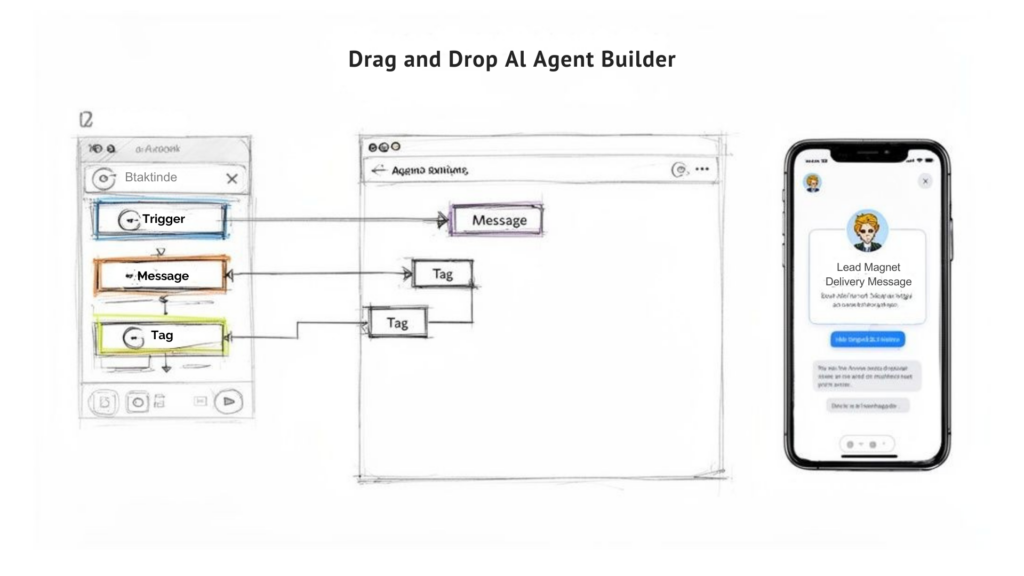
AI agent for Sales AI Builder
You can get this entire setup live in under an hour, turning passive post engagement into an active lead generation machine that works 24/7.
Step 1: Connect Your Channels and Set Your Trigger
First, connect the channels where your audience hangs out, like your Facebook Page and Instagram Business account, to a platform like Clepher.
Next, define the trigger—the specific action that wakes up your AI agent.
For our example, we’ll use a “Comment on a Post” trigger:
- Select the Post: Pinpoint the exact Instagram post you want the agent to watch.
- Define the Keyword: Tell the agent to respond only when a comment includes a specific word (e.g., “GUIDE”).
- Craft the Public Reply: The agent posts a public reply to the user’s comment, like, “Awesome! Just sent the guide over to your DMs.” This creates social proof and encourages others to comment.
This trigger is the front door to your conversational funnel.
Step 2: Design the Conversational Flow
Now, design the conversation inside a visual builder. This maps out the back-and-forth exchange the agent will have with the user in their direct messages.
The conversation kicks off right after that public reply.
- Initial Message: “Hey [First Name]! Thanks for grabbing my 5-Step Marketing Guide. Here’s the link to download it: [Link to Guide].”
- Qualifying Question: Immediately follow up to learn more: “While you’re checking that out, what’s the biggest marketing challenge you’re dealing with right now?”
- Segment with Tags: Based on their answer, automatically apply tags to their profile. If they mention “lead generation,” you can tag them as
Interest-Leads. This customer data is gold for running personalized campaigns later.
A well-designed flow does more than just send a file. It opens a dialogue, gathers intel, and segments your audience on autopilot.
Step 3: Add Intelligence with AI Keywords and Handoffs
What happens if the user asks something you didn’t plan for? This is where an AI agent for sales proves its worth. It uses AI Keyword Triggers to provide smart answers instead of hitting a dead end.
You can train your agent to recognize keywords important to your business.
- Example 1 (Pricing): If a user asks, “How much does your coaching cost?” the agent spots “cost” or “pricing” and sends a pre-written message explaining your program details with a link to the sales page.
- Example 2 (Human Handoff): If they ask, “Can I talk to a real person?” the agent understands the intent and triggers a human handoff, pinging your team to jump into the live chat and take over.
This setup ensures the agent handles repetitive work and intelligently passes complex queries to a human, creating a seamless customer experience. Building a system like this is easier than it sounds. You can follow a detailed guide on how to create AI agents to nail down the fundamentals.
Measuring and Optimizing Your Agent’s Performance
Launching your AI agent for sales isn’t the finish line; it’s the starting gun. Too many businesses “set it and forget it,” but the real magic happens when you treat it like a new member of your sales team—one that needs coaching, feedback, and constant refinement.
The key is to measure its impact. Without solid data, you’re just guessing. When you track the right numbers, you can turn guesswork into a clear process for boosting your agent’s effectiveness and your bottom line.
Key Performance Indicators That Actually Matter
Forget vanity metrics like total messages sent. To understand your agent’s real-world value, zero in on KPIs that connect directly to sales outcomes.
These numbers tell the true story:
- Lead Qualification Rate: What percentage of conversations result in a successfully qualified lead? This tests your agent’s ability to identify real prospects.
- Chat-to-Conversion Rate: How many chats turn into actual sales or booked calls? This is your bottom-line metric.
- Cart Recovery Revenue: If you use your agent for abandoned carts, track the exact dollar amount it recovers. There’s no clearer way to prove its ROI.
- Customer Satisfaction Score (CSAT): After an interaction, ask for feedback. A simple thumbs-up/thumbs-down gives instant insight into the agent’s performance.
For a deeper dive, our guide on essential chatbot KPI metrics provides a comprehensive framework for tracking and improving your automated conversations.
Key Metrics for Your AI Sales Agent
Here’s a breakdown of the most important KPIs, what they tell you, and how to improve them.
| Metric | What It Measures | How to Improve It |
|---|---|---|
| Lead Qualification Rate | The agent’s ability to identify high-intent prospects. | Refine your qualifying questions and adjust the criteria for a “good” lead. |
| Chat-to-Conversion Rate | The percentage of conversations that directly result in a sale or desired action. | A/B test your offers, calls-to-action, and the overall conversational flow to reduce friction. |
| Cart Recovery Revenue | The total sales generated from abandoned cart recovery sequences. | Experiment with different reminder timings, offer incentives, and adjust the tone. |
| Customer Satisfaction (CSAT) | The user’s overall experience with the agent. | Analyze low-rated conversations to find frustrating loops or unclear responses, then fix them. |
Tracking these numbers isn’t just about creating reports; it’s about finding opportunities to make your agent smarter every day.
From Data to Actionable Optimization Strategies
Collecting data is just step one. The real skill is turning those numbers into smart, actionable changes that improve performance. Think of it as an ongoing cycle: test, learn, and refine.
A/B Testing Conversational Paths
Never assume your first draft is the best one. A/B testing is your secret weapon. Split your traffic and test different versions of your conversational flows to see which gets better results.
For example, you could test:
- Opening Hooks: Does a direct question (“What brings you here today?”) outperform a statement (“I can help you find the perfect product”)?
- Offer Phrasing: Does “15% Discount” convert better than “Free Shipping“? The answer might surprise you.
- Interaction Style: Do people prefer clicking pre-defined buttons or typing a quick reply?
Even tiny adjustments in wording or flow can lead to massive jumps in conversion rates. Stop guessing and let the data show you the path to a sale.
Common Mistakes to Avoid When Launching Your Agent
Launching your first AI agent for sales is a big step, but a few common pitfalls can make it an automated roadblock rather than a helpful assistant.
The biggest mistake? Creating a conversation that’s robotic. Customers know they’re talking to an AI, but they don’t want to interact with a cold, lifeless script. A good agent should echo your brand’s voice and personality.
Forgetting the Human Handoff
No matter how smart your agent gets, some questions will be out of its league. Many businesses forget to build a clear, easy way for a user to connect with a real person. Hitting a conversational dead end is one of the quickest ways to lose a sale.
A seamless transition to a human isn’t a sign the AI failed; it’s a sign of a well-designed sales system. It ensures high-intent leads get the nuanced support they need, right when they need it.
This one simple feature can turn a moment of friction into a closed deal.
Neglecting Business-Specific Training
Another major pitfall is launching an AI agent without teaching it the ins and outs of your business. A generic AI has no idea about your product details, return policy, or what makes you different. This leads to vague answers and a poor customer experience.
Before you go live, feed your agent a solid knowledge base covering:
- Product Information: Specs, pricing, and common questions.
- Company Policies: Details on shipping, returns, and warranties.
- Frequently Asked Questions: The top 10-20 questions your human sales team answers every day.
This initial training turns a generalist AI into a specialist—a true expert on your brand. Lastly, ensure your AI agent for sales is integrated with your CRM to create a unified workflow from day one.
Got questions about bringing an AI sales agent into your business?
Here are straight answers to the most common ones.
Conclusion
Adopting an AI agent for sales can transform your sales operations by combining conversational AI, agentic AI, and autonomous agents to automate repetitive tasks and free sales teams to focus on closing deals. The right AI tool for sales helps sales organizations analyze sales data, improve personalized outreach, streamline the outreach process, and shorten the sales cycle so sales teams can concentrate on high-value sales conversations and sales opportunities.
Whether you build AI agents in-house or deploy custom AI agents from top AI sales agents and sales automation platforms, these sales tools and automation tools act as a sales assistant that analyzes pipelines, automates sales calls, and supports sales and marketing alignment. Choosing an AI sales agent requires evaluating how agents work, how AI agents automate key parts of the sales pipeline, and whether the AI sales agents excel at tasks your team needs — from lead scoring to follow-ups — so your sales operations and sales strategies are optimized.
In both b2b sales and various sales contexts, AI sales tools and AI sales agents work by using relevance AI, conversational AI, and other AI technologies to transform your outreach, improve conversion rates, and help sales teams focus on closing. Ultimately, agents help sales by reducing manual work, improving sales data visibility, enhancing sales conversations, and enabling your organization to build AI solutions that scale — making agentic AI and AI agents that automate core processes a top choice for anyone looking to improve sales performance and deploy a tool for sales automation.
Ready to build an AI sales engine that works for you 24/7? With Clepher, you can design powerful, no-code AI agents to qualify leads, recover sales, and support customers on your website, Facebook, Messenger, and Instagram. Start your free trial today and see the results for yourself.
Related Posts
Social Media Marketing Automation: Your Ultimate Guide
March 27, 2026Unlock Growth with Conversational AI for Customer Support
March 26, 2026Your Ultimate Guide to Instagram Chat Bots
March 25, 2026
Founder Clepher