
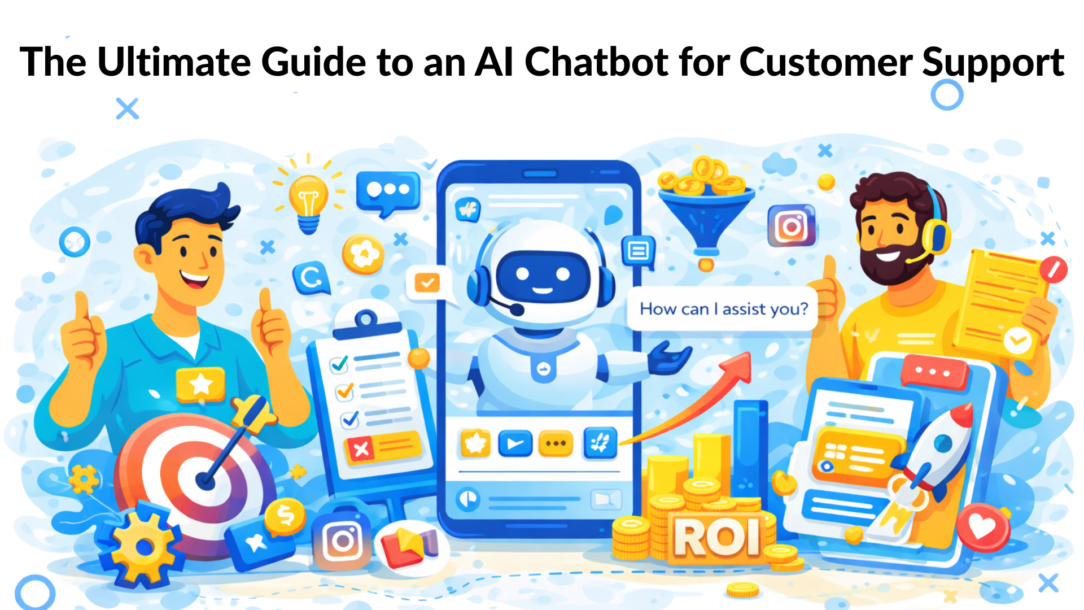
An AI chatbot for customer support is a smart tool that gives your customers instant, 24/7 answers. Think of it as your most efficient employee—one who can handle thousands of conversations at once, resolve common issues, qualify new leads, and guide users to the right solution without needing a human to step in for every single question.
This isn’t just theory; it’s a practical way to transform your customer experience.
The New Era of Customer Support with AI Chatbots
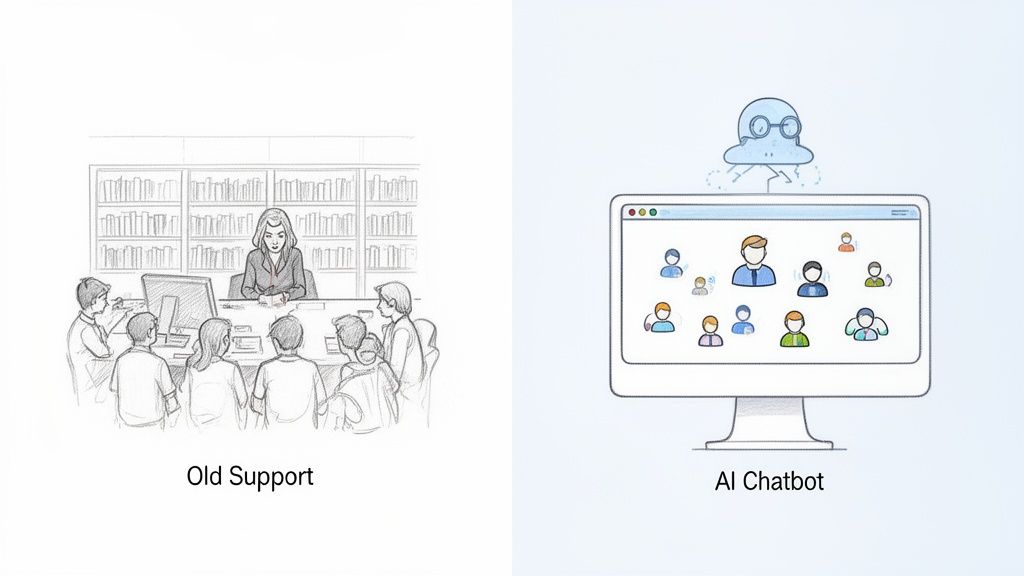
Customer Support Contrast
Remember long hold times and endless email chains? For decades, customer support was a bottleneck. A limited number of agents juggled a flood of repetitive questions, leading to frustrating delays for customers and burnout for support teams.
This old model is like a single librarian trying to help everyone in a packed library. No matter how skilled they are, they can only help one person at a time. Everyone else waits in line, and the experience quickly turns sour.
From Overwhelmed Teams to Instant Resolutions
Now, imagine a digital concierge that pulls up the right information for thousands of people simultaneously. That’s the power of an AI chatbot for customer support. It never sleeps, never gets overwhelmed, and delivers the right answers on demand.
This isn’t just an upgrade; it’s a fundamental shift. Today’s customers expect immediate solutions. A slow response isn’t an inconvenience—it’s bad service. A staggering 83% of customers now expect to engage with someone immediately when they contact a company.
This demand for speed is exactly why customer service is more important than ever. It’s not just about fixing problems anymore. It’s about creating a frictionless experience that builds loyalty and drives growth.
The New Standard for Digital Businesses
For modern e-commerce brands, SaaS companies, and digital creators, providing instant, personalized, 24/7 support isn’t a “nice-to-have”—it’s a core expectation. The good news? This technology, once complex and expensive, is now incredibly accessible.
This shift delivers game-changing results:
- Always-On Availability: Provide support around the clock, capturing leads and solving problems in every time zone.
- Massive Scalability: A single chatbot can handle a virtually unlimited number of conversations without any drop in performance.
- Improved Efficiency: Automate repetitive queries, freeing up your human agents to focus on complex issues that need a personal touch.
How AI Chatbots Drive Real Business Growth
Forget the tech jargon. Think of an AI chatbot for customer support as your most efficient digital employee.
This employee is trained on your exact sales and support processes, can handle thousands of conversations at once, and never needs a coffee break. They work 24/7 to turn visitors into leads, answer questions instantly, and make every customer feel heard. That’s the engine behind how these tools drive measurable growth.
More Than Just Answering Questions
We’ve all dealt with clunky, rule-based bots that feel like a frustrating phone tree. They operate on a rigid “if-then” script and fall apart the second you ask something unexpected.
A true AI chatbot is different. It uses Natural Language Processing (NLP) to understand what a customer is actually asking—typos, slang, and all. It figures out the intent behind the words, which allows for natural, helpful conversations that actually get things done.
Turning Conversations into Conversions
So, how does a smart conversation translate into tangible business results?
- For an e-commerce brand, an AI chatbot can pop up to help a visitor hesitating on a product page, answer a last-minute question about shipping, and guide them to checkout. That one interaction can be the difference between a sale and an abandoned cart.
- For a SaaS company, it can automate the first onboarding steps, answering common setup questions so new users find value right away.
- For a coach or consultant, it’s a 24/7 lead qualification machine, asking the right questions to spot high-value prospects and booking calls directly on their calendar.
The business impact is direct and powerful:
- Slash Cart Abandonment: Proactively handle objections and give instant answers, keeping customers on the path to purchase.
- Automate Onboarding: Guide new users through their first steps, cutting down on churn and freeing up your support team.
- Qualify Leads 24/7: Capture and qualify prospects while you sleep, making sure you never miss an opportunity.
The Immediate Impact on Your Bottom Line
Your customers are already on board. A whopping 67% of consumers worldwide used a chatbot for support in the last year. These tools are so effective they can independently handle up to 80% of routine support questions, letting your human agents focus on the complex issues where they’re needed most.
This shift is why businesses using AI chat see a 2.3 times increase in customer engagement and can boost landing page conversions by up to 20%. You can learn more about how businesses are using these AI customer service statistics to their advantage.
The ultimate goal isn’t just to answer questions faster. It’s about creating a seamless customer journey that nurtures relationships, builds trust, and actively contributes to revenue.
This efficiency delivers a powerful one-two punch: massive cost savings by automating manual tasks, and a dramatically improved customer experience with instant, helpful answers. It’s a clear win-win that directly boosts your operational efficiency and your bottom line.
Must-Have Features of a High-Performing Chatbot
Not all chatbots are created equal. A basic bot might answer a simple question, but a high-performing AI chatbot for customer support is an engine for sales and retention. To actually drive growth, your chatbot needs a specific set of powerful features.
These are the non-negotiables that separate a glorified FAQ page from a digital employee that generates revenue and builds loyalty.
Meet Customers Everywhere with Multi-Channel Support
Your customers aren’t just on your website. They’re on Instagram, Facebook Messenger, and WhatsApp. An effective chatbot meets them right where they are, delivering a consistent experience on every channel.
This isn’t just about convenience; it’s about capturing every opportunity.
- Use Case: A customer sees your ad on Instagram, has a question, and wants an answer in their DMs. Multi-channel support turns that fleeting curiosity into a real conversation, qualifying them as a lead without you lifting a finger.
Design Conversations with an Intuitive Flow Builder
The best chatbot conversations feel natural and helpful, not robotic. That magic happens with a visual, no-code flow builder. This tool lets you map out conversation paths using a simple drag-and-drop interface, so you can design experiences that guide users toward their goals.
A flow builder empowers you to create complex logic without writing a single line of code.
- Use Case: If a user mentions “shipping,” the bot can offer choices like “Track My Order” or “View Shipping Policies,” with each option leading down its own helpful path. Your marketing team can build this themselves, no developer needed.
Know When to Pass the Baton with Seamless Human Handoff
Automation is powerful, but some problems need a human. A critical feature is knowing when a conversation needs to be escalated to a live agent—and making that handoff seamless.
Nothing frustrates a customer more than having to repeat their problem. A great system sends the agent the full chat transcript, allowing them to jump in and solve the issue without missing a beat.
The goal isn’t to replace your human team; it’s to supercharge them. A great chatbot acts as the first line of defense, handling up to 80% of routine queries so your expert agents can focus on high-value problems.
Create “Wow” Moments with Deep Personalization
Generic, one-size-fits-all responses are dead. A high-performing AI chatbot connects with your business tools—like your CRM or e-commerce platform—to deliver deeply personalized interactions.
This is where you stop providing support and start building relationships.
- Use Case: A returning customer is greeted by name, with the chatbot referencing their last purchase and asking if they need help with it. That’s the kind of personalization that makes customers feel seen and valued.
To nail this, a bot must understand language nuances. We cover the technology that makes this possible in our guide on chatbot natural language processing.
Key AI Chatbot Features and Their Business Impact
| Feature | Description | Primary Business Benefit |
|---|---|---|
| Multi-Channel Support | Engages customers on their preferred platforms, like your website, Facebook Messenger, Instagram DMs, and WhatsApp, with a consistent experience. | Increased Lead Capture & Sales: Meet customers where they are, turning social media interactions into conversions. |
| Intuitive Flow Builder | A no-code, drag-and-drop interface for designing and visualizing conversational paths without needing a developer. | Faster Implementation & Agility: Marketing and support teams can build and update bots on their own, saving time and money. |
| Seamless Human Handoff | Intelligently transfers complex conversations from the bot to a live agent, providing full context and chat history. | Improved Customer Satisfaction & Efficiency: Solves tough issues faster, freeing up agents for high-value tasks. |
| Deep Personalization | Integrates with your CRM and other tools to use customer data (name, purchase history) for tailored, relevant conversations. | Higher Engagement & Loyalty: Makes customers feel understood and valued, which strengthens brand relationships. |
These aren’t just bells and whistles. They are the essential components of a system designed to improve customer experience, drive sales, and make your team more effective.
Building Your First Customer Support Flow
Diving into building an AI chatbot for customer support is surprisingly simple with modern tools. Think of it less like coding and more like building with digital LEGOs—you’re just snapping conversational blocks together to guide customers to a solution.
The key is to start small. Don’t try to automate everything at once. Pick one high-impact, repetitive task.
- Actionable Idea: For an e-commerce brand, a “Track My Order” flow is a classic win. For a SaaS company, a “Book a Demo” flow can qualify leads for you 24/7.
This diagram breaks down the core pieces of a modern chatbot system—it needs to be available on multiple channels, hand off to a human when needed, and deliver a personal touch.
When these elements work in sync, you create a journey that’s efficient for your business and genuinely helpful for the customer.
Mapping Out a “Track My Order” Flow
Let’s walk through a common e-commerce scenario. Here’s how you can build a simple, effective flow to instantly handle the “Where’s my stuff?” question.
- Set a Welcoming Tone: The first message is everything. Try something like, “Hi there! Looking for an update on your order? I can help. What’s the order number from your confirmation email?”
- Guide with Quick Replies: Don’t make people type everything. Add buttons like “I can’t find my number” or “Other questions.” This keeps the conversation moving.
- Capture the Right Info: Once they provide the order number, your bot pings your e-commerce platform (like Shopify or WooCommerce) to find the matching order.
- Deliver the Answer Clearly: The bot should present the info simply. For example: “Great news! Your order #12345 has shipped. You can track it live here: [Tracking Link].”
The Power of a Visual No-Code Builder
You don’t have to write a single line of code to make this happen. With a visual flow builder, you map out these steps by dragging and dropping elements onto a canvas.
Each box represents a step in the conversation, letting you see the customer’s journey from start to finish. This visual approach means your marketing and support teams can build and tweak their own automated flows without waiting on developers.
Knowing When to Bring in a Human
No bot can handle every question. A critical piece of any good flow is knowing when to pass the conversation to a human. If a customer types “My package is lost,” that’s your cue.
Your chatbot should seamlessly transfer the entire conversation—full chat history included—to a live agent. This ensures the customer doesn’t have to repeat themselves, and your team has all the context to solve the problem fast.
This smooth handoff is the heart of a hybrid support model. By integrating your chatbot with a CRM and ticketing system, you create one unified inbox where automation and human expertise work side-by-side.
Customers today are not patient. 53% of them will abandon a purchase if they wait just 10 minutes for an agent. AI chatbots deliver that instant first response, handling up to 80% of inquiries and cutting resolution time for tricky cases by 52%.
How to Measure Your Chatbot’s ROI
Implementing an AI chatbot for customer support feels like a win, but how do you prove it’s working? To justify the investment, you need to track the right metrics. Forget vanity numbers like “total conversations” and focus on KPIs that tie back to your business goals.
These numbers aren’t just for a report card; they’re your roadmap for making the bot even better.
Resolution and Deflection Rates
Resolution Rate is the percentage of customer issues your bot handles from start to finish without a human ever stepping in. A high resolution rate means your bot is genuinely solving problems.
- Practical Example: An e-commerce bot that successfully answers “Where is my order?” 90% of the time shows exactly how much work it’s taking off your team’s plate.
Deflection Rate measures how many support tickets your chatbot prevents from ever being created. Every conversation the bot handles is one less ticket a human agent has to touch. It’s a powerful, direct indicator of cost savings.
By automating common questions, you’re not replacing your team—you’re upgrading them. This allows your expert agents to dedicate their time to the complex interactions that truly need a human touch.
Customer Satisfaction and Lead Generation
Efficiency means nothing if customers are frustrated. That’s where Customer Satisfaction (CSAT) scores come in. A simple, post-chat question like, “How would you rate this interaction?” gives you a direct pulse on how users feel.
For many businesses, a chatbot is also a sales tool. The Lead Conversion Rate tracks how many bot conversations lead to a valuable action, like booking a demo or making a purchase. This metric connects your chatbot’s performance directly to revenue.
AI chatbots are proving to be powerful satisfaction engines. 69% of companies report better service quality after bringing one on board. For marketing, this can translate into 55% better lead quality, as bots can handle up to 70% of conversations end-to-end. You can dig into more chatbot statistics and their impact.
Measuring ROI is a balancing act. You need to mix operational metrics like resolution rate with experience-focused KPIs like CSAT. This complete picture proves how your AI chatbot is cutting costs, boosting revenue, and making customers happier.
Common Chatbot Implementation Mistakes to Avoid
Launching an AI chatbot for customer support is exciting, but success often comes from knowing which traps to sidestep. By understanding a few common pitfalls ahead of time, you can roll out a bot that actually helps people instead of frustrating them.
Mistake 1: Setting Unrealistic Expectations
One of the biggest mistakes is seeing chatbots as a magic wand that will instantly solve every single customer issue. They excel at tackling high-volume, predictable questions with lightning speed, not handling incredibly complex, nuanced conversations from day one.
- Actionable Takeaway: Start with a clear, achievable goal. Automate your top 3-5 most frequent questions first. Master those, then expand.
Mistake 2: Creating Robotic and Unnatural Conversations
Another classic error is designing conversations that feel like a rigid phone tree. When a chatbot can’t understand slight variations in how people talk, it quickly becomes a point of frustration.
- Actionable Takeaway: Build flexible conversations. Use quick reply buttons to guide users, but also lean on AI keywords and Natural Language Processing (NLP) to understand the intent behind what a user is saying, not just the exact words.
Mistake 3: Making It Impossible to Reach a Human
Nothing is more infuriating than being stuck in an endless chatbot loop with no escape hatch. Your chatbot should be a helpful first line of defense, not a wall between your customers and your team.
- Actionable Takeaway: Always include a clearly visible button like “Speak to a Person.” Set up triggers to automatically escalate conversations when the bot detects frustration (e.g., keywords like “angry” or “useless”). Ensure the full chat transcript is passed to the agent.
Mistake 4: Forgetting to Train and Update Your Bot
Finally, a huge oversight is treating your chatbot as a “set it and forget it” project. An AI chatbot is a dynamic tool that learns and improves over time, but it needs your input.
- Actionable Takeaway: Schedule monthly or quarterly reviews of your chatbot’s conversation logs. Identify where it struggles, what new questions are popping up, and update its knowledge base accordingly. This keeps it sharp and effective.
Can an AI Chatbot Handle Complex Customer Questions?
Yes — modern AI chatbots, powered by artificial intelligence, can handle complex customer questions and are essential for customer support. Conversational AI and generative AI models enable chatbots and AI agents to understand context, analyze intent, and resolve complex queries that go beyond answering FAQs or routine inquiries. When integrated with a robust knowledge base, crms, and ticketing systems, AI-powered customer service chatbots provide real-time assistance across multiple channels — web chat, WhatsApp, voice assistants, and more — delivering seamless, personalized support for every customer.
How they handle complexity
- Natural language understanding (NLP) and machine learning allow the bot to parse complex issues, follow multi-turn conversations, and escalate only when necessary to human agents or a help desk.
- Generative capabilities and llms improve response accuracy and can draft nuanced replies, recommend products, or summarize customer data for the customer service team.
- Sentiment analysis and conversational context let the AI agent prioritize urgent or frustrated customers, ensuring consistent support and better customer satisfaction.
- Integration with a knowledge base and crms enables the chatbot to pull relevant information, update tickets, and reduce ticket volume for the contact center.
Benefits for customer support teams
AI-powered customer service chatbots reduce workload on human agents, automate common customer requests, and free the customer service team to focus on complex issues that truly require human judgment. They provide round-the-clock support, improve response times, and lower operational costs while maintaining the best customer service standards. By supporting self-service and assisting with help desk processes, these bots enhance service experiences and overall customer experience.
When to escalate
While AI can resolve many complex queries, best practices route ambiguous legal, medical, or highly emotional cases to human agents. The chatbot should detect escalation triggers — unresolved queries, high sentiment scores, or requests for human intervention — and create a seamless handoff to ensure continuity of care.
Implementation and impact
Organizations can build and deploy AI chatbots and virtual assistants to automate answering FAQs, recommending products, and responding to customer inquiries in real-time. Proper chatbot implementation — training on company data, continuous performance over time, and monitoring — ensures higher response accuracy, improved customer engagement, and measurable reductions in workload on human staff and helpdesk ticket volume. Whether as AI customer service chatbots, AI support agents, or customer service chatbot overlays, these solutions transform customer care and elevate service experiences across multiple channels.
AI chatbot can handle complex customer questions when it is AI-driven, well-integrated, and supported by human agents for escalation. These systems provide consistent support, personalized support, and real-time assistance, transforming customer interaction and delivering the best customer service in many use cases.
Conclusion
Deploying a conversational AI agent and AI-powered chatbots for customer support enables real-time assistance that responds to customer inquiries, answers FAQs and routine inquiries, and provides self-service across multiple channels like web chat, WhatsApp, and voice assistants. By combining generative AI, LLMs, NLP, and machine learning with integrations into crms and knowledge base systems, businesses can automate common questions, escalate complex queries to human agents, reduce ticket volume, and lower operational costs while improving response accuracy and sentiment analysis for better customer care. These AI-driven customer service chatbots and virtual assistants offer consistent, personalized support and human-like conversations round-the-clock, improving customer satisfaction, enhancing customer interaction, and transforming the contact center into a multi-channel support hub. Over time, performance over time and continual learning let AI support agents refine recommendations, handle complex customer issues, support human agents in the helpdesk, and help improve overall customer experience, making ai chatbots one of the best AI solutions to deploy for next-generation customer service.
Ready to see what an AI-powered chatbot can actually do for your business? Clepher gives you a simple, no-code builder to create and launch powerful automations on your website, Messenger, Instagram, and WhatsApp. It’s time to start building smarter conversations.
Discover Clepher and Start Your Free Trial
Related Posts
Social Media Marketing Automation: Your Ultimate Guide
March 27, 2026Unlock Growth with Conversational AI for Customer Support
March 26, 2026Your Ultimate Guide to Instagram Chat Bots
March 25, 2026
Founder Clepher