
What if you could clone your best salesperson? Imagine a team member who greets every single visitor to your website, 24/7, without ever getting tired. They know the perfect questions to ask to instantly separate serious buyers from casual browsers, and they never, ever miss a lead.
That’s a bot for sales. It’s not just a pop-up window; it’s a smart, automated assistant designed to accelerate your entire sales process.
What Is a Bot for Sales and Why Does It Matter?

bot for sales
A sales bot is a conversational engine built to understand what a visitor wants, provide instant answers, and guide them toward the next step—whether that’s booking a demo, talking to a rep, or finding the right product.
In a world where buyers expect immediate responses, making them wait for a human is a surefire way to lose business. A sales bot closes that gap, turning passive website browsers into actively engaged leads.
The Big Shift to AI Sales Chatbot Engagement
The old sales playbook—cold calls and long email chains—is broken. Today’s buyers are in control. They do their own research, and when they finally reach out, they want fast, helpful conversations, not a contact form.
This is where a sales bot becomes a game-changer. It transforms your website from a static, one-way brochure into a dynamic, two-way conversation. This is the core of what is conversational marketing: building relationships through real-time dialogue.
A sales bot doesn’t replace your sales team; it empowers them. By handling the initial lead qualification and routing, it frees up your human experts to focus their energy on closing deals with the most promising prospects.
Why It’s a Competitive Necessity
In today’s market, speed is everything. A delay of just five minutes in responding to a lead can cause conversion rates to plummet. A sales bot eliminates that delay, guaranteeing every lead gets an immediate, helpful interaction the moment their interest peaks.
Sales bots are a key part of the AI revolution, representing a major step toward a smarter internet with effective AI-driven solutions reducing human interaction for routine tasks. By automating these first touchpoints, businesses see transformative results:
- Capture More Leads: Your business is open 24/7. The bot engages visitors on nights and weekends, ensuring no opportunity is missed.
- Improve Lead Quality: The bot acts as a filter, asking qualifying questions you define. This means only the best, most relevant leads land in your sales team’s inbox.
- Shorten the Sales Cycle: By instantly booking meetings on your reps’ calendars, the bot cuts out the back-and-forth emails that kill sales momentum.
Ultimately, a bot for sales is a strategic asset. It aligns your sales process with how modern buyers want to buy, driving both efficiency and revenue.
Core Capabilities That Drive Revenue
A smart sales bot does much more than answer questions. It actively generates revenue by automating the critical, time-consuming tasks that bog down your sales team. Think of it as a force multiplier for your funnel—it handles the top, freeing your reps to focus on what they do best: closing deals.
Let’s break down the three core functions that have a direct impact on your bottom line: instant lead qualification, 24/7 engagement, and seamless appointment booking.
Instant Lead Qualification
Imagine a successful marketing campaign sends a flood of traffic to your site. A sales bot acts as your instant filter, separating high-intent buyers from curious browsers in real time. It does this by asking targeted, pre-planned questions the second a visitor starts a chat.
This isn’t just about getting a name and email. A well-designed bot for sales can dig deeper to uncover crucial details:
- Company Size: “How many people are on your team?” This helps segment leads for different sales tiers.
- User Role: “What’s your current role?” This identifies if you’re talking to a decision-maker.
- Specific Pain Points: “What’s the biggest challenge you’re facing with [your service area]?” This qualifies their actual need.
Based on the answers, the bot routes the conversation instantly. A high-value prospect can be connected to a live sales rep in seconds, while a lower-priority lead might get added to an automated email nurture sequence. This ensures your sales team’s time is always spent on conversations most likely to convert.
AI Chatbot for 24/7 Automated Engagement
Your sales team has to sleep, but your website doesn’t. A sales bot is your always-on front line, ready to engage prospects at 10 PM on a Friday or 6 AM on a Sunday—the exact moments they might be doing their research. This constant availability means you never miss an opportunity.
The data is clear: using AI chatbots for sales can boost sales by as much as 67%. It’s why an estimated 63% of sales teams plan to add conversational AI to their toolkit in 2025 alone. You can dig into more chatbot statistics to see the full scope of this trend.
Key Takeaway: A sales bot turns your website from a passive brochure into an active engagement machine. It guarantees every visitor, regardless of their time zone, gets an immediate and helpful interaction, preventing valuable leads from simply clicking away.
This tireless engagement maintains sales momentum. Instead of a lead filling out a “Contact Us” form and waiting hours (or days) for a reply, they get answers on the spot, moving them down the funnel while their interest is red-hot.
Seamless Appointment Booking
One of the biggest momentum-killers in sales is the painful back-and-forth of scheduling. “Does Tuesday at 2 PM work?” “Sorry, I’m booked. How about Wednesday?” This friction is where deals go to die.
A sales bot eliminates this bottleneck entirely. Once it qualifies a lead, the bot can tap directly into your sales reps’ calendars.
Here’s how that flow works in practice:
- Qualification: The bot confirms the visitor is a good fit for your product.
- Offer: It makes a direct offer: “It looks like we can definitely help. Would you like to schedule a 15-minute call with one of our specialists?”
- Scheduling: The bot displays available time slots right inside the chat window.
- Confirmation: The lead clicks a time. The meeting is automatically added to both calendars, and a confirmation email with a meeting link is sent out.
This single capability dramatically shrinks the time from initial interest to a scheduled conversation, capitalizing on intent before a lead gets distracted or checks out a competitor.
To see the transformation, let’s compare how a sales bot handles tasks versus the old-school manual approach.
Sales Bot Capabilities vs Traditional Sales Tasks
| Sales Task | Traditional Manual Method | Sales Bot Automated Method | Key Benefit |
|---|---|---|---|
| Lead Qualification | Reps manually review form submissions, emails, or call logs to identify promising leads. | Asks targeted questions in real-time chat, scores leads based on answers, and instantly identifies high-intent prospects. | Speed & Focus: Sales reps only engage with pre-qualified, high-value leads, saving hours of wasted time. |
| Initial Engagement | A lead waits for a rep to respond to a form or email, often for hours or even days. | Engages every visitor instantly, 24/7, answering common questions and providing relevant resources on the spot. | No Missed Opportunities: Every lead gets an immediate response, capturing interest at its peak and preventing drop-off. |
| Scheduling Meetings | Endless back-and-forth emails or phone calls to find a mutually available time slot. | Integrates with sales calendars to show real-time availability and lets leads book a meeting with a single click. | Zero Friction: The time from a qualified lead to a booked demo is reduced from days to minutes. |
| Data Collection | Reps manually enter lead information into a CRM after a call or email exchange. | Automatically captures conversation data and syncs it with your CRM, creating a detailed record of the interaction. | Accuracy & Efficiency: Eliminates manual data entry errors and ensures all lead information is captured consistently. |
As you can see, it’s not just about doing the same tasks faster. A bot for sales fundamentally changes how these tasks are done, creating a far more efficient and effective sales process.
How to Implement Your First Sales Bot
Diving into sales automation might seem complex, but launching your first bot for sales is more about smart strategy than coding. With a clear plan, you can have a powerful assistant working for you in no time. Think of it as creating a simple playbook for your new digital team member.
Here’s a five-step roadmap to get your first bot live and delivering results, no developer needed.
Step 1: Define Your Primary Goal
First, what do you want this bot to achieve? A vague goal like “get more leads” is a recipe for a mediocre bot. You need a specific, measurable target to give it a clear purpose and a way to know if it’s working.
Pinpoint a single, high-impact objective you can track.
Actionable examples:
- Book 15% more qualified sales demos this quarter.
- Reduce initial lead response time to under 30 seconds, 24/7.
- Increase the lead-to-opportunity conversion rate by 10% for website visitors.
- Automatically qualify 80% of inbound leads from our social media ads.
Pick one. You can expand later, but starting with a laser-focused goal is the secret to a successful launch.
Step 2: Map a Simple Conversation Flow
Now, sketch out the conversation. This is your bot’s “decision tree,” guiding a visitor from “hello” to your goal. The key here is simplicity. A straightforward path is always better than a confusing maze with a dozen branches.
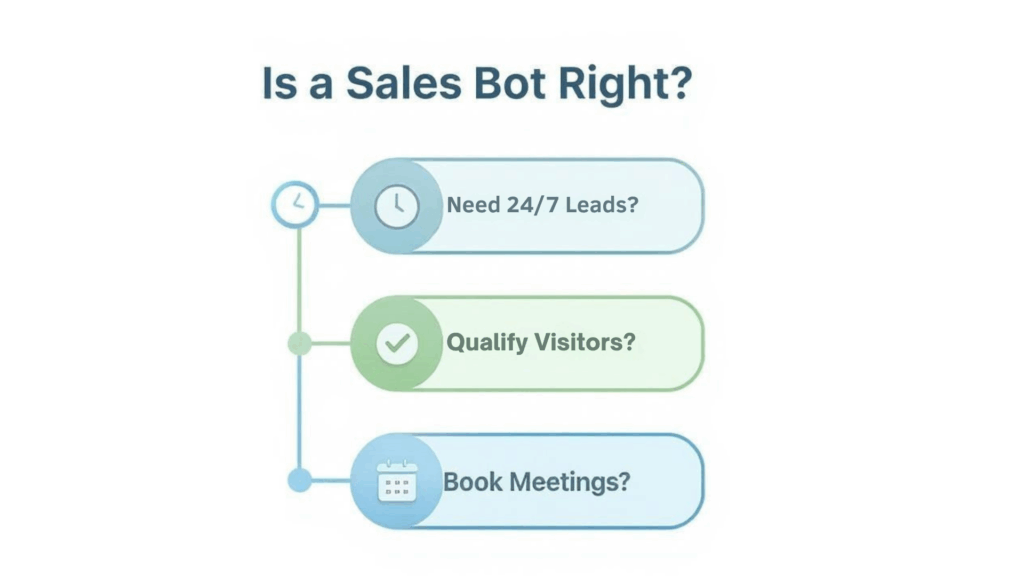
This decision tree shows how a sales bot helps businesses determine if it’s the right fit for their needs by addressing key goals like 24/7 lead capture and meeting booking.
Sales bot decision tree
As the visual confirms, if round-the-clock lead gen, automated qualification, or frictionless scheduling is on your wishlist, a sales bot is a direct line to that goal.
Break down the ideal conversation into simple steps:
- The Opener: How does the chat begin? A friendly “Hey there! How can I help you today?” is a great start.
- Qualification: What are the 2-3 must-ask questions to identify a good fit? Think “What’s your company size?” or “What’s the biggest challenge you’re facing with X?”
- The Action: Based on their answers, what happens next? This is the payoff—booking a demo, connecting them to sales, or offering a helpful resource.
Modern tools make this easy. With a no-code chatbot builder, you can visually map the entire conversation by dragging and dropping elements. No coding required.
Step 3: Write a Human-Sounding Script
This is where many bots fail. They sound… robotic. Your script should be conversational, helpful, and reflect your brand’s personality. Use short sentences, ask direct questions, and write like a human.
Pro Tip: Read your script out loud. If it sounds stiff or awkward when you say it, rewrite it until it flows naturally. You’re aiming for a tone that’s professional but friendly, like a helpful colleague.
Instead of a robotic “Please select an option,” try a warmer “Got it. So, what are you looking for help with today?” These small tweaks build trust from the very first message.
Step 4: Set Clear Handoff Rules
Your bot won’t have all the answers—and that’s okay. The key is knowing exactly when to pass the conversation to a real person. This is your human handoff strategy, and it needs to be seamless.
Define the triggers that tell the bot to call for backup. Common triggers include:
- A user directly asks to speak to a person.
- The bot identifies a hot, high-value lead based on their answers.
- A visitor asks a complex question that the bot isn’t programmed to handle.
- The person shows strong buying signals (like asking about enterprise pricing).
Make the transition smooth. The bot should say, “Let me find a specialist who can help with that,” while passing the entire chat history to the sales rep. This way, the customer never has to repeat themselves.
Step 5: Test and Launch
Before you go live, test your bot. Run through the conversation flow yourself, then ask a few coworkers to do the same. Hunt for typos, broken logic, or any spots where the script feels confusing.
This quick testing phase lets you iron out the kinks before they affect real prospects. Once you’re confident, it’s go-time. But launching isn’t the end. Monitor its performance, gather feedback, and continuously tweak it to make it even better.
Real-World Use Cases That Convert
Theory is one thing, but seeing a bot for sales in action is where its power truly clicks. The best way to grasp its impact is by looking at specific business scenarios where automation turns a simple interaction into a measurable conversion.
These aren’t futuristic ideas; businesses are using these plays right now to drive revenue. Let’s explore practical use cases for your website and social media.
Proactive Website Engagement
Think of your website as your digital storefront and your sales bot as the attentive employee on the floor. Instead of waiting for visitors to find the “Contact Us” page, the bot proactively starts conversations at just the right moment.
One of the most effective tactics is placing a bot on high-intent pages, like your pricing page.
Use Case: The Pricing Page Assistant
A potential customer is comparing your subscription plans, spending more than 45 seconds on the page. They’re clearly interested but might be confused about the best fit.
- Bot Trigger: Time on page exceeds 45 seconds.
- Bot Action: A friendly chat bubble appears: “Hey there! Picking the right plan can be tricky. Can I ask a couple of quick questions to help you find the perfect fit?”
- Result: The bot asks about their team size and key goals, then recommends a plan and offers to connect them with a sales rep to start a trial. This contextual engagement smashes through decision paralysis and directly addresses a common sales bottleneck.
By engaging visitors on high-intent pages, you move from passively displaying information to actively guiding a purchasing decision. This targeted approach can significantly boost your lead-to-opportunity conversion rate.
Another powerful play is catching visitors just before they leave.
Use Case: Exit-Intent Lead Capture
A visitor has just read a blog post and moves their cursor to close the tab. This is your last chance to turn them from an anonymous visitor into a known lead.
- Bot Trigger: The bot detects exit-intent mouse movement.
- Bot Action: It offers a valuable, relevant resource: “Before you go, would you like a free copy of our ‘5-Step Guide to [Solving a Relevant Problem]’?”
- Result: The visitor provides their email to get the guide. Instantly, they’re in your marketing funnel, tagged by their interest, and ready for a nurture sequence. That’s a lead that would have been lost forever.
Turning Social Media Into a Sales Funnel
Social media is a lead generation gold mine. A sales bot can turn passive scrollers on Facebook and Instagram into actively engaged prospects, automating the entire process from a simple comment to a qualified lead.
This is especially powerful when connected to your paid ad campaigns.
Use Case: Facebook Ad Lead Qualification
You’re running a Facebook ad promoting a new service and ask people to comment with a keyword like “INFO” to learn more.
- Bot Trigger: A user comments “INFO” on your ad.
- Bot Action: Your bot instantly sends them a direct message via Messenger: “Thanks for your interest in our new service! To make sure it’s the right fit, could you tell me a bit about your business?”
- Result: The bot asks a few qualifying questions in Messenger, identifies them as a hot lead, and offers to book a demo on the spot. This creates a frictionless path from seeing an ad to becoming a sales-qualified lead in minutes.
Instagram Stories provide a similar opportunity for instant engagement.
Use Case: Instagram Story Quick Reply
You post an Instagram Story with a poll asking about a specific business challenge.
- Bot Trigger: A follower taps an option on your poll.
- Bot Action: The bot immediately sends a DM related to their response: “Glad to see you’re interested in [Topic]! A lot of our clients struggle with that. We actually have a resource that might help. Interested?”
- Result: A simple tap on a Story transforms into a one-on-one conversation. The bot nurtures this connection, provides value, and seamlessly guides them toward your sales funnel—all without your team lifting a finger.
Measuring Success and Sales Bot ROI
A high-performing sales bot isn’t just a cool website gadget; it’s a revenue-generating machine. To prove its value, you must track the right metrics—the ones that show a direct impact on your bottom line.
Focusing on the right Key Performance Indicators (KPIs) is the only way to know if your bot is pulling its weight and delivering a clear return on investment (ROI).
Key Sales Bot KPIs That Actually Matter
Forget vanity metrics like “total conversations.” To measure real business impact, you need to track how your bot influences lead quality, sales velocity, and revenue.
Start by obsessing over these essentials:
- Lead Qualification Rate: What percentage of bot conversations result in a sales-qualified lead (SQL)? This is the ultimate test of your bot’s ability to identify genuine prospects.
- Bot-Sourced Revenue: This is the total revenue closed from leads that the bot originally qualified or booked. It’s the most direct line you can draw from bot activity to money in the bank.
- Reduction in Sales Cycle Length: How much faster are deals closing when a bot is involved? By engaging leads instantly, a good bot can shave days or even weeks off your sales cycle.
For a more detailed look, you can explore a wider range of chatbot KPI metrics to build a complete performance dashboard.
How to Calculate Your Bot’s Performance
Knowing the KPIs is one thing; calculating them is another. Let’s make it practical.
1. Calculating Lead Qualification Rate
This formula shows how effective your bot is at finding high-quality leads.
Formula: (Number of Sales-Qualified Leads from Bot / Total Number of Bot Conversations) x 100
Example: Your bot handled 500 conversations last month, and 75 were passed to sales as qualified leads. Your Lead Qualification Rate is 15%. If that number is trending up, your bot’s script is working.
2. Attributing Bot-Sourced Revenue
This requires connecting your bot platform to your CRM. When a bot qualifies a lead, it should tag that contact record in the CRM.
- Example: Your bot qualifies a prospect named “Jane Doe” and automatically tags her as “Bot-Sourced” in your CRM. Three weeks later, your team closes a $10,000 deal with her. That $10,000 is now directly credited to your sales bot.
3. Measuring the Sales Cycle Reduction
Compare the average time-to-close for bot-sourced leads against leads from other channels.
- Example: You find that leads from your “Contact Us” form take an average of 60 days to close. But leads who booked a demo through your bot? They close in just 40 days. Your bot just cut the sales cycle by 33%.
A Simple Framework for ROI
Calculating your overall ROI is what proves your bot is a “can’t-live-without-it” asset. You can start with this straightforward framework.
- Gains: Add up your Bot-Sourced Revenue plus any cost savings from efficiency (e.g., the value of hours your reps saved on manual qualification).
- Costs: Sum up your chatbot platform subscription and any time your team spent on setup.
Formula: (Total Gains – Total Costs) / Total Costs x 100
If your bot helped bring in $50,000 in revenue and saved $5,000 in labor costs, and your platform subscription was $1,500, your ROI would be a staggering 3567%. A number like that proves your bot isn’t an expense—it’s a profit center.
Common Mistakes to Avoid for Maximum Impact
A sales bot can be a superpower, but a few common missteps can turn it into a frustrating experience for your prospects. Learning from the mistakes others have made will ensure your bot builds relationships instead of burning them.
The goal isn’t just to automate; it’s to create a smooth, helpful interaction. By sidestepping these common pitfalls, you can make sure your bot fuels growth, not a roadblock that sends customers running.
Mistake 1: Overly Complex Conversations
This is the biggest mistake we see. An excited team tries to build a bot that does everything. They create a conversation with dozens of confusing branches, overwhelming visitors. A confused prospect is a lost prospect.
Remember, users want quick answers, not a digital maze. A bot that asks too many irrelevant questions or offers ten different options creates friction, and people will simply leave.
What to do instead:
- Stick to one goal per conversation flow. Is the purpose to book a demo? Focus only on that.
- Keep the path straight and simple. Guide the user with clear, direct choices. Less is always more.
- Ask no more than 3-4 questions to qualify a lead before moving to the next step.
Mistake 2: Creating a ‘Bot Loop’
Is there anything more annoying than a bot that keeps saying “I don’t understand” with no way out? This happens when a bot can’t answer a question and just repeats the same generic prompt, trapping the user in a dead-end experience.
This blunder usually happens because there’s no clear escape hatch to a real person. Without an easy way to escalate the chat, you risk losing high-intent leads who just needed a quick answer from a human.
What to do instead:
- Always include a “Talk to a human” option. Make it clearly visible at every stage of the chat.
- Program your bot to recognize frustration. If it fails to understand a user twice in a row, it should automatically offer to connect them with a live agent.
- Ensure a seamless handoff. When the bot passes the chat to a rep, it must pass the entire conversation history so the user doesn’t have to repeat themselves.
Mistake 3: Using Impersonal, Robotic Language
Your bot is often the very first “voice” a prospect hears from your company. If that voice is cold, stiff, and sounds like a robot from an 80s movie, you’re making a terrible first impression. Generic language makes the interaction feel transactional, not personal.
People connect with personality, not code. A bot that lacks a distinct, helpful tone fails to build the trust needed to guide a prospect down the sales funnel.
What to do instead:
- Write the script in your brand’s voice. Are you playful? Professional? Straight-to-the-point? Your bot should sound like you.
- Use short, conversational sentences. Read the script out loud. If it sounds clunky, rewrite it.
- Add touches of personality. A well-placed emoji or a bit of friendly phrasing can make the interaction feel more engaging and human.
Your Top Sales Bot Questions, Answered
Thinking about adding a sales bot to your strategy? Smart move. But it’s natural to have questions. Let’s tackle the most common ones we hear.
Conclusion: Chatbots Automation
Adopting a bot for sales is no longer optional — AI-powered chatbots and AI chat tools are reshaping how sales and support teams engage prospects. Whether you add an AI chatbot to automate lead qualification or deploy an AI sales chatbot to assist with sales conversations, these chatbot tools streamline sales workflows, automate responses to customer queries, and create personalized experiences across platforms like Facebook Messenger and across platforms like WhatsApp.
Many companies already use AI bots and AI-powered chat to drive results: chatbots drive sales, chatbots for sales teams boost conversion, and chatbots drive better customer support by integrating with your knowledge base, email marketing, and sales assistant features. Using a chatbot can reduce friction in sales and support, automate recurring tasks, and personalize messages based on user behavior to create personalized product recommendations and follow-ups.
Ready to turn conversations into conversions? Clepher gives you all the tools you need to build, launch, and manage a high-performing sales bot without writing a single line of code. Start automating your sales process today.
Related Posts
How to Create a Survey on Facebook for Maximum Engagement
March 28, 2026Social Media Marketing Automation: Your Ultimate Guide
March 27, 2026
Founder Clepher