
Conversational AI for customer engagement is how you stop making customers wait. It’s a powerful way for businesses to automate one-on-one conversations on platforms like Messenger, Instagram, and their own websites. This isn’t about replacing your team; it’s about giving them a tireless 24/7 assistant for sales, support, and marketing.
What Is Conversational AI and Why It Matters Now
Conversational AI for Customer Engagement
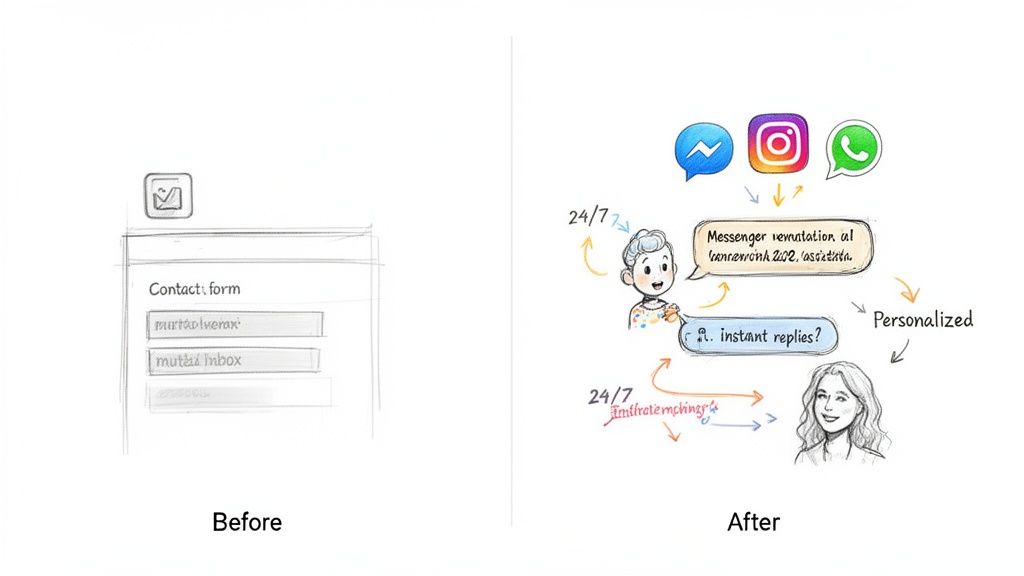
Think about the old way of getting leads. You put a “Contact Us” form on your site and just… wait. You hope someone fills it out, and then you hope they’re patient enough for you to get back to them. It’s a passive, one-way street where the customer does all the work, and businesses often miss their chance.
Conversational AI for customer service flips that script. Instead of waiting, you proactively engage every single visitor, subscriber, and follower—instantly. Powered by generative AI, this approach allows businesses to respond in real time, answer questions, and guide users toward the next step without delays. It’s like having an intelligent AI agent on your website, in your Instagram DMs, and on WhatsApp, ready to help around the clock.
This shift doesn’t just improve response time—it helps transform center operations from reactive support into proactive engagement hubs. Instead of handling isolated queries, businesses can manage entire customer journeys through automated yet personalized conversations.
This isn’t about creating clunky, robotic experiences. It’s about meeting customers where they already are and delivering immediate, meaningful value at every interaction.
When done right, good conversational AI feels less like talking to a machine and more like a helpful, guided chat. For a deeper dive, check out our complete guide explaining what conversational AI is.
Let’s look at a practical comparison to see the real-world difference this makes.
Traditional Engagement vs. Conversational AI Engagement
| Aspect | Traditional Method (The Old Way) | Conversational AI Method (The New Way) |
|---|---|---|
| Availability | Limited to business hours. Customers wait. | 24/7/365. Instant responses, always on. |
| Interaction | Passive. Relies on forms and emails. | Proactive. Starts conversations instantly. |
| Personalization | Generic, one-size-fits-all approach. | Dynamic. Adapts to user data and behavior. |
| Scalability | Limited by team size. One agent, one chat. | Nearly infinite. Handles thousands of chats at once. |
| Customer Journey | Disjointed. Users might get lost or leave. | Guided. Moves users from question to conversion. |
The table makes it clear: this isn’t just a minor upgrade. It’s a fundamental shift in how you connect with your audience, turning passive observers into engaged customers.
From Basic Chatbots to Smart Conversations
You’ve probably run into basic chatbots—the kind that only handle simple, pre-programmed questions. If you ask something slightly outside their script, they break with a classic “I don’t understand.” Conversational AI is the next evolution, powered by advanced AI technology that goes far beyond rigid decision trees.
It uses technologies like Natural Language Processing (NLP) to understand intent and context. This is how conversational AI works in real-world scenarios, enabling more natural and effective interactions. In practice, this means the AI can:
Understand What People Mean:
It interprets intent, even with typos, slang, or vague phrasing. A customer typing “how much” and another typing “price” for the same product both receive the same accurate response. This is one of the core benefits of conversational AI, reducing friction in customer interactions.
Remember the Conversation:
It maintains context throughout the exchange, so users don’t have to repeat themselves. If someone asks about shipping, the system remembers that context when the next question is about delivery time. This continuity is key to transforming customer engagement from fragmented interactions into seamless conversations.
Make It Personal:
It leverages customer data to tailor responses. For example, it can greet a returning customer by name or recommend products based on past purchases. This level of personalization is what makes modern conversational AI tools so powerful in today’s digital landscape.
As businesses expand their AI use, conversational AI becomes a strategic asset—not just for answering questions, but for delivering meaningful, personalized experiences that strengthen customer relationships and drive better outcomes.
This shift from rigid scripts to dynamic dialogue is what modern customer engagement is all about. The ideas behind this aren’t new; a look into Automation and Artificial Intelligence in Call Centers shows how these concepts have been reshaping customer support for years.
The Immediate Business Impact
The move toward this automation isn’t just a trend; it’s a massive business shift. The global market for AI in customer service is projected to hit a staggering $15.12 billion by 2026. That growth is fueled by businesses using AI on channels like WhatsApp and Instagram to automate support and drive sales.
The Takeaway: Conversational AI transforms your marketing from a one-way broadcast into a two-way dialogue, letting you build relationships and close deals at scale.
For an e-commerce store, this means automatically recovering abandoned carts. For an agency, it means qualifying leads around the clock. For a content creator, it means automating replies to hundreds of DMs asking the same question. It’s about being available, helpful, and personal—all at once.
Real-World Benefits: Why You Should Care
So, why should you really care about conversational AI? It’s not about chasing new tech. It’s about solving business problems that hit your bottom line, boosting efficiency, sales, and customer loyalty. These are real results businesses are seeing right now.
Dramatically Reduce Support Costs
Imagine instantly answering the same few questions your team gets all day, every day. For most businesses, up to 90% of customer inquiries are repeats: “Where’s my order?”, “What are your hours?”, “How do I return this?”
An AI chatbot handles all of that, 24/7. This frees up your human agents for the complex issues where a personal touch really matters. Your team becomes more effective, they’re less burned out, and your operational costs drop.
The Result: With a well-trained AI, support escalations to human agents can fall by as much as 45%. You’re left with a leaner, more powerful support operation. For an e-commerce brand, that’s fewer tickets. For a coach, it’s fewer DMs about your schedule.
Accelerate Sales and Boost Revenue
Don’t just think of AI as a defensive tool for support. It’s one of the best offensive players on your sales team. It engages potential customers the second they show interest, guiding them from browsing to buying. To see how this works, explore how specialized AI chatbots for ecommerce are driving major sales growth.
Consider these sales-driving use cases:
- Abandoned Cart Recovery: A shopper leaves without buying. Minutes later, your AI bot hits them up on Messenger or Instagram with a friendly reminder, maybe even a small discount, to close the sale.
- Proactive Lead Qualification: A visitor lands on your website. Instead of waiting for a form fill, your AI starts a conversation, asks key questions, and even books a meeting. Your sales team only talks to warm, qualified leads.
- Product Recommendations: The bot acts like a personal shopper. By asking a few simple questions, it can recommend the perfect product, increasing your average order value and making the customer feel understood.
This isn’t fluff; it’s a revenue machine. For a deeper look, check out the other benefits of AI chatbots for your business.
Enhance the Customer Experience 24/7
In a world where everyone wants everything now, making customers wait is the fastest way to lose them. People expect instant answers. In fact, 51% of consumers prefer getting an immediate answer from a bot over waiting in a queue for a human. Conversational AI delivers on that expectation every single time.
Being available 24/7 builds incredible trust. A customer who gets their problem solved at 11 PM on a Sunday feels taken care of. They remember that. This is about being reliably present whenever your customer needs you, on their terms.
This isn’t a niche trend. By the end of 2026, AI is set to handle 37% of all customer interactions. For SaaS companies, that translates to 2.3 times higher engagement. And for coaches, a comforting 65% of consumers are already fine with AI handling tasks like booking appointments. You can read the full research about these customer interaction trends to see just how fast the market is moving.
Actionable Use Cases for Marketing, Sales, and Support
Theory is one thing, but results are what matter. Let’s get practical. This is where we break down exactly how you can put conversational AI for customer engagement to work across your entire business.
We’ll look at marketing, sales, and support—the three pillars of every customer relationship. Each of these mini-playbooks is designed to solve a real problem and deliver a measurable outcome.
Supercharge Your Marketing Efforts
Conversational AI is a machine for building your audience and capturing leads. It turns passive social media followers into active subscribers and anonymous website visitors into qualified prospects.
Here are two marketing plays you can run right away:
1. Automate Instagram Giveaways and Contests
Running an Instagram giveaway is great for engagement, but manually tracking every comment and DM is a nightmare. This is where conversational AI takes over.
- How it Works: You post your giveaway, asking people to comment with a keyword like “WIN!”. Your AI bot automatically DMs every single person who comments. That DM can confirm their entry, ask for their email to join your newsletter, and even drop a small “thank you” discount code.
- The Result: You grow your email and Messenger lists on autopilot, your post’s engagement skyrockets, and your audience gets a fun, interactive experience.
2. Capture Leads with a Website Chat Widget
Your website is your digital storefront. But how many people visit and then leave without a trace? A simple chat widget connected to Messenger can turn those anonymous visitors into subscribers you can talk to again.
- How it Works: Install a chat widget on your site. When someone clicks it, a Messenger chat opens instantly. You can set up an automated flow to welcome them, offer help, or provide a lead magnet—like a free guide or a 10% discount—in exchange for their contact info.
- The Result: You build a high-value subscriber list right inside Messenger, where open rates crush email. From there, you can nurture these leads with automated follow-ups.
Drive More Sales Automatically
Using conversational AI in your sales process is like having a top-tier sales rep who works 24/7. It engages prospects the moment they show interest, qualifies them, and guides them toward a purchase.
Actionable Insight: Microsoft’s research on its Copilot shows that customer journeys are 33% shorter with conversational AI compared to traditional search. This means fewer steps from interest to conversion.
Here are a few powerful sales plays:
- Automated Lead Qualification: Stop wasting your sales team’s time. Set up a flow that asks critical qualifying questions—budget, timeline, needs—to filter prospects. Only the hottest leads get passed to a human or prompted to book a call.
- Abandoned Cart Recovery: This is non-negotiable for e-commerce. When a customer abandons their cart, the AI can trigger a follow-up on Messenger or Instagram. A simple, “Hey, did you forget something?” message with a small incentive can recover a huge chunk of lost sales.
- Product Recommendation Quizzes: Help shoppers find their perfect match with an interactive quiz. The bot asks a series of questions (“What’s your skin type?” or “What’s your biggest fitness goal?”) and then recommends the ideal product. This personal shopper experience boosts both conversions and customer confidence.
Deliver Instant, World-Class Support
Great support builds loyalty. Conversational AI ensures you’re always there to help, delivering instant answers and freeing up your human team for the issues that truly need them.
1. Build an Instant FAQ Bot
Most support questions are repetitive. An FAQ bot can handle these instantly, any time of day.
- How it Works: You build a flow that answers your most common questions. Using keyword triggers like “shipping,” “returns,” or “pricing,” the bot delivers an immediate, accurate answer. If a question is too complex, it can seamlessly offer to connect the user with a live agent.
- The Result: Your customers get instant gratification, and your support team’s workload drops dramatically, freeing them to focus on high-value interactions.
2. Master the Smart Handoff
The best support systems blend AI efficiency with human empathy. A smart handoff creates a smooth transition from bot to human agent.
- How it Works: The AI gathers all essential info upfront—the customer’s name, order number, and a summary of their issue. When the conversation is transferred, the human agent has all the context they need. The customer never has to repeat themselves.
- The Result: You deliver a frictionless, professional support experience that resolves issues faster and makes customers feel valued.
These are just a few examples. For more inspiration, check out our guide to the best chatbot use cases in 2024 and see how other businesses are getting creative.
Building Your First Conversational AI Flow: A 4-Step Guide
Jumping from theory to practice is easier than you think. You don’t need to be a developer. With a platform like Clepher, you can launch a simple automated conversation in minutes.
The goal isn’t to build a complex robot on day one. It’s to get a quick win. We’re going to build a simple, effective automation that engages customers and starts saving you time, right now.
Step 1: Connect Your Social Media Accounts
First, you have to connect your tools. This is the foundation that lets your AI assistant talk to customers for you. Think of it as handing over the keys to your digital storefronts—your Facebook Page and Instagram account.
This part is usually a simple one-time setup. Inside a platform like Clepher, you’d just head to the “Channels” area, pick Facebook or Instagram, and follow the login prompts. A few clicks and you’re done.
Step 2: Design a Simple Welcome Message
Your welcome message is your handshake. It’s the first thing a new subscriber sees, so it’s your chance to make a great impression and set expectations. A drag-and-drop builder makes this incredibly simple.
Instead of staring at a blank screen, you visually map out the conversation. A basic welcome flow could look like this:
- Start with a warm, personal greeting. Use personalization tags to add the user’s first name. “Hey, {{first_name}}! So glad you’re here,” immediately makes the interaction feel human.
- Give them clear options. Use buttons to guide them. This stops people from getting stuck and directs them to high-value actions, like “Browse Products,” “Get Support,” or “View Pricing.”
Actionable Insight: A no-code builder lets you design an experience, not just write text. You can see exactly how the conversation will unfold and make adjustments on the fly, ensuring a smooth journey for the user.
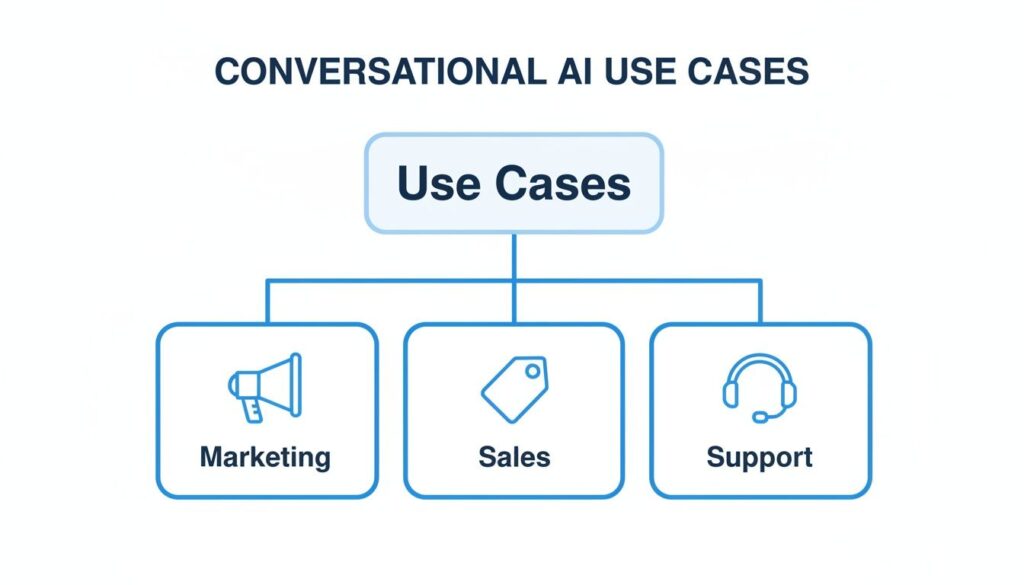
Below, you can see a simple diagram showing how the core use cases of conversational AI for customer engagement are typically categorized.
Conversational AI for Customer Engagement Use Cases
This visual shows that automation can be applied across marketing, sales, and support—which is exactly what our simple flow aims to do by directing users to the right department.
Step 3: Set Up a Keyword Trigger
Keyword triggers are your AI’s “ears.” They listen for specific words in customer messages and automatically fire off the right response. This is how you deliver instant answers to frequently asked questions.
For example, set up a trigger for the word “pricing.” When a user types a message with that word, your AI can instantly reply with a link to your pricing page. This one little automation saves you from typing the same answer over and over.
You can create triggers for other common terms like “shipping,” “hours,” or “contact.”
Step 4: Activate a Lead Capture Widget
Now, put your new automation to work on your website. A lead capture widget—often called a chat widget—is a small button that sits on your site, inviting visitors to start a conversation in Messenger or Instagram DM.
Getting it live is usually just a matter of copying a small code snippet and pasting it into your website builder.
Once active, every visitor to your site becomes a potential lead. When they click the widget and send a message, they are automatically subscribed to your list, and your welcome flow kicks in immediately. This is how you turn anonymous website traffic into engaged, qualified leads—a core goal of using conversational AI for customer engagement.
How to Measure Your Conversational AI ROI
Putting a new tool in place is one thing; proving its worth as an investment is another. When it comes to conversational AI for customer engagement, you have to look past vanity metrics like total messages sent. Focus on the numbers that hit your bottom line.
Calculating your return on investment (ROI) isn’t just for corporate boardrooms. It’s how you confidently show your team—or just yourself—that this technology is a profit center, not a cost.
Key Performance Indicators That Matter
Let’s get straight to the KPIs you should have on your analytics dashboard. These metrics tell the real story of your AI’s performance.
1. Chat-to-Sale Conversion Rate
This is the holy grail of sales metrics. It tracks how many conversations your AI starts that directly lead to a sale, proving your bot is closing deals.
- Formula: (Total Sales from AI / Total AI Conversations) x 100
- What to Aim For: A rate of 1-3% is a great start. Well-tuned flows for abandoned cart recovery can push this to 5% or higher.
2. Lead Qualification Rate
For agencies and service-based businesses, this KPI is gold. It measures how well your bot screens prospects, ensuring your sales team only talks to people who are a genuine fit.
- Formula: (Number of Qualified Leads / Total Leads Generated) x 100
- What to Aim For: You should aim for a qualification rate of 60% or more. This is a clear sign your AI is asking the right questions.
From Cost Savings to Revenue Growth
Beyond direct sales, conversational AI delivers huge ROI by making your business more efficient and keeping customers happy.
3. Cart Recovery Rate
This is the low-hanging fruit for any e-commerce store. This number shows how many sales your AI clawed back that would have been lost.
- Formula: (Carts Recovered by AI / Total Carts Abandoned) x 100
- What to Aim For: A recovery rate between 10-15% is fantastic. Even getting a small piece of that pie back can add thousands in revenue.
4. Reduction in Support Ticket Volume
This metric puts a dollar value on your cost savings. By tracking the drop in questions that hit your human team’s inbox, you can calculate the hours and money you’ve saved.
- Formula: ((Old Ticket Volume – New Ticket Volume) / Old Ticket Volume) x 100
- What to Aim For: A 30-50% reduction is a very realistic and achievable goal, freeing up your support agents for high-value conversations.
The Results Speak for Themselves: Businesses using AI chat see 2.3 times more customer engagement, driving up to 20% higher landing page conversions and 40% better lead qualification. This translates to tangible wins like 23% boosts in website conversions and 35% fewer support tickets. You can discover more insights about chatbot performance statistics to see the industry-wide impact.
Advanced Strategies for Deeper Customer Engagement
Conversational AI for Customer Engagement Personalization Workflow
So you’ve got the basics down. Your bot can answer questions and handle simple tasks. Now it’s time to move beyond functional Q&A and start creating conversations that build relationships.
This is where you turn a simple chatbot into a sophisticated marketing and support engine. Let’s get into the pro-level techniques that drive real results.
Create Hyper-Personalized Experiences
Hyper-personalization is more than just adding a first name to your message. It’s about using customer history to create a one-of-a-kind interaction. This is how you make someone feel seen, not sold to.
- For an e-commerce store: Imagine a returning customer getting this: “Hey, Sarah! We noticed you love our running shoes. We just dropped a new trail running collection—want to check it out?” That’s a message that gets clicks.
- For a coach: If someone downloaded your “Productivity Hacks” guide, follow up a week later: “Hi, Alex. How are you finding the productivity guide? I have a new mini-course on time management you might find valuable.”
The Takeaway: The goal is to make every conversation feel like a continuation of a previous one. When two-thirds of younger consumers expect this level of personalized content, especially from AI, it’s no longer a nice-to-have; it’s a core expectation.
Segment Your Audience for Laser-Focused Messaging
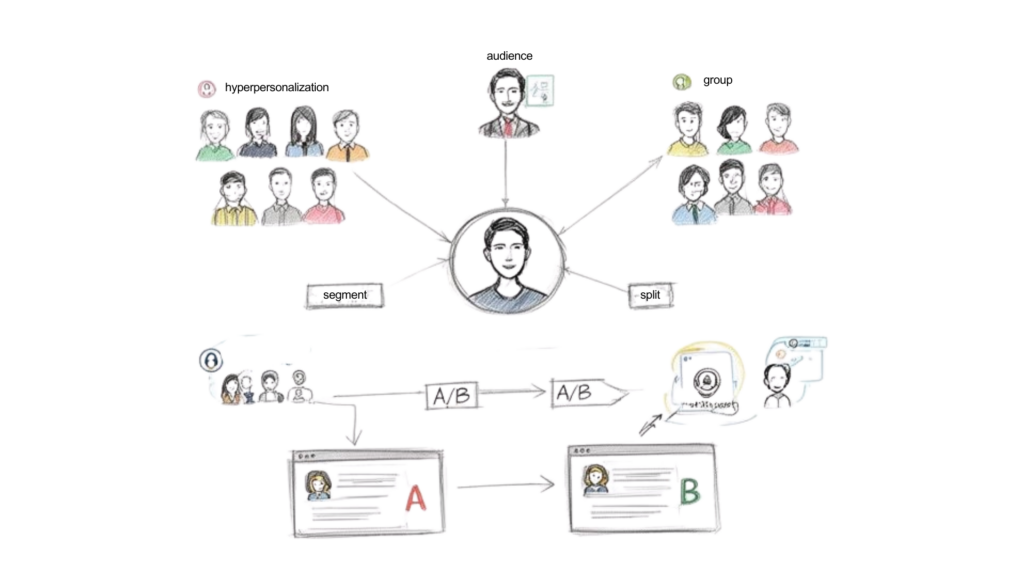
Your customers aren’t all the same, so why send them the same message? Audience segmentation is your secret weapon for relevance. It’s the practice of grouping subscribers based on their actions or interests so you can send the right message to the right people.
You can create segments based on almost anything:
- Actions Taken: Group users who clicked a specific link, bought a certain product, or abandoned their cart.
- Data Provided: Segment by location, or by users who told you they’re beginners versus advanced.
An agency, for example, could send a targeted offer for “Local SEO services” only to subscribers who identified their business as local. This precision is what separates campaigns that work from those that get ignored.
Continuously Optimize with A/B Testing
How do you know if your message is actually working? You test it. A/B testing (or split testing) is how you stop guessing and start making data-driven decisions. It’s as simple as sending two different versions of a message to small parts of your audience to see which performs best.
You can test just about anything:
- Headlines and copy: Does a direct offer work better than a question?
- Calls-to-action: Is “Shop Now” more effective than “Explore Collection”?
- Offers: Does a 15% discount get more sales than free shipping?
By constantly testing and refining, you turn your automation into an asset that gets smarter over time. This process ensures your conversational AI for customer engagement maximizes results from every interaction.
Got Questions About Conversational AI? We Have Answers.
Jumping into new technology can feel like a big leap, and it’s smart to ask questions. When it comes to using conversational AI for customer engagement, you probably have a few things on your mind.
Let’s tackle those common hesitations head-on.
Ready to stop making customers wait and start building relationships that drive growth? Clepher gives you all the tools you need to create powerful, automated conversations on your website, Messenger, Instagram, and WhatsApp. Start building with our no-code AI chatbot builder today.
Related Posts
What Is an Open Domain Chatbot?
April 11, 2026Conversational AI for Sales: Your 2026 Guide to Boosting Revenue
April 10, 2026Transform Your Sales Game with an AI Powered Sales Assistant
April 9, 2026
Founder Clepher