
Think of conversational AI for sales as the ultimate upgrade for your business—transforming your static website into a dynamic, 24/7 sales floor. It’s the technology that uses natural-sounding chat to automatically engage website visitors, qualify leads on Messenger and Instagram, and turn passive traffic into real sales conversations. It makes your business instantly available and responsive, day or night.
Before we dive in, let’s contrast the old way of doing things with this new, smarter approach.
Traditional Sales vs. Conversational AI Sales
| Sales Challenge | Traditional Approach | Conversational AI Solution |
|---|---|---|
| Lead Response Time | Manual follow-up via email or phone, often hours or days later. | Instant engagement the moment a visitor shows interest, 24/7. |
| Lead Qualification | Sales reps spend valuable hours asking repetitive screening questions. | Automated, intelligent questions to instantly separate hot leads from browsers. |
| 24/7 Availability | Leads arriving after-hours get a “we’ll get back to you” message and often go cold. | An always-on concierge that captures, nurtures, and converts every lead, anytime. |
This table just scratches the surface. Let’s explore what this transformation actually looks like for your business.
The Future of Sales Is a Conversation

Conversational AI Lead Generation
Imagine your website is a physical store. Without conversational AI, it’s like leaving the doors unlocked with no staff inside. People wander in, look around, and most walk right back out without ever speaking to anyone.
That’s how most businesses operate online. They invest heavily in driving traffic but lose countless opportunities simply because no one is there to say, “Hi, can I help you find something?”
Conversational AI for sales flips this script. It acts as your digital sales assistant, greeting every potential customer, answering their questions, and gently guiding them toward the right solution using conversational AI tools like AI chatbots and advanced AI agents powered by generative AI. It transforms silent, anonymous traffic into engaged, qualified prospects ready for your sales and marketing teams through conversational marketing.
Why This Is a Game-Changer for Your Business
This isn’t about slapping a generic chatbot on your site. It’s about implementing conversational AI within a powerful AI platform to automate the most frustrating yet critical parts of your sales funnel. Think about the common momentum-killers: slow response times, missed leads after 5 PM, and a sales team bogged down asking the same qualifying questions over and over.
Conversational AI tackles these problems head-on, delivering immediate results across every key use case in conversational AI in sales.
It engages leads instantly. A Harvard Business Review study found that companies responding within an hour are nearly 7 times more likely to qualify a lead. Conversational AI handles this in seconds.
It qualifies prospects for you. The AI asks the right questions to identify hot leads. This means your sales and marketing teams only spend time on conversations likely to convert.
It works around the clock. Your lead generation doesn’t stop when you log off. The AI is your night shift and weekend crew, ensuring no potential customer is ever missed.
The takeaway: Meet customers where they are—on your website, Messenger, or Instagram—and start a helpful conversation immediately. This approach builds trust from the first interaction and dramatically shortens the sales cycle.
This shift is more than a trend; it’s a fundamental change in how modern businesses grow. The market projections say it all, with the global conversational AI market expected to rocket from $12.24 billion in 2024 to an estimated $61.69 billion by 2032. For any business in e-commerce, B2B services, or retail, this technology is becoming non-negotiable for staying competitive.
By bringing these tools into your workflow, you aren’t just adding a feature. You’re building a more efficient, responsive, and profitable sales engine. If you’re curious about the tech that makes this possible, you might be interested in our guide on what conversational AI is and how it works.
How Conversational AI Actually Boosts Your Revenue
Let’s cut to the chase. How does conversational AI for sales actually put more money in your bank account? It’s not about a cool tech toy; it’s about deploying a tireless, 24/7 sales assistant that actively generates revenue through automated sales plays. Instead of just hoping a customer finds the “buy” button, the AI jumps in at the perfect moment to drive action.
Automate Lead Qualification and Booking
One of the fastest ways to see a return is by automating the top of your sales funnel. Your sales team’s time is too valuable to be spent on repetitive screening calls. Conversational AI acts as the perfect gatekeeper, ensuring only high-potential leads reach your team.
Here’s a practical example for a consulting business:
- A visitor lands on the “Services” page, and the chat widget pops up: “Hi! Looking for expert advice? I can help you find the right consultant. First, what’s your biggest challenge right now?”
- The AI asks a few sharp, qualifying questions: “What’s your company size?” and “What’s your monthly budget for this project?”
- If the answers indicate a high-potential lead (e.g., a budget over $10k), the AI immediately connects to the consultant’s calendar and says, “It looks like we’re a great fit. Let’s book a 15-minute discovery call. What time works for you tomorrow?”
That entire process can turn a casual visitor into a scheduled sales call in under two minutes, without any human intervention. You get a shorter sales cycle, and your team spends their day closing deals, not chasing leads.
Recover Abandoned Carts and Boost AOV
For any e-commerce brand, abandoned carts are a silent profit killer. Conversational AI turns this problem into a massive revenue opportunity, especially on platforms like Instagram and Messenger, where you can reach customers directly.
Picture this for an online clothing store:
- Upselling in Chat: A customer asks the AI, “Do you have this dress in blue?” The AI confirms availability and then adds, “Great choice! Many customers pair that dress with our leather belt. Want to add it for 15% off?” This simple suggestion immediately boosts the average order value (AOV).
- Cart Recovery via DM: An hour after a cart is abandoned, the AI sends a friendly message on Instagram: “Hey [First Name]! Looks like you left something behind. We saved your cart for you. Just reply ‘YES’ and I’ll send you a link straight to checkout.”
This isn’t just another email buried in a spam folder. It’s a personal, timely follow-up that re-engages shoppers while their interest is high. It’s how you rescue sales you would have otherwise lost for good.
Proactive Cross-Selling and Customer Nurturing
The first sale is just the beginning. The real profit is in turning one-time buyers into loyal, repeat customers. Conversational AI is your engine for increasing customer lifetime value (LTV) by making smart, data-backed recommendations.
Imagine a subscription box service using an AI assistant:
- A week after a customer’s first box arrives, the AI checks in via Messenger: “Hi [First Name]! How are you enjoying your box? On a scale of 1-5, how would you rate your experience so far?”
- Based on a positive rating, it can offer a special add-on for their next shipment.
- It can also proactively answer common questions about billing or shipping, preventing customer service tickets and building loyalty.
Each of these plays—from qualifying leads to upselling and recovering carts—turns a conversation into cash. It’s a system that works around the clock to make sure you never miss a chance to sell.
Understanding the Financial Return of AI in Sales
Anytime you invest in new tech, it boils down to one question: is it really worth it? For conversational AI for sales, the answer is a resounding yes—and the numbers prove it. This isn’t about minor tweaks; it’s about fundamentally changing your cost structure and revenue potential.
The first place you’ll see a difference is in your customer acquisition cost (CAC). AI automates top-of-funnel tasks like lead qualification and initial outreach. This frees your sales team from repetitive, low-impact work.
Instead of paying a skilled salesperson to ask the same five screening questions 100 times a day, the AI does it instantly and at scale. That expensive human expertise can then be focused where it truly counts: closing high-value deals. This directly lowers the cost of every qualified lead you generate.
Squeezing More Revenue from Every Interaction
Conversational AI doesn’t just make your sales process cheaper—it makes it more profitable. It’s a master at spotting and acting on revenue opportunities that a busy team might miss.
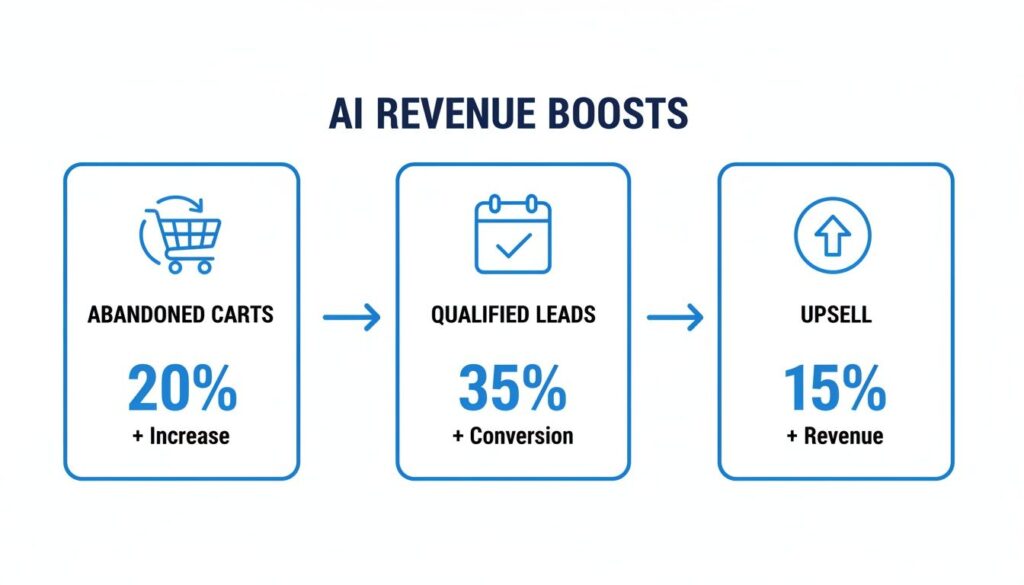
This visual breaks down exactly how AI drives real money into the business, from saving lost sales to teeing up qualified leads for your team.
Conversational AI for Sales Revenue
As you can see, AI isn’t a passive support tool. It actively participates in driving sales, whether it’s rescuing an abandoned cart with a timely offer or executing a perfectly timed upsell during a product query.
The technology delivers results for both new visitors and loyal customers. A recent analysis of over 17 million shopping sessions found that a staggering 64% of sales driven by AI came from first-time shoppers—proving its power in converting cold traffic.
But it doesn’t stop there. The same report found that returning customers who interacted with an AI spent 25% more per session than those who didn’t. That’s the power of smart, targeted suggestions in action.
The takeaway: This double impact—acquiring new customers more efficiently while increasing the spend of existing ones—is a powerful engine for growth. It makes the financial case for AI in your sales strategy crystal clear.
Calculating the True Value
If you’re building a business case for conversational AI, focus on these concrete metrics that the technology directly impacts:
- Increased Conversion Rate: By engaging every visitor instantly, AI turns more browsers into buyers.
- Higher Average Order Value (AOV): Smart, automated upsells and cross-sells inside the chat add real dollars to each transaction.
- Shorter Sales Cycles: Automating lead qualification and meeting scheduling gets hot leads to your sales reps faster, closing deals quicker.
- Improved Customer Lifetime Value (LTV): Proactive support and personalized follow-ups build loyalty that keeps customers coming back.
At the end of the day, investing in conversational AI isn’t an expense. It’s an investment in a faster, smarter, and more profitable sales machine.
Your Step-by-Step Implementation Roadmap
Conversational AI for Sales Workflow Steps
Ready to get your own conversational AI for sales up and running? Good. It’s far more straightforward than you might think. This isn’t a massive tech project requiring a team of developers; modern tools like Clepher have turned it into a series of logical steps anyone can manage.
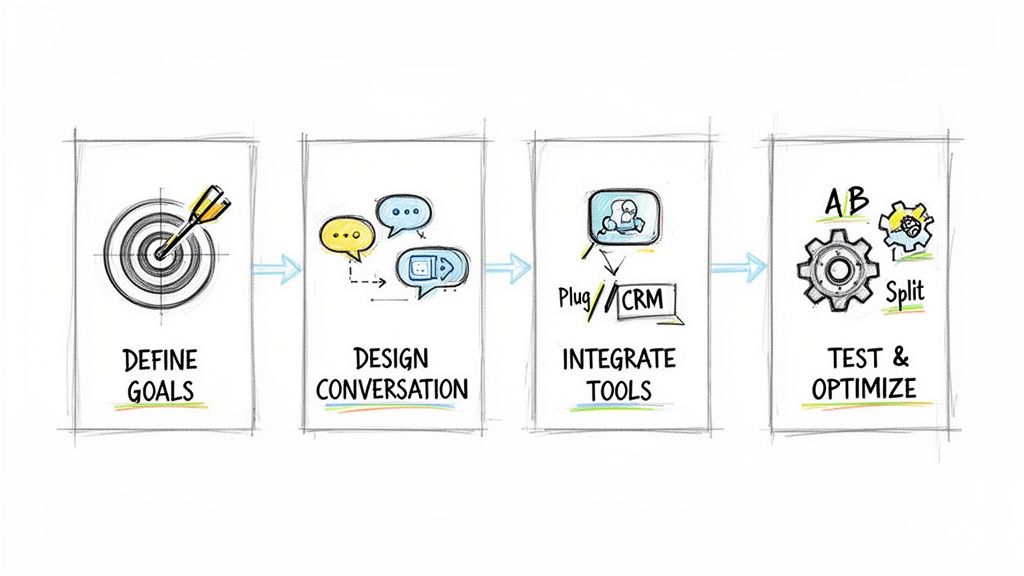
Let’s walk through the four-stage roadmap to take you from a blank canvas to a fully functioning sales bot that delivers real results.
Stage 1: Define Your Goals
Before you design any conversation, you need to know what you’re trying to accomplish. A bot built to book demos will operate very differently from one designed to recover abandoned carts. Your goal is the North Star for every decision.
Start by asking: “What’s the single biggest bottleneck in my sales process right now?”
- Is it lead volume? Your goal is to capture more leads from your website or social media traffic.
- Is it lead quality? Your objective is to have the bot qualify prospects so your team only talks to people ready to buy.
- Is it sales efficiency? You could aim to automate meeting scheduling and eliminate back-and-forth emails.
- Is it post-sale revenue? Your focus could be on upselling existing customers or providing instant support.
Actionable insight: Pinpoint one primary goal to start. A popular and effective first goal is automating lead qualification. For example, a marketing agency might set a goal to “Qualify all website visitors who click ‘Get a Quote’ and book meetings with those who have a budget over $5,000.”
This level of specificity is critical. It simplifies the rest of the process and ensures your first bot solves a real business problem, delivering a clear return right out of the gate.
Stage 2: Design the Conversation Flow
With your goal locked in, it’s time to map out the conversation. Think of it like creating a flowchart for a helpful dialogue. You’re anticipating what a customer might say and deciding how the bot should respond to guide them toward your goal.
Modern no-code platforms make this completely visual. You’re not writing code; you’re connecting blocks on a screen. If your goal is lead qualification, your flow might look like this:
- Greeting: A simple, friendly welcome. “Hi! Thanks for your interest. I can help get you a quote. Just need to ask a couple of quick questions first.”
- Qualifying Questions: Ask the essentials. “What’s the approximate size of your team?” or “Which of our services are you most interested in?”
- Conditional Logic: This is where the magic happens. The bot’s path changes based on the answers. If a lead’s budget is “high,” it offers to book a meeting. If it’s “low,” it might offer a downloadable guide instead.
- Action: The conversation ends with a clear result—booking a meeting, capturing an email, or handing off to a live sales rep.
The key here is to put yourself in your customer’s shoes. Keep it simple, be helpful, and always focus on moving them to the next logical step.
Stage 3: Integrate Your Tools
Your sales bot shouldn’t be a lonely island. To make it truly powerful, it needs to talk to the other tools you already use. This is how you turn a simple chatbot into a core part of your sales engine. Native integrations are a game-changer here.
- CRM Integration: When your bot qualifies a lead, it can automatically create a new contact in your CRM (like HubSpot or Salesforce), assign it to the right rep, and log the entire chat history. No more manual data entry.
- Calendar Integration: Connect to Calendly or Google Calendar so the bot can see real-time availability and book qualified meetings on the spot.
- Email/SMS Integration: The moment a lead is captured, trigger an automated email sequence in your marketing platform or send an instant SMS confirmation.
These connections ensure the valuable information your bot gathers is immediately put to work. You can explore this topic in more detail in our guide on how to use AI in your sales process.
Stage 4: Test and Optimize
Your first launch isn’t the finish line—it’s the starting gun. The final stage is a continuous loop of testing, learning, and improving. Your conversational AI provides a goldmine of data on what messages connect with your audience and which ones fall flat.
Use this data to make your sales bot smarter over time.
- Review Transcripts: Read the actual conversations. Where are people getting stuck? What questions are they asking that you didn’t anticipate?
- Analyze Key Metrics: Keep an eye on your conversion rates. What percentage of chats result in a booked meeting? If it’s low, rethink your qualifying questions or opening line.
- Run A/B Tests: Test different versions of your messages. Does a more casual tone work better? Does asking a different first question bring in more qualified leads?
As you get more advanced, consider robust LLM monitoring solutions to ensure the AI models themselves perform at their peak. This constant optimization is what separates a good sales bot from a great one that consistently drives more revenue.
Best Practices for Crafting Conversations That Convert
Conversational AI for Sales AI Capabilities
Having powerful conversational AI for sales is a great start, but the technology is only half the battle. The real magic happens when you design conversations that connect with people and guide them toward a purchase. This is what separates a frustrating chatbot from a helpful automated assistant that customers enjoy talking to.
Give Your AI a Distinct Personality
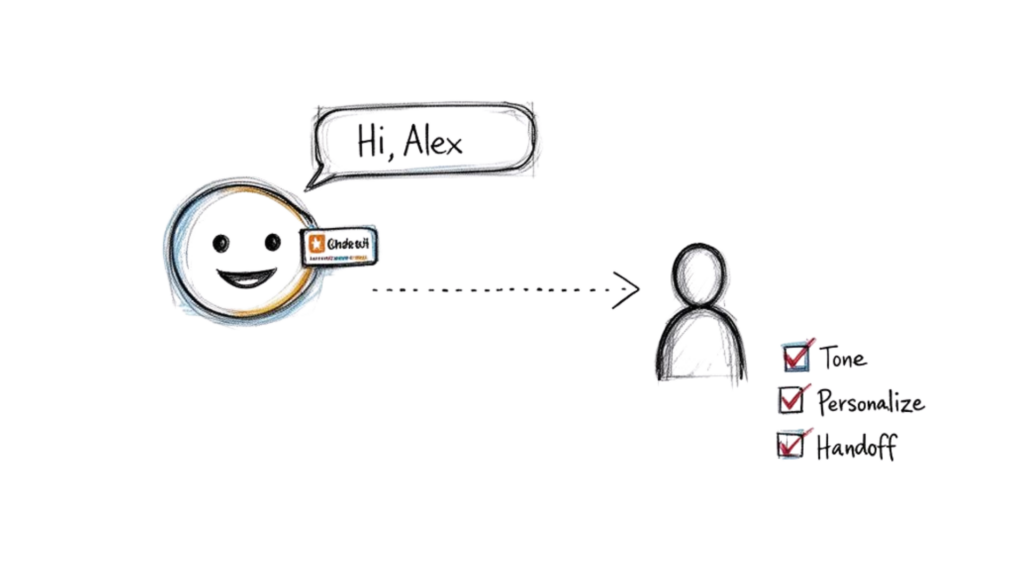
Your AI is a direct extension of your brand, so a generic, robotic tone won’t cut it. Define its personality first. Is it friendly and casual? Professional and direct? Or witty and fun? This voice should be consistent in every interaction. An e-commerce brand selling to Gen Z might use emojis and laid-back language, while a B2B finance firm should project authority and expertise.
The goal: Don’t try to trick users into thinking they’re talking to a human. Instead, create an experience so smooth and helpful that they don’t care. A little character can make an automated chat feel like a real conversation.
Personalize Every Interaction
In sales, personalization is non-negotiable. One-size-fits-all messages are lazy and ineffective. Your AI must use available data to make every interaction feel personal.
- Use Their Name: A simple “Hi, Sarah!” (pulled from their social profile or a form) immediately grabs attention.
- Reference Their Behavior: Did they just look at a specific product? The bot should know. “Hey, saw you were checking out the new running shoes! Have any questions about them?”
- Ask Smarter Questions: Use conditional logic to keep the conversation relevant. If a customer says they’re interested in “marketing,” don’t ask them about “sales.”
These small adjustments make your customer feel seen and understood. For hyper-personalization, Custom ChatGPT solutions can be trained on your customer data to craft incredibly specific and effective sales dialogues.
Master the Seamless Human Handoff
No bot can handle everything. Knowing when to get a human involved is crucial. A clumsy handoff where the customer has to repeat everything is a guaranteed way to lose a sale. The transition must be seamless. When the AI detects a complex question or a strong buying signal, it must transfer the entire chat history so your sales rep can jump in without missing a beat. Learn more about how to design a chatbot that nails these critical transitions.
Conversation Design Do’s and Don’ts
Here’s a quick-reference guide for building sales conversations that work.
| Best Practice (Do This) | Common Mistake (Not That) |
|---|---|
| Use Typing Delays to make responses feel more natural and less instant. | Responding Instantly with a huge block of text, which feels robotic and overwhelming. |
| Leverage Keyword Triggers to provide instant, relevant answers to common questions. | Forcing Users Down a Rigid Path with only button options, leaving no room for questions. |
| Keep Messages Short and Focused with one main idea per message. | Writing Long Paragraphs that are difficult to read on a mobile screen. |
| End With a Clear Call to Action like a question or a button, to guide the user. | Leaving the Conversation Open-Ended without telling the user what to do next. |
By following these principles, you’ll build a conversational sales engine that builds real relationships, solves problems, and—most importantly—drives more revenue.
Frequently Asked Questions About Conversational AI
Thinking about bringing conversational AI into your sales process? It’s a big move, and it’s smart to understand how it will actually impact your team and your bottom line. Let’s tackle the most common questions we hear from business owners.
Ready to see how a tireless AI assistant can boost your revenue? With Clepher, you can build and launch powerful conversational AI for your website, Messenger, and Instagram in minutes—no code required. See the results for yourself.
Related Posts
Conversational AI for Sales: Your 2026 Guide to Boosting Revenue
April 10, 2026Transform Your Sales Game with an AI Powered Sales Assistant
April 9, 2026No-Code AI Agent Builder: Your 2026 Growth Playbook
April 8, 2026
Founder Clepher