

Remember when marketing felt like shouting into a crowd? You’d blast a single message and hope the right person heard it. A conversational marketing platform flips that script. It swaps one-way announcements for real-time, two-way dialogues that build relationships and drive sales.
From Megaphones to Meaningful Conversations
That old megaphone approach just doesn’t work anymore. Today’s customers expect immediate answers and personal experiences, not generic email blasts and slow support tickets. Forcing someone to wait or navigate a confusing website is a fast way to lose a sale.
This is where a conversational marketing platform becomes your growth engine.
Think of it as giving every website visitor a personal guide. Instead of leaving them to wander, you can engage them, answer their questions, and steer them toward the perfect solution. It’s the digital version of a helpful store associate asking, “How can I help you today?”
The Shift from Monologue to Dialogue
The real magic is moving from a brand monologue to a customer dialogue. This isn’t just marketing theory; it’s a strategic pivot with tangible results. This technology helps you:
- Engage Instantly: Greet visitors with a personalized message the second they land on a key page. For example, a chatbot on a pricing page can ask, “Have any questions about our plans?”
- Qualify Leads 24/7: Use automated chatbots to ask the right questions, pinpoint high-intent prospects, and even book meetings for your sales team while they sleep.
- Accelerate Sales Cycles: By answering questions immediately and removing friction, you dramatically shorten the time it takes to turn a visitor into a customer.
This approach boils down to one truth: conversations sell. You can dive deeper into the core ideas behind this strategy by learning more about what conversational marketing is and how it drives results.
A Growing Demand for Real Conversations
The rush to adopt this technology isn’t a trend; it’s the new standard. Industry forecasts show the global conversational AI market is expected to hit roughly $41.4 billion by 2030—a huge jump from about $11.6 billion in 2024.
This growth shows that conversational tools are no longer a “nice-to-have” but a core part of any modern marketing stack. You can find more insights on this high-growth tech over at Future Market Insights.
The Core Components of a Modern Platform
A conversational marketing platform isn’t just one piece of software. It’s a suite of tools working together to create a smooth, natural customer journey. Think of these components as direct solutions to real business headaches—like lost sales, confused visitors, and an overworked support team.
The goal is to shift from the old, one-way broadcast model to a dynamic, two-way dialogue. This powerful evolution is what modern marketing is all about.
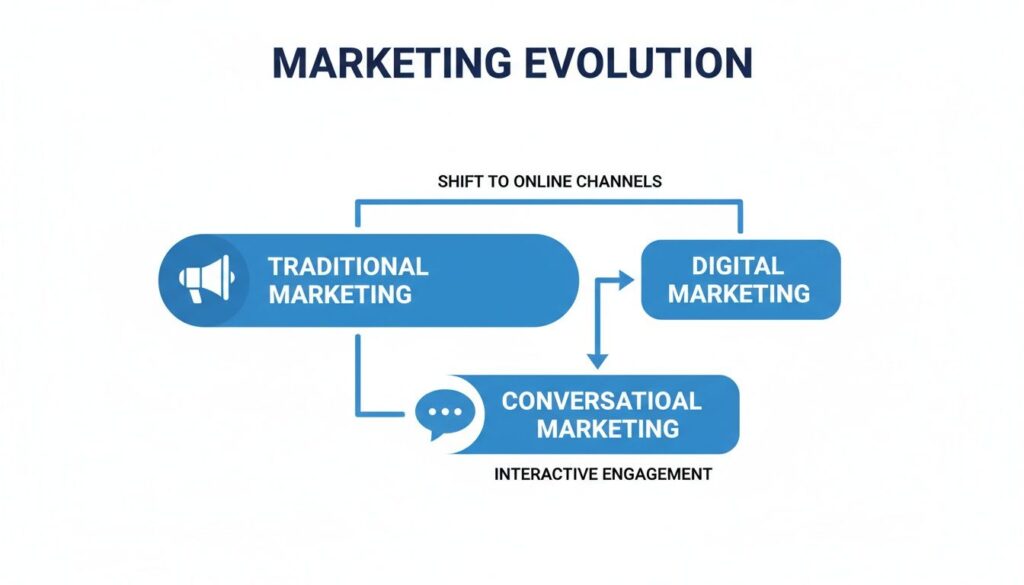
Conversational Marketing Platform Evolution
This visual shows the journey from shouting with a megaphone (mass announcements) to engaging with interactive chat bubbles—a perfect picture of how marketing has become centered on actual conversations.
Below, we’ll break down the key features you’ll find in any solid conversational marketing platform and what they actually do for your business.
Key Features and Their Business Impact
A good platform combines powerful tools to create a cohesive experience. Here’s a look at the must-have features and the real-world value they deliver.
| Feature | Primary Function | Key Business Benefit |
|---|---|---|
| AI-Powered Chatbots | Provide instant, automated responses to common questions and guide users 24/7. | Increases lead capture, reduces response times, and frees up human agents for high-value tasks. |
| Live Chat | Enables real-time, one-on-one conversations between customers and human support agents. | Resolves complex issues, builds customer trust, and handles high-value interactions that need a human touch. |
| Unified Inbox | Consolidates all customer conversations from various channels (website, social, etc.) into a single dashboard. | Boosts team efficiency, creates a seamless customer experience, and ensures no message gets lost. |
| Proactive Messaging | Sends targeted, automated messages to users based on their on-site behavior. | Re-engages hesitant buyers, reduces cart abandonment, and drives conversions with timely prompts. |
| CRM Integration | Syncs conversation data with your Customer Relationship Management system like Salesforce or HubSpot. | Provides a 360-degree customer view, enabling highly personalized follow-ups and smarter sales outreach. |
Each of these components plays a critical role. Without them working together, you end up with a disjointed process that frustrates your team and your customers. Let’s dive deeper into a few of the most important ones.
AI-Powered Chatbots for 24/7 Engagement
At the core of any modern platform are AI-powered chatbots. Forget the clunky bots of the past. Today’s chatbots are your tireless front-line agents, ready to engage visitors the moment they land on your site, day or night.
Imagine an e-commerce store selling running shoes. A visitor lands on a product page at 11 PM. A chatbot instantly pops up: “Looking for the right fit? I can help you find your perfect size or suggest a shoe based on your running style.”
This immediate interaction achieves several goals:
- Qualifies Leads: The bot asks targeted questions (“Do you run on trails or roads?”) to understand the visitor’s needs and guide them to the right product.
- Provides Instant Answers: It handles FAQs about shipping, returns, and materials, freeing up your team for more complex problems.
- Captures Sales: By guiding the user and answering questions in real-time, the bot prevents cart abandonment and closes sales that might have otherwise been lost.
Live Chat for Human-Powered Support
While chatbots are great for routine tasks, sometimes a customer needs to talk to a person. That’s where live chat comes in. A great conversational marketing platform makes the handoff from bot to human completely seamless.
If a chatbot can’t answer a complex question or identifies a high-value lead, it can instantly transfer the chat to a live agent. This “human in the loop” approach gives you the best of both worlds: the efficiency of automation and the empathy of a real person.
A seamless transition from an AI chatbot to a live agent isn’t just a feature; it’s a critical trust-builder. It shows the customer that you’re committed to solving their problem, using whatever resource is best.
This ensures that customers with urgent or complicated issues feel heard and supported, which is the bedrock of long-term loyalty.
A Unified Inbox to Manage All Conversations
Your customers don’t just live on your website. They’re on Facebook, Instagram, WhatsApp, and SMS. A unified inbox is the command center that pulls all these conversations into one manageable place.
Without it, your team is stuck juggling different apps, leading to slow responses and missed messages. With a unified inbox, your team sees the full conversation history across every channel. For instance, if a customer asks a question on Instagram and follows up on your website, your agent sees both messages in a single thread. This context allows them to provide a helpful, consistent answer, creating a cohesive journey for the customer and a saner workflow for your team.
How Conversational Marketing Drives Real Growth
Let’s move past features. The real question is: how does this help your business grow? It’s about turning cool tech into revenue. The biggest win is its power to accelerate your sales funnel by engaging and qualifying people the moment they show interest.
Imagine someone lands on your pricing page. Instead of letting them leave confused, a chatbot pops up: “Have any questions about our plans?” That single interaction can be the difference between a new lead and a bounced visitor. Giving people answers right when they need them is a direct line to better conversion rates.
This immediate back-and-forth shrinks the time it takes to turn a curious browser into a qualified lead. When your response time drops from hours to seconds, you gain a massive sales advantage.
Turn Website Traffic into Qualified Leads
A static website is like a silent salesperson. It just stands there with information. A conversational marketing platform gives your site a voice, turning passive browsers into active participants. This is where you see a huge jump in lead quality and quantity.
For example, a bot can ask a few simple questions to qualify a visitor:
- “What’s your biggest challenge with [your industry problem]?”
- “How big is your team?”
- “Are you looking for a solution for yourself or for a business?”
Based on the answers, the platform can instantly qualify them, route them to the right sales rep, or even book a demo on the spot. This automated triage means your sales team spends its time talking to people who are ready to buy, not chasing dead ends. Our guide on using a bot for sales dives deeper into how this automation directly fuels revenue.
Increase Sales and Customer Loyalty
The numbers don’t lie—this approach works. Brands using conversational marketing see real improvements. Around 80% of companies report a jump in sales after implementing these tools, with chatbots often handling up to 80% of routine customer questions. This frees up your human agents to tackle complex, high-value conversations.
Conversational campaigns also get way more engagement. Brands have seen click-through rates four to five times higher than typical digital ads. It’s clear proof that customers prefer a dialogue over a monologue. You can find more stats on conversational marketing effectiveness here.
And this isn’t just about the first sale. It’s about building a relationship. When customers know they can get quick, helpful answers anytime, their trust in your brand skyrockets.
Boost Team Efficiency and Productivity
A conversational marketing platform is a game-changer for your internal teams, too. By automating repetitive tasks—like qualifying leads and answering the same FAQs—the platform frees up your team to focus on work that requires strategic thinking.
Think about the hours saved when your support team isn’t answering “Where’s my order?” five times a day. That time can be reinvested into proactive customer outreach or improving help docs. Your sales team can focus on closing deals instead of just finding them. This productivity boost means you can accomplish more with the same number of people, directly improving your ROI.
See Conversational Marketing in Action
Theory is great, but seeing how this works in a real business makes it click. Let’s look at how conversational marketing platforms are solving everyday problems, turning frustrating challenges into measurable wins.
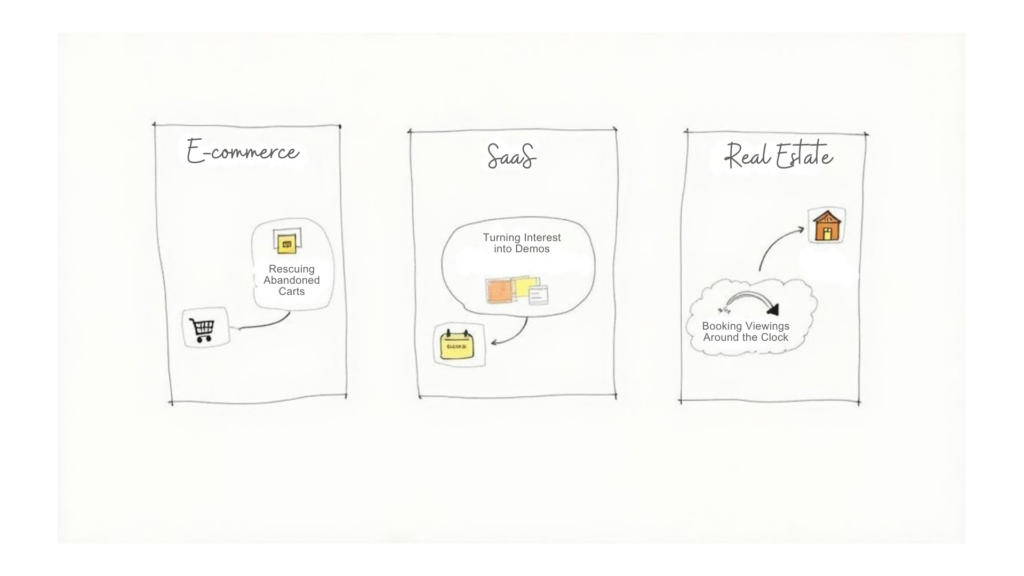
Conversational Marketing Platform Use Cases
These aren’t just clever ideas; they’re practical strategies you can adapt for your own business. They prove how a simple, well-timed conversation can fix a complex problem and drive serious growth.
E-commerce: Rescuing Abandoned Carts
Abandoned carts are a huge source of lost revenue. A customer finds products, adds them to their cart, gets to checkout… and then disappears. A conversational marketing platform can step in at that moment of hesitation to save the sale.
The Challenge: An online clothing store saw that 68% of their carts were being abandoned, with a huge drop-off at the shipping information step. Their automated emails were being ignored.
The Conversational Strategy: Instead of sending an email hours later, they put a proactive chatbot on the checkout page. If someone paused for more than 45 seconds, the bot popped up: “Hey there! Have any questions about shipping or returns I can help with?”
This tiny prompt opened the door. The bot was ready to handle common deal-breakers:
- It instantly clarified international shipping times.
- It explained their simple return policy.
- If the user still seemed hesitant, it offered a one-time 10% discount to close the deal.
The Outcome: This simple change gave customers the immediate answers they needed. The brand saw a 22% reduction in cart abandonment and recovered thousands in lost revenue in the first three months.
SaaS: Turning Interest into Demos
For a SaaS company, the main goal is booking qualified demos. But the old way—making someone fill out a form and wait for a sales rep to email back—is slow and full of friction.
The Challenge: A B2B software company was getting good traffic to its pricing page, but few visitors were completing the demo request form. By the time the sales team followed up, the leads had gone cold.
The Conversational Strategy: They replaced their static form with an intelligent chatbot. Now, when a visitor lands on the pricing page, the bot starts a real-time qualifying conversation.
Chatbot Flow Example:
- Greeting: “Welcome! Are you looking for a solution for a team of 1-10, 11-50, or 50+?”
- Qualification: “Great! And what’s the biggest challenge you’re hoping our software can solve?”
- Booking: “It sounds like we can definitely help. I can book a 20-minute demo for you right now. Does tomorrow at 10 AM or 2 PM work?”
The bot connected directly to the sales team’s calendars. A hot lead could go from landing on the page to having a demo booked in under two minutes.
The Outcome: The friction vanished. By engaging high-intent visitors instantly, the company increased demo bookings by 40% in two months. Their sales cycle also shortened because reps were only talking to engaged, qualified leads.
Real Estate: Booking Viewings Around the Clock
Real estate agents are constantly on the move, making it impossible to answer every call or text instantly. A single missed inquiry can mean a lost opportunity.
The Challenge: A real estate agency was swamped with viewing requests, especially after hours. Agents were spending more time playing phone tag to schedule appointments than showing properties.
The Conversational Strategy: They put a chatbot on their website and connected it to their Facebook Messenger to act as an automated booking assistant. It could answer basic property questions and then guide potential buyers to schedule a viewing on the spot. The bot displayed open time slots and confirmed the booking instantly, dropping it right onto the agent’s calendar.
The Outcome: This automated system allowed the agency to capture and qualify leads 24/7. They saw a 35% increase in property viewings scheduled and freed up their agents to focus on closing deals. Buyers loved the immediate, hassle-free booking experience.
Choosing the Right Conversational Marketing Platform
Picking the right platform is a big deal. Get it right, and it becomes the nerve center for customer conversations, sparking growth and loyalty. Get it wrong, and you’re stuck with a tool that creates headaches and burns your budget.
How do you avoid the guesswork?
Start with your customer journey. Map the entire path a visitor takes, from first contact to loyal fan. Where do they get stuck? Where do questions pop up? Those friction points are your goldmine—they tell you exactly where a conversation can make the biggest impact.
Your Core Evaluation Checklist
A solid platform must nail three things: it needs to connect with your other tools, be ready for your growth, and be simple enough for your team to use.
- Integration Capabilities: Your conversational tool can’t be an island. It must integrate with your existing tech, especially your CRM (like Salesforce or HubSpot), email marketing software, and analytics dashboards.
- Scalability for Growth: The platform that works for a startup has to work for a scale-up. Ask yourself: can this tool handle a massive spike in website traffic? Can it expand to new channels like WhatsApp or Instagram? Avoid any platform that will box you in later.
- Ease of Use: If the platform is a nightmare to navigate, your team won’t use it. You need an intuitive, no-code builder that lets marketers create and launch chat flows without calling a developer for help.
The best platform isn’t the one with the longest feature list; it’s the one that solves your specific business problems most effectively. Focus on tools that directly impact your identified customer journey friction points.
Key Questions to Ask During a Demo
A live demo is where you separate contenders from pretenders. Don’t just watch a canned sales pitch. Show up with pointed questions tied to your goals to get past the marketing fluff.
Use this list to drive the conversation:
- Onboarding and Support: “What does your onboarding process look like? If we hit a wall, can we talk to a real person, or are we stuck with a help doc?”
- Customization and Branding: “How much control do we have over the look and feel of the chat widgets? Can we make this sound exactly like our brand’s voice and tone?”
- Analytics and Reporting: “Show me the dashboard. What specific metrics can we track? Let’s walk through how we would measure lead quality, conversion rates, and ROI.”
- Security and Compliance: “How are you protecting our customer data? What specific measures do you have for regulations like GDPR?”
When weighing options, check out reviews of leading online form builders, as they often form the backbone of a good conversational strategy.
Platform Evaluation Checklist
Use this table to compare platforms side-by-side. It forces you to focus on what truly matters for your business.
| Evaluation Criteria | What to Look For | Key Questions to Ask |
|---|---|---|
| Integrations | Native connections to your essential tools (CRM, email, analytics). A public API for custom builds. | Does it connect to Salesforce/HubSpot? Can our developers build on top of it? |
| Ease of Use | An intuitive, visual, drag-and-drop bot builder. Clear navigation and user interface. | Can a non-technical marketer build a complete chatbot flow without help? |
| Scalability | Ability to handle high traffic volumes. Support for multiple channels (web, social, SMS). | What happens if our site traffic doubles overnight? Can we add WhatsApp later? |
| Analytics | Dashboards for tracking conversions, engagement, and lead quality. A/B testing features. | How do we measure the ROI of a specific campaign? Can we test different messages? |
| Customization | Full control over widget design (colors, fonts). Ability to define a unique brand voice and tone. | Can we make the chatbot look and sound exactly like our brand? |
| Support & Onboarding | A clear onboarding process with human guidance. Access to live support agents. | What does the first 30 days look like? Who do we call when something breaks? |
| Security & Compliance | GDPR, CCPA, and other relevant compliance certifications. Data encryption and secure hosting. | How is our customer data stored and protected? Are you GDPR compliant? |
By methodically working through this checklist, you’ll have a clear, data-driven reason for your final decision, ensuring the tool you choose is the right fit for now—and for the future.
Your Implementation and Measurement Roadmap
A great platform is only as good as the strategy behind it. Jumping in without a plan is a recipe for confusing bots and frustrated users. A successful rollout is a phased approach focused on quick wins and constant learning.
Instead of trying to automate everything at once, start with a pilot project. Find your highest-traffic page—like a key product page—and deploy a simple chatbot designed to solve one specific problem, like answering the top 5 FAQs.
This “start small” method lets you gather real-world data fast, so you can fine-tune your approach before expanding it across your entire site.
Crafting Your Brand Voice
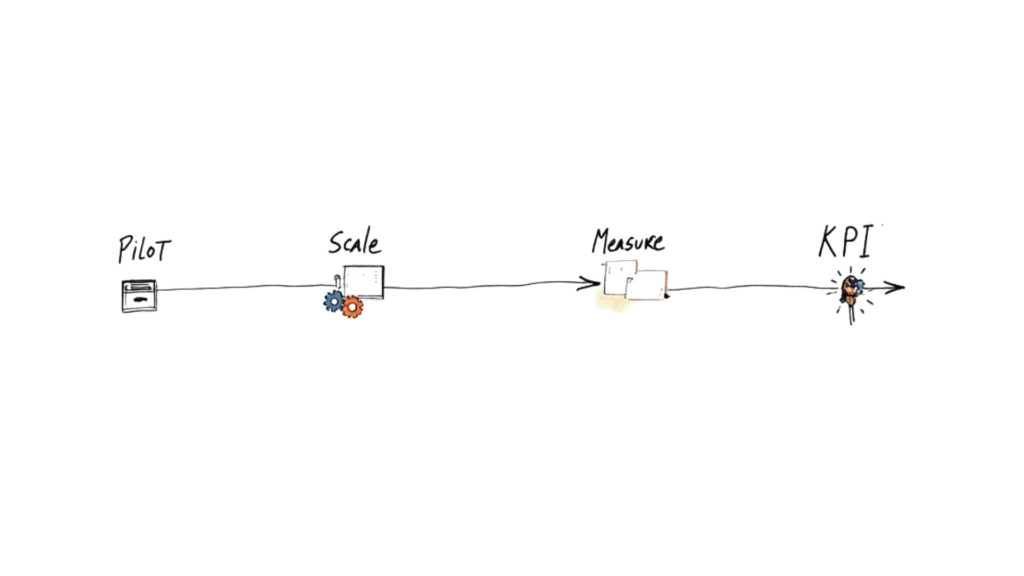
Conversational Marketing Platform Process Flow
One of the biggest mistakes businesses make is letting their chatbot sound like a generic robot. Every interaction is a chance to reinforce your brand. Before you write a single script, define your chatbot’s personality.
Is your brand witty and playful, or professional and direct? Make sure the language, tone, and even the emojis you use in your automated conversations are a perfect match for your brand voice. An authentic, consistent voice builds trust.
Measuring What Truly Matters for Growth
Vanity metrics like “total conversations” won’t tell you if your strategy is moving the needle. To prove ROI, track KPIs that tie directly to business growth.
Focus on the numbers that reveal the true impact on your sales and support teams:
- Lead-to-Opportunity Conversion Rate: How many bot conversations are turning into actual sales prospects?
- Sales Cycle Length: Are conversations helping you close deals faster?
- Customer Satisfaction (CSAT) Scores: After a chat, ask users for a quick rating to measure how helpful your interactions are.
- Bot Handoff Rate: What percentage of bot conversations need a human? A high rate might mean your bot flows are too complex or are missing key answers.
For a deeper look, check our guide on the most important chatbot KPI metrics to track.
Robust tracking is essential for any marketing effort. Learn how to set up your Google Ads conversion tracking setup to effectively tie your spending to real outcomes.
Avoiding Common Implementation Pitfalls
Even with the best intentions, it’s easy to stumble. The two most common pitfalls are overly complex bot flows and clumsy human handoffs.
First, avoid building massive, confusing conversation trees. Keep your initial bots focused and simple. It’s better to do one thing perfectly than ten things poorly.
Equally important is a seamless handoff to a human agent. If a customer asks to speak to a person, the bot should never trap them in an endless loop. A smooth, immediate transition shows you value their time and builds trust.
Frequently Asked Questions
Jumping into new tech always brings up a few questions. Let’s tackle the most common ones so you can move forward with confidence.
Ready to turn passive website visitors into engaged customers? Clepher gives you the AI-powered tools to build intelligent chatbots, manage all your conversations in one place, and drive real growth. Start your free trial and launch your first chatbot today.
Related Posts
Social Media Marketing Automation: Your Ultimate Guide
March 27, 2026Unlock Growth with Conversational AI for Customer Support
March 26, 2026Your Ultimate Guide to Instagram Chat Bots
March 25, 2026
Founder Clepher