
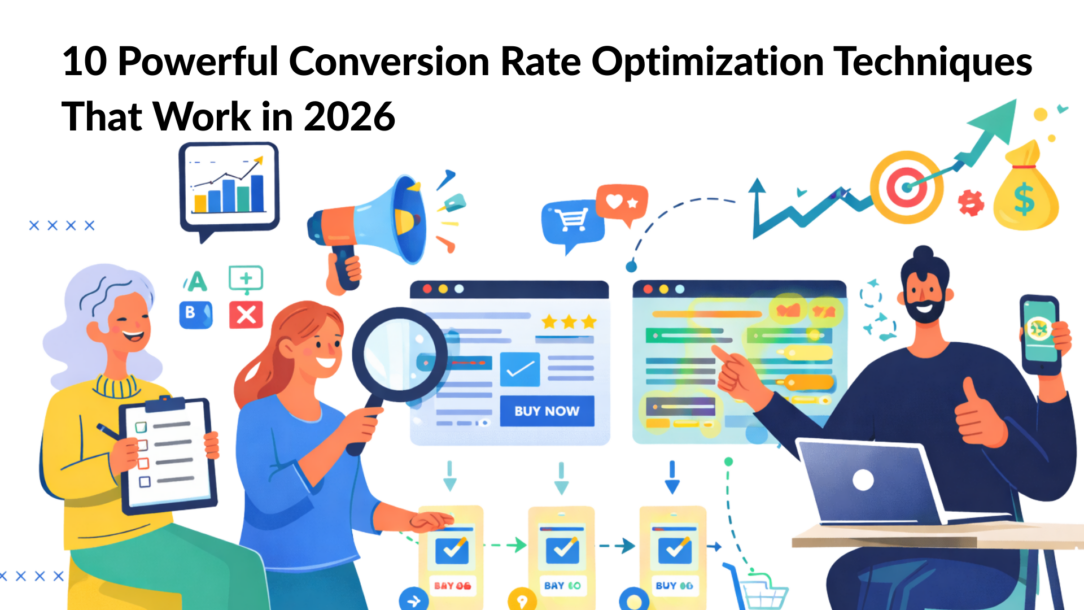
Are rising ad costs and fierce competition making it tough to grow? Simply driving traffic to your website isn’t enough. The real challenge—and your biggest opportunity—is turning those visitors into customers. So, how do you transform casual browsers into committed buyers without a massive budget?
The answer is conversion rate optimization (CRO). This isn’t about guesswork or chasing trends. It’s a systematic process of understanding what your users want and giving it to them. CRO is about making small, data-driven changes that lead to huge increases in revenue. By improving your user experience and messaging, you maximize the value of every single visitor you get.
This guide skips the abstract theory and dives straight into 10 proven, actionable conversion rate optimization techniques you can start using today. We’ll cover everything from foundational A/B testing to the power of AI-driven chatbots, giving you clear, step-by-step guidance for each one.
You’ll learn how to build trust with social proof, create urgency that drives action, and personalize experiences for different audiences. We’ll also provide practical examples of how you can use tools like Clepher to automate your growth and get measurable results. It’s time to stop guessing and start converting.
1. A/B Testing (Split Testing)
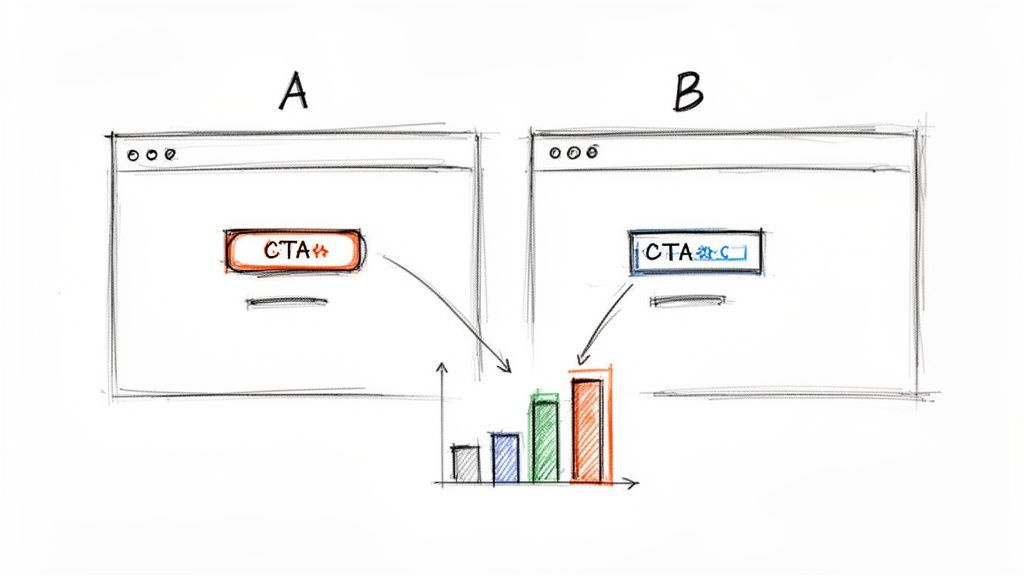
A/B testing, or split testing, is a core CRO technique that lets you make decisions with data, not gut feelings. It’s simple: you create two versions of something (like a webpage or an email), show each version to a different group of people, and see which one performs better. By measuring how users interact with each option, you can prove which one drives more conversions.
Split Testing
This data-driven approach is how you make small improvements that add up over time. It’s the difference between saying, “I think this red button will work better,” and knowing, “The red button increased our sign-ups by 17%.”
How to Implement A/B Testing Effectively
To get reliable results, you need a structured process. Start by focusing on high-impact elements like headlines, call-to-action (CTA) buttons, and form layouts.
- Test One Thing at a Time: To know what caused a change, only alter one element between your original (Version A) and your new version (Version B). If you change both the headline and the button color, you won’t know which one made the difference.
- Know Your Baseline: Before you start a test, you need to know your current conversion rate. This is your benchmark for measuring the impact of your changes.
- Run Tests Long Enough: Let your test run long enough to get a statistically significant result (usually 95% confidence or higher). This often means running it for at least two weeks to smooth out any daily ups and downs in user behavior.
- Document Everything: Keep a log of all your tests. Note your hypothesis, what you tested, the results, and what you decided to do. This creates a powerful playbook for your team.
Practical Example: An e-commerce store could test an “Add to Cart” button against a “Buy Now” button. A SaaS company could test a short, direct chatbot onboarding flow against a more detailed, guided one using Clepher’s A/B testing to see which one gets more trial sign-ups.
2. Personalization and Dynamic Content
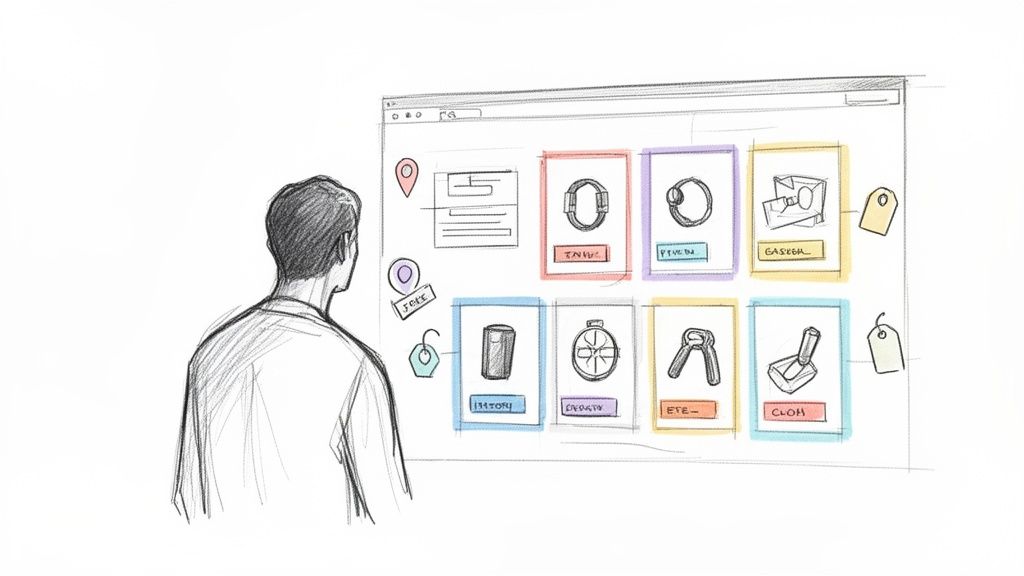
Personalization is a powerful CRO technique that ditches the one-size-fits-all approach. It’s about tailoring your website content, product recommendations, and offers to individual users based on their data—like their browsing history, past purchases, or location. By delivering experiences that are uniquely relevant, you dramatically increase engagement and the chances of a conversion.
Dynamic Content
This tactic turns a generic visit into a one-on-one conversation. Instead of just hoping your message connects, you’re actively showing customers you understand their needs. This builds trust and speeds up the path to purchase.
How to Implement Personalization Effectively
To do personalization well, you need a smart approach to collecting and using data. Start with simple segments and expand from there as you learn more about your users’ behavior.
- Start with Simple Segments: You don’t need complex AI from day one. Begin by grouping your audience into simple categories like new vs. returning visitors, their location, or what they’ve bought before. This first step can deliver big wins.
- Use Dynamic Variables: Use tools like Clepher to insert dynamic content. For example, a simple personalization tag like
{{first_name}}In a chatbot greeting or an email subject line, instantly makes the interaction feel more personal. - Create Data-Driven Personas: Go beyond assumptions and build customer profiles based on actual user data. See what your best customers have in common and use those insights to personalize the experience for new, similar visitors.
- Test Against Generic Content: Always prove your personalization efforts work. Use A/B testing to compare a personalized page against a generic version to see exactly how much it impacts conversions.
Practical Example: An e-commerce store could display a “Recently Viewed Items” section for returning visitors. A SaaS company could use Clepher to trigger a unique chatbot onboarding flow based on a user’s role (e.g., “Marketer” vs. “Developer”) right after they sign up.
3. Lead Capture and Segmentation
Effective lead capture and segmentation are techniques that turn your website traffic into an engaged audience you can talk to directly. This involves collecting visitor information with forms or chatbots and then organizing those contacts into groups based on their interests or actions. By segmenting leads, you can send highly relevant follow-up campaigns that are far more effective at moving them toward a sale.
This process turns anonymous visitors into known contacts. Instead of shouting one message at everyone, you can tailor your communication. This is the difference between yelling into a crowd and having a direct, meaningful conversation with someone who’s already interested.
How to Implement Lead Capture and Segmentation Effectively
To build a high-quality list, your capture strategy must be valuable and frictionless. The goal is to make it easy for visitors to give you their information in exchange for something they want.
- Offer Real Value: Your lead capture should be tied to a compelling offer. This could be a discount code, a free guide, or access to an exclusive webinar. Give them a reason to sign up.
- Keep It Simple at First: Make your initial capture forms as short as possible. Just ask for a name and email. You can always gather more information later once you’ve started building a relationship.
- Use Conversational Capture: Instead of a static form, use a chatbot that feels like a natural conversation. A chatbot can guide users, ask qualifying questions, and segment them in real-time based on their answers. Learn more about how to set up a chatbot for lead generation on clepher.com.
- Segment Immediately: Use tags and custom fields to organize new leads the moment you capture them. A SaaS company, for instance, could tag leads by company size or industry, allowing them to send a perfectly tailored onboarding sequence right away.
4. Conversational Marketing and Chatbots
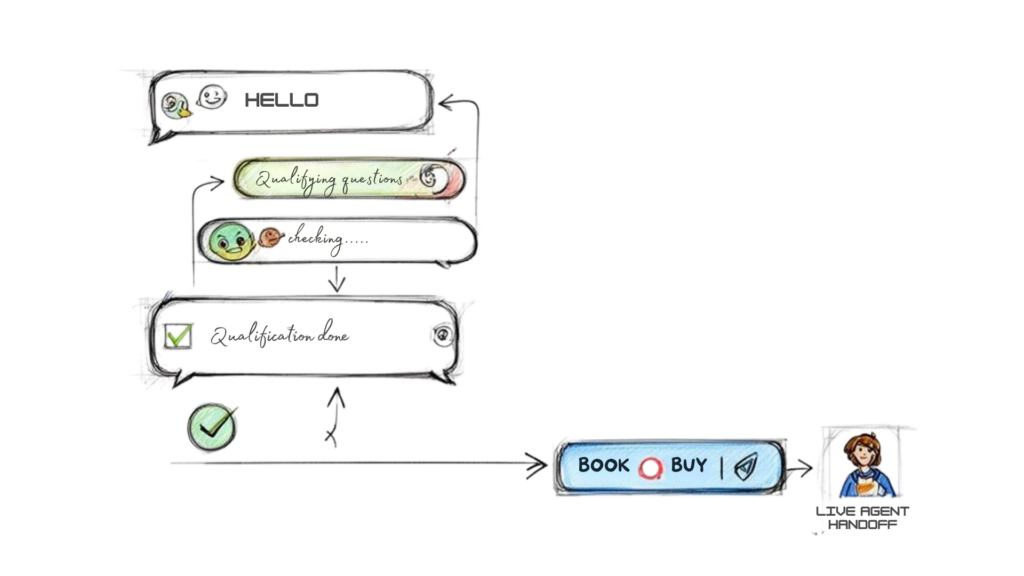
Conversational marketing flips your strategy from passive forms to active, real-time dialogues. This approach uses chatbots and live chat to engage visitors the moment they show interest, guiding them through their journey with personalized conversations. By meeting customers on channels they already use, like Messenger or Instagram DM, you create a more human experience that captures leads that might otherwise leave your site.
Conversational Marketing and Chatbots
This is one of the most effective CRO techniques because it shortens the sales cycle. Instead of making a prospect fill out a form and wait, a chatbot can qualify them, answer questions, and even schedule a demo instantly, 24/7. This immediate value directly addresses what the user wants and removes friction.
How to Implement Conversational Marketing Effectively
A great chatbot strategy starts with a clear goal. Focus on automating interactions that deliver immediate value to both the user and your business.
- Define a Clear Goal: Decide what you want your bot to do. Is it for generating leads, booking appointments, recovering abandoned carts, or customer support? A focused goal makes designing the conversation much easier.
- Design Natural Conversations: Map out your chatbot dialogues to feel like a real conversation, not a robotic survey. Use a friendly tone and offer clear choices. Explore best practices on how to design a chatbot conversation.
- Create an Escape Hatch: A bot can’t handle everything. Implement a seamless handoff so users can connect with a live agent when their problem is too complex or they ask for a person.
- Monitor and Improve: Regularly check your chatbot’s analytics to see where users get stuck or drop off. Use this data to refine your flows and improve responses, continuously optimizing for better conversion rates.
Practical Example: An e-commerce store can use a Messenger bot to proactively offer a discount to a user who just abandoned their cart. A marketing agency could use an Instagram DM bot to ask potential clients about their budget and goals before scheduling a call.
5. Retargeting and Audience Segmentation
Retargeting is a powerful technique that reconnects your brand with people who visited your site but didn’t convert. Instead of letting warm leads go cold, you serve them targeted ads, emails, or automated messages that remind them of your value and guide them back. By segmenting these audiences based on their behavior, you can deliver hyper-relevant content that speaks directly to their needs.
This strategy is highly effective because you’re talking to an audience that has already shown interest. It’s the digital equivalent of a helpful salesperson saying, “I noticed you were looking at this. Do you have any questions?” This personalized follow-up is a key component of modern conversion rate optimization techniques.
How to Implement Retargeting and Segmentation Effectively
A successful retargeting strategy delivers the right message to the right person at the right time. Start by identifying key user actions that signal intent, like abandoning a cart or viewing a pricing page.
- Create Dynamic Segments: Use tools like Clepher to automatically group users based on their actions. For example, create one segment for users who added a specific product to their cart but didn’t buy, and another for those who just read a blog post.
- Use Sequential Messaging: Don’t just show the same ad over and over. Guide users with a series of messages. Start with a simple reminder, follow up with a case study or benefit, and finish with an offer to drive a purchase.
- Limit Ad Frequency: Avoid annoying your audience. Cap the number of times a user sees your retargeting ads in a certain period. Bombarding people can create a negative impression.
- Combine with Urgency: Get better response rates by adding time-sensitive offers or scarcity to your retargeting. A “24-hour discount on your abandoned cart” is often more effective than a generic reminder.
Practical Example: An e-commerce store can use Clepher to send a Messenger broadcast to a segment of cart abandoners, offering a limited-time free shipping code. A SaaS company can retarget trial users who haven’t logged in recently with a short educational video to re-engage them.
6. Urgency and Scarcity Tactics
Urgency and scarcity are psychological triggers that compel users to act now. These CRO techniques work by creating a sense of limited availability, either in time (urgency) or quantity (scarcity). By highlighting that an offer is ending soon or a product might sell out, you tap into the fear of missing out (FOMO), which encourages immediate action.
When done right, these tactics don’t feel like pressure. They feel like helpful information that empowers a customer to make a timely decision. It’s the difference between a vague “Sale” banner and a specific “Sale ends in 24 hours” countdown timer.
How to Implement Urgency and Scarcity Effectively
The key to using urgency and scarcity is to be truthful. False scarcity can destroy brand trust, so make sure your claims are based on real inventory or genuine deadlines.
- Be Authentic and Specific: Don’t use fake countdown timers that reset. Instead, show real stock levels like “Only 3 left!” or use true deadlines for promotions, like early-bird pricing for a course launch.
- Combine with a Clear Value Proposition: Scarcity works best when the customer already sees high value in your offer. The urgency is just the final nudge to overcome hesitation, not the main reason to buy.
- Segment Your Reminders: Use marketing automation to send targeted reminders as a deadline approaches. This helps convert indecisive customers who may have forgotten about the offer.
- Provide a Clear Next Step: Make it incredibly easy for the user to act. Your urgent call-to-action should lead directly to a streamlined checkout or sign-up process.
Practical Example: An online course creator can offer a limited-time bonus for the first 50 students who enroll. Using Clepher, they could send automated Messenger broadcasts to their audience with a countdown timer, reminding them of the deadline and driving a surge of sign-ups.
7. Landing Page Optimization
Landing page optimization is one of the most powerful CRO techniques because it creates a distraction-free experience with a single goal. Unlike a homepage, a landing page is built specifically for a marketing campaign. Its only job is to persuade a visitor to take one action, like signing up for a trial, downloading an ebook, or making a purchase.
By removing navigation menus, sidebars, and other links, you create a laser-focused path for the user. This clarity leads to higher conversion rates because it removes decision fatigue and guides the visitor toward the action you want them to take.
How to Implement Landing Page Optimization Effectively
A great landing page is a seamless extension of the ad or link that brought the visitor there. Consistency in messaging and design is key to building trust.
- Match Your Message: The headline and offer on your landing page must directly match the ad copy the user clicked. A mismatch here is a major reason for high bounce rates.
- Write Benefit-Driven Headlines: Instead of listing features (“Our software has an AI scheduler”), focus on the outcome (“Schedule a month of social media posts in 10 minutes”). Your headline should answer the question: “What’s in it for me?”
- Simplify Your Forms: Only ask for essential information. For a newsletter sign-up, an email is enough. Each extra field you add can decrease your conversion rate.
- Include Social Proof: Add testimonials, customer logos, or case studies to build credibility and make visitors feel more comfortable.
- Optimize for Mobile: A huge chunk of your traffic will be on mobile. Make sure your page loads quickly and is easy to use on a small screen, with big, tappable buttons and readable text.
Practical Example: A brand running a Facebook ad for a specific sneaker should link to a landing page featuring only that sneaker, not the entire shoe category. A SaaS company could add a Clepher chatbot to its free trial landing page to answer last-minute questions and engage visitors in real-time.
8. Email and SMS Nurture Sequences
Nurture sequences are automated, multi-step campaigns sent via email or SMS that guide prospects through the buyer’s journey. Instead of single, disconnected messages, this technique delivers a series of valuable communications over time. By systematically building trust and educating leads, nurture sequences warm up cold prospects and significantly increase conversion rates.
This strategic approach ensures your brand stays top-of-mind. It’s the difference between asking for a sale right away and building a relationship that makes the sale a natural next step. This is a crucial part of any modern conversion rate optimization playbook.
How to Implement Nurture Sequences Effectively
A successful nurture sequence is built around a specific goal and tailored to a specific audience. Define what you want the user to do at the end, then work backward to create the steps to get them there.
- Segment Your Audience: Don’t send the same messages to everyone. Create different sequences for new subscribers, trial users, or people who abandoned a cart. This makes your content highly relevant.
- Provide Value Before You Ask: A common mistake is making every message a sales pitch. Your first few messages should offer value—like tips, educational content, or case studies—to build trust. Explore these effective sample sales letters for inspiration on crafting persuasive messaging.
- Use Behavioral Triggers: Make your sequences dynamic. Use a platform like Clepher to trigger messages based on user actions, like visiting a pricing page or engaging with a chatbot.
- Map the Journey: Start with a simple 3-5 step sequence. For example, a SaaS company could create a trial-to-paid sequence that highlights key features, shares a success story, and then presents a limited-time offer.
9. Social Proof and Trust Signals
Social proof is a powerful CRO technique that uses a simple psychological principle: people are more likely to do something if they see others doing it. It involves showing evidence that other people have chosen and valued your product. By displaying testimonials, reviews, and user counts, you reduce anxiety and build credibility.
This tactic changes a visitor’s internal question from “Can I trust this company?” to “Look at all these happy customers; maybe I’ll be happy too.” To see this in action, many businesses showcase customer testimonials to highlight positive experiences. Adding trust signals like security badges and guarantees reinforces this confidence, making users feel safe to convert.
How to Implement Social Proof and Trust Signals Effectively
Place evidence of customer satisfaction at key decision points, like on product pages, landing pages, and during checkout.
- Be Specific and Authentic: Vague praise like “Great product!” is less impactful than a detailed review. Encourage customers to share specific results, like “This software saved our team 10 hours per week.”
- Use Different Formats: Don’t just use written text. Use video testimonials, customer photos, star ratings, case studies, and logos from well-known clients to build trust.
- Show Real-Time Proof: Implement notifications like “25 people bought this in the last hour” or “Sarah from New York just signed up” to create a sense of popularity and urgency.
- Automate Your Requests: Use automated email or chatbot sequences to ask for reviews at the perfect time, like a week after a product is delivered or when a customer reaches a success milestone in your software.
Practical Example: A SaaS company can display logos of its well-known clients on its homepage to build instant authority. An online course creator could embed video testimonials from successful graduates on a sales page to show tangible proof of their program’s value.
10. Checkout and Friction Reduction
The checkout process is the final, most critical step—and it’s where most conversions are lost. Checkout optimization is a CRO technique focused on removing barriers and simplifying steps that cause users to abandon their carts. By creating a seamless path from cart to confirmation, you can capture significantly more revenue.
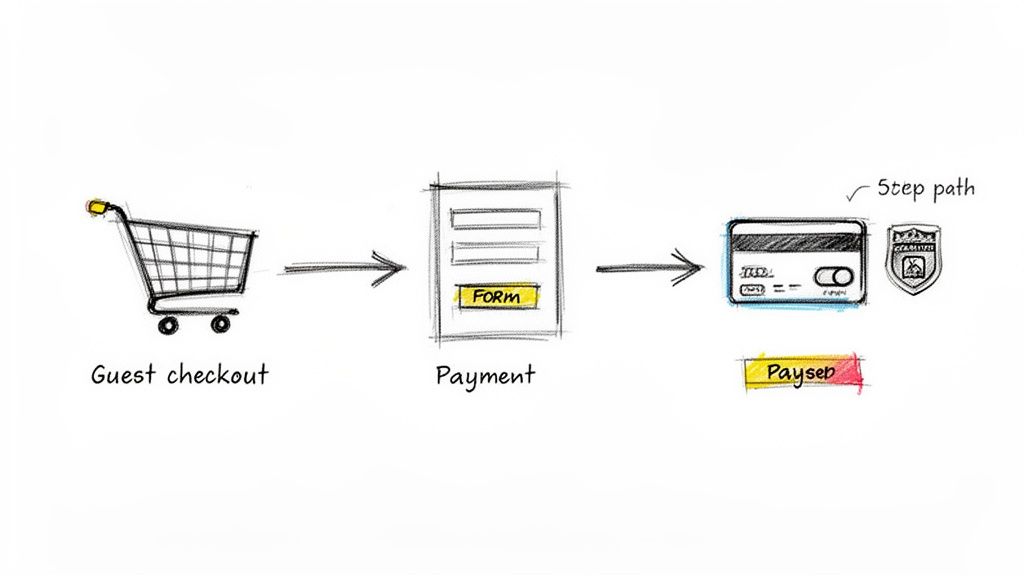
This is about more than just design; it addresses the core psychology of the buyer. It’s the difference between a user getting frustrated by a mandatory “create account” screen and a user completing their purchase in seconds with a guest checkout option. A frictionless checkout leads directly to more sales.
How to Implement Checkout and Friction Reduction
Map out your entire checkout journey from the customer’s perspective to find every potential point of friction. Then, work on removing those pain points.
- Offer Guest Checkout: The biggest friction point is often a forced account registration. Let users purchase as guests to capture immediate sales. You can always offer to create an account after the purchase is complete.
- Simplify Forms and Steps: Only ask for what’s absolutely necessary. Use tools like address auto-fill and show a clear progress bar to manage expectations. The goal is to make it feel as fast and easy as possible.
- Build Trust at the Payment Step: Display security badges (SSL, McAfee), accepted payment logos (Visa, PayPal), and money-back guarantees right on the payment page to reassure hesitant buyers.
- Automate Pre-Checkout Support: Use a Clepher chatbot to proactively answer common questions about shipping or returns directly on the checkout page, so users don’t have to leave to find information.
- Recover Abandoned Carts: Implement an automated sequence using email, SMS, or Messenger to re-engage users who abandon their carts. Check out these 7 ways to reduce shopping cart abandonment for more ideas.
Practical Example: An e-commerce store can reduce its checkout process from three pages to a single, streamlined page. A SaaS business could enable one-click upgrades for existing customers, removing the need to re-enter payment info.
Top 10 CRO Techniques Comparison
| Technique | Implementation Complexity 🔄 | Resource Requirements ⚡ | Expected Outcomes 📊 ⭐ | Ideal Use Cases 💡 | Key Advantages ⭐ |
|---|---|---|---|---|---|
| A/B Testing (Split Testing) | Medium — set up experiments, track stats | Moderate — testing tool, sufficient traffic, time | 📊 Measurable lift; incremental, statistically validated gains | High-traffic CTAs, checkout flows, email variants | Data-driven decisions; lowers risk of bad changes |
| Personalization and Dynamic Content | High — data integration, rules/AI models | High — customer data, engineering, privacy controls | 📊 Significant relevance uplift; higher conversion & AOV | Product recommendations, onboarding, targeted campaigns | Highly relevant UX; scalable individualized experiences |
| Lead Capture and Segmentation | Low–Medium — forms/widgets, segmentation rules | Low–Moderate — capture tools, CRM, list maintenance | 📊 Builds owned audience; improves retargeting and qualification | List growth, webinars, gated content, chat capture | Creates nurtureable audience; improves lead quality |
| Conversational Marketing and Chatbots | Medium — flow design, AI tuning, integrations | Moderate — platform, content, monitoring, training | 📊 Higher engagement; faster qualification and conversions | Real-time lead qualification, support, cart recovery | 24/7 real-time engagement; converts more than static CTAs |
| Retargeting and Audience Segmentation | Medium — pixel/list setup, audience syncing | Moderate–High — ad spend, audience size, platform tools | 📊 Better ROI on warm audiences; recovers lost conversions | Cart abandonment, content retargeting, funnel sequencing | Targets warm prospects; lowers cost per conversion |
| Urgency and Scarcity Tactics | Low — messaging, timers, inventory signals | Low — creative assets, scheduling, inventory tracking | 📊 Short-term conversion spikes; risk of fatigue if overused | Flash sales, limited stock offers, launch promotions | Rapid uplift when authentic; reduces procrastination |
| Landing Page Optimization | Medium — design, copy, testing | Moderate — design/dev resources, analytics, traffic | 📊 Higher conversion rates; improved ad relevance & tracking | Paid campaigns, product-specific pages, lead gen offers | Focused single-goal pages; easier to test and optimize |
| Email and SMS Nurture Sequences | Medium — sequence mapping, branching logic | Moderate — content creation, deliverability tools, lists | 📊 Sustained conversion uplift over time; improved LTV | Trial-to-paid flows, post-purchase education, re-engagement | Scalable relationship-building; cost-effective conversions |
| Social Proof and Trust Signals | Low — collect & display reviews, badges | Low–Moderate — review platforms, content curation | 📊 Reduces purchase anxiety; notable conversion lifts | Product pages, landing pages, checkout, chat dialogs | Increases credibility; persuasive via user validation |
| Checkout and Friction Reduction | Medium — UX changes, payment integrations | Moderate–High — dev work, payment/security compliance | 📊 Large lift in completed purchases; lower abandonment | E‑commerce checkouts, subscription upgrades, one-click buys | Directly reduces drop-offs; high ROI per improvement |
From Theory to Transformation: Your Next Step in CRO
You now have a blueprint of ten powerful conversion rate optimization techniques. We’ve gone beyond theory and looked at the practical application of A/B testing, personalization, conversational marketing, and social proof. Each strategy is a lever you can pull to not only boost your metrics but also create a smoother, more persuasive customer journey.
The common thread is a commitment to understanding your customer. CRO isn’t about tricks; it’s about systematically removing friction, answering questions, and delivering the right message at the right moment. Whether you’re streamlining your checkout or using urgency to drive action, the goal is always to serve the user better. This customer-centric approach is the foundation of sustainable growth.
Turning Insights into Actionable Growth
The most important takeaway is that CRO is not a one-time project but a continuous cycle. Trying to implement all ten techniques at once will lead to overwhelm. The real path to transformation is focused, strategic execution.
Here are your immediate next steps:
- Find Your Biggest Bottleneck: Where are you losing the most customers? Is it a specific landing page, during lead capture, or at the final payment step? Use your analytics to pinpoint your biggest opportunity.
- Form a Testable Hypothesis: Don’t just make random changes. Create a clear hypothesis. For example, “By adding customer testimonials below the ‘Add to Cart’ button, we can increase conversions by 5% because it will reduce purchase anxiety.”
- Choose the Right Technique: Based on your hypothesis, select one of the techniques from this guide. If your problem is engagement, try conversational marketing. If it’s a lack of trust, focus on social proof.
- Measure, Learn, and Repeat: Run your test, analyze the results, and document what you learned. Whether you were right or wrong, you gain valuable insight into your audience. Use that to inform your next test.
CRO Strategies
Calculate conversion rate by dividing conversions by visitors, so you know every conversion’s value and can compare the conversion rate across all industries or against the average ecommerce conversion rate. Use conversion optimization techniques and conversion rate optimization best practices: A/B testing, user testing, and using a tool like session recordings. Improve your conversion rate by optimizing copy, forms, and calls-to-action to increase your conversion and achieve a high conversion rate.
Optimization efforts should pair with search engine optimization and digital marketing to drive qualified traffic. Tools to identify friction, cro tips, and top conversion rate optimization tactics will help turn a low conversion rate into a measurable increase in conversion rates and a healthier open rate for email-driven campaigns.
Conclusion
In summary, applying conversion rate optimization techniques and conversion optimization best practices creates an approach to conversion that can significantly boost conversion rates and improve your site’s conversion rate. Use analytics tools and conversion rate optimization tools to analyze the conversion funnel, calculate your conversion rate, identify pain points on a landing page or product page, and run CRO tests as part of a continuous optimization process.
Combining optimization strategies — from improving user experience and offering free shipping to adding social proof and optimizing pricing page and newsletter flows — helps increase the percentage of visitors who take a desired action or make a purchase. Successful CRO relies on a structured conversion rate optimization process and optimization tools within a CRO program: prioritize key conversion goals, measure average conversion rate across pages, and iterate using analytics and CRO best practices.
Whether you manage ecommerce conversion or lead-generation campaigns, these conversion rate optimization strategies and marketing strategies will boost your conversion and increase conversion rates, helping you optimize your conversion, improve conversion rate optimization, and ultimately benefit from conversion rate optimization across your website’s conversion objectives.
Ready to automate your growth? Many of the advanced segmentation, personalization, and conversational marketing techniques discussed here can be implemented and scaled effortlessly with Clepher. Stop guessing and start converting by exploring how our platform can transform your customer interactions today at Clepher.

Related Posts
Unlock Growth with Conversational AI for Customer Support
March 26, 2026Your Ultimate Guide to Instagram Chat Bots
March 25, 2026How to Create a Killer Poll Game on Instagram to Boost Engagement and Leads
March 24, 2026
Founder Clepher