
Building an email list from scratch is one of the most powerful ways to create a direct, lasting connection with your audience. It’s a simple value exchange: you offer something useful, and in return, someone trusts you with their email address. By using a dedicated landing page, you can step outside the chaos of social media algorithms and start to grow your email list into a marketing asset you truly own.
This direct line to your audience isn’t just a nice-to-have—it’s the foundation for steady, predictable business growth and long-term control over your marketing efforts.
Why an Email List Is Your Unbeatable Marketing Asset
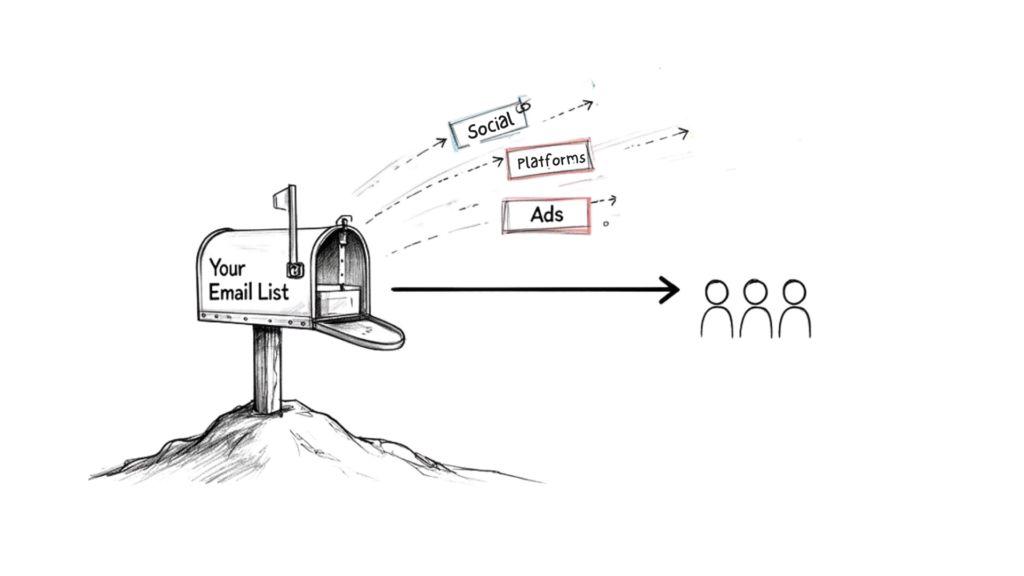
In a world where we’re all just renting space on platforms like Instagram and Facebook, your email list is the one piece of digital real estate you control completely. Think of social media as borrowing someone else’s microphone. At any moment, they can change the rules, shrink your reach, or just turn the mic off.
An email list? That’s your own private stage.
This direct access gives you incredible stability and a killer ROI. You can get a great overview of the email newsletter landscape to see how different platforms stack up, but the core principle remains the same: ownership is everything.
Email List Marketing
From Rented Audiences to Owned Assets
Every time a social platform tweaks its algorithm, businesses everywhere hold their breath. An email list shields you from that drama. It’s a stable, reliable channel where you can nurture leads and drive sales on your own terms.
Here’s how this transforms a business in the real world:
- For an E-commerce Brand: A small clothing boutique can announce a 24-hour flash sale directly to its most loyal shoppers’ inboxes. No fighting for attention in a crowded feed—just immediate revenue.
- For a SaaS Company: A software business can use an automated email sequence to guide new trial users through key features, answer common questions, and nudge them toward a paid plan. This automation turns sign-ups into customers.
- For a Coach or Creator: A business coach can share exclusive insights and build a genuine community, establishing the trust that makes selling high-ticket programs feel natural and easy.
In every case, the email list is more than a database of contacts. It’s a direct line for building relationships and hitting real business goals.
The Undeniable ROI of Email Marketing
The numbers don’t lie. Email has 400 million more users than all social media platforms combined. 81% of Gen Z checks it daily, and the total user count is expected to climb to nearly 4.8 billion by 2026.
But here’s the real kicker: the average reported ROI is a staggering 36:1. That means for every dollar you invest, you can expect a $36 return. You can discover more email marketing stats that drive this point home.
Your email list is the only marketing channel where you’re not just a participant; you’re the owner. It’s the difference between building your business on rented land versus solid ground.
Learning how to build an email list isn’t just about mastering another marketing tactic. It’s about investing in a foundational business asset that pays dividends for years to come.
Defining Your Audience and Crafting an Irresistible Offer
Trying to build an email list without knowing exactly who you’re talking to is like shouting into a void and hoping the right person hears you. A powerful list isn’t measured by its size; it’s measured by its relevance.
Before you think about pop-up forms or fancy automation, get laser-focused on your ideal subscriber.
Go Beyond Demographics to Understand Your Ideal Subscriber
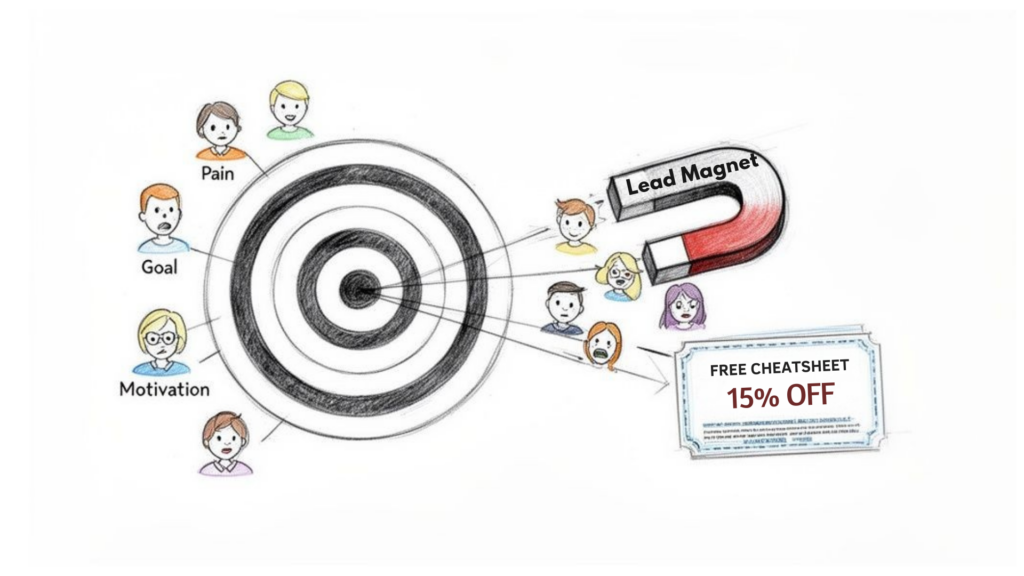
Forget basic demographics like age and location. To create something truly valuable, you need to go deeper into psychographics—the real human drivers behind every action. What keeps your ideal subscriber up at night? What are their biggest frustrations, and what does success look like for them?
Build Email List Lead Magnet
When you truly understand their core motivations, your list-building strategy shifts from a guessing game to a precision strike. You stop marketing at them and start creating solutions for them.
Here’s what that looks like in practice:
- E-commerce (Sustainable Home Goods): Your ideal subscriber isn’t just “women aged 25-40.” They’re eco-conscious parents who feel a pang of guilt every time they use a plastic bag. They value quality over quantity and are actively searching for beautiful, non-toxic alternatives for their families.
- SaaS (Project Management Tool): You’re not targeting a generic “project manager.” You’re targeting a stressed-out team lead overwhelmed by missed deadlines and chaotic Slack channels. What they truly crave is clarity and control.
This deep understanding is your secret weapon for creating an offer so compelling that handing over an email address feels like a no-brainer.
Creating a Lead Magnet They Can’t Refuse
That compelling offer is your lead magnet. It’s a specific, valuable piece of content you give away for free in exchange for an email address. The goal is to deliver an immediate win that directly solves one of those pain points you just uncovered.
To get the full picture, it helps to understand how to generate leads online.
The best lead magnets solve a small, specific problem instantly. Your new subscriber should be able to consume it and get value in minutes. This quick win creates a powerful and positive first impression of your brand.
Think about the sheer volume of noise out there. In 2024, an incredible 251,100,000 emails were sent every single minute worldwide. Your offer has to be exceptional to cut through that clutter.
Choosing the Right Lead Magnet for Your Business
The perfect lead magnet depends entirely on your business model and your audience’s goals. Generic offers get ignored, but specific solutions feel like a gift. Here’s a quick comparison of the most effective lead magnet types for different industries.
| Lead Magnet Type | Best For (Business Model) | Why It Works | Example |
|---|---|---|---|
| Discount/Coupon Code | E-commerce, Local Services | Addresses price sensitivity and drives an immediate sale. | “15% off your first order“ |
| Checklist/Cheatsheet | Coaching, Consulting, B2B | Provides a quick, actionable solution to a specific problem. | “The 5-Point Pre-Launch Website Checklist” |
| Free Trial/Demo | SaaS, Software, B2B Services | Removes risk and lets the user experience the value firsthand. | “14-Day Free Trial (No credit card required)” |
| Webinar/Workshop | High-Ticket Services, SaaS | Positions you as an expert and builds a deeper connection. | “Live Workshop: How to Double Your Leads in 30 Days” |
| Resource Library/Toolkit | Content Creators, Agencies | Offers immense, ongoing value and establishes authority. | “Access Our Free Library of Marketing Templates” |
| Quiz/Assessment | Any (especially E-comm/Health) | Engages users with personalized results and provides valuable data. | “What’s Your Marketing Blind Spot? Take the Quiz!” |
Ultimately, the goal is simple: create something that makes your ideal person think, “Wow, this was made just for me.” When you nail that feeling, you start building a targeted list of high-quality leads who are genuinely excited to hear from you.
Mastering Email Capture with Smart On-Site Tactics
You’ve created an irresistible offer—now it needs to be incredibly easy for visitors to say “yes.” This is where your on-site capture strategy plays a critical role in email list building, using the right message at the right moment without disrupting the user experience. With the help of modern email marketing software and an email marketing platform, you can present opportunities to sign up for your email list in a way that feels helpful rather than pushy.
Think of your website like a physical store. You wouldn’t have a salesperson shouting at customers the moment they walk in. Instead, you’d rely on clear signs and attentive staff who step in when someone shows interest. Your on-site email capture tactics should work the same way—subtle, supportive, and perfectly timed to guide visitors toward joining your email list.
The Classic Pop-Up, Reimagined
Pop-ups get a bad rap, but when used thoughtfully, they are one of the most effective list-building tools. The key is to ditch the obnoxious, full-screen pop-up that attacks visitors instantly. Modern pop-ups are smarter and far more respectful.
Consider these high-impact variations:
- Timed Pop-Ups: Set your form to appear only after someone has spent 30 or 60 seconds on a page. This targets people who are clearly engaged.
- Scroll-Triggered Pop-Ups: Trigger the pop-up when a user scrolls a certain percentage down the page. If they’ve made it that far, they probably find your content valuable.
- Two-Step Opt-Ins: Instead of an immediate form, start with a simple button (e.g., “Click Here for Your Free Guide”). This creates a micro-commitment, making users more likely to finish the action.
Subtlety and Persistence with Embedded Forms
While pop-ups grab attention, embedded forms are the quiet workhorses of email capture. These are sign-up boxes you place strategically within your website’s layout so they feel like a natural part of the content.
Weave them into high-traffic, high-intent areas:
- Within Blog Posts: After delivering value in an article, offer a related lead magnet. In a post about “10 Social Media Tips,” embed a form for a “Complete Social Media Content Calendar.”
- In the Footer: Every page should have a simple sign-up form in the footer. It’s a low-pressure, always-on opportunity for interested visitors to subscribe.
- On Your “About” Page: People on this page are trying to understand your brand. It’s a perfect spot to invite them to join your community.
Pro Tip: Don’t ask for too much information upfront. For most initial sign-ups, a name and email are all you need. Every extra field you add creates friction and can slash your opt-in rate by up to 11%.
Rescue Abandoning Visitors with Exit-Intent Overlays
What about visitors who are about to leave? Exit-intent technology is a game-changer. It tracks a user’s mouse movements and triggers an overlay the moment their cursor heads for the back button or browser tab.
This is your last chance to make an impression. Forget a generic “Join our newsletter.” Present your most compelling lead magnet or a special, limited-time discount. For an e-commerce store, a classic exit-intent offer is “Before you go, take 10% off your first order!” It’s a simple tactic that recovers otherwise lost sales and adds valuable subscribers.
Engage in Real Time with Conversational Chatbots
Perhaps the most engaging way to build an email list is with conversational AI. Tools like Clepher let you deploy smart chatbots that interact with visitors in real-time, turning a passive browsing session into an active conversation.
This is about creating context-aware assistants that guide users and capture leads in a helpful, natural way.
Imagine these scenarios:
- On a Pricing Page: A visitor is comparing plans. A chatbot pops up: “Have questions about which plan is right for you? I can send a detailed feature comparison guide straight to your inbox.” It then simply asks for their email.
- On a Product Page: A customer is looking at running shoes. The chatbot can offer, “Want to know when these go on sale? Drop your email here, and we’ll notify you first!”
- On the Homepage: A new visitor lands. The chatbot greets them with a quiz like “Find your perfect skincare routine,” capturing their email at the end to deliver personalized results.
By meeting people where they are with relevant offers, you transform email capture from a disruptive interruption into a value-add. This contextual approach boosts sign-up rates and builds a positive relationship from the very first interaction.
Connecting Your Tech Stack for Seamless Automation
Having killer on-site tactics is great, but ensuring every new subscriber smoothly enters your world requires a solid technical foundation. This is just about choosing two core tools—an Email Service Provider (ESP) and a capture tool—and getting them to talk to each other.
Get this right, and you’ll have an automated system that works for you 24/7, turning visitors into subscribers while you sleep.
Choosing the Right Email Service Provider
Your ESP is your home base for email marketing, so picking the right one is crucial. Don’t just grab the first one you see; think about your business goals. An e-commerce brand needs product recommendation features, while a coach might want advanced segmentation for different client groups.
Here are the non-negotiables to look for:
- Excellent Deliverability: What good is an email list if your messages land in spam? Look for ESPs with a proven track record of high deliverability rates—anything above 98% is the gold standard.
- Powerful Segmentation: You need to group subscribers based on their actions, interests, or how they signed up. This is how you send hyper-relevant content that gets opened.
- Intuitive Automation Builder: Creating a welcome sequence shouldn’t require a degree in engineering. A visual, drag-and-drop workflow builder makes setting up automations a breeze.
Using a Chatbot as Your Central Hub
While pop-ups and forms are great, a conversational AI chatbot can act as the central nervous system for your lead capture strategy. It’s more than a static form; it’s an interactive experience that can qualify, segment, and sync new leads in real-time.
The real magic happens when your chatbot connects directly to your ESP. This integration ensures that the moment someone provides their email in a chat, their data is instantly and accurately passed to your email platform. No manual work, no delays.
Email List Capture
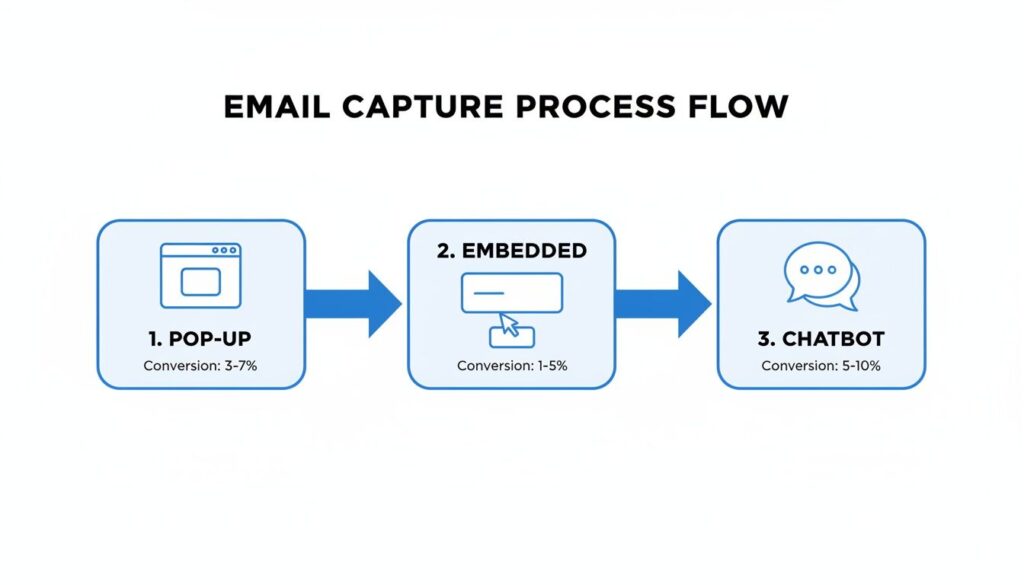
Whether a visitor engages with a pop-up, an embedded form, or a chatbot, the end goal is the same: seamless entry into your email list.
A Practical Integration Example
Let’s walk through a real-world scenario. Imagine you’re using a chatbot like Clepher for on-site engagement alongside Mailchimp as your ESP, and you’re offering a “Beginner’s Guide to Sourdough” on your baking blog built with a website builder.
When a visitor clicks “Send Me the Guide” in the chatbot, the conversation starts instantly. The bot confirms their interest and asks for an email address, turning a casual interaction into a qualified email sign-up. This moment—often called the email sign up step—is where interest becomes a real connection.
From there, automation takes over. Instead of manually exporting and importing contacts, the integration works quietly in the background, syncing new subscribers directly into your list. This seamless process not only simplifies email sign-ups, but also creates scalable ways to grow your email list without adding manual work or slowing down your workflow.
The moment the user provides their email, the Clepher-to-Mailchimp connection triggers multiple actions at once:
- Add Subscriber to a Specific Audience: The new contact is added to your “Sourdough Enthusiasts” audience in Mailchimp.
- Apply a Tag: The subscriber is automatically tagged with “LeadMagnet-SourdoughGuide” for precise segmentation.
- Trigger a Welcome Sequence: That tag triggers your automated welcome email, which immediately delivers the PDF guide.
This entire process is instant and error-free. You can learn more about how to specifically integrate Clepher with Mailchimp to create this exact kind of powerful, hands-off automation. By connecting your tools, you build an efficient machine that works for you.
Designing a Welcome Sequence That Builds Real Connection
Getting an email address isn’t the finish line—it’s the starting pistol. The work of turning a casual sign-up into a loyal fan happens in the moments that follow. A killer automated welcome sequence is your best shot at making a great first impression and building genuine trust from day one.
Think of it as the digital version of a firm handshake and a warm smile. This is where you move from a simple transaction to a real relationship.
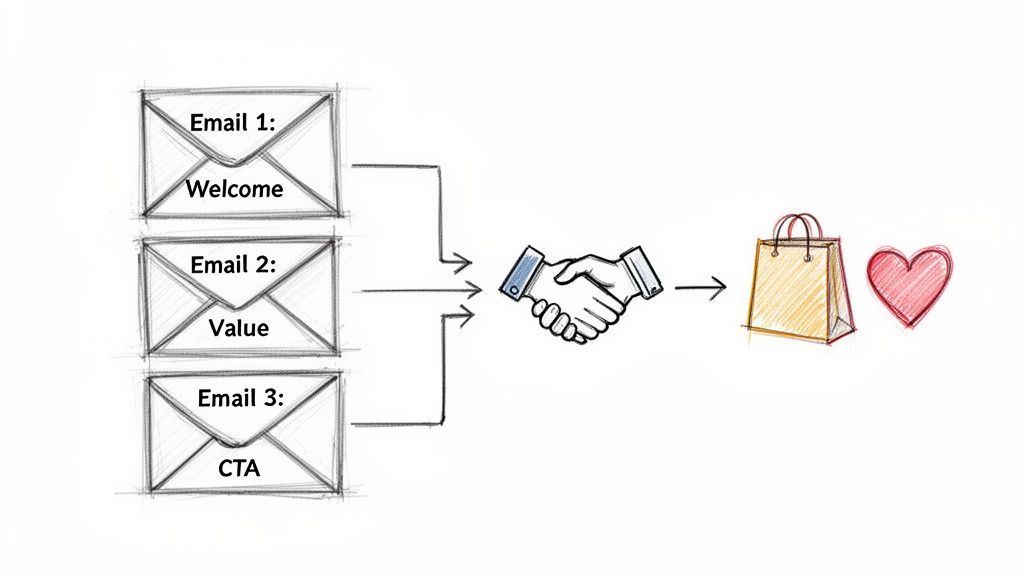
Email List Email Sequence
You Only Get One First Impression
Your welcome email is the most opened email you’ll ever send. Data consistently shows welcome emails hitting average open rates of over 80%—that’s more than four times higher than a typical promotional email. This is your moment. Your new subscriber is paying full attention.
Wasting this opportunity on a generic “Thanks for subscribing” email is a massive mistake. You need a strategic series of emails designed to welcome, deliver, and connect on a human level.
The Essential 3-Email Welcome Series
You don’t need a complex 20-step automation to see real results. For most businesses, a simple but effective three-email welcome series is the ideal place to start. It’s designed to deliver immediate value, build trust, and show new email subscribers exactly why they chose to join your list.
This approach makes building your list more sustainable by creating a strong first impression and encouraging long-term engagement. When done right, a welcome series helps you create an email list that isn’t just larger, but more responsive and ready to take the next step with your brand.
Here’s a simple template you can adapt for your business.
3-Day Welcome Email Sequence Template
This day-by-day plan shows you exactly what to send to make a solid first impression without overwhelming your new subscriber.
| Day | Email Purpose | Key Content Points | Call-to-Action (CTA) |
|---|---|---|---|
| Day 1 | Welcome & Delivery | Immediately send the lead magnet. Express genuine gratitude for them joining and briefly introduce your brand’s mission. | “Download Your Free Guide Here” or “Access Your Coupon Code.” |
| Day 2 | Value-Add & Story | Share your origin story or a customer success story. Offer an extra piece of high-value content, like a related blog post or a quick tip. | “Read the full story here” or “Check out this helpful resource.” |
| Day 3 | Gentle Nudge | Connect their initial interest (the lead magnet) to a core product or service you offer. Frame it as the natural next step, not a hard sell. | “Explore our best-selling products” or “Book a free discovery call.” |
This simple flow respects your new subscriber’s inbox while actively pulling them deeper into your world.
Beyond the Welcome: Building a Nurture Funnel
Once you’ve nailed the welcome sequence, you can zoom out to think about the bigger picture: a full nurture funnel. This is where you evolve from a one-off welcome into an ongoing, personalized conversation. The secret sauce here is segmentation.
Segmentation is just a fancy word for dividing your list into smaller, more relevant groups. It lets you send the right message to the right person at the right time. Instead of blasting everyone with the same generic offer, you tailor your communication based on what you know about them.
An engaged list of 100 people who love what you do is infinitely more valuable than a list of 10,000 who barely remember signing up. Segmentation is how you build that small, mighty, and highly engaged audience.
For an e-commerce store, segmentation might look like this:
- Purchase History: Send special offers to repeat buyers or re-engagement campaigns to customers who haven’t bought in a while.
- Browsing Behavior: If someone viewed your running shoes but didn’t buy, you can follow up with an email about that specific category.
- Lead Magnet: Subscribers who downloaded a “Beginner’s Guide to Keto” should get different content than those who grabbed an “Advanced Keto Recipes” cheatsheet.
This is the foundation of a smart drip campaign—an automated series of emails triggered by specific subscriber actions. To go deeper on this, check out this guide that gives a complete drip campaign definition and practical examples.
By combining segmentation with triggered campaigns, you make every email feel relevant and personal, dramatically boosting engagement and sales over time.
How to Optimize and Scale Your List Building Efforts
A healthy email list is a living thing. It needs constant attention to grow and thrive. Once your capture forms are live and your welcome emails are firing, the real work begins: optimization. It’s time to turn your good results into great ones.
This isn’t about chasing vanity metrics. It’s about creating a powerful feedback loop where you use real data to sharpen your strategy, attracting higher-quality subscribers more efficiently as you go.
The Power of A/B Testing Your Capture Strategy
Guesswork is the enemy of growth. The only way to know what truly clicks with your audience is to test it. A/B testing, or split testing, means creating two versions of a single element to see which one performs better.
You’d be surprised how small tweaks can lead to huge lifts in your opt-in rates. For an e-commerce brand, this might mean testing the discount on an exit-intent pop-up. Does “15% off” convert better than “Free Shipping“? You’ll never know for sure until you test.
Here are a few high-impact elements to test right away:
- Headlines: Pit a benefit-driven headline (“Get Flawless Skin”) against a curiosity-driven one (“The Skincare Mistake You’re Making”).
- Call-to-Action (CTA) Button: Experiment with the button text (“Get the Guide” vs. “Send My Guide”) and even the color.
- Form Fields: Does asking for just an email perform better than asking for a name and email? Test it.
- Chatbot Openers: Test your chatbot’s first greeting. “Hi there! How can I help?” might be less effective than a proactive, page-specific offer.
The goal isn’t to find one “perfect” version that works forever. It’s about building a habit of continuous improvement that keeps your list-building engine sharp and effective.
Key Metrics That Tell the Real Story
To optimize well, you need to track the right numbers. Focus on the metrics that directly reflect the health of your list-building machine.
Two of the most important metrics are:
- Opt-in Rate: The percentage of visitors who see your sign-up form and actually subscribe. A low rate could mean your offer isn’t compelling enough or your form is hard to find.
- Conversion Rate: This tracks how many new subscribers take the next step you want them to, like making a purchase after your welcome series. This metric tells you about the quality of the subscribers you’re attracting.
Tracking these numbers helps you diagnose problems. A high opt-in rate but a low conversion rate suggests you’re attracting the wrong audience. A low opt-in rate but a high conversion rate means your offer is great, but you need to get it in front of more people. This data-driven approach is also fundamental to learning how to increase email open rates later on.
Advanced Tactics for Accelerated Growth
Once you have a solid, optimized foundation, it’s time to pour fuel on the fire. These strategies are all about tapping into new audiences and scaling your efforts.
- Content Upgrades: Go back to your most popular blog posts and create a specific, high-value bonus resource for each. A hyper-relevant offer like this often converts far better than a generic, site-wide lead magnet.
- Viral Giveaways & Contests: Run a contest where people get extra entries for referring friends. This creates a viral loop, turning your existing audience into an engine for new subscribers.
- Strategic Partnerships: Team up with a brand that serves a similar audience but isn’t a direct competitor. Co-host a webinar or create a joint resource to promote to both of your lists for valuable cross-pollination.
Got Questions? Let’s Clear a Few Things Up
Even the best email list strategy comes with questions. When you’re in the trenches, a few common hurdles always seem to pop up. Here’s how to handle them.
Ready to stop chasing leads and start converting them with smart, automated conversations? Clepher gives you the AI chatbot tools you need to capture visitors on your site, segment them on the fly, and grow your list without the grind. Start building your email list on autopilot today.
Related Posts
Website Facebook Messenger: Setup & AI for Sales in 2026
April 1, 2026How an API Chat Bot Transforms Your Business (And How to Build One)
March 31, 2026
Founder Clepher