
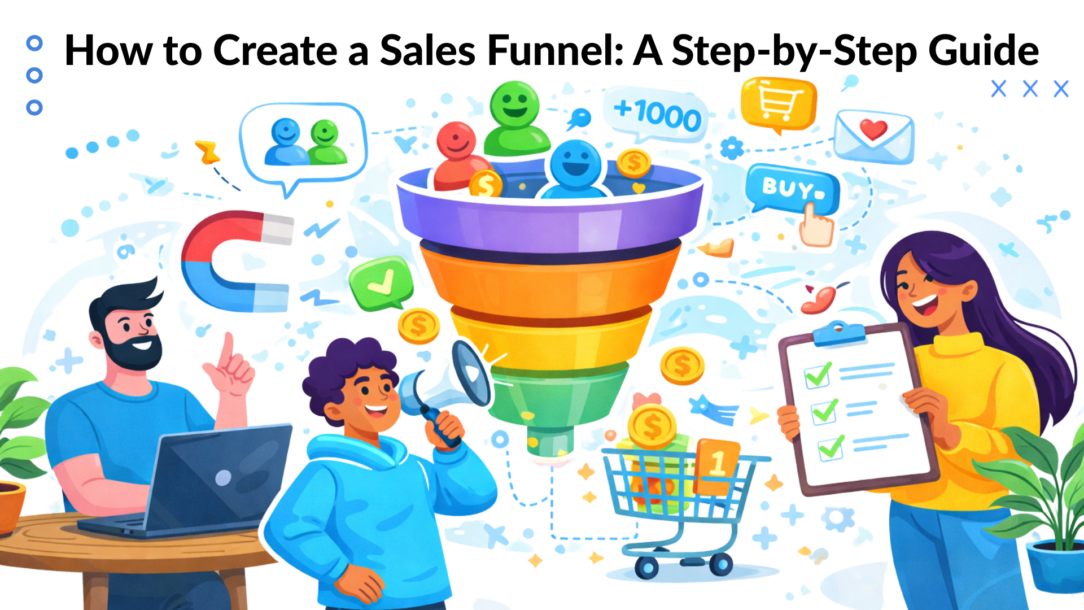
Building a sales funnel isn’t just another marketing task; it’s a predictable system for turning strangers into loyal customers. It’s the engine that stops you from guessing with your marketing budget and starts generating consistent, measurable revenue. The goal is to map the customer journey—Awareness, Consideration, Conversion, and Loyalty—and guide people from one stage to the next.
Why a Sales Funnel Is Your Most Powerful Growth Tool
Ever feel like your marketing is all over the place? You’re running social ads, publishing blog posts, and sending newsletters, but it all feels disconnected. You get some clicks and maybe a few sales, but you can’t pinpoint why one month was a success and the next was a flop. This is the exact chaos a well-designed sales funnel eliminates.
A sales funnel is more than jargon; it’s a strategic roadmap for acquiring and keeping customers. It creates a clear path that someone follows from their first interaction with your brand to the moment they become a repeat buyer. You replace random luck with a predictable, repeatable system for growth.
The Predictable Path from Stranger to Customer
Every business has a sales funnel, whether they’ve designed it or not. The magic happens when you stop leaving it to chance and start building it with intention. When you do that, your funnel becomes a reliable engine, turning casual interest into real revenue.
It all breaks down into four core stages:
- Awareness: This is the first impression. Someone with a problem you can solve discovers your brand. It might be through a social media post, a targeted ad, or a Google search. They aren’t ready to buy yet—they’re just learning you exist.
- Consideration: Now that they know who you are, they’re figuring out if you’re the right choice. This is when they might download your free guide, watch a webinar, or read case studies. You’re building trust and proving your expertise.
- Conversion: This is the moment of truth. Your prospect is ready to make a decision. Your job is to make it incredibly easy for them to buy, start a trial, or book a call. A clear call-to-action and a seamless checkout process are non-negotiable.
- Loyalty: The sale isn’t the end of the journey. This final, often-overlooked stage is about turning a first-time buyer into a brand advocate. Great customer service, thoughtful follow-ups, and exclusive offers encourage repeat business and priceless word-of-mouth referrals.
From Leaky Bucket to Revenue Engine
Without a defined funnel, businesses constantly lose potential customers. It’s like trying to fill a bucket full of holes. Research shows that a staggering 68% of companies haven’t identified or measured a sales funnel. While the average conversion rate sits around 2.35%, businesses that actively optimize their funnel see deal sizes 102% higher and achieve revenue growth that’s 18 times greater. You can dig deeper into these impactful sales funnel statistics to see the difference this makes.
A sales funnel transforms your marketing from random activities into a cohesive, intelligent system. It gives you the clarity to see where people are dropping off, so you can fix the leaks and maximize your results.
Charting the Course: From First Look to Loyal Customer
Now for the fun part: mapping the path your customers will take. This isn’t just about theory; it’s about deliberately crafting every touchpoint that guides a stranger from “just browsing” to becoming a happy customer. We need to create a smooth, intentional journey.
Think of it like a river—wide at the top and narrowing as it flows. Your job is to keep as much water in the river as possible until it reaches its destination.
This visual drives home the reality of drop-off at each stage. It’s exactly why fine-tuning every step isn’t just a good idea—it’s critical to your success.
Igniting Awareness and Grabbing Attention
The top of the funnel (TOFU) is all about getting on the right people’s radar. You have to cut through the noise and give them a reason to stop and look. This isn’t about casting a wide net; it’s about surgical precision.
A great way to do this is with targeted social media ads. But don’t just run a generic “buy my stuff” ad. For example, if you sell sustainable yoga mats, target ads to people interested in yoga, wellness, and eco-friendly living. The ad’s goal is simple: get them to click to a product page or a blog post on the “Top 5 Benefits of a Cork Yoga Mat.”
The moment they land on your site, you have seconds to connect. This is where a conversational chat widget can be a game-changer. Imagine a small pop-up: “Hey there! Looking for the perfect mat? I can help you find your match.” This simple greeting turns passive browsing into an active conversation, keeping them engaged.
Building Trust During Consideration
You’ve got their attention. Now the real work begins. The middle of the funnel is where you build a relationship and prove you’re worth their trust. The best way to do this is by offering something valuable in exchange for their contact info. This is your lead magnet.
An effective lead magnet solves a specific problem, turning a casual visitor into a qualified lead.
- For a Fitness Coach: Offer a free PDF: “5 Stretches to Relieve Back Pain in Under 10 Minutes.”
- For an E-commerce Store: An instant 15% discount code delivered via Messenger for a first-time purchase is hard to resist.
- For a SaaS Company: Give access to an exclusive webinar that teaches a valuable skill related to your software.
The key is instant delivery. When someone opts in, an automated flow in Messenger or Instagram should immediately send the promised goods. This immediate reward creates a fantastic first impression and opens a direct line of communication. From here, you can use tags to automatically segment new subscribers, paving the way for hyper-relevant follow-ups.
By segmenting your audience from the first interaction, you stop shouting into a crowd. Instead, you can send tailored messages to smaller groups, speaking to their specific problems. This skyrockets relevance and engagement.
Designing a Frictionless Conversion
This is it—the moment a lead becomes a customer. Your only job is to get out of their way. A clunky, multi-page checkout process is the ultimate conversion killer. Strip it down to the absolute essentials.
Even with a perfect checkout, last-minute questions can cause hesitation. An AI-powered chatbot can be your MVP here, trained to answer common questions about shipping, returns, or sizing right in the chat window. They get answers without leaving the page, and you save the sale.
What if they leave anyway? An abandoned cart isn’t a failure; it’s an opportunity. Automated reminders sent via Messenger or email an hour later can be incredibly effective. A simple, “Hey, did you forget something? Your items are waiting!” with a direct link back to their cart can recover a huge chunk of lost revenue.
Across 14 different industries, the average funnel conversion rate is a sobering 2.9%. It’s not uncommon for 10,000 visitors to become just one customer. This highlights the monumental impact of optimizing every single step. Want to see how you stack up? Check out these industry conversion benchmarks to get a better picture.
Bringing Your Funnel to Life with Automation
You’ve mapped the customer journey. Now it’s time to turn that strategy into an automated machine that works for you 24/7. This is where we move from theory to action, building your first conversational funnel using a simple, no-code platform.
Don’t feel you need to build a massive, intricate system from the start. The best approach is to build a simple, effective flow that engages visitors and captures their info. Launch fast, gather real data, and then build on that momentum.
Most modern tools use a visual, drag-and-drop builder, making the process intuitive. You can see the conversation take shape as you connect the different steps.
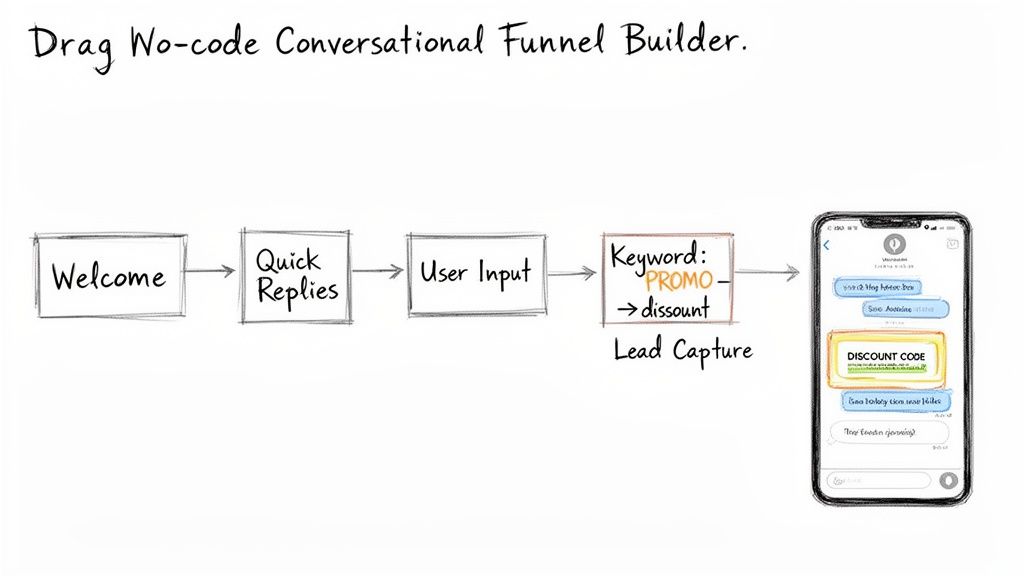
Conversational Funnel
Each block represents a part of the chat, giving you a bird’s-eye view of how a user will experience the funnel from start to finish.
Nailing the First Impression
In a chat, the first message is everything. Think of it as your digital welcome mat. It has to be clear, engaging, and set the right tone. It’s your one shot to make a good impression.
Start with a direct, friendly message that acknowledges why they’re there. If they clicked an ad for a 15% discount, your opening line should immediately confirm they’re in the right place. From there, lean on quick-reply buttons. These are pre-set responses users can tap, guiding them forward without making them type.
Here’s a simple, real-world example for an e-commerce store:
- Welcome Message: “Hey! Thanks for stopping by. Ready to grab your 15% off discount code? Just tap the button below!”
- Quick-Reply Button: [Get My Code]
This simple two-part exchange feels effortless and smoothly moves the person to the next step.
Capturing Leads Without Being Pushy
You’ve hooked them. Now it’s time for the exchange where a visitor becomes a lead. The trick is to make this feel like a natural part of the conversation, not a sudden interrogation.
Forget clunky forms. Instead, use user input fields that ask for one piece of information at a time. It’s a far less intimidating way to get details and dramatically improves completion rates.
Pro Tip: Always give a reason for asking. A little transparency goes a long way. Something as simple as, “Where should I send the discount code?” makes the request for an email feel logical and helpful, not greedy.
So, after a user taps “Get My Code,” your bot could follow up with: “Awesome! Just pop your best email in below, and I’ll send it right over.” It feels guided and helpful, not demanding.
Putting Your Funnel on Autopilot with Keyword Triggers
Here’s where your conversational funnel gets really smart. By using AI keyword triggers, you can set up your system to listen for specific words or phrases and launch an automated flow in response.
This creates a dynamic, on-demand experience that feels incredibly responsive. It’s like having a sales assistant who is always on, ready to help.
Here are a few actionable examples:
- For E-commerce: Set a trigger for keywords like “PROMO” or “DISCOUNT.” When someone messages your page with one of those words, the bot instantly replies with the latest offer and a link to shop.
- For Service Businesses: An agency could use triggers for “PRICING” or “SERVICES.” The bot could then ask a couple of qualifying questions (e.g., “What’s your monthly ad budget?”) to segment the lead before it ever lands on a sales rep’s desk.
- For Basic Support: Keywords like “SHIPPING” or “RETURN” can trigger a flow that provides tracking info or explains the return policy, freeing up your human support team for complex issues.
By anticipating user needs, you can build a funnel that doesn’t just capture leads but actively serves your audience around the clock.
Plugging Your Funnel into Your Marketing Machine
Your conversational funnel is a fantastic lead capture engine, but its real power is unlocked when it talks to the rest of your marketing tools. If it stands alone, your data is stuck in a silo, forcing you to manually export contacts and lose valuable momentum.
To build a system that saves you time and works seamlessly, your funnel needs to communicate with everything else. This turns a simple tool into the central nervous system for your marketing.
Why a Connected Stack Matters
Let’s walk through a real-world scenario. A potential customer slides into your Instagram DMs, gets a discount code, and provides their email. They get tagged as a “Hot Lead.” Without integration, that lead’s info just sits there.
Now, picture that same scenario with integrations. The instant they give you their email, a chain reaction kicks off:
- Your CRM gets the signal: A new contact is created in a platform like HubSpot, complete with their name, email, and the “Hot Lead” tag.
- Your email platform gets the handoff: The contact is automatically added to a “New Subscriber” list in Klaviyo or Mailchimp, triggering a welcome email sequence.
- Your SMS platform gets the text: If you collected a phone number, an SMS campaign could send a follow-up text a day later.
This creates a powerful, multi-channel experience where every part of your marketing machine has the context it needs to deliver the right message at the right time.
How to Connect Your Tools
You don’t need a team of developers to make this happen. Most modern marketing platforms, including conversational tools like Clepher, give you two main ways to sync your data: native integrations and third-party connectors.
Native integrations are pre-built bridges between two specific apps. These are the easiest to set up, usually requiring just a few clicks to authorize the connection.
Third-party connectors like Zapier, Make, or Pabbly act as universal translators between thousands of applications. If a direct native integration doesn’t exist, these platforms have your back.
You simply set up a “Zap” or “Scenario” that follows a simple rule: “When this happens in my conversational funnel, then do that in another app.” The possibilities for automation are practically endless.
Practical Integration Workflows You Can Build Today
Let’s move from theory to action. Here are real-world examples of how integrating your funnel can level up your marketing.
One of the most effective workflows is syncing conversational leads directly to your email marketing platform.
- The Trigger: A user goes through your lead magnet flow in Messenger and provides their email to get a free guide.
- Action 1 (in Clepher): The system automatically tags that user as “Downloaded Ebook – Fitness.”
- Action 2 (The Integration): That contact info, along with the tag, is instantly sent to your email service provider.
- The Result: The user is added to a specific email list and immediately gets a tailored welcome sequence that references the fitness ebook they just downloaded, making the follow-up feel incredibly personal and relevant.
This simple setup ensures your email marketing isn’t generic. You can send targeted campaigns based on the specific actions people take inside your funnel, turning new leads into loyal customers.
Using Data to Optimize and Improve Funnel Performance
Launching your sales funnel is the starting line, not the finish line. The real growth comes from paying obsessive attention to what the data is telling you.
A funnel isn’t a “set it and forget it” tool; it’s a living system that needs continuous fine-tuning. Think of yourself as a detective. Your goal is to spot the leaks: Where are people dropping off? What messages are falling flat? By tracking the right numbers, you can make small, data-backed adjustments that create a massive impact.
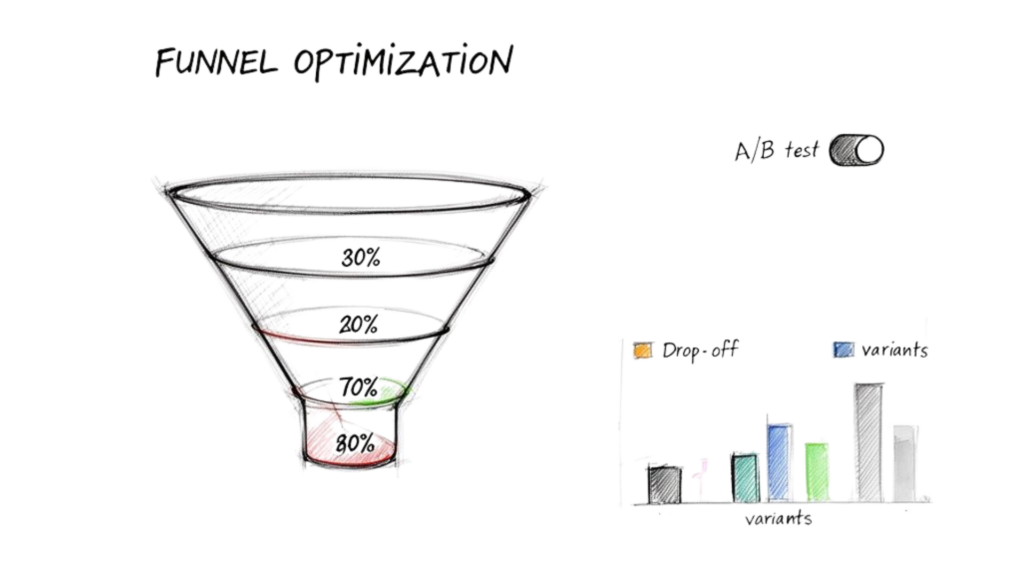
Funnel Optimization
Key Metrics to Watch at Every Stage
To improve your funnel, you have to measure it accurately. Different metrics matter at different stages, giving you a clear report card on your funnel’s health.
- Top of Funnel (Awareness): At this stage, it’s all about attracting eyeballs. The most important metric is your Visitor-to-Lead Rate. Out of all the people who see your ad, how many start a conversation? A low rate could mean your ad creative or offer isn’t compelling enough.
- Middle of Funnel (Consideration): Once a visitor becomes a lead, the game shifts to engagement. Here, track the Lead-to-MQL (Marketing Qualified Lead) Rate. An MQL is someone who has taken an action—like downloading a guide—that shows genuine interest. If this number is weak, your flow might not be building enough trust.
- Bottom of Funnel (Conversion): This is where the money is made. The critical metric is your Close Rate. Of all the qualified leads you generate, what percentage become paying customers? A poor close rate often points to issues with your sales process, pricing, or final call-to-action.
Understanding these drop-offs is vital. For B2B businesses, the average overall conversion rate is a sobering 2-5%. The visitor-to-lead rate is often around 2%, while the lead-to-MQL rate sits at 31%, and the final close rate is between 22-30%. These numbers highlight how crucial it is to plug every leak. Discover more about B2B conversion benchmarks to get the full picture.
Key Funnel Stages and Optimization Tactics
| Funnel Stage | Primary Goal | Key Metric (KPI) | Optimization Tactic |
|---|---|---|---|
| Awareness | Capture Attention & Generate Leads | Visitor-to-Lead Rate | A/B test your ad copy and the initial hook in your chat widget. |
| Consideration | Nurture & Qualify Leads | Lead-to-MQL Rate | Refine your conversational flow to answer common questions and build trust. |
| Conversion | Close the Sale | Close Rate | Test different CTAs (e.g., “Buy Now” vs. “Get Started”) and pricing presentations. |
| Retention | Build Loyalty & Drive Repeat Business | Customer Lifetime Value (CLV) | Use tags in Clepher to segment customers and send targeted follow-up offers. |
This table serves as a great starting point for connecting a specific goal to a real, measurable action.
The Power of A/B Testing Your Conversational Funnel
Once you know your numbers, you can start improving them with A/B testing. This is simply the process of comparing two versions of something—a headline, a button, a message—to see which one performs better. In a conversational funnel, you have endless opportunities to test and refine.
A/B testing removes guesswork from your marketing. It allows your audience to tell you—through their actions—what they actually prefer. It’s the most direct feedback you can possibly get.
The key is to change just one variable at a time. That way, you can be confident about what caused the change in performance.
Practical A/B Tests You Can Run Today
You don’t need to be a data scientist to get started. Here are a few simple but powerful A/B tests you can set up in a platform like Clepher.
- Test Your Welcome Message: The first few words are crucial. Try testing a direct, benefit-driven message (“Get your 15% discount code now!”) against a more engaging, question-based one (“Ready to find the perfect gift?”).
- Experiment with Your Call-to-Action (CTA): The language you use to prompt action matters. Compare a “soft” CTA like “Learn More” against a more urgent CTA like “Get Instant Access.” This small tweak can have a huge effect.
- Vary Your Conversational Path: For a more advanced test, send 50% of new leads down a short, direct path to the sale and the other 50% down a longer, more educational path. This will tell you if your audience prefers a quick transaction or more relationship-building.
By consistently measuring your metrics and running targeted A/B tests, you transform your sales funnel from a static flowchart into an intelligent system that gets more profitable over time.
Got Questions About Building Your Sales Funnel?
Even with a great guide, you’re bound to have questions when building your first sales funnel. Let’s tackle some of the most common ones to save you headaches down the road.
Conclusion
Creating a sales funnel is a strategic process: define your target audience, craft compelling offers, map the customer journey, optimize conversion points, and measure results to iterate. Focus on clarity at each stage—awareness, interest, decision, action—and align content, lead magnets, landing pages, email sequences, and retargeting to guide prospects smoothly toward purchase. Test headlines, calls-to-action, forms, pricing, and follow-up workflows; use analytics to reduce friction, improve conversion rate, and increase lifetime value. Maintain consistency between messaging and product delivery, nurture leads with relevant content, and scale what works while pruning what doesn’t. Emphasize tracking (KPIs, A/B tests, funnel visualization), automation (CRM, email automation, chatbots), and continuous optimization to grow revenue and retention.
Ready to stop guessing and start building a high-converting conversational sales funnel? With Clepher, you can use a simple drag-and-drop builder to launch your first automated flow in minutes, not months. Turn your social media visitors into leads and customers 24/7.
Start building your automated sales funnel for free with Clepher today.
Related Posts
Website Facebook Messenger: Setup & AI for Sales in 2026
April 1, 2026How an API Chat Bot Transforms Your Business (And How to Build One)
March 31, 2026
Founder Clepher