
Improving your click-through rate comes down to three things: sharpening your audience targeting, crafting copy and visuals that grab attention, and writing calls-to-action that are impossible to ignore. Master these, and you’ll build a powerful bridge between what your audience sees and what they do next.
Why Click Through Rate Is Your Most Important Metric
Your Click-Through Rate (CTR) is more than just a number on a dashboard; it’s the pulse of your digital strategy. A low CTR isn’t a dead end—it’s a clear signal pointing you toward a huge growth opportunity. It shows a disconnect between your message and your audience, and fixing it is one of the highest-impact moves you can make.
Think of it like this: impressions are the people walking past your storefront. Your CTR is the percentage of those people who stop, look at your window display, and actually step inside. A low CTR means your display isn’t working, even if thousands of people are walking by.
The True Impact of a High CTR
A strong click-through rate creates a positive ripple effect across your entire marketing funnel. It’s not just about getting more traffic; it’s about attracting the right traffic—people genuinely interested in what you offer. This directly improves other critical metrics.
- Better Quality Scores: Platforms like Google Ads reward high CTRs with better Quality Scores. This translates directly to lower ad costs and better ad placements, giving you a competitive edge without a bigger budget.
- Increased Organic Rankings: While not a direct ranking factor, a high organic CTR tells search engines your result is a great match for a user’s query. Over time, this can help boost your search rankings, creating a powerful feedback loop.
- Higher Conversion Potential: Someone who clicks your link is actively showing interest. This pre-qualified audience is far more likely to take the next step, whether that’s signing up, downloading a resource, or making a purchase.
In short, a higher CTR means you’re attracting more engaged prospects for the same effort or ad spend. It’s the ultimate measure of how well your message is landing, transforming passive scrollers into active participants.
This guide skips the theory and dives straight into actionable strategies you can use today. We’ll show you exactly how to improve click-through rates by diagnosing the real problems and applying proven tactics across every channel, from search ads to email newsletters.
Finding the Real Reason Your CTR Is Low
Before you change a single headline, you need to play detective. A low click-through rate is a symptom, not the disease. If you just treat the symptom—say, by frantically testing new creative—you’re just painting over a crack in the foundation. It might look fixed for a minute, but the real problem remains.
To find the root cause, you have to look beyond the CTR metric itself. The clues are almost always in your campaign data; you just need to know what to look for.
Is It an Audience Mismatch?
More often than not, a low CTR comes down to a simple audience mismatch. Your ad might be brilliant, but if you’re showing it to the wrong people, it’s going to fail. It’s like setting up a booth for premium ribeye steaks at a vegan festival—great product, wrong crowd.
Here’s how to diagnose it:
- Who is actually seeing your ad? Dive into your analytics. In Meta Ads, for example, check your audience demographics, interests, and placements. Do they align with your ideal customer profile? For instance, if you sell high-end skincare for women over 40 but your ads are being shown mostly to men aged 18-24, you’ve found your problem.
- Is your targeting too narrow? On the other hand, being too specific can suffocate your campaign. If your audience is too small, the same people see your ad repeatedly, leading to the next big problem.
Have You Hit Message Fatigue?
Even the best ad has an expiration date. Message fatigue happens when your audience has seen your ad so many times they’ve become numb to it. It’s no longer a scroll-stopper; it’s just background noise.
The classic sign is a campaign that started strong but has seen its CTR steadily decline. Your ad frequency metric is your best friend here. A high frequency means the same people are seeing your ad again and again.
A high ad frequency paired with a falling CTR is the textbook sign of message fatigue. Your audience is telling you, “We’ve seen it, we’ve heard it, and we’re not interested anymore.” It’s time for a creative refresh.
Does Your Offer Align with Your Ad?
Finally, there’s offer misalignment. This happens when the promise in your ad doesn’t match the reality of your landing page. If someone clicks an ad promising “50% Off All Shoes” but lands on a page with a tiny “Up to 10% Off Select Styles” banner, that disconnect creates instant distrust. It also signals to ad platforms that you’re providing a poor user experience.
Look at metrics beyond CTR. A high CTR combined with an unusually high bounce rate is a massive red flag. It means your ad was compelling enough to earn the click, but the landing page immediately broke the promise. To get a handle on what users do after the click, our guide on how to track website visitors is a great resource.
This decision tree helps visualize the diagnostic process, taking you from problem to solution.
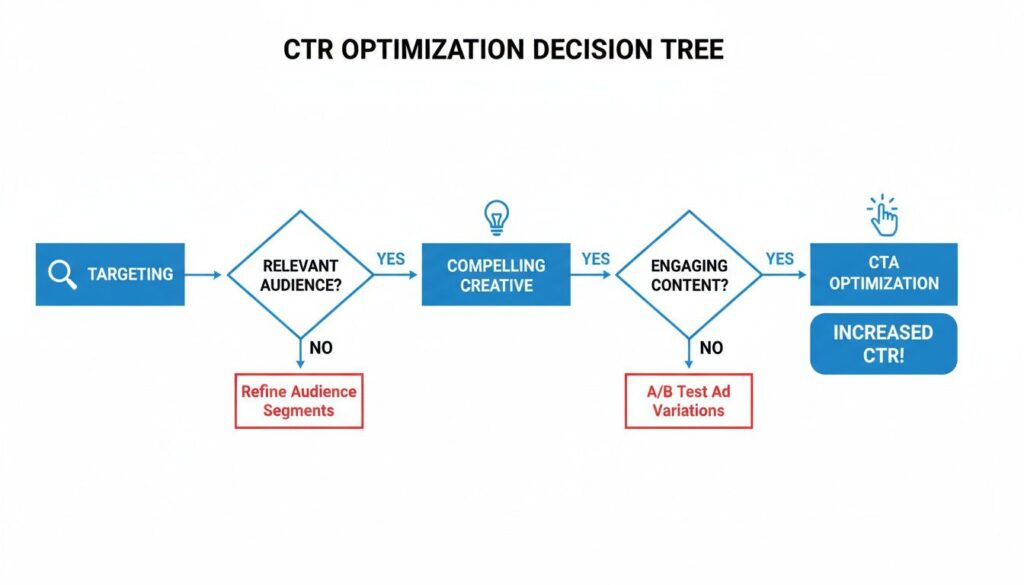
CTR OPTIMIZATION DECISION TREE
As the flowchart shows, boosting your CTR is a systematic process of refining targeting, sharpening creative, and strengthening your call to action. On specific platforms, you can find even more actionable insights, like these strategies to solve low CTR in Amazon PPC. By methodically checking each issue, you can stop guessing and start making data-backed decisions that move the needle.
Winning the Click on Google and Organic Search
Improving your organic click-through rate is one of the highest-leverage activities in SEO. Think of the search engine results page (SERP) as a digital storefront. Ranking on the first page gets you onto the busiest street, but your meta title and description are your window display. If they don’t convince people to come inside, that prime location is wasted.
The psychology is simple: people scan, they don’t read. They’re looking for the one result that most clearly and quickly promises a solution. Your job is to make your listing a magnet for their click.
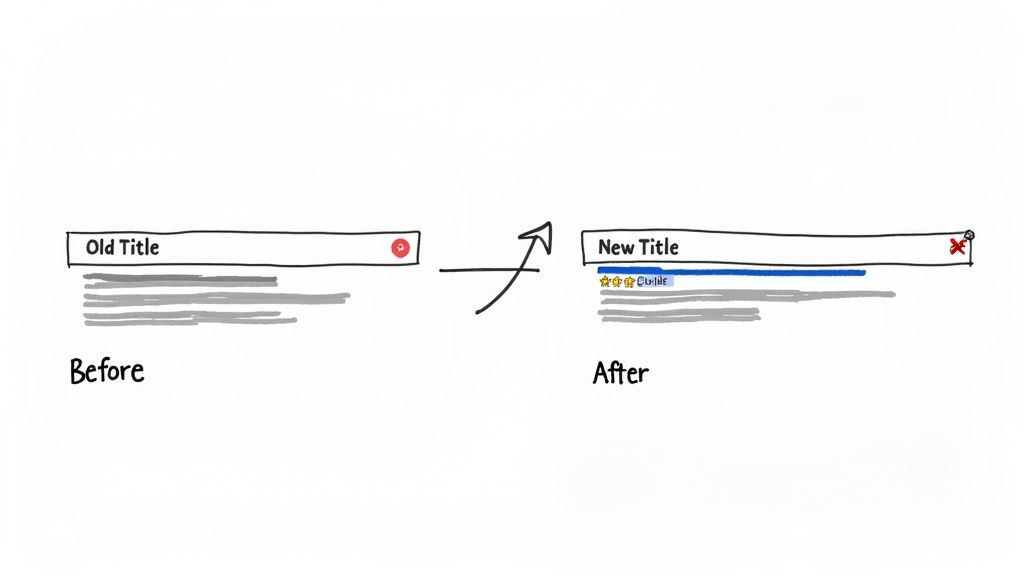
IMPROVE CTR THROUGH TITLES
Crafting Magnetic Meta Titles and Descriptions
Your meta title is the single most important factor for earning the click. A generic title like “Our Marketing Services” is forgettable. A stronger version? “10x Your Leads in 90 Days [Case Study].” The second title uses a specific number, promises a tangible result, and uses brackets to spark curiosity.
Your meta description is your supporting sales pitch. It’s your chance to expand on the title’s promise and give searchers another compelling reason to choose your result.
Here are proven formulas that work:
- Incorporate Numbers and Data: “7 Easy Ways to…” is almost always more clickable than “How to…” Numbers feel specific and credible.
- Use Power Words: Words that trigger an emotional response can dramatically improve CTR. Think Ultimate, Proven, Effortless, Instantly.
- Add Brackets or Parentheses: Studies show that adding brackets—like [Template], [Guide], or [2024 Update]—can increase CTR by drawing the eye and clarifying the content.
- Ask a Question: A title like, “Are You Making These Common SEO Mistakes?” directly engages a user’s curiosity and makes them want to know the answer.
A well-crafted title doesn’t just describe your page; it sells the click. It aligns perfectly with user intent and makes a clear promise of value that your content must then deliver.
This approach is especially powerful when user interest is high. For instance, in Q3 2025, the news industry saw a massive jump in Google search CTRs. Websites in the top three positions saw their combined CTR increase by 5.15 percentage points, showing how compelling, relevant information can dominate the SERP. You can explore more about these trends in this Google CTR analysis from ALM Corp.
Claiming More SERP Real Estate with Structured Data
Beyond great copy, you can make your listing physically larger and more visually appealing by using structured data (schema markup). This is code you add to your page that helps Google display it with rich snippets. Think of it as decorating your window display while everyone else has a simple sign.
Common Types of Schema to Boost CTR
- FAQ Schema: This adds a dropdown list of questions and answers directly below your meta description. It takes up more space and instantly demonstrates your page’s authority.
- Review Schema: For products or services, this displays star ratings (e.g., ⭐⭐⭐⭐⭐ 4.9/5 stars) in your search result. This social proof builds instant trust.
- How-to Schema: Perfect for step-by-step guides, this markup can outline the process directly in the search results, making your content appear more actionable.
Implementing schema might sound technical, but many WordPress plugins and online tools can generate the code for you. The small effort can lead to a huge advantage, making your search result impossible to ignore.
Crafting Ads That People Actually Want to Click
In paid social and PPC, your click-through rate is the lifeblood of your campaign. A high CTR signals to platforms like Meta and Google that your ad is relevant, and they’ll reward you with lower costs and better placement. A low CTR means you’re just paying for impressions on people who keep scrolling.
To win that click, you need four things: a scroll-stopping visual, a headline that sparks curiosity, copy that shows you understand the user’s problem, and a call-to-action (CTA) that promises a clear benefit.
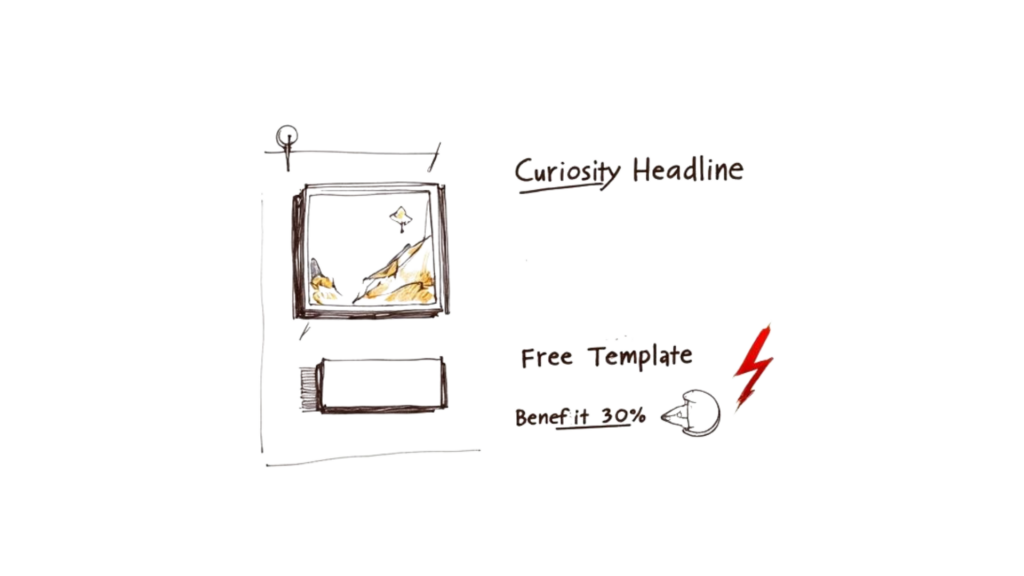
IMPROVE CTR MARKETING SKETCH
Beyond Pretty Pictures: The Power of Scroll-Stopping Visuals
Your visual has one job: stop the scroll. You have about a second to do it. While professional photos can work, the real magic is in authentic, user-generated content (UGC). Why? It feels native to the feed, cutting through the “ad blindness” we’ve all developed.
- UGC-Style Video: A customer’s unboxing video, a quick demo on a phone, or a simple testimonial can be incredibly powerful because it feels real.
- Authentic Imagery: Ditch the perfect stock photos. Use images of real customers using your product. It’s instant social proof.
- High-Contrast Graphics: If you’re using graphics, keep them bold and simple. A clear image with minimal text will always beat a cluttered design.
Writing Headlines and Copy That Actually Connect
Once your visual grabs their attention, your headline and copy reel them in. The best ad copy doesn’t list features; it speaks directly to your audience’s pain points and dreams. A killer technique is to start with a question your target customer is already asking themselves.
For example, “Our New Project Management Software” is forgettable. But what about, “Tired of Juggling Five Apps to Manage One Project?” The second one hits a nerve because it connects with a real frustration. You can dive deeper into this approach in our guide on how to create Facebook ads that convert.
Your ad copy should feel like you’re joining a conversation already happening in the customer’s mind. Acknowledge their problem, show you understand, and then present your product as the clear solution.
Ditching “Learn More” for CTAs That Drive Action
Your Call-to-Action is the final, crucial step. “Learn More” is overused and ineffective because it’s vague. A great CTA is specific, highlights a benefit, and creates urgency.
Look at the difference:
| Generic CTA | Action-Oriented CTA | Why It Works |
|---|---|---|
| Learn More | Get Your Free Template | It offers immediate, tangible value. |
| Shop Now | Claim Your 20% Discount | It focuses on the benefit (saving money). |
| Sign Up | Start Your Free Trial | It removes risk and commitment. |
When you frame the CTA around what the user gets instead of what they have to do, you boost their motivation to click.
Finally, you have to test. Constantly. A/B testing creative elements is the most reliable way to improve CTR. One brand saw a 40% uplift just from refreshing creative every 3-4 weeks. Another campaign that swapped to UGC-style video and sharpened its targeting saw its CTR jump to 2.6%—way above average. The lesson is clear: consistent optimization is the key to climbing CTRs.
Driving Clicks in Email and SMS Campaigns
Email and SMS are your direct lines to your most engaged audience. A high click-through rate here is proof of a strong relationship with your subscribers. But inboxes are overflowing. To earn that click, you need a smart, personal touch, not a generic blast.
The fight for attention starts with your subject line and preview text. They’re a one-two punch that has to land perfectly. Instead of a boring “Weekly Newsletter,” try something that sparks curiosity, like “Your Next Favorite [Product] Is Inside…” Then, use the preview text to seal the deal: “…and we saved you 10%.” This makes opening the email feel like the logical next step. For more strategies, check out our guide on how to increase email open rates.
Designing for the Click
Once they’re in, your design has to do the heavy lifting. Most emails are read on a phone, so a mobile-first design is non-negotiable. This means clean, single-column layouts, large fonts, and plenty of white space. Your goal is to create a clear visual path that leads their eyes right to your call-to-action (CTA).
- Stick to one, focused CTA: Don’t confuse people with a dozen links. Decide on the single most important action and make everything else secondary.
- Make that button impossible to miss: Use a contrasting color for your CTA button and make it large enough to easily tap with a thumb.
- Keep your copy scannable: Use short sentences, bullet points, and bold text so people can grasp the value in seconds.
The best email and SMS campaigns feel less like mass marketing and more like a one-to-one conversation. They hit the right person with the right message at the right moment.
The Real Magic is in Personalization
This is where you can see a dramatic shift in your CTR. One-size-fits-all campaigns get ignored. Personalized campaigns get clicked. The data shows personalization can boost email click-through rates by up to 15.6%, crushing the typical 2-3% industry average. Simple segmentation can lead to 30% more opens, creating far more opportunities for a click.
Using behavioral data is how you make this happen:
- Past Purchases: A month after someone buys a coffee maker, send them an email featuring your new single-origin espresso beans. It’s a natural next step.
- Browsing History: If a subscriber looked at hiking boots but didn’t buy, send a follow-up email a few days later. A simple, “Still thinking about these?” can be incredibly effective.
- Cart Abandonment: A timely reminder with a direct link back to their cart is often one of the highest-converting automations you can set up.
When you treat each subscriber like an individual, your messages feel helpful, not intrusive. That’s how you build trust and turn passive subscribers into active clickers. To keep that momentum going, make sure you’re incorporating these email newsletter best practices into your strategy.
Answering Your Burning Questions About CTR
Even with a solid plan, you’re bound to have questions about click-through rates. Let’s tackle some of the most common ones with clear, practical answers.
Conclusion
Improving click-through rates (CTR) requires a holistic approach that balances high-level strategy with technical execution. To see sustainable growth, focus on these three pillars:
- Content & Clarity: Blend clear CTAs and compelling meta descriptions with content that is strictly relevant to the user’s search intent.
- Technical Optimization: Ensure your site is mobile-friendly, utilizes responsive design, and leverages schema markup to stand out in search results.
- Data-Driven Refinement: Use A/B testing, personalization, and audience segmentation to sharpen your messaging. Additionally, analyze heatmaps and dwell time to understand user behavior and identify where they lose interest.
By continuously iterating on both your creative assets and your targeting, you can move beyond quick fixes and build a long-term strategy for higher CTR.
Ready to turn more visitors into subscribers and customers with conversations? Clepher gives you the AI-powered tools to design, launch, and automate chatbot flows that drive engagement and boost your CTR across your website, Messenger, and Instagram. Start building smarter conversations today.
Related Posts
How to Create a Killer Poll Game on Instagram to Boost Engagement and Leads
March 24, 202612 Fresh Social Media Content Ideas That Convert in 2026
March 23, 2026Elevate Your Customer Experience with Conversational AI for Customer Engagement
March 22, 2026
Founder Clepher