
Want to promote your local business? The answer isn’t just throwing money at ads and hoping for the best. The real secret is building a rock-solid digital foundation first.
We’re talking about your Google Business Profile and a simple, conversion-focused website. These two assets are, without a doubt, the most powerful free marketing tools you have. They’re critical for getting in front of customers who are already looking for what you offer. This guide gives you the actionable steps to turn local searchers into loyal customers.
Building Your Digital Foundation
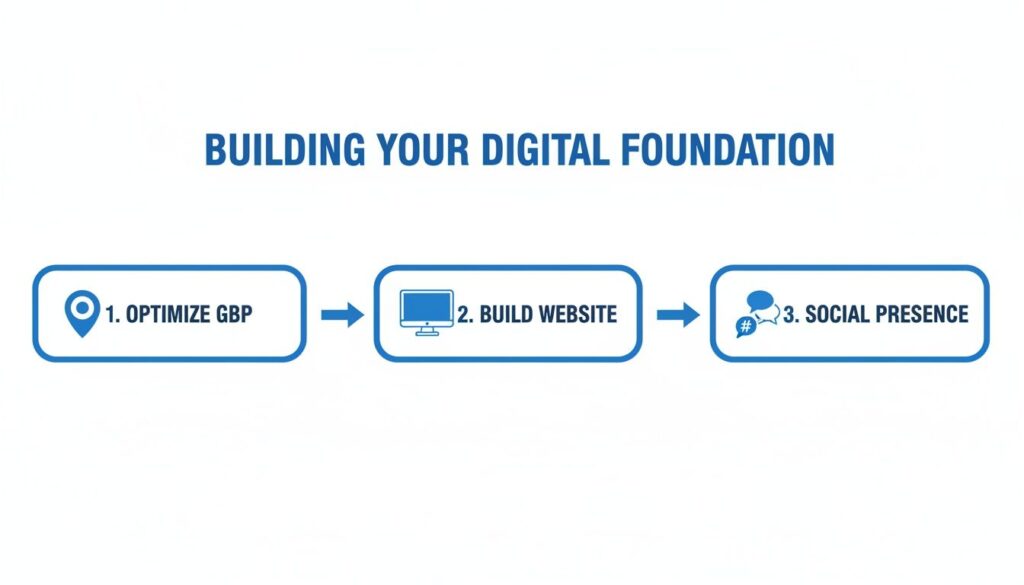
Before you spend a single dollar on advertising, you need to own your digital real estate. It’s like building a house—you don’t start hanging pictures before the foundation is poured and the walls are up. For any local business looking to promote your business locally, that foundation rests on two assets you completely control: your Google Business Profile (GBP) and your website.
These platforms are among the best ways to establish visibility in your area because they allow you to appear in local searches and connect directly with your local community. When properly optimized with strong SEO, your Google Business Profile and website help customers discover your services when they’re actively searching for solutions nearby.
Get these right, and you’ll establish a powerful online presence, build trust with potential customers, and start turning online searchers into paying clients. They become the core tools you use to market your business effectively online. Skip this step, and any money you put into ads is like pouring water into a leaky bucket—it’s simply inefficient.
Most Powerful Free Marketing Tool for Small Business Marketing
Think of your Google Business Profile as your digital front door. It’s the first thing people see in Google Maps and the local “3-pack” when they search for “pizza near me” or “best plumber in [Your Town].” If you want to attract local customers, you absolutely must optimize Google Business Profile.
This free listing is often the very first interaction a potential customer has with your brand. The numbers don’t lie: a staggering 46% of all Google searches carry local intent. These aren’t just people browsing; they’re actively looking to buy something or visit a store.
Your GBP is basically a mini-website right on the search results page, giving customers instant access to your hours, phone number, address, and reviews.
Actionable Tip: Your GBP is not a “set it and forget it” tool. Treat it like a social media profile. Once a week, add new photos of your shop or recent projects. Create a “Post” about this weekend’s special. Answer a question in the Q&A section. This activity signals to Google that your business is active and relevant, helping you rank higher.
Your 24/7 Digital Storefront
If your GBP is the introduction, your website is where you close the deal. Its main job is simple: convert visitors into leads or customers.
It doesn’t need to be some complex, 50-page monster. A simple, one-page site that loads fast and clearly explains what you do is often far more effective.
Build Digital Foundation
These two assets work hand-in-hand. Your GBP grabs the attention of local searchers, and your website provides the details and path to purchase.
An effective local business website must do three things the second someone lands on it:
- Tell them who you are and what you do. (e.g., “Maplewood’s favorite family-owned bakery.”)
- Show them how to buy or book your service. (e.g., A big “Order Now” or “Book an Appointment” button.)
- Make it dead simple to get in touch. (Your phone number and address, clear as day.)
Your website is also the perfect place to capture visitor information so you can keep the conversation going. By adding simple forms, you can turn passing traffic into a long-term asset and start building relationships.
Mastering Social Media That Actually Sells
Local Business Promotion
Let’s get one thing straight: for a local business, social media isn’t about going viral. It’s about getting people through your door. Stop chasing empty “likes” and start building a loyal community that actually shows up. The goal is to turn your social profiles into a direct line to store visits, booked appointments, and sales.
The proof is in the numbers. A recent report found that 73% of people use social platforms to check out products, and a staggering 42% of consumers visit a local spot after seeing one of their posts. Your feed has a direct impact on foot traffic.
Create Content That Builds Community
And please, engage with your audience. When someone leaves a comment, write back with a real answer, not just a thumbs-up emoji. Ask questions in your posts. This makes followers feel seen and part of an exclusive club. For an extra local boost, learn how to use geo-tagging on Instagram so people nearby can discover your posts.
Turn DMs Into an Automated Sales Force
What if every DM and story reply could become a potential sale, even when you’re busy or your doors are locked for the night? That’s the power of conversational marketing—using AI-powered chatbots to engage customers the second they reach out.
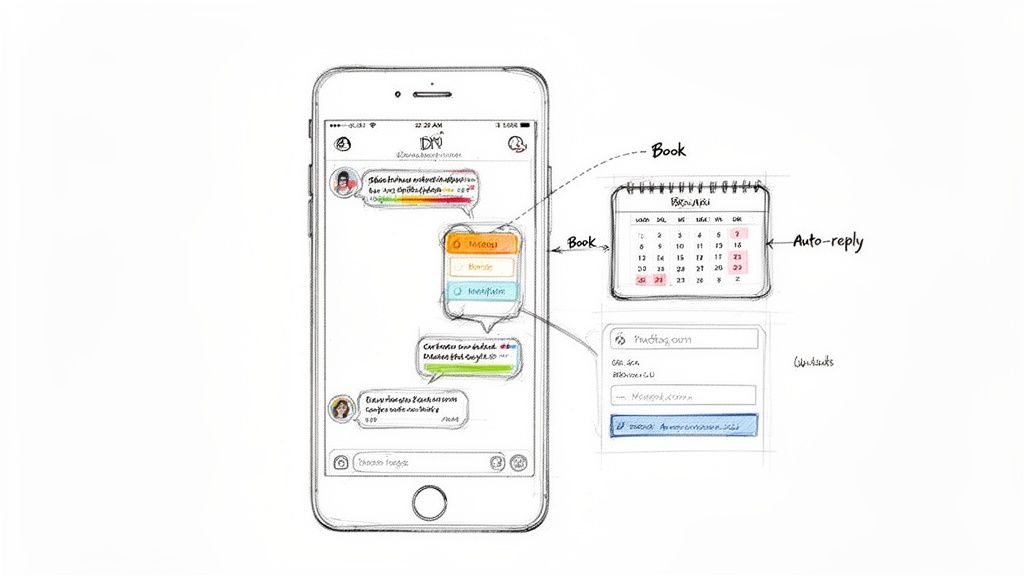
Imagine a potential customer DMs your gym’s Instagram page at 10 PM, asking about class times. Without a chatbot, that lead goes cold overnight. With one, they get an instant response. The bot can share the schedule, answer questions, and even offer a free trial class on the spot.
This isn’t science fiction; it’s a real, practical tool for growth. Platforms like Clepher let you build these automated conversations with a simple drag-and-drop interface, no coding required. You can design a flow that qualifies leads, grabs their contact info, and guides them straight to a purchase.
Real-World Use Case: The Yoga Studio
Let’s break it down with a practical example. A local yoga studio wants more sign-ups. They post an Instagram Story with a poll: “Ready to try a free yoga class this week?”
Instead of manually replying to every person who votes “Yes,” they set up an AI chatbot. Here’s the automated flow:
- Instant Reply: The moment someone votes “Yes,” the chatbot sends them a DM. “Awesome! We’d love to have you. We have a few spots left in our free intro class this Saturday at 10 AM. Sound good?”
- Capture Information: If the user says yes, the bot asks for their name and email to “hold their spot.”
- Confirmation and Follow-Up: Once the info is saved, the bot confirms their registration and sends a friendly reminder the day before the class.
In just a few seconds, the studio turned a casual story viewer into a confirmed lead who is highly likely to show up. They did it instantly, at scale, and without lifting a finger. This is how you promote your local business today—by mixing great content with smart automation.
Driving Targeted Traffic With Local Ads
Chat Booking
Organic growth is the long game. But sometimes, you need results now. That’s where paid ads come in—they’re the turbo boost for immediate, predictable traffic.
Think of it as putting your best offer directly in front of the people most likely to buy, right when they’re looking. When done right, local advertising isn’t burning cash; it’s a strategic investment with a measurable return.
This is about spending small, targeted amounts to bring customers from around the corner right to your door. We’ll focus on two powerhouses perfect for this: Google Local Services Ads and hyper-targeted ads on Facebook and Instagram.
Hyper-Targeted Ads on Facebook and Instagram
While Google Ads are fantastic for capturing existing demand, Facebook and Instagram are masters at creating it.
These platforms let you get ridiculously specific with who sees your ads. It’s the difference between a shotgun blast and a laser-guided missile. You can target people by their location, interests, behaviors, and demographics.
For a local business, this is a goldmine. You can serve ads to people within a few miles of your shop, in certain zip codes, or even to people who recently visited a nearby park. The goal is simple: stop wasting money on people who will never become customers.
Real-World Use Case: The Local Bakery
Imagine you own a neighborhood bakery, “The Sweet Spot,” and you’re launching a new “Weekend Brunch Box.” Instead of just posting and praying people see it, you run a targeted Instagram ad.
Here’s your action plan:
- Location: Everyone within a 3-mile radius of your bakery.
- Age: 25-55, your prime demographic for a weekend brunch.
- Interests: People who’ve shown interest in “coffee,” “brunch,” “desserts,” or “local farmers’ markets.”
Just like that, your ad—with a mouth-watering photo of the brunch box—appears directly in the feeds of hundreds of potential customers nearby. Your ad copy can speak right to them: “Skip the grocery store this weekend! Your delicious brunch from The Sweet Spot is just around the corner.”
Google Local Services Ads For Service Businesses
If you run a service-based business—a plumber, electrician, or house cleaner—then Google Local Services Ads (LSAs) are non-negotiable.
These are the ads that sit at the very top of Google search results, often above the regular ads and the map pack. They come with a “Google Guaranteed” or “Google Screened” badge, which builds instant trust with searchers.
The best part? With LSAs, you pay per lead, not per click. This means you only spend money when a potential customer actually calls or messages you directly through the ad. It’s a low-risk, high-reward way to get your phone ringing.
Setting up is straightforward. You define your service area and the exact jobs you do. So, when someone in your town frantically searches for “emergency plumber near me,” your profile can pop up right at the top, complete with your reviews and that powerful Google Guarantee badge. It’s one of the most direct ways to promote a local business that relies on service calls. Want to dig deeper into social ads? Check out our beginner’s guide to Facebook advertising.
Building Community With Partnerships And Events
Your biggest weapon against big-box stores isn’t price or inventory. It’s your “local-ness.” You are a part of the community, and that connection is something a national chain can never truly replicate. The best local promotion strategies turn that advantage into measurable growth.
Community marketing weaves your business into the fabric of your neighborhood. When you build authentic relationships with customers and other local businesses, you create unshakable loyalty, organic word-of-mouth, and more sales.
Forge Powerful Local Partnerships
One of the fastest ways to get in front of new customers is to team up with other non-competing businesses in your area. Think of it as a “borrowed audience”—you get access to their customer base, and they get access to yours. It’s a win-win that builds a stronger local economy.
The key is finding partners whose customers look a lot like yours.
- A local pet groomer could co-host an adoption day with a nearby animal shelter.
- A bookstore can offer a 10% discount to anyone who shows a receipt from the coffee shop next door.
- A fitness studio might partner with a health food store for a joint “wellness workshop.”
These cross-promotions feel organic and add real value for the customer. According to the 2024 State of Local Marketing report from BrandMuscle, businesses that use local digital tactics like social media see up to 30% higher customer engagement. When you co-promote your partnership on Facebook and Instagram, you amplify your reach. You can discover more local marketing insights from the full report.
Turn Offline Events Into Online Growth to Promote Your Business
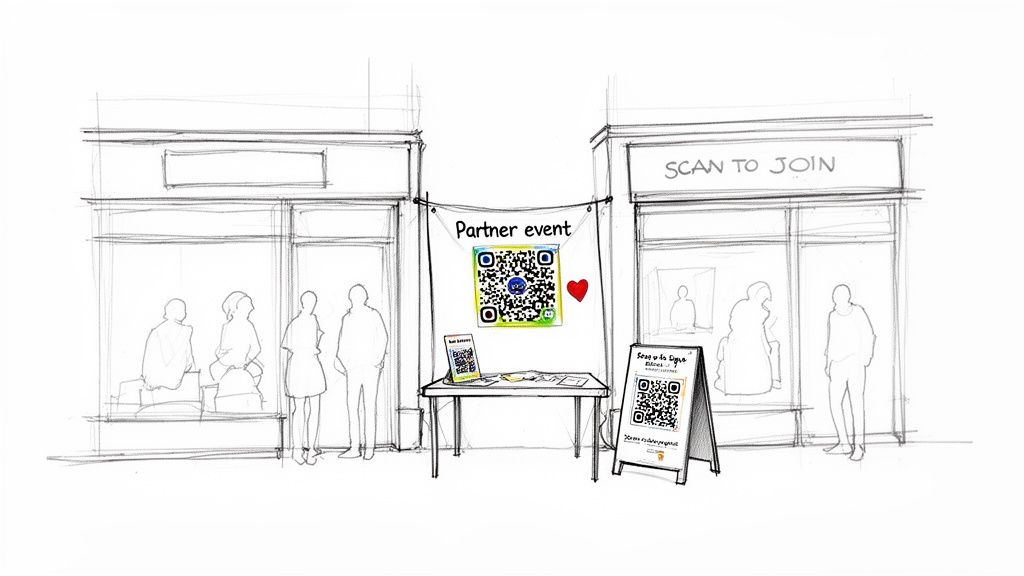
Local farmers’ markets, street fairs, and community festivals are goldmines for face-to-face interaction. But your goal shouldn’t stop at handing out flyers. These events are the perfect chance to connect your offline presence with your online marketing engine.
Don’t just set up a table and wait. Make your booth an experience. Your main goal is to capture leads and turn a brief handshake into a lasting digital relationship.
Actionable Tip: Design your event setup for action. A simple sign that says “Scan this QR code for 15% off your next purchase” is infinitely more powerful than a stack of business cards. It gives people an immediate reason to act and pulls them right into your digital world.
Here are a few ways to turn your next event into a lead-generation machine:
- Run a QR Code Giveaway: Have people scan a code to follow you on Instagram or join your email list. In return, they’re entered into a drawing for a prize.
- Offer an Event-Only Discount: Create a special discount code exclusively for attendees. This creates urgency and makes it easy to track the ROI from that event.
- Collect Emails for a VIP List: Use a tablet with a simple sign-up form. Give them a compelling reason to subscribe, like “Join our VIP list for secret sales and first dibs on new products.”
By linking offline events to your digital channels, the conversation doesn’t die when the festival packs up. You’re building a valuable list of warm, local leads who are far more likely to become loyal customers.
Cultivating Reviews and Managing Your Reputation
In the local business world, your reputation isn’t just a nice-to-have; it’s everything. Before a potential customer ever looks at your website, they’re looking at your reviews. What their neighbors say online is the ultimate social proof—it shapes their entire perception of your business.
Partner Event
Smart local promotion means mastering the art of feedback. A strong profile on platforms like Google, Facebook, or Yelp, packed with recent, positive reviews, doesn’t just build trust. It’s a massive signal to search engines that you’re a relevant business worth showing to more people.
Make It Easy for Happy Customers to Share
Here’s a simple truth: most happy customers are perfectly willing to leave a review. They just won’t think of it on their own. Your job is to ask, and to make it incredibly simple when you do.
The timing of your ask is critical. Catch them right after a great experience, when the positive feelings are fresh. This is easy to automate with a simple email or SMS follow-up.
For example, a local hair salon could send an automated text about a day after an appointment. Something like:
“Hi [Client Name]! Hope you’re loving the new look. If you had a great experience with us, would you mind sharing your feedback on Google? It helps our small business a ton! [Link to Google Review Page]”
This approach is direct, personal, and takes almost zero effort for the customer. It’s a proven way to dramatically increase your review count.
The Art of Responding to Every Review
Replying to reviews is non-negotiable. Period. It shows you’re listening and that you care about the customer experience. This public conversation is as much for future customers reading your reviews as it is for the original commenter.
For the good ones:
Thank the customer by name and reference something specific about their visit. It shows a real person is on the other end. A quick, “Thanks so much, Sarah! We’re thrilled you enjoyed the weekend brunch box. Can’t wait to see you again!” feels genuine.
For the tough ones:
A negative review isn’t a disaster—it’s an opportunity. It’s your chance to show off your customer service in public and turn a critic into a fan.
Here’s the game plan:
- Acknowledge and Apologize. Start by validating their frustration. “We’re so sorry to hear your delivery experience didn’t meet our standards.”
- Take It Offline. Don’t get into a back-and-forth. Provide a direct contact to resolve it privately. “This isn’t the service we aim for. Please email our manager, Dave, at [email] so we can make this right for you.”
- Never Get Defensive. Your goal isn’t to “win” the argument online. It’s to show everyone else that you take feedback seriously and are committed to fixing problems.
Turn Customers Into Raving Fans
A steady flow of great reviews is a side effect of having a loyal customer base—people who feel a real connection to your brand. Building that kind of relationship goes way beyond a single transaction.
To really foster that long-term loyalty, you should explore effective loyalty program strategies, learning from giants like the Starbucks Rewards Program. When you reward repeat business, you’re not just saying “thank you.” You’re giving your best customers one more reason to come back and tell their friends about you.
FAQs to Promote Your Business Locally
Running a local business means marketing questions pop up constantly. Let’s cut through the noise and get straight to practical answers for the challenges business owners face every day. This is about spending your time and money where it actually counts.
Ready to turn those social media conversations into customers, 24/7? Clepher gives you the power to build AI chatbots that answer questions, capture leads, and book appointments automatically on your website, Facebook, and Instagram. Start building smarter customer relationships today.

Related Posts
Your Guide to the Facebook Page URL in 2026
April 7, 20265 Best Chatfuel Alternatives in 2026 You Need to Try!
April 6, 2026How to Customize Your Facebook Page URL: A 2026 Guide to Boost Your Brand
April 5, 2026
Founder Clepher