
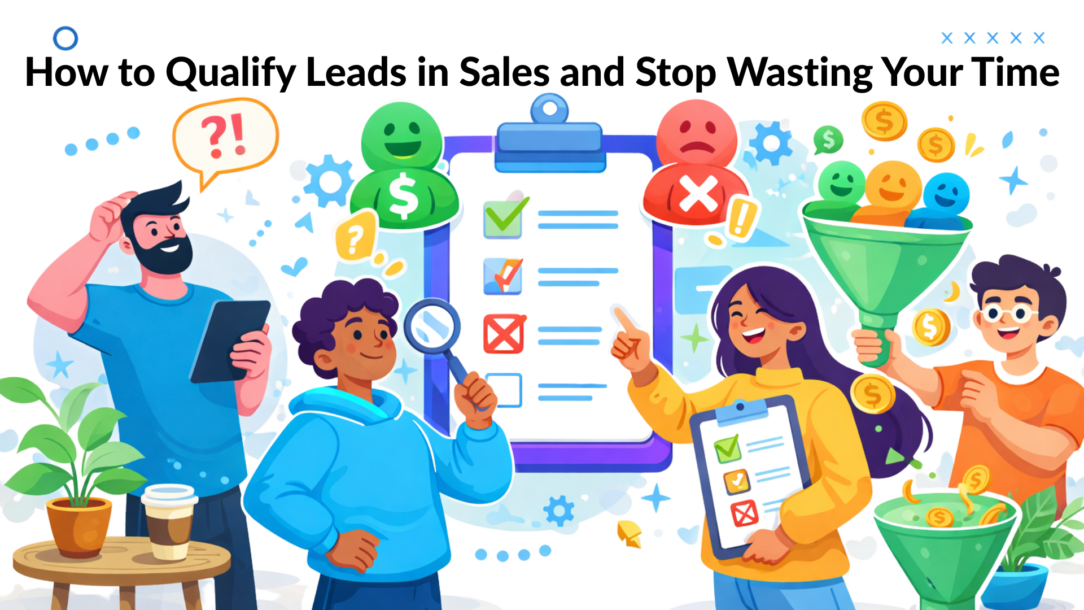
Qualifying leads is your sales team’s secret weapon. It’s the process of figuring out which prospects are a perfect fit for your product and, just as importantly, who is ready to buy now. A great process transforms a messy pipeline into a predictable revenue machine.
To do it right, you need a system. It starts with a crystal-clear definition of your ideal customer. Then, you use a proven framework—like BANT or MEDDIC—to ask smart, targeted questions. This simple act filters out the tire-kickers from the serious buyers, allowing your sales team to focus their energy only on conversations that lead to closed deals.
Why Your Sales Team Is Wasting Time on Unqualified Leads
Does this sound familiar? Your reps are chasing down leads that go nowhere, ending in ghosting or a polite “not interested.” This isn’t just a drain on time and morale; it’s a huge hit to your bottom line. The real cost of a broken qualification process is missed opportunities, painfully slow sales cycles, and a burned-out team.

Sales Funnel
This isn’t just a feeling; the data is clear. Over 50% of marketers hear from sales that the leads they send over are unqualified. It’s no surprise, then, that sales leaders estimate a staggering 50% of prospects they talk to aren’t a good fit. This misalignment is a huge problem.
This gap forces your best closers into a repetitive cycle of dead-end calls, pulling them away from what they do best: building relationships and closing deals with people who genuinely need your solution.
Shifting from Chore to Strategy
The first step is to completely reframe how you think about qualification. Stop seeing it as a boring administrative checkbox. Start seeing it as the most powerful strategic filter you can apply to your entire sales process. A solid system aligns marketing and sales by creating a shared, concrete definition of what a “good lead” actually looks like.
This alignment creates a ripple effect of powerful results:
- Sky-High Efficiency: Reps stop wasting time on dead-end conversations and focus their energy on high-potential deals.
- Better Conversion Rates: Every conversation starts with a prospect who has a confirmed need and the means to solve it.
- Improved Team Morale: Nothing motivates a sales team more than a pipeline filled with viable opportunities they’re excited to close.
For a deeper look at building a system like this, this guide on how to qualify sales leads effectively is a great resource. By putting a clear process in place, you’ll turn a chaotic funnel into a well-oiled machine that delivers consistent, predictable revenue.
Laying the Foundation: Your Ideal Customer Profile
Before you can qualify a single lead, you have to know exactly who you’re looking for. Trying to sell to everyone is a surefire way to sell to no one. The foundational first step in mastering sales qualification is building a detailed Ideal Customer Profile (ICP).
Lead Qualification
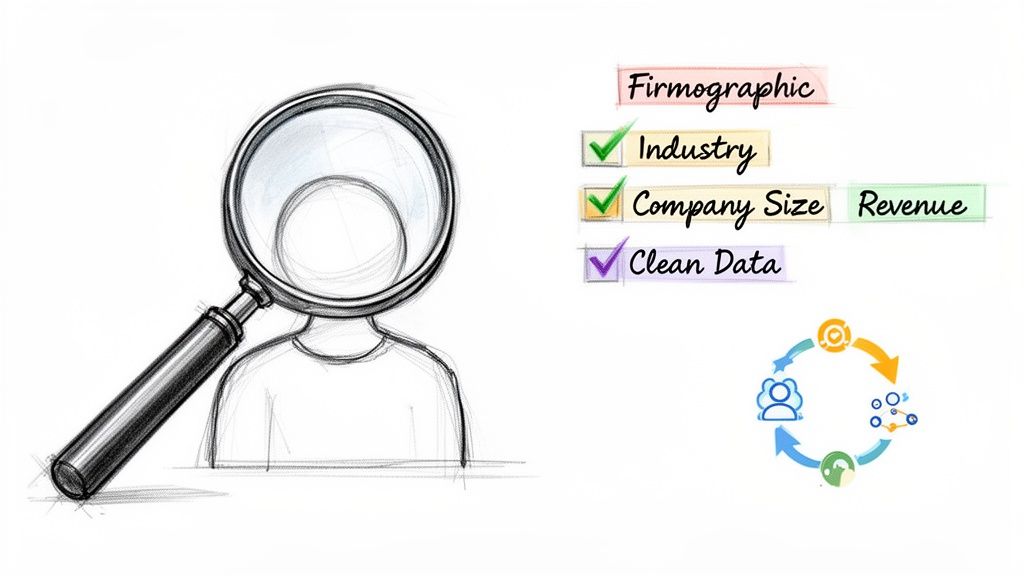
Think of your ICP as a strategic blueprint that defines the perfect company for your product—the one that will get the most value, stick around the longest, and be your most profitable partner. An ICP goes beyond basic demographics; it digs into firmographics—the specific, defining characteristics of a business. For more on this, our guide to understanding your ideal customer through buyer personas is a great place to start.
From Data to Definition
So, where do you find this information? Start with your own data. Your existing customer base is a goldmine. Open your CRM and analyze your absolute best customers—the ones with the highest lifetime value, the smoothest sales cycles, and the fewest support tickets.
Look for the patterns. What do they all have in common?
- Industry: Are they all in SaaS, e-commerce, or healthcare? Get specific. Example: “B2B SaaS companies in the fintech space.”
- Company Size: Are they typically startups with 10-50 employees, or enterprises over 500? Example: “Companies with 50-250 employees.”
- Geography: Is there a concentration in North America or Western Europe?
- Technology Stack: Do they all use complementary tools like HubSpot or Shopify? This is a huge buying signal.
Your ICP isn’t about who could buy your product; it’s about who should buy it. Focusing on this group makes every part of the sales process, from outreach to closing, significantly more effective.
Once you have the hard data, it’s time for the human element. Talk to your top-performing sales reps. They have invaluable insights you won’t find in a spreadsheet. Ask them pointed questions like, “Which clients were the easiest to close, and why?” or “What common challenges did our most successful customers have before they signed with us?”
By blending quantitative data from your CRM with qualitative insights from your team, you create a powerful, actionable profile that will guide every single qualification conversation from now on.
2. Choose the Right Lead Qualification Framework
Once you know who you’re looking for, you need a consistent system to evaluate them. A lead qualification framework provides that structure, turning messy sales calls into focused, effective discovery conversations. Think of it as a roadmap for your reps, ensuring they ask the right questions every single time.
This consistency is the secret to building a predictable pipeline and knowing which leads are genuinely worth pursuing. The goal is to pick a model that fits your product, your sales cycle, and your customer’s buying journey.
BANT: The Classic for Straightforward Sales
BANT is one of the most direct frameworks out there. It stands for Budget, Authority, Need, and Timeline. It’s perfect for businesses with a relatively simple sales cycle where these four factors are the main hurdles.
Use Case: A marketing agency selling a $2,000 website package can use BANT effectively. The questions are direct: Does the prospect have the budget approved? Are you the one who signs the checks? Do you have a clear need for a new site? Do you want it launched this quarter? It quickly filters out leads who don’t have the basic requirements. For a detailed breakdown, learn more about the BANT framework for lead qualification.
CHAMP: A Modern, Customer-First Approach
CHAMP flips the traditional model around by putting the customer’s problems first. It stands for Challenges, Authority, Money, and Prioritization. This subtle shift makes the conversation feel more consultative and less like an interrogation. You start by digging into their pain points, which builds immediate rapport.
Use Case: A SaaS company selling project management software. A rep using CHAMP would start by asking, “What are the biggest challenges your team is facing with your current workflow?” By focusing on challenges first, you ensure your solution is relevant before even discussing the budget.
MEDDIC: For High-Stakes Enterprise Deals
When you’re navigating complex, high-value enterprise sales, you need a more robust framework. That’s where MEDDIC comes in. It’s the gold standard for these deals, covering Metrics, Economic Buyer, Decision Criteria, Decision Process, Identify Pain, and Champion. This framework forces you to dig deep, identify the person with ultimate budget control (Economic Buyer), and find an internal advocate (Champion).
For a deeper understanding of various models, this guide on how to qualify sales leads with proven frameworks is an excellent resource.
A framework isn’t a rigid script; it’s a guide to ensure you cover all the critical bases. The best salespeople adapt their chosen framework to create a natural, flowing conversation that uncovers the information they need.
Comparing Lead Qualification Frameworks
Here’s a quick-glance comparison to help you choose the right framework for your business needs.
| Framework | Best For | Key Focus |
|---|---|---|
| BANT | Simple, transactional sales with a shorter sales cycle. | Quick qualification based on core purchasing ability. |
| CHAMP | Consultative selling, where understanding the customer’s pain is key. | Solving the customer’s challenges first. |
| MEDDIC | Complex, high-value enterprise sales with multiple stakeholders. | Deeply understanding the buying process and proving ROI. |
Ultimately, the best framework is the one your team will actually use consistently. Start with the one that most closely matches your sales process and adapt it as you learn what works best for your audience.
Crafting Qualifying Questions That Uncover Real Needs
A great framework is the engine, but your questions are the fuel. The quality of your questions directly dictates the quality of your insights. The goal isn’t to fire off a checklist; it’s to start a real conversation that gets to the heart of your prospect’s needs and motivations.
Globally, 34% of salespeople point to lead qualification as their biggest challenge. Often, it’s because they aren’t asking the right questions early on. You have to move beyond blunt, yes-or-no questions. For instance, asking “Do you have the budget?” is a conversation killer.
A much better approach is to ask, “How does your team typically allocate funds for new solutions like this?” This phrasing opens the door to a discussion about their process and reveals far more than a simple dollar amount. Structured qualification can improve forecast accuracy for more than half of all sales teams.
Moving From Theory to Dialogue
The best qualifying questions are always open-ended. They encourage the prospect to share stories, challenges, and goals, making them feel heard and understood, not interrogated. Here are some practical examples you can adapt.
- To Uncover Need: Instead of “What’s your problem?” try, “Could you walk me through what your team’s workflow looks like on a typical day?” This gets them talking and helps you pinpoint the exact bottlenecks.
- To Understand Authority: Instead of “Are you the decision-maker?” ask, “Who besides yourself would be involved in evaluating a new tool like this?” This is a softer, more collaborative way to map out the buying committee.
- To Gauge Timeline: Instead of “When do you want to buy?” ask, “What’s the main driver behind looking for a solution right now?” This uncovers the urgency and tells you if a compelling event is pushing them forward.
Creating Simple and Effective Scripts
A question script isn’t about robotic repetition; it’s about consistency. It ensures every rep gathers the essential information on every call. This is also incredibly useful when programming automated chatbots to handle initial qualification.
Here’s a simple script flow that works:
- Start with their challenges. Always begin by asking about the problems they’re trying to solve to build rapport.
- Connect challenges to impact. Follow up with, “How is that challenge currently impacting your team’s goals?” This links their pain to a tangible business outcome.
- Explore their ideal outcome. Ask, “If you could wave a magic wand, what would the perfect solution look like for you?” This cuts through the noise and reveals their deepest priorities.
By weaving these types of questions into a natural dialogue, you transform qualification from a simple filter into a powerful discovery session.
Using Automation to Qualify Leads at Scale
Imagine every lead that visits your website gets qualified the moment they arrive, 24/7, without your team lifting a finger. This isn’t a fantasy; it’s what happens when you pair a solid qualification process with smart automation. Think of AI chatbots as your most efficient Sales Development Rep—one that never sleeps.
While 84% of marketers still rely on static forms, only 33.2% use live chat to generate leads. That’s a massive opportunity. We know that companies responding to leads within an hour are 7 times more likely to have a real sales conversation. AI chatbots don’t just shrink that gap; they eliminate it.
How Chatbots Automate Qualification
A well-programmed AI chatbot can run your chosen qualification framework—like BANT—flawlessly, every time. It asks your pre-scripted questions, collects data, and uses logic to determine the next best step, all within a natural conversation. It turns a passive website visit into an active qualification session.
Let’s break down how this works for a typical B2B software company:
- Welcome: A friendly message pops up: “Hey there! Looking for a better way to manage your team’s projects? I can help point you in the right direction.”
- Problem Inquiry: It gets to the heart of the matter: “What’s the biggest headache with your current project management process? (e.g., missed deadlines, poor collaboration)”
- Sizing Question: It gathers key data: “Got it. And roughly how many people are on your team?”
This structured conversation is essentially a decision tree in action. A lead must meet certain criteria to move forward.
As you can see, a truly qualified lead isn’t just someone who fits your ICP. They need a defined problem and a clear path toward making a buying decision.
From Data Collection to Action
Automation isn’t just about collecting information; it’s about acting on it instantly. This is how you build an intelligent chatbot for lead generation that does the heavy lifting for you.
Example in Action: You can set up simple rules inside the bot. For instance, if a lead says their team is over 20 people and their main challenge is “poor collaboration,” the bot knows exactly what to do next.
It can immediately respond with, “It sounds like our Team Plan would be a perfect fit. Would you like to book a quick 15-minute demo with one of our specialists to see it in action?”
If the person says yes, the chatbot can trigger a whole sequence of events:
- Tag the lead as “Hot Lead” in your CRM.
- Instantly notify the right sales rep on Slack with the full chat history.
- Display a calendar right in the chat window to book a meeting on the spot.
This all happens in seconds, removing the delays that cause so many high-intent leads to go cold. Automation ensures your sales team spends their time talking to prospects who’ve already raised their hands and confirmed they’re a good fit.
Nail the Handoff to Your Sales Team
Even the most perfectly qualified lead can go cold if the handoff from marketing to sales is a clumsy mess. This is where potential revenue disappears—lost to friction, delays, and miscommunication. A seamless process ensures your sales team gets every lead with the full story, ready for a warm, effective conversation.
The transfer of information is everything. When a lead moves from a chatbot to a live rep, all the context must follow instantly. This means more than just contact details.
Make sure you’re passing along:
- Full Qualification Answers: Every single response to your BANT, CHAMP, or MEDDIC questions. Don’t make the rep ask again.
- Interaction History: What pages did they view? What was the full chatbot conversation log?
- Lead Source: Where did they come from? This context helps your team understand their initial intent.
Set Clear Rules of Engagement
To make this handoff bulletproof, create a Service Level Agreement (SLA) between your marketing and sales teams. Think of it as a simple rulebook that gets rid of ambiguity and creates shared accountability. It defines the exact moment a lead is officially ready for sales.
Your SLA needs to clearly define a Sales Qualified Lead (SQL). For example, an SQL might be a lead who matches your ICP, confirms a budget over $5,000, and has requested a demo.
A strong SLA is the bridge connecting marketing efforts to sales results. It holds marketing accountable for lead quality and sales accountable for speed, turning a disjointed process into a unified revenue engine.
Another critical piece of the SLA is defining the follow-up time. A highly effective rule is that a sales rep must contact every SQL within one business hour. This speed is crucial to capitalize on a lead’s peak interest.
When you automate this data transfer and establish clear SLAs, you eliminate guesswork. Your sales team can stop wasting time on repetitive discovery questions and start conversations from a place of genuine insight, dramatically improving your chances of closing the deal.
Lead Qualification Process
Putting a solid lead qualification process in place is a game-changer, but it almost always brings up a few questions. Let’s tackle some of the most common ones to help you get started on the right foot.
Reviewing ICP
Your Ideal Customer Profile is not a “set it and forget it” document. Think of it as a living guide that needs regular check-ins. Review and tweak your ICP at least every six months. You should also revisit it anytime your business hits a major milestone—like launching a new product, expanding into a new market, or noticing a shift in your sales cycle. This keeps your qualification criteria laser-focused on who your best customers are right now.
Difference Between an MQL and an SQL
This distinction is critical for a smooth handoff between marketing and sales.
A Marketing Qualified Lead (MQL) is someone who has shown interest by engaging with your marketing content. They’ve downloaded an ebook, signed up for a webinar, or visited your pricing page multiple times. They’re curious, but they haven’t been properly vetted yet.
A Sales Qualified Lead (SQL) is an MQL that has passed the test. Your team (or an automated chatbot) has engaged with them and confirmed they meet your qualification criteria—they have a real need, the authority to buy, and a potential budget. This is the lead sales actually want to talk to.
Think of it this way: MQLs are the people who showed up to your free concert. SQLs are the ones who’ve been invited backstage for a private meet-and-greet. Your job is to efficiently move the right people from the crowd to that conversation.
Leads-based strategies
Lead-based strategies are central to b2b sales, and sales lead qualification is the process that helps sales professionals determine which leads are worth pursuing; that’s where lead qualifying and a chosen lead qualification framework come in to streamline lead flow so sales teams gain quality leads consistently and leads for sales move forward in the sales experience. Proper lead qualification helps identify whether a lead is a good fit and whether a lead is likely to become a customer, using questions to qualify and the right questions to qualify leads in the sales lead qualification process to accurately qualify leads and determine lead fit. By using a lead scoring system or lead scoring approach—where you score leads based on lead behavior and firmographics—you can score leads based on probability and qualify leads quickly, separating leads who aren’t ready from high-potential leads and ensuring leads are qualified before moving forward in the sales cycle. Common lead qualification steps include asking questions to determine lead interest, determining which leads are worth follow-up, and applying a lead scoring model so sales operations and sales teams can qualify a lead, qualify leads and determine who to contact directly, and increase sales conversion rates by focusing on leads that are likely to become customers rather than wasting time on leads that aren’t a good fit.
Conclusion
Effective lead qualification is the process that turns raw sales leads into sales-qualified leads by applying a clear lead qualification framework and checklist so sales and marketing teams can qualify leads faster and focus on high-quality sales opportunities. When you qualify your sales leads with qualification questions, qualification criteria, and a consistent lead scoring system—whether rule-based lead scoring, predictive lead scoring, or an automated lead scoring model—you can score leads automatically, segment leads, and identify hot leads and types of qualified leads that are worth a sales call. A strong lead qualification process and lead scoring model give sales reps and sales managers actionable lead data, help sales teams prioritize the sales pipeline, and reduce time wasted on unqualified leads. Integrating lead management across marketing and sales, aligning the sales funnel, and using lead source and sales conversation insights improve qualification decisions across the entire sales process. In short, when you qualify leads with a repeatable framework and score leads accurately, lead quality rises, the sales cycle shortens, sales success increases, and the entire sales team benefits from clearer, faster paths to close.
Ready to qualify every lead instantly, 24/7? Clepher‘s AI-powered chatbots can automate your entire lead qualification process right on your website or social media. Build your first no-code chatbot today.

Related Posts
How to Create a Survey on Facebook for Maximum Engagement
March 28, 2026Social Media Marketing Automation: Your Ultimate Guide
March 27, 2026
Founder Clepher