
When we talk about using AI in marketing, we’re not just throwing around buzzwords. It’s about putting smart automation to work on real-world tasks—like personalizing customer journeys, qualifying leads while you sleep, and offering 24/7 support. This isn’t about theory; it’s about using data to make your marketing sharper, more efficient, and directly tied to your bottom line.
Why AI Is an Essential Modern Marketing Tool
AI for Marketing
Let’s be honest. AI isn’t some far-off concept for Silicon Valley giants anymore. It’s here, it’s practical, and it’s completely changing how businesses of all sizes connect with their customers. For e-commerce stores, agencies, and course creators, AI has become the great equalizer.
It handles the tedious, repetitive work that eats up your day, freeing you up to think about the big picture. But the real magic is in its ability to create smarter, more personal customer interactions at a scale that was once impossible for small teams. This goes way beyond efficiency; it’s about forging stronger relationships that actually drive revenue.
The Real-World Impact on Your Business
Think about the daily grind. Answering the same questions over and over in your Instagram DMs. Trying to guess which leads are actually ready to talk to a salesperson. Losing sales because a customer had a simple question at 11 PM on a Saturday. AI is built to solve these exact problems.
This is where conversational AI becomes a true game-changer. By meeting your customers on the platforms they’re already scrolling through—like Messenger and Instagram—you can build automated experiences that feel genuinely personal and helpful. We’re not talking about those clunky, robotic scripts from five years ago. These are intelligent conversations that can:
- Qualify leads 24/7: An AI chatbot can ask the right questions to segment new inquiries on the spot. Hot leads get tagged for immediate follow-up, while colder leads are automatically nurtured.
- Provide instant support: Get immediate answers to common questions about shipping, pricing, or product specs into your customers’ hands, which boosts satisfaction and lightens the load on your support team.
- Drive sales directly: Guide users through product discovery, offer tailored recommendations based on their interests, and even recover abandoned carts with a timely, helpful message. We cover more of the benefits of AI chatbots in our detailed guide.
The shift is undeniable. AI isn’t here to replace marketers. It’s here to supercharge them, turning everyday interactions into concrete opportunities for growth.
The numbers don’t lie. Businesses are integrating AI at a breakneck pace, especially in marketing and sales. A recent Microsoft report revealed that out of 359 million companies worldwide, a staggering 280 million now use AI in at least one business function. You can read the full AI adoption report from Microsoft to see just how fast this is moving.
Ultimately, learning how to use AI for marketing is all about using smart automation to create more human, timely, and effective connections with your audience.
Pinpointing Your First High-Impact AI Project
Diving into AI marketing can feel like trying to drink from a firehose. With so many possibilities, the single biggest mistake is trying to do everything at once. The secret to getting started on the right foot? Choose one specific, high-impact project that delivers a quick win and builds momentum.
Forget about drafting a massive AI strategy for now. Instead, start by looking for friction in your business. Where do you or your team spend way too much time on repetitive tasks? Where do your customers get stuck, ask the same questions, or just drop off? These pain points are absolute goldmines for your first AI project.
The goal is to find a problem that, once solved, delivers immediate and measurable value. This approach proves the concept to stakeholders (and to yourself) and generates a clear return right out of the gate.
Find the Bottlenecks in Your Customer Journey
Every business has them. They’re those small but frustrating hurdles that slow down sales, annoy customers, and eat up your team’s valuable time. When you focus your first AI efforts here, you create a tangible improvement that everyone can feel.
Think about these common scenarios:
- The DTC Brand: You’re losing sales because shopper questions go unanswered after 5 PM. An AI chatbot could instantly handle queries about shipping, returns, and product details, converting those after-hours visitors into actual customers.
- The Online Coach: You spend hours sifting through applications for your high-ticket program. An AI assistant can pre-qualify leads by asking targeted questions, tagging the best fits, and scheduling calls only with the most promising candidates.
- The SaaS Company: Your support team is swamped with basic “how-to” questions. A simple AI bot on your website could handle the top 10 most common FAQs, freeing up your team to tackle more complex technical issues.
Your first project shouldn’t be about overhauling your entire marketing plan. It should be a surgical strike against a single, annoying problem that AI is uniquely equipped to solve.
This laser-focused approach simplifies everything. You’re not building a complex, all-knowing AI; you’re automating one specific conversation or task to get a clear, defined outcome. This is how you learn to use AI marketing effectively.
A Simple Framework for Choosing Your Project
Once you’ve brainstormed a few potential ideas, you need a way to prioritize them. A simple decision matrix is perfect for evaluating each option objectively. The best projects to start with are almost always those with high customer or business impact but relatively low implementation effort.
AI Use Case Prioritization Matrix
Use this simple matrix to score your potential projects. Just assign a value from 1 (low) to 5 (high) for each category. This will help you spot the clear winner.
| Use Case (Example) | Customer Impact (1-5) | Revenue Potential (1-5) | Implementation Effort (1-5) | Priority Score (Impact + Revenue – Effort) |
|---|---|---|---|---|
| Qualify Course Applicants | 4 | 5 | 2 | 7 |
| Answer After-Hours FAQs | 5 | 3 | 1 | 7 |
| Recover Abandoned Carts | 3 | 5 | 3 | 5 |
| Onboard New Users | 4 | 2 | 4 | 2 |
Based on this matrix, both qualifying applicants and answering FAQs emerge as top priorities. They promise significant results without requiring a massive upfront investment of time or resources, making them perfect candidates for your first foray into AI-powered marketing.
Choosing the Right No-Code AI Marketing Tools
Alright, you’ve pinpointed a high-impact problem to solve. Now comes the fun part: picking your weapon. The market is absolutely flooded with AI platforms, but you don’t need some overly complex, enterprise-level system to see real results. For most of us marketers, the smartest place to start is with a no-code conversational AI builder.
These platforms are built for marketers and support teams, not developers. Forget confusing code. Think intuitive, drag-and-drop interfaces that let you build, launch, and manage powerful automations yourself. This is so important because it puts you—and your marketing strategy—back in the driver’s seat.
Key Features of a Great No-Code AI Platform
It’s easy to get distracted by flashy features you’ll probably never use. Don’t fall for it. Instead, focus on the core functions that actually deliver results. A solid no-code platform should be built around a few essential components that make automation both powerful and ridiculously easy to manage.
Here’s what I consider non-negotiable:
- Visual Flow Builder: This is the heart of any no-code tool. It lets you map out conversations visually, like a flowchart. You can see exactly how a user moves from one step to the next, which makes building and troubleshooting a breeze.
- Multi-Channel Support: Your customers are on Instagram, Messenger, and your website. Your AI needs to be there, too. Deploying similar automations across different channels from one central hub is a massive time-saver.
- Powerful Segmentation: Look for the ability to use tags and custom fields. This is how you label users based on their actions (e.g., tagging someone as a
hot_lead) and store specific data about them (like their budget in a custom field). This is the foundation of smart, personalized marketing. - Simple Integrations: Your AI tool can’t be an island. It needs to plug into the rest of your marketing stack—your CRM, your email software—so data flows where it needs to go. You can check out a variety of AI marketing automation tools in our comprehensive overview.
This diagram breaks down the process of finding where to start, from identifying a pain point to locking in your first project.
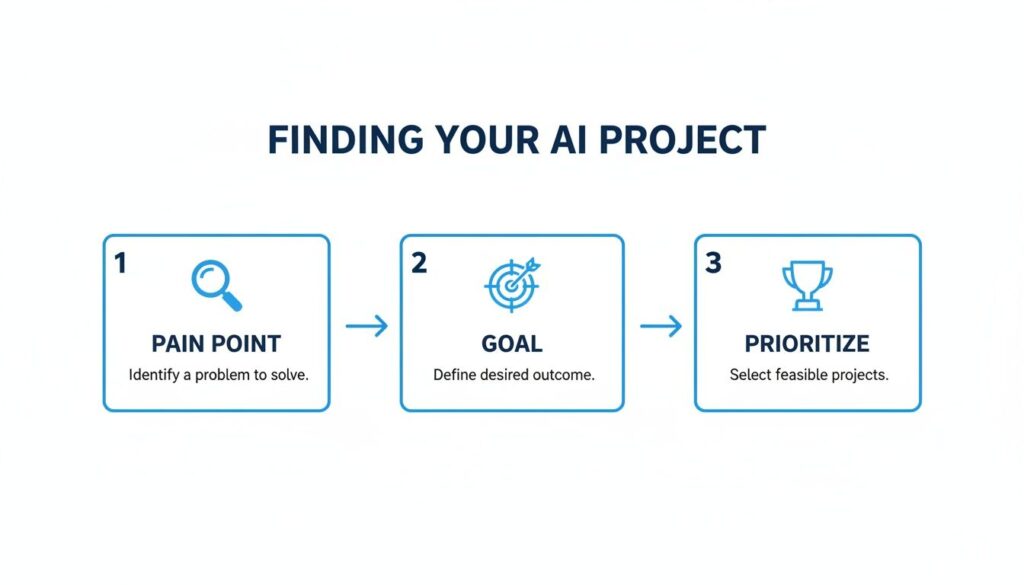
AI Project Steps
The big takeaway here? A successful AI project starts with a clear, strategic focus on solving a real business problem, not with the tech itself.
Building Your First Lead Qualification Chatbot
Theory is great, but let’s get our hands dirty. We’re going to build a simple lead qualification chatbot for an online coach who sells a high-ticket program. The goal? To automatically filter Instagram DM inquiries, identify the most promising applicants, and save the coach hours of manual vetting every single week.
Step 1: Craft the Welcome Message
First impressions count. As soon as someone slides into your DMs, the chatbot needs to respond with a warm, clear welcome that sets expectations.
- Example Welcome Message: “Hey {{user_first_name}}! Thanks for your interest in the Momentum Coaching program. I’m an AI assistant, and I can help answer some initial questions to see if we’re a good fit. To start, are you a coach or a consultant?”
This feels personal right away by using their name, and it immediately asks a simple qualifying question with clear options. No friction.
Step 2: Ask Smart Qualifying Questions
Now, guide the user through a few key questions. Each one should build on the last and help you segment the lead. You’re trying to understand their needs and see if they meet the program’s basic criteria.
You’d add questions like:
- “Great! What’s your current monthly revenue? (e.g., <$5k, $5k-$10k, >$10k)”
- “And what’s the biggest challenge you’re facing in your business right now?”
Pro Tip: Always use quick reply buttons for multiple-choice questions. It makes it effortless for users to respond with a single tap and keeps the conversation flowing smoothly.
Step 3: Tag Users for Smart Segmentation
This is where the magic happens. As the user answers, the tool automatically applies tags behind the scenes, without them ever knowing.
If they select “>$10k” for revenue, the system can instantly apply a hot-lead tag. If they choose “<$5k,” they might get a nurture-sequence tag. This simple action builds an intelligent profile of every single person who interacts with your bot.
Step 4: Hand Off to a Human
For anyone tagged as a hot-lead, the chatbot’s job is done. Now it’s time for a seamless transition to a human. The bot can send a final message to the user while simultaneously pinging the coach or their sales team.
- Example Handoff Message: “Awesome, it sounds like you could be a great fit for the program! My human teammate, Sarah, will review your answers and get back to you personally within the next few hours to discuss next steps. Talk soon!”
And that’s it. In four simple steps, you’ve created an automated system that works 24/7 to qualify leads, segment your audience, and make sure your valuable time is spent only with the most promising prospects. This is the practical power of using no-code AI in marketing.
Designing Conversations That Actually Convert
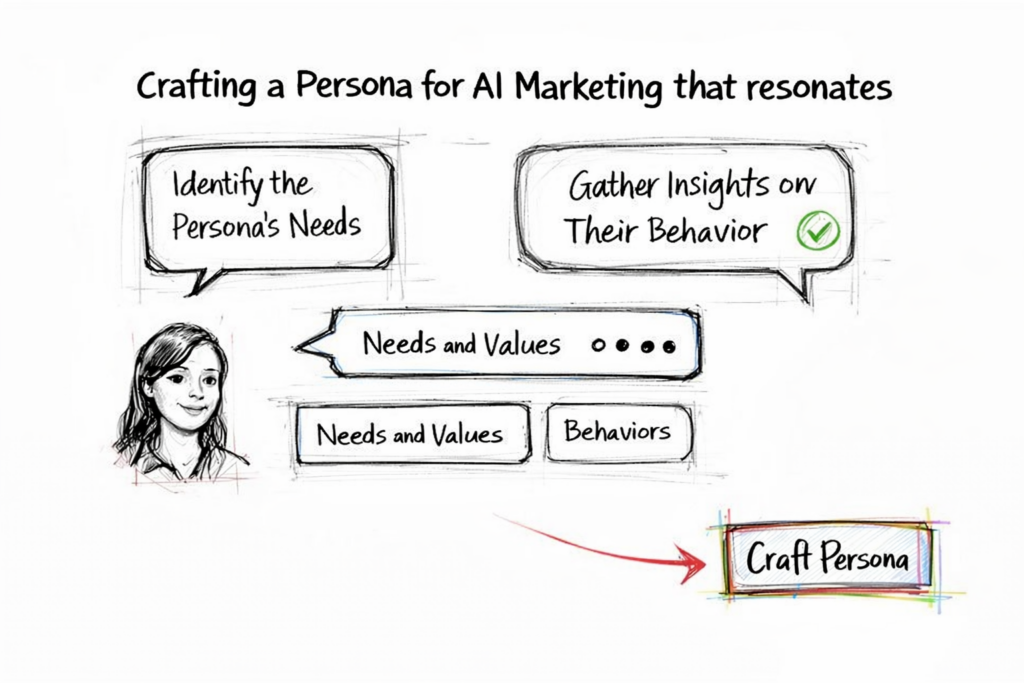
AI for Marketing Persona UI
Having a powerful AI marketing tool is one thing; making it feel human is a whole other ballgame. A clunky, robotic conversation will send potential customers running for the hills. The real magic is in designing conversational “Flows” that are genuinely helpful, guide users toward a goal, and never feel pushy.
This is where you graduate from basic automation to building real connections. A well-designed conversation builds trust, delivers instant answers, and makes it incredibly easy for people to buy from you. It’s the difference between a frustrating dead-end and a smooth, revenue-generating experience.
Crafting a Persona That Resonates
Before you write a single line of copy, you need to decide who your AI is. Is it friendly and casual, dropping emojis and keeping the tone light? Or is it professional and straight to the point, focused purely on efficiency? There’s no wrong answer—it just needs to align perfectly with your brand voice.
A consistent persona makes the interaction feel like a real conversation, not a script. This builds familiarity and makes people more comfortable engaging with your bot.
Think about these key elements:
- Tone of Voice: What adjectives describe your brand? Helpful, witty, knowledgeable, maybe a little quirky? Pinpoint them.
- Word Choice: Create a simple list of words to use and words to avoid. This keeps your language consistent across every automated message.
- Pacing: Keep sentences short and use natural pauses. Adding subtle typing delays between messages is a small trick that mimics human interaction and makes the whole thing feel more organic.
Guiding the Conversation with Smart Design
A great conversational Flow anticipates what a user needs and makes it ridiculously easy for them to get it. Your main job is to cut out the friction. Instead of making people type out long questions, you can steer the conversation with pre-defined options.
Your primary job in conversational design is to make the user’s next step obvious and easy. When you reduce cognitive load, you increase the chances of conversion.
For example, after a welcome message, don’t just ask, “How can I help you?” That’s way too open-ended. Offer clear choices that map directly to your business goals.
Example Scenario: A DTC Brand
Instead of a generic greeting, try something like this:
“Hey there! 👋 Welcome to Aura Skincare. What can I help you with today?”
- [Track My Order]
- [Explore Best Sellers]
- [Get a Skincare Quiz]
These quick reply buttons are a game-changer. They guide the user down a specific path, simplify the interaction to a single tap, and help you collect structured data you can use for segmentation later. For a deeper dive into building these interactions, you can learn more about how to design a great chatbot experience.
Using AI Keywords to Provide Instant Value
While guided flows are fantastic, you also have to plan for people who know exactly what they want and ask direct questions. This is where setting up AI keywords becomes a superpower. You can train your system to recognize common words or phrases and trigger an immediate, relevant response.
This handles your most frequent questions instantly, freeing up your team and giving customers quick wins. A Nielsen report highlights this trend, noting that 59% of marketers see AI-driven personalization as a key to future success. Predictive AI, in particular, has been shown to improve conversions by up to 30%.
Here’s how you can put keywords to work:
- Pricing Questions: If a user types “price,” “cost,” or “how much,” trigger a message linking straight to your pricing page. Simple.
- Shipping Inquiries: Keywords like “shipping,” “delivery,” or “track” can automatically ask for an order number to provide a status update.
- Discount Requests: Words like “discount,” “coupon,” or “sale” could trigger a flow offering a first-time buyer discount in exchange for their email.
By combining a strong brand persona, smart conversational design, and intelligent keyword triggers, you can turn a simple AI tool into a conversion-focused marketing asset that works for you 24/7.
Integrating AI with Your Existing Tech Stack
Your AI chatbot is a powerful tool on its own, but its true potential is only unlocked when it starts talking to the other platforms you already use. Think of it this way: the AI is your front-line data gatherer, but that data is most valuable when it’s immediately put to work across your entire marketing ecosystem.
An isolated AI is a massive missed opportunity. When you integrate it with your CRM, email service provider, and other systems, you create a seamless flow of information that makes your entire operation smarter. Every lead qualified and every piece of customer data collected by your AI becomes instantly actionable.
Connecting Your Tools for Seamless Automation
The real goal here is to build an automated funnel where your tools work together without any manual effort on your part. For instance, when your Instagram AI qualifies a hot lead, you don’t want that information just sitting inside the chatbot platform. You want it to instantly appear in your CRM and kick off a follow-up email sequence.
This is where integrations come in. Many AI platforms offer native integrations, which are just direct, pre-built connections to popular tools like HubSpot or Mailchimp. For everything else, there are amazing intermediary services like Zapier or Make that use webhooks to connect virtually any two apps you can think of.
Connecting your AI to your tech stack transforms it from a simple conversational tool into the central nervous system of your marketing automation. It ensures no lead is left behind and every customer interaction enriches their overall profile.
This connectivity is what makes modern AI marketing so effective. It’s not just about automating a single conversation; it’s about automating the entire customer lifecycle, from the first DM to the final sale and beyond.
A Practical Integration Example, Step by Step
Let’s walk through a real-world scenario for an online coach. The goal? Capture a new lead from an Instagram DM, add them to a database, and immediately start a welcome email series.
Here’s exactly how the automated workflow would look:
- Step 1: Lead Capture on Instagram: A potential client slides into your DMs and starts chatting with your AI. The bot asks a few qualifying questions and grabs their email address.
- Step 2: Webhook Trigger: The moment that the email is collected, the AI platform sends a webhook to Zapier. This little packet of data contains everything—the user’s name, their email, and any tags they were assigned during the conversation (like
hot_lead). - Step 3: Data Sync to Google Sheets: Zapier catches the data, and its first move is to add a new row in a Google Sheet. Just like that, you have a simple, clean database of every single lead generated through your Instagram DMs.
- Step 4: Email Sequence Activation: Immediately after, Zapier’s second action fires off. It sends that same contact information to an email platform like ActiveCampaign, adds the user as a new subscriber, and enrolls them in a specific “Welcome Sequence” automation.
In just a few seconds, a brand-new Instagram inquiry has been qualified, logged, and is now receiving your automated email nurture sequence—all without you lifting a finger. This is the practical power of integrating AI into your marketing stack.
How to Measure and Optimize Your AI Marketing ROI
Launching your AI chatbot is just the starting line. The real magic happens when you dive into the data, figure out what’s working, and relentlessly tweak it to make it better. Without clear measurement, your AI is just a cool website feature. With it, it becomes a predictable engine for growth.
This process isn’t about getting lost in complex analytics. It’s about zeroing in on a handful of key metrics that tell you exactly how your AI is performing against your business goals. Focusing on the right numbers turns guesswork into a clear, data-driven strategy.
Pinpoint the Metrics That Matter
To measure ROI, you need to look beyond vanity metrics like the total number of conversations. Instead, focus on data that shows a direct impact on your marketing funnel and customer experience.
You’ll want to start by tracking these essential performance indicators:
- Open Rates: This is simple but crucial. It shows you the percentage of users who see your chatbot widget or a prompt in their DMs and actually start a conversation. Low open rates might mean your call-to-action just isn’t compelling enough.
- In-Flow Conversion Rate: This is the big one. It measures the percentage of users who complete the desired action within the conversation—like providing an email, booking a call, or using a discount code.
- Lead Quality Score: For lead generation bots, you need to know if the leads are any good. Track how many leads tagged as
hot_leadby your AI actually turn into customers. This tells you if your qualifying questions are effectively spotting high-intent prospects. - Human Handoff Rate: Keep an eye on how often conversations need to be escalated to a live agent. A high rate could be a red flag that your chatbot’s responses aren’t actually answering user questions effectively or the flow is confusing.
The goal isn’t just to automate conversations; it’s to automate results. By focusing on conversion rates and lead quality, you tie your AI’s performance directly to revenue and business growth.
Use A/B Testing to Systematically Improve
Once you have your baseline metrics, you can start optimizing. This is where features like A/B testing (or random path distribution) become your secret weapon. Instead of guessing what might work better, you can test different approaches and let the data tell you what your audience truly responds to.
For instance, a DTC brand could test two different welcome messages on its website’s chatbot. Path A might be a direct, sales-focused “Hey, want 15% off your first order?” while Path B could be a more conversational, quiz-based approach like “Take our 30-second quiz to find your perfect fit!”
After running the test for a week, you just look at the numbers. Which path led to a higher in-flow conversion rate? The data makes the decision for you.
This approach removes ego and assumptions from your marketing decisions. It creates a simple, repeatable process for continuous improvement, turning your AI from a static tool into an adaptive marketing asset that gets smarter over time. The numbers back this up, with a massive 79% of marketers identifying efficiency as AI’s top benefit. Why? Because AI can process massive amounts of campaign data that humans simply can’t, allowing for incredibly precise optimization. You can discover more insights about AI marketing statistics from Sopro.io.
Got Questions About AI in Marketing?
Stepping into AI for your marketing can feel like a big move, and it’s natural to have a few questions. Let’s clear up some of the most common ones so you can move forward feeling confident.
Ready to put this into practice? Clepher offers a no-code platform to build AI-powered chatbots that qualify leads, recover sales, and support customers around the clock on your website, Messenger, and Instagram. Start your free trial today and launch your first AI assistant in minutes!
Related Posts
Your Ultimate Guide to Instagram Chat Bots
March 25, 2026How to Create a Killer Poll Game on Instagram to Boost Engagement and Leads
March 24, 202612 Fresh Social Media Content Ideas That Convert in 2026
March 23, 2026
Founder Clepher