
Forget the futuristic jargon. The use of AI in digital marketing comes down to a few practical things you can start doing right now: using conversational systems powered by natural language processing to talk to customers instantly, setting up intelligent automation with modern AI marketing tools, and applying data-driven personalization so every customer feels seen. This is where generative AI, machine learning, and advanced AI technologies quietly work behind the scenes to make marketing smarter—not more complicated.
This isn’t theory. It’s a hands-on way to boost sales, strengthen customer relationships, and reclaim your time. When you use AI in marketing, you’re not replacing strategy—you’re scaling it. Let’s break down why AI is no longer optional.
Why AI Is No Longer Optional in Modern Marketing
At its core, AI in marketing is about building stronger, more scalable connections with your audience. AI can help e-commerce brands and agencies nurture leads, answer questions, and guide buyers across the platforms they already use every day—Messenger, Instagram, and WhatsApp. By combining AI models with automation, marketers can move beyond clunky, one-at-a-time interactions and create personalized conversations that run 24/7.
This is how AI works in the real world: customers get instant responses at 2 AM, personalized recommendations on a Sunday afternoon, and consistent support without increasing your workload. Every marketing campaign becomes more responsive, relevant, and efficient.
The Real-World Impact on Your Strategy
Now imagine your marketing performance improving because AI is handling personalization at a scale no human team could manage manually. This shift is already underway. A recent Nielsen survey found that 59% of global marketers believe AI-driven personalization will be the most impactful trend by 2025. That insight highlights how rapidly AI technologies are reshaping marketing strategies.
What this means for marketers is clear. With the right AI marketing tools, you can increase engagement by responding instantly in DMs, automate follow-ups like abandoned cart reminders, and deliver truly personalized offers based on real user behavior. Whether it’s recommending products, qualifying leads, or running automated promotions, AI models powered by machine learning and natural language processing allow you to deliver the right message to the right person at the right time.
The biggest takeaway is simple: adopting AI isn’t about becoming a data scientist. It’s about becoming a smarter marketer. When you understand how to use AI in marketing, you unlock more effective campaigns, better customer experiences, and scalable growth driven by intelligent automation.
Core Applications of AI in Your Marketing Strategy
Before we get into the “how,” think of these as the foundational pillars for your AI marketing strategy.
| AI Application | Key Business Benefit | Practical Example |
|---|---|---|
| Conversational AI | Instantly engage leads & answer questions 24/7. | A website chatbot booking appointments for a local salon. |
| Intelligent Automation | Recover lost sales & nurture leads automatically. | A WhatsApp bot reminding a customer about items left in their cart. |
| Data-Driven Personalization | Deliver unique offers based on user behavior. | An Instagram bot sending a special offer to users who engaged with a specific product post. |
These applications work together. A personalized offer (data) can be delivered via an automated chatbot (conversation), creating a seamless and effective customer journey.
Your First AI Workflow: From Idea to Reality
Alright, let’s get practical. Moving from theory to action is where the magic happens. We’ll walk through building your first AI marketing workflow, step-by-step.
We’ll use a common scenario: an e-commerce brand getting hammered with Instagram DMs asking, “How much is this?” Instead of replying all day manually, we’ll build a smart AI trigger to handle it. This automation will instantly spot keywords like “price” and kick off a helpful, personalized chat—no coding required.
Step 1: Map Your Ideal Conversation
Before touching any tools, sketch out the perfect customer interaction. When someone asks about price, what’s next? A great automated flow doesn’t just spit out a number; it steers them toward a sale.
Your map might look like this:
- Trigger: User sends a DM with “price,” “cost,” or “how much.”
- Instant Reply: The bot immediately acknowledges the question and asks a clarifying one. For example: “Thanks for asking! Are you interested in our standard package or the premium one?”
- Personalized Info: Based on their answer, the bot provides specific pricing and highlights a key benefit.
- Call to Action: The bot gives a clear next step—a direct link to the product page or a special discount code to encourage immediate action.
This simple logic transforms a basic question into a guided sales conversation that works for you 24/7. The framework is simple: engage, automate, and personalize.
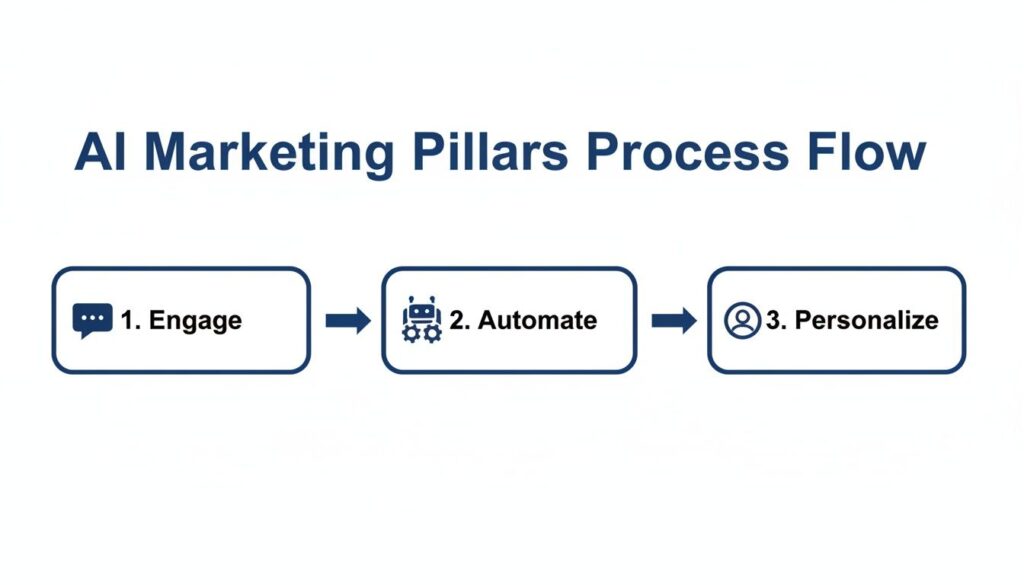
AI Marketing Process Flow
This visual breaks down how each step logically flows into the next, creating a smooth experience that feels helpful, not robotic.
Step 2: Bring Your Automation to Life
Now, let’s turn that map into a real automation. In a tool like Clepher, you’d use a visual, drag-and-drop builder to create this sequence. You’d start by setting up an AI Keyword Trigger for words like “price” and “cost.”
Next, you connect that trigger to a Flow—the series of messages you mapped out. Each message can be customized with text, images, and buttons. You can even add typing indicators to make the chat feel more human and use conditional logic to send different replies based on what the user chooses.
Pro Tip: Don’t send a wall of text. Break your messages into small, easy-to-digest chunks. Use emojis for personality and buttons so people can tap to respond instead of typing.
The final piece is dropping in a direct link to the product or checkout page. By making the path to purchase as short and frictionless as possible, you drastically increase your chances of making the sale.
This one automation can capture leads and drive sales while you’re focused on other things. For more ideas, check out this list of top-tier AI marketing automation tools to get started.
Using Conversational AI to Boost Sales and Support
Conversational AI is where your marketing stops shouting and starts listening—at scale. Think of AI chatbots as your best salespeople and support reps, working 24/7. They turn reactive customer service into proactive sales conversations, guiding visitors on your website, Messenger, and Instagram DMs.
This isn’t about clunky, robotic replies. It’s about building smart automations that understand what a user wants and nudge them toward a purchase. Whether it’s saving an abandoned cart or qualifying a new lead, AI handles those crucial first touches with speed and precision, freeing up your team for high-value conversations.
The impact is huge. Salesforce data shows sales teams using AI see 83% revenue growth, blowing past the 66% seen by those who don’t. It’s a core part of modern marketing that lets teams spend less time on repetitive tasks and more time on strategy.
Turn Abandoned Carts into Conversions
Every abandoned cart is a conversation that ended too soon. Conversational AI restarts that dialogue at the most critical moment. Instead of a generic reminder email that gets lost, you can trigger an automated, personal message directly inside Facebook Messenger or an Instagram DM.
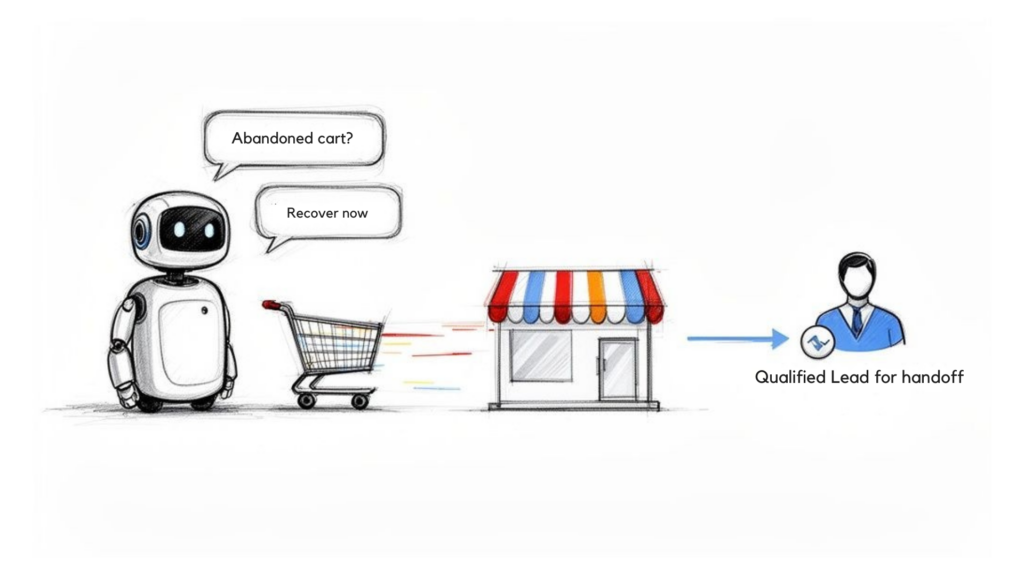
AI Marketing Cart Recovery
Here’s a simple, effective sequence for e-commerce stores:
- The Gentle Nudge: An hour after they leave, the bot sends a friendly message: “Hey [First Name]! Looks like you left something behind. Did you have any questions about your order I can help with?”
- The Value Offer: If there’s no reply, follow up with an incentive: “Just a heads up, we can offer free shipping on your order if you complete it in the next 24 hours. Here’s the link to your cart!”
- The Scarcity Angle: A day later, a final message creates urgency: “Items in your cart are popular, and we can’t hold them for long! Let me know if you need any help checking out.”
This approach feels helpful, not pushy. It’s a core tactic you can learn more about in our guide on what is conversational marketing.
Prequalify Leads Before a Human Steps In
For agencies and service businesses, time is money. Chasing unqualified leads is a massive resource drain. An AI Agent can act as your front-line screener, asking the right questions to separate serious prospects from tire-kickers.
Your AI agent can ask about budget, timeline, and specific needs before a lead ever lands on your sales team’s calendar. This guarantees your experts only spend their valuable time on conversations that have a real chance of converting.
Imagine a digital agency’s website chatbot. The flow could be:
- Greeting: “Welcome! Are you looking for help with SEO, Paid Ads, or Web Design?”
- Budget Question: “To give you the best recommendation, could you share your approximate monthly budget for this project? (e.g., <$1k, $1k-$5k, >$5k)”
- Smart Hand-off: Based on their answers, the AI can instantly schedule a call with a senior strategist (for high-value leads) or send a relevant case study (for smaller leads). Every person gets an immediate, tailored response.
AI Chatbot Use Case Comparison
This table breaks down how different businesses can use AI chatbots to hit specific marketing goals. It’s all about applying the right feature to the right problem.
| Business Type | Primary Use Case | Clepher Feature Used | Expected Outcome |
|---|---|---|---|
| E-commerce Store | Recover abandoned carts via social DMs. | Flow Builder | 15-20% increase in recovered sales, higher LTV. |
| Digital Agency | Pre-qualify inbound leads on the website. | AI Agent | 30% more qualified sales calls, shorter sales cycle. |
| Local Service | Answer FAQs & book appointments 24/7. | Conversational Flow | Fewer support calls, 25% more appointments booked. |
| SaaS Company | Onboard new users with guided tutorials. | Triggered Messages | Improved user activation rates, reduced churn. |
The application is incredibly flexible. Whether your goal is direct sales, lead quality, or support efficiency, a well-designed conversational AI flow directly contributes to your bottom line.
How to Achieve Hyper-Personalization with AI
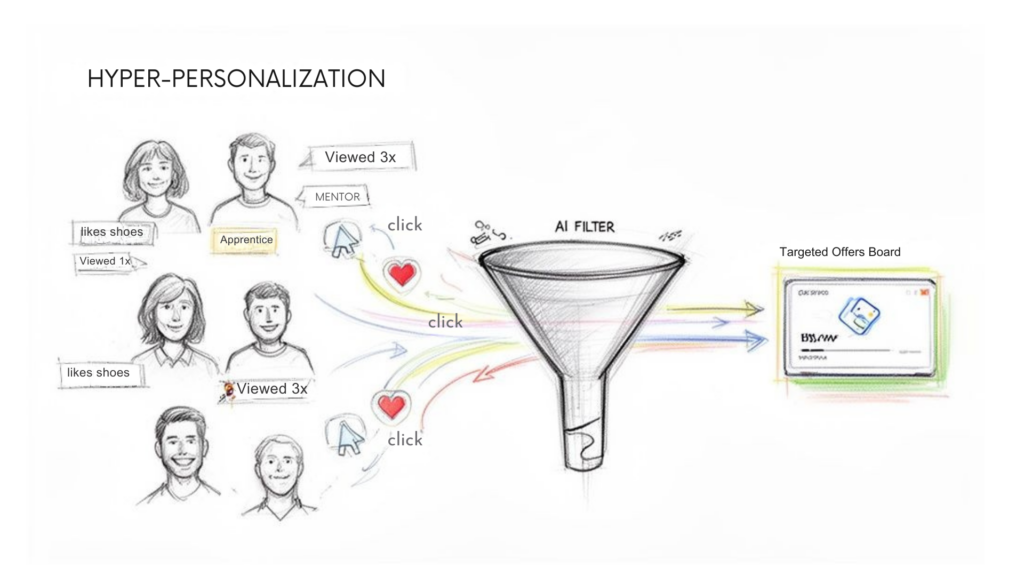
AI Hyper Personalization
Real personalization is more than just dropping a {{first_name}} tag into an email. With AI, you can deliver one-to-one marketing messages at scale, turning generic campaigns into genuinely individual conversations.
This is where you stop guessing and start listening. AI tracks what users actually do—every click, every question, every interaction—and uses that behavior to deliver exactly what they want. It’s about building a unique journey for each person.
From Broad Strokes to Individual Portraits
The old marketing playbook had us lumping people into vague buckets like “women, ages 25-40.” AI lets you get far more granular, creating dynamic segments based on what people actually do.
Effective segmentation in marketing is the bedrock of personalization, and AI puts it on steroids. You can automatically identify and group users based on their real-time engagement. This means you can instantly separate casual window shoppers from hot leads asking specific questions about a product.
This shift is critical. Instead of pushing what you think an audience wants, you’re responding directly to their expressed interests. Your marketing stops feeling like an ad and starts feeling like a helpful recommendation from a friend.
This isn’t some far-off concept; it’s built right into platforms like Clepher, where you can use tags to automatically label users based on the buttons they click or the questions they ask.
A Practical Blueprint for AI Personalization
Imagine someone lands on your Instagram and starts interacting with your bot. They tap a button to learn more about “anti-aging creams.” This is your trigger.
Here’s how to turn that single click into a hyper-personalized follow-up sequence:
- Automated Tagging: The second they tap that button, a workflow automatically applies a tag like
interest-anti-aging. That person is now in a super-specific micro-segment. - Targeted Nurturing: A few days later, you can send a broadcast message only to users with that tag. It’s not a generic blast, but a customer testimonial about your best-selling anti-aging serum.
- Adaptive Offers: If they engage with the testimonial, the AI can follow up with a time-sensitive offer: “Hey, here’s 15% off our Radiance Serum, just for you.”
This entire flow is automated and works because it continues a conversation the user started. You’re not just shouting about products; you’re guiding them based on their actions.
To succeed, you need solid customer segmentation strategies tied to your business goals. When you connect actions to tags, you build a smart system that nurtures prospects with content they actually care about, driving far higher conversion rates.
Measuring the ROI of Your AI Marketing Efforts
Great marketing is measurable, and your AI initiatives are no different. Investing in AI tools isn’t about chasing trends; it’s about generating a tangible return. To prove its worth, you have to look past vanity metrics and focus on the numbers that impact your bottom line.
Stop caring about how many messages your bot sends and start focusing on how many qualified leads it generates. The real value of AI in marketing is clear when you can draw a straight line from your automated efforts to your revenue.
Identifying the Metrics That Matter
Don’t let data overwhelm you. Tie your AI efforts directly to specific business goals. Are you trying to drive more sales, improve lead quality, or cut down on customer support costs? Once you know the goal, you can pinpoint the key performance indicators (KPIs) that matter.
Here are a few practical examples:
- Lead Qualification Rate: What percentage of AI-led conversations turn into leads your sales team actually wants?
- Automated Conversion Rate: How many sales come directly from your AI-powered abandoned cart flows? This is pure, automated revenue.
- Cost Per Conversation: How much are you saving by letting AI handle initial support chats versus the cost of a human agent’s time?
- Customer Lifetime Value (CLV): Are customers who interact with your AI-driven personalization more valuable over time than those who don’t?
Focusing on these outcome-driven metrics creates an undeniable link between your AI tools and revenue growth. This isn’t just about being more efficient; it’s about building a rock-solid business case for your automation strategy.
Creating a Powerful Feedback Loop for Optimization
Tracking metrics is only half the job. The other half is using that data to improve—this is where a continuous optimization loop comes in. Think of your analytics dashboard as a goldmine of insights.
Your chatbot is talking to customers 24/7, spotting trends and giving you the data needed to make smarter decisions. This is why AI usage in business is skyrocketing. AI can process massive datasets from digital campaigns that no human could tackle alone.
What does this look like in practice?
Let’s say you notice many users drop off after your bot asks a specific question. That’s your signal to tweak the script. You can A/B test a few different responses to see what works better. Maybe a friendlier tone or a clearer call-to-action is all it takes to push more people toward a purchase.
To truly grasp the financial impact, dig into strategies for effective marketing ROI measurement. This constant cycle of measuring, analyzing, and refining is what turns a good AI strategy into an unstoppable growth engine.
Got Questions About AI in Marketing? We Have Answers.
Stepping into AI marketing can bring up a lot of questions. Let’s tackle the most common ones so you can move forward with confidence.
Ready to put these answers into action? Clepher gives you all the tools you need to build intelligent, automated conversations on your website, Messenger, and Instagram. Start your free trial and launch your first AI-powered workflow today.
Related Posts
Customer Success Metrics To Track: Master KPIs to Boost Retention and Growth
March 9, 2026A Guide to the 2026 Customer Support Software Comparison
March 8, 2026
Founder Clepher