
You’ve captured a lead. Now what? That initial spark of interest is valuable, but it is also fragile. The journey from a new contact to a loyal customer is where many businesses lose momentum, allowing promising prospects to go cold before meaningful engagement occurs. Traditional one-size-fits-all email blasts have become background noise in an environment defined by instant communication and hyper-personalization. Effective lead nurturing is not about increasing message volume; it is about delivering the right message to the right individual on the right channel at the right moment through well-designed lead nurturing best practices and data-driven interaction models.
This guide moves beyond theory and provides a practical framework to transform a leaking pipeline into a revenue-generating system through structured lead nurturing campaigns and intelligent sequencing. We will break down the top ten lead nurturing strategies high-growth companies use to build durable relationships, accelerate conversion velocity, and maximize lifetime value.
Each practice focuses on actionable execution, from advanced segmentation and AI-assisted lead scoring to personalized nurture flows that adapt in real time. The objective is not simply communication frequency, but strategic continuity that converts early interest into sustained customer loyalty and measurable revenue impact.
1. Segment Your Audience for Targeted Messaging
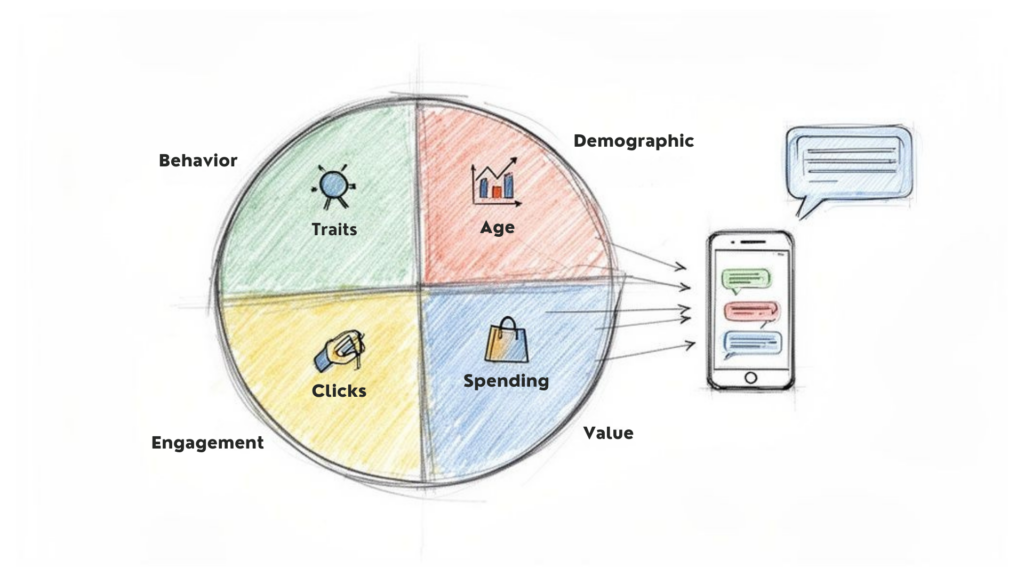
Stop broadcasting generic messages. The foundation of modern lead nurturing is personalization driven by precise audience segmentation. Instead of sending the same lead nurturing email to an entire database, high-performing teams divide contacts into smaller, behavior-based and intent-based groups that reflect where each prospect sits in the buyer’s journey. This structure allows every message to feel contextual rather than promotional, turning email nurturing from mass outreach into targeted communication that aligns with real user needs and timing.
When segmentation is integrated into a structured nurturing program, both automation systems and the sales rep operate with clearer intelligence instead of assumptions. Content becomes role-specific, lifecycle-specific, and problem-specific, which significantly increases engagement and conversion probability. The objective is not higher email volume but higher semantic relevance, where each interaction contributes to progressive trust rather than repetitive noise.
Customer Segmentation
This approach is powerful because it recognizes that a new subscriber who downloaded a beginner’s guide has different needs than a lead who repeatedly viewed your pricing page. Sending them the same message is a wasted opportunity.
How to Implement Audience Segmentation
Your goal is to create groups that allow for more targeted messaging. You don’t need dozens of segments to start.
- Behavioral: Group leads based on what they do. Have they visited your pricing page, downloaded an e-book, or abandoned a cart?
- Example: An e-commerce brand can create a segment of “cart abandoners” and send them a gentle reminder via Messenger, perhaps with a small discount code to encourage them to complete the purchase.
- Demographic: Segment by attributes like location, industry, or company size (for B2B).
- Example: A B2B software company can segment leads by company size to send tailored case studies—enterprise clients see case studies from Fortune 500s, while startups see stories from similar small businesses.
- Engagement Level: Create segments for highly engaged “hot leads” versus those who haven’t opened a message in 90 days. This allows you to run targeted re-engagement campaigns for the inactive group.
Pro Tip: In platforms like Clepher, you can automate this by applying tags based on user actions. If someone clicks a button for “Beginner Tips,” they are automatically tagged and added to your “Beginner” segment for future campaigns.
Start with 3-5 core segments to maintain focus. As you gather more data, you can refine your criteria for even greater personalization.
2. Implement Multi-Channel Nurturing Across Messenger, WhatsApp, and Instagram DM
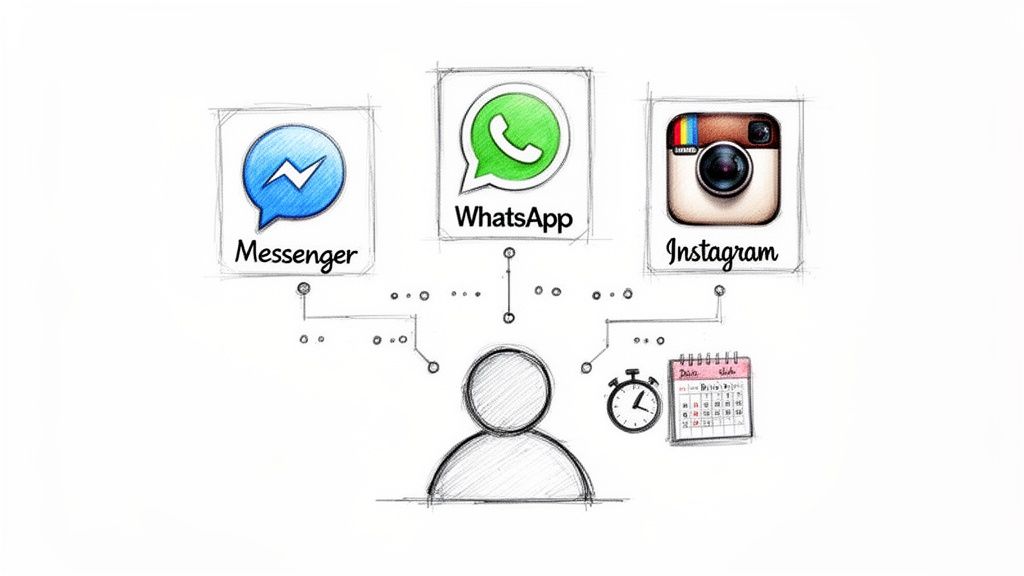
Relying only on email is like trying to have a conversation in an empty room. One of the most impactful lead nurturing best practices is to meet leads where they already spend their time: on messaging apps. A multi-channel strategy across platforms like Messenger, WhatsApp, and Instagram DM creates high-visibility touchpoints that get seen and acted on.
Digital Platforms
This approach leverages the immediacy and conversational feel of direct messaging. A notification from Instagram feels more personal and urgent than an email, leading to higher engagement and faster movement through your sales funnel. A comprehensive multi-channel marketing strategy ensures your message is seen, not lost in a crowded inbox.
How to Implement Multi-Channel Nurturing
The key is using each channel for its unique strengths while maintaining a cohesive message.
- Map Channels to the Journey: Use different platforms for specific stages. Messenger is great for initial discovery via a chatbot. Instagram DM is perfect for casual engagement. WhatsApp works well for high-priority messages like order confirmations or appointment reminders.
- Adapt Your Tone: Your brand voice should be consistent, but the tone can shift. Instagram DMs can be more informal and visual. WhatsApp communication should be concise and to the point.
- Respect the Rules: Stay compliant with platform policies, like using approved message templates for WhatsApp and respecting Instagram’s messaging windows, to protect your accounts.
Real-World Example: A real estate agent captures a lead via a Facebook ad that starts a Messenger conversation. They qualify the lead in Messenger, then send a personalized property listing via WhatsApp. After the viewing, they follow up on Instagram DM with a “behind-the-scenes” video of a similar property. This creates a seamless, high-touch experience.
Pro Tip: With Clepher, you can build a single automated flow that broadcasts messages across Messenger, Instagram DM, and WhatsApp. Use the platform’s random path distribution feature to A/B test which channel generates the best response for a specific campaign.
3. Use AI-Powered Lead Scoring to Prioritize High-Intent Prospects
Not all leads have the same purchase intent. One of the most effective lead-nurturing best practices is to identify your most valuable prospects and focus your energy there. AI-powered lead scoring automates this by assigning points to leads based on their behaviors (like visiting the pricing page) and demographics (like company size).
This system allows your sales team to stop chasing cold leads and engage with prospects who are already showing strong buying signals. It’s a data-driven approach that ensures high-value opportunities get immediate attention, dramatically improving your team’s efficiency and accelerating the sales cycle.
How to Implement AI-Powered Lead Scoring
A good lead scoring model combines demographic data with behavioral signals. The goal is to set up a system that automatically flags sales-ready leads.
- Identify Key Buying Signals: Pinpoint the actions that indicate high intent.
- For a SaaS company: Viewing the pricing page three times, starting a free trial, and watching a product demo video.
- For an e-commerce store: Adding multiple items to a cart, viewing a product more than once, and using the size guide.
- Assign Point Values: Give more points for high-intent actions. A “demo request” might be worth 50 points, while opening an email is only worth 5. Also, give more weight to recent activities.
- Set Score Thresholds: Establish clear benchmarks for action. A lead scoring over 75 might be automatically routed to the sales team for a personal follow-up. A lead with a score of 30-74 gets placed into a mid-funnel nurturing sequence to warm them up further.
For instance, a subscription box company could use AI to analyze user behavior. The model might discover that users who complete a personalization quiz and share it with a friend are 80% more likely to convert. These users would be automatically flagged as high-priority leads. To dive deeper into this process, you can learn more about how to qualify sales leads.
Pro Tip: Don’t rely on AI scores in isolation. Combine automated scoring with manual sales review. Regularly review your scoring model quarterly to ensure it accurately predicts conversions and aligns with your business goals.
4. Create Personalized Nurture Flows Based on Lead Behavior
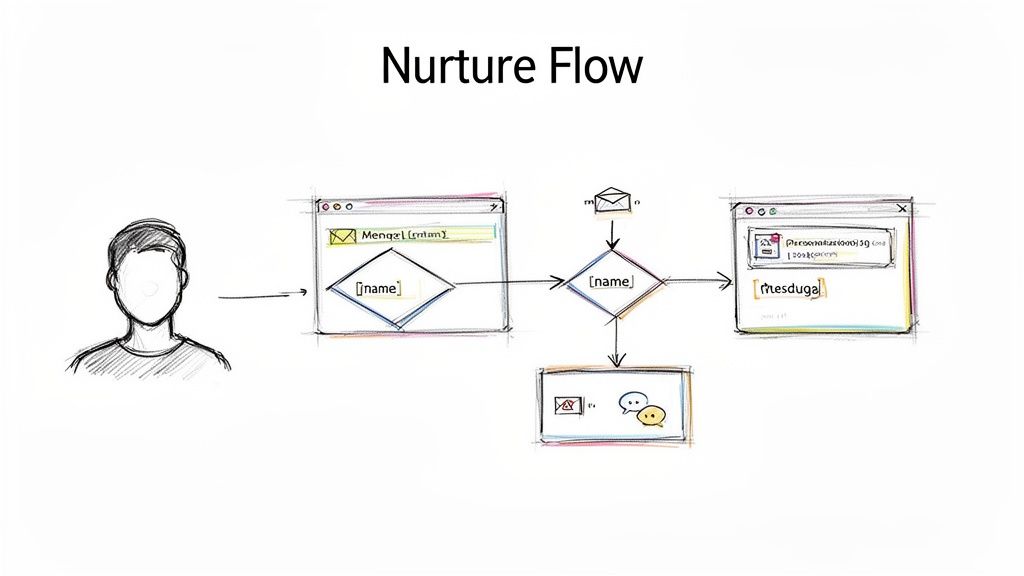
Effective lead nurturing goes beyond simple segmentation. It involves creating dynamic, personalized journeys based on what individual leads do. Instead of pushing everyone down the same path, behavior-triggered flows deliver content based on a lead’s specific actions.
This means a lead who downloads a product comparison guide receives a different follow-up sequence than someone who only watched a demo video. Every message feels relevant to their demonstrated interests.
Nurture Flow
This level of personalization dramatically increases engagement because you’re continuing a conversation the lead already started. You’re not just sending content; you’re guiding them from one stage to the next in a way that feels natural and helpful.
How to Implement Behavioral Nurture Flows
Building these flows requires mapping the customer journey and using automation to create customized paths.
- Map the Journey: Before building, sketch out the ideal customer journey. Identify key decision points and the content needed to address questions at each stage.
- Use Conditional Logic: Implement “if/then” decision points in your flows. For example, if a lead indicates their company size is “Enterprise,” route them to a flow showcasing enterprise-level features. If they say “SMB,” show them a different set of benefits.
- Keep it Simple at First: Start with a 3-5 step flow for a single behavior, like a cart abandonment sequence. You can add more complexity later as you gather data.
- Set Time Delays: Space out your messages to mimic a natural conversation. A follow-up one hour after an action is great, but three messages in three minutes is overwhelming.
Real-World Example: An online course creator offers a free webinar. Attendees who stay for the entire webinar get a follow-up message with a special early-bird discount. Those who left early receive a message with a link to the recording and a summary of what they missed.
Pro Tip: In Clepher, you can visually build these multi-path flows using a drag-and-drop builder. Set up triggers based on clicks, tags, or form submissions to automatically enroll leads into the correct nurturing sequence across any channel.
5. Leverage Interactive Content and Conversational Elements for Higher Engagement
Static content is a one-way street, while interactive formats turn attention into measurable engagement. Quizzes, polls, calculators, and conversational chatbots shift prospects from passive reading to active participation, which is one of the most effective lead nurturing tactics available today. Instead of forcing users through rigid forms, dynamic interactions create a two-way dialogue that feels assistive rather than promotional. This is why best lead nurturing frameworks increasingly prioritize interactivity over static downloads or generic landing pages.
The real advantage is data depth and intent clarity. Interactive experiences hold attention longer, surface preferences in real time, and provide richer qualification signals that directly improve lead conversion rate. When prospects choose answers, explore options, or converse with a bot, they reveal motivation patterns that static content never captures. This is where successful lead nurturing differentiates itself — not by volume of touchpoints, but by quality of engagement. Simply put, lead nurturing helps transform curiosity into actionable insight, allowing personalization to be driven by behavior rather than assumption.
How to Implement Interactive and Conversational Nurturing
The goal is to replace one-way communication with engaging experiences that guide leads toward a solution.
- Product Selector Quizzes: An e-commerce brand can use a chatbot to ask, “What’s your typical weekend style? Casual or dressy?” to recommend the perfect outfit.
- Capability Assessments: A digital agency can build a bot that asks about a lead’s marketing challenges to qualify them for different service packages.
- Interactive Demos: A SaaS company can use a chatbot to walk a lead through key product features in a step-by-step flow instead of just sending a link to a video.
Real-World Example: A financial advisor uses an interactive “Retirement Readiness” quiz delivered via chatbot. Based on the user’s answers about their age, savings, and goals, the bot provides a personalized score and offers to book a free consultation to discuss the results. This turns a cold lead into a warm, qualified appointment.
Pro Tip: In Clepher, you can build these interactive flows without any code. Use elements like quick reply buttons to guide the conversation. Gradually ask for information across multiple interactions to build a complete lead profile without overwhelming them.
6. Implement Lead Capture Widgets and Forms Strategically Across Customer Touchpoints
Effective lead nurturing begins at the point of capture. Simply having a form on your contact page isn’t enough. A key best practice is the strategic placement of lead capture widgets and forms across all high-traffic customer touchpoints. This ensures you capture leads at the peak of their interest, improving both the quantity and quality of new subscribers.
This strategy is about meeting potential customers where they are, when they are most receptive. Instead of a passive “Contact Us” page, you actively present relevant offers based on user behavior, such as exit intent (when they are about to leave your site), scroll depth, or time on page. This turns your website from a simple brochure into a lead generation engine.
How to Implement Strategic Lead Capture
The goal is to make it incredibly easy for visitors to opt in by presenting a compelling offer at the perfect moment.
- Behavior-Based Triggers: Deploy widgets based on user actions. An exit-intent pop-up offering a 10% discount can capture a shopper before they leave. A slide-in widget offering a free guide after a user scrolls 50% down a blog post targets highly engaged readers.
- Contextual Placement: Tailor the offer to the page. A blog post about social media should feature a form for a “Social Media Strategy” template. A service page is the perfect place for a “Get a Free Quote” widget.
- Form Optimization: Keep initial forms short. Ask for just an email. You can gather more details later in your automated follow-up sequences. The easier it is to sign up, the higher your conversion rate will be.
Real-World Example: A SaaS company places a “Book a 15-Min Demo” widget that only appears on their pricing page after a visitor has been there for 60 seconds. This targets users who are clearly showing high purchase intent.
Pro Tip: Use a tool like Clepher’s Capture Widget system to deploy unlimited, customized widgets across your web pages. You can A/B test different triggers (e.g., exit-intent vs. time on page) and offers to find the highest-converting combination for each page on your site.
7. Send Strategic Follow-Up Messages at Optimal Timing
The right message at the wrong time is just noise. Timing your communication to perfection can dramatically improve open rates, click-throughs, and conversions. Sending a message when a lead is most likely to be active feels like a helpful, personal conversation.
This strategy acknowledges that optimal send times vary by channel and audience. A B2B professional checks their email at different times than a consumer browsing Instagram on the weekend. Sending a blanket broadcast ignores these crucial patterns and reduces your campaign’s effectiveness.
How to Implement Strategic Timing
Analyze your engagement data and audience behavior to build a sending schedule that aligns with when your leads are most receptive.
- Channel-Specific Timing: Optimize for each platform. Messenger often sees peaks mid-morning (9-11 AM) and early evening (5-7 PM).
- Audience-Specific Timing: Tailor schedules to your segments. B2B leads are generally most responsive during business hours (Tuesday-Thursday mornings), whereas B2C audiences may engage more on evenings and weekends.
- Time Zone Optimization: If you have a global audience, messages must be sent according to each lead’s local time zone to avoid sending updates in the middle of their night.
Real-World Example: An e-commerce brand schedules a flash sale announcement for Sunday evening, when consumers are relaxing and browsing online. A SaaS company, on the other hand, sends a new feature update on a Tuesday morning, when their B2B clients are at their desks and focused on work.
Pro Tip: In Clepher, you can easily schedule broadcasts and optimize for time zones. The platform’s analytics also help you identify when your specific audience is most engaged, allowing you to use data-driven timing for your campaigns.
Start with established best practices for each channel, then use your own performance data to pinpoint the perfect send times for each audience segment.
8. Implement Progressive Profiling to Gather Data Without Friction
Asking for a lead’s entire life story on the first form is a guaranteed way to kill conversions. Progressive profiling avoids this by collecting information gradually over multiple interactions. Instead of one intimidating form, you gather data across natural touchpoints, building a rich customer profile without overwhelming the user.
This approach respects the user’s time and builds trust. The first interaction might only ask for an email, while a later chatbot conversation could ask about their specific challenges. This method balances your need for data with the user’s need for a good experience.
How to Implement Progressive Profiling
Turn data collection into a two-way conversation, not an interrogation.
- Initial Capture: Keep the first form simple: just an email address or name. This maximizes top-of-funnel conversions.
- Secondary Questions: In a follow-up message or a second interaction, ask the next most important question. After a lead downloads a whitepaper, a SaaS company could ask for “company size” in the follow-up chat.
- Conversational Data Gathering: Use chatbot quizzes to gather information in an engaging way. Ask about their goals or pain points to better tailor your content.
Real-World Example: A fitness coach’s website first captures an email with a free meal plan. In the follow-up Messenger flow, the chatbot asks, “What’s your primary fitness goal? (e.g., Lose Weight, Build Muscle).” This single piece of data allows the coach to send highly targeted content moving forward.
Pro Tip: Use automation tools like Clepher to make progressive profiling seamless. You can use custom fields to store new information gathered during a chatbot conversation. Set up flows that use conditional logic to only ask questions you don’t already have answers for.
9. Use A/B Testing to Continuously Optimize Messaging and Strategy
Effective lead nurturing is not “set it and forget it.” To truly excel, you must embrace continuous optimization through A/B testing. This practice involves creating two versions of a message (Version A and Version B) and sending them to different subsets of your audience to see which performs better. By letting data, not assumptions, guide your decisions, you can systematically improve your results over time.
This is crucial because what resonates with your audience today might not work tomorrow. A/B testing helps you understand their preferences, from the subject lines that grab their attention to the calls-to-action that drive them to convert.
How to Implement A/B Testing
The core principle is to test one variable at a time to get clean, actionable results.
- Test High-Impact Variables First: Start with elements that have the biggest influence, such as the opening line of a message, the call-to-action (CTA) button text, or the main image.
- Establish a Clear Hypothesis: Before launching a test, define what you are testing and what you expect the outcome to be. For example, “A CTA button with ‘Get My Discount’ will have a higher click-through rate than ‘Learn More’.”
- Ensure Statistical Significance: Your test needs a large enough sample size to be reliable. Aim for at least 100 responses per variation to trust the results.
Real-World Example: An e-commerce brand could test a “20% Off” offer against a “Free Shipping” offer to see which incentive drives more conversions for a specific product category. They might find that for higher-priced items, “Free Shipping” is the more powerful motivator.
Pro Tip: Within Clepher, you can build A/B tests directly into your flows. Use the “A/B Split” action to send 50% of users down one message path and 50% down another. The platform tracks the results, allowing you to see which branch leads to more clicks or conversions, so you can make the winning version the default.
Document every test. This creates a knowledge base that compounds over time, leading to consistent, data-backed improvements.
10. Maintain Consistent Communication Cadence and Align Sales & Marketing
Effective lead nurturing requires a delicate balance—staying top-of-mind without being annoying. This is where a consistent communication cadence and tight alignment between sales and marketing become critical. These two pillars work together to deliver the right message at the right time while ensuring qualified leads are handed off seamlessly for conversion.
This dual approach prevents two common failures: marketing bombarding uninterested leads and sales wasting time on unqualified prospects. By establishing a predictable rhythm and a unified definition of a “good lead,” you build a more efficient and effective nurturing engine.
How to Implement Cadence and Alignment
Map out your communication frequency and formalize the lead handoff process. This ensures marketing nurtures effectively and sales acts decisively.
- Define Your Cadence: Plan your message frequency. An e-commerce brand might send two promotional messages and one educational tip weekly. A B2B SaaS company may send an onboarding message every few days, then transition to a weekly newsletter.
- Establish Clear Lead Stages: Work with sales to define a Marketing Qualified Lead (MQL) and a Sales Qualified Lead (SQL). An MQL might be someone who downloaded a guide. An SQL has also viewed the pricing page and requested a demo.
- Create a Service Level Agreement (SLA): This is a formal agreement between teams. For example, sales agrees to contact all SQLs within four hours. Marketing agrees to continue nurturing any leads that sales disqualifies.
Pro Tip: Distribute your touchpoints across different channels. A weekly plan could involve a Messenger broadcast on Monday, an educational email on Wednesday, and a promotional WhatsApp message on Friday. This multi-channel approach keeps your brand present without being repetitive on a single platform.
Start with a conservative cadence, like one or two touchpoints per week, and monitor unsubscribe rates. If engagement remains high, you can test a higher frequency.
Lead Nurturing Best Practices — 10-Point Comparison
| Strategy | 🔄 Implementation complexity | ⚡ Resource requirements | 📊 Expected outcomes | 💡 Ideal use cases | ⭐ Key advantages |
|---|---|---|---|---|---|
| Segment Your Audience for Targeted Messaging | Medium — setup tagging, data hygiene, ongoing refinement | Moderate — CRM/custom fields, analytics, maintenance | High — higher relevance, conversion uplift, lower churn | Personalization at scale (e‑commerce recs, SaaS tiers, multi-client agencies) | ⭐ Greater relevance; improved ROI; cleaner A/B testing |
| Implement Multi-Channel Nurturing Across Messenger, WhatsApp, and Instagram DM | High — coordinate formats, compliance, channel logic | High — channel integrations, content variants, and monitoring | Very high — much higher open/response rates vs email alone | Brands with cross-platform audiences, flash sales, and agencies | ⭐ Reach where users are; omnichannel sync; better CTRs |
| Use AI-Powered Lead Scoring to Prioritize High-Intent Prospects | High — model training, validation, bias checks | High — historical data, ML tooling, sales-marketing alignment | High — faster sales cycles, higher conversion efficiency | High-volume lead environments (SaaS, enterprise sales) | ⭐ Prioritizes effort; increases sales productivity; reduces waste |
| Create Personalized Nurture Flows Based on Lead Behavior | Medium–High — conditional logic and testing required | Moderate — flow builder, content variants, testing time | High — stronger engagement and conversion lift | Behavior-driven journeys (downloads vs demo watchers, product interest) | ⭐ Scales personalization; matches messages to intent |
| Leverage Interactive Content and Conversational Elements | Medium — UX design, flow testing, mobile optimization | Moderate — bot builder, media assets, analytics for conversation paths | High — 2–3x engagement; richer preference data for qualification | Product selectors, quizzes, assessment bots, qualification flows | ⭐ Higher engagement; better data capture; real-time qualification |
| Implement Lead Capture Widgets and Forms Strategically | Low–Medium — placement strategy and optimization | Low–Moderate — widget setup, copy/design, A/B tests | Moderate — converts 2–5% visitors; recovers exit intent | Landing pages, blog content, pricing pages, and exit intent offers | ⭐ Quick deployment; increases lead volume; A/B testable |
| Send Strategic Follow-Up Messages at Optimal Timing | Medium — analysis of patterns, time-zone logic | Moderate — analytics, scheduling, timezone features | Moderate–High — improved open/response rates; less fatigue | Time-sensitive campaigns; global audiences; onboarding sequences | ⭐ Better open rates; reduced fatigue; channel-aware timing |
| Implement Progressive Profiling to Gather Data Without Friction | Medium — multi-step logic, CRM sync, tracking | Moderate — smart forms, conversational questions, field logic | High — higher initial conversions and richer profiles over time | High-value sales cycles, long nurture funnels, and personalization needs | ⭐ Higher capture rates; richer lead records; reduced friction |
| Use A/B Testing to Continuously Optimize Messaging and Strategy | Medium — experiment design and statistically valid analysis | Moderate — traffic/sample size, testing tools, reporting time | Incremental gains — small wins compound (5–15% quarterly) | Messaging, subject lines, CTAs, send times, channel experiments | ⭐ Data-driven decisions; reduces guesswork; continuous improvement |
| Maintain Consistent Communication Cadence and Align Sales & Marketing | High — process, SLAs, cross-team coordination | Moderate–High — CRM integration, meetings, routing rules | High — fewer lost leads, better conversion, reduced churn | Org with sales handoffs; complex funnels; long nurture cycles | ⭐ Improves handoffs; prevents fatigue; aligns teams and KPIs |
From Leads to Loyal Customers: Your Nurturing Blueprint
Turning a new lead into a loyal customer is the ultimate goal. These ten lead-nurturing best practices provide a complete blueprint for getting there. This isn’t about sending more messages; it’s about engineering a better customer experience—one that feels personal, timely, and genuinely helpful.
We’ve moved beyond generic advice to focus on the specific mechanics of modern nurturing. From the power of audience segmentation to the engagement-boosting potential of multi-channel messaging across platforms like Messenger and Instagram, the core principle is the same: meet your customers where they are with the right message at the right time.
The Shift from Broadcasting to Conversing
The most critical takeaway is the shift from a ‘batch and blast’ mindset to one of fostering one-on-one conversations at scale. This is where automation and personalization truly shine.
- AI-Powered Lead Scoring: No longer a guessing game, you can now scientifically prioritize your efforts on leads showing the highest purchase intent.
- Behavior-Based Flows: By triggering nurture sequences based on specific actions, you ensure every communication is contextually relevant.
- Progressive Profiling: You can systematically build rich customer profiles without scaring new leads away with long, intimidating forms.
These strategies transform your marketing from a monologue into a dynamic dialogue. You are no longer just pushing information; you are actively listening and responding to user behavior, creating a feedback loop that continuously refines your approach.
Your Actionable Path Forward
Don’t feel pressured to implement all ten practices at once. Instead, identify the biggest opportunity for your business right now.
Perhaps you have a high volume of leads but no segmentation. Start there. Or maybe your email open rates are plummeting, making a pivot to multi-channel nurturing the logical next move. Choose one or two key practices, such as implementing strategic follow-up timing or introducing A/B testing, and commit to mastering them.
By focusing your efforts, you can generate measurable wins that build momentum. Each successful test and every refined segment will provide valuable data, informing your next move and compounding your results over time. The goal is to build an intelligent, automated system that not only converts leads but also builds lasting brand affinity. Your leads are not just entries in a database; they are future customers waiting for an experience that proves you understand them. It’s time to deliver it.
Ready to put these advanced lead nurturing best practices into action with powerful automation? Clepher provides the all-in-one platform to build intelligent, multi-channel funnels, segment your audience with precision, and convert more leads into customers. Explore how Clepher can transform your lead nurturing from a manual chore into your most effective growth engine.
Related Posts
How to Create Email Lists in Gmail (The Right Way)
March 21, 2026Create a Group Email List in Gmail the Right Way
March 20, 202610 Actionable Lead Scoring Best Practices for 2026
March 19, 2026
Founder Clepher