
In a world of endless digital conversations, how do you find the ready-to-buy customers among the casual browsers? The answer isn’t more data; it’s smarter data. Lead scoring is the system that bridges chaotic marketing activity and a focused sales team, automatically telling you, “Pay attention to this person, right now.”
But many businesses get stuck in theory, creating complex models that don’t translate to sales. This guide is different. We’re breaking down 10 proven, actionable lead scoring best practices you can implement immediately. Forget abstract concepts; this is about practical steps and real-world workflows that turn engagement into revenue, especially on conversational channels like Messenger and Instagram, where buying intent is revealed instantly.
This process requires a system to track and assign these values automatically. A crucial first step is to research the right lead scoring software that integrates with your existing tools. By the end of this list, you’ll have a clear blueprint for a lead scoring machine that identifies your hottest leads and gets them to sales faster than ever.
Here’s what we’ll cover:
- Prioritizing behavioral signals over simple demographics.
- Automating workflows with AI and keyword detection.
- Establishing clear handoff criteria between marketing and sales.
- Auditing and refining your scoring model against actual conversion data.
1. Implement Multi-Channel Lead Scoring Across Messaging Platforms
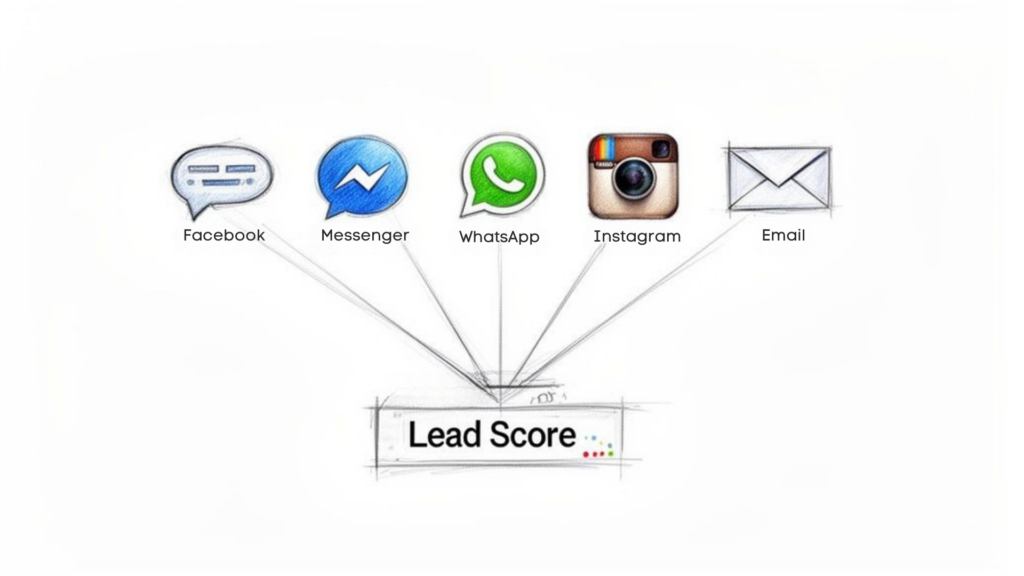
Old-school lead scoring often just looks at email or website activity. That approach misses most of the modern customer journey, which happens in chatbots, social media DMs, and messaging apps. A multi-channel lead scoring strategy creates a complete picture of a prospect’s engagement by tracking their behavior everywhere they interact with you—from your website to Facebook Messenger, Instagram, and WhatsApp.
This method assigns points based on actions and keywords on each platform, so no high-intent interaction is missed. A lead’s score becomes a true reflection of their overall interest, not just a partial snapshot.
Lead Scoring
The Transformation
A multi-channel model prevents valuable leads from slipping through the cracks. A prospect who asks about pricing in an Instagram DM is just as qualified—if not more so—than someone who downloads a PDF. Scoring these conversational signals gives your sales team an accurate, real-time view of who is ready to buy.
Actionable Insight: The hottest leads often reveal their intent through direct questions on messaging apps. Ignoring these signals means leaving revenue on the table.
How to Make It Happen
To put this into action, you need to connect these separate channels into one system.
- Integrate Your Platforms: Use a tool like Clepher to connect your website chatbots, Facebook Messenger, Instagram DMs, and CRM. This creates a central hub where all interactions are logged and scored against a single contact.
- Assign Points to Key Actions: Define high-value actions for each channel and assign points. For example:
- Instagram DM: Asks for a “price” or “link to buy” = +15 points
- Website Chatbot: Requests a “demo” = +20 points
- Facebook Messenger: Mentions a competitor’s name = +10 points
- Set Up Automated Tagging: Create rules that apply tags when a lead hits a score threshold. For instance, once a lead reaches 50 points, automatically tag them as a “Marketing Qualified Lead” (MQL) and notify your sales team. This is one of the most effective lead scoring best practices for accelerating the sales cycle.
2. Prioritize Behavioral Scoring Over Demographic Data
Focusing only on demographics like company size or job title gives you an incomplete picture. A more powerful approach prioritizes behavioral scoring, which assigns value based on a prospect’s real-time actions. This method recognizes that buying intent is shown through behavior, making it a much better predictor of who will convert.
For example, an online course seller should score a prospect higher for completing a preview lesson (+20 points) than for having a certain job title (+5 points). This shift from static attributes to dynamic actions makes your scoring reflect genuine interest.
The Transformation
Demographics tell you who a person is, while behavior tells you what they want. A lead asking product questions in a Messenger chat shows clear intent, regardless of their job title. Prioritizing engagement allows your sales team to focus on prospects who are actively moving toward a purchase, not just those who fit a profile.
Actionable Insight: A prospect’s actions speak louder than their demographic profile. High-engagement behaviors are the most reliable signs of a lead who is ready to convert.
How to Make It Happen
To make this work, define and track the specific actions that lead to a sale.
- Map Key Engagement Actions: Identify behaviors that signal strong interest. This could include message opens, conversation depth, or clicks on specific links. For an e-commerce brand, a customer repeatedly asking about product availability in DMs is a much stronger signal than just a page view.
- Assign Weighted Scores to Behaviors: Create a point system that values high-intent actions more.
- Message Sent: +5 points
- Specific Product Mentioned: +10 points
- Price Inquiry: +15 points
- Booking Link Clicked: +25 points
- Track Conversation Depth and Recency: Use a platform like Clepher to automatically track how many back-and-forth messages occur. You can also add points when a prospect returns to a conversation within 24-48 hours, signaling they’re still thinking about your offer. This is one of the most effective lead scoring best practices for finding motivated buyers.
3. Automate Lead Scoring with AI-Powered Keyword Detection
Manual lead scoring is slow and can’t keep up with real-time conversations. To stay ahead, use AI-driven systems that automatically detect intent-rich keywords within chats. This method assigns scores instantly without human review, identifying high-potential leads the moment they express interest.
This enables real-time scoring as conversations happen. A prospect asking about “pricing” in a chatbot can be immediately scored and routed to a sales rep before they lose interest—making this one of the most effective lead scoring best practices for accelerating your sales cycle.
The Transformation
AI-powered keyword detection shifts your scoring from reactive to proactive. Instead of waiting for someone to review activity logs, the system identifies buying signals as they happen. An e-commerce brand can instantly flag a customer who messages “checking inventory,” while a SaaS company can prioritize someone who mentions a “demo request.”
Actionable Insight: Your response speed is directly tied to your conversion rate. AI keyword detection closes the gap between a prospect’s question and your sales team’s answer, capturing leads at their peak interest.
How to Make It Happen
Setting up automated keyword scoring involves creating a smart system that listens for and acts on specific phrases.
- Create Tiered Keyword Lists: Not all keywords have the same value. Group them by sales funnel stage and assign points.
- Awareness Stage: “how does it work,” “learn more” = +5 points
- Consideration Stage: “pricing,” “vs competitor,” “features” = +15 points
- Decision Stage: “demo request,” “get a quote,” “buy now” = +30 points
- Use AI Keyword Triggers: Tools like Clepher let you set up automations that trigger when specific keywords are detected. Use this to automatically add points to a lead’s score, apply a tag, and notify a sales rep in real time. For a deeper look at the technology, explore chatbot natural language processing.
- Combine with Behavioral Scoring: Make your scoring more robust by layering keyword detection with other actions. For instance, a lead who mentions “pricing” (+15 points) and also clicks the pricing page link you send (+10 points) would get a total of 25 points, signaling even higher intent.
4. Establish Clear MQL to SQL Handoff Criteria
One of the biggest failures in lead generation happens at the handoff between marketing and sales. A high lead score is useless if the sales team doesn’t agree that the lead is ready. Establishing explicit criteria for when a Marketing Qualified Lead (MQL) becomes a Sales Qualified Lead (SQL) bridges this gap and aligns both teams.
This practice involves creating a formal Service Level Agreement (SLA) that defines the exact score and behaviors required for a lead to be passed to sales. It stops marketing from sending unqualified prospects and holds sales accountable for following up on warm leads.
The Transformation
Clear MQL-to-SQL criteria eliminate friction and finger-pointing between teams. When sales trusts the quality of the leads they receive, follow-up times shorten and conversion rates improve. Marketing gets clear feedback, allowing them to refine their campaigns to attract better prospects, creating an efficient revenue engine.
Actionable Insight: The MQL-to-SQL handoff is a pact. A shared definition of a “qualified lead” is the foundation of a high-performing revenue team and one of the most critical lead scoring best practices for growth.
How to Make It Happen
Building this alignment requires collaboration and clear documentation.
- Define Criteria Together: Host a workshop with marketing and sales. Agree on specific signals that define an SQL. For example:
- SaaS Business: An MQL with 40+ points who confirms their budget and timeline is an SQL.
- DTC Agency: An MQL with 25+ points who has asked at least two product questions in Messenger is an SQL.
- Document and Share: Record these definitions in a shared document that’s easy for both teams to access. This “single source of truth” prevents confusion. You can learn more about how to qualify sales leads effectively in our detailed guide.
- Automate the Handoff: Use a platform like Clepher to build workflows that automatically route leads to your CRM (via Zapier or native integrations) once they meet the SQL criteria. Tag them and notify the assigned sales rep for immediate action.
- Establish Sales Acceptance Rules: Require sales to formally accept or reject leads in the CRM within 24 hours, providing a clear reason for any rejections. This feedback is gold for optimizing your scoring model.
5. Weight Recent Activity Higher Than Historical Data
A lead’s score shouldn’t be a permanent record. A prospect who downloaded an ebook six months ago is far colder than one who just asked for pricing in your chatbot. This is where time decay and velocity scoring come in. By giving more weight to fresh, rapid engagement, your scoring system becomes a dynamic reflection of current buying intent.
This method recognizes that a prospect’s interest has a shelf life. It ensures your sales team focuses on leads showing momentum right now, not those whose interest has faded. The more recent and frequent the engagement, the hotter the lead.

Lead Scoring Priority Timeline
The Transformation
Traditional models that treat a year-old click the same as one from yesterday will mislead your sales team. Time-sensitive scoring keeps your pipeline fresh and accurate, directing reps to prospects who are actively in a buying cycle. A SaaS lead engaging with your features page multiple times in a single week is showing a clear, present need.
Actionable Insight: Purchase intent is a wave of momentum. Scoring for recency and velocity lets your sales team catch that wave at its peak, right before a decision is made.
How to Make It Happen
Building this into your model requires rules that adjust scores based on time and frequency.
- Establish Score Decay Rates: Implement rules that automatically reduce a lead’s score over time. This keeps your MQL list clean. A simple model could be:
- 7-Day Decay: Reduce score by 10% if no new engagement.
- 14-Day Decay: Reduce score by an additional 25%.
- 30-Day Decay: Reduce score by another 40%.
- Create Velocity Bonuses: Reward rapid engagement with score spikes. For instance, if a prospect sends three or more high-intent messages across any channel within 48 hours, add a +20 point velocity bonus to their score.
- Set Score Refresh Triggers: When a dormant lead re-engages, their score should reflect their renewed interest. Create an automation that resets their score decay and brings them back to “active” status. This is a crucial step in effective lead scoring best practices.
6. Score Different Buyer Personas Separately
A one-size-fits-all model misses opportunities. Different buyer personas have unique needs and behaviors, so a high-intent signal for one segment could be mere curiosity for another. Creating separate scoring models for your key customer types allows you to evaluate leads with context that matters to them.
For example, an agency’s scoring for a small business prospect should prioritize signals of urgency, while its enterprise model should focus on actions that indicate committee-based buying, like multiple people from one company downloading a whitepaper.
The Transformation
Segmented scoring stops you from applying generic rules to different buying journeys. An online course creator knows a first-time student is price-sensitive, so questions about payment plans are high-intent. A seasoned coach looking for a “done-for-you” service will signal intent by asking about premium support. Separating these models aligns your scoring with real-world buyer behavior, one of the most effective lead scoring best practices for accuracy.
Actionable Insight: The value of a lead’s action is relative to their persona. Scoring them separately turns generic data into precise, actionable intelligence about their specific buying intent.
How to Make It Happen
Start by identifying your main buyer personas and building a scoring framework for each. You can learn more about defining your ideal customer to create accurate buyer personas.
- Identify 3-4 Key Personas: Don’t over-segment. Focus on the most distinct and valuable customer groups. For an e-commerce brand, this might be “New Customer,” “Repeat Customer,” and “High-Value VIP.”
- Assign Persona-Specific Scores: Use custom fields to automatically assign leads to a persona. Then, set unique scoring rules:
- SaaS SMB Persona: Requesting a “monthly plan” demo = +25 points (high intent)
- SaaS Enterprise Persona: Requesting the same demo = +10 points (early stage interest)
- E-commerce Repeat Customer: Abandons cart = +15 points (retargeting priority)
- Set Different Thresholds: A lead’s qualification score should reflect their persona’s typical sales cycle. An SMB lead might become an SQL at 30 points, whereas an enterprise lead, who needs more nurturing, might not qualify until 50 points.
7. Integrate Lead Scores with Your CRM for Automatic Routing
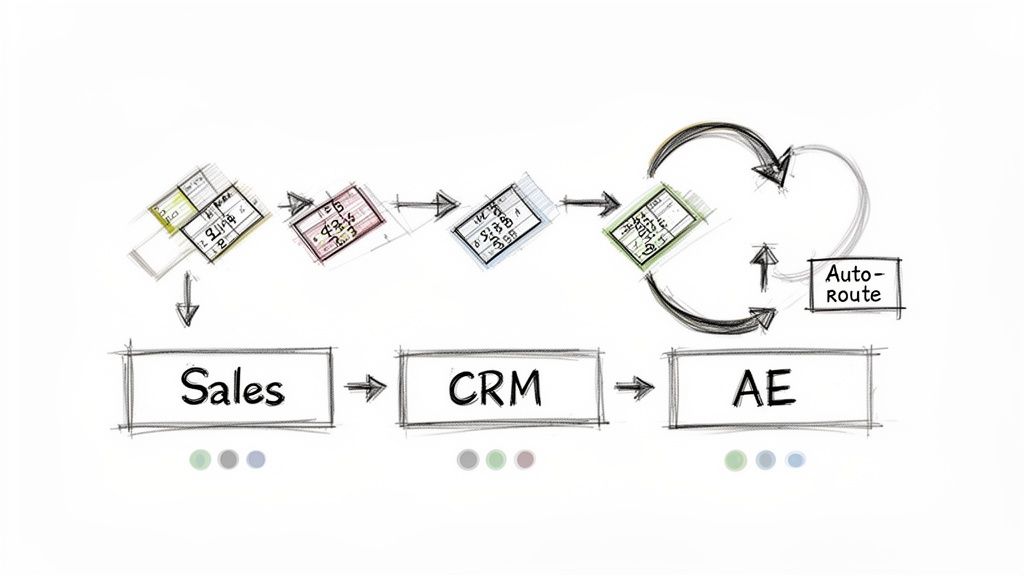
A robust lead scoring system generates data, but its power is only unlocked when that data triggers immediate action. Integrating your lead scoring platform with your CRM automates the handoff process, ensuring high-scoring leads are routed to the right sales reps without any manual delay.
Lead Scoring Workflow
The Transformation
Speed is critical in sales. The odds of converting a lead drop significantly with every minute that passes. Automatic routing eliminates delays, placing hot leads in front of your sales team the moment they hit a score threshold. An e-commerce brand can send a lead who reaches 40 points to their CRM and have them assigned to a sales rep in under 60 seconds.
Actionable Insight: Automation doesn’t just make your process more efficient; it makes it more effective. Immediate routing based on lead scores directly increases the likelihood of conversion.
How to Make It Happen
Connecting your systems is the key to making your scores actionable.
- Map Scores to CRM Status: Define what scores correspond to different stages. For example, map Clepher scores to a CRM lead status like MQL at 25 points, SQL at 40 points, and “Sales-Ready” at 60 points.
- Set Up Assignment Rules: Use your CRM’s built-in automation (like HubSpot’s workflows) to create routing logic. You could route MQLs into a nurture sequence and assign SQLs to the next available account executive.
- Use Native Integrations or Zapier: Connect your systems with zero-code solutions. Clepher offers native integrations with popular CRMs like HubSpot and Pipedrive, while Zapier can connect it to nearly any other sales tool. This makes building automated workflows simple.
- Customize CRM Views: Add the “Lead Score” field to your CRM list views. This small change allows reps to instantly see and prioritize the most engaged contacts, one of the most practical lead scoring best practices for daily sales operations.
8. Regularly Audit Your Scoring Model Against Actual Sales Data
Launching a lead scoring model is not a “set it and forget it” task. The best systems are dynamic. Regularly auditing your model against actual sales outcomes is critical to ensure its accuracy. This means comparing a lead’s score with whether it actually converted into a sale.
Without this validation, your scoring model can quickly become outdated, assigning high scores to actions that no longer signal buying intent. This leads to sales teams wasting time on poorly qualified leads while high-potential prospects are overlooked.
The Transformation
Auditing closes the loop between marketing assumptions and sales reality. A SaaS company might score “demo attended” at 40 points, but if those leads only convert 12% of the time, the score is inflated. An audit reveals these issues, allowing you to recalibrate weights based on what actually drives conversions. This continuous improvement is one of the most important lead scoring best practices for long-term success.
Actionable Insight: Your lead scores are hypotheses about buyer intent. You must test these hypotheses against real conversion data to prove they work and refine your model.
How to Make It Happen
Set up a recurring process to analyze and adjust your model based on performance data.
- Establish a Reporting Cadence: Create a monthly or quarterly report that tracks how lead scores map to conversion rates at each stage: MQL, SQL, and closed-won deals.
- Calculate the Average Score of Won Deals: Analyze all your closed-won deals from the last period and find their average lead score. If your average winning score is 35, but you’re passing leads with scores of 70 to sales, some of your criteria are likely overvalued.
- A/B Test Scoring Changes: When you identify a potential improvement, don’t change the whole system. Run an A/B test by applying the new logic to 50% of incoming leads while the old model runs on the other 50%. Compare conversion rates to validate your changes.
- Collaborate with Sales: Schedule quarterly meetings with the sales team to review the data. They provide invaluable qualitative feedback on lead quality that numbers alone can’t capture. Use their insights to adjust scoring rules.
9. Use Score Decay and Re-engagement Triggers for Stale Leads
A lead’s score should reflect their current interest, not past behavior. Without a decay mechanism, a lead who was hot three months ago will clog your pipeline with an artificially high score. Implementing lead score decay automatically reduces a lead’s score over time when they show no engagement, ensuring your team focuses only on active prospects.
This works with re-engagement triggers. When a dormant lead shows new interest (e.g., messages your chatbot), an automated workflow can instantly boost their score and flag them for follow-up. This keeps your lead data clean and responsive.
The Transformation
Score decay stops sales reps from wasting time on leads who are no longer interested. It cleans the pipeline, improves forecast accuracy, and directs effort where it matters most: on prospects showing current buying intent. Re-engagement triggers create a safety net, ensuring you never miss an opportunity when a cold lead warms back up.
Actionable Insight: A high score is only valuable if it’s recent. Lead score decay ensures your “hot leads” list is a true reflection of immediate opportunity, not a museum of past interest.
How to Make It Happen
You can build these rules directly into your marketing automation platform.
- Set a Decay Schedule: Create rules that subtract points based on inactivity. For a SaaS business, you might set a schedule like this:
- 14 days inactive: -5 points
- 30 days inactive: -10 points
- 60 days inactive: -20 points (until a minimum score is reached)
- Create “Resurrection” Workflows: Build automation that reverses the decay. If a lead with a score below 15 messages your chatbot, you could automatically add a +25 point bonus and reset their decay clock.
- Trigger Re-engagement Campaigns: Use lead scores to identify stale leads for nurturing. For example, set up a rule in Clepher to automatically send a targeted message to any lead whose score drops below 10 and who hasn’t engaged in 45 days. This is one of the most effective lead scoring best practices for reactivating your audience.
10. Create Transparent Scoring Communication for Sales Team Alignment
A lead scoring model is only as good as the sales team’s belief in it. If reps don’t understand or trust the scores, they will ignore them. Creating clear, documented explanations of how your scoring system works is essential for building alignment and ensuring your model gets used.
This involves showing the sales team exactly what behaviors trigger points, why certain actions are weighted more heavily, and how the scores correlate with real sales. When sales sees the logic and data behind a score, they gain confidence and prioritize leads correctly.
The Transformation
Transparency turns lead scores from a mysterious metric into a trusted sales tool. When the sales team understands that a lead with 50 points has a proven 35% higher chance of closing than a lead with 10 points, they will naturally focus their energy on the higher-value opportunities. This makes the system work.
Actionable Insight: Sales teams won’t follow a black-box algorithm. Proving the “why” behind your scoring model with data and clear communication is the fastest way to get their buy-in and improve sales efficiency.
How to Make It Happen
Building trust requires a consistent communication strategy.
- Develop a Scoring “One-Pager”: Create a simple, visual guide that breaks down the model. Post it in Slack or embed it in the CRM dashboard. Clearly state the value of key actions, like “Requesting a demo = +20 points (these leads have a 45% meeting-booked rate).”
- Host Regular Deep-Dive Calls: Schedule monthly or quarterly meetings where marketing explains the model’s performance and sales provides direct feedback. This creates a collaborative loop where reps feel heard and the model is continuously improved.
- Share Performance Reports: Build a CRM report that shows the average lead score by sales rep alongside their close rate. This visually demonstrates the link between focusing on high-scoring leads and achieving better sales outcomes. This is one of the most important lead scoring best practices for long-term success.
Top 10 Lead Scoring Best Practices Comparison
| Approach | Complexity 🔄 | Resource Requirements ⚡ | Expected Outcomes ⭐ | Ideal Use Cases 📊 | Key Advantages & Tips 💡 |
|---|---|---|---|---|---|
| Implement Multi-Channel Lead Scoring Across Messaging Platforms | High — requires integrations and data consolidation across channels | Engineering + data pipeline + privacy compliance effort | ⭐⭐⭐⭐ — complete cross-channel view, fewer missed interactions | E‑commerce, DTC agencies, SaaS with multi-touch buyers | Use unified DB, set channel-specific thresholds, and leverage Clepher’s native integrations |
| Behavioral and Engagement-Based Scoring Over Demographic Data Alone | Medium — requires event tracking and calibration | Moderate analytics and conversation-tracking capacity | ⭐⭐⭐⭐ — more predictive of purchase intent than demographics | Online courses, e‑commerce product inquiries, and coaching services | Score explicit behaviors, use time decay, and build separate models for visitor types |
| Automate Lead Scoring Workflows with AI-Powered Keyword Detection | Medium–High — NLP model training and tuning needed | AI tooling, high-quality conversational data, and monitoring | ⭐⭐⭐⭐ — instant identification of high-intent leads in real time | SaaS demo requests, e‑commerce “ready to buy” signals, and agencies | Create tiered keyword lists, combine with behavior scoring, and test detection monthly |
| Establish Clear MQL to SQL Handoff Criteria and Sales Acceptance Standards | Medium — requires cross-team alignment and documented SLAs | Organizational time for workshops, documentation, workflow config | ⭐⭐⭐⭐ — improved handoffs, accountability, and conversion tracking | Companies with separate marketing & sales teams, RevOps setups | Hold joint workshops, document criteria, automate handoffs in Clepher |
| Weight Recent Activity and Engagement Velocity Higher Than Historical Data | Medium–High — implement time-decay and velocity logic | Timestamped interaction data, scoring rules, and alerting systems | ⭐⭐⭐⭐ — prioritizes hot leads and improves conversion timing | Fast‑moving e‑commerce, returning visitors, time‑sensitive offers | Use decay schedules (7/14/30d), add velocity bonuses, and monitor conversion correlations |
| Segment and Score Different Buyer Personas and Customer Types Separately | High — multiple models and maintenance overhead | More setup effort, segmentation data, volume per persona | ⭐⭐⭐⭐ — more accurate qualification tailored by persona | Businesses with distinct buyer types (SMB vs enterprise, new vs repeat) | Limit to 3–4 personas, use Clepher tags/fields, track persona-level conversions |
| Integrate Lead Scores with CRM and Sales Tools for Automatic Routing | Medium–High — integration and mapping complexity | Integration infra, CRM configuration, routing rules | ⭐⭐⭐⭐ — faster sales response, fewer missed hot leads | Sales teams using Salesforce, HubSpot, Pipedrive, and high-volume leads | Map thresholds to CRM statuses, use native Clepher integrations or Zapier, and set assignment rules |
| Regularly Audit and Validate Scoring Models Against Actual Conversion Data | Medium — needs analytics processes and access to deal data | Analytics resources, closed‑deal access, A/B testing capability | ⭐⭐⭐⭐ — improves model accuracy and builds trust | Data-driven marketing orgs, teams refining predictive models | Run monthly dashboards, A/B test weight changes, and meet with sales quarterly |
| Establish Lead Score Decay and Re-engagement Triggers for Stale Leads | Medium — design decay rules and re-engagement workflows | Automation tools, re‑engagement campaign assets | ⭐⭐⭐ — reduces CRM clutter and reactivates dormant prospects | SaaS with long cycles, e‑commerce, and online courses | Set decay schedule, use Clepher broadcasts for re-engagement, separate decay by segment |
| Create Transparent Scoring Communication for Sales Team Alignment | Low–Medium — documentation and training effort | Time for docs, visuals, and recurring training sessions | ⭐⭐⭐ — higher adoption and actionable feedback from sales | Any org deploying lead scoring that needs buy-in | Publish simple scoring charts, share conversion stats, hold regular scoring reviews |
From Theory to Transformation: Putting Your Scoring Plan into Action
We’ve covered a detailed roadmap for building a high-performance lead scoring system. Moving from theory to practice can feel big, but success comes from small, intentional changes that build on each other.
The core principle is a shift in perspective: see lead scoring as a dynamic conversation with your prospects. It’s about listening to their digital body language—their behaviors, their engagement, their recency—and responding appropriately. This is why focusing on behavioral signals and recent activity is so critical. These actions tell you what a lead wants right now.
Key Takeaways for Immediate Impact
A few core themes emerge as the foundation for any successful program:
- Alignment is Non-Negotiable: The most perfect scoring model will fail if marketing and sales aren’t aligned. Establishing clear MQL-to-SQL handoff criteria and creating transparent communication (Practices #4 and #10) are the bedrock of a system that produces revenue.
- Automation Drives Results: Manually tracking every interaction is impossible. Automation is what makes lead scoring work. By using AI-powered keyword detection (Practice #3) and integrating your scoring with your CRM for automatic routing (Practice #7), you eliminate bottlenecks and ensure leads get to the right person at the right time.
- Agility is Your Superpower: Your market and customers will change. A “set it and forget it” approach is a recipe for failure. Your lead scoring model must be a living system. This means regularly auditing your model against sales data (Practice #8) and using score decay to keep your pipeline fresh (Practice #9).
Actionable Insight: A successful lead scoring model is not a static report; it is a dynamic, automated system that reflects your customer’s journey in real time and strengthens the bond between marketing and sales.
Your Actionable Next Steps
Don’t try to do everything at once. The most effective way to begin is by choosing one or two areas to focus on this quarter. Here’s a simple plan:
- Start with a Conversation: Schedule a meeting between marketing and sales leaders. The only agenda item: define what a “sales-ready lead” is. Document the agreed-upon criteria. This single step addresses Practices #4 and #10.
- Implement One High-Value Behavior: Choose a single, high-intent action to score. This could be “Visited the Pricing Page” (+15 points), “Requested a Demo” (+30 points), or engaged with a chatbot keyword like “pricing” (+10 points).
- Audit and Iterate: After 30 days, review the leads that met your new criteria. Did they convert? Use this real-world data to adjust your scoring. This begins your journey into Practice #8.
By taking this iterative approach, you build momentum and show value quickly. As you gain confidence, you can layer on more sophisticated elements like persona-based scoring. To further refine your strategy, explore these additional lead scoring best practices. Mastering these concepts is what turns your marketing funnel from a leaky bucket into a predictable pipeline, transforming scattered interactions into a consistent stream of revenue.
Ready to automate your lead scoring right inside your messaging channels? Clepher connects to your Facebook Messenger, Instagram DMs, and website chatbots to track user actions, apply scores based on keywords and behaviors, and automatically sync qualified leads with your CRM. Start turning conversations into conversions by trying Clepher today.

Related Posts
Conversational AI for Sales: Your 2026 Guide to Boosting Revenue
April 10, 2026Transform Your Sales Game with an AI Powered Sales Assistant
April 9, 2026No-Code AI Agent Builder: Your 2026 Growth Playbook
April 8, 2026
Founder Clepher