
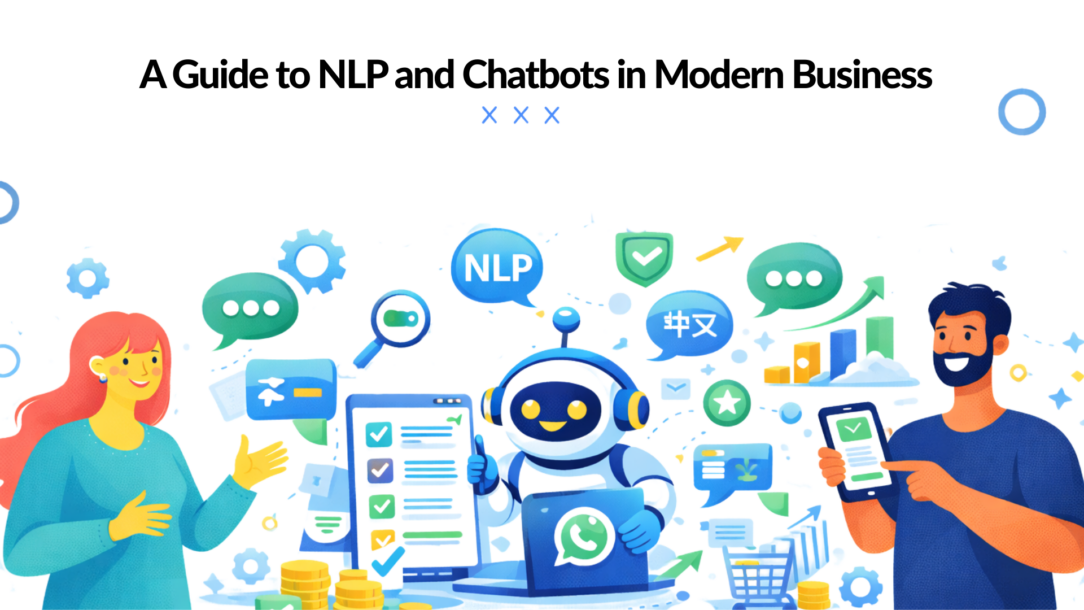
Natural Language Processing (NLP) is the magic that lets chatbots understand and talk back like a real person. A basic bot follows a script. An NLP-powered chatbot understands what your customer actually means—their intent, context, and even their mood. This turns a clunky Q&A tool into a smart, conversational partner for your business.
The Power Duo Transforming Customer Communication
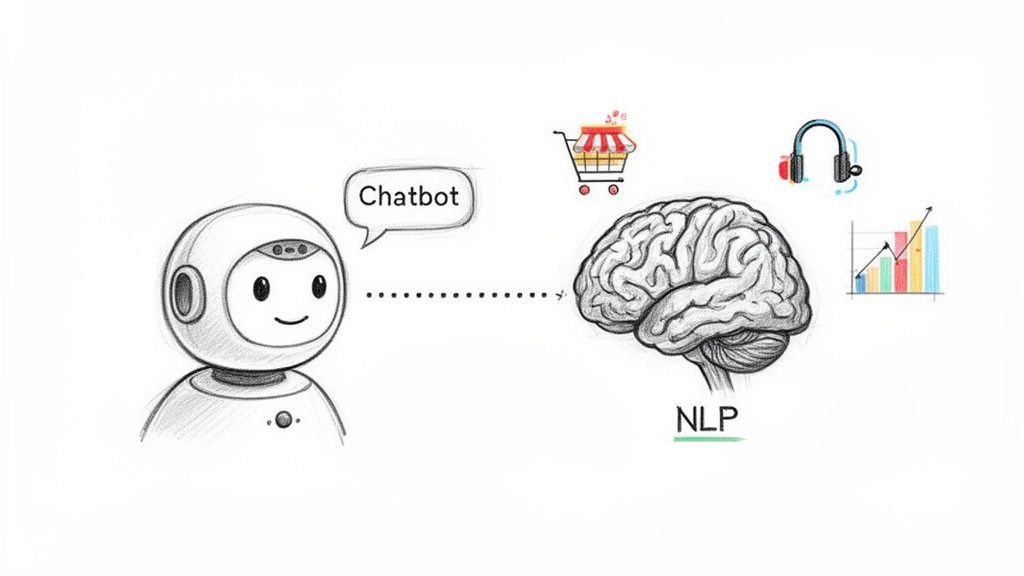
NLP Applications
Think of a standard chatbot like a vending machine. You press a specific button and receive a pre-programmed response. It functions, but it’s rigid. Step outside the defined inputs, and the system fails. This is exactly where conversational AI changes the equation.
Powered by artificial intelligence, modern systems use natural language understanding to interpret intent, context, and nuance — not just keywords. Instead of forcing users into structured commands, they allow people to speak or type naturally. On the output side, natural language generation enables responses that feel fluid, relevant, and human. The result is a dynamic exchange rather than a scripted transaction.
This evolution is no longer optional for serious businesses. In customer service, especially, the ability to interpret unstructured language and respond intelligently determines whether a brand feels accessible or outdated. The rapid expansion of the NLP market reflects a structural shift: companies are investing in systems that transform everyday conversations into operational intelligence, measurable efficiency, and revenue growth.
From Simple Scripts to Smart Conversations
Without NLP, a chatbot is stuck in a decision tree. It can only handle phrases it’s been explicitly programmed to recognize. It might get “Track my order,” but if a customer types, “Where’s my stuff?” — it’s lost. Traditional bots lack the intelligence modern AI systems rely on.
An NLP-powered chatbot is far more intelligent. Because NLP works by interpreting intent rather than matching keywords, it allows generative AI chatbots to respond more like humans. As a subset of NLP, natural language understanding enables the system to:
Identify Intent: It knows “Where’s my stuff?” and “Track my order” are the same request.
Extract Key Information: It can pick out details like an order number, date, or product name from a longer sentence.
Manage Context: It remembers what you discussed earlier in the chat to provide relevant follow-up answers.
This technology bridges the gap between how people naturally communicate and how AI systems process information, making automated conversations feel intuitive and genuinely helpful.
A chatbot gives your brand a voice, but NLP gives that voice intelligence. That’s the real shift driving the future of NLP chatbots — moving from scripted tools to adaptive, problem-solving systems.
Let’s break down how these core NLP concepts show up in a modern chatbot.
How Key NLP Concepts Power Modern Chatbots
This table shows the essential NLP tasks and how they translate into tangible chatbot capabilities that drive business results.
| NLP Concept | Simple Explanation | Practical Business Use Case |
|---|---|---|
| Intent Recognition | Figuring out what the user wants to do. | A customer types “my order isn’t here yet.” The chatbot understands this as a “Track Order” request and asks for the order number. |
| Entity Extraction | Pulling out specific pieces of information from text. | In “I want to book a flight to Paris for two people,” the bot extracts “Paris” as the destination and “two” as the number of passengers. |
| Sentiment Analysis | Detecting the emotional tone behind a message (positive, negative, neutral). | The chatbot detects an angry customer’s tone and automatically escalates the conversation to a human agent for priority support. |
| Contextual Awareness | Remembering previous parts of the conversation to provide relevant answers. | User: “Show me blue shirts.” Bot shows options. User: “What about in a large?” The bot knows they are still asking about the blue shirts. |
These building blocks allow a chatbot to move beyond simple keyword-matching and into the realm of truly intelligent, helpful conversations.
Why This Matters for Your Business
Adding NLP to your chatbot isn’t just a tech upgrade—it’s a strategic move for growth. Your bot transforms from a simple support tool into a proactive engine for marketing, sales, and customer retention.
With a smarter bot, you can build better relationships, automate complex tasks, and unlock new revenue streams. If you’re ready to go deeper, our guide on chatbot natural language processing unpacks this with more detailed examples. Mastering this is the first step toward using automation to its full potential.
How NLP Helps Chatbots Understand Customers
Ever wonder how a chatbot just gets what you’re asking, even when you use slang or misspell a word? That’s its brain at work, powered by Natural Language Processing (NLP). NLP translates our messy, unpredictable human language into structured commands a machine can act on.
Without NLP, a chatbot is just a glorified search bar, hunting for exact keywords. With NLP, the bot stops matching words and starts understanding meaning. This is the secret sauce that lets it handle the thousand different ways a customer might ask for the same thing.
The Three Pillars of Understanding Customer Queries
When a customer sends a message, NLP instantly breaks it down in a three-step analysis to figure out what to do next.
Let’s use a real-world example to see this in action.
Customer Message: “Hey, I need to know the status of my order #AB-54321, it was supposed to get here yesterday.”
This single sentence is packed with information. Here’s how the chatbot unpacks it.
Step 1: Intent Recognition
First, the bot must figure out the user’s main goal. This is Intent Recognition. What is the customer trying to do? Phrases like “status of my order” and “get here yesterday” all point to one core intent: track_order.
The chatbot isn’t just looking for the word “track.” It’s smart enough to recognize dozens of variations:
- “Where is my package?”
- “When will my delivery arrive?”
- “Can I get an update on my shipment?”
Nailing the intent is critical. Get it right, and the bot triggers the correct automated workflow. Get it wrong, and you get the dreaded, “Sorry, I don’t understand.” Modern chatbots use techniques like semantic analysis to understand the context and meaning behind words, ensuring high accuracy.
Step 2: Entity Extraction
Once the chatbot knows what the user wants, it needs to pull out the specific details. This is Entity Extraction. Think of entities as the key pieces of data in the conversation.
From our example message, the chatbot snags two crucial entities:
- Order Number:
AB-54321(The unique ID needed to look up the order). - Date Mention:
yesterday(Adds important context about the customer’s expectation).
Entities can be anything—dates, times, locations, product names, or email addresses. Extracting them accurately means the bot can act immediately without asking annoying follow-up questions, creating a fast and frictionless experience.
Step 3: Sentiment Analysis
Finally, the chatbot checks the emotional tone of the message. This is Sentiment Analysis. Is the customer happy, frustrated, or neutral? This adds a layer of emotional intelligence that separates a good bot from a great one.
The phrase “it was supposed to get here yesterday” clearly signals impatience. The chatbot would likely flag the sentiment as slightly negative or urgent.
This emotional context is a game-changer. A chatbot that detects negative sentiment can automatically offer to connect the user with a human agent, creating a safety net that prevents customer frustration from escalating.
By combining Intent, Entities, and Sentiment, the NLP-powered chatbot gets a complete picture. It knows the user wants to track order #AB-54321, understands they’re worried about a delay, and has the info it needs to give a real-time update.
To learn how to build this intelligence into your own bots, our guide on how to train an AI chatbot breaks down the practical steps.
Choosing the Right Chatbot for Your Goals
Not all chatbots are created equal. Using the wrong bot for a marketing campaign is like using a screwdriver to hammer a nail. Your choice of architecture directly impacts your chatbot’s intelligence, flexibility, and its ability to achieve your business goals.
The world of NLP and chatbots is built on a few core models. Understanding the differences will help you make a smart investment in automation.
Rule-Based Chatbots
Think of a rule-based chatbot as an interactive FAQ page. It runs on a fixed decision tree, guiding users through predefined questions and answers using simple if/then logic. You map out every possible conversation path, and the bot follows the script perfectly.
- Best For: Booking appointments, answering simple FAQs like “What are your store hours?”, or capturing basic lead info.
- Key Advantage: They are predictable, reliable, and cheap to build. You have 100% control over every conversation.
- Limitation: The moment a user asks something outside the script, the bot fails with a frustrating, “Sorry, I don’t understand.”
Retrieval-Based Chatbots
This is a solid step up. Instead of just following a script, a retrieval-based chatbot uses basic NLP to find the best-fit answer from a pre-existing knowledge base. It’s like a smart search engine for conversations.
When a user asks a question, the bot analyzes their intent and keywords, then “retrieves” the most appropriate pre-written answer. The key is that you still write all the responses, ensuring they’re always on-brand.
This model hits a sweet spot. It offers more conversational flexibility than a rule-based bot but still gives you total control over the bot’s messaging.
Generative Chatbots
This is where things get truly intelligent. Generative chatbots, powered by large language models (LLMs) like those behind ChatGPT, create brand new responses on the spot. They don’t just pull from a list; they generate unique sentences in real time, much like a human would.
- Best For: Complex customer support, dynamic product recommendations, and creating engaging, human-like marketing interactions.
- Key Advantage: Their ability to handle unexpected questions and maintain long, coherent conversations makes them incredibly powerful.
- Limitation: This power comes at a cost. You give up direct control over the bot’s exact wording, which can lead to unpredictable or off-brand answers if not managed properly.
Comparing Chatbot Architectures
This side-by-side look at chatbot models will help you choose the best fit for your marketing and support needs.
| Architecture | How It Works | Best For | Limitations |
|---|---|---|---|
| Rule-Based | Follows a strict, pre-programmed decision tree (if/then logic). No real NLP involved. | Simple, predictable tasks like FAQs, appointment booking, or basic lead capture. | Instantly fails if the user goes off-script. Very rigid and not conversational. |
| Retrieval-Based | Uses basic NLP to understand user intent and pulls the best answer from a pre-written library. | Customer support knowledge bases, moderately complex queries where accuracy is key. | Can’t answer questions it doesn’t have a pre-written response for. Limited creativity. |
| Generative | Uses advanced AI (LLMs) to create brand-new, unique responses in real time. | Human-like conversations, complex support, dynamic content creation, and deep engagement. | Loss of direct control over responses can lead to off-brand or incorrect answers. More complex to manage. |
| Hybrid | Blends rule-based/retrieval methods for predictable tasks and generative AI for complex ones. | Most modern business use cases; lead qualification, sales, and advanced support automation. | Can be more complex to set up initially, but offers the most balanced and effective solution. |
For most businesses, a single approach isn’t enough. The real power is in combining them.
The Hybrid Model: The Best of Both Worlds
For most businesses, the most effective solution is a hybrid chatbot that blends the reliability of rule-based systems with the intelligence of a generative model.
This approach lets you use structured flows for predictable tasks like lead qualification but seamlessly switch to generative AI when the conversation gets more complex. For example, Clepher’s AI Agents use this hybrid method, giving marketers the power to build solid automation flows while using NLP to understand user intent and trigger the right actions.
NLP Query Analysis
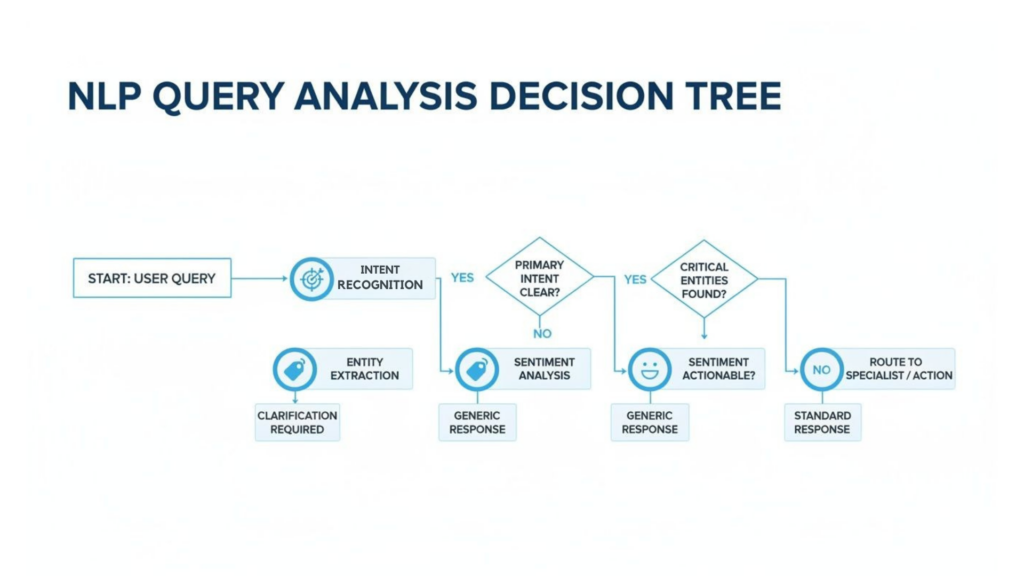
The flowchart shows how the system first figures out intent, then pulls out key details (entities), and finally checks sentiment to deliver the most appropriate response. Ultimately, your choice boils down to your goals. Need a simple, foolproof bot for FAQs? A rule-based model is perfect. Aiming to automate complex support and sales? A hybrid or generative bot is the clear winner.
Real-World Examples of NLP Chatbots in Action
NLP Business Applications
Theory is great, but seeing how real businesses use NLP and chatbots to drive results is where it all clicks. Let’s move past the “what if” and dive into proven applications you can use for your own business.
Your customers are already on board: 62% of users would rather talk to a bot than wait for a human agent. This shift is driving a market boom, with AI chatbots projected to be a $27.30 billion industry by 2030. For businesses, this means serious efficiency gains, as NLP bots can cut customer support workloads by up to 30%.
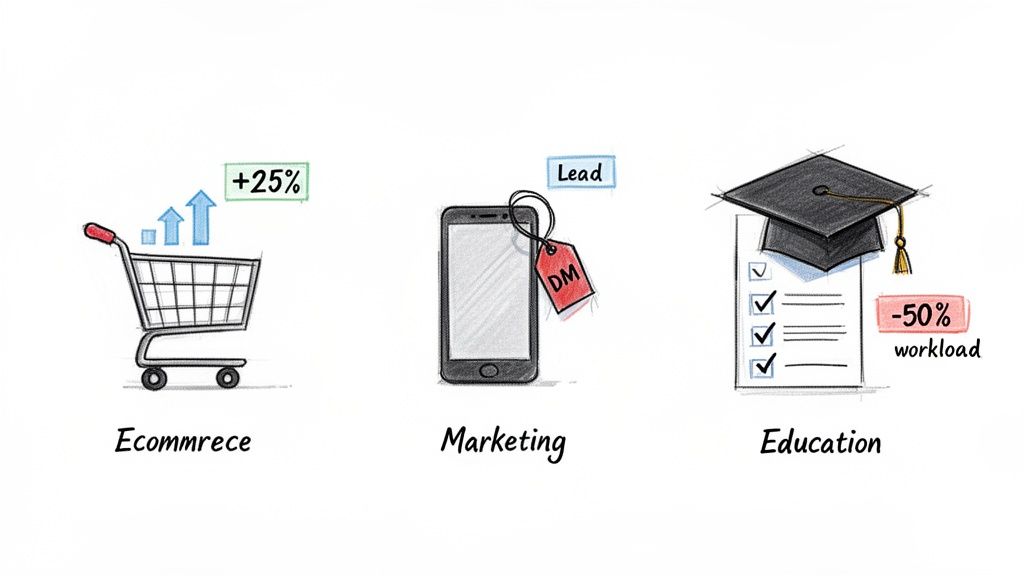
Here’s what this looks like in three different business scenarios.
E-Commerce Cart Abandonment Recovery
The Challenge: A direct-to-consumer (DTC) fashion brand was losing money from abandoned carts. Shoppers would fill their carts and then leave, usually because of a last-minute question about shipping, returns, or sizing.
The NLP Chatbot Solution: They deployed an NLP chatbot on their website and Messenger. The bot was trained to detect exit intent—the moment a user’s mouse heads for the close button on the cart page—and proactively engage.
Instead of a generic pop-up, the bot would ask, “Hey, saw you were checking out the Nomad Jacket. Any questions about the fit before you go?”
- Intent Recognition: The bot understood questions about shipping costs, return policies, and materials.
- Entity Extraction: It could pull out product names like “Nomad Jacket” to personalize the chat.
- Actionable Response: If a user asked about shipping, the bot provided the answer and a free shipping code to close the deal.
The Tangible Outcome: By providing instant answers and a timely incentive, the brand slashed its cart abandonment rate by 18% in one quarter. The chatbot became their best salesperson, working 24/7 to save sales.
Automated Lead Qualification for a Digital Agency
The Challenge: A digital marketing agency was getting swamped with leads from its Instagram ads, but the sales team was wasting hours filtering out unqualified inquiries.
The NLP Chatbot Solution: The agency connected an AI-powered chatbot to its Instagram DMs. When a new user sent a message, the bot launched a friendly, automated qualification sequence, asking questions like:
- What kind of business do you run?
- What’s your monthly marketing budget?
- What’s your main goal right now?
The bot used NLP to understand the answers. If a prospect’s budget was over a set amount, they were tagged “Hot Lead,” and a sales rep was notified instantly. Everyone else received a link to a free case study, keeping them engaged for the future.
This simple change turned their messy Instagram inbox into a clean, automated lead generation machine. High-intent prospects got an immediate, personal response.
The Tangible Outcome: The agency reduced lead qualification time by over 70% and booked 25% more sales calls with qualified prospects. The sales team could finally focus on closing deals, not filtering leads. Others achieve similar results by using an AI phone answering service to automate initial calls.
Streamlining Student Onboarding for a Course Creator
The Challenge: A successful course creator was drowning in repetitive questions from new students about course materials, schedules, and getting started.
The NLP Chatbot Solution: She built an onboarding chatbot inside her private student community, feeding it a knowledge base with all essential info.
Now, when a new student joins, the bot greets them with, “Ready to dive in? Ask me anything about finding your course materials, joining live calls, or accessing bonuses!”
The Tangible Outcome: This one automation transformed her onboarding. The creator saw a 60% drop in repetitive support questions, freeing her up to create more content. Students felt supported from day one, leading to higher satisfaction and fewer refund requests.
How to Put NLP Chatbots to Work in Your Business
Understanding the theory behind NLP and chatbots is one thing; putting that power to work is the real goal. Modern platforms turn what used to be a complex engineering challenge into a practical marketing tool anyone can use.
Think of these platforms as the bridge between powerful AI and your business goals. They provide an intuitive, no-code interface where you can build smart automations without writing a single line of code. This frees you to focus on strategy and crafting great customer experiences.
Triggering Automated Flows with AI Agents
One of the quickest wins is using AI Agents to understand and react to keywords and phrases. Picture these agents as smart listeners working inside your Messenger and Instagram DMs.
You can set them up to spot specific user intents. For instance, if someone asks, “Do you have any discounts?” or “Are there any sales on?”, the AI Agent instantly recognizes the discount_inquiry intent. This triggers a pre-built conversation that can:
- Share an exclusive promo code.
- Link them directly to your sales page.
- Ask questions to offer a personalized deal.
This immediate, relevant response is far more effective than a delayed human reply, catching a user’s interest at its peak and boosting conversion rates.
By using NLP to catch high-intent keywords in real-time, you turn your social inboxes from passive communication channels into proactive, automated sales engines that work for you 24/7.
Achieving Hyper-Targeted Segmentation
Great marketing is about sending the right message to the right person. NLP gives you a powerful way to segment your audience based on what they actually tell you.
As a chatbot talks with a user, it uses NLP to understand their needs, pain points, and interests. A modern platform lets you use this information to automatically tag contacts.
- A user asking about pricing for your top-tier plan gets tagged
high-intent_lead. - Someone looking for help with a problem gets tagged
support_request. - A prospect curious about a specific feature gets tagged with that
feature_interest.
Here’s a look at how you can configure AI Agents to respond to specific triggers, like a user’s comment, and launch an automated sequence.
This screenshot shows how simple it is to set up these triggers in a no-code builder. This capability allows you to build incredibly targeted audience segments for future campaigns, ensuring your messages always hit the mark.
Driving Tangible Business Outcomes
At the end of the day, it’s all about results. The true power of a modern conversational marketing platform is its ability to tie NLP features directly to business outcomes. It’s not just about having clever chats; it’s about what those chats achieve.
With a no-code builder, you can directly link these NLP-driven interactions to your bottom line:
- Higher Engagement: Instant, personal answers on platforms like Messenger and Instagram keep users hooked.
- Efficient Lead Qualification: Let a bot handle the initial screening, freeing up your sales team to focus on hot leads.
- Increased Sales: Guide users from conversation to conversion, recover abandoned carts, and proactively help hesitant shoppers.
This approach transforms your chatbot from a simple Q&A tool into a core piece of your marketing and sales funnel, delivering measurable returns.
Common Chatbot Implementation Mistakes to Avoid
Launching an NLP chatbot isn’t a “set it and forget it” project. Even with smart tech, simple mistakes can ruin the user experience and your ROI. Nailing the basics from day one is everything.
The biggest mistake? Failing to define a clear business goal. Many businesses build a bot because it feels “modern,” without asking: What specific problem will this solve? A bot without a purpose is just a confusing gadget.
Instead of building a bot that does everything, focus on one high-impact use case first. Qualify sales leads, answer your top five support questions, or recover abandoned carts. Nail that single objective, prove its value, and then expand.
Creating a Robotic and Impersonal Tone
Another classic mistake is forgetting the “chat” in “chatbot.” An overly robotic, formal, or jargon-packed tone will alienate users instantly. Your chatbot is an extension of your brand’s voice—it needs to sound like it.
Give your bot a personality that matches your brand. Use conversational language, add emojis where appropriate, and keep the tone friendly. Instead of “Query received. Processing request,” try “Got it! Let me look that up for you.” It makes the interaction feel like a helpful conversation, not a cold transaction.
A great chatbot experience feels less like talking to a machine and more like messaging a helpful, efficient assistant. The goal is a natural flow, not a rigid interrogation.
Forgetting the Human Escape Hatch
No matter how intelligent your bot is, it won’t be able to handle every situation. A critical mistake is not providing a clear and easy way for users to connect with a human agent. Hiding the “talk to a person” option creates massive frustration and can lose you a customer for good.
Your chatbot should be the first line of defense, not a wall. Ensure a seamless handoff process that transfers the user—and their conversation history—to a live agent without making them repeat everything. A simple prompt like, “Would you like me to connect you with a team member?” empowers the user and builds trust.
Got Questions About NLP and Chatbots?
Diving into NLP and chatbots often brings up a few key questions. Let’s tackle the most common ones so you can move forward with confidence.
Ready to transform your customer conversations? Clepher gives you all the power of AI Agents and NLP in an easy-to-use, no-code platform. Start building smarter chatbots today and see the results for yourself. Get started with Clepher.
Related Posts
What Is an Open Domain Chatbot?
April 11, 2026Conversational AI for Sales: Your 2026 Guide to Boosting Revenue
April 10, 2026Transform Your Sales Game with an AI Powered Sales Assistant
April 9, 2026
Founder Clepher