
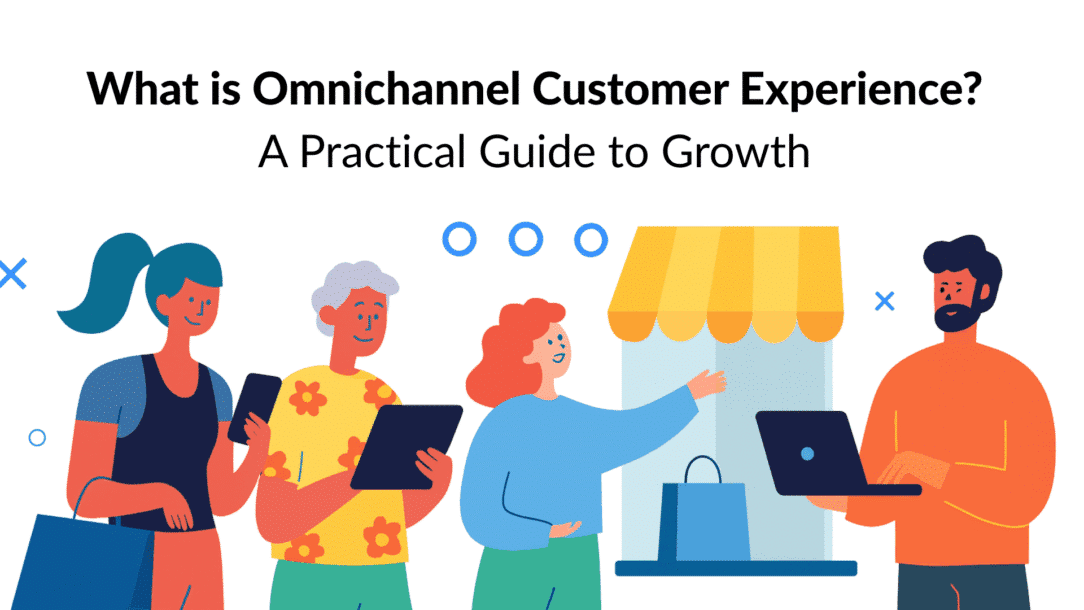
Ever start a conversation with a friend on the phone, hang up, and then seamlessly pick up right where you left off over text? No repeating yourself, no awkward resets. It just flows. That’s the essence of what an omnichannel customer experience feels like. It’s a single, continuous conversation with a business where every interaction—from a quick chat on Facebook Messenger to a visit in a physical store—is part of one connected journey.
The Core of a Connected Customer Journey
Omnichannel customer service refers to much more than just being available on different platforms. It’s about weaving those platforms into a cohesive ecosystem where the customer is always at the center. The goal is to make jumping between channels feel completely natural and intelligent.
To create an omnichannel marketing strategy, businesses must tear down the walls between their internal teams and their data. When your marketing, sales, and support systems are all sharing notes, the customer stops feeling like they’re dealing with different departments. Instead, every touchpoint builds on the last, creating an omnichannel and genuinely personal, context-aware experience.
Why This Matters More Than Ever
Today, the real battle for customers is won on experience, not just price or features. Think about it: a staggering 70% of consumers expect anyone they interact with at a company to already have the full context of their previous conversations.
When you force them to repeat their problem or explain their history again, you create friction. That frustration is a brand killer. A true omnichannel strategy solves this by delivering consistent customer service through unified customer interactions across channels.
- Consistency: Your brand’s voice, messaging, and quality of support feel the same, whether the customer is on Instagram, your website, or standing in your store.
- Convenience: Customers can hop onto whatever channel is easiest for them in that moment without being punished with a disjointed experience.
- Personalization: With a unified view of the customer, you can anticipate their needs and offer smart recommendations, turning a simple transaction into a real relationship.
The Real Business Impact of Going Omnichannel
So, we know what omnichannel is. But why should you care? Adopting an omnichannel model isn’t just a fancy customer service tweak—it’s a direct strategy for impacting your bottom line. The benefits of omnichannel customer engagement go way beyond a few five-star reviews.
Boosting Retention and Lifetime Value
The link between a seamless experience and loyalty is impossible to ignore. When customers feel like you “get” them at every touchpoint, why would they look elsewhere?
Research shows companies with strong omnichannel strategies retain an average of 89% of their customers, compared to a dismal 33% retention rate for businesses with weak, disconnected channels. Better yet, omnichannel campaigns drive a 287% higher purchase rate than single-channel efforts.
Slashing Costs and Driving Efficiency
While making customers happy is the main goal, a huge side benefit is how much more efficient your entire operation becomes. A fragmented, multichannel setup is a mess behind the scenes.
- Reduced Support Burden: When agents have the full story—from the last purchase to a recent bot chat—in one place, they solve problems in a fraction of the time.
- Smarter Marketing Spend: A complete picture of customer behavior means your marketing gets laser-focused, lowering your customer acquisition costs.
For a deeper dive into these quantifiable advantages, you can explore these 7 key benefits of omnichannel retail for business growth.
Ultimately, the business case is clear. A multichannel approach means you’re available in different places. An omnichannel strategy ensures every interaction is smart, connected, and valuable. It’s the difference between just showing up and truly being present. Our guide to multi-channel marketing automation shows how AI can bridge this gap even further.
How to Build Your Omnichannel Strategy
Shifting to an omnichannel model isn’t about flipping a switch. It’s a series of deliberate, strategic moves to transform disconnected channels into a unified customer experience engine. This requires a clear roadmap that starts with a deep dive into your customer’s journey and ends with a team culture that puts them at the center of every decision.
The goal isn’t just to be on multiple channels; it’s to make the jump between them feel invisible to your customer. Getting this right delivers the seamless experience everyone expects today and drives measurable business results.
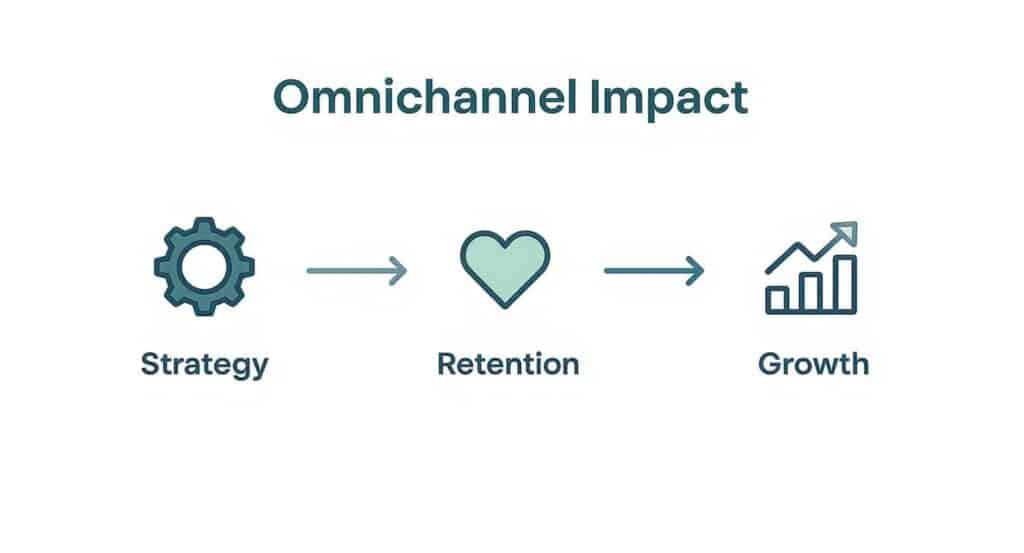
This visual breaks down how a well-defined strategy directly feeds into customer retention, which then fuels sustainable business growth.
omnichannel impact
The key takeaway? Growth isn’t random. It’s the natural outcome of a customer-first strategy focused on loyalty and retention.
Step 1: Map Every Customer Touchpoint
Before you can connect the dots, you have to find them. The first step is to meticulously map out every possible interaction a customer might have with your brand. Put yourself in their shoes and trace their path, from the moment they first hear about you all the way to post-purchase support.
This isn’t just about listing your channels. It’s about understanding the why behind each interaction. Why do they visit your website? What questions do they ask on social media? What are the friction points when they try to make a return?
Your touchpoint map should cover:
- Discovery Channels: How customers find you (social media ads, Google searches, recommendations).
- Engagement Channels: Where they interact and ask questions (website chat, Messenger, email newsletters, in-store visits).
- Transactional Channels: Where the purchase happens (e-commerce checkout, in-person register, mobile app).
- Support Channels: Where they turn for help after buying (help desk, phone support, community forums).
Step 2: Unify Your Customer Data
This is the most critical and often the toughest step. You cannot have an omnichannel experience if your customer data is trapped in separate silos. Your CRM knows their purchase history, your email platform knows which campaigns they opened, and your chatbot knows their latest support query. A real omnichannel strategy pulls all of that together.
The goal is to create a single source of truth—a unified customer profile that gives your team a 360-degree view. When an agent can see a customer’s recent browsing, past purchases, and support tickets in one place, they can offer context-aware, personalized help instantly.
Unifying data isn’t just a technical exercise; it’s a customer experience imperative. It’s the foundation that lets you stop treating customers like strangers at every new touchpoint.
This often means integrating key systems like your CRM, e-commerce platform, and customer support software. Advanced techniques like customer identity resolution with AI can be a game-changer here, helping you accurately stitch together customer profiles from different sources.
Step 3: Integrate the Right Technology Stack
With a solid data strategy, you need the right tools to act on it. Your tech stack should be chosen based on how well the tools talk to each other. A clunky, disconnected set of tools will only recreate the data silos you’re trying to tear down.
A modern omnichannel tech stack usually includes:
- Customer Relationship Management (CRM): The central hub for all customer data and interaction history.
- Customer Data Platform (CDP): A system that pulls in and organizes customer data to create unified profiles.
- AI Chatbot Platform: Tools like Clepher that handle conversations across messaging channels while feeding data back into your CRM.
- Marketing Automation Software: Platforms that use unified data to send personalized email, SMS, and ad campaigns that feel relevant.
For expert help building your strategy, it can be valuable to work with agencies that specialize in comprehensive customer engagement strategies.
Step 4: Train Your Teams for a Customer-Centric Mindset
Technology is only half the puzzle. Your team brings the omnichannel experience to life. A successful strategy requires breaking down internal department walls just like you broke down data silos. Marketing, sales, and support can no longer operate on separate islands.
Train your people on the entire customer journey, not just their small piece of it. A support agent should understand how a marketing campaign might influence the questions they get. A salesperson should be able to see a prospect’s recent support tickets.
Build a culture of collaboration where everyone understands their role in the bigger picture. When your whole organization is aligned behind the customer, you create a powerful, consistent experience that technology alone can never match.
Omnichannel Examples Across Different Industries
Theory is great, but seeing a concept in action is where it clicks. The power of an omnichannel experience comes to life when you see how businesses adapt it to solve real-world problems. It’s a flexible strategy that reshapes the customer journey, no matter your industry.
The core idea is always the same: create a single, continuous conversation. With about 90% of customers expecting consistent experiences across all channels, it’s clear that disjointed, siloed conversations lead to frustration. As this detailed statistical analysis from Marketing LTB shows, customers often use up to six channels in their buying journey. Your job is to make that journey feel like one smooth path.
Let’s break down what this looks like in practice.
E-commerce: The Seamless Shopping Journey
For online retailers, the line between digital and physical is dissolving. A smart omnichannel strategy uses this as a competitive edge by making the entire shopping process—from discovery to returns—feel like a single, effortless flow.
A classic example is the “Buy Online, Pick Up In-Store” (BOPIS) model. A customer browses your website, adds a product to their cart, and selects in-store pickup. When they arrive, the item is waiting, and a store associate can even suggest accessories based on their online purchase history.
But it goes deeper. Picture this scenario:
- A shopper uses your mobile app to scan a QR code on an in-store product to see reviews.
- They add an item to their cart on the app but decide to think about it.
- Later, they see a retargeting ad on Instagram for that exact item.
- They click through, buy it, and get an SMS notification when it ships.
Every step is connected. The in-store experience informed the digital ad, which led back to the online store, with updates delivered on the channels the customer actually uses.
SaaS: Continuous and Context-Aware Support
In the software world, a frustrating support experience can easily cause a user to cancel their subscription. Here, an omnichannel strategy is all about providing seamless, intelligent support that respects the customer’s time.
Imagine a user hits a snag on your platform. Here’s how an omnichannel support flow works:
- Initial Contact: The user opens a chat with an AI chatbot on your website to explain the problem.
- Seamless Escalation: The issue is too complex for the bot, so it offers to escalate to a live agent. The entire chat history is automatically bundled into a support ticket.
- Picking Up the Conversation: A live agent picks up the ticket and continues the conversation via email without asking the user to repeat a single thing.
The magic isn’t just offering a chatbot and email; it’s that the context of the conversation travels with the customer. They never have to start over.
This approach dramatically cuts down resolution time and, more importantly, reduces customer effort, showing you value their time.
Local Businesses: Connecting Online and Offline
Omnichannel isn’t just for huge corporations. Local businesses like salons and mechanics can use it to create a smoother experience for their community by connecting digital booking with the in-person service.
For example, a modern hair salon could use this simple strategy:
- A client sees a stylist’s work on Instagram and clicks the “Book Now” button.
- This links to a scheduling page where they book an appointment.
- The system automatically sends an SMS reminder 24 hours before the appointment.
- After the visit, a follow-up email asks for a review and offers a discount on their next booking.
Every touchpoint, from social media discovery to the post-visit follow-up, is part of a single, coordinated system. It streamlines operations and creates a professional, convenient experience that builds loyalty.
The Role of AI in Modern Omnichannel Experiences
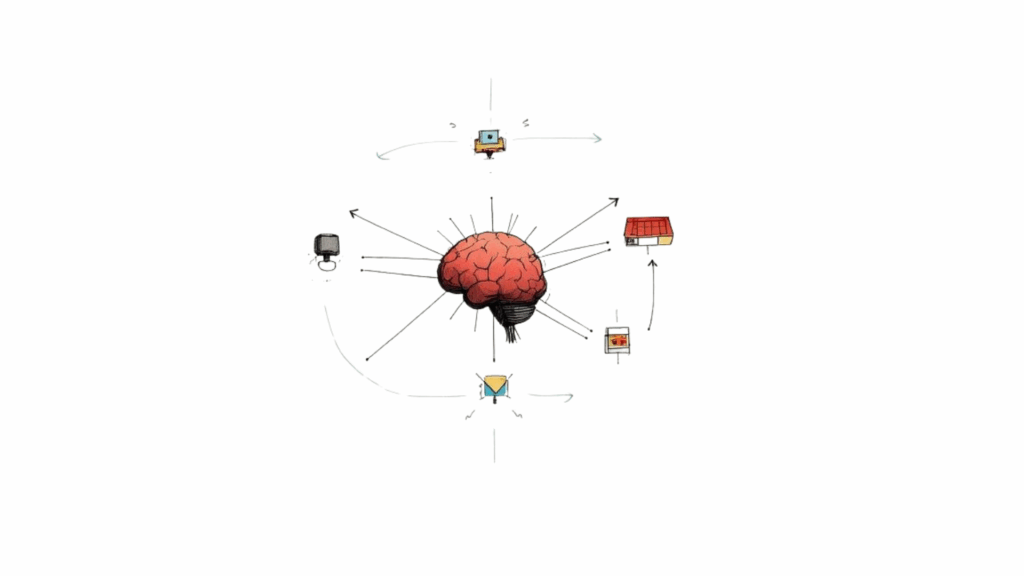
Let’s be honest: a true omnichannel strategy is nearly impossible without AI and automation. These are the engines that make a seamless, personalized customer experience work at scale. By letting AI handle routine tasks, your human team is freed up to focus on the complex, high-touch interactions that build loyalty.
This is what allows your business to be there for customers 24/7. When someone messages you at 2 AM, an AI-powered system can instantly provide answers or kickstart a sale. You never miss an opportunity, and the customer feels heard immediately.
omnichannel customer experience
Driving Efficiency with AI Chatbots
Think of AI chatbots as the front line of your omnichannel experience. Deployed on your website, Messenger, or Instagram, they become the first point of contact, handling a huge volume of conversations at once. This is non-negotiable, since 72% of customers now expect an immediate response.
But modern chatbots do more than just answer FAQs. A well-built bot can:
- Qualify Leads: It asks the right questions to identify serious prospects and sends them straight to your sales team.
- Recover Abandoned Carts: The bot can proactively message someone who left items in their cart, perhaps offering a discount to seal the deal.
- Gather Customer Data: Every chat is a chance to learn. Bots can tag users based on their interests, gradually building a richer customer profile.
This smart automation takes pressure off your human agents, letting them tackle the most complex problems. To see how this works, check out our guide on using an omnichannel chatbot to improve CX.
Hyper-Personalization with Machine Learning
Behind the scenes, machine learning turns your unified customer data into gold. It analyzes browsing history, past purchases, and support chats to figure out what each customer really wants—often before they realize it themselves.
Machine learning shifts your strategy from reactive to proactive. Instead of waiting for customers to ask for things, you start anticipating their needs. That’s how you create “wow” moments that build fierce loyalty.
This predictive power fuels hyper-personalization. For an e-commerce store, this might be a recommendation engine that suggests products based on what similar customers are buying. For a SaaS company, it could mean identifying users showing early signs of churn and triggering a personalized message to bring them back. AI is the key that unlocks these sophisticated, context-aware interactions across your entire business.
How to Measure Omnichannel Success
A great omnichannel strategy is only as good as the results it delivers. You have to move beyond vanity metrics and focus on the numbers that reflect the health of your connected customer journey. Without a data-driven approach, you’re flying blind.
The goal is to build a performance dashboard that links your omnichannel activities directly to business growth.
The KPIs for Your Omnichannel Dashboard
To get a true picture of success, zero in on KPIs that measure the quality of the customer experience and their long-term value. These three are non-negotiable for understanding the real impact of your efforts.
- Customer Lifetime Value (LTV): This is the ultimate metric. LTV calculates the total revenue you can expect from a single customer over their entire relationship with you. A rising LTV is a powerful signal that your seamless experience is encouraging repeat business and turning casual buyers into loyal fans.
- Customer Retention Rate: This metric shows what percentage of customers stick around. It’s a simple fact: companies with strong omnichannel strategies see significantly higher retention. This KPI is direct proof that a connected journey makes customers less likely to jump ship to a competitor.
- Customer Effort Score (CES): This measures how easy you make it for customers to get help. A low score is what you’re aiming for. It’s a direct reflection of how seamless your channels are. If a customer can move from a chatbot to a live agent without repeating themselves, their effort is low, and their satisfaction is high.
To help you get started, here’s a quick-reference table of the most important KPIs you should be tracking.
Essential KPIs for Measuring Omnichannel Success
A summary of key performance indicators to track the effectiveness of your omnichannel customer experience strategy.
| KPI (Key Performance Indicator) | What It Measures | Why It’s Important for Omnichannel |
|---|---|---|
| Customer Lifetime Value (LTV) | The total predicted revenue a customer will generate over their entire relationship with your brand. | A rising LTV shows that a seamless, connected experience is encouraging repeat purchases and building long-term loyalty. |
| Customer Retention Rate | The percentage of customers who continue to do business with you over a set period. | High retention is direct proof that your integrated channels are creating a “sticky” experience that keeps customers from leaving for competitors. |
| Customer Effort Score (CES) | How much effort a customer has to put in to resolve an issue, make a purchase, or get an answer. | A low CES score means your channels are working together seamlessly, reducing friction and frustration for the customer. |
| Channel-to-Channel Conversion Rate | The rate at which customers successfully complete a goal after moving between different channels (e.g., from social media ad to website purchase). | This KPI directly measures how effective your handoffs between channels are. A high rate indicates a smooth, uninterrupted journey. |
| Average Resolution Time | The average time it takes to resolve a customer support ticket from the first contact to the final resolution, across all channels. | A lower resolution time, especially on complex issues that cross channels, signals efficiency and a well-integrated support system. |
This table isn’t just a list; it’s a blueprint for your measurement framework. By focusing on these indicators, you can connect your strategic efforts to real business results.
Building a Framework for Measurement
Tracking these KPIs can’t be a one-off task. You need a system that consistently gathers and analyzes data from your unified customer profiles. Your CRM and analytics tools must report on these metrics regularly so you can spot trends and make informed decisions.
An effective measurement framework turns raw data into actionable insights. It tells you not just what is happening, but why, enabling you to pinpoint friction points and optimize your strategy for maximum impact.
By focusing on LTV, retention, and CES, you create a clear, quantifiable link between your omnichannel initiatives and tangible business outcomes.
Conclusion
Omnichannel customer experience is the practice of delivering a seamless, consistent, and personalized journey across all customer touchpoints — online and offline. By integrating channels, unifying customer data, and aligning processes and teams, businesses can reduce friction, increase loyalty, and drive revenue. Implementing omnichannel requires a clear strategy, the right technology stack, and ongoing measurement to adapt to changing customer expectations. Organizations that prioritize omnichannel customer experience will be better positioned to meet customers where they are and turn interactions into long-term relationships.
Got Questions about Omnichannel Customer Experience? We’ve Got Answers.
When you’re diving into a new strategy like omnichannel, it’s natural for questions to pop up. Let’s tackle some of the most common ones so you can move forward with confidence.
Hands down, the single biggest hurdle in creating a seamless omnichannel experience for customers across all channels is data integration. Most businesses have customer info scattered everywhere—a CRM for sales, an email platform for marketing, a helpdesk for support. They don’t talk to each other.
Breaking down these silos to create one unified view of the customer is a heavy lift, both technically and organizationally. But without it, you can’t deliver the seamless, context-aware experience that makes omnichannel work. This focus on unified data is central to the future of customer service.
Ready to build an AI-driven omnichannel experience that turns conversations into customers? Clepher brings all your messaging—from your website, Messenger, Instagram, and WhatsApp—into one place. Market, sell, and support customers from a single, intuitive platform. Start your journey with Clepher today.

Related Posts
How to Create a Killer Poll Game on Instagram to Boost Engagement and Leads
March 24, 202612 Fresh Social Media Content Ideas That Convert in 2026
March 23, 2026Elevate Your Customer Experience with Conversational AI for Customer Engagement
March 22, 2026
Founder Clepher