
Imagine engaging directly with your customers in the app they use daily—driving sales, building loyalty, and offering instant support, all on autopilot. That’s the power of modern WhatsApp marketing. For too long, businesses treated it like another email inbox, sending generic blasts and hoping for the best. That approach is officially dead. With the WhatsApp Business API and automation platforms like Clepher, a new era of personalized, conversational marketing is here.
This isn’t just about sending messages; it’s about building relationships. It’s about solving problems in real-time and creating experiences that turn subscribers into lifelong fans. The goal is to shift from one-way communication to two-way conversations that drive revenue and boost satisfaction. While these strategies focus on acquiring and converting customers, retaining them is where the real profit lies. To round out your approach, exploring 10 actionable customer retention strategies for small businesses will provide a powerful complement to your WhatsApp efforts.
Forget theory. This guide dives into 10 proven, battle-tested WhatsApp marketing strategies you can implement today. We’ll break down exactly what to do, how to do it, and why it works, complete with real-world examples for e-commerce, SaaS, creators, and agencies. Get ready to transform your customer communication and unlock unprecedented growth.
1. Strategy 1: 24/7 Engagement with AI Chatbots via the WhatsApp Business API
Using the official WhatsApp Business API to deploy AI chatbots is the foundation for scalable marketing. This strategy transforms WhatsApp from a simple messaging app into an automated, 24/7 engagement engine. By connecting to the API through a platform like Clepher, you can build intelligent chatbots that handle inquiries, recommend products, and manage support tickets without any manual oversight.
The core benefit is instant, consistent service. While your team sleeps, an AI chatbot can confirm an order, answer a question about shipping, or guide a new user through a SaaS onboarding flow. This immediately boosts customer satisfaction by eliminating wait times and frees up your human agents to focus on complex, high-value conversations that actually close deals.
How to Implement This Strategy
- Get WhatsApp Business API Access: Sign up with a Business Solution Provider (BSP) like Clepher to connect to the official API. This is a non-negotiable step for using advanced automation features.
- Map Your Core Flows: Identify common customer journeys. Start with high-frequency interactions like FAQs (“Where is my order?”), order status checks, or lead qualification questions (“What’s your budget?”).
- Build Your Chatbot: Use a no-code builder to create conversational flows. Set up keyword triggers (e.g., “shipping,” “price,” “demo”) that automatically launch the correct automated response sequence.
- Personalize and Test: Use personalization tags like
{{first_name}}to make automated messages feel human. Run internal tests to ensure all conversation paths work as intended before going live.
Why It Works
This strategy meets the modern consumer’s demand for instant answers. E-commerce brands use it to send automated order confirmations, which drastically reduces “where is my order?” (WISMO) support tickets. Agencies use it to manage multiple client campaigns from one dashboard, deploying customized bots for each. For a deeper technical dive, explore this guide on building a powerful chatbot for WhatsApp. By automating the routine, you reserve your team for revenue-generating activities.
2. Lead Generation and Capture via WhatsApp Flows
One of the most powerful WhatsApp marketing strategies is using interactive “Flows” to actively generate and qualify leads. This transforms your website, social media profiles, and even QR codes into powerful lead funnels. Instead of a boring web form, you engage potential customers in a dynamic, two-way conversation that gathers information and segments them automatically.
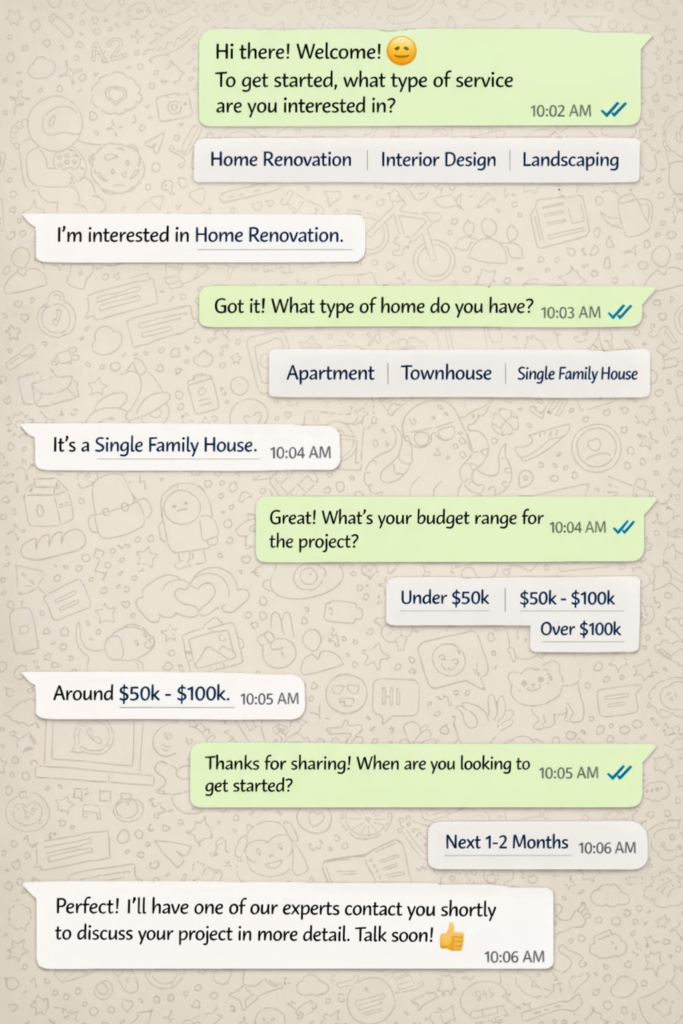
WhatsApp Screen
The idea is to make lead submission feel like a natural chat, not a chore. A business coach can use a flow to ask a few qualifying questions and share their calendar link. An e-commerce brand can capture product preferences for personalized recommendations. This conversational approach significantly boosts completion rates compared to traditional forms, turning passive visitors into opted-in, engaged leads ready for nurturing.
How to Implement This Strategy
- Identify Your Capture Points: Decide where your WhatsApp entry point will live. This could be a “Chat with Us” button on your website, a link in your Instagram bio, or a QR code on a flyer.
- Design Your Conversational Flow: Map out a short, engaging conversation (3-5 questions max) to capture key info. Ask qualifying questions first to identify high-intent leads early.
- Build the Flow in a Platform: Use a tool like Clepher’s drag-and-drop builder to create the flow. Use conditional logic to personalize the chat based on user answers (e.g., if they select “e-commerce,” show them relevant case studies).
- Connect and Automate: Sync the captured data with your CRM or email platform. Tag subscribers based on their responses to enable highly targeted follow-up campaigns.
Why It Works
This strategy works because it meets customers on a platform they already use and trust, which removes friction from the lead generation process. A digital agency can use this to create a client intake form that gathers project requirements before the first call, saving time and improving preparation. To see more advanced techniques, discover how to build a chatbot for lead generation on clepher.com. By making lead capture conversational, you create a better user experience and build a high-quality subscriber list.
3. Broadcast Campaigns with Segmentation and Personalization
This strategy is about sending targeted broadcast messages to segmented audiences at scale. This isn’t spamming your entire contact list; it’s a sophisticated approach that uses data to deliver relevant, personalized content that people actually want to read. With a platform like Clepher, you can send unlimited promotional campaigns, feature announcements, or exclusive offers to specific customer groups.
The power here is in precision. Instead of a generic blast, an e-commerce brand can send a special discount for a specific product only to users who previously viewed it but didn’t buy. This level of targeting transforms WhatsApp into a high-conversion channel, driving direct revenue and fostering customer loyalty by delivering content that feels personal and timely.
How to Implement This Strategy
- Build Your Subscriber List: Use opt-in tools like click-to-chat ads, website widgets, or QR codes to ethically grow your WhatsApp audience. Never send broadcasts to users who have not explicitly opted in.
- Segment Your Audience: Create segments based on user data. Common segments include purchase history (VIP customers vs. first-time buyers), engagement level (active vs. inactive), or expressed interests.
- Craft Your Personalized Message: Write compelling copy for your broadcast. Use personalization tags like
{{first_name}}or{{last_order_id}}to make the message feel individual. Include a clear call-to-action (CTA) with a link or button. - Schedule and Analyze: Choose the optimal time to send your broadcast based on audience analytics. After sending, use your platform’s dashboard to track key metrics like open rates, click-through rates (CTR), and conversions to refine future campaigns.
Why It Works
This is one of the most effective WhatsApp marketing strategies because it combines the immediacy of messaging with the power of email-style segmentation. A SaaS company can announce a new feature only to its power users. A course creator can re-engage students who haven’t logged in for 30 days with an exclusive offer. It drives action by ensuring the right message reaches the right person at the right time. For a deeper look at creating effective audience groups, explore these powerful customer segmentation strategies.
4. Abandoned Cart Recovery via WhatsApp
Automated abandoned cart recovery is one of the highest-ROI WhatsApp marketing strategies for e-commerce. The tactic is simple: when a shopper adds items to their cart but leaves without purchasing, an automated, personalized WhatsApp message is sent to encourage them to complete the transaction. By using trigger-based automation, you re-engage potential customers when their purchase intent is still high.
Cart Recovery
The core benefit is recapturing lost revenue. Unlike email, which can be ignored or sent to spam, WhatsApp messages have exceptionally high open rates, making your reminder far more likely to be seen and acted upon. This direct, conversational approach feels less intrusive and provides an opportunity to answer last-minute questions that may have prevented the sale.
How to Implement This Strategy
- Integrate Your E-commerce Store: Connect your Shopify, WooCommerce, or other e-commerce platform with a WhatsApp marketing tool like Clepher. This is essential for syncing cart data.
- Set Up the Abandoned Cart Trigger: In your automation builder, create a workflow that activates when a cart is abandoned for a specific period (e.g., 60 minutes). Ensure you only message users who have opted in.
- Craft a Multi-Message Sequence: Design a sequence of 2-3 messages. The first is a simple reminder. The second could offer a small incentive, like a 10% discount. A third can create urgency with a final offer.
- Personalize and Add a Direct Link: Use personalization tags to include the customer’s name and the products they left behind. Most importantly, include a direct link to their pre-filled cart to make completing the purchase seamless.
Why It Works
This strategy works because it’s timely, personal, and incredibly convenient. It meets the customer right where they are—on their phone—and removes the friction of having to find their way back to your site. Fashion brands use it to show images of the exact items left behind. Electronics retailers can offer a limited-time free shipping code to close the deal. By automating this, you create a consistent revenue recovery system that operates 24/7.
5. Customer Support and Service Excellence via WhatsApp
Transforming WhatsApp into a world-class customer support channel is one of the most impactful WhatsApp marketing strategies for building loyalty. This approach uses a blend of AI automation and human agents to provide fast, personalized, and convenient service. Instead of forcing users to navigate a separate portal or wait on hold, you resolve issues in a familiar, conversational environment.
The core benefit is meeting customers where they are, which drastically reduces friction and improves satisfaction. An AI bot can instantly handle common inquiries like “Where is my order?” around the clock. For complex problems, the conversation can be seamlessly handed off to a human agent who has the full chat history for context. This hybrid model delivers both the efficiency of automation and the empathy of human support.
How to Implement This Strategy
- Identify Top Support Inquiries: Analyze your support tickets to find the top 10 most frequently asked questions. These will be the foundation of your automated support flows.
- Build AI-Powered Keyword Triggers: In a platform like Clepher, create automated flows that trigger when a user sends a message containing keywords like “refund,” “broken,” or “shipping.”
- Create an Escalation Path: For each automated flow, build a clear path to a human agent. This can be a simple “Talk to an agent” button that routes the conversation to your live chat inbox.
- Integrate with Your CRM/E-commerce Platform: Connect your WhatsApp API solution to systems like Shopify or your CRM to pull customer data (e.g., order history) directly into the conversation for personalized support.
Why It Works
This strategy excels because it aligns with modern consumer behavior. Customers value speed and convenience, and resolving an issue via a quick WhatsApp message is far better than traditional support channels. E-commerce brands use this to manage returns and shipping inquiries, significantly lowering support costs. SaaS companies deploy it to offer instant technical troubleshooting, improve user onboarding, and reduce churn. By providing exceptional service in the channel customers prefer, you create a powerful competitive advantage.
6. Product Recommendations and Upsell Sequences
Sending personalized product recommendations and automated upsell sequences is one of the most effective WhatsApp marketing strategies for increasing revenue per customer. This tactic uses customer data—like purchase history and browsing behavior—to deliver highly relevant offers. Using a platform like Clepher to segment your audience, you can trigger conversational flows that feel less like a sales pitch and more like a helpful suggestion.
The primary goal is to boost both Average Order Value (AOV) and Customer Lifetime Value (LTV). For example, a fashion store can send a message a few days after a dress purchase, suggesting matching shoes. A subscription box service can offer a premium add-on product to its most engaged subscribers. This conversational approach is a natural, non-intrusive way to introduce customers to more of what they love.
How to Implement This Strategy
- Integrate Your E-commerce Platform: Connect your Shopify, WooCommerce, or other store to Clepher. This is crucial for syncing customer purchase history and behavior data.
- Segment Your Audience: Create dynamic segments based on triggers. Examples include “purchased X product in the last 7 days,” “viewed Y category but did not purchase,” or “high-LTV customers.”
- Build Your Recommendation Flows: Design automated messages that trigger based on your segments. For a post-purchase upsell, set a 2-3 day delay after an order is fulfilled. Use compelling visuals and clear calls-to-action like “View Matching Items.”
- Incorporate Social Proof: Make your recommendations more persuasive by adding phrases like, “Customers who bought {{last_purchased_item}} also loved this.” This builds trust and validates the suggestion.
Why It Works
This strategy works because it leverages relevance and timing. A recommendation is most powerful when it’s based on a recent action and aligns with a customer’s known preferences. Instead of a generic promotional blast, you are delivering a curated suggestion when the customer’s interest is high. For SaaS companies, it’s a perfect way to recommend advanced features to power users, increasing product adoption. By personalizing the shopping experience, you transform a one-time transaction into an ongoing relationship.
7. Event Promotion and Registration Campaigns
Using WhatsApp to promote events like webinars, workshops, or product launches is a powerful strategy that leverages the channel’s high open rates. This approach enables automated registration flows, sends timely reminders, and delivers post-event follow-ups, all within WhatsApp. This transforms event marketing from a broadcast-only activity into an interactive, high-conversion experience.
The primary benefit is a streamlined and engaging user journey that significantly boosts attendance. Instead of relying on email, where invitations can get lost, WhatsApp delivers messages instantly. Coaches and course creators use this to fill their programs, while SaaS companies can drive attendance for feature training sessions. The entire process, from promotion to post-event follow-up, is managed in one place.
How to Implement This Strategy
- Segment Your Audience: Create a targeted segment for users who have shown interest in similar topics or past events. This ensures your promotion reaches the most relevant contacts.
- Launch a Promotional Broadcast: Send a broadcast announcing the event. Use compelling copy that highlights the value, and include a clear call-to-action button like “Register Now” that triggers an automated flow.
- Build a Registration Flow: Create a chatbot sequence that asks for necessary details (e.g., name, email) and confirms their spot. For paid events, this flow can direct them to a payment page.
- Schedule Automated Reminders: Set up timed reminders to go out 24 hours, 1 hour, and 10 minutes before the event begins. Include the date, time, and a direct link to join.
Why It Works
This is one of the most effective WhatsApp marketing strategies because it capitalizes on urgency and convenience. The direct, personal nature of a WhatsApp message makes an event invitation feel more exclusive. Agencies promoting client webinars can demonstrate higher registration-to-attendance rates. By automating the registration and reminder process with a tool like Clepher, you eliminate manual work and ensure no registrant is left behind, maximizing your event’s ROI.
8. Customer Feedback and Surveys via WhatsApp
Collecting customer feedback is crucial, but traditional email surveys suffer from low open rates. Using WhatsApp for surveys transforms this process into an engaging, conversational experience. This strategy leverages the high open rates of WhatsApp to gather valuable insights, product reviews, and Net Promoter Score (NPS) data directly within a familiar chat interface.
The main advantage is the immediate and interactive nature of the platform. Instead of a sterile form, customers receive a friendly message asking for their thoughts. E-commerce stores can automatically request a product review a few days after delivery. SaaS companies can trigger an NPS survey after a user interacts with a key feature. This approach boosts response rates and allows for real-time follow-up on negative feedback, turning a poor experience into a recovery opportunity.
How to Implement This Strategy
- Define Your Goal: Determine what you want to learn. Are you measuring post-purchase satisfaction, gauging interest in a new feature, or collecting NPS data?
- Build a Conversational Survey Flow: Using a tool like Clepher, create an automated message sequence. Start with a friendly opener, then use quick-reply buttons for easy responses (e.g., “On a scale of 1-5, how would you rate your recent purchase?”).
- Set Up the Trigger: Automate the survey delivery. Common triggers include “Order Delivered” in Shopify, a specific time after a support ticket is closed, or 30 days after a new SaaS user signs up.
- Segment and Analyze Responses: Tag users based on their answers. Tag low NPS scores for immediate follow-up by a support agent. Tag positive reviewers for a future testimonial request. Analyze the data to spot trends.
Why It Works
This is one of the most effective WhatsApp marketing strategies because it meets customers where they are with a low-friction request. An online course creator can send a two-question survey to students after they complete a module, gathering instant feedback. An agency can survey clients about campaign performance directly in WhatsApp, fostering a stronger relationship. By making feedback easy to give, you receive more of it, enabling you to make smarter, customer-centric business decisions.
9. Loyalty Programs and VIP Tier Rewards via WhatsApp
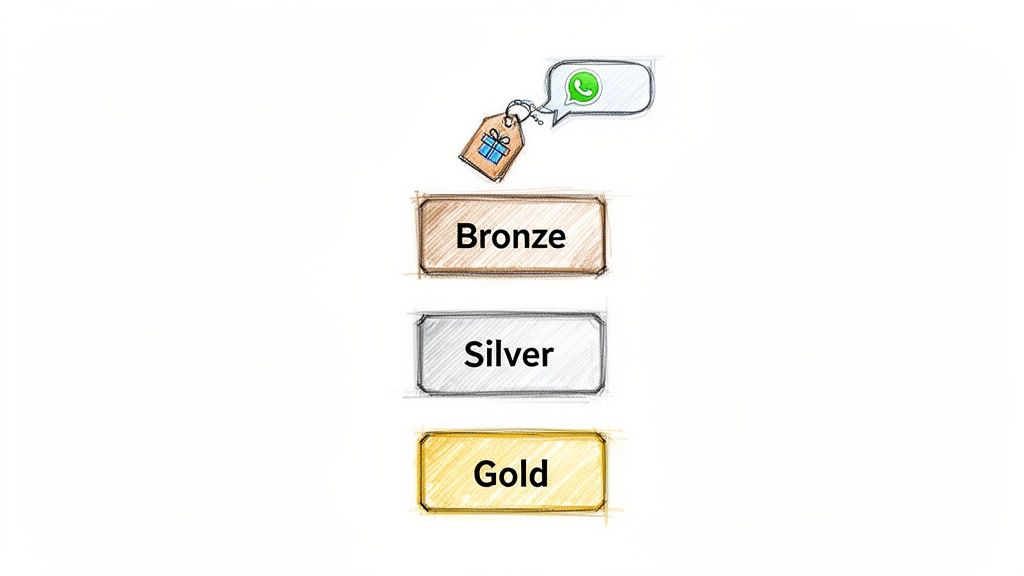
Transforming one-time buyers into lifelong fans requires recognition and reward. Building loyalty programs through WhatsApp is a powerful strategy to make customers feel valued and encourage repeat purchases. This approach uses segmentation and personalization to deliver exclusive offers, rewards updates, and VIP tier recognition directly to your most valuable customers’ inboxes.
Loyalty Programs
Unlike email-based programs that get lost in cluttered inboxes, WhatsApp messages have near-perfect open rates, ensuring your rewards are seen. When a customer reaches a new VIP tier, an instant, celebratory WhatsApp message makes the achievement feel significant. It’s a direct, personal way to say “thank you” and immediately outline their new perks, solidifying their connection to your brand.
How to Implement This Strategy
- Define Your Tiers and Rewards: Establish clear loyalty tiers (e.g., Bronze, Silver, Gold) with criteria for advancement, such as total spend. Assign tangible rewards to each tier, like free shipping, early access, or exclusive discounts.
- Segment Your Audience: In a platform like Clepher, use tags to track customer loyalty status. Create segments for each tier, as well as segments for customers nearing the next tier to encourage them to level up.
- Automate Tier Recognition: Set up automated flows that trigger when a customer’s loyalty status changes. Send a congratulatory message instantly, welcoming them to the new tier and detailing their new benefits.
- Launch Exclusive Campaigns: Use your loyalty segments to send targeted broadcasts with offers only available to that tier. For example, send an early access link to your “Gold” members for a new product launch.
Why It Works
This is one of the most effective WhatsApp marketing strategies because it directly addresses customer retention, which is far more cost-effective than acquisition. Fashion e-commerce brands use this to grant VIP members early access to new collections. Beauty subscription services reward top-tier customers with bonus points. By managing these interactions on WhatsApp, the experience feels exclusive and personal, turning passive buyers into active brand advocates.
10. Omnichannel Integration and Cross-Channel Orchestration
Integrating WhatsApp with other channels like email and SMS is a sophisticated strategy that creates a seamless customer journey. This approach, known as cross-channel orchestration, ensures each platform works in harmony, delivering the right message on the right channel at the right time. Instead of treating each channel as a silo, you can orchestrate a unified conversation that adapts to customer behavior.
The core benefit is creating a customer-centric flow that boosts engagement. For instance, a customer who abandons their cart might first receive an instant reminder on WhatsApp. If they don’t respond, an automated follow-up email with more detailed product information could be triggered a day later. This intelligent sequencing respects user preferences and maximizes the chance of conversion without being annoying. To fully grasp its power, a foundational understanding of what omnichannel marketing entails is essential.
How to Implement This Strategy
- Map the Customer Journey: Identify key touchpoints from awareness to post-purchase and determine the optimal channel for each interaction (e.g., WhatsApp for urgency, email for detail).
- Unify Your Tech Stack: Use a platform like Clepher that offers native integrations with your CRM, email service provider, and other tools.
- Define Orchestration Rules: Create automated workflows with clear logic. For example: “If a user doesn’t open the WhatsApp broadcast in 2 hours, send an SMS backup.”
- Offer Channel Preferences: Allow customers to choose how they want to be contacted in their account settings, respecting their preferences and improving engagement.
Why It Works
This strategy puts the customer in control while ensuring your message gets through. E-commerce brands use it to recover abandoned carts by staggering WhatsApp and email reminders. SaaS platforms can send urgent outage alerts via WhatsApp while delivering longer monthly newsletters via email. This approach ensures critical information is seen immediately and less urgent content is consumed at the user’s leisure, building a smarter, more respectful communication ecosystem.
WhatsApp Marketing: 10-Point Strategy Comparison
| Strategy | Implementation Complexity 🔄 | Resource Requirements ⚡ | Expected Outcomes 📊⭐ | Ideal Use Cases 💡 | Key Advantages ⭐ |
|---|---|---|---|---|---|
| WhatsApp Business API with Automated Chatbots | High — technical integration, verification & compliance 🔄 | High — dev, hosting, AI models, verified business number ⚡ | Reliable 24/7 engagement; high deliverability; reduced support costs 📊 ⭐⭐⭐ | E‑commerce order updates, SaaS onboarding, subscription reminders | Official API, scalability, compliance, delivery receipts ⭐ |
| Lead Generation and Capture via WhatsApp Flows | Medium — flow design, widget setup and testing 🔄 | Low–Medium — marketer time, flow builder; minimal dev ⚡ | Higher conversions vs forms; real‑time lead capture & segmentation 📊 ⭐⭐ | Course creators, SaaS demos, DTC brands building first‑party data | Conversational capture, CRM sync, better conversion rates ⭐ |
| Broadcast Campaigns with Segmentation and Personalization | Medium — segmentation, compliance and scheduling 🔄 | Medium — content, analytics, opt‑in list management ⚡ | High open/CTR; targeted promotions at scale; measurable ROI 📊 ⭐⭐⭐ | E‑commerce promotions, renewals, product launches | Personalized scale, A/B testing, strong engagement ⭐ |
| Abandoned Cart Recovery via WhatsApp | Medium — e‑commerce triggers and platform integration 🔄 | Low–Medium — integration with store, templates, timing logic ⚡ | Recovers ~10–30% of carts; immediate revenue lift 📊 ⭐⭐ | E‑commerce with mid/high AOV, subscription renewals | Timely reminders, direct checkout links, high ROI ⭐ |
| Customer Support and Service Excellence via WhatsApp | Medium–High — AI training, escalation & workflow setup 🔄 | High — support staff, AI maintenance, monitoring tools ⚡ | Faster resolutions, lower workload, higher CSAT; 24/7 coverage 📊 ⭐⭐⭐ | High‑volume e‑commerce, SaaS technical support, subscription services | AI first response + human handoff, context preservation ⭐ |
| Product Recommendations and Upsell Sequences | Medium — catalog sync, behavioral logic and timing 🔄 | Medium — product data, personalization engine, analytics ⚡ | AOV +15–30%; increased CLV through targeted offers 📊 ⭐⭐ | E‑commerce with varied catalogs, subscription upsells | Personalized recommendations, automated cross‑sells ⭐ |
| Event Promotion and Registration Campaigns | Low–Medium — registration flows and calendar integration 🔄 | Low — messaging, reminders, simple integrations ⚡ | Higher registration & attendance; improved pre/post engagement 📊 ⭐⭐ | Webinars, workshops, course launches, product events | Conversational sign‑ups, automated reminders, calendar adds ⭐ |
| Customer Feedback and Surveys via WhatsApp | Low — short conditional flows and reporting setup 🔄 | Low — survey design, sentiment tools, analytics ⚡ | Higher completion and honest feedback; real‑time insights & NPS 📊 ⭐⭐ | Post‑purchase surveys, NPS, course feedback, churn analysis | High response rates, quick sentiment analysis, actionability ⭐ |
| Loyalty Programs and VIP Tier Rewards via WhatsApp | Medium — tier logic, reward tracking and fairness rules 🔄 | Medium — customer data, reward inventory, integration ⚡ | Increased CLV (≈25–50%); improved retention & advocacy 📊 ⭐⭐ | Repeat‑purchase e‑commerce, subscriptions, beauty/fashion brands | Tiered personalization, exclusive offers, retention focus ⭐ |
| Omnichannel Integration and Cross‑Channel Orchestration | High — multi‑platform integrations, data governance 🔄 | High — integrations, automation builders, cross‑channel analytics ⚡ | Consistent CX, optimized reach, better campaign performance 📊 ⭐⭐⭐ | Enterprises, agencies, complex onboarding and lifecycle campaigns | Unified customer view, channel optimization, reduced duplication ⭐ |
Your Turn: Start Building a Conversational Engine for Growth
We’ve explored 10 powerful WhatsApp marketing strategies, each a blueprint for transforming how you communicate, engage, and grow. From the efficiency of AI chatbots and the revenue-saving power of cart recovery to the community-building potential of VIP loyalty programs, the opportunity is clear. WhatsApp is no longer just a messaging app; it’s a dynamic platform for creating meaningful conversations that drive tangible business results.
The central theme is a fundamental mindset shift: move away from impersonal broadcasting and embrace conversational commerce. This is where you build relationships, not just blast promotions. By leveraging the immediacy of WhatsApp, you can meet customers where they are, providing value and support that traditional channels like email simply cannot match.
Key Takeaways: From Theory to Action
Here are the non-negotiable principles for success with WhatsApp marketing:
- Personalization is Paramount: Generic blasts are dead. Success hinges on using data to make every message feel like a one-on-one conversation.
- Automation Unlocks Scale: You cannot manually manage thousands of chats. Implementing automated chatbots and flows is essential for handling inquiries and guiding customers 24/7 without burning out your team.
- Value Must Precede the Ask: Before you sell, serve. Offer helpful tips, provide instant support, or share exclusive content. Building this foundation of trust earns you the right to present an offer.
- Integration is a Superpower: Your WhatsApp marketing strategies should not exist in a vacuum. Integrating with your CRM and e-commerce platform creates a seamless, omnichannel experience.
Your Actionable Next Steps
Don’t try to implement everything at once. Instead, take a focused, strategic approach.
- Identify Your Biggest Bottleneck: What is the single biggest challenge in your business right now? Is it converting leads? Reducing cart abandonment? Improving customer retention?
- Choose One High-Impact Strategy: Pick the one strategy from this list that directly addresses your bottleneck.
- Struggling with lead conversion? Start with a WhatsApp Flow on your website.
- Losing sales at checkout? Implement an abandoned cart recovery sequence.
- Want to boost customer lifetime value? Launch a simple customer feedback survey or a basic VIP loyalty program.
- Map Out the Conversation: Before building anything, sketch out the ideal conversational flow. What are the key messages? What actions do you want the user to take?
- Measure, Learn, and Iterate: Launch your first campaign and track key metrics. Monitor open rates, click-through rates, and conversion rates. Use this data to refine your messaging and timing for better performance.
The conversation with your customers is already happening on WhatsApp. By taking these deliberate steps, you can move from being an observer to being an active participant in that dialogue. This is how you build a resilient brand, foster true loyalty, and create a powerful, sustainable engine for growth.
Ready to turn these strategies into reality without writing a single line of code? Clepher is the all-in-one conversational marketing platform designed to help you build, automate, and scale your WhatsApp communications effortlessly. Start your free trial today and build your first automated conversational flow in minutes at Clepher.
Related Posts
How to Create a Survey on Facebook for Maximum Engagement
March 28, 2026Social Media Marketing Automation: Your Ultimate Guide
March 27, 2026
Founder Clepher