
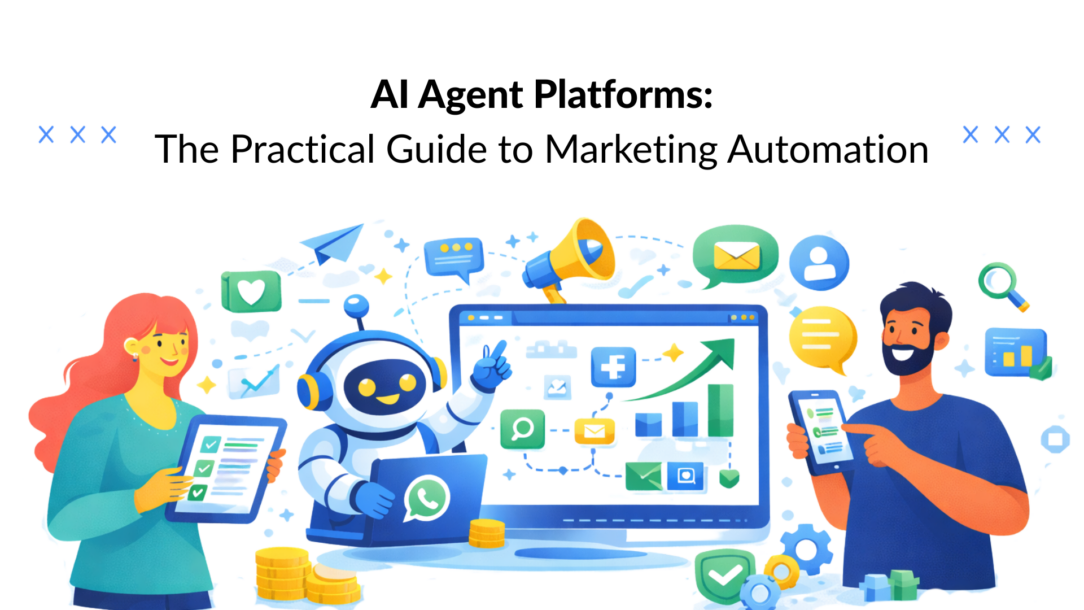
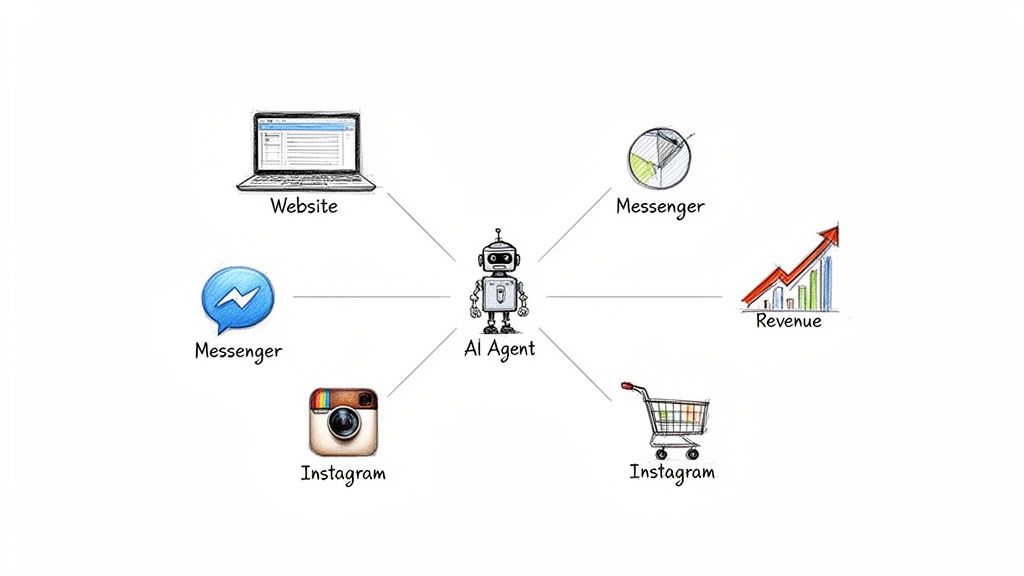
AI agent platforms are more than just fancy chatbots. They are smart, autonomous systems built to manage complex marketing, sales, and support tasks from start to finish. Using powerful AI, they understand what customers actually want, execute multi-step actions, and proactively guide the entire customer journey across channels like Messenger, Instagram, and your website.
What Are AI Agent Platforms and Why Marketers Need Them
AI Integration
If you’ve ever dealt with a basic chatbot, you know the drill. You click a button, and it spits out a canned response. It’s a stiff, one-way street. AI agent platforms represent a massive leap forward, transforming these reactive tools into proactive, autonomous systems that get results.
Think of an AI agent as an automated team member. It doesn’t just answer a question; it performs a whole sequence of tasks to achieve a specific goal. It’s the difference between a bot that says, “Our hours are 9-5,” and an agent that says, “I see you’re asking about store hours. We’re open until 5 PM. Would you like me to book a time for you to visit?”
Moving Beyond Basic Automation
The real power of these platforms is their ability to manage entire customer journeys without a human stepping in. For marketers juggling lead nurturing, customer support, and sales follow-ups, this is a total game-changer.
For instance, an AI agent can:
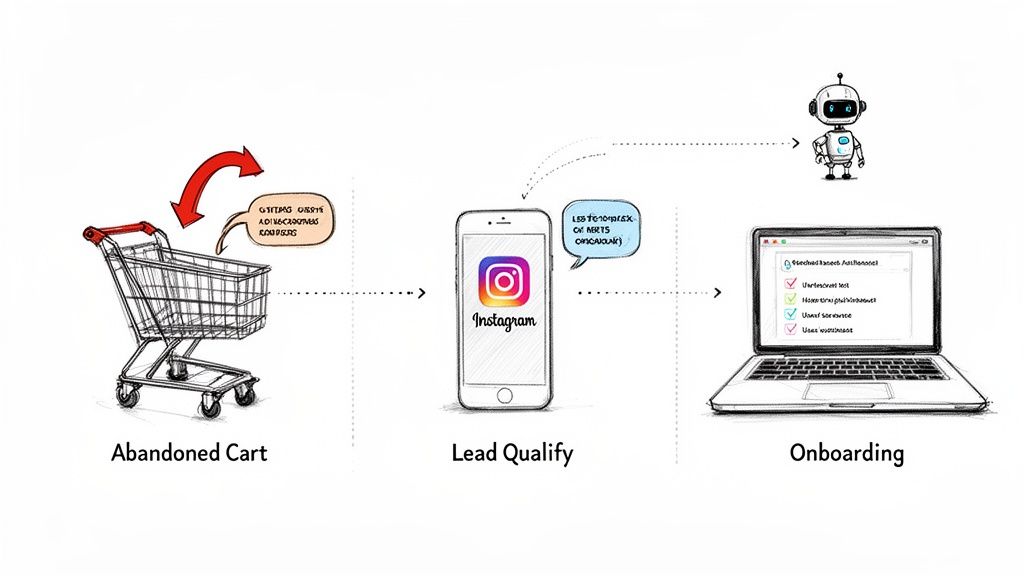
- Qualify leads on Instagram: Ask screening questions, identify high-intent prospects, and even schedule a discovery call right inside the DMs.
- Recover abandoned carts: Message a user on Messenger who ditched their cart, offer a timely discount, and guide them directly back to checkout.
- Onboard new customers: Deliver a welcome series, answer common first-time questions, and point users to key resources automatically.
This market is exploding for a good reason. The global conversational AI market is projected to skyrocket, driven by businesses hungry for smarter, more efficient ways to engage customers. This isn’t just a trend; it’s a fundamental shift in how businesses operate.
The Shift to Proactive Engagement
What makes this possible is the powerful combination of no-code builders and advanced AI. You no longer need to be a developer to build complex conversational flows. With simple drag-and-drop tools, you can design, test, and deploy an agent that works for you 24/7. To get a better handle on the mechanics, it’s worth understanding how AI powers efficient workflows through content automation.
Actionable Takeaway: AI agents are here-and-now tools that let e-commerce brands, agencies, and entrepreneurs automate meaningful conversations, scale their operations, and directly boost revenue. They are not some far-off future technology.
For any modern business, this is about more than just saving time. It’s about meeting customers right where they are—on platforms like Facebook Messenger and Instagram DMs—and giving them instant, personalized value that builds real relationships and drives sales. If you’re ready to bring this into your own playbook, explore our detailed guide on how to use AI in marketing.
How to Choose the Right AI Agent Platform
Picking the right AI agent platform can feel like a huge decision, but it boils down to a few core business needs. Instead of getting lost in endless feature lists, let’s focus on the practical capabilities that will actually move the needle for your marketing. This framework cuts through the noise and helps you find a tool that genuinely works for you.
First up, and arguably the most important piece of the puzzle, is the conversational builder. Your marketing team—not a developer—is going to be in the driver’s seat. The builder must be intuitive, fast, and powerful enough to map out complex customer journeys without writing a single line of code.
Evaluate the No-Code Builder
A solid no-code builder is the difference between launching a campaign this afternoon and waiting weeks for your tech team. This is your command center for creating every interaction, from a simple “welcome” message to a sophisticated lead qualification flow. Look for a drag-and-drop interface where you can visually map the conversation.
When you’re testing a builder, ask these practical questions:
- Can I A/B test different conversation paths? This is non-negotiable for optimizing lead qualification questions or promotional offers to see what actually converts.
- How easily can I segment users? You need to tag users based on their answers or actions (e.g., “interested_in_service_A”) to send hyper-targeted follow-ups.
- Does it support conditional logic? The platform must let you create smart flows that branch based on user input, making the conversation feel personal and relevant.
A powerful builder lets you create dynamic, intelligent agents—not just rigid, one-trick bots. This is where your marketing strategy comes to life.
Check Channel Support and Integrations
Your shiny new AI agent is useless if it can’t talk to customers where they already are. For most marketers, that means your website, Facebook Messenger, and Instagram DMs. Ensure the platform has official, stable support for the channels your audience actually uses.
Beyond channels, an AI agent platform must plug into your existing marketing stack. Without deep integrations, your agent becomes an isolated island of data. It needs to connect seamlessly with your CRM, email marketing service, and any other tools you rely on.
Practical Insight: Native integrations are almost always better than relying on third-party connectors like Zapier. A native link to your email platform means a new lead can be added to a nurture sequence instantly, without delays or potential points of failure.
Before you commit, list your must-have tools. Can the platform push a qualified lead straight into your HubSpot or ActiveCampaign account? Can it pull customer data from Shopify to personalize a conversation? These connections transform your agent into a fully integrated part of your marketing engine.
Analyze the Analytics and Reporting
You can’t improve what you don’t measure. Strong analytics are non-negotiable if you want to prove ROI and make your agent perform better over time. Basic metrics like “messages sent” don’t cut it; you need data tied directly to business goals.
Look for a platform that delivers clear, actionable insights, such as:
- Conversion Rates: How many people who started a conversation actually completed a key goal, like signing up for a webinar or using a discount code?
- Flow Performance: Which conversational paths are most effective at qualifying leads or resolving support tickets?
- User Engagement: Where are people dropping off in a conversation? This is gold for finding and fixing bottlenecks.
Solid reporting helps you demonstrate the agent’s value—like showing a 30% increase in lead capture from Instagram DMs—and gives you the hard data you need to refine your strategy for even better results.
Comparing The Top AI Agent Platforms
Alright, you know what to look for. Now, let’s get into the actual AI agent platforms on the market. The options generally fall into two camps: technical, developer-first frameworks, and business-friendly platforms built for speed and simplicity. Which one you pick depends entirely on your team’s skills, your project’s complexity, and how fast you need to get results.
Developer tools are powerful, but they come with a steep learning curve and demand serious coding chops. On the other hand, no-code solutions prioritize usability, letting marketers and business owners build powerful agents without touching a line of code. This choice will define your entire automation strategy.
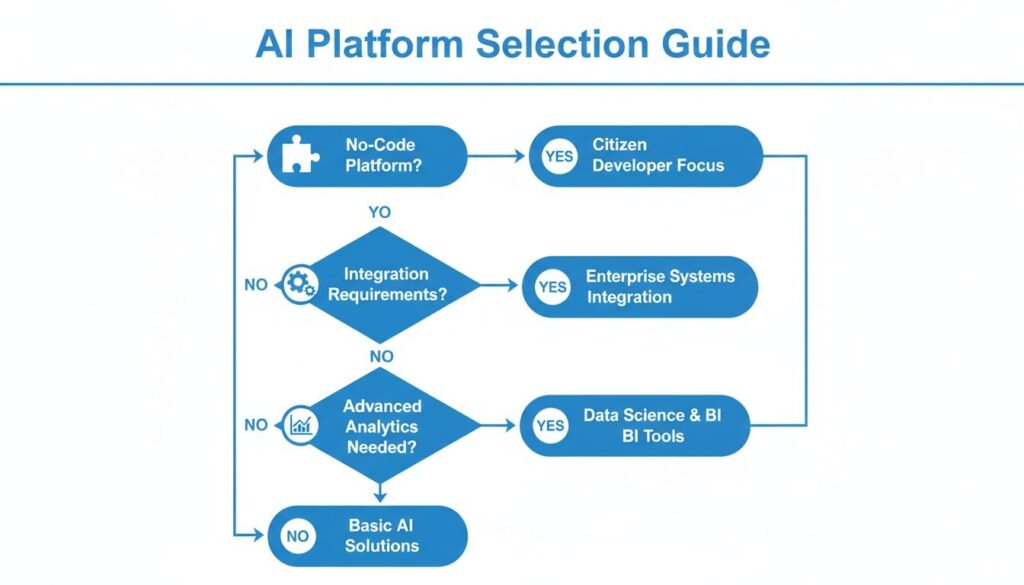
This decision tree can help you determine the right path.
AI Platform Selection Guide
As you can see, it comes down to your team’s tech skills, the importance of deep integrations, and your need for built-in analytics to prove what’s working.
Developer-Centric Frameworks
Think of platforms like LangGraph and CrewAI as toolkits for software developers. They provide the raw building blocks—SDKs and frameworks—to construct highly customized, multi-agent systems from the ground up.
These are perfect for large companies with incredibly specific, complex needs that an off-the-shelf tool can’t handle. For example, a global logistics company could use a framework to build a proprietary system where specialized agents manage inventory, coordinate shipping, and send customer updates.
But the trade-offs are significant.
- Massive Learning Curve: You need advanced programming skills, usually in Python. Your marketing team won’t be able to just hop in and create a new campaign flow.
- Long Development Cycles: Building, testing, and launching an agent is a full-blown software project, often taking weeks or months.
- No Built-in Marketing Tools: Features like analytics dashboards, A/B testing, or user segmentation are not included. You have to build everything yourself.
Business Use Case: Only go the developer route if you have a dedicated engineering team and a unique, complex problem that a no-code platform can’t solve. For 99% of marketing and sales use cases, this is overkill.
Business-Focused Platforms
This is where platforms like Clepher shine. These tools are designed for business users—marketers, agency owners, and entrepreneurs who need to move fast and get results. The entire philosophy is to hide the technical complexity behind a visual, no-code builder.
Instead of writing code, you drag and drop elements to design conversations on channels like Messenger, Instagram, or your website. This puts advanced AI automation directly into the hands of the people who manage customer relationships.
For a digital marketing agency, this is transformative. You can design and deploy a lead qualification agent for a client’s Instagram account in a single afternoon and start delivering value immediately. No developers or long build cycles are needed. You can see how this fits into the bigger picture in our deep dive on AI marketing automation tools.
AI Agent Platform Feature Comparison
To make the differences clearer, here’s a high-level look at how key players stack up. This table frames the “developer vs. business” choice in practical terms.
| Platform | Ideal User | Key Strength | Supported Channels | Integration Ecosystem | Pricing Model |
|---|---|---|---|---|---|
| Clepher | Marketers, Agencies, SMBs | No-code visual builder, built-in marketing tools & analytics | Messenger, Instagram, Website Chat, WhatsApp, SMS | Native (Shopify, HubSpot, etc.), Zapier, Make, Webhooks | Subscription-based (SaaS) |
| LangGraph | Python Developers, AI Researchers | Building stateful, multi-agent applications | Custom-built by developers | Developer-led via APIs & libraries | Open-source (free) |
| CrewAI | AI Developers, Tech Startups | Autonomous agent collaboration & task delegation | Custom-built by developers | Python libraries & custom APIs | Open-source (free) |
| IBM watsonx | Large Enterprises | Enterprise-grade security, scalability, and compliance | Enterprise systems, voice, web | Deep enterprise (Salesforce, SAP, etc.) | Usage-based (API calls) |
| Oracle Digital Assistant | Oracle Customers, Enterprises | Native integration with Oracle’s software ecosystem | Web, mobile, Oracle apps, voice | Primarily Oracle-centric | Per-user or per-request |
This table shows a clear divide: tools like Clepher are all-in-one solutions designed for business outcomes, while frameworks like LangGraph and CrewAI are raw materials for building from scratch. Enterprise giants like IBM and Oracle focus on large-scale deployments within their existing ecosystems.
A Practical Head-to-Head Comparison
Let’s ground this in real-world scenarios to see how these differences play out.
Goal 1: Recover Abandoned Carts for an E-commerce Store
- Using a Developer Framework (e.g., CrewAI): A developer would have to build a custom integration with your e-commerce platform’s API to detect an abandoned cart. Then, they’d need to code the agent’s logic—when to send a message, how to handle replies, and how to offer a discount. This is easily a multi-week project.
- Using a Business Platform (e.g., Clepher): You’d connect your Shopify store in a few clicks with a native integration. Then, you’d use the visual builder to create a flow that automatically triggers when a cart is abandoned, sends a message on Messenger, and guides the user back to checkout. You could have this live in under an hour.
Goal 2: Qualify Leads for a Marketing Agency’s Client
- Using a Developer Framework (e.g., LangGraph): You’re coding the entire conversation from scratch, including every possible question and response. You’d also have to build a custom webhook to push qualified lead data into the client’s CRM.
- Using a Business Platform (e.g., Clepher): You’d visually map out the qualifying questions in the flow builder, use tags to segment leads based on their answers, and use a pre-built integration to send high-quality leads directly into HubSpot or ActiveCampaign. You could even A/B test different questions to optimize performance.
The market for AI agent platforms is growing rapidly, with tools like LangGraph, CrewAI, and enterprise solutions from IBM and Oracle driving innovation. When making your choice, it helps to look at the broader automation landscape. Reviewing resources on the best AI powered marketing tools can give you a better sense of how different technologies fit into your stack. Ultimately, the right platform empowers your team to execute your strategy, turning conversations into measurable conversions.
Real-World Use Cases That Drive Marketing Results
AI Agent Use Cases
Knowing the features of AI agent platforms is one thing, but seeing them in action is where their power clicks. The value isn’t in the tech itself; it’s in the tangible business results you can achieve. Let’s dig into specific, high-impact scenarios where AI agents are changing the game for marketers.
These aren’t theories; they are practical blueprints for solving everyday marketing headaches. The best part? Platforms with no-code builders and deep integrations make these outcomes not just possible, but surprisingly accessible.
E-commerce Cart Recovery on Messenger
For any e-commerce brand, abandoned carts are a constant leak in the revenue bucket. An AI agent plugs that hole by turning a customer’s exit into an active conversation inside Facebook Messenger, where open rates are sky-high.
Here’s the blueprint:
- The Trigger: A customer adds items to their Shopify cart but gets distracted and leaves. The AI platform, connected via a native integration, detects this instantly.
- The Engagement: Instead of a generic email that gets lost in an inbox, the agent pings the customer on Messenger. It’s a simple, conversational prompt like, “Hey [First Name], looks like you left something behind. Need any help with your order?”
- The Nudge & Conversion: If they reply, the agent can answer questions about shipping or even offer a small, time-sensitive discount to close the deal. It then provides a direct link back to their pre-filled cart.
The result is a direct lift in recovered sales. Brands using this strategy often see a 15-25% increase in cart recovery, simply because the interaction is immediate, personal, and happens on a channel people actually check.
Automated Lead Qualification for Agencies
Digital marketing agencies thrive on the quality of leads they generate for clients. But manually sifting through Instagram DMs and contact forms is a massive time sink. An AI agent automates this entire front-end process, ensuring the sales team only talks to people who are ready to buy.
Actionable Insight: The goal of lead qualification isn’t just to grab an email. It’s to understand a prospect’s budget, timeline, and needs before a human gets involved. This makes the first sales call incredibly efficient.
An agency can set up an AI agent on a client’s Instagram account to:
- Start the Conversation: When someone DMs or comments with a keyword like “info,” the agent engages immediately.
- Ask the Right Questions: The agent follows a smart script, asking key questions like, “What’s your monthly budget for this project?” or “Are you looking to start in the next 30 days?”
- Segment and Escalate: Based on the answers, the agent tags the lead (e.g., “hot_lead,” “low_budget”). The best leads are instantly pushed into the client’s CRM, and the sales team gets a notification to follow up.
This single automation can boost qualified lead capture by 30% or more, all while freeing up hours of manual work every week. Plus, every potential customer gets an instant response, which is a huge win for the client experience.
Proactive Onboarding for SaaS Companies
For SaaS businesses, the first week after a user signs up is critical. A confusing onboarding experience leads directly to churn. An AI agent acts as a personal onboarding specialist, guiding new users through the essential first steps and answering their questions 24/7.
This approach transforms onboarding from a one-way street of static emails into a helpful, interactive dialogue.
- Welcome and Guide: The moment a user signs up, the agent sends a welcome message and points them to their first task, like setting up their profile.
- Answer FAQs Instantly: The agent is trained on a knowledge base of common questions. When a new user asks, “How do I integrate this with my calendar?” they get an immediate, accurate answer instead of filing a support ticket.
- Check In and Nurture: After a couple of days, the agent can proactively check in: “Hey [First Name], I noticed you haven’t connected your account yet. Can I help with that?”
The impact is huge. Businesses often see a reduction in support tickets by up to 50% and a measurable lift in user activation rates. This frees up the human support team to focus on complex, high-value customer problems. It’s practical applications like these that explain why the AI agent platforms market is growing so fast; you can explore more data on this market growth to see the full picture.
Your AI Agent Implementation Plan
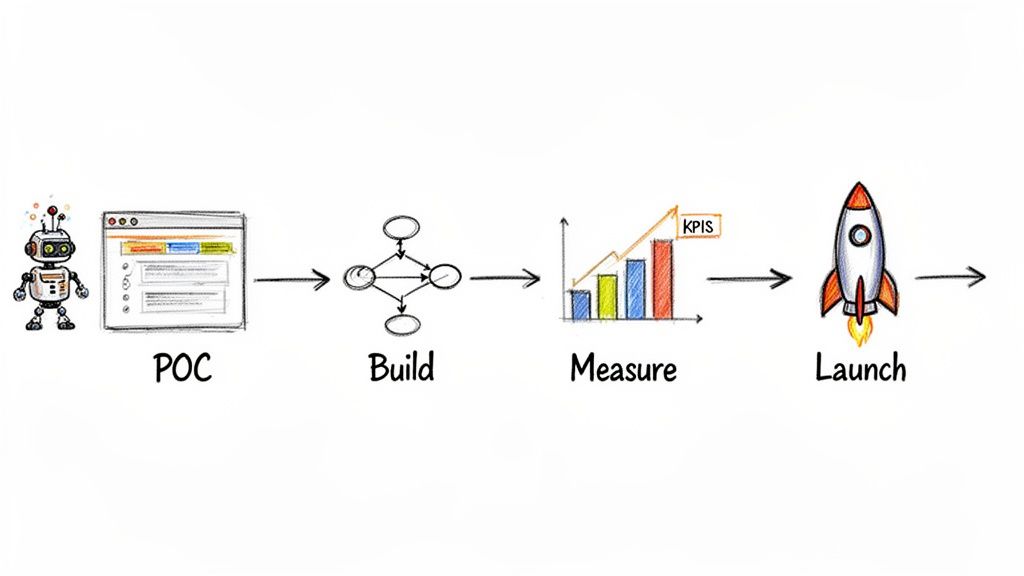
AI Agent Implementation Plan
Alright, you understand the power of AI agent platforms, you’ve seen what they can do, and you’ve chosen a tool that fits your business. Now it’s time to stop planning and start doing.
The best approach isn’t to build a massive, all-knowing agent right away. Instead, launch a small, focused pilot project.
This proof-of-concept (POC) approach is your ticket to a fast, low-risk win. It lets you test the tech, get comfortable with the platform, and build momentum with something that delivers real results in weeks, not quarters. The goal is simple: solve one specific, high-impact problem first.
Launch Your First Proof-of-Concept
The secret to a successful POC is keeping the scope incredibly tight. Resist the urge to automate everything at once. Instead, pick a single, nagging bottleneck in your marketing or support workflow and build an agent designed to fix just that.
Here are a few perfect first projects:
- A Simple FAQ Agent: Build an agent that handles your top 5-10 most common questions on your website. This is a classic “quick win” that immediately lightens the load on your support team.
- A Lead Capture Agent for One Ad: Create an agent that engages people who comment on a single Facebook or Instagram ad. Its only job is to ask a couple of qualifying questions and grab an email address.
- A Welcome Message for New Followers: Set up an agent to send a friendly welcome message to new Instagram followers, pointing them to a valuable blog post or free guide.
Choosing a focused project keeps the build process from getting overwhelming and gives you a crystal-clear outcome to measure. It’s the fastest way to prove the value of AI automation to your team and stakeholders.
Actionable Insight: Your first AI agent project should take an afternoon to build, not a quarter. A successful POC is all about speed to launch and clear, measurable results. It proves that AI agent platforms are accessible and effective from day one.
Define Your Key Performance Indicators
Before you launch, you need to know what success looks like. Without clear metrics, you’re just guessing. Key Performance Indicators (KPIs) turn your business goals into measurable targets, letting you prove the agent’s ROI with hard data.
Your KPIs should be tied directly to the problem your agent is built to solve. For example, if your goal is to get more qualified leads, you need to track more than just how many chats you had.
Here’s how you can align KPIs with common POC goals:
- For an FAQ Agent:
- KPI: A reduction in support ticket volume.
- How to Measure: Track the number of support inquiries for the questions your agent now handles. A 20% decrease in those specific tickets is a huge win.
- For a Lead Capture Agent:
- KPI: Lead-to-qualified-lead conversion rate.
- How to Measure: Monitor how many conversations end with a user providing their contact info and meeting your qualification criteria.
- For an E-commerce Promotion Agent:
- KPI: Coupon code redemption rate.
- How to Measure: See how many people who receive a discount code from the agent actually use it at checkout.
Setting these benchmarks up front is non-negotiable. It gives you a clear finish line and helps you show everyone exactly how your new agent is moving the needle. If you need a more detailed walkthrough, our guide on how to create AI agents breaks down the entire process.
Measure, Iterate, and Scale
Your work isn’t done after you go live. The real magic happens when you start digging into the data and making your agent smarter over time. Most solid AI agent platforms come with built-in analytics that show you exactly where conversations are flowing smoothly or hitting a wall.
Make it a weekly habit to check your analytics dashboard. Look for drop-off points in your conversational flows. Are people getting stuck on a certain question? Are they using words you didn’t anticipate? Use those insights to tweak your agent’s script, rephrase confusing questions, and add new paths to handle what real users are saying.
This cycle of measuring, learning, and improving is what turns a simple POC into a powerful, long-term asset. Once you’ve proven the value of your first agent, you’ll have the data, confidence, and internal buy-in to start tackling bigger, more complex automation challenges across the business.
Common Questions About AI Agent Platforms
Even with the best plan, jumping into AI agent platforms for the first time usually brings up a few last-minute questions. We get it. This is new territory for many marketers.
Let’s clear up some of the most common things we hear, so you can move forward with confidence.
Related Posts
No-Code AI Agent Builder: Your 2026 Growth Playbook
April 8, 2026Your Guide to the Facebook Page URL in 2026
April 7, 20265 Best Chatfuel Alternatives in 2026 You Need to Try!
April 6, 2026
Founder Clepher