

Imagine having a personal concierge for every customer—someone available 24/7 to answer questions, guide them, and offer support the second they need it. That’s the real promise of automated customer engagement. It’s about using smart technology like AI to have personalized, timely conversations at a scale humans just can’t match. This isn’t about replacing people; it’s about building better relationships, not just closing tickets.
From Reactive Support to Proactive Relationships
Traditionally, customer support is a reactive game. A customer hits a snag, gets frustrated, and reaches out for help. Automated engagement flips the script. It shifts your strategy from reacting to problems to actively preventing them and guiding customers toward success.
Instead of waiting for a customer to report an issue, you use automated workflows to guide, inform, and assist them at every step of their journey.
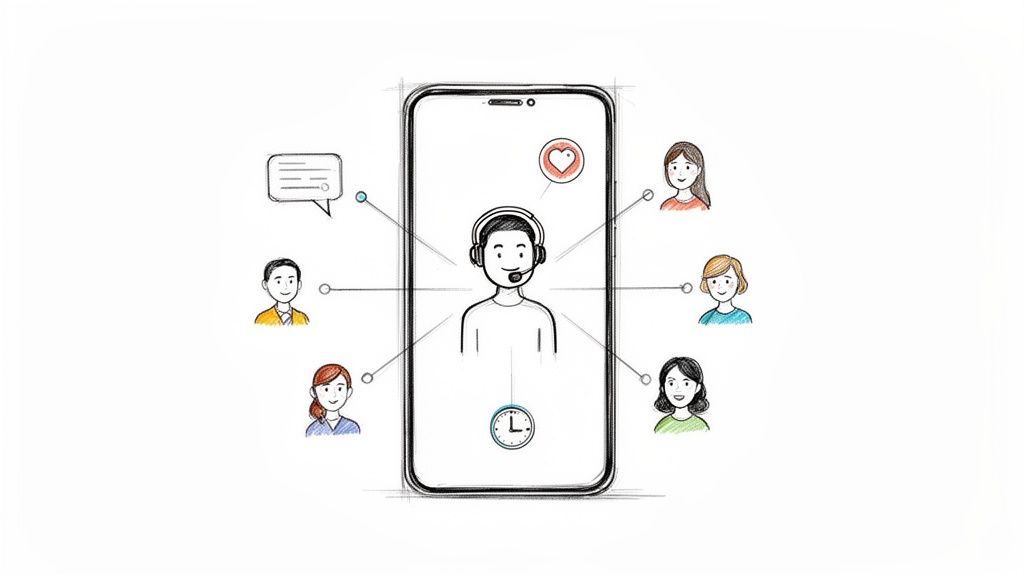
Automated Customer Support
Think of it this way: manual support is like a firefighter, rushing in only when there’s a blaze. Automated engagement is like a sprinkler system. It works quietly in the background to make sure fires don’t even start, ensuring a smooth, positive experience from the get-go.
How Does It Actually Work?
This approach uses tech—mostly AI-powered chatbots and pre-planned workflows—to interact with customers across all the channels they already use. The goal isn’t to replace your team with robots but to supercharge their abilities.
Real-world example: A customer lands on your e-commerce site and is instantly greeted by a chatbot offering a welcome discount. After they buy something, an automated email confirms their order. A few days later, an SMS alert lets them know it has shipped. This entire sequence unfolds without a single human touching it, creating a seamless and consistent experience.
Connecting Automation to Business Goals
The real magic of automated engagement is how it directly fuels your core business objectives. By delivering instant, personalized interactions, you get tangible results that create a serious competitive advantage.
- Higher Customer Satisfaction: Nobody likes waiting on hold. Instantly answering common questions keeps customers happy. In fact, 51% of consumers actually prefer using bots for immediate help.
- Stronger Loyalty: Proactive communication makes customers feel seen and valued, which gives them a powerful reason to stick with your brand for the long haul.
- Streamlined Operations: Taking repetitive tasks off your team’s plate frees them up to tackle the complex, high-stakes issues that truly require a human touch. This shift can slash customer service operational costs by a massive 30%. You can learn more about these powerful AI-driven statistics and their impact on customer service.
The Takeaway: By automating routine conversations, you empower your human agents to become expert problem-solvers for high-value issues, transforming your support center from a cost center into a growth engine.
To see the difference, let’s look at a side-by-side comparison.
Manual vs Automated Engagement at a Glance
This quick comparison highlights the transformative impact of automating customer interactions.
| Aspect | Manual Engagement | Automated Engagement |
|---|---|---|
| Availability | Limited to business hours | 24/7, instant responses |
| Scalability | 1-to-1 interactions, hard to scale | Handles thousands of conversations at once |
| Cost | High labor and operational costs | Lowers costs by up to 30% |
| Consistency | Varies by agent and workload | Perfectly consistent messaging every time |
| Proactivity | Mostly reactive (waits for contact) | Proactive (guides and anticipates needs) |
| Data Collection | Manual and often inconsistent | Gathers rich data automatically |
The table makes it clear: while manual engagement has its place for complex issues, automation is what allows you to scale exceptional service without scaling your headcount.
What Are the Real Payoffs of Automating Customer Interactions?
Let’s move past the buzzwords. Automated customer engagement delivers real, tangible results that become the foundation for serious growth. This isn’t just about sticking a chatbot on your website; it’s about fundamentally upgrading how you connect with customers—making you more efficient, scalable, and memorable all at once.
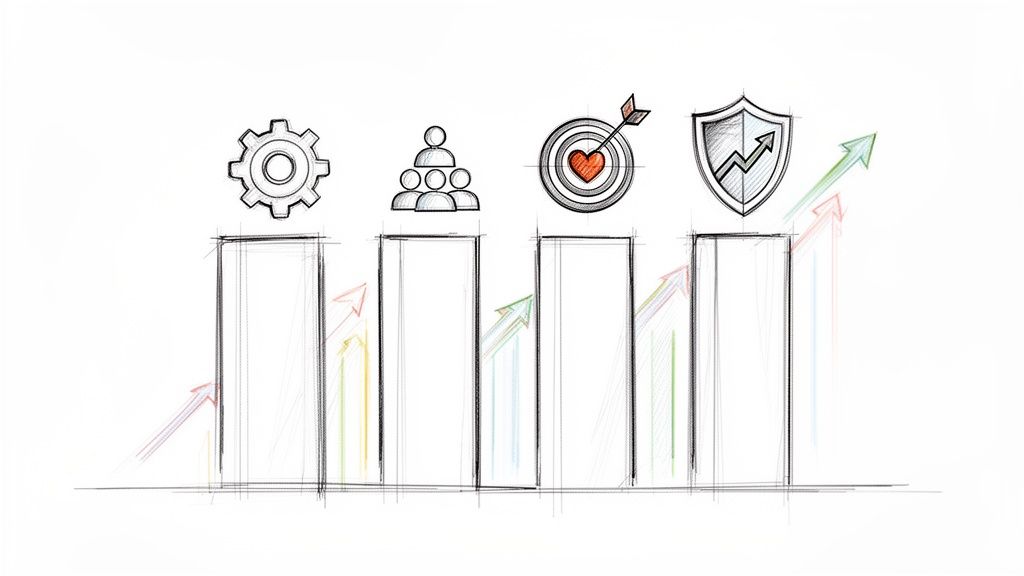
Automated Customer Engagement Growth Strategy
When you make this shift, the advantages are clear and measurable. Let’s break down the four core benefits you can expect from a smart automation strategy.
Achieve Radical Efficiency and Focus
The first thing you’ll notice is a massive jump in team efficiency. Automation acts as your digital front line, handling the repetitive, simple questions that eat up your support team’s day.
Think about all the time spent answering “What’s your return policy?” or “Where is my order?” An automated system can handle those instantly, 24/7. This frees up your human agents to pour their expertise into high-value, complex problems that demand real empathy and critical thinking—like calming a frustrated customer or walking someone through a detailed product consultation. You can learn more about how to boost your support team with customer service automation software.
The Transformation: Automation doesn’t replace your team; it elevates them. By filtering out the noise, you empower your agents to become expert problem-solvers, turning your support department from a cost center into a powerful retention engine.
Scale Your Conversations Infinitely
Picture a holiday sale or a new product launch. Customer inquiries can easily spike by 500% or more overnight. A human-only team simply can’t keep up. The result? Long wait times, frustrated customers, and lost sales.
Automated customer engagement completely removes this bottleneck. It lets you manage thousands of conversations at the same time without ever sacrificing quality or speed.
- E-commerce Example: A Shopify store can use an automated chatbot to field thousands of Black Friday questions about discount codes and shipping times, ensuring no customer is left hanging.
- SaaS Example: A software company can onboard hundreds of new users at once with an automated welcome flow, guiding each person through setup without needing a dedicated specialist for every single account.
This on-demand scalability means you can grow your business without having to linearly increase your support headcount. That makes your growth far more profitable.
Deliver Hyper-Personalization at Scale
Real personalization is more than just using a customer’s first name. It’s about delivering relevant, contextual experiences based on their actual behavior and data. Automation finally makes this possible for every single customer, not just a VIP few.
By plugging into your customer data platforms, an automation system can create unique journeys. For specialized industries like real estate, using robust tools like advanced real estate customer relationship management (CRM) systems is absolutely critical for managing leads and nurturing relationships effectively.
Proactively Boost Loyalty and Retention
Finally, automation lets you be proactive. Instead of waiting for a customer to run into an issue and complain, you can anticipate their needs and reach out first. This is how you build incredible loyalty and dramatically cut down on churn.
A 2025 industry study highlighted this perfectly, showing that automated campaigns triggered by behavior—like a user’s inactivity on a product—produce the biggest gains in retention. The same study found that 87% of organizations using AI-driven personalization saw a significant boost in customer engagement. That’s the power of meeting needs before they’re even expressed.
Choosing Your Channels for Automated Engagement
Great automated engagement isn’t about shouting the same message from every rooftop. It’s about meeting customers on their home turf and starting conversations that feel natural to that specific platform. You have to be where your audience is already active.
The goal is to design automated chats that deliver instant value, turning a simple website visit or an Instagram comment into a real conversation. This means your strategy has to be nimble. A fun, emoji-filled bot on Instagram won’t land the same way in a formal WhatsApp notification for a shipping update.
By understanding what makes each channel tick, you can build a smart, interconnected system that guides customers from one touchpoint to the next without a hitch.
Website Chat for Instant Support and Lead Capture
Think of your website as your digital storefront. A website chat widget is the friendly sales associate who greets visitors the moment they walk in. It’s the perfect spot for automated engagement that gives instant answers and grabs high-intent leads before they click away.
No more making people dig around for a contact page—you bring the help right to them. Instead of letting a potential customer leave with questions, a chatbot can jump in and help right away.
- 24/7 FAQ Handling: Automate answers to all the usual questions, like “What are your shipping options?” or “Do you have a free trial?” This offers immediate value and frees up your team from repetitive work.
- Proactive Lead Qualification: Set up your bot to ask smart qualifying questions based on the pages someone is viewing. For example: “Are you looking for a solution for yourself or your team?” It’s an easy way to segment leads on autopilot.
- Seamless Human Handoff: When a question gets too tricky for the bot, it can gather the user’s details and smoothly pass the entire conversation to a live agent. The best part? The agent gets the full chat history, so they have all the context they need.
Messenger and Instagram DMs for Social Commerce
Facebook Messenger and Instagram DMs are the new town squares of modern commerce. These aren’t just messaging apps; they’re powerful channels for building relationships and driving sales right inside the social platforms people love. Here, automation needs to feel personal, conversational, and super interactive.
For example, a platform like Clepher brings all these conversations into one central dashboard so you can manage everything without losing your mind.
This unified view is how you keep track of every automated conversation and make sure your strategy is actually working.
The Transformation: The real magic of social media automation is turning passive scrollers into active customers. A simple comment on a post can kick off a personalized DM chat that leads straight to a sale—all without a human lifting a finger.
Real-world example: An e-commerce brand runs a “comment-to-message” automation. A user comments “shoes” on an Instagram post. Instantly, a bot slides into their DMs with a direct link to the product and a special discount code. That’s a frictionless experience that captures buying intent the second it appears.
WhatsApp for High-Priority Personal Service
WhatsApp feels more private and direct, making it perfect for high-priority updates and one-on-one customer service. People treat their WhatsApp inbox as a more personal space, so reserve automated messages for genuinely valuable, time-sensitive information, not generic marketing blasts.
Think of it as the VIP line for your customers.
- Order and Shipping Alerts: Send real-time order confirmations, shipping notifications, and delivery updates straight to a customer’s phone.
- Appointment Reminders: For service businesses, this is a lifesaver. Send an automated reminder 24 hours before a scheduled appointment and watch your no-show rate drop.
- Personalized Consultations: A customer can start a chat to get a product recommendation. The bot can ask a few guiding questions before connecting them with a human expert for the final touch.
Channel-Specific Automation Strategies
To tie this all together, here’s a quick breakdown of how to think about automation for each of these key channels. The trick is to play to each platform’s strengths.
| Channel | Primary Use Case | Example Workflow |
|---|---|---|
| Website Chat | Instant Support & Lead Capture | A visitor on a pricing page is proactively asked if they want a demo. The bot qualifies them and books a meeting on the spot. |
| Messenger | Conversational Commerce | A user clicks a “Send Message” button on a Facebook ad. A bot engages them in a quiz to find the perfect product. |
| Instagram DM | Community Engagement & Sales | A user comments on an Instagram Story. The bot replies in their DMs with a special offer, turning a viewer into a lead. |
| Transactional & High-Touch Service | After a purchase, the customer receives order confirmations and shipping updates directly in WhatsApp. |
Ultimately, the best strategy uses a mix of these channels to create a seamless journey.
Email and SMS for Critical Journey Touchpoints
While flashy new channels get all the attention, email and SMS are still the trusty workhorses of automated engagement. They’re absolutely essential for confirming actions, nurturing leads, and bringing back customers who might have gone quiet. Their power lies in their reliability—everyone has email and SMS.
A smart strategy uses these classic channels to support the others. For instance, a customer journey might start when a lead is captured by a Messenger bot. That action could trigger a welcome email series that nurtures them over the next week. Once they finally make a purchase, they get an SMS with their shipping confirmation.
This creates a cohesive experience that feels reassuring and professional. To dive deeper, check out our guide on building a winning multi-channel marketing strategy. By weaving in these foundational channels, you ensure no customer ever falls through the cracks.
How to Build Your Automated Engagement Strategy
Making the jump to automated customer engagement can feel like a massive project, but it doesn’t have to be. Break the process down into clear, manageable steps. This lets you start small, prove the value quickly, and then scale your efforts systematically. Think of this as your practical playbook for building a strategy that delivers results right out of the gate.
The whole idea is to move with intention. Instead of just flipping a switch on a generic chatbot, you’re going to build a thoughtful system designed to hit specific business goals.
Step 1: Start With Clear and Measurable Goals
Before you write a single automated message, define what success looks like. Your goals will steer every decision you make, from the channels you pick to the conversation flows you design. Without a clear target, you’re just automating for the sake of it.
Ask yourself what you’re really trying to achieve. Is your main goal to:
- Reduce support tickets? Aim to deflect 25% of common inquiries within the first quarter by launching a simple FAQ bot.
- Capture more qualified leads? Aim to increase marketing-qualified leads from your website by 15% using a proactive chat widget on your pricing page.
- Improve customer onboarding? Aim to boost user activation rates by 20% with an automated welcome series on Messenger or WhatsApp.
Defining these specific, measurable goals gives your strategy direction and a clear benchmark to measure against.
Step 2: Map Your Customer Journey
Once you know your destination, you need a map. A customer journey map is a visual breakdown of every interaction a customer has with your brand, from first hearing about you to becoming a loyal fan. This exercise is critical for finding the exact moments where automated engagement will make the biggest splash.
For an e-commerce brand, the journey might look something like this: discovery (seeing a social media ad), consideration (browsing product pages), purchase (going through checkout), and post-purchase (getting shipping updates). By mapping this out, you can spot the friction points where customers get stuck or have questions.
Actionable Insight: A journey map turns abstract ideas into real opportunities. It shows you precisely where a perfectly timed automated message can answer a question, remove a barrier, or create a moment of delight.
For instance, you might notice a ton of people abandon their carts right at the checkout page. That’s a golden opportunity to deploy an automated bot that proactively offers a small discount code or answers a last-minute question about shipping, saving the sale.
The flowchart below shows how automation can engage customers across different channels as they move through their journey.
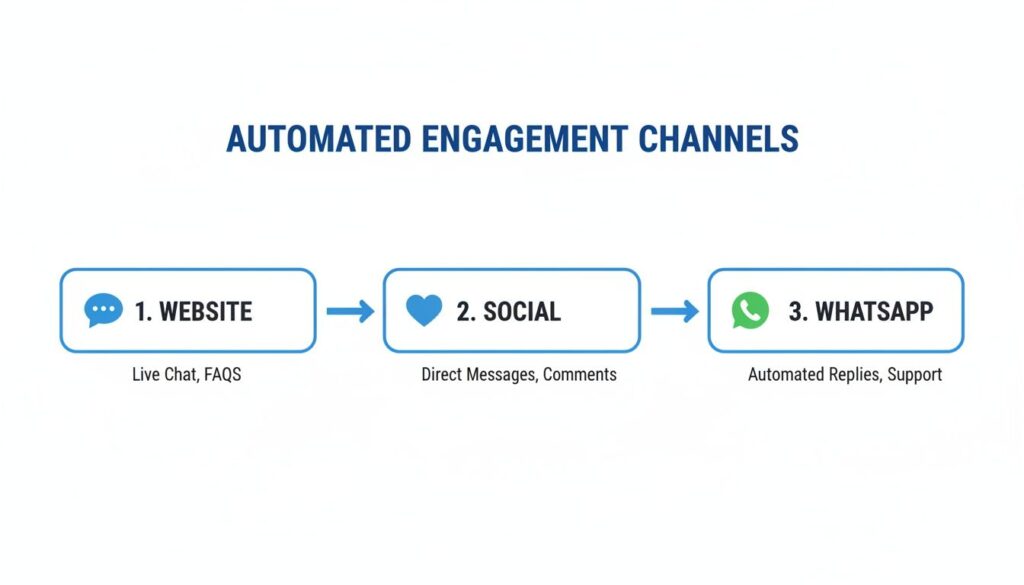
Automated Customer Engagement Channels
This visual brings it all together, highlighting how platforms like your website, social media, and direct messaging apps can work in concert to create a single, unified customer experience.
Step 3: Choose the Right Tools and Platforms
With your goals set and your journey mapped, it’s time to pick your tech. The key is to find a unified platform that lets you manage multiple channels from one central dashboard. Trying to juggle separate tools for your website chat, Messenger, and Instagram DMs is a recipe for disaster—it’s inefficient and leads to a choppy customer experience.
Look for a platform like Clepher that centralizes all your conversations and connects smoothly with the tools you already use, like your CRM or email provider. This gives you a single view of each customer and allows you to build out complex, multi-channel workflows without writing a single line of code.
Step 4: Design Your First High-Impact Workflows
Don’t try to boil the ocean by automating everything at once. Start with the low-hanging fruit—the simple, high-impact automations that will deliver the fastest and most visible results. This approach helps you score some early wins, build momentum, and prove the value of your strategy.
Here are a few great places to start:
- Welcome Series: Create an automated sequence to greet new subscribers on Messenger or Instagram. Use it to deliver a welcome discount, share your brand story, or point them toward your best-selling products.
- FAQ Bot: Build a straightforward bot on your website to handle your top 5-10 most frequently asked questions. This instantly lightens the load on your support team and gives customers 24/7 access to answers.
- Lead Qualification Bot: Set up a chatbot on your key landing pages to ask visitors a few qualifying questions. This helps you identify high-intent leads and route them directly to your sales team, speeding up the whole cycle.
And when you’re using email as part of your automated outreach, it’s absolutely crucial to know how to prevent automated emails from going to spam to make sure your messages actually get seen.
Step 5: Measure, Analyze, and Iterate
Your automated engagement strategy isn’t a “set it and forget it” kind of thing. It’s a living system that needs constant monitoring and tweaking. Regularly track the key metrics you defined in the first step and use that data to make smart improvements.
This data-driven approach is where AI-powered automation really proves its worth. Industry reports have shown that tying automation to predictive scoring can lead to an average 25% increase in conversion rates and a 30% reduction in customer acquisition costs. Some pilot AI engagement programs have even seen a staggering 344% ROI.
Dig into the analytics. See which messages are hitting the mark and which ones are causing people to drop off. Use the A/B testing features in your platform to experiment with different copy, offers, and conversation flows. This constant cycle of measuring, learning, and refining is what separates a good automation strategy from a great one. To get even more granular with your targeting, dive into these powerful customer segmentation strategies.
Measuring the Success of Your Automation Efforts
So you’ve launched your automated engagement strategy. How do you actually know if it’s working? To justify the investment and figure out what to tweak next, you have to move past gut feelings and start tracking the right numbers.
We’re talking about key performance indicators (KPIs) that tie directly to real business impact. Forget vanity metrics. Let’s break down the numbers that matter into three buckets: Efficiency, Engagement, and Business Outcomes.
Tracking Operational Efficiency
The first place you’ll see automation pull its weight is in your team’s efficiency. These metrics show how you’re streamlining operations, cutting down on manual work, and freeing up valuable resources.
A few key metrics to watch:
- First Response Time (FRT): How fast does a customer get their first reply? Automation should crush this metric, dropping it to mere seconds. It’s the clearest sign that you’re “always on.”
- Resolution Rate: What percentage of questions does the bot handle completely, without a human ever stepping in? A high rate here means your bot is successfully deflecting common, repetitive inquiries.
- Cost Per Interaction: Divide the total cost of your automation platform by the number of conversations it handles. The goal is for this number to be dramatically lower than the cost of a human-powered chat.
The Takeaway: When you track these, you can stop telling stakeholders about the benefits and start showing them. For instance: “Our new automation resolved 4,000 tickets last month, saving the support team an estimated 150 hours.” Now that’s a stat that gets budgets approved.
Measuring User Engagement
Efficiency is great, but it’s only half the story. Are your automated conversations actually connecting with customers, or are they just a source of frustration? Engagement metrics give you the answer.
These KPIs tell you how well your flows are performing and pinpoint exactly where you might need to adjust your scripts.
Here’s what to look for:
- Conversation Completion Rate: Of all the people who start a chat, what percentage actually make it to the end of the flow? If that number is low, you’ve likely got a point of friction that needs fixing.
- Click-Through Rate (CTR): Your bot sends a link to a product, a help article, or a checkout page. How many people are actually clicking it? This measures how compelling your calls-to-action really are.
Looking at these numbers helps you get inside the customer’s head. If a specific conversational path has a massive drop-off rate, you know exactly where to start digging to improve the experience.
Connecting Automation to Business Outcomes
At the end of the day, every business initiative has to contribute to the bottom line. This is where you connect the dots between your automation efforts and core business goals like revenue, lead generation, and customer retention.
These are the heavy hitters—the numbers that prove automation isn’t just a cost-saver but a genuine growth engine.
Track metrics like:
- Lead Conversion Rate: Of all the leads your bot qualified, how many turned into paying customers? This is a direct line from conversation to cash.
- Customer Lifetime Value (CLV): Are customers who interact with your automated channels sticking around longer and spending more over time?
- Churn Reduction: Is proactive, automated support helping you keep more customers from leaving?
When you can walk into a meeting and report that your lead qualification bot on Messenger increased marketing-to-sales conversions by 15%, you’ve proven its strategic value beyond any doubt.
Still Have Questions About Automated Engagement?
Diving into automation for the first time naturally brings up a few questions. I hear them all the time from businesses, wondering about the impact on their teams, the technical side of things, and whether a bot can ever truly feel human.
Let’s clear the air on some of the most common concerns so you can move forward with confidence. The goal here isn’t to replace people, but to give them the tools to build even better customer relationships.
Conclusion
Adopting a customer engagement automation strategy and the right customer engagement platform transforms marketing automation into an automated customer engagement platform that delivers personalized engagement across the entire customer journey.
By leveraging customer engagement automation tools and engagement tools, businesses can analyze customer data and first-party data to build a unified customer profile that provides valuable insights into customer behavior and an understanding of their customers.
These insights enable marketing campaigns and automation solutions to personalize customer interactions for each individual customer, improve the customer experience, and increase engagement.
Automation helps streamline customer engagement automation 101 tasks, offering comprehensive customer engagement solutions and all-in-one customer engagement and marketing tools that enhance engagement and increase customer success.
Whether through customer engagement automation examples or detailed data analysis, automation allows you to tailor engagement solutions based on customer needs and deliver more effective, personalized marketing campaigns that drive measurable benefits of customer engagement automation.
Ready to build smarter, more effective customer conversations? Clepher gives you an intuitive, no-code platform to design, launch, and manage AI-powered chatbots across your website, Messenger, Instagram, and WhatsApp. Start turning visitors into loyal customers today.
Related Posts
Unlock Growth with Conversational AI for Customer Support
March 26, 2026Your Ultimate Guide to Instagram Chat Bots
March 25, 2026How to Create a Killer Poll Game on Instagram to Boost Engagement and Leads
March 24, 2026
Founder Clepher