
A chatbot development service is your expert partner for building automated, revenue-generating conversations. When you engage an AI chatbot development service, you’re not just outsourcing a technical task — you’re deploying a strategic digital asset. Think of it as hiring a dedicated team to design, build, and continuously optimize a 24/7 digital employee that chats with customers, qualifies leads, and delivers instant support across your website, Messenger, and Instagram.
A professional AI chatbot development company goes beyond basic flows. It engineers a scalable AI chatbot solution tailored to your sales funnel, support workflows, and customer lifecycle. An experienced chatbot developer ensures the bot understands intent, routes conversations intelligently, integrates with your CRM, and drives measurable business outcomes.
What an AI Chatbot Development Service Really Does
A true AI chatbot development service delivers strategic automation, not just lines of code. It begins by identifying a core business bottleneck — whether that’s lead qualification, repetitive support queries, abandoned carts, or low engagement — and then architecting a smart automated system to solve it around the clock.
The result is not just a chatbot. It’s a performance-driven AI system that converts passive visitors into engaged subscribers and ultimately into loyal customers — consistently, predictably, and at scale.
This isn’t about setting up a basic FAQ bot. It’s about creating a system that guides users toward a specific business goal.
- For an e-commerce store: Imagine a bot that automatically messages shoppers with abandoned carts, suggests products they’ll love, and instantly answers “Where’s my order?” inquiries. This transforms a lost sale into a completed purchase.
- For a marketing agency: Picture a system that smoothly onboards new clients by gathering project details and scheduling their first call, freeing up your account managers for strategic work.
The core purpose is to build an automated engine that works in the background, freeing up your team to focus on high-value tasks.
Moving Beyond Basic Definitions
To understand the value a chatbot development service provides, look at the key stages involved in a professional project like those offered in B2B marketing services for tailored AI chatbots.
- Strategy and Discovery: This is the planning phase. The team works with you to define the exact business problem you want to solve. For example, is the goal to reduce support ticket volume by 30% or to increase qualified demo bookings by 50%?
- Conversation Design: Next, they craft the actual conversations. The goal is to make the bot sound natural and on-brand, reflecting your company’s voice.
- Technical Build and Integration: This is where the bot is built and connected to your existing tools, like your CRM, email platform, or e-commerce store. This creates a seamless, automated workflow.
- Ongoing Optimization: A great service doesn’t just launch the bot and disappear. They continuously analyze performance data to make it smarter and deliver a better ROI.
This strategic approach is why the global chatbot market is exploding—projected to grow from USD 11.45 billion in 2026 to USD 32.45 billion by 2031. With most companies now using or planning to use AI chatbots, it’s a critical tool for growth.
Core Functions of a Chatbot Development Service
Here’s a practical breakdown of how these services create direct business value.
| Service Component | What It Does | Business Outcome |
|---|---|---|
| Strategy & Discovery | Identifies your biggest automation opportunities. | Focuses resources on solving high-impact problems. |
| Conversation Design | Creates natural, human-like chat flows. | Improves user engagement and brand perception. |
| Build & Integration | Develops the bot and connects it to your tech stack. | Creates a seamless, automated workflow. |
| Testing & Deployment | Ensures the bot works flawlessly before going live. | Delivers a reliable and bug-free user experience. |
| Optimization & Analytics | Tracks performance and makes data-driven improvements. | Continuously increases lead conversion and ROI. |
As you can see, it’s an end-to-end solution designed to deliver measurable results, not just deploy technology.
The Tangible Business Impact
Ultimately, high-quality AI chatbot services deliver results you can see and measure. This isn’t about deploying a flashy tool — it’s about engineering a system that solves real operational bottlenecks and accelerates revenue. When you develop AI chatbots strategically, you reduce response times, qualify leads automatically, and eliminate repetitive manual work. When you create AI chatbots with clear business logic and CRM integration, they become predictable growth engines — not experiments.
A well-architected AI chatbot has a direct, measurable impact on your bottom line. It captures demand the moment it appears, nurtures prospects in real time, and routes high-intent users straight into your sales pipeline.
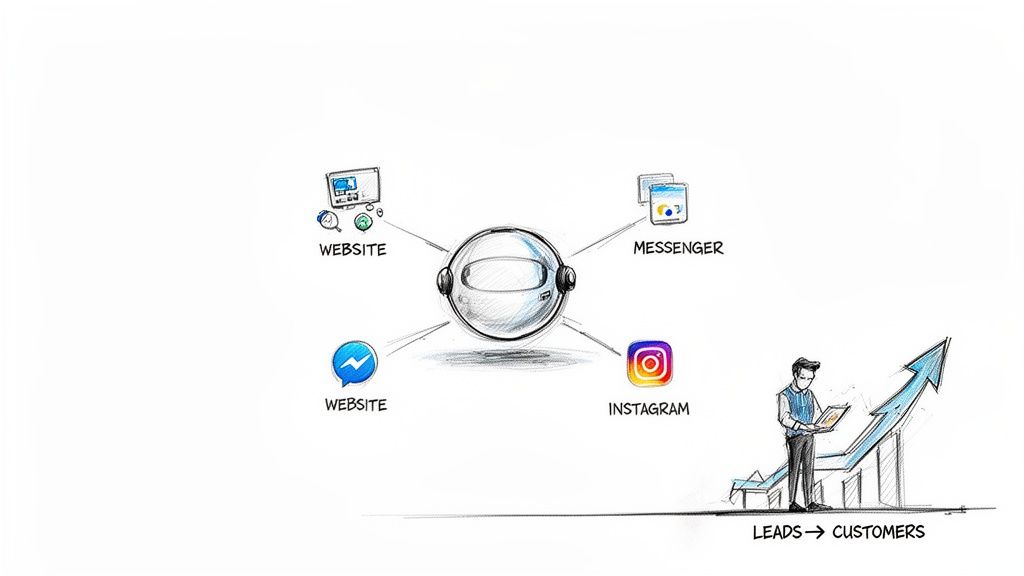
The image below illustrates this perfectly: a chatbot functioning as a central automation hub — engaging visitors instantly, segmenting them intelligently, and transforming passive interest into active leads and loyal customers.
Chabot Conversion
This setup is the heart of a great chatbot service: building an automated engine that captures and converts leads wherever they find you. By meeting customers on their preferred channels, you create a powerful, scalable system for growth. To dive deeper into the mechanics, you can learn more about how chatbots work.
Choosing Your Chatbot Development Path
You’re convinced you need a chatbot. Smart move. Now, the big question is: how will you actually build it?
There’s no single right answer. The best path for you depends on your budget, your team’s technical skills, and how quickly you need to see results.
Let’s break down the three main options. Each has its own pros and cons regarding cost, speed, and customization. Making the right choice here is key to aligning your chatbot project with your business goals.
Option 1: The In-House Team
Building in-house means your own developers and designers create a chatbot from scratch. This gives you complete control over the code, data, and every detail of the conversation, allowing for highly tailored custom chatbots. You can optimize the AI model and fine-tune every interaction to align perfectly with your business needs.
However, this control comes at a high cost. You’ll need a dedicated team with expertise in AI, natural language processing (NLP), and backend systems. Development cycles are long, and achieving high chatbot performance often takes months of testing and iteration. For many companies, this is a slow and resource-intensive route.
Partnering with a professional AI chatbot development service provider offers an alternative: ready access to advanced conversational AI solutions and scalable chatbot software without the overhead of building everything internally. While in-house development may be justified for large enterprises with specific security or customization requirements, most businesses achieve faster results and lower risk by leveraging expert AI chatbot services.
Option 2: The Specialist Agency
Hiring a chatbot development agency is like bringing in a special forces team. You get experts who live and breathe conversational AI. They handle everything from strategy and conversation design to the technical build and ongoing optimization.
This is a great middle-ground option for businesses that want a sophisticated, deeply integrated chatbot but lack the internal team to build it. An agency can deliver a custom solution much faster than an in-house team and brings a wealth of experience. The downside? Cost. A project with a top agency can easily run from $10,000 to $50,000+, making it a significant investment.
Option 3: The No-Code Platform
No-code chatbot platforms have changed the game, making powerful automation accessible to everyone. Tools like Clepher provide a visual, drag-and-drop interface to build, launch, and manage complex chatbots—all without writing a single line of code.
This is the fastest and most cost-effective way to get started. An e-commerce store can build a cart recovery bot in an afternoon. A coach can set up a lead qualification flow in under an hour. You can see the power of this approach by exploring a no-code chatbot builder.
The chatbot industry is booming, largely due to generative AI. ChatGPT now holds between 79.79% and 80.51% of the global market share. This isn’t just a trend; it’s a fundamental shift. The chatbot market is projected to skyrocket from $9.9 billion by the end of 2025 to $113.35 billion by 2034. You can find more data in this comprehensive AI chatbot statistics report.
The key takeaway: You no longer need a team of developers to build a chatbot that drives real business results. No-code platforms let you launch quickly, test ideas, and start seeing a return on investment almost immediately.
Platforms like Clepher give you a visual canvas where you can literally map out a conversation.
This intuitive design allows you to connect conversational steps, add logic, and link to other tools visually, making the process feel more like strategic planning than coding.
To help you decide, here’s a side-by-side comparison of the three paths.
Chatbot Development Options Compared
The table below breaks down the key differences in cost, speed, and skills required to help you choose the best option for your business.
| Factor | In-House Team | Development Agency | No-Code Platform (e.g., Clepher) |
|---|---|---|---|
| Cost | Very High (salaries, infrastructure) | High (project fees, retainers) | Low (monthly subscription) |
| Speed to Launch | Slow (6-12+ months) | Moderate (4-12 weeks) | Fast (hours or days) |
| Customization | Unlimited | High (within agency’s framework) | High (with pre-built tools) |
| Required Skills | An expert development team is needed | No technical skills needed from you | No coding skills needed |
| Best For | Large enterprises with unique needs | Mid-to-large businesses needing expertise | SMBs, agencies, and entrepreneurs |
For most small to medium-sized businesses, agencies, and entrepreneurs, a no-code platform offers the perfect mix of power, speed, and affordability to get started and see an impact quickly.
Your Step-By-Step Implementation Roadmap
Building a chatbot isn’t just flipping a switch; it’s a structured process that transforms an idea into a valuable business asset. Think of it like building a house—you need a solid blueprint before you start. This roadmap walks you through the essential stages, from defining your goal to launching and optimizing for peak performance.
Each step builds on the last, ensuring your final chatbot is a powerful tool that moves the needle on your business goals.
Step 1: Define Your Business Goals
Before you design any part of the conversation, answer this critical question: What specific problem will this chatbot solve?
A vague goal like “improve customer service” is not enough. You need a clear, measurable objective.
- Actionable Goal Example 1: “Increase qualified leads by 40%” by having the bot ask targeted questions before scheduling a demo.
- Actionable Goal Example 2: “Reduce support ticket volume by 25%” by providing instant answers to the top 10 most common customer questions.
- Actionable Goal Example 3: A local gym wants to “automate 100% of its class bookings” via Messenger to free up front-desk staff.
Pinpointing a specific, quantifiable goal is the foundation of every successful chatbot project.
Step 2: Map The Customer Journey
With a clear goal, it’s time to map the ideal customer path. Where does the conversation start? What information does the user need? What action do you want them to take?
This is where you storyboard the interaction. For an e-commerce store recovering abandoned carts, the journey could look like this:
- Trigger: A user adds an item to their cart but leaves without buying.
- Nudge: After 60 minutes, the chatbot messages them on Instagram: “Hey [FirstName], did you forget something? Your items are waiting!”
- Incentive: If there’s no response, the bot offers a 10% discount code to encourage them to complete the purchase.
- Handle Objections: The bot is ready to answer common questions like “What’s the shipping cost?” or “What’s your return policy?”
- Close: Once the purchase is complete, the bot sends an order confirmation and a thank-you message.
Mapping this flow creates a helpful, intuitive conversation that guides the user smoothly toward your goal.
Step 3: Design The Conversational Flow
This is where you give your chatbot a personality. A great conversational flow feels natural and human, reflecting your brand’s voice. This means writing dialogue that is clear, concise, and engaging.
A key lesson from building thousands of bots: the best ones don’t pretend to be human. They aim to be helpful, efficient, and pleasant assistants. This builds trust far more effectively than trying to trick someone.
To achieve this, use short sentences, add emojis where appropriate for your brand, and use typing indicators to simulate a real chat. Break up information into small, digestible messages. For example, an agency’s onboarding bot might use this script:
- Bot: “Awesome! To get started, I just need a few details. First, what’s your company website?”
- (User provides URL)
- Bot: “Perfect, thanks! Next, could you briefly describe your main goal for this project?”
This simple back-and-forth feels much more engaging and keeps the user focused.
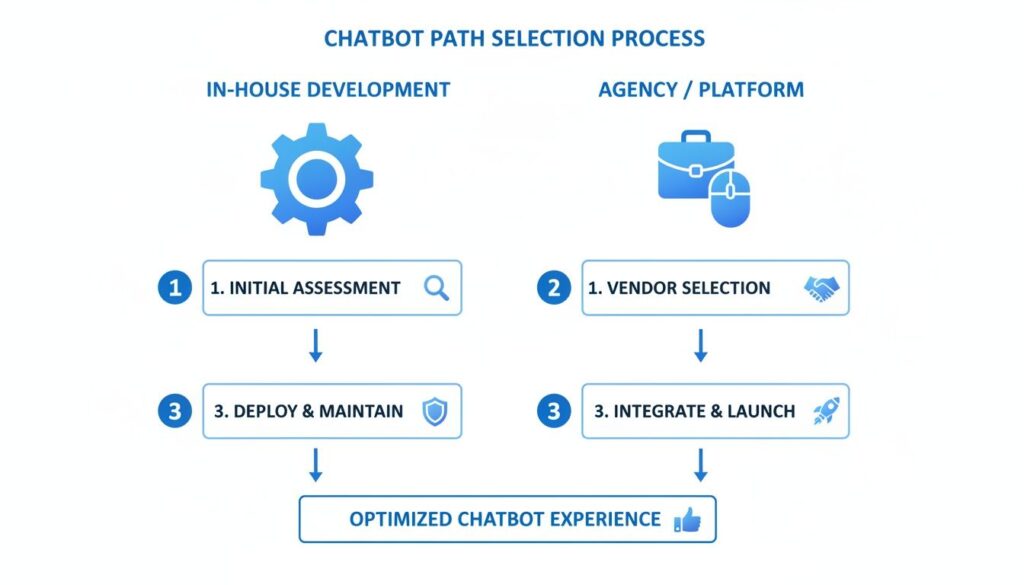
The flowchart below shows the different development paths, but the core stages—strategy, design, and testing—are universal.
Chatbot Development Process
These stages are what separate a helpful chatbot from a frustrating one, regardless of how you build it.
Step 4: Test And Refine
No chatbot is perfect right out of the box. Before you launch it to your entire audience, you must test it thoroughly. Get your team or a small group of loyal customers to interact with the bot and try to break it.
Give them these tasks:
- Use slang and typos to see how it handles errors.
- Ask off-topic questions not in the script.
- Go through every conversational path from start to finish.
This feedback is invaluable for finding confusing phrases, dead ends, and technical glitches. After launch, monitor your analytics to see where users get stuck or drop off, and use that data to continuously improve the experience.
For a deeper look at the process, check out our guide on how to make a chatbot that people actually enjoy using.
What to Expect: Costs, Timelines, and What You Actually Get
When you invest in a chatbot, you’re not just buying software; you’re paying for a business outcome—more leads, happier customers, or lower support costs. So, what does that look like, and what should you budget? Let’s break down the costs, timelines, and deliverables.
The price and schedule for any chatbot project depend on its complexity. A simple, rule-based bot that answers ten basic questions might be ready in a week. A sophisticated e-commerce assistant that connects to your inventory system and CRM could take months to perfect.
The great news is that powerful automation is no longer just for large corporations. Small and medium-sized businesses (SMEs) are adopting chatbots at a rapid pace, with growth at 25.1% CAGR. It’s easy to see why. Modern tools can deliver a massive ROI, with many businesses seeing returns up to 200%. Furthermore, 75% of customers prefer bots for their speed. You can explore more data in this detailed chatbot statistics report.
What To Expect For Your Investment
Chatbot costs can range from a small monthly fee for a DIY platform to tens of thousands for a custom agency build. Here’s a general guide to what you get at different price points.
-
Entry-Level (Simple & Effective): At this tier, you get a straightforward, rule-based chatbot for basic tasks like lead capture (name and email) or handling a handful of FAQs. These are typically built on no-code platforms and can go live in a few days.
-
Mid-Range (Advanced & Integrated): Here, you get more complexity, including conditional logic and key integrations. This could be an e-commerce bot that guides shoppers through product categories or a bot for a coach that qualifies leads before they can book a call.
-
High-End (Fully Custom AI): This is where you get deep customization and advanced AI. These bots use NLP to understand user intent, integrate with multiple business systems (like your ERP), and handle complex, multi-step conversations.
A Clear Look At Project Timelines
Like cost, your timeline will scale with the project’s complexity. Defining a clear scope upfront is the best way to avoid delays. Here are some general benchmarks to help you plan.
| Project Complexity | Estimated Timeline | Typical Use Case |
|---|---|---|
| Simple FAQ & Lead Capture Bot | 1-2 Weeks | A local business capturing contact info or a SaaS company answering pricing questions. |
| Advanced E-commerce Assistant | 4-8 Weeks | An online store with cart recovery, product recommendations, and order status lookups. |
| Custom Enterprise Solution | 12+ Weeks | A large organization needing deep integration with internal databases and proprietary software. |
These timelines cover the entire process, from initial strategy to testing and launch. Using a no-code platform can significantly shorten these timelines, getting a working bot in front of your customers much faster.
The Core Deliverables You Should Always Receive
No matter which path you choose, a professional chatbot project should include a clear set of deliverables. These are non-negotiable items that ensure the final product meets your business needs.
The final chatbot is just one piece of the puzzle. The strategic documents, flow maps, and performance dashboards are what turn a piece of technology into a measurable business asset.
Ensure your project includes these key deliverables:
- Strategy & Discovery Document: This blueprint outlines the business goals, target audience, KPIs for success, and technical requirements.
- Conversation Flow Diagrams: This visual map shows every possible user path in the conversation, ensuring there are no dead ends.
- A Fully Tested Chatbot: The final, working bot deployed on your website, Messenger, or other channels, rigorously tested to be bug-free.
- Performance Dashboard: Access to an analytics dashboard to track metrics like user engagement, conversion rates, and conversion volume in real-time.
- Training & Handover: A session to train your team on how to manage the bot, make minor updates, and interpret the performance data.
How To Choose The Right Chatbot Partner
Choosing the right chatbot development service or platform is a critical decision. The right partner becomes an extension of your team, helping you achieve your growth goals. The wrong one leads to a wasted budget and a frustrating user experience.
This choice is about more than just features and price. It’s about finding a partner who understands your industry, your business goals, and has a proven track record of delivering results.
The Vendor Evaluation Checklist
To make the right choice, you need to ask the right questions. Treat this process like an interview for a key team member.
Here are the essential questions to ask any potential chatbot partner:
- Can you show me case studies from my industry? A partner with experience in your niche (e.g., e-commerce cart recovery or agency lead qualification) will already understand your challenges.
- How do you measure and report on ROI? They should focus on business metrics like lead conversion rates, cost savings, or revenue generated by the bot—not just conversation volume.
- What does your onboarding and support process look like? A great partner provides structured training and has a responsive support team ready to help when you need it.
- How does your platform scale as my business grows? Ask how they handle increased user volume, adding new channels like WhatsApp, or building more complex conversation flows in the future.
A partner’s willingness to share specific, verifiable success stories is a huge green light. If their examples are vague or they can’t provide clear data, that’s a major red flag.
Digging Deeper Into Technical Capabilities
Once you’ve covered the strategic basics, it’s time to look at the technology. A chatbot’s technical capabilities directly impact its effectiveness.
Integrations are critical. Your chatbot should not be an isolated tool; it needs to connect with the systems you already use every day.
Ask about:
- Native Integrations: Do they offer direct connections to essential tools like your CRM (HubSpot, Salesforce), email platform (Mailchimp, ActiveCampaign), or e-commerce system (Shopify)?
- API and Webhook Access: Can they build custom connections to your in-house software? This demonstrates flexibility for unique setups.
- Third-Party Connectors: Do they support services like Zapier or Make? These open up connections to thousands of other apps.
Strong integration capabilities are a sign of a mature, flexible platform that can become a core part of your marketing and sales engine.
Evaluating Analytics And Reporting
A chatbot is only as good as the data it provides. Without clear analytics, you’re flying blind. A top-tier partner will provide a dashboard that offers actionable insights, not just a sea of raw numbers.
During a demo, look for a dashboard that clearly tracks:
- User Engagement: How many people start conversations, and where do they drop off? This helps you identify and fix weak points.
- Conversion Goals: How many users completed the desired action, like scheduling a demo or using a discount code?
- Unanswered Questions: What are people asking that the bot can’t handle? This is a goldmine for improving your conversation flows.
The ability to see what’s working and what isn’t is what allows you to continuously optimize your chatbot for better results.
Measuring Success And Calculating Chatbot ROI
A chatbot’s value is determined by the results it delivers. To justify the investment, you need to track its real-world impact on your bottom line. This means focusing on Key Performance Indicators (KPIs) that signal business growth, not vanity metrics.
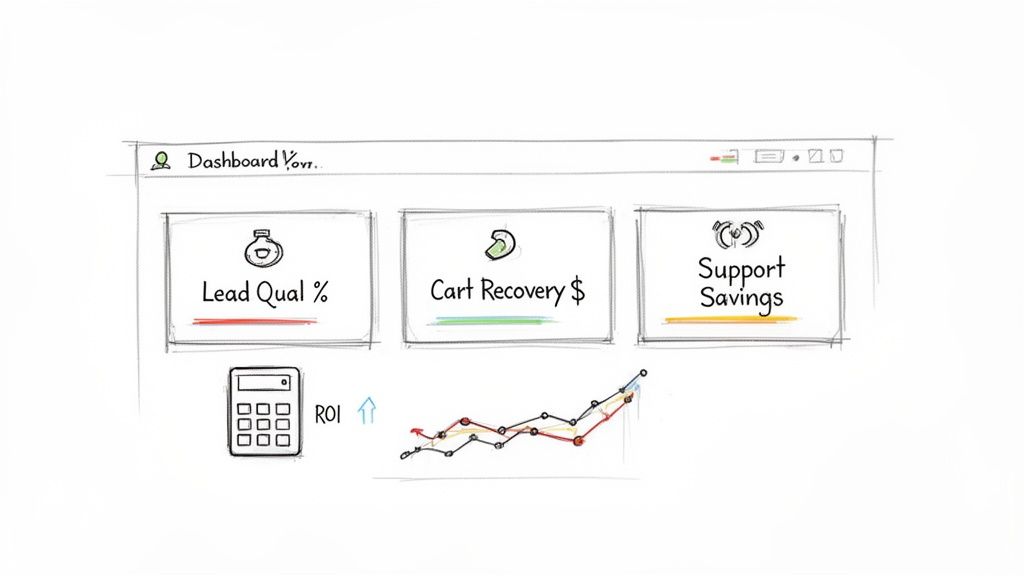
Chatbot Development Service Business Dashboard
The right metrics depend on your goals. An e-commerce brand will focus on cart recovery revenue, while a SaaS company might track the reduction in sales cycle length. The key is to draw a direct line from the bot’s actions to a financial outcome.
KPIs That Actually Matter
To prove your chatbot’s worth, measure what it truly accomplishes. Focus on the metrics that directly tie to making or saving money.
Here are the essential KPIs you should be watching:
- Lead Qualification Rate: What percentage of conversations result in a sales-qualified lead? This shows how effectively the bot is filtering prospects.
- Cart Recovery Revenue: For e-commerce, this is crucial. How much revenue did the bot generate by re-engaging users who abandoned their carts?
- Customer Support Cost Savings: Calculate this by multiplying the number of tickets the bot resolved by your average cost-per-support-ticket. The result is instant savings.
- Sales Cycle Length: Compare the time it takes a bot-qualified lead to close versus leads from other channels. A shorter cycle means faster revenue.
Your chatbot’s analytics dashboard is your source of truth. It should provide undeniable proof of its value, making it easy to show stakeholders exactly how automation is contributing to growth.
A Simple Formula For ROI
Calculating your chatbot’s Return on Investment (ROI) doesn’t have to be complicated. A simple formula can give you a clear picture of its performance.
ROI (%) = ( (Financial Gain – Project Cost) / Project Cost ) x 100
Let’s use a real-world example for an online coaching business.
- Financial Gain: The chatbot qualified 20 new clients last month. Each client is worth $500, for a total gain of $10,000.
- Project Cost: The monthly subscription for your chatbot platform is $150.
- ROI Calculation: ( ($10,000 – $150) / $150 ) x 100 = 6,566% ROI
This simple calculation transforms the chatbot from a “nice-to-have” tool into a powerful, revenue-generating asset. By focusing on these concrete numbers, you can make data-driven decisions to fuel even more growth.
Got Questions? We’ve Got Answers
Ready to see what a powerful, no-code chatbot can do for your business? With Clepher, you can build, launch, and manage automated conversations that drive real growth. Start your journey today and turn visitors into loyal customers.
Related Posts
How to Promote Your Local Business: A Main Street Playbook
March 18, 2026Decode Instagram Insights Meanings and Boost Your Growth
March 17, 2026Geographic Segmentation Definition: A Practical Guide to Localized Marketing
March 16, 2026
Founder Clepher