
Client success metrics are the vital signs of your business. They tell you exactly how much value customers are getting from your product or service, revealing the health of your customer relationships and pointing directly to opportunities for growth.
Think of it this way: you wouldn’t drive a car without a dashboard. These metrics are your business’s dashboard, giving you the real-time data you need to steer toward customer loyalty and sustainable growth.
Why Client Success Metrics Are Your New Command Center
The old playbook is dead. In the past, the main goal was just acquiring new customers. Today, that’s only half the battle. Real, sustainable growth is built on keeping the customers you already have happy, loyal, and successful.
This is where client success metrics become your most powerful guide. They shift the entire focus from just closing a deal to ensuring the long-term success of the people who trust you with their business.
These aren’t just vanity numbers; they’re a data-driven early warning system. They help you spot at-risk customers and step in before they churn. On the flip side, they also shine a spotlight on your biggest fans—the perfect candidates for upsells, glowing reviews, and powerful case studies.
From Theory to Actionable Growth
Knowing the definitions is one thing. Turning raw data into strategic action that grows your bottom line is what really matters.
Imagine a marketing agency tracking a client’s lead generation. A sudden dip in their weekly leads isn’t just a number; it’s a signal. It’s a reason to proactively reach out, diagnose the issue, and adjust the strategy. That’s how you turn a potential crisis into a chance to prove your value and strengthen the partnership.
“The goal of a successful business is to have a customer who is so happy with their purchase that they become a walking, talking billboard for your brand.”
For a SaaS or subscription business, tracking key subscription metrics like Monthly Recurring Revenue (MRR) and customer churn is non-negotiable. For an e-commerce store, metrics like repeat purchase rate and average order value (AOV) directly reflect customer satisfaction. Every business has its own set of indicators that tell the real story.
This guide will show you how to move past the theory and get practical results. We’re going to dig into:
- The most critical metrics for different business models (SaaS, e-commerce, and agencies).
- How to measure and track them with modern tools that make the data easy to understand.
- Actionable steps to actually improve your numbers and drive real, tangible results.
When you master your client success metrics, you move from a reactive, “firefighting” support model to a proactive success strategy. You stop guessing what your customers want and start knowing what they need to succeed—building a business that thrives on their success.
Understanding Your Customer Health Score
If you had a single number that could instantly tell you which clients are thriving and which are about to walk away, would you use it? That’s the entire idea behind a Customer Health Score (CHS).
Think of it as a credit score for your client relationships. It’s a single, predictive metric that sums up their overall well-being, moving you past gut feelings. A CHS helps you spot at-risk accounts, find happy customers who are perfect for an upsell, and manage your entire client base with precision. Instead of waiting for a client to complain, a health score helps you see the smoke long before the fire starts.
The process is a simple loop: you track key behaviors, analyze what they mean, and then act on those insights to steer your clients toward success.
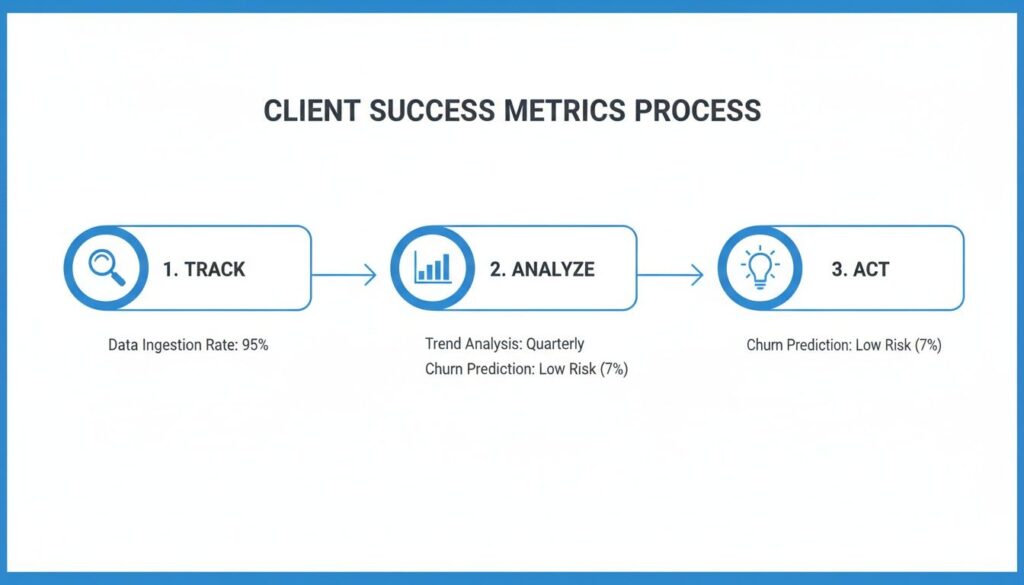
Client Success Metrics Process
This isn’t just about collecting data. As the cycle shows, tracking is just the first step. The real magic happens when you interpret that data and take action to get results. It’s an ongoing process, not a one-time report.
Building Your Customer Health Score
Creating a CHS isn’t as complex as it sounds. You start by pinpointing the key behaviors that align with a successful (or unsuccessful) customer. These actions will differ from one business to the next, but the core question is always the same: what tells you a client is actually getting value?
For a SaaS company, you might track things like:
- Product Adoption: How many key features are they really using? Are they logging in every day?
- Support Tickets: How many tickets are they filing? Are they small questions or show-stopping bugs?
- Payment History: Do they pay on time? Have they ever had a payment fail?
You then assign a point value and a weight to each of these components. For instance, daily logins might be far more important than just attending a one-off webinar. Add up these weighted scores, and you have a single, actionable number for every client.
A low health score isn’t a failure—it’s an opportunity. It’s a clear signal to engage, understand the customer’s challenges, and proactively guide them back to a path of success.
This metric is quickly becoming essential. A recent report found that 60% of Customer Success organizations now rank Customer Health Scores as their top non-revenue metric, highlighting a major shift toward proactive health monitoring. You can check out the full details in the 2023 Customer Success Index report on gainsight.com.
A Practical Example in SaaS
Let’s say a project management SaaS company wants to build its own health score. They decide the best signs of a healthy customer are feature usage, team collaboration, and account growth.
Here’s a simple way they could structure their scoring:
- Product Engagement (60% weight):
- Daily Logins: Are users active every day? (+20 points)
- Key Feature Adoption: Have they used the “Reporting Dashboard” feature? (+15 points)
- Task Completion Rate: Are their projects actually moving forward? (+10 points)
- Support and Feedback (20% weight):
- Recent Support Tickets: Lots of critical tickets lately? (-15 points)
- NPS Score: Did they give a promoter score (9-10)? (+10 points)
- Account Information (20% weight):
- Late Payments: Any invoices overdue by 30+ days? (-20 points)
- User Licenses: Did they add more users recently? (+10 points)
A brand-new client might start with a neutral score. But a power user who logs in daily, uses every feature, and just added five team members would have a sky-high score (say, 95/100). That’s a clear green light—they’re a prime candidate for a case study or an upsell to an enterprise plan.
On the flip side, a client whose activity has dropped, recently filed several bug reports, and missed a payment would have a dangerously low score (like 30/100). This score is a red flag, automatically alerting their Customer Success Manager to reach out immediately, figure out what’s wrong, and offer a solution. This proactive step can turn a potential churn into a saved account—and often, a more loyal customer for life.
2. Taking the Temperature of Loyalty with NPS and CSAT
NPS CSAT
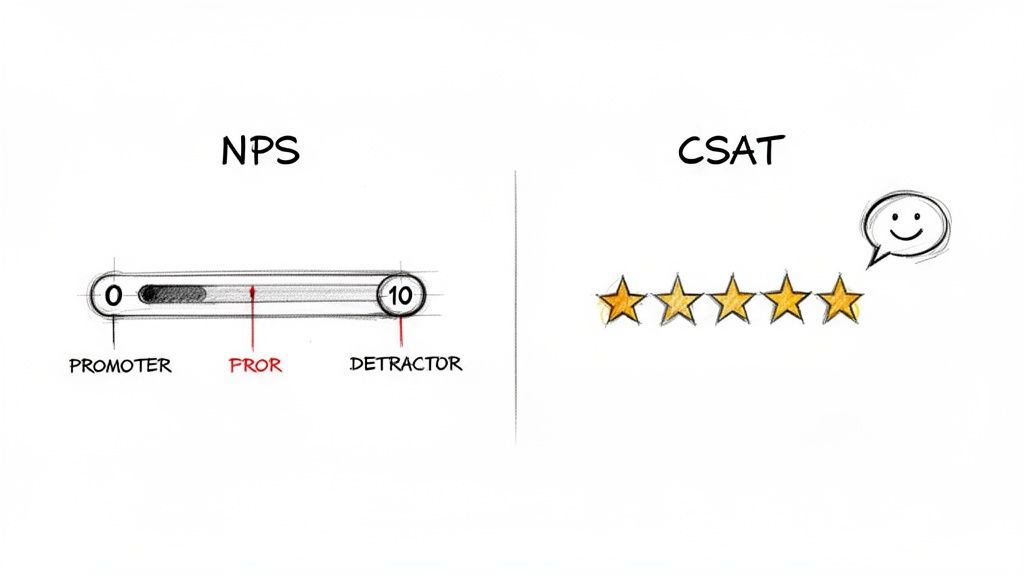
While a Customer Health Score gives you a long-term view, you also need a way to measure how clients feel in the moment. This is where sentiment metrics like Net Promoter Score (NPS) and Customer Satisfaction (CSAT) come in. Think of them as giving you a direct line into your customers’ minds.
Gauging Long-Term Loyalty with NPS
Net Promoter Score is built around one simple question: “On a scale of 0-10, how likely are you to recommend our company/product to a friend or colleague?” It’s a powerful indicator of brand loyalty, not just satisfaction with a single purchase.
Based on their answer, you sort customers into three camps:
- Promoters (9-10): Your biggest fans. They’re loyal, enthusiastic, and drive word-of-mouth marketing.
- Passives (7-8): They’re satisfied, but not thrilled. They could be swayed by a competitor.
- Detractors (0-6): Your unhappy customers. They’re a churn risk and may share negative feedback.
The formula is straightforward: NPS = % of Promoters – % of Detractors. A score above 0 is good, over 50 is excellent, and above 70 is world-class.
But the real gold is in the follow-up question: “What’s the main reason for your score?” This is where you get the unvarnished truth about what to fix or what to double down on.
An NPS survey isn’t a report card; it’s a conversation starter. The score tells you what customers feel, but the open-ended feedback tells you why, giving you a clear roadmap for improvement.
For example, a marketing agency sends a quarterly NPS survey. A client responds with a 5 (a Detractor), adding, “Reporting is confusing and always late.” The agency now has a specific, actionable problem to solve. They can overhaul their reporting process and potentially save the account.
Capturing In-the-Moment Feedback with CSAT
While NPS measures long-term loyalty, Customer Satisfaction (CSAT) captures immediate, “in-the-moment” feedback. It usually asks, “How satisfied were you with [a specific interaction]?” and uses a simple scale like 1-5 stars or smiley faces.
CSAT is all about timing. You send it right after a key moment in the customer journey—like after a support chat closes or a purchase is completed—to get a quick pulse check.
This immediacy makes CSAT powerful. The experience is fresh, so the feedback is honest and highly specific, helping you pinpoint exact points of friction. A low CSAT score after a support ticket closes, for instance, tells you a particular agent might need more coaching or a process is broken.
For a deeper look at collecting this kind of invaluable feedback, check out our guide on how to collect customer feedback. By automating these surveys in messaging apps with a tool like Clepher, you can fire off a CSAT question the second a conversation ends, driving a 90% response rate or higher and getting real-time data to improve your service on the fly.
Connecting Client Success to Revenue
While metrics like health scores and NPS are great for tracking sentiment, your finance team wants to know one thing: how does all this “client success” actually impact the bottom line? This is where we make the direct connection between happy customers and real, tangible revenue.
Understanding these financial client success metrics is non-negotiable. They’re the proof you need to justify your retention efforts and make smarter business decisions. These are the direct financial results of how well you serve your clients.
Let’s break down three of the most critical revenue-focused metrics.
Churn Rate: The Silent Growth Killer
Churn is the leaky bucket that sinks even the fastest-growing companies. Churn Rate is the percentage of customers who leave during a specific period. But to understand its impact, you need to look at both Customer Churn and Revenue Churn.
- Customer Churn is the number of customers you lost.
- Revenue Churn is the money you lost from those customers.
Why does this matter? Imagine you lose two customers: one paying $50/month, the other a $5,000/month enterprise client. Your customer churn is just two, which might not sound alarming. But your revenue churn is a painful $5,050. Tracking revenue churn makes the pain of losing high-value clients impossible to ignore.
Churn Rate Formula (Customer): (Customers Lost in Period / Total Customers at Start of Period) x 100
A “good” churn rate varies. For SaaS companies serving small businesses, a monthly rate of 3-5% is often acceptable. But for enterprise clients, the goal should be well below 1%. High churn is a massive red flag that your product or service isn’t delivering on its promise.
Net Revenue Retention: The Engine of Sustainable Growth
If churn is what you lose, Net Revenue Retention (NRR) is what you keep and grow from the customers you already have. It’s arguably the single most important metric for any subscription business, as it accounts for both revenue churn and expansion revenue from upsells and cross-sells.
NRR answers a powerful question: “If we didn’t sign a single new customer this month, would our revenue still grow?”
An NRR over 100% means your existing customers are generating more new revenue than you’re losing from churn. This is the holy grail, often called “negative churn,” where your business grows automatically.
Let’s see it in action. A company starts with $100,000 in MRR.
- They lost $5,000 from customers who churned.
- They gain $15,000 in expansion revenue from existing customers upgrading.
Their NRR is calculated as: (($100,000 – $5,000 + $15,000) / $100,000) = 110%. This business grew by 10% without acquiring a single new customer. That’s the power of focusing on client success.
Customer Lifetime Value: The Ultimate Profit Predictor
Customer Lifetime Value (CLV) predicts the total profit you can expect from a single customer over their entire relationship with you. It’s a forward-looking metric that shifts your focus from short-term transactions to long-term value.
Once you know what a customer is worth, you can make smarter decisions about how much to spend to acquire and retain them.
A simple way to calculate CLV is:
CLV = Average Purchase Value x Average Purchase Frequency x Average Customer Lifespan
For example, if a typical customer for your meal-kit service spends $120 per month and stays subscribed for 24 months, their CLV is $2,880. That number tells you how much you can invest in onboarding, support, and marketing to keep them happy and profitable.
Here’s the best part: improving your other client success metrics directly pumps up your CLV. When you reduce churn, you increase the customer lifespan. When you improve CSAT, you encourage more frequent purchases or upgrades. It all works together. For a deeper dive, our guide on how to increase customer lifetime value has detailed strategies you can use right away.
How to Improve Your Client Success Metrics (With Examples)
Knowing your numbers is the first step. The real growth happens when you move from just tracking client success metrics to actively improving them. It’s about turning data into action and transforming insights into better experiences that build loyalty and drive revenue.
Let’s get into the concrete strategies you can implement today, broken down for e-commerce, SaaS, and agency businesses.
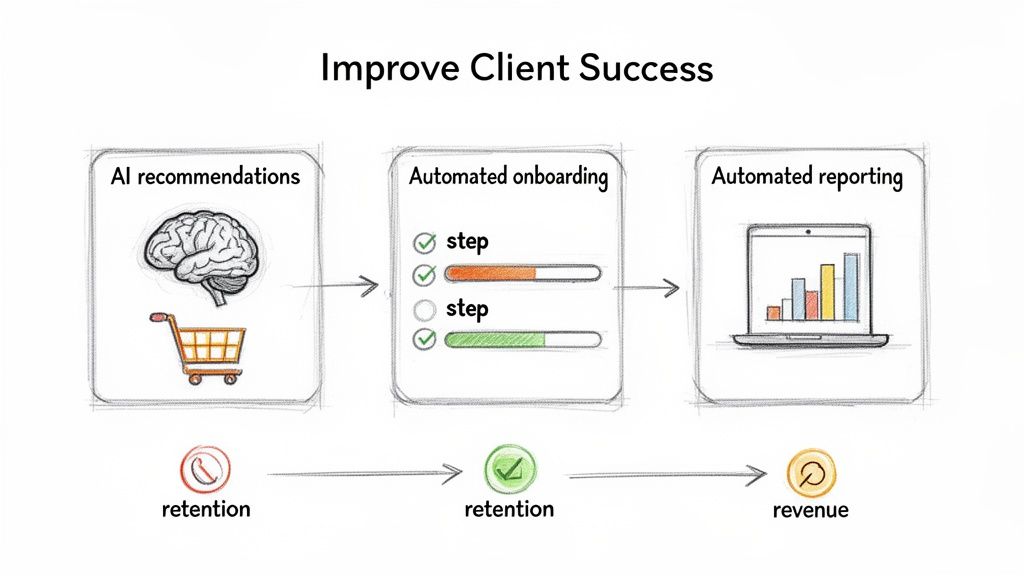
Improve Client Success
The image above nails the core principle: using automation to proactively guide customers toward success. Whether through AI-driven recommendations or automated check-ins, the goal is to improve their journey, keep them around longer, and ultimately, grow your bottom line.
For E-Commerce Brands: Boost CSAT with AI
For e-commerce, Customer Satisfaction (CSAT) often comes down to finding the right product and getting quick support. A low CSAT score is almost always tied to a frustrating shopping experience or a clunky post-purchase process.
You can tackle this head-on by using an AI chatbot on your site or in messaging apps to offer instant, personal help.
- AI-Powered Recommendations: When a customer asks about a product, a Clepher-powered bot can instantly analyze their question and suggest things they’ll actually love. It’s like having an in-store personal shopper, making the customer feel understood.
- Instant Post-Purchase Support: Don’t make customers wait for an email response. A chatbot can handle returns, exchanges, and order status questions 24/7. This immediate resolution can turn a frustrating experience into a positive one.
For SaaS Companies: Drive Adoption and Health Scores
In the SaaS world, customer health is all about product adoption. If users aren’t engaging with your key features, they aren’t getting value, and their health score will tank.
Automated onboarding flows are your secret weapon here. Never just dump a new user into your software and hope they figure it out. Guide them.
An automated onboarding sequence is like a personalized tour guide for your software. It shows users exactly how to find value from day one, setting them up for long-term success and turning early engagement into lasting loyalty.
Here’s a practical, automated flow you can build in Clepher to get adoption soaring:
- Welcome & First Win: The second a user signs up, trigger a message sequence that walks them to their first “aha!” moment. For a project management tool, that could be creating their very first task.
- Feature Discovery Drip: Over the next few days, send bite-sized tips showcasing core features they haven’t touched yet.
- Proactive Check-Ins: If a user hasn’t logged in for three days, automatically send a friendly message asking if they need a hand. This simple touch can re-engage someone who just got stuck.
This approach ensures users are constantly finding value, which directly improves their Customer Health Score and makes them far less likely to leave. For more retention strategies, our guide on how to reduce customer churn provides even more actionable ideas.
For Agencies: Enhance Transparency and Retention
For marketing agencies, keeping clients happy often comes down to transparency and proving your value. Clients who feel they’re in the dark about performance are the first ones to start questioning their investment.
Customer expectations for service are through the roof. Salesforce data shows a stunning 67% of customers expect a high standard for good customer experiences, and 74% of those who get it will stick around. This proves proactive service is a core driver of retention. You can learn more about these customer success statistics.
Here’s how an agency can automate its way to better transparency:
- Weekly KPI Snippets: Set up an automated message that sends key metrics (like leads generated or ad spend ROI) straight to the client every Friday.
- Milestone Alerts: Automatically notify a client the second a major campaign goal is hit.
- Meeting Schedulers: Use a bot to automate the booking for monthly review calls, killing the back-and-forth email chains.
This level of proactive communication builds trust, reinforces your agency’s value, and makes clients feel like true partners. For a complete guide to optimizing your client success efforts, check out these proven Customer Success Best Practices to Reduce Churn.
Common Pitfalls in Tracking Client Success
Getting your client success metrics in place is a huge win. But here’s the truth: collecting data is the easy part. Many teams fall into common traps that turn powerful insights into little more than dusty reports.
The real goal isn’t to pile up numbers. It’s to build a system that inspires action and pushes your business forward. Let’s walk through the three biggest mistakes and how you can sidestep them.
Overdosing on Vanity Metrics
The first trap is focusing on vanity metrics. These are numbers that feel good but have no link to your bottom line or how happy your clients really are. Think total social media followers, website page views, or the raw number of signups.
Sure, those numbers look great in a presentation, but they don’t tell you if your clients are getting value. A million page views are worthless if your churn rate is through the roof.
How to avoid it: Force every metric to answer this question: “Does this number prove our clients are succeeding and sticking around?” Instead of just tracking total users, laser-focus on Daily Active Users (DAU). Forget celebrating social media likes and start measuring how many support tickets you resolve in your DMs. Always tie your metrics back to revenue or retention.
Suffering from Data Silos
The second pitfall is a classic organizational headache: Data Silos. This is what happens when your sales, marketing, and success teams all hoard valuable data instead of sharing it. Your success team has no clue what promises sales made, and marketing is blind to which features are driving the most support tickets.
When your departments aren’t talking, the customer feels it. The experience becomes choppy and frustrating as they are forced to repeat themselves.
A siloed view of the customer is a broken view. You can’t guide a client to success if you’re only looking at one small piece of their journey.
How to avoid it: Centralize your customer data. Tools like Clepher can act as your central nervous system, pulling in data from different platforms to create one unified customer profile. When your chatbot, CRM, and help desk are all in sync, every team member gets a 360-degree view, enabling proactive support.
Falling into Analysis Paralysis
The final trap is Analysis Paralysis. You’re drowning in data with beautiful dashboards, but nobody is using them to make decisions. The insights just sit there while your team operates on gut feelings.
The research on this is telling. While a staggering 60% of companies say the Customer Health Score is their most important non-revenue metric, a tiny 7% actually track it. As you can see in these findings, there’s a huge disconnect between knowing what’s important and doing something about it.
How to avoid it: Build action directly into your tracking. Use automation to fire off alerts when metrics change. For example, if a client’s health score dips below 40, automatically create a task for their success manager to schedule a call. If a low CSAT score comes in, instantly notify a team lead to follow up. By linking data directly to action, you guarantee your insights never go to waste.
Frequently Asked Questions about Client Success Metrics
Let’s talk about the practical side of things. When you start digging into client success metrics, a few key questions always pop up. Here are the straight-up answers you need to stop guessing and start turning your data into real growth.
Conclusion
Measuring client success requires selecting the right customer success metrics and customer success KPIs that align with your saas business objectives — from retention rate and customer retention cost to ltv, renewal rate, usage metrics, and revenue per customer. A disciplined customer success program and a coordinated customer success team (cs) that leverages a customer success platform will help you track metrics such as customer satisfaction score, customer effort score, first contact resolution rate, customer support tickets, and adoption metrics. Focus on measuring customer data that reveals the health of your business and the customer journey: total number of customers, number of new customers, conversion rate, customer acquisition, and overall customer satisfaction.
Prioritize metrics and KPIs that matter — voice of the customer, customer engagement, and customer growth — so you can measure customer success, improve customer retention rate, and increase customer satisfaction. By combining top customer success metrics for saas with revenue metrics and per customer analysis, you’ll be able to demonstrate the value of your customer success program, reduce customer retention cost, grow total revenue, and strengthen your overall customer base.
Ready to turn these insights into action? Clepher gives you the AI-powered tools to automate customer communication, track satisfaction, and proactively improve your metrics across your website, Messenger, and Instagram. Start building better client relationships today.

Related Posts
How to Create a Survey on Facebook for Maximum Engagement
March 28, 2026Social Media Marketing Automation: Your Ultimate Guide
March 27, 2026
Founder Clepher