
Think of your e-commerce store less like a static product catalog and more like a dynamic, interactive shopping experience. An AI chatbot for ecommerce is the tool that makes this transformation happen. It acts as a virtual sales assistant—always on, ready to answer questions, guide shoppers to the perfect product, and even recover abandoned carts, directly impacting your bottom line.
What Is an AI Chatbot and Why Your Store Needs One
Imagine your online store is a real, physical shop. Without a chatbot, you’re leaving customers to wander the aisles alone, hoping they find what they need. An AI chatbot, on the other hand, is like having your best salesperson on the floor, ready to help the moment a customer looks lost or needs a recommendation.
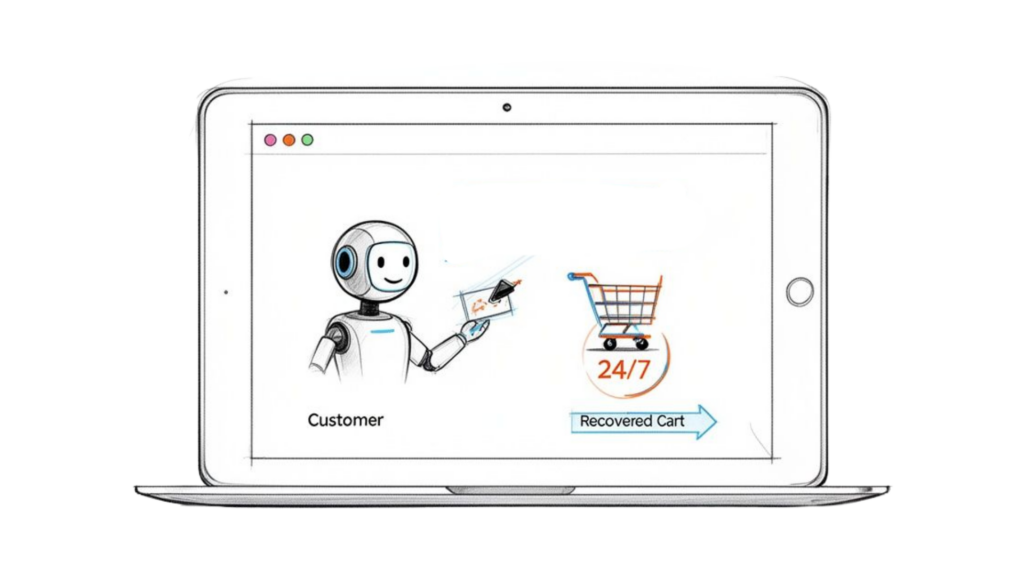
Cart Recovery
This isn’t your old-school, rule-based bot that follows a rigid script. A modern AI chatbot for ecommerce uses chatbot natural language processing (NLP) to understand what your customers are really asking. It gets smarter with every conversation, personalizes its replies, and can handle complex questions that would stump a simple FAQ page.
The Immediate Business Impact
Adding an AI chatbot isn’t just a tech upgrade; it’s a strategic move with a real, measurable impact on your sales. These intelligent assistants are designed to deliver tangible results from day one.
The numbers tell a compelling story. In the fast-paced world of e-commerce, 78% of businesses already use chatbots for critical tasks like order tracking. But the real win is in the revenue—companies see 15-35% increases in sales from smarter conversion tactics and upsell opportunities. The average ROI? A stunning 340% in the first year alone.
Here’s how an AI chatbot starts paying for itself immediately:
- Instant 24/7 Support: Your chatbot handles all the common questions about shipping, returns, and product details instantly, even at 3 AM. This frees up your human team to focus on the complex issues that actually require a person.
- Proactive Sales Recovery: When a shopper adds an item to their cart but gets distracted, the chatbot can pop up with a helpful message or a small discount to nudge them over the finish line. It saves sales that would otherwise be lost.
- Personalized Shopping Guides: By asking a few smart questions (“Are you looking for a gift or something for yourself?”), The chatbot acts like a personal shopper, recommending products based on the customer’s needs and improving their experience.
To really see the difference, let’s compare the old way of doing things with the new, AI-powered approach.
Manual Support vs AI Chatbot Automation
| Business Function | Traditional Manual Approach | AI Chatbot-Powered Approach |
|---|---|---|
| Customer Support | Limited to business hours, slow response times, and high staff costs. | 24/7 instant answers, handles 80% of common queries automatically. |
| Lead Generation | Relies on passive forms and pop-ups that are easily ignored. | Proactively engages visitors and qualifies leads in real-time conversations. |
| Cart Recovery | Dependent on delayed email campaigns with low open rates. | Engages shoppers in real-time on-site, offering help or incentives. |
| Product Discovery | Customers must use filters and search bars, often feeling overwhelmed. | Acts as a personal shopper, guiding users to products with questions. |
| Data Collection | Gathers basic analytics, but lacks conversational context. | Collects direct customer feedback and insights from every chat. |
The difference is clear. An AI chatbot doesn’t just automate tasks; it creates new opportunities for engagement and sales that are impossible to manage manually.
Key Takeaway: An AI chatbot is more than a support tool; it’s a proactive sales and engagement engine. It automates critical tasks, provides a superior customer experience, and creates new revenue opportunities that are impossible to capture with a static website.
Core Chatbot Features That Drive Real Growth
Let’s move past the theory and into the practical features that turn a chatbot from a cool gadget into a growth engine for your store. These aren’t just lines of code; they’re solutions to real business problems that drive sales and keep customers coming back.
Think of the right AI chatbot as your hardest-working employee. It never sleeps, juggles thousands of conversations at once, and remembers every customer’s preferences. This is about automating for real, measurable growth.
24/7 Sales and Support Automation
One of the biggest time drains for any e-commerce team is the constant flood of repetitive questions like “Where’s my order?” or “What’s your return policy?” These questions are important, but they pull your team away from tasks that actually generate revenue.
An AI chatbot for ecommerce can instantly handle up to 80% of these common questions. By plugging directly into your store’s backend, it delivers real-time order updates, explains shipping policies, and walks users through returns—all without a human lifting a finger.
- Practical Example: A customer lands on your site at midnight, wondering if you ship to their country. Instead of them leaving to find a competitor, the chatbot provides an immediate, accurate answer. Sale saved.
This automation doesn’t just cut down on support tickets; it frees up your human agents to focus on high-value sales questions and build relationships with your best customers.
Proactive Lead Capture and Engagement
Most people who visit your website are ghosts. They browse, look around, and then leave without a trace. A proactive chatbot flips this script, turning anonymous visitors into engaged leads you can market to later.
Instead of hitting them with a static pop-up form, an AI chatbot can start a conversation at the perfect moment. For example, it can trigger when a visitor has been looking at a product page for over 30 seconds or when their mouse moves toward the exit button.
By jumping in with a helpful question or a timely offer (“Hey, before you go, can I offer you 10% off your first order?”), a chatbot can capture contact details for Messenger, Instagram, or email. That simple move transforms a fleeting visit into a long-term marketing asset.
Once they’re subscribed, you can send targeted follow-ups, flash sales, and new product alerts directly to the channels they actually use. You start building an audience you own, reducing your reliance on expensive ads.
Personalization at Scale
Personalization is the key to winning in e-commerce today. But giving a one-on-one experience to thousands of customers is impossible for a human team. This is where AI excels.
An intelligent chatbot uses customer data—past purchases, browsing history, and answers to its questions—to create a unique, relevant experience for every single person. It acts like a personal shopper for everyone, all at once.
Here’s how that looks in practice:
- Tailored Product Recommendations: If a customer just bought a pair of running shoes, the chatbot can follow up by suggesting, “Great choice! We have matching performance socks that other runners love.”
- Customized Promotions: For a product a user has viewed three times but hasn’t bought, the chatbot can pop in with a unique discount code to nudge them over the finish line.
- Segmented Messaging: It can automatically tag users based on their interests (like “loves skincare” or “interested in new tech”) so you can send them hyper-relevant updates later.
This level of personalization makes customers feel understood, which directly leads to higher conversion rates and lifetime value. It shifts the shopping experience from a cold transaction to a helpful, guided journey.
Your Step-by-Step Guide to Implementing a Chatbot
Getting an AI chatbot for ecommerce up and running is more straightforward than you might think. You don’t need to be a coding expert. With today’s no-code platforms, you can launch a powerful assistant in just a few hours. The key is to start small and focus on one high-impact goal first.
Think of it like building with LEGOs. You start with a clear idea, grab the right pieces, and click them together. You can always add more complexity later.
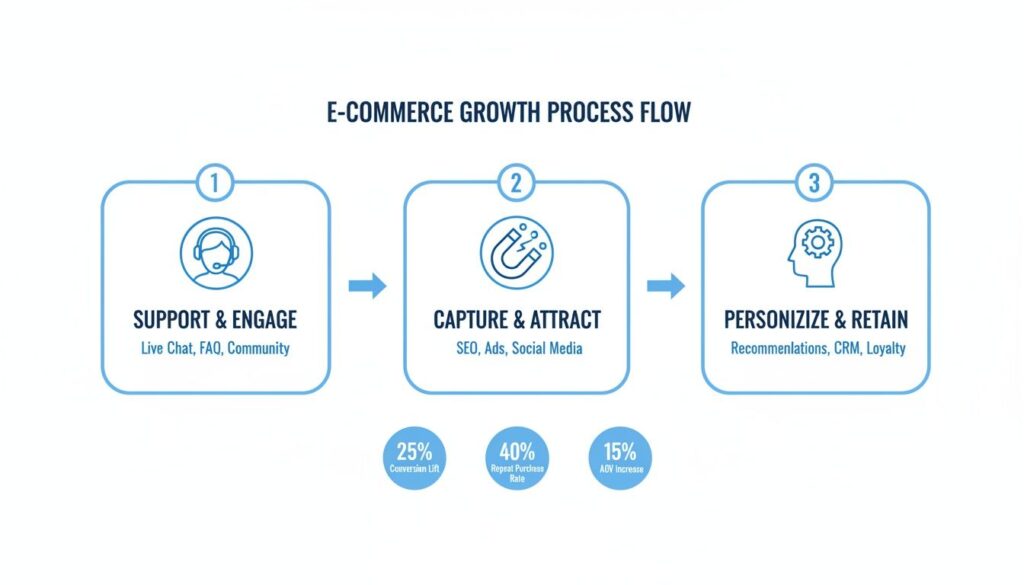
E-commerce Growth
Step 1: Define Your Primary Objective
Before you touch a single setting, decide on the one big job you want your chatbot to do. Spreading a bot too thin is a classic mistake that leads to a confusing experience. Pick one specific, measurable goal to tackle first.
Here are a few solid starting points:
- Reduce Cart Abandonment: Proactively engage shoppers who have items in their cart but haven’t checked out.
- Automate FAQ Responses: Instantly answer the top 3-5 questions that clog up your support inbox daily, like “Where is my order?”
- Capture More Leads: Turn website visitors into Messenger or Instagram subscribers by offering a welcome discount.
Focusing on one objective makes building the conversation flow easier and allows you to clearly measure your success before expanding the bot’s responsibilities.
Step 2: Choose Your Channels
Where do your customers spend their time? Your chatbot needs to meet them there. An AI chatbot isn’t just for your website; it can be a powerhouse on social media platforms where your audience already is.
Consider where you get the most engagement:
- Your Website: This is the ideal spot for a bot that can guide visitors, answer common questions, and assist with checkout.
- Facebook Messenger & Instagram DMs: These channels are perfect for re-engaging customers, running flash sales, and capturing leads directly from your social posts and ads.
Start on the channel where you already have the most traffic. Better yet, many platforms like Clepher let you build a bot once and then deploy it across multiple channels simultaneously.
Step 3: Map Out a Simple Conversation
Now for the fun part: designing the chat. You don’t need to script every possible scenario. Start with a simple flow that guides the user toward your main objective. Modern chatbot builders are drag-and-drop, making this feel more like sketching a flowchart than coding.
Key Takeaway: Your first conversation flow should be a straight line from problem to solution. If your goal is to reduce abandoned carts, the flow could be as simple as: Trigger > “Hey, see you left something behind. Need help?” > Offer a small discount > Link them directly back to their cart.
You can get a better feel for how these conversations come together in our guide on how to build a chatbot from scratch. The goal is clarity, not complexity.
The e-commerce chatbot market is exploding and is projected to drive $142 billion in global retail spending by 2024. Businesses are already reporting a 67% sales increase with chatbot assistance, and 26% of all sales now start with a bot conversation.
Step 4: Install and Test Your Chatbot
Once your basic conversation is mapped out, installation is usually simple. For a website, it’s often as easy as copying and pasting a single line of code. For platforms like Messenger or Instagram, you just connect your business account with a few clicks.
Before you go live, test it. Then test it again. Go through the entire flow yourself and have your team try to break it. This critical step helps you catch awkward phrasing, broken links, or dead-end paths before your customers do. A few minutes of testing now can save you from a world of customer frustration later.
Proven Use Cases That Boost Sales and Loyalty
Theory is one thing, but seeing how an ai chatbot for ecommerce actually transforms a business is where the real magic happens. These are proven strategies brands are using right now to plug revenue leaks, save time, and build customer loyalty.
Think of each use case as a blueprint you can adapt for your own store.
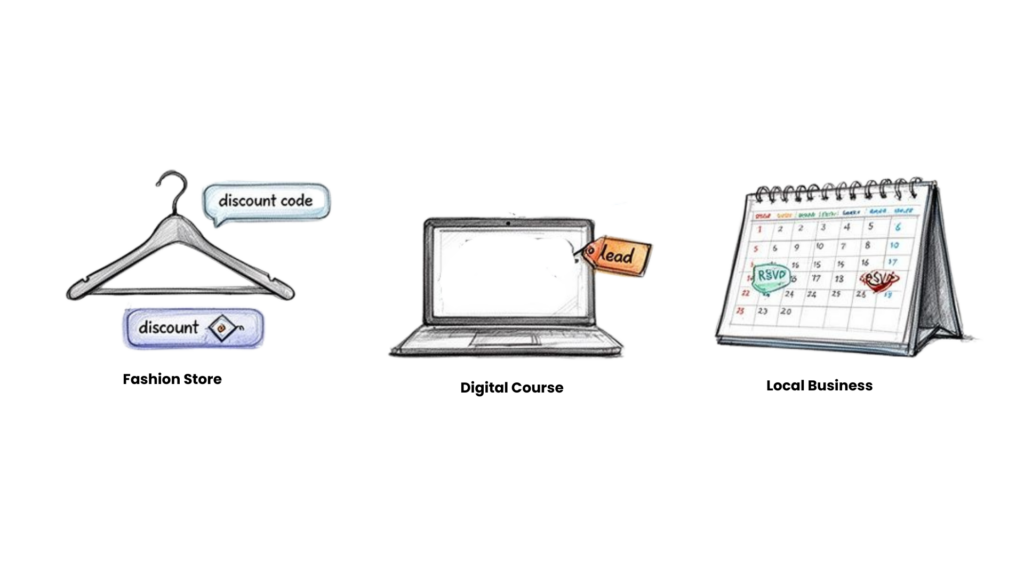
Chatbot Use Cases
From rescuing abandoned carts to qualifying high-ticket leads, these examples show how a simple, automated conversation can have a massive impact.
Recovering Lost Sales on Instagram
The Scenario: A trendy fashion brand runs an Instagram ad. A user clicks, loves a jacket, and adds it to their cart. Then, life happens—a text message, a notification—and the sale is lost.
The Actionable Fix: An automated cart recovery flow that triggers inside Instagram DMs.
- The Trigger: A user who engaged with the brand’s Instagram page abandons their Shopify cart.
- The Conversation: Within an hour, the AI chatbot sends a friendly DM: “Hey, looks like you left something amazing in your cart! Did you have any questions about sizing or shipping?”
- The Nudge: If they don’t buy, another message arrives 24 hours later with a 10% discount code or free shipping offer.
- The Result: This simple flow can recover 15-30% of otherwise lost sales. For a store with decent volume, that’s game-changing revenue pulled back from the brink, all on autopilot.
Key Insight: This works because it’s immediate and happens where the customer is active. Instead of a boring email that gets ignored, the brand meets them on a platform they use all day, making the interaction feel natural and timely.
Qualifying High-Ticket Leads for a Course Creator
The Scenario: A course creator sells a high-ticket coaching program. They get a flood of inquiries from people who aren’t a good fit, wasting hours of valuable sales call time.
The Actionable Fix: An AI chatbot on Facebook Messenger acts as a smart gatekeeper.
- It asks strategic qualifying questions like, “What’s your single biggest challenge with [your topic] right now?” and “What’s your budget for growth this quarter?”
- Based on the answers, the chatbot automatically sorts the leads.
- Serious prospects get a link to book a sales call instantly.
- Anyone who isn’t a good fit is gently pointed toward a free webinar or a lower-priced product, so they still get value without draining the sales team’s time.
The results are huge. Businesses using AI chat see lead qualification jump by as much as 40%. You can learn more about AI statistics to see the broader impact.
Managing Event Sign-Ups for a Local Business
The Scenario: A local yoga studio is hosting a special workshop. In the past, managing sign-ups meant answering the same DMs over and over about the schedule, price, and what to bring.
The Actionable Fix: An AI chatbot automates the entire process.
- Instant Info: A user scans a QR code or comments on a post, and the chatbot immediately sends the full workshop schedule, prices, and FAQs.
- Seamless Sign-Up: It captures the user’s name and email right inside the chat.
- Automated Reminders: The bot sends a confirmation and a friendly reminder the day before the event.
This use case transforms a chaotic manual task into a smooth, professional experience, ensuring no leads get missed.
AI Chatbot Impact on Key Ecommerce KPIs
Implementing these strategies isn’t just about convenience; it’s about moving the needle on the metrics that matter. Here’s the typical uplift you can expect across core e-commerce KPIs.
| KPI (Key Performance Indicator) | Industry Average Uplift with AI Chatbot |
|---|---|
| Conversion Rate | 3.5% – 10% increase |
| Cart Abandonment Recovery | 15% – 30% of carts recovered |
| Customer Satisfaction (CSAT) | 20% – 30% improvement |
| Average Order Value (AOV) | 5% – 15% increase via upselling |
| Lead Qualification Rate | 30% – 40% improvement |
| Customer Support Costs | 25% – 40% reduction |
These figures show a clear picture: a well-executed AI chatbot is one of the highest-ROI investments an e-commerce business can make.
Integrating Your Chatbot with Your Marketing Tools
An AI chatbot for ecommerce should never be a lonely island. Its real power is unlocked when it acts as the conversational hub for your entire marketing ecosystem.
When your chatbot operates in isolation, it’s just a support tool. But when it’s integrated, it becomes the engine driving your entire growth strategy forward. Think of your marketing tools as a team: your CRM knows your customers, your email platform sends newsletters, and your SMS service sends alerts. An integrated chatbot is the team leader that gets them all talking.
Why Integration is Non-Negotiable
A standalone chatbot can answer questions. An integrated one can take action.
By connecting your chatbot to the software you already use, you create seamless, automated workflows that turn conversations into profit. It breaks down data silos and ensures every customer interaction is informed by their entire history with your brand.
For example, when a customer asks about an order, the bot can pull data directly from Shopify. If they ask for a discount, the bot can check your CRM to see if they’re a VIP and offer an exclusive deal on the spot. This is what separates a basic bot from a strategic growth asset.
Key Takeaway: Integration transforms your chatbot from a passive Q&A tool into an active participant in your marketing. It allows the bot to make smarter decisions, personalize interactions, and trigger automated campaigns across your entire tech stack.
Creating a Unified Marketing Machine
When your chatbot, CRM, and email platform are in sync, you can build powerful automations that were impossible before. This creates a single, complete view of each customer, allowing for hyper-targeted marketing that feels personal. Connecting your bot to a CRM and ticketing system is especially critical for this unified profile.
Here are a few practical examples of what this looks like in action:
- From Instagram DM to Email List: A user comments on your Instagram post. Your chatbot instantly DMs them, captures their email in the chat, and automatically adds them to a welcome sequence in Klaviyo.
- Segmenting Leads on Autopilot: A website visitor answers a few qualifying questions in the chatbot. Based on their answers, the bot tags them in your CRM as a “high-intent lead” and notifies your sales team.
- Multi-Channel Flash Sales: You announce a flash sale in a Messenger broadcast. The chatbot handles questions and guides users to checkout. For those who don’t buy, it can trigger an SMS reminder through a text marketing app just before the sale ends.
These integrated workflows create a consistent and intelligent customer journey, moving beyond one-off interactions to build long-term relationships and maximize customer lifetime value.
How to Choose the Right AI Chatbot Platform
With so many options available, picking the right ai chatbot for ecommerce can feel overwhelming. The secret isn’t finding the platform with the most features, but the one with the right features—the ones that solve your specific problems and can grow with your business.
Focus on a few core capabilities to cut through the noise. Think of it like hiring a new team member: you want someone who’s easy to work with, integrates with your existing systems, and delivers measurable results from day one.
Must-Have Platform Capabilities
When comparing platforms, some features are non-negotiable for a modern e-commerce business. These fundamentals separate a basic widget from a true growth engine.
Your evaluation checklist should include:
- An Intuitive No-Code Builder: You shouldn’t need to write code. Look for a visual, drag-and-drop interface that makes designing conversation flows as easy as sketching on a whiteboard. This keeps you in control.
- Multi-Channel Support: Your customers are on your website, but they’re also on Instagram, Messenger, and WhatsApp. A solid platform lets you build once and deploy everywhere.
- Robust Analytics and Reporting: If you can’t measure it, you can’t improve it. Your platform must provide clear data on engagement rates, lead captures, and sales generated so you can prove ROI and refine your strategy.
These core features ensure you can get started quickly, reach your audience, and make data-driven decisions.
Integrations and Scalability
A chatbot that can’t talk to your other tools is operating with one hand tied behind its back. Seamless integration is what turns your bot into the central hub of your marketing automation.
Before you commit, make sure it connects easily with the software you already use, like Shopify, Klaviyo, and your CRM. These connections unlock powerful automations, such as adding a new Messenger subscriber directly to an email welcome series. When selecting a platform, consider the broader landscape of leveraging AI apps for your Shopify store, as chatbots are often part of a larger AI strategy.
Key Consideration: Does the platform scale with you? A tool that’s perfect for a startup might crumble under the pressure of a Black Friday sales rush. Ensure the platform can handle high volumes of conversations without a drop in performance.
Choosing the right platform is a strategic decision. By focusing on an easy-to-use builder, multi-channel support, strong analytics, and seamless integrations, you’ll select a partner that solves today’s challenges and supports your future growth.
Still Have Questions? Let’s Clear a Few Things Up
Thinking about putting an AI chatbot for e-commerce to work, but still have a few nagging questions? You’re not alone. Let’s tackle some of the most common concerns we hear from store owners.
Conclusion
AI chatbots and ecommerce chatbot solutions are transforming the world of ecommerce by acting as an ai assistant and ai agent that seamlessly enhance customer engagement and streamline the sales process. An AI-powered chatbot or conversational ai platform can provide instant responses to customer queries, manage the helpdesk, and use customer data and ecommerce data to deliver a personalized shopping experience that boosts conversions on your ecommerce site or ecommerce platform like Shopify.
Whether you choose the best ai chatbots for ecommerce or build a custom chatbot solution, advanced ai and generative ai capabilities enable conversational commerce through chat widgets, live chat, and conversational chatbot flows that fit your business needs. Train your chatbot using a robust knowledge base and follow best practices so the chatbot can help customers, handle complex requests, and integrate smoothly with existing ecommerce systems and platforms like Shopify to streamline operations.
From marketing and sales to post-purchase support, the best ai chatbot acts as an ai shopping assistant and chat system that reduces response times, automates repetitive tasks with ai automation, and captures insights from customer interactions. Consider chatbot software and conversational ai platforms as strategic ai solutions that can scale with your ecommerce business—ensuring your chatbot is powered by ai, aligned to business requirements, and able to provide the right experience depending on your business needs.
Ultimately, creating an ecommerce chatbot or deploying chatbots for ecommerce is about choosing the right chatbot examples, ensuring integration with your ecommerce platform, and focusing on the customer: when the chatbot can handle routine queries, surface relevant products, and support a personalized shopping journey, your ecommerce store gains efficiency, higher satisfaction, and measurable growth.
Ready to see how an AI chatbot can transform your customer conversations and drive real growth? Clepher gives you an intuitive, no-code builder to automate sales, support, and lead generation across your website, Messenger, and Instagram.
Related Posts
How to Create a Survey on Facebook for Maximum Engagement
March 28, 2026Social Media Marketing Automation: Your Ultimate Guide
March 27, 2026Unlock Growth with Conversational AI for Customer Support
March 26, 2026
Founder Clepher