
Geographic segmentation is a simple yet powerful marketing idea: where people live changes what they need and how they buy. It’s why you see ads for snow shovels in Boston during a blizzard but promotions for surfboards in San Diego all year round.
This strategy is about ditching the one-size-fits-all message and speaking to customers in a way that feels local, relevant, and personal.
What Is Geographic Segmentation and Why It Matters
At its core, the geographic segmentation definition is the practice of dividing your audience based on their physical location. This could mean targeting specific countries, cities, climates, or even neighborhoods. It’s the difference between shouting a generic message into the void and having a meaningful conversation with the right people in the right place.
This isn’t just theory—it’s a massive business driver. The global geomarketing market was valued at USD 29.38 billion in 2026 and is on track to explode to USD 85.83 billion by 2031. That kind of growth happens for one reason: location-based marketing gets tangible results.
From Broad Strokes to Hyper-Local Focus
Thinking geographically lets you get incredibly specific. You can operate on a large scale by adjusting for national holidays, or you can zoom in to target specific zip codes with local promotions. For a small business, this focus can be a game-changer.
A perfect practical example is local search optimization, a strategy laser-focused on attracting customers in a specific neighborhood. It’s about being the top result when someone searches “coffee shop near me.”
This precision ensures your marketing budget is spent on people who can actually become customers. For instance, a local coffee shop can run a digital ad that only appears to people within a two-mile radius, maximizing the return on every dollar.
To apply this, it helps to understand the different variables you can use. Each one offers a different way to slice your audience and tailor your message.
Key Variables in Geographic Segmentation
| Variable | Description | Actionable Marketing Use Case |
|---|---|---|
| Location | Country, region, state, city, or zip code. | A clothing brand promotes winter coats in colder states and swimwear in warmer states. |
| Climate | Weather patterns of an area (e.g., tropical, arid, temperate). | An HVAC company advertises AC repair services during a summer heatwave in hot climates. |
| Culture | Local traditions, values, languages, and lifestyle preferences. | A food company creates special packaging and flavors for holidays like Lunar New Year in Asian markets. |
| Population Density | Whether an area is urban, suburban, or rural. | A ride-sharing service focuses its ad spend on densely populated urban centers where car ownership is lower. |
| Language | The primary language spoken in a specific region. | A software company offers its website and customer support in both English and Spanish for U.S. customers. |
Understanding these variables gives you a powerful toolkit for transformation. You’re no longer marketing to a vague “audience” but to real people in a specific context—which makes all the difference.
Key Benefits of a Location-First Approach
When you put location at the center of your strategy, you unlock clear business advantages that show up on your bottom line. By knowing where your customers are, you can:
- Improve Ad Relevance: Your messages connect instantly because they reflect local culture, weather, and events. This naturally leads to higher engagement and click-through rates.
- Boost Conversion Rates: Presenting location-specific offers, like free shipping to a certain state or a discount for a local store, gives people a compelling reason to buy now.
- Reduce Wasted Ad Spend: You stop showing ads to people in regions where your product isn’t available or just doesn’t make sense. Every dollar works harder to drive real results.
Of course, geographic segmentation is just one piece of the puzzle. The smartest marketers combine it with other methods for a complete customer view. To see how it all fits together, explore different customer segmentation strategies.
Let’s move from theory to action. Geographic segmentation is about using a few core variables to slice up your audience. This is how you stop shouting at everyone and start having real conversations that drive results.
The most obvious variable is location. This can be as big as a country or as small as a zip code. A national clothing brand, for instance, wouldn’t market heavy winter coats in Miami. But you can get much more granular. A local business might focus its marketing on specific neighborhoods, ensuring it’s the most relevant choice for nearby customers.
Climate and Population Density
Next up is climate. The weather where your customers live directly shapes their needs. An auto company pushing all-wheel-drive vehicles in snowy Colorado makes perfect sense. Trying to sell those same cars with the same message in sunny Arizona? Not so much. It’s a small tweak that makes your product feel like it was made just for them.
Population density is another game-changer. Are your customers in a dense city, a sprawling suburb, or a quiet rural area? Their lifestyle—and what they buy—is completely different.
Think about it: an e-commerce brand could show ads for compact, stylish furniture to people in small city apartments. For customers in the suburbs, they’d see ads for big backyard patio sets. You’re not just selling furniture; you’re solving a specific living situation, transforming a generic ad into a practical solution.
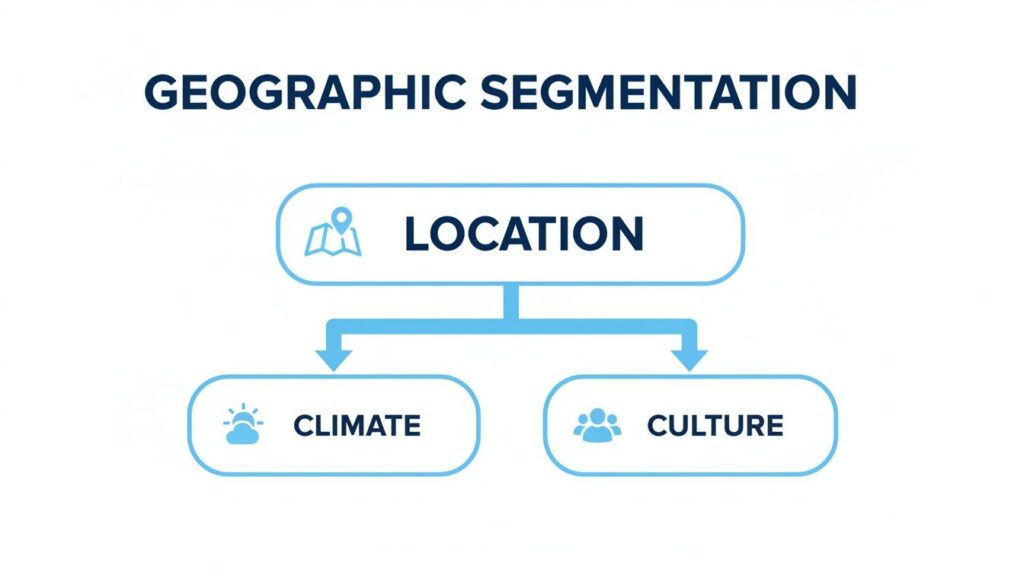
This diagram breaks down how these fundamental variables—Location, Climate, and Culture—fit together.
Geographic Segmentation
As you can see, each variable gives you a new lens to view your market, allowing you to get more specific and effective with your targeting.
Cultural and Regional Nuances
Finally, don’t ever forget culture. This is where the real magic happens. We’re talking about local holidays, traditions, language, and even food preferences. A global fast-food chain knows this better than anyone—they don’t offer the same menu in India as they do in the U.S. for a reason.
Here are a few practical ways this transforms marketing:
- Language Targeting: In an area with a large Spanish-speaking community, running ads in Spanish isn’t just a nice-to-have. It’s a must. It shows you see and respect your customers.
- Regional Promotions: A grocery store could launch a “Grilling Season” sale in the South way before they’d even think about it in the Northeast. This is timing your message to match their reality.
- Local Event Tie-ins: Sponsoring a local 5k race? Run geo-targeted ads around that event. You’re no longer just a faceless brand; you’re part of the community.
When you master these variables, your campaigns stop feeling like ads and start feeling like helpful, relevant conversations, driving deeper engagement and loyalty.
Real-World Examples of Geographic Segmentation
Theory is one thing, but seeing it work in the real world is where the magic happens. Let’s move past the geographic segmentation definition and look at how smart brands use location to win big.
These examples are a blueprint for turning a generic brand into a local favorite.
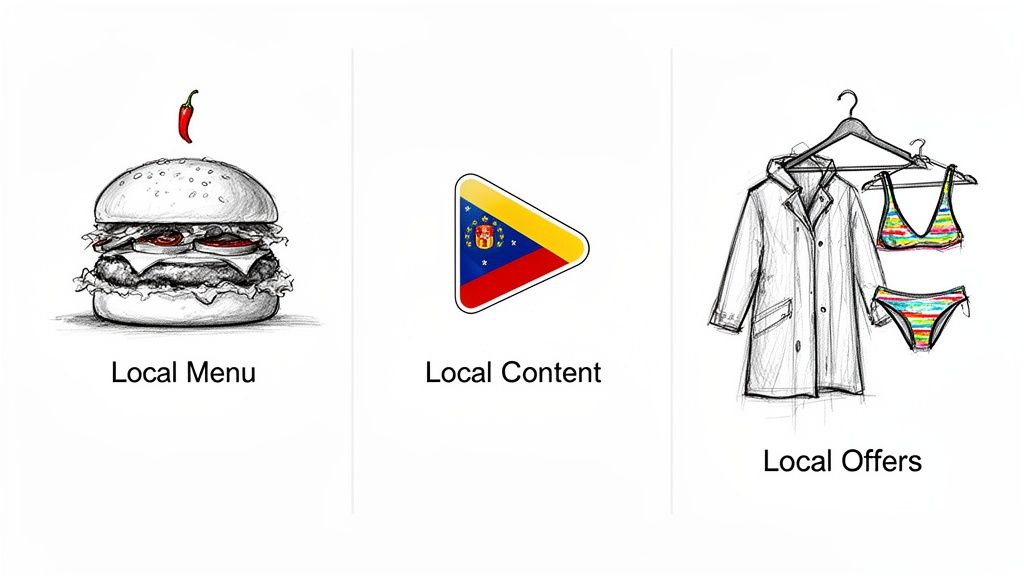
Geographic Segmentation Local Offerings
Think about a global fast-food brand. They don’t just sling the same hamburger in every country. In India, they add paneer burgers to the menu. In Mexico, they dial up the spice with specialty sauces.
This isn’t just a small tweak. It’s a powerful application of geographic segmentation—adapting a core product to meet local tastes and cultural norms.
The result? They stop being a foreign corporation and start feeling like a part of the local scene. This simple shift is a massive driver for market share and customer loyalty.
Content and Culture: The Netflix Model
Streaming services like Netflix are masters of segmenting by geography. They don’t just dump the same movie library on everyone. They invest millions in producing and promoting content that resonates with viewers in specific countries.
Here’s a look at their playbook:
- Local Content First: In South Korea, K-dramas are front and center. In Brazil, it’s all about promoting the latest telenovelas. Their entire interface is built to push what’s culturally relevant.
- Cultural Nuances: They even A/B test movie thumbnails and trailers for different regions. Why? Because what grabs attention in Japan might fall flat in Germany.
- Language and Accessibility: Offering deep language and subtitle options based on user location isn’t a bonus feature; it’s a core strategy to tear down barriers and make the platform feel native.
This approach creates a hyper-relevant experience that makes users feel seen and understood. It’s exactly why Netflix can enter and dominate so many different markets—they know entertainment isn’t one-size-fits-all.
Driving Growth with Geospatial Data
What powers all these smart decisions? Data. And the technology making this precision possible is exploding.
The Geographic Information System (GIS) market is expanding from USD 15.86 billion in 2025 to USD 18.17 billion in 2026, with Asia-Pacific being the fastest-growing region.
This growth is fueled by businesses getting tangible returns from using GIS data to spot high-growth areas and underserved markets. Understanding this trend is critical for expansion. You can discover more insights about the GIS market growth to see why geospatial analytics are a key to future success.
From menus and movies to store placements, these examples prove the point. Geographic segmentation transforms broad marketing efforts into a series of precise, profitable local wins. It’s all about meeting your customers exactly where they are—literally and figuratively.
How to Automate Your Geographic Segmentation
Forget manually sorting customers by location—that’s a thing of the past. Today, modern tools put powerful geographic segmentation into anyone’s hands, letting you scale personalized marketing without burying yourself in spreadsheets. This is how you turn raw location data into automated, relevant conversations that drive sales.
The secret is to let your systems do the heavy lifting. Instead of spending hours on tedious data entry, you can build simple, automated flows that handle the sorting for you. This frees you up to focus on strategy, not manual tasks.
Use Chatbots to Capture Location Data
One of the most direct ways to segment your audience is to just… ask them where they are. AI-powered chatbots on your website, Messenger, or Instagram are the perfect tool for this. You can design a simple, conversational flow that grabs this info and immediately puts it to work.
Imagine a chatbot for a retail brand greeting a new subscriber. It could ask, “What city are you in? We’d love to send you deals for stores near you!” Once they reply, the chatbot can instantly tag their profile with “City: New York” or “City: Los Angeles.”
That one interaction sets you up for highly effective marketing. The next time you run a sale at your New York store, you can send a message exclusively to users with that tag.
This process turns a single chat into a long-term targeting asset. It’s where the geographic segmentation definition moves from a textbook concept to a real-world process that drives local sales.
By capturing location directly, you build a clean, reliable audience segment ready for any location-based campaign. It’s a foundational step in making your marketing smarter, not harder. Explore the basics of no-code automation to see how businesses build these systems without a single line of code.
Automate Location-Based Offers and Content
Once a customer is tagged with their location, the real fun begins. You can set up triggers that fire off perfectly-timed, relevant content based entirely on where they live.
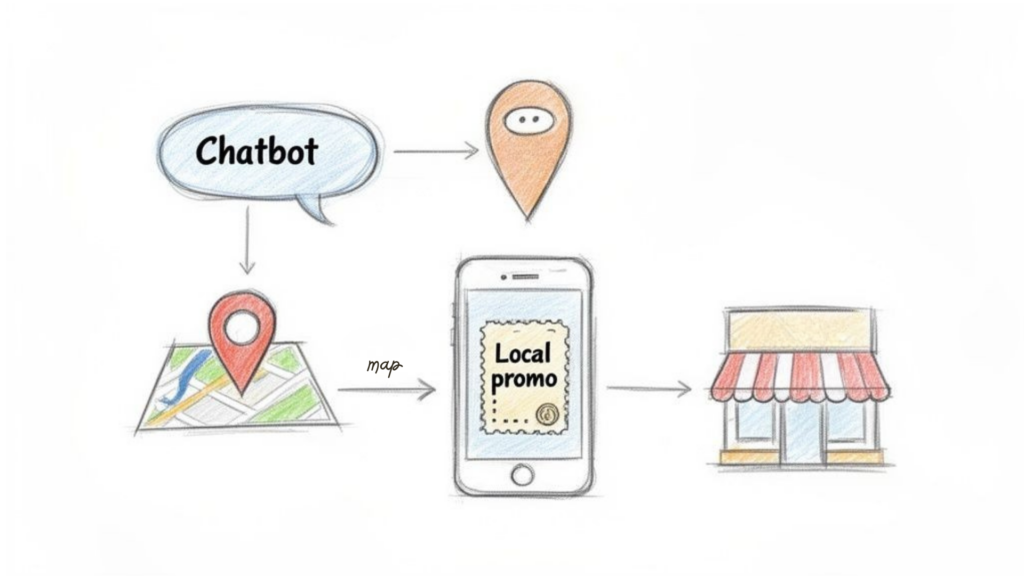
Here’s a glimpse of how you can use a platform like Clepher to put your geographic marketing on autopilot.
Geographic Targeting
The visual above shows the flow: a chatbot identifies a user’s location, then automatically sends a personalized offer for a local store right to their phone. It’s seamless, it’s relevant, and it feels like a one-on-one conversation that delivers immediate value.
Here are a few powerful automations you could build right now:
- Local Store Promotions: Automatically message subscribers in a specific city about an in-store event or sale. No more blasting everyone with an offer they can’t use.
- Climate-Based Product Recommendations: Know a group of your users who live in a cold region? Set up an automated campaign in the fall to promote your new winter jackets.
- Regional Holiday Greetings: Schedule messages to celebrate local holidays, making your brand feel like a genuine part of their community.
- Timezone-Specific Sends: Ensure your messages always land at the perfect time (like 9 AM local time) for every subscriber, no matter where they are in the world.
This isn’t just about sending emails. It’s about creating an automated system that delivers the right message to the right person, at the right time—all based on the simple fact of where they are.
Common Pitfalls and How to Avoid Them
While geographic segmentation is a fantastic tool, it’s loaded with traps. Get it right, and your marketing feels incredibly relevant. Get it wrong, and you risk alienating customers by leaning on harmful stereotypes.
The key is to see location as a starting point, not the final word on who your audience is.
The most common mistake? Relying on outdated assumptions about a place. Thinking everyone in Texas is a cowboy or everyone in New York City is a fast-talking exec is a recipe for marketing disaster. These clichés lead to tone-deaf campaigns that fail to connect.
Another major pitfall is using bad data. If your system thinks a customer is in Chicago when they moved to Phoenix a year ago, you’re just wasting money sending them ads for winter coats. It’s a bad look and an even worse user experience.
Moving Beyond Stereotypes
To avoid these traps, you have to go deeper. Don’t just stop at where they are. Dig into who they are and why they buy. This is where you blend different segmentation types to get a complete, human picture.
-
Behavioral Data: Look at what your customers actually do. What products do they browse? What have they bought before? This reveals their real interests, not just assumptions based on their zip code.
-
Psychographic Data: Understand their values, lifestyles, and attitudes. A person living in a rural area might be a tech-savvy early adopter, shattering a common stereotype.
When you combine location with behavior and values, your geographic segmentation definition evolves. It stops being about grouping people by maps and starts being about finding like-minded individuals who just happen to live near each other.
Using Location as a Clue, Not a Conclusion
The smartest marketers treat geography as just one clue in the customer puzzle. This shift in thinking is driving massive market trends.
For instance, the geospatial analytics market is projected to explode from USD 117.30 billion in 2026 to USD 309.84 billion by 2034. This growth isn’t just about maps; it’s fueled by businesses blending location with cultural and psychographic data to create hyper-specific audiences.
You can discover more research to see how this layered approach is transforming global marketing.
By layering your data, you create marketing that is both relevant and respectful. You acknowledge the local context without boxing people in, helping you build genuine connections instead of just banking on lazy assumptions.
Got Questions? We’ve Got Answers.
You have the concepts down. You’ve seen the examples and strategies. Now, let’s tackle the practical questions that come up when you start using geographic segmentation. Here are some quick, straightforward answers to help you put this all into action.
Ready to put geographic segmentation into action automatically? Clepher gives you the tools to ask customers for their location and send hyper-targeted messages on Messenger, Instagram, and more—all with a simple, no-code builder. Start building smarter, location-based conversations today.

Related Posts
Chatbots for Banks: The Ultimate Guide for 2026
April 4, 2026Mastering Conversational AI for E-commerce Success
April 3, 2026Turn Visitors Into Leads With a Web Chat Widget
April 2, 2026
Founder Clepher