
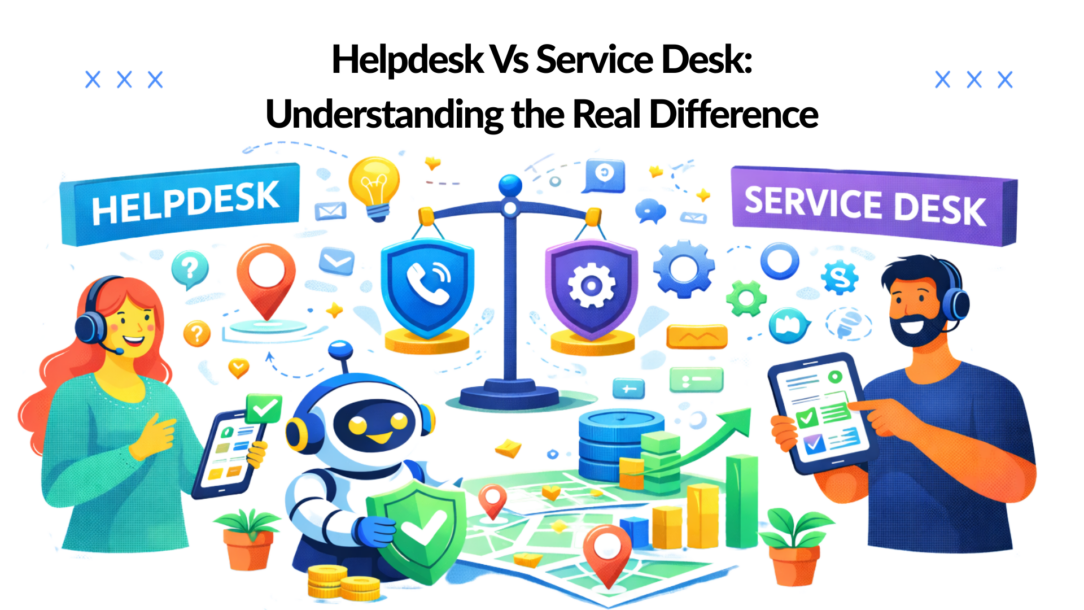
It’s a classic mix-up. People often use “helpdesk” and “service desk” interchangeably, but they aren’t the same. Not even close.
Understanding the difference is your first step toward building a support operation that doesn’t just put out fires but actively helps your business run smoother and grow faster. This isn’t just theory—it’s about transforming support from a cost center into a strategic advantage.
The Critical Difference Between Helpdesk and Service Desk
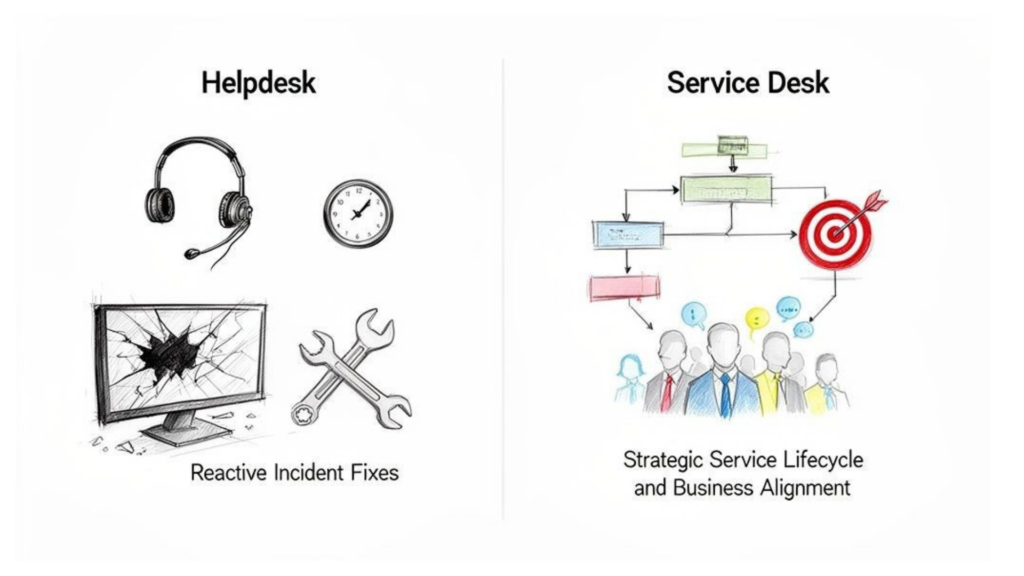
At its core, the difference is straightforward: a helpdesk is tactical and reactive. It’s your on-demand fix-it crew. In contrast, a service desk is strategic and proactive, focusing on the big picture of how services support the entire business.
While they might sound similar, their purpose, scope, and impact on your bottom line are worlds apart. Let’s get practical.
Helpdesk vs Service Desk
What Is a Helpdesk? The Break-Fix Crew
Think of a helpdesk as your frontline “break-fix” team. Its primary job is incident management—solving specific, isolated problems for users as quickly as possible. The focus is purely reactive.
- Practical Example: A customer at your e-commerce store can’t log in. They contact your helpdesk. An agent troubleshoots the login, resets the password, and closes the ticket. Problem solved, interaction over.
The goal is to get the user back on track with minimum fuss. It’s a vital function, but it’s always about fixing something that has already gone wrong. To make those fixes happen even faster, you can explore what’s possible with modern help desk automation.
What Is a Service Desk? The Strategic Hub
A service desk operates on a completely different level. It’s the central hub for all IT and business services, woven directly into your company’s processes. Within modern IT service management (ITSM) frameworks, the help desk and service desk serve different roles, and understanding the help desk vs service desk distinction is essential for improving overall service delivery. While a help desk primarily reacts to technical issues, a service desk goes further by managing the entire lifecycle of services across the organization.
Practical Example: Your marketing agency hires a new designer. The service desk handles the entire onboarding “service”—creating a user account, granting access to the CRM and project management tools, and setting up their company email. This structured workflow clearly illustrates the difference between a help desk and a service desk. Instead of simply responding to problems, the service desk executes repeatable processes that support business operations and ensure consistent service delivery.
A helpdesk fixes incidents; a service desk manages services. This simple phrase captures the core of the help desk vs service desk discussion. One focuses on resolving immediate issues, while the other supports long-term service delivery and operational efficiency. In essence, it’s the difference between putting out fires and designing a fireproof building.
Helpdesk Vs. Service Desk at a Glance
This table breaks down the core differences in focus, approach, and what each ultimately delivers for the business. Every row highlights a shift from tactical reaction to strategic action.
| Aspect | Helpdesk (Tactical) | Service Desk (Strategic) |
|---|---|---|
| Primary Focus | Incident Management (Break-Fix) | Service Management & Improvement |
| Operational Goal | Resolve immediate user issues quickly | Align IT and business services with company goals |
| Approach | Reactive (Fixing what’s broken) | Proactive & Reactive (Fulfilling requests and preventing issues) |
| Scope | End-user problems and technical glitches | All service requests, incidents, changes, and problems |
As you can see, a helpdesk is a crucial component, but a service desk is a much broader, integrated system designed to support the entire organization’s operational success.
Comparing Core Functions and Operational Scope
Helpdesk Service
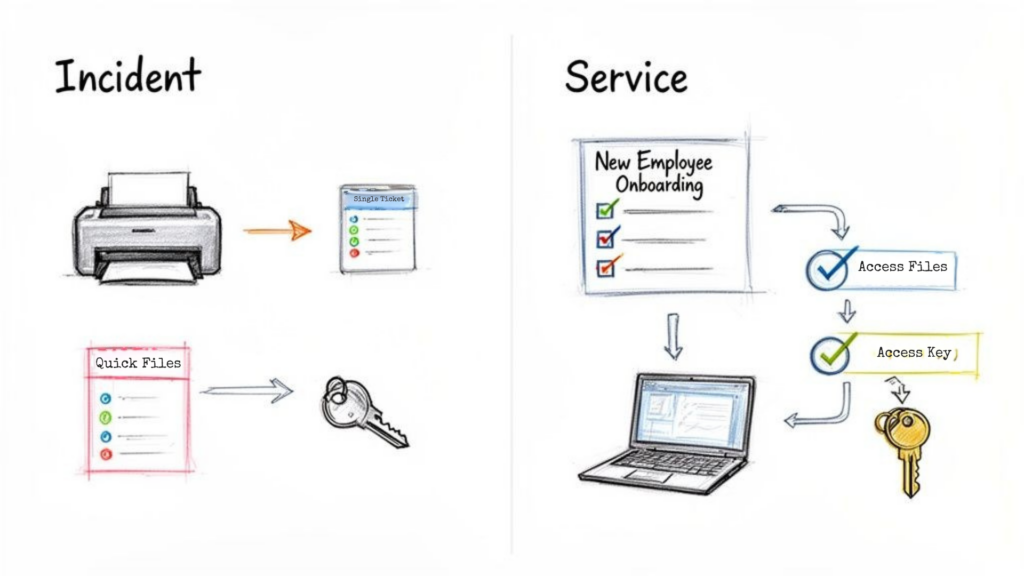
This image nails the core difference: a helpdesk fixes what’s broken, while a service desk delivers structured, repeatable services. Once you get past the basic definitions, the real daylight between a helpdesk vs service desk appears in their day-to-day work.
A helpdesk is all about incident management. Its entire world revolves around fixing things—right now. The scope is tight and tactical, focused on getting a single user back to business as fast as possible.
A service desk, on the other hand, plays a much bigger game. It doesn’t just manage incidents; it also handles service request management, fulfilling pre-approved requests for new tools, access, or hardware. It’s about providing something new, not just patching up something old.
A Tale of Two Support Scenarios: The Real-World Impact
Let’s make this real with an e-commerce example. A customer can’t apply a discount code at checkout.
-
The Helpdesk Approach: An agent gets a chat or ticket. They look into the code, maybe test it, and give the customer a working one or a manual discount. Once the customer completes the purchase, the ticket is closed. Mission accomplished. The incident is resolved.
-
The Service Desk Approach: The agent starts by doing the exact same thing—solving the customer’s immediate problem. But they don’t stop there. They create a problem ticket to investigate the root cause. Was the code expired? Is there a bug in the checkout system? They then work with the marketing and development teams to ensure this never happens again, improving the entire “Promotional Discounts” service.
That leap from fixing one transaction to improving the whole process? That’s the service desk mindset. It’s about building a better, more reliable system that generates more revenue and protects brand trust.
User Focus Versus Business Integration
Here’s another operational split: a service desk and help desk operate with different priorities even though both aim to support users. A help desk is laser-focused on the end-user’s immediate happiness. The goal is simple: get them back to work or shopping with zero friction through fast technical support and quick issue resolution.
A service desk, while still caring about the user, aims for deep business process integration. Using modern desk software and structured desk solutions, it acts as the single point of contact for a whole range of business needs. A service desk often works closely with internal teams or an external service provider to ensure services are delivered consistently and aligned with company goals.
A helpdesk is a destination for users with a problem. A service desk is a partner in the business’s operational strategy, managing the entire lifecycle of services that employees and customers rely on. This distinction between service desk vs help desk becomes clear when comparing their responsibilities: traditional help desk functions focus on incident resolution, while broader desk functions within a service desk include request management, service coordination, and process improvement.
The Onboarding Process: A Clear Contrast in Action
Nowhere is the difference in scope clearer than in employee onboarding.
A helpdesk gets involved when something goes wrong. For example, a new hire’s laptop won’t connect to the Wi-Fi. A ticket is created in the help desk system, an agent provides technical support, fixes the issue, and the ticket is closed. The help desk functions end once the incident is resolved.
A service desk, however, owns the “New Employee Onboarding” service from start to finish. This is a pre-defined item in the service catalog managed through enterprise desk software. The process includes provisioning the laptop, creating user accounts, granting software access based on the employee’s role, and even scheduling IT orientation. In many organizations, the service desk offers this structured onboarding workflow as part of its broader desk solution for managing business services.
It’s a proactive, repeatable process that ensures new hires are productive from day one—not a reaction to a problem. This real-world example clearly demonstrates the practical difference in service desk vs help desk operations within modern organizations.
Both models rely on solid tools to manage their workflows. A CRM with a complete support & ticketing system is the backbone for either approach, tracking every ticket and service request. The choice depends on a simple question: is your goal just to close tickets, or is it to improve the very services your business runs on?
Measuring What Matters: The Right KPIs for the Job
Your KPIs are more than just numbers on a dashboard—they reflect what your support team truly values. They reveal whether you’re focused on short-term fixes or playing a long-term strategic game, which is the core difference in the desk vs help desk vs service desk conversation.
What you measure is what you improve.
A helpdesk is all about speed and efficiency. Its KPIs are laser-focused on one question: How fast did we solve the immediate problem? Using a basic desk tool or ticketing platform, the goal is quick incident resolution and minimal downtime for users. In this model, the help desk may prioritize metrics like first response time, ticket resolution time, and the number of tickets closed per day. It’s a tactical approach that prioritizes throughput.
A service desk, on the other hand, asks bigger questions. Instead of focusing only on speed, it measures how support operations contribute to business performance. With advanced service desk software and integrated desk and service tools, teams track service availability, request fulfillment efficiency, and user satisfaction across entire workflows. In this context, the service desk may evaluate KPIs related to process optimization, service quality, and alignment with organizational goals.
This shift highlights the importance of service desk operations in modern organizations. Rather than simply reacting to issues, the service desk uses structured processes, analytics, and specialized tools to improve long-term service delivery and operational efficiency.
Helpdesk KPIs: All About Tactical Efficiency
Helpdesk metrics are locked on the “here and now,” measuring how well the team handles incoming issues on a ticket-by-ticket basis.
- First Contact Resolution (FCR): What percentage of issues are solved in a single interaction? High FCR means fast fixes and happy users.
- Average Handle Time (AHT): How long does it take to close one ticket? This is crucial for understanding agent productivity.
- Ticket Volume: A simple count of incoming tickets. Tracking this helps with staffing and resource management.
These metrics are essential for running a lean, fast support function. But they don’t give you the full picture of your business’s operational health.
Service Desk KPIs: Focusing on Strategic Impact
A service desk tracks the same tactical KPIs but adds a powerful strategic layer on top. These metrics measure the quality of the entire service and how well it aligns with business goals.
A helpdesk tracks how many fires it puts out. A service desk tracks how many fires it prevented from ever starting. This proactive measurement is the ultimate indicator of a mature support strategy.
- Customer Satisfaction (CSAT): Instead of just looking at speed, a service desk asks, “How happy were you with the support you received?” This provides direct insight into the quality of the entire experience.
- Service Level Agreement (SLA) Compliance: What percentage of requests are resolved within the promised timeframe? SLAs set clear expectations and measure reliability.
- Problem Recurrence Rate: This is a game-changer. It tracks how often the same root problem triggers new incidents. A low recurrence rate is proof that your service desk is implementing permanent fixes, saving countless hours and future support costs.
For a marketing agency, a high helpdesk FCR on a “can’t access file” ticket is good. But a low service desk problem recurrence rate for the same issue is infinitely better—it means a permissions issue was fixed for everyone, preventing future downtime. To dive deeper, explore these essential client success metrics that align perfectly with a service desk philosophy.
How to Choose the Right Model for Your Business
Deciding between a helpdesk and a service desk isn’t about which one is “better.” It’s about which one fits your business reality right now—and where you plan to go. Getting this right means you either build an efficient support engine or waste resources on a system you don’t need.
A startup doesn’t need a sprawling service catalog, and a scaling enterprise can’t survive on a purely reactive, break-fix model. Let’s cut through the noise.
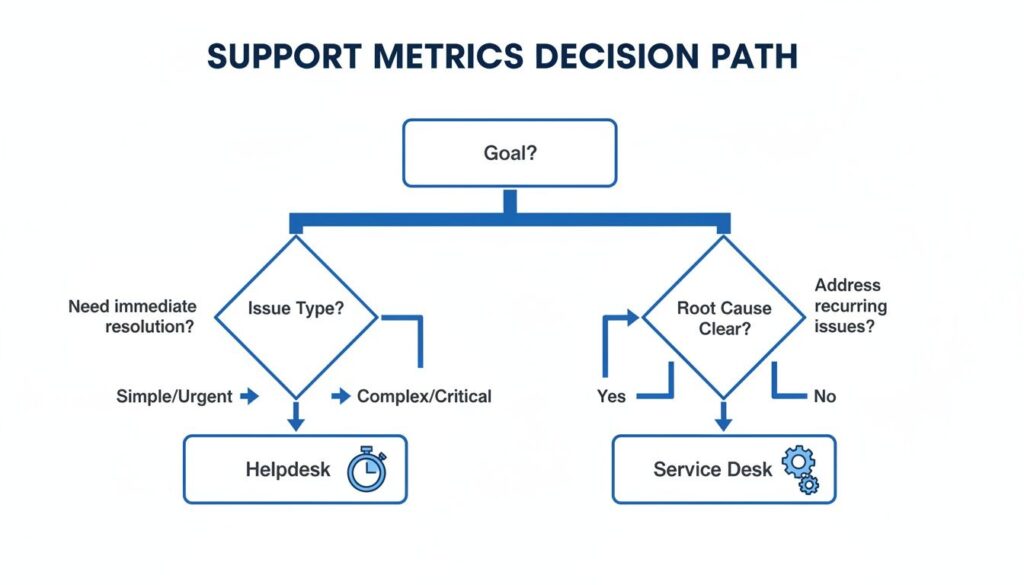
The key fork in the road is your main objective: are you trying to fix issues as fast as possible, or are you trying to improve the entire process?
Support Metrics Decision Path
The flowchart makes it simple. If your game is all about speed and tactical fixes, the helpdesk is your answer. If your focus is on strategic improvements that prevent future problems, you’re looking at a service desk.
Scenarios Where a Helpdesk Is the Perfect Fit
A helpdesk model shines when your main job is to resolve incidents efficiently. For many businesses, it’s the perfect place to start.
Choose a helpdesk if:
- You’re a small business or startup: Resources are tight, and your priority is solving immediate customer or employee problems without getting tangled in a complex framework.
- Your support needs are straightforward: Most issues are repetitive—like password resets, “Where is my order?” questions, or basic troubleshooting. The focus is transactional.
- Your primary goal is rapid response: Speed is everything. You want to resolve as many tickets as possible on the first contact to keep users happy.
A helpdesk is the pragmatic choice. It’s for businesses that need to deliver fast, reliable support without getting bogged down in big-picture strategy. It’s about doing one thing—incident management—and doing it incredibly well.
Practical Example: A Local E-commerce Store
A boutique selling handmade goods online gets a few support requests daily, mostly about shipping times or returns. A simple helpdesk, powered by an AI chatbot from a platform like Clepher to handle FAQs, is all they need. It gives customers instant answers and frees up the owner to run the business.
When to Evolve to a Service Desk
As your business grows, so does its complexity. The simple systems that worked yesterday start to crack. That’s your cue to move beyond just fixing problems and adopt a more strategic approach.
Transition to a service desk if:
- You’re scaling up: Your team is growing, you’re adding new software, and multiple departments need consistent support. The break-fix model can’t keep up.
- Recurring problems are killing your productivity: You’re stuck putting out the same fires. A service desk provides the framework for root cause analysis to solve these for good.
- You’re managing more than just IT incidents: Requests now include structured service requests like onboarding new hires or managing software licenses.
- You need to connect support to business goals: You want to show how your support function adds real value with metrics like SLA compliance and improved business processes.
Practical Example: A Growing SaaS Company
A SaaS company hits 50+ employees and finds its helpdesk is swamped. The team isn’t just fixing bugs; they’re also fielding internal requests for software access and new hire equipment. By moving to a service desk, they can build a service catalog with defined items like “New Employee Tech Kit.” This standardizes processes, sets clear delivery expectations (SLAs), and lets the team focus on strategic improvements.
How AI Chatbots Elevate Both Support Models
The helpdesk vs. service desk debate often gets stuck on process and people. But the real game-changer is automation, and AI chatbots are leading the charge. An AI isn’t just a stand-in for a human; it’s the engine that makes both models run faster and smarter, turning support from a cost center into a strategic asset.
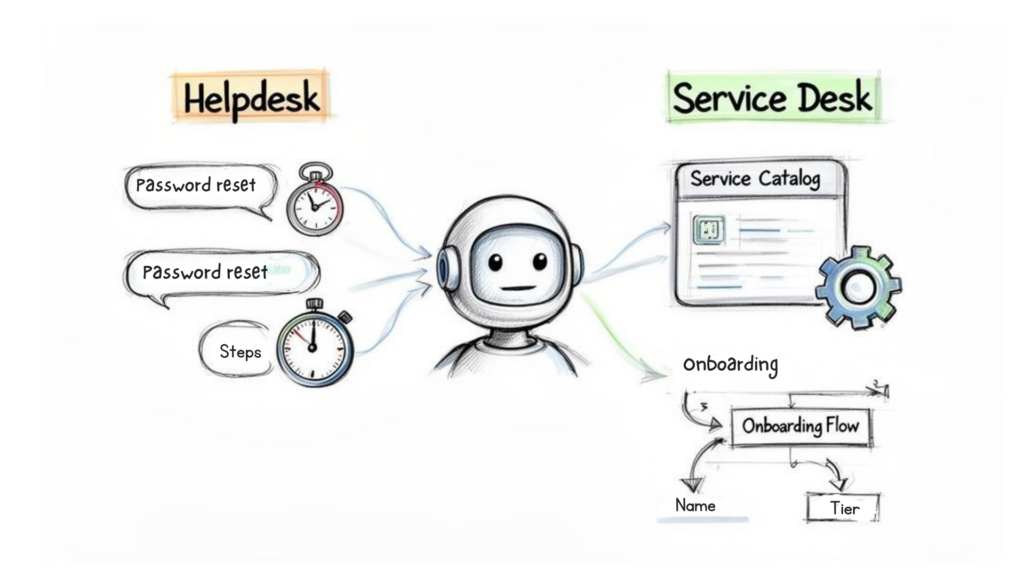
Helpdesk vs Service Desk Automation
It doesn’t matter if you’re putting out immediate fires or managing complex services. Smart automation is how you scale support without letting quality slip. The best AI tools mold themselves to your strategy, giving you either tactical speed or strategic insight right where you need it.
Turbocharging the Helpdesk with AI
A helpdesk is all about one thing: speed. An AI chatbot is the perfect tool for the job. Think of it as a tireless Tier 1 agent that resolves common, repetitive problems instantly, freeing your human agents for truly difficult issues.
An AI chatbot can:
- Deliver Instant Answers: Using keyword triggers and Natural Language Processing (NLP), a chatbot can immediately answer questions like “Where is my order?” or “How do I reset my password?”
- Gather Key Info Upfront: Before a ticket hits the queue, the bot can collect crucial details like an order number, so agents get the full picture without back-and-forth.
- Offer 24/7 Support: Chatbots provide around-the-clock help for basic questions, a massive win for customer satisfaction, and eliminating overnight ticket backlogs.
A helpdesk chatbot’s primary role is ticket deflection. By handling 70-80% of inquiries that are repetitive, it slashes handling times and directly cuts support costs.
Practical Example: An E-commerce Brand’s Helpdesk Bot
A direct-to-consumer store deploys a chatbot on its website. It’s trained on keywords like “shipping,” “return,” and “discount.” A customer types “shipping status,” the bot asks for their order number, and then uses an integration to pull the tracking link—all in seconds. This single flow can cut ticket volume by 30% or more.
Elevating the Service Desk with Strategic AI
With a service desk, the AI’s role becomes far more strategic. The chatbot is no longer just deflecting tickets; it becomes the smart “front door” for your entire catalog of services.
An intelligent chatbot supercharges a service desk by:
- Guiding Users Through Services: Instead of digging through a portal, a user can just say what they need. The bot directs them to the right service request, whether it’s for new software or access to a project folder.
- Automating Proactive Engagement: A service desk bot can trigger an onboarding flow for new users trying a SaaS product, heading off common setup issues before they become problems.
- Helping With Root Cause Analysis: Every chat is a data point. The bot can tag conversations and gather feedback that feeds directly into your problem management system, helping you spot recurring issues.
This transforms the user experience from reactive to proactive. To see how you can build these strategic flows, check out our guide on using an AI chatbot for customer support.
Practical Example: An Agency’s Service Desk Bot
A marketing agency uses a service desk bot for internal needs. A new employee starts a chat, and the bot kicks off the “New Employee Onboarding” process. In the background, it creates tickets to provision a laptop, grant access to the agency’s project management tool, and add the new hire to the right Slack channels. It’s a complex, multi-department process, all managed from a single conversation.
Your Implementation Roadmap: From Theory to Action
Alright, let’s turn theory into a working support system. It’s about taking clear, deliberate steps—not trying to boil the ocean overnight. The key is to start small and scale smart.
The choice between a helpdesk vs. service desk isn’t just semantics; it completely shapes your game plan. One path is about quick, reactive problem-solving, while the other builds a strategic foundation for long-term growth.
Launching Your First Helpdesk: The 3-Step Plan
If your goal is fast, efficient, and reactive support, a helpdesk is your starting line. This plan is all about getting a tactical system up and running quickly.
- Step 1: Find the Patterns. What are the top 5-10 questions you get repeatedly? Pinpoint these recurring headaches, from “Where’s my order?” for an e-commerce store to “I can’t log in” for a SaaS platform.
- Step 2: Build a Basic Knowledge Base. Write clear, simple answers to those common issues. This becomes the fuel for both your human agents and any automation you add.
- Step 3: Deploy an AI Chatbot for Triage. Use a no-code tool like Clepher to build a simple chatbot. Program it with keyword triggers for those common questions. This bot can start deflecting basic tickets instantly, freeing up your team from day one.
Evolving into a Strategic Service Desk: The 3-Step Plan
As your business gets more complex, your focus must shift from just fixing things to managing services. This jump requires a more structured, process-driven approach.
Evolving to a service desk means you stop asking, “How do we fix this faster?” and start asking, “How do we stop this from breaking again?” It’s a fundamental shift from incident response to business process improvement.
- Step 1: Catalog Your Business Services. Identify and define the core, repeatable services you provide. For an agency, this might be “New Client Onboarding.” For a software company, it could be “Software Access Request.” Get specific.
- Step 2: Set Initial Service Level Agreements (SLAs). Define realistic timeframes for delivering each service. How long should it take to set up a new user account? Setting and communicating clear expectations is non-negotiable.
- Step 3: Integrate with Your Core Platforms. Connect your support tool to your CRM or e-commerce platform. This gives your agents full context, letting them deliver service that feels personal and aware, not robotic.
Frequently Asked Questions
Let’s tackle some common questions that pop up when you’re weighing a helpdesk against a service desk. We’ll cut through the jargon and give you straight answers.
Ready to elevate your support, whether you’re running a helpdesk or evolving to a service desk? Clepher provides the AI-powered automation to make either model more efficient and effective. Start building smarter support conversations today.

Related Posts
Helpdesk Vs Service Desk: Understanding the Real Difference
March 15, 2026Geo Tagging Instagram: Your Guide to Boosting Local Reach
March 14, 2026What is Marketing Attribution? A Practical Guide to Measuring ROI
March 13, 2026
Founder Clepher