
If you want to lift your ecommerce conversion rates, you have to figure out where the friction is in your customer’s journey and then tackle those issues one by one. This means shifting your focus from just buying more traffic to converting the traffic you already have. It all comes down to optimizing the user experience, nailing your value proposition, and clearing out roadblocks in the checkout process to increase the conversion rate.
Pinpointing Why Your Conversion Rate Is Leaking Revenue
Before you can fix a leaky bucket, you have to find the holes. Too many businesses pour more money into sales and marketing, hoping a flood of new traffic will magically solve their sales problem.
The real breakthrough for achieving higher conversion rates happens when you stop asking, “How can we get more visitors?” and start asking, “Why aren’t our current visitors buying?”
That change in perspective is everything. Every visitor who lands on your site and leaves without converting is a missed opportunity and wasted ad spend. These aren’t just blips on a dashboard; they’re potential customers who were interested enough to click but hit a wall that stopped them cold.
Identifying Common Conversion Bottlenecks
Often, the reasons for a low conversion rate are hiding in plain sight. Your first job is to play detective and investigate the usual suspects by walking through your user’s journey. A solid first step is a thorough understanding of your e-commerce sales funnel. Knowing each stage helps you pinpoint exactly where people are dropping off.
Here are the most common friction points to look for:
- Confusing Navigation: If a user can’t find your best-selling product in three clicks, they’re gone. A cluttered menu or vague categories are instant frustration-fuel.
- Sluggish Page Speeds: Every second counts. A site that drags, especially on mobile, is a guaranteed conversion killer. Even a two-second delay can send a huge chunk of your visitors bouncing before the page even loads.
- Unclear Value Proposition: Your site has seconds to answer a visitor’s most important question: “What’s in it for me?” If your unique value isn’t crystal clear the moment they land, they won’t stick around to figure it out.
The Disconnect Between Traffic and Conversions
It’s easy to get obsessed with traffic metrics, but what’s far more valuable is understanding how people behave on your site. Using tools to analyze visitor paths is non-negotiable. For a deeper look at this, check out our guide on how to track website visitors for insights you can actually use. This data shows you precisely where users get stuck.
A classic example is high traffic but low “add to cart” rates. This usually means your marketing gets people in the door, but the in-store experience falls flat.
Device usage is a huge factor. While mobile traffic often makes up the majority of visits (around 65%), desktop conversion rates can be a powerful 5.06%—more than double the 2.49% on mobile. Why? Bigger screens make it easier to see product details, compare options, and fill out forms, which boosts buying confidence. Brands that don’t neglect their desktop experience often see the reward.
Actionable Takeaway: Fixing your conversion issues isn’t about finding one silver bullet. It’s about methodically finding and removing dozens of small friction points that, together, create a smooth path from prospect to paying customer.
High-Impact CRO Tactics You Can Implement Today
Once you’ve found where your funnel is leaking, it’s time to plug the holes. You don’t need a massive, site-wide overhaul to see a real lift in your conversion rate. Often, a few smart, foundational tweaks deliver surprisingly big results, fast.
The trick is to focus on changes that make a tangible difference in the user experience (UX) and bring clarity to your messaging. For example, Expedia famously boosted its profits by $12 million just by removing one optional field from their checkout form. It’s a classic example of how reducing friction pays off.
This entire process is a cycle: find the problem, figure out why it’s a problem, and then plan how you’re going to fix it.
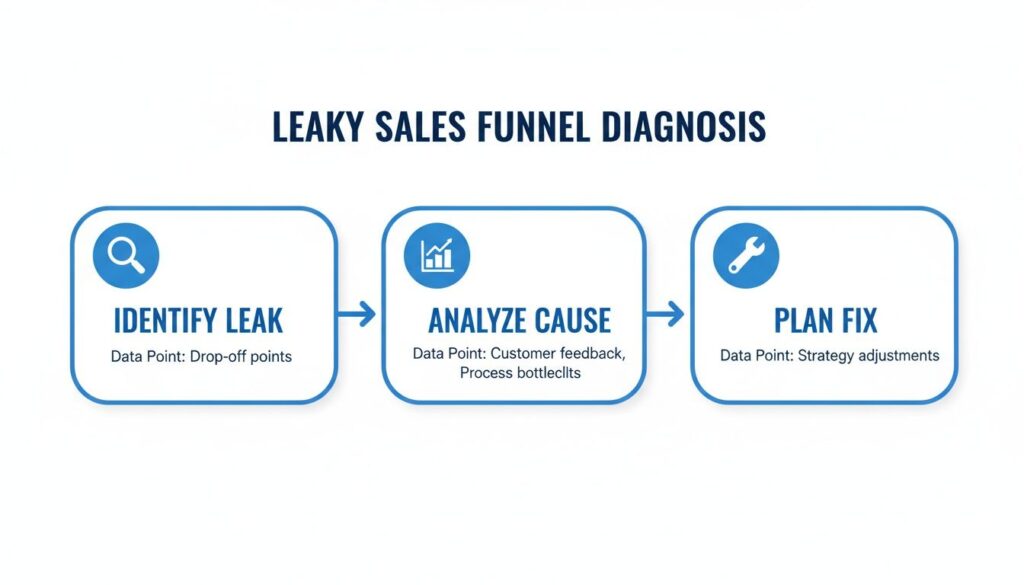
Increase Sales Conversion Rate Funnel Diagnosis
This simple workflow helps you zero in on where you’re losing people so you can apply the right solution without guessing.
Sharpen Your Value Proposition And Call to Action
When someone lands on your page, you have seconds to answer their unspoken question: “What’s in it for me?” Your value proposition needs to scream the answer. It should be impossible to miss—front and center, above the fold, with a headline that grabs them and copy that holds them.
Just as critical is your call to action (CTA). A generic button that says “Submit” is a dead end. Your CTA needs to be specific, compelling, and action-oriented.
- Instead of: “Get Started”
- Try: “Claim Your Free Trial” or “Build Your First Chatbot Now.”
Make the button pop with a contrasting color that naturally draws the eye right to the one action you want them to take.
Optimize Your User Experience for Conversions
Nothing kills conversions faster than a clunky, slow, or confusing website. To increase your sales conversion rate, make the path from visitor to customer as smooth as possible. Here are a few things you can tackle right away:
- Speed Up Your Pages: A site that takes more than three seconds to load can lose you over 30% of potential customers. Compress your images, minify your code, and leverage browser caching. Make it fast.
- Simplify Your Navigation: Don’t make people think. Your menu should be so intuitive that visitors find what they’re looking for without a second thought. If they can’t find it, they can’t buy it.
- Nail the Mobile Experience: Most of your traffic likely comes from mobile devices. Your site must work flawlessly on a small screen. That means big, tappable buttons, readable text, and forms that are a breeze to fill out on the go.
One of the quickest ways to see a lift is by optimizing your product listings. For a masterclass in this, check out a comprehensive guide to listing optimization—the principles apply to any e-commerce platform, not just Amazon.
Pro Tip: Your ad copy and landing page must be in perfect sync. If your ad promises a “50% Off Flash Sale,” that landing page better shout the same thing. Any mismatch creates confusion, shatters trust, and sends people scrambling for the back button. This “message match” is non-negotiable for high-converting campaigns.
Craft Compelling Copy That Sells
Your website copy isn’t just there to describe things; it’s there to connect with your audience and persuade them to act. The right words can single-handedly boost your conversion rate by speaking directly to your customer’s deepest needs.
Start by focusing on benefits, not features.
- Feature: “AI-powered chatbot”
- Benefit: “Answer customer questions 24/7 and never miss a lead.”
This simple shift in perspective makes your offer infinitely more attractive. It’s also crucial to speak in your customer’s voice. Dive into their reviews and support tickets. Use the exact words they use to describe their problems. When your copy sounds like them, it builds immediate rapport and makes them feel understood.
High-Impact CRO Tactics Prioritization Matrix
With so many potential changes, where do you start? This matrix helps you prioritize by balancing the potential return with the effort required. Focus on the high-impact, low-effort tasks first to get quick wins.
| Tactic | Potential Impact (Low, Medium, High) | Implementation Effort (Low, Medium, High) | Best For |
|---|---|---|---|
| A/B Testing CTAs | Medium | Low | E-commerce, SaaS, Lead Gen |
| Improving Page Speed | High | Medium | All Businesses |
| Simplifying Checkout | High | High | E-commerce |
| Adding Social Proof | Medium | Low | All Businesses |
| Optimizing Mobile UX | High | Medium | All Businesses |
| Personalizing Offers | High | High | E-commerce, SaaS |
| Refining Value Proposition | Medium | Low | All Businesses |
This framework isn’t about doing everything at once. It’s about making smart, strategic choices that will move the needle the most with the resources you have. Pick your battles, start testing, and watch your conversion rates climb.
Building a Foundation of Trust with Social Proof
In the digital world, trust is everything. When a new visitor lands on your site, they’re skeptical. They don’t know you or your products. Your job is to close that trust gap fast, and the most powerful way to do that is with social proof.
People trust other people more than they trust brands. It’s a simple psychological shortcut. When potential customers see that real people have bought and loved your product, their defenses immediately come down.
Validation from peers tells visitors that your product is a safe and smart choice, long before they’ve even read your product description.
Harness the Power of User-Generated Content
User-Generated Content (UGC)—customer reviews, testimonials, and photos or videos of your product in action—is the gold standard of social proof. It feels authentic because it is authentic. It’s the genuine voice of your customers, not polished marketing copy.
And it’s a direct line to higher conversions. A study of 1,200 websites found that those featuring UGC saw a solid 3.2% conversion rate. That jumped another 3.8% when visitors simply scrolled through the customer content.
But the real magic happens when users actively engage with it. Their likelihood of purchasing doubles, spiking conversions by a massive 102%. You can explore more data on industry conversion rates to see how UGC helps brands in beauty and skincare blow past the averages.
Actionable Takeaway: Strategically placed UGC can be the deciding factor for a customer on the fence. It answers their unasked questions and overcomes objections before they even fully form in their minds.
Where and How to Display Social Proof
Collecting reviews isn’t enough. You have to put them where they’ll have the most impact. Don’t bury your best testimonials on a dedicated “reviews” page. Instead, weave social proof directly into the buyer’s journey.
- On Product Pages: Place star ratings directly below the product title. Display your most compelling written reviews and customer photos right on the page, showing the product in the real world.
- Throughout the Checkout Flow: As a customer gets closer to paying, their anxiety can rise. Reassure them with trust signals, like a snippet of a five-star review or a “Customers Love Us” badge near the payment fields.
- On Your Homepage: Showcase logos of well-known clients, feature a scrolling feed of positive customer tweets, or highlight a powerful quote from a happy customer to build immediate credibility.
Making Your Testimonials More Powerful
“Great product!” is nice, but it doesn’t do much heavy lifting. The most effective testimonials are specific, outcome-oriented, and tackle a common objection head-on.
Instead of just asking for a review, guide your customers to give you more valuable feedback. Ask questions like:
- “What was the main problem you were trying to solve with our product?”
- “What was your biggest hesitation before buying, and what do you think now?”
- “What specific result or benefit have you seen since using it?”
A testimonial that says, “I was worried this skincare serum would be too oily, but it absorbs instantly and my skin has never been clearer,” is infinitely more persuasive than a generic compliment. It speaks directly to a potential customer’s specific fear and provides a reassuring answer from someone just like them.
Using Conversational AI To Recover Lost Sales
When a shopper almost clicks “Buy” but then drifts away, you’ve lost more than a sale—you’ve lost momentum. Conversational AI bridges that gap, turning passive browsing into an interactive experience. Imagine your website staffed 24/7 by a smart assistant that detects hesitation and jumps in with the right nudge.
Today’s bots are not the clunky scripts of the past. They can answer detailed questions, showcase products based on browsing history, and guide users through checkout. In short, they’re built to increase your sales conversion rate by meeting customers exactly when and where they need help.
Proactive Engagement That Drives Conversions
A good salesperson in a brick-and-mortar store knows when to step in. Conversational AI does this for your e-commerce site at scale. It watches for signals like stalled carts or extended time on a product page, then triggers a friendly, non-intrusive chat.
- Answering Pre-Sale Questions: A shopper is lingering on a jacket page. A bot pops up: “Wondering about fit or fabric? I can pull up the size chart for you.”
- Offering Personalized Recommendations: Someone is looking at smartwatches. The bot suggests a matching strap or a charging dock, boosting average order value.
- Guiding Through Friction Points: Shipping costs are a common hurdle. A quick message clarifying timelines or free shipping thresholds can be all it takes to seal the deal.
This real-time support removes tiny obstacles before they become deal-breakers. You can dive deeper into how Messenger bots improve sales conversion rate and retention in our dedicated guide.
Winning Back Customers With Abandoned Cart Sequences
It’s startling: nearly 70% of online carts are abandoned. Standard email reminders often get lost. That’s why smart businesses layer in SMS and Messenger follow-ups, cutting through the noise.
Text messages boast a 112.6% higher recovery rate than emails alone. For instance, a fashion retailer might send:
“Your cart’s still waiting—with a 10% off code just for you!”
This multi-channel push feels personal and helpful, not pushy.
Real-World Example: A shopper adds running shoes to their cart but closes the tab. Twenty minutes later, they get a message:
“Hey Alex, still thinking about those running shoes? Let me know if you have any questions about our 30-day return policy!”
This timely, conversational outreach shifts the tone from “marketing spam” to “helpful service.”
Setting Up An Effective Recovery Flow
Recovering abandoned carts is an art of timing and tact. Bombard too often, and you’ll annoy; wait too long, and interest fades. Here’s a proven rhythm:
- Immediate Touch (15–30 Minutes): A casual check-in—“Forgot something?”—without a discount.
- Helpful Reminder (4–6 Hours): Reiterate a key benefit—“Remember, our shoes include a 30-day risk-free trial.”
- Incentive Offer (24 Hours): Introduce urgency—“We saved your cart! Enjoy 10% off for the next 24 hours.”
Mixing gentle prompts, value adds, and small incentives lets you reel back a healthy slice of that 70% you’d otherwise miss. By blending conversational AI with strategic follow-ups, you’re not just hoping customers return—you’re actively making it happen.
Streamlining Your Checkout for Effortless Conversions
You’ve made it to the final hurdle. The checkout is the one-yard line where a visitor becomes a customer, and it’s where an astonishing number of sales are lost. Every extra step or unexpected fee can inject just enough friction to make an eager buyer abandon their cart.
If you want to seriously increase your sales conversion rate, you must transform your checkout from a roadblock into a frictionless glide path to purchase.
Your marketing and product pages did the heavy lifting to get them this far. The checkout’s only job is not to mess it up. Yet, it’s often littered with conversion-killing mistakes that seem small but have a massive impact.
Increase Sales Conversion Rate UI Sketch
Obliterate Friction at Every Step
Friction is the enemy of conversions. When a customer is ready to buy, your job is to make that process as easy as possible. The more hoops you make them jump through, the more time you give them to second-guess their decision.
Audit your own checkout. Go through the entire process on both desktop and mobile as if you were a new customer. Where does it feel clunky? What information is unnecessary? Every single field you can eliminate is a win.
Pro Tip: Never force account creation before a purchase. It remains a top reason for cart abandonment. Always offer a prominent “Guest Checkout” option. You can invite them to create an account on the thank you page after you’ve secured the sale.
Eliminate Surprises and Build Last-Minute Trust
Nothing shatters trust faster than a surprise fee. The number one reason people ditch carts is unexpected costs, especially shipping. Be transparent about all costs right from the start, either on the product page or in the cart itself.
The checkout is also your last chance to reassure the buyer. Place trust signals where they need them most: near the payment fields and the “Complete Purchase” button.
- Display Security Badges: Show logos for SSL certificates (like Norton or McAfee) to signal that their payment data is secure.
- Showcase Payment Logos: Displaying familiar icons like Visa, Mastercard, PayPal, and Apple Pay creates an immediate sense of legitimacy.
- Reiterate Your Guarantee: A simple reminder of your “30-Day Money-Back Guarantee” or “Free Returns” policy can be the final nudge a hesitant buyer needs.
Offer Payment Flexibility
Assuming everyone wants to pay with a traditional credit card is a costly mistake. Your customers expect to pay with their preferred method, and if you don’t offer it, they’ll find a competitor who does.
Offering a variety of payment options isn’t a “nice-to-have” anymore; it’s a fundamental conversion tactic. Adding digital wallets like Apple Pay and PayPal can have a huge impact, letting customers breeze through with a one-click experience.
Research shows that offering dominant local payment methods can dramatically lift conversions in specific regions. For example, businesses that offer BLIK to customers in Poland see an average 46% increase in conversion. This underscores how crucial it is to cater to regional preferences.
Common Checkout Friction Points and Solutions
| Friction Point | Why It Hurts Conversions | Actionable Solution |
|---|---|---|
| Forced Account Creation | Creates a high-effort barrier right before purchase. It feels like a commitment they aren’t ready for. | Offer a prominent “Guest Checkout” option. Make it the easiest path to purchase. |
| Surprise Shipping Costs | Breaks trust instantly and makes the total price feel deceptive. It’s a bait-and-switch, plain and simple. | Use a shipping calculator in the cart or display all costs clearly on the product page. No surprises. |
| Long, Complicated Forms | Causes user fatigue and drastically increases the chance of errors, especially on mobile devices. | Remove all non-essential fields. Use features like address auto-fill to do the work for them. |
| Limited Payment Options | Excludes customers who prefer digital wallets or rely on popular local payment methods. | Integrate Apple Pay, PayPal, and relevant regional payment systems like BLIK or iDEAL. |
| No Visible Trust Signals | Raises security concerns and makes shoppers hesitant to enter their sensitive credit card details. | Display security badges (SSL) and payment logos prominently near the final call-to-action button. |
By systematically identifying and ruthlessly eliminating these friction points, you make the decision to buy an easy one. A streamlined checkout respects your customers’ time and trust, which directly translates into a higher sales conversion rate.
Common Questions About Increasing Sales Conversion Rate
Conversion rate optimization can feel like a maze. Here are clear answers to the questions I hear most often—so you can make smarter tweaks and see real improvements.
Conclusion
Improving how to increase sales conversion rate requires a focused sales process, strong alignment between marketing and sales teams, and the right sales tech stack. To increase your conversion rate, start by identifying qualified lead sources, reducing bounce rate, and shortening the sales cycle where possible. Use sales analytics and sales dashboards to calculate your conversion rate, track conversion metrics, and spot where the sales funnel stages leak potential sales. Conversion optimization tactics — such as a clearer sales pitch, offering free shipping, optimized email marketing, and faster handoff from marketing to sales — help increase conversion rates and make a purchase more likely.
Sales leaders and sales reps should collaborate on strategies to improve win rate and sales effectiveness, measure lead conversion rate and average deal size, and test ways to improve with A/B experiments.
In short, achieving higher conversion rates requires constant refinement. By aligning sales and marketing to remove friction, you turn existing traffic into a growth engine. Prioritizing value over volume is the fastest way to master your e-commerce conversion rates and permanently increase the conversion rate.
Ready to turn more visitors into customers with intelligent, automated conversations? Clepher gives you the tools to build AI-powered chatbots that guide users, answer questions, and recover abandoned carts 24/7. Start your free trial today and see how easy it is to increase your sales conversion rate.
Related Posts
Unlock Growth with Conversational AI for Customer Support
March 26, 2026Your Ultimate Guide to Instagram Chat Bots
March 25, 2026How to Create a Killer Poll Game on Instagram to Boost Engagement and Leads
March 24, 2026
Founder Clepher