

To qualify sales leads effectively, start by defining your Ideal Customer Profile (ICP). Once you know exactly who you’re looking for, you can use a structured framework like BANT or MEDDIC to ask targeted questions that uncover a prospect’s budget, authority, needs, and timeline.
This process is about transformation—shifting your sales team’s focus from chasing every inquiry to engaging only with genuine buyers. It’s how you filter out the time-wasters and dedicate your energy to deals that are destined to close.
Stop Chasing Every Lead and Start Closing Deals

Lead Qualification
Let’s be honest: trying to sell to everyone feels like searching for a needle in a haystack. When every new lead gets the same five-star treatment, your sales team burns hours on prospects who were never going to buy. The outcome is always the same: a team that’s busy but not productive, a pipeline clogged with dead ends, and missed revenue targets.
Learning how to qualify sales leads effectively is the single most powerful lever for transforming your team’s results. It’s about building a systematic filter that ensures your reps spend their valuable time talking to high-potential prospects who match your ICP.
Why a Structured Process Matters
Without a clear qualification process, sales reps rely on gut feelings—a recipe for inconsistent results and wasted effort. A structured approach removes the guesswork, aligning everyone on what a “good lead” actually is.
The impact is massive. Strong lead qualification dramatically boosts conversion rates. Qualified leads can convert at 40%, while unqualified leads linger at a measly 11%.
The data tells a clear story:
- 75% of marketing leads never become sales-ready.
- A staggering 79% of those leads will never convert, eating up your team’s time.
- By disqualifying bad fits early, teams save an average of 32% of their sales time, which can be reinvested in the promising 25% that remain.
The goal isn’t just to fill the pipeline; it’s to fill it with the right opportunities. A disciplined qualification process is the bridge between marketing’s hard work and sales’ success.
Finding the Right Framework for Your Business
You don’t have to reinvent the wheel. Proven frameworks exist to guide your qualification conversations. Each offers a different lens for evaluating leads, making them suitable for various sales cycles, products, and business models.
Choosing the right one is your first step toward a repeatable and scalable sales motion. Let’s compare the most common frameworks to help you find your starting point.
At-a-Glance Guide to Lead Qualification Frameworks
A quick comparison of the most common sales lead qualification frameworks to help you choose the right starting point for your team.
| Framework | What It Stands For | Best For |
|---|---|---|
| BANT | Budget, Authority, Need, Timeline | Quick, high-volume sales cycles where speed is critical. |
| CHAMP | Challenges, Authority, Money, Prioritization | Consultative selling where understanding the prospect’s pain points is key. |
| MEDDIC | Metrics, Economic Buyer, Decision Criteria, Decision Process, Identify Pain, Champion | Complex, high-value enterprise deals with multiple stakeholders. |
Think of these frameworks as your playbook. They give your team a consistent set of criteria to check off, ensuring every lead is vetted properly before moving down the pipeline.
Choosing the Right Qualification Framework
A qualification framework isn’t just a checklist; it’s a repeatable system that gives your sales conversations purpose and direction. It ensures every rep asks the right questions to uncover the details that actually matter for closing a deal.
Think of it like this: qualifying without a framework is like solving a puzzle without the picture on the box. You have all the pieces, but no guide. A framework provides that guide, showing you exactly what a qualified opportunity looks like.
The key is to pick a model that fits your sales motion. A framework designed for a high-volume SaaS business will fall flat for a company selling complex, seven-figure enterprise solutions. Let’s break down the most effective options and when to use them.
BANT: The Classic for Speed and Simplicity
First up is BANT, which stands for Budget, Authority, Need, and Timeline. Developed by IBM, its staying power comes from its direct, no-nonsense approach. It’s built to quickly determine if a prospect has the basic resources and intent to buy.
BANT is a fantastic fit for businesses with:
- High-volume sales: When reps juggle dozens of leads a day, you need a fast way to filter out time-wasters.
- Shorter sales cycles: If deals close in under 30-60 days, BANT covers the essentials without overcomplicating things.
- Transactional products: It shines when the value proposition is straightforward and the decision doesn’t involve a large committee.
Real-World Example: Imagine you sell a project management tool for small agencies. A lead signs up for a trial. A rep using BANT would ask:
- Budget: “Do you have a budget set aside for new software this quarter?”
- Authority: “Are you the one who makes the final decision on new tools?”
- Need: “What specific project management challenges are you hoping to solve?”
- Timeline: “How soon are you looking to implement a new solution?”
If the lead lacks budget, authority, and an urgent timeline, they are deprioritized, freeing the rep to focus on leads who are ready to act.
CHAMP: A Modern Twist Focused on Challenges
While BANT starts with Budget, CHAMP flips the script and begins with Challenges. It stands for Challenges, Authority, Money, and Prioritization. This subtle shift reframes the conversation from “Can you afford this?” to “How can I help you solve this problem?”
This approach is a much better fit for consultative selling, positioning your sales rep as a trusted advisor, not just another vendor.
CHAMP is the go-to framework for:
- Solution-oriented sales: When your product solves a complex business pain, understanding that pain is everything.
- Competitive markets: Leading with challenges helps you differentiate your solution based on what the prospect actually needs.
- Building long-term relationships: It fosters a deeper, more empathetic connection from the first call.
By focusing on the prospect’s pain first, you align your product with their goals. This makes subsequent conversations about money and authority feel natural, not interrogative.
MEDDIC: The Gold Standard for Complex Enterprise Deals
Finally, we have MEDDIC, the most rigorous framework of the three. It’s purpose-built for high-value, complex B2B sales involving multiple stakeholders and long decision processes. MEDDIC stands for Metrics, Economic Buyer, Decision Criteria, Decision Process, Identify Pain, and Champion.
Implementing a detailed framework like MEDDIC often requires a robust system to manage the data. Discover the best CRM for sales teams to effectively build and manage this process.
MEDDIC is essential when you’re dealing with:
- Enterprise-level sales: Six or seven-figure deals demand a deep understanding of the buyer’s organization.
- Multiple decision-makers: It helps you map the entire buying committee, from the person signing the check (economic buyer) to the internal advocate who champions your solution (champion).
- Long sales cycles: For deals taking six months or more, MEDDIC ensures no critical detail slips through the cracks.
A MEDDIC Example: A salesperson for an enterprise cybersecurity platform would use MEDDIC to ask:
- Metrics: “What quantifiable improvements are you targeting, like a 20% reduction in security incidents?”
- Economic Buyer: “Who ultimately holds the budget for a project of this size?”
- Decision Criteria: “What specific technical and business requirements will you use to evaluate solutions?”
- Identify Pain: “What are the business consequences if you don’t address these security vulnerabilities?”
- Champion: “Is there someone on your team who is passionate about solving this and can help us navigate the internal process?”
This level of detail is overkill for small deals but is the bare minimum for winning large contracts. To learn more, explore our in-depth guide on what the MEDDIC framework is.
Building a Practical Lead Scoring Model
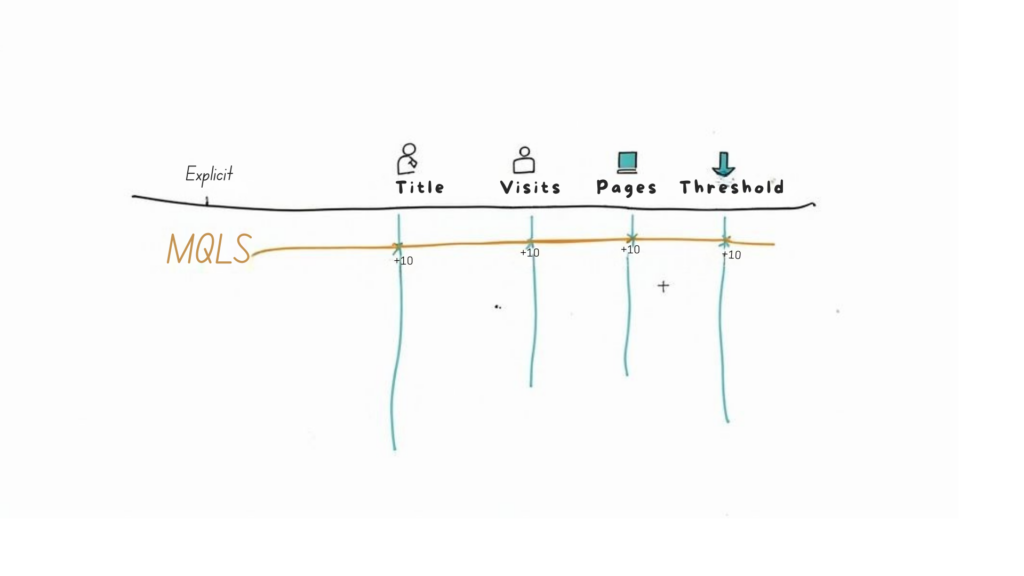
Lead Scoring
A qualification framework tells you what to ask, but a lead scoring model tells you who to talk to first. Think of it as a priority system that assigns points to leads based on their profile and actions, ensuring your reps always chase the hottest prospects.
Without it, reps could waste hours calling a student who downloaded an ebook while ignoring a C-level executive who just visited your pricing page. Lead scoring cuts through the noise and creates a clear, data-driven pecking order.
Explicit vs. Implicit Scoring Data
The best lead scoring models combine two types of data for a complete view of a lead’s potential. It’s about assessing both who they are and what they do.
Explicit data is information people provide directly. These firmographic and demographic details show how well they fit your Ideal Customer Profile (ICP).
- Job Title: A ‘Director of Marketing’ gets more points than an ‘Intern.’
- Company Size: A lead from a 500+ employee company is more valuable if you sell enterprise software.
- Industry: A prospect in your target industry (e.g., SaaS) is worth more than one you don’t serve.
- Location: If you only operate in North America, leads from other regions get a lower score.
Implicit data is all about behavior. These digital breadcrumbs signal a lead’s interest and intent. Tracking these actions is key to effective behavioral segmentation, as it reveals who is actively searching for a solution now.
- Website Visits: Visiting the pricing page is a stronger signal than reading a single blog post.
- Content Downloads: A detailed case study shows more intent than a top-of-funnel checklist.
- Email Engagement: Consistently opening and clicking your emails is a great sign.
- Demo Requests: This is a high-intent action that should earn a high point value.
A lead’s score is a direct reflection of their sales readiness. A high score means they not only fit your target profile but are also actively showing buying signals.
Building Your Scoring Template
You don’t need a data scientist to start. Just open a spreadsheet and assign points to the attributes and behaviors that matter most. The key is getting marketing and sales to agree on what a “good lead” actually looks like.
Here’s a sample structure you can adapt.
Example Scoring Template
| Data Type | Attribute / Action | Points Awarded |
|---|---|---|
| Explicit | Job Title: C-Level/VP | +15 |
| Job Title: Director | +10 | |
| Company Size: 500+ Employees | +10 | |
| Industry: Matches ICP | +10 | |
| Implicit | Requested a Demo | +25 |
| Visited Pricing Page | +10 | |
| Attended a Webinar | +5 | |
| Downloaded a Case Study | +5 | |
| Negative | Personal Email (e.g., gmail.com) | -10 |
| Job Title: Student/Intern | -20 |
Setting Scoring Thresholds
Once your point system is in place, set thresholds to automatically sort leads into buckets and trigger actions.
- Cold Lead (0-24 points): Keep them in a marketing nurture sequence to warm them up over time.
- Marketing Qualified Lead (MQL) (25-49 points): They’re getting interesting. Marketing should continue engaging them with targeted content.
- Sales Qualified Lead (SQL) (50+ points): This is a hot lead! This score should automatically route them to a sales rep for immediate follow-up.
Don’t forget negative scoring to filter out time-wasters. Deduct points for personal email domains, student job titles, or competitor IP addresses. This keeps your pipeline clean and your reps focused. Remember, review and tweak your model quarterly based on which leads actually become customers.
Crafting Effective Qualifying Questions
Your framework provides the map and your scoring model prioritizes the calls, but the questions you ask are where the magic happens. The right questions transform a generic sales call into a strategic conversation that uncovers real needs and motivations.
The goal is to get prospects talking. Move beyond simple yes/no answers by asking open-ended questions that invite them to share the context behind their problems. This builds rapport and positions you as a thoughtful advisor.
Questions That Uncover True Need and Intent
Generic questions yield generic answers. To determine if a lead is worth your time, dig deeper with questions that pinpoint specific pains and priorities.
Here’s how to phrase questions based on common frameworks.
For a CHAMP-based approach (Challenges first):
Instead of asking, “What are your needs?” try these:
- “What specific challenges prompted you to start looking for a solution right now?” This uncovers the urgency driving their search.
- “If you didn’t solve this problem, what would the impact be on your business in the next six months?” This reveals the tangible cost of inaction.
For a MEDDIC-focused conversation (Metrics and Pain):
Enterprise deals depend on ROI. Your questions must reflect this from the start.
- “What key metrics will you be using to evaluate the success of this project?” This directly ties your solution to their definition of a win.
- “Can you walk me through the business consequences you’re dealing with because of [the specific pain point they mentioned]?” This helps you—and them—quantify their pain.
The most powerful qualifying questions don’t feel like an interrogation. They feel like the start of a collaborative problem-solving session.
Identifying Decision-Makers Without Being Pushy
Directly asking, “Are you the decision-maker?” is awkward and can put a prospect on the defensive. A more subtle, collaborative approach works better for mapping the internal hierarchy.
Instead of putting them on the spot, use language that assumes a team effort:
- “Who else on your team is typically involved in evaluating new tools like this?” This non-threatening question acknowledges that B2B decisions are rarely made alone.
- “Besides yourself, whose input would be most valuable as we move forward?” This respects their role while asking them to point you toward other key players.
These questions help you map out the decision process—a critical piece of MEDDIC—without making your contact feel like you’re going over their head.
Probing Budget and Timeline Gracefully
Talking about money is necessary, but it can be uncomfortable. Frame the conversation around value and investment, not just cost.
Avoid blunt questions like, “What’s your budget?” Instead, try to understand their financial perspective:
- “Have you allocated a budget for this kind of initiative, or is this something you’re currently building a business case for?” This reveals where they are in their internal approval process.
- “Typically, our clients invest between [Range A] and [Range B] to solve this type of challenge. Does that align with what you were thinking?” This provides a helpful frame of reference and lets you gauge their reaction.
The same applies to their timeline. Instead of “When do you want to buy?” ask about the events driving their urgency. For example, “Is there a specific deadline or internal event that’s driving your timeline on this?” This connects their purchase to a real business goal, giving you a clearer picture of their seriousness.
Automating Qualification Without Losing the Human Touch
Manually qualifying every lead is a recipe for burnout. Your sales team gets bogged down, and high-intent prospects who are ready to talk now slip through the cracks. As you scale, giving every website visitor immediate, one-on-one attention becomes impossible. This is where smart automation becomes a game-changer.
The goal isn’t to replace your sales reps. It’s to use automation to do the initial heavy lifting 24/7. This frees up your team to focus on what they do best: having meaningful conversations with qualified prospects. Technology handles the repetitive work, and your team adds the human touch to close the deal.
Designing a Chatbot-Driven Qualification Flow
Imagine a hot prospect lands on your pricing page at 10 PM on a Saturday. Without automation, they fill out a form and wait. By Monday morning, their initial interest may have cooled.
A well-designed chatbot engages them instantly. It can ask the right questions, qualify them, and route them to the next step in real-time. This isn’t a generic “Can I help you?” pop-up; a smart chatbot acts as a virtual sales development rep, guiding the conversation using your qualification framework. To learn the mechanics, explore how to qualify leads with chatbots.
This flowchart shows how a bot can quickly probe key areas to determine a lead’s potential.
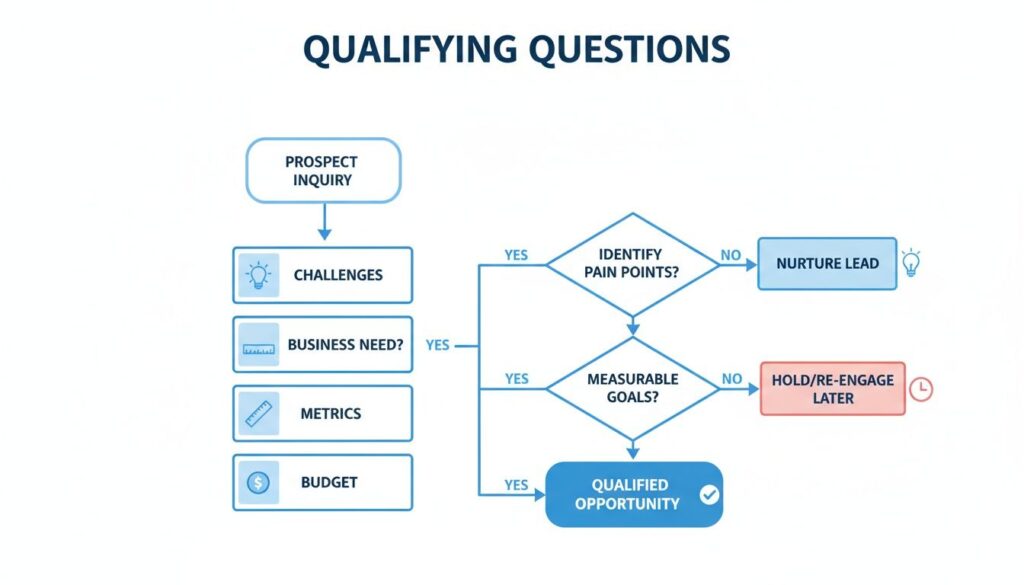
Qualifying Questions
As you can see, a chatbot can triage leads by asking targeted questions about their challenges, budget, and metrics, sending them down the right path based on their answers.
Crafting a Winning Chatbot Script
The secret to a chatbot that doesn’t feel robotic is the script. The questions should be direct yet conversational, just like a real person would ask. You’re building a decision tree where each answer determines the next question.
Here’s a simple flow for a SaaS company:
Scenario: A visitor is viewing a specific product feature page.
- The Opener: “Hey there! Saw you’re checking out our [Feature Name]. Are you trying to solve a specific problem with it?” This open-ended question gets the conversation started.
- Digging into the Challenge: If they respond with “Yes, we’re struggling with X,” the bot can follow up: “Got it. Many of our customers use this feature for that exact reason. How many people on your team would be using this?”
- Gauging Authority & Size: This question subtly helps you understand company size and whether you’re talking to a decision-maker or an end-user.
- Checking Timeline & Intent: “Great! Are you looking to get a solution in place in the next month, or are you still in the early research phase?”
In just a few messages, you’ve gathered crucial BANT-style information without a single form field.
The real magic of an automated qualification flow is its ability to segment leads in real-time. The chatbot isn’t just asking questions; it’s scoring the lead with every single answer.
The Seamless Bot-to-Human Handoff
Automation is just the first step. The handoff from bot to human must be frictionless. This is where your lead scoring comes into play.
Here’s how to structure the handoff:
- Hot Leads (SQLs): If a lead ticks all the boxes, the chatbot must take immediate action. Instead of “Thanks, we’ll be in touch,” try: “It sounds like we can definitely help. Feel free to book a 15-minute chat directly on our team’s calendar now.” This lets the hottest leads bypass the line and book a meeting instantly.
- Warm Leads (MQLs): For leads who are interested but not ready to buy, the bot can offer value without being pushy. For example: “Thanks for the info! It sounds like our latest case study on [Their Challenge] would be really helpful. Can I send it to your email?” This captures their contact info and drops them into a nurturing sequence.
- Poor-Fit Leads: If someone is clearly not a good fit, the bot can politely disqualify them and guide them toward helpful resources like your blog, saving your sales team from wasting time.
This tiered system ensures every lead gets the right follow-up at the right time. Your website is no longer a static brochure; it’s a dynamic, 24/7 lead qualification machine.
Measuring Success and Refining Your Process
A great lead qualification process is never static—it evolves. You can’t just set up a framework, build a scoring model, and expect perfect results forever. To truly move the needle, you must treat it like a living system, constantly measuring what works and tweaking your approach.
This final step is what separates good sales teams from great ones. It transforms your qualification process from a simple checklist into a data-driven engine that gets smarter with every lead.
Key Performance Indicators You Must Track
Vague feelings about lead quality won’t cut it. You need hard numbers to diagnose problems and spot opportunities. Start by tracking these essential KPIs to get a complete picture of your process’s health.
- MQL-to-SQL Conversion Rate: This is the ultimate test of marketing and sales alignment. It measures the percentage of Marketing Qualified Leads that sales accepts as Sales Qualified Leads.
- Lead-to-Opportunity Conversion Rate: Of all incoming leads, what percentage become legitimate sales opportunities? This reveals the true efficiency of your top-of-funnel strategy.
- Sales Cycle Length: How long does it take to close a deal? A pipeline filled with well-qualified leads should naturally lead to a shorter, more predictable sales cycle.
- Win Rate by Lead Source: Are webinar leads closing at a higher rate than paid ads? This KPI helps you double down on the channels that deliver real revenue.
Tracking these numbers gives you a diagnostic toolkit to stop guessing and start making informed, data-backed decisions.
Interpreting the Data and Taking Action
Metrics are useless unless you act on the story they tell. Let’s say your team has a low MQL-to-SQL Conversion Rate—only 20% of marketing leads are accepted by sales. That’s a massive red flag signaling a disconnect.
A low MQL-to-SQL rate is the symptom, not the disease. It almost always means marketing’s definition of a ‘good lead’ is completely different from what sales needs.
To fix this, dig for the root cause. A low conversion rate could mean:
- Your Lead Scoring is Too Lenient: Marketing might be sending leads over at 50 points, but sales knows that only leads with 75+ points are ready for a conversation.
- Your ICP is Misaligned: Marketing may be targeting small businesses while the product has evolved to better serve enterprise clients, which is sales’ new focus.
- Key Qualifying Information is Missing: Leads might look good on paper but lack a critical piece of BANT or MEDDIC information that sales needs to engage effectively.
Creating a Feedback Loop for Continuous Improvement
The solution is a consistent, structured feedback loop between your marketing and sales teams. This isn’t a one-off meeting but a continuous process for collaboration.
Schedule a bi-weekly or monthly “lead quality review.” In this meeting, have the sales team present their best and worst leads from the past few weeks. They should explain why certain leads were amazing and why others were a complete waste of time.
This collaborative review closes the loop. Marketing gets direct, actionable feedback on what a closable lead actually looks like. They can use that insight to refine campaigns, adjust the lead scoring model, and ultimately deliver higher-quality leads. Over time, this process ensures your method for qualifying sales leads becomes a finely tuned machine that drives revenue.
Turn every conversation into a qualified lead. With Clepher, you can design intelligent, AI-powered chatbot flows for your website and social media to qualify visitors 24/7, book meetings automatically, and create a seamless handoff to your sales team. Start building your automated qualification engine today.

Related Posts
Social Media Marketing Automation: Your Ultimate Guide
March 27, 2026Unlock Growth with Conversational AI for Customer Support
March 26, 2026Your Ultimate Guide to Instagram Chat Bots
March 25, 2026
Founder Clepher