
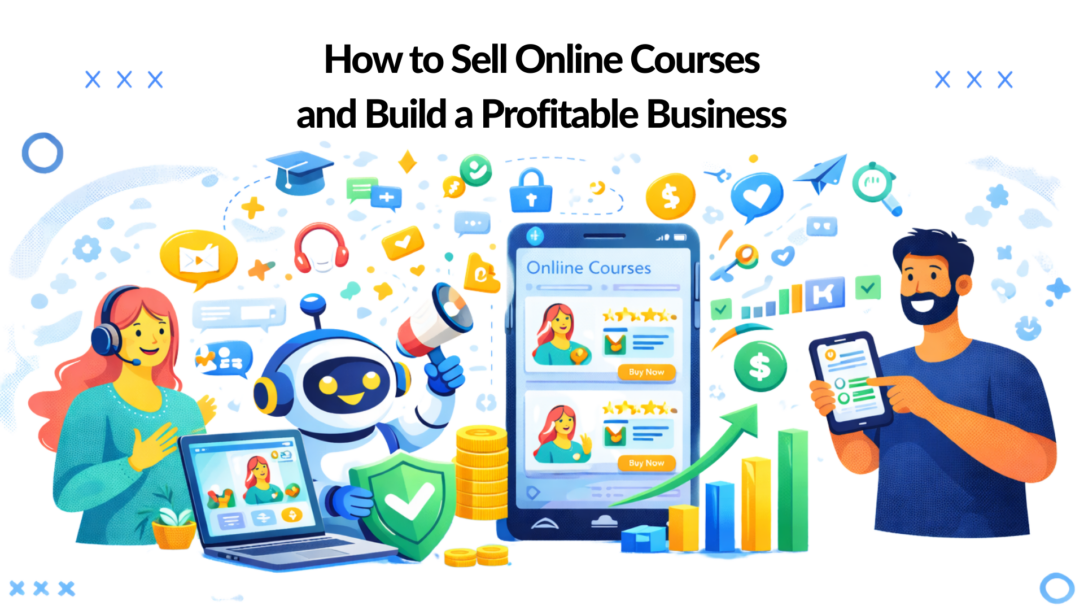
So you’ve poured your expertise into an online course. That’s a great start, but creating amazing content is only half the battle. To actually build a business, you need a proven formula: find a hungry audience, craft an irresistible offer, and build an automated system that sells for you 24/7.
The Modern Blueprint for Selling Online Courses
Forget the old “if you build it, they will come” strategy. Selling online courses today is about building a predictable revenue engine, and the timing couldn’t be better. The global online education market is exploding—projected to hit $1 trillion by 2028.
This guide is your practical, step-by-step roadmap to grabbing a piece of that pie.
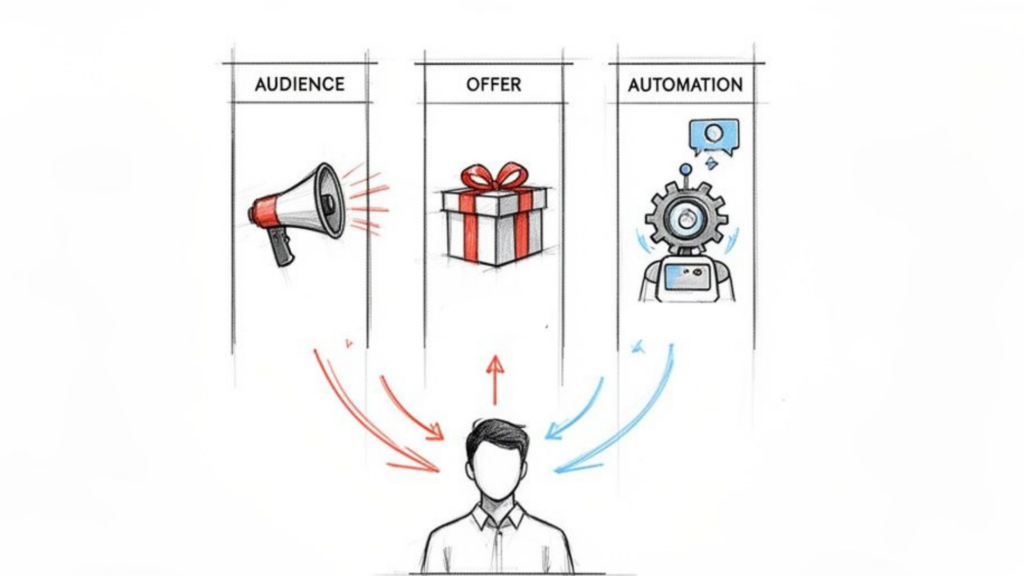
Marketing Diagram
Think of this as your playbook, filled with actionable strategies that deliver real results. We’re skipping the fluff and focusing on the transformation—for both your future students and your business.
To build a truly profitable and scalable course business, you need to master five key areas. These pillars are the foundation of your marketing and sales.
The 5 Pillars of a Profitable Course Business
| Pillar | What It Is | The Actionable Goal |
|---|---|---|
| Audience | A specific group with a painful problem you can solve. | Find where they hang out online and listen to their exact frustrations. |
| Content | Your expertise, structured into a transformative learning path. | Create a clear roadmap that takes a student from Point A (pain) to Point B (result). |
| Offer | The complete package you sell (content, community, support, bonuses). | Bundle your course with support and bonuses to make the value obvious. |
| Funnel | The automated marketing and sales system that attracts and converts students. | Build a sales page and email/chat sequence that turns visitors into buyers. |
| Automation | The tech (chatbots, email sequences) that powers your funnel. | Use tools to handle sales conversations and follow-ups so you don’t have to. |
Each pillar builds on the last, creating a powerful engine that drives your business forward. Neglect one, and the whole system can falter.
Your goal isn’t just to teach a topic; it’s to sell a result. People don’t buy courses—they buy the transformation your course promises. Package that outcome, and the sales will follow.
Your Quick-Start Framework
This guide walks you through the entire process, starting with the most critical step: validating your course idea before you waste time building it. From there, we’ll show you how to structure your expertise into a high-value offer your audience is eager to buy.
Finally, we’ll build the automated marketing systems that turn your knowledge into a scalable business. For even more powerful strategies, check out these valuable online course tips.
By the end, you’ll have a clear, actionable blueprint to launch and grow a profitable education business. Let’s dive in.
Validate Your Course Idea Before You Create Anything
Let’s talk about the single biggest mistake new course creators make: they build a course nobody actually wants. Hundreds of hours down the drain because they skipped one critical phase. This is your insurance policy against that—a playbook for proving people will pay for your expertise before you create a single lesson.

Online Courses Selling
The goal here isn’t to build a perfect course. It’s to confirm there’s a real, painful problem people are desperate to solve. We’re going to use lean, practical methods to gauge demand and even lock in pre-sales.
Uncover Pain Points Where Your Audience Lives
Your future students are already talking about their problems online. Your job is to become a digital detective and listen. Forget expensive surveys; just go where your ideal audience already hangs out.
-
Reddit & Facebook Groups: Search for subreddits and groups related to your topic. Actionable Example: For a “Productivity for Freelancers” course, search r/freelance and “Digital Nomad” Facebook groups for posts starting with “How do I…?”, “I’m struggling with…”, or “Does anyone else find it hard to…?”. These phrases are pure gold for understanding your audience’s pain.
-
Quora & Forums: Search for questions people are asking. Pay close attention to the exact language they use. You’re not just looking for topics; you’re looking for the emotional triggers behind them—frustration, confusion, and overwhelm.
-
Competitor Course Reviews: Go to platforms like Udemy or Skillshare and read the 1-star and 3-star reviews for existing courses. What are students complaining about? What’s missing? Actionable Example: If reviews say, “Great theory, but no real-world templates,” you know that including ready-to-use templates is a huge selling point for your course.
Gauge Demand with Low-Effort Tests
Once you have a list of pain points, see if people care enough to take a small action. Instead of a vague “Would you buy this?” question, test their interest with simple, low-commitment requests.
The goal is to move from passive interest (“likes”) to active validation (clicks, comments, email signups). An action is a much stronger signal of real intent.
Actionable Example: Run a simple Instagram Story poll. Don’t just ask, “Interested in a productivity course?” Frame it with a specific problem you discovered:
- Poll 1: “Freelancers: What’s your biggest time-waster?” (Option A: Client emails, Option B: Finding new work)
- Poll 2: “Struggling to manage client work and marketing? I’m thinking of creating a 2-hour workshop to fix this. Who’s in?” (Option A: “Yes, I need this!”, Option B: “Not for me”)
This gives you direct, actionable feedback. The people who vote “Yes!” are your first potential students. You can follow up in their DMs to dig deeper.
Pre-Sell Your Course with a Pilot Program
The ultimate validation is getting paid. A pilot program or beta launch is the best way to do this. You simply sell a small number of spots to an early version of your course at a significant discount.
This strategy is a massive win-win:
- You get paid upfront: This cash flow validates the idea and funds the creation process.
- You get valuable feedback: Your founding members become co-creators, telling you exactly what works and what doesn’t, helping you build a much better final product.
- You get powerful testimonials: Once your beta students get results, you have rock-solid social proof ready for your full launch.
The massive open online course (MOOC) market is set to grow by 40% by 2027, driven by demand for practical skills. You can find more insights on this growth from Research and Markets. By validating your idea with a specific audience, you’re positioning yourself to meet this demand.
Actionable Example: Take the list of “Yes!” voters from your Instagram poll, send them a simple three-part email sequence, and offer 20 spots in your “Productivity Pilot Program” for $97. Securing those first sales isn’t just about revenue; it’s the ultimate green light.
Package Your Expertise into a High-Value Offer
Alright, your idea is validated. Now let’s turn that concept into a premium product people line up to buy.
Let’s be clear: just recording a bunch of videos isn’t enough. The most successful course creators don’t sell information; they sell transformation. You need to package your expertise into an offer so compelling it feels like a no-brainer.
Think of it this way: you’re not selling a pile of bricks. You’re selling the blueprint, tools, and guidance to build a dream home.
Structure Your Course with a Results Roadmap
Nothing kills momentum faster than a confused student. To prevent this, structure your curriculum around a Results Roadmap.
Forget dry, academic syllabi. Your course map should be a step-by-step journey from their biggest frustration to their desired transformation. Every module must deliver a tangible result.
Here’s how to build it:
- Hook them with a Quick Win: Your first module should solve a small, nagging problem to build immediate trust and momentum. Actionable Example: For a public speaking course, make the first lesson a 10-minute exercise to kill pre-speech jitters. Instant value.
- Build a Logical Path: Each module must build on the last. Students need to see the “why” behind what they’re learning and how it all connects.
- Celebrate the Milestones: Weave in small checkpoints and “wins” throughout the course, like completing a worksheet or finishing a key project. This keeps them engaged.
Perceived value isn’t tied to video length. It’s about how efficiently you guide a student from Point A (problem) to Point B (goal). A shorter, focused course that delivers a clear transformation will always outsell a long, rambling one.
Craft Irresistible, Outcome-Driven Names
How you name your course and modules matters. A lot. Generic names describe a topic; powerful names promise an outcome.
For instance, which of these would you rather buy?
| Generic Name (Topic-Focused) | Outcome-Driven Name (Result-Focused) |
|---|---|
| Course: Public Speaking Basics | Course: Confident Presenter in 30 Days |
| Module 1: Introduction | Module 1: Your 5-Minute Confidence Boost |
| Module 2: Vocal Tonality | Module 2: Find Your Unshakeable Voice |
| Module 3: Body Language | Module 3: Command the Room Without Saying a Word |
See the difference? Outcome-driven names sell the dream, not the process. You’re tapping directly into your student’s desires.
Create Tiered Offers to Maximize Revenue
Not every student has the same budget or needs the same level of support. By creating tiered offers, you can serve different segments of your audience and dramatically boost your revenue.
This is a fundamental part of building a high-converting sales machine. To really nail this, you’ll want to check out this guide on how to create a sales funnel that actually works.
Here’s a proven three-tier structure:
- The Self-Paced (DIY) Tier: Your core offering—video lessons and worksheets. It’s the most affordable option, perfect for motivated self-starters.
- The Community (Group) Tier: Includes the DIY package, plus access to a private community (like a Facebook Group or Mighty Networks) and group coaching calls. This adds accountability and justifies a higher price.
- The VIP (Accelerator) Tier: Your premium, high-ticket offer. It includes all of the above, plus direct one-on-one access to you for personalized coaching.
This structure meets people where they are. Someone might start with the DIY course and later upgrade to the community tier. This model is essential for scaling your online course business.
Build Your Automated Sales Engine with Chatbots
You’ve got a validated idea and a high-value package. Now it’s time to build the machine that sells it for you. This is your sales engine—an automated system designed to attract leads, nurture them, and turn them into students, 24/7. At its core are two things: a killer sales page and a powerful ally: the AI chatbot.
Forget thinking of chatbots as clunky support tools. When used correctly, they become your best salespeople, engaging visitors the moment they show interest and guiding them toward a purchase.
Crafting a High-Converting Sales Page
Your sales page is your most important piece of marketing. It has one job: to convince the right person that your course is the exact solution they’ve been searching for.
To turn traffic into students, you need to understand how to design landing pages that sell. If you’re new to this, learning what is a landing page is a great place to start.
Every great sales page follows a proven structure that takes the visitor on a psychological journey:
- A Powerful Headline: Grab attention and promise an outcome. Instead of “Learn Social Media Marketing,” try “Become a Client-Getting Social Media Manager in 6 Weeks.”
- Problem Agitation: Remind them of the pain their problem is causing, using the exact words you heard during your research.
- Your Solution: Introduce your course as the bridge from their current pain to their desired future, laying out your Results Roadmap.
- Social Proof: Show them they aren’t the first. Use student testimonials, case studies, and any media mentions.
- A Clear Offer & Bonuses: Detail exactly what they get. List every module, worksheet, and bonus. Create urgency with limited-time offers.
- Frequently Asked Questions (FAQs): Address common objections head-on. “What if I’m a beginner?” “What if I don’t have time?”
- A Risk-Free Guarantee: A 30-day money-back guarantee is non-negotiable. It removes the final barrier to purchase.
Deploying Your 24/7 Chatbot Sales Team
Now, let’s supercharge that sales page. Imagine a visitor lands on your page. They’re intrigued but hesitant. A friendly chatbot pops up—not with a generic “How can I help?” but with a strategic, context-aware question.
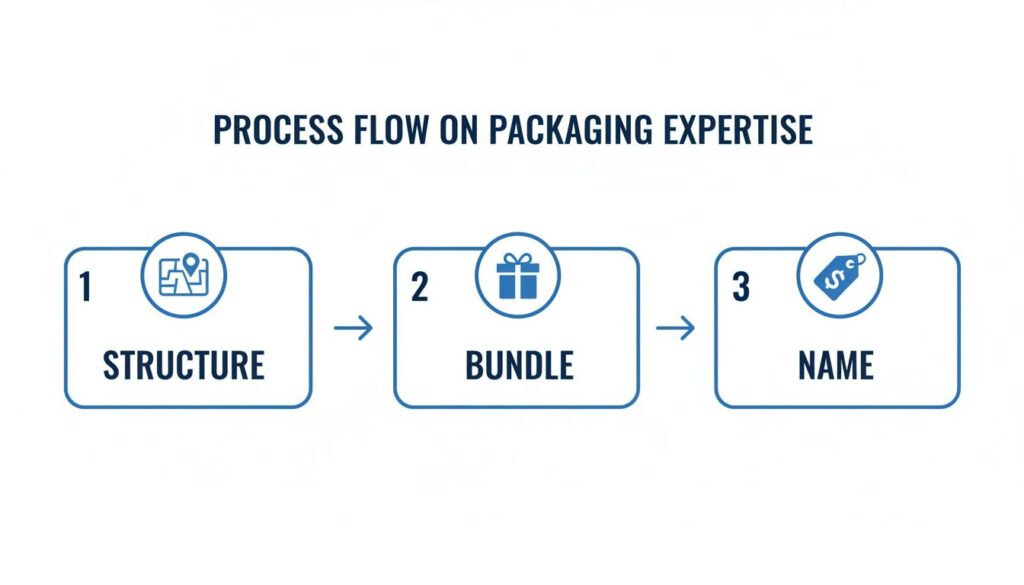
Sell Online Courses Process Flow
This process flow shows how structuring, bundling, and naming are the pillars for creating a high-value offer before you even start building your sales engine.
Platforms like Clepher make this incredibly simple to set up without coding. You can design a conversational flow that acts as a friendly concierge, proactively engaging visitors.
A chatbot on your sales page can increase conversions by proactively answering questions, overcoming objections, and guiding users to checkout—turning passive browsers into active buyers.
Here’s a practical example of a Clepher chatbot flow:
- Proactive Engagement: After 15 seconds on the page, the bot appears: “Hey! Reading up on the ‘Confident Presenter’ course? Curious what a lesson looks like? I can send you a free preview right now.”
- Lead Capture: The user clicks “Yes!” and the bot asks for their Messenger or email. Boom. You’ve captured a warm lead.
- Objection Handling: The bot follows up: “Awesome, I’ve sent that over! While you wait, got any questions? You can ask me about the guarantee, who it’s for, or the time commitment.”
- Guided Selling: The user asks about the guarantee. The bot provides the info and pivots back to the sale: “It’s a 100% risk-free guarantee. Ready to enroll and start your transformation?” with a button linking to checkout.
Recovering Lost Sales with Automation
What about visitors who add the course to their cart but don’t finish? This is a massive revenue leak. With a tool like Clepher, you can automate cart recovery on Instagram and Messenger. You can learn more about how to automate sales with chatbots and capture these missed opportunities.
Actionable Example: A potential student gets distracted and leaves. Within an hour, they get an automated message:
“Hey [First Name], I saw you were about to join the ‘Confident Presenter’ course but didn’t finish. Was it a tech issue, or did you have a last-minute question? As a little nudge, here’s a bonus module on ‘Handling a Tough Q&A’ if you enroll in the next 24 hours.”
This single, automated flow can recover a huge percentage of otherwise lost sales, directly boosting your bottom line with almost zero manual effort.
Drive Traffic and Launch Your Online Course
You can have the best course and a killer offer, but without an audience, it’s just an idea collecting dust. Once your sales engine is built, it’s time to pour in the fuel—qualified traffic. This is where you shift from having a product to running a business.
There are two main ways to do this: creating free, valuable content that pulls in an audience over time (organic marketing) and paying to place your offer directly in front of targeted users (paid advertising). The best creators masterfully blend both.
Attracting Your Audience with Organic Marketing
Think of organic marketing as building assets that pay you back for months or years. It requires consistency, but the payoff is a loyal and engaged community that trusts your expertise before you even ask for a sale. This trust is especially valuable when you create and sell an online course, because students are far more likely to enroll when they already see you as a reliable source of knowledge.
Here are two powerful organic channels to start with:
SEO-Optimized Blog Content:
Write in-depth articles that answer the questions your ideal students are already searching for. This strategy supports effective course creation because your content naturally attracts people interested in learning your topic.
Actionable Example: A personal trainer planning to create and sell an online course about fitness could write posts like “How to Lose Your First 10 Pounds Without Giving Up Carbs” or “The Best At-Home Workouts for Busy Moms.” These posts act as magnets for high-intent visitors who are likely to become students.
Short-Form Video (Reels & TikTok):
Create quick, engaging videos that solve a small, specific problem. This builds credibility and encourages viewers to explore your full training program.
Actionable Example: If you plan to create an online course on Udemy about public speaking, you could film a 30-second Reel on “One Simple Trick to Stop Saying ‘Um’ in Your Speeches.” Short tips like this position you as an expert and guide viewers to the link in your bio where they can learn more.
To further increase engagement, you can include interactive elements like a short quiz inside your course or on your landing page. Quizzes help potential students assess their current skill level and make your course feel more personalized, which can significantly improve conversions when promoting your online training.
The appetite for online learning is exploding. The US online education market alone is on track to hit $128.54 billion by 2034. Right now, 46% of learners are drawn to business-related courses, a red-hot niche for creators. You can dig into these market trends and projections to see where the opportunities are.
Accelerating Sales with Paid Advertising
While organic marketing builds your foundation, paid ads give you immediate, predictable traffic. For new creators, Meta Ads (Facebook and Instagram) are usually the best place to start.
A simple but incredibly effective strategy uses two core campaigns:
- Lookalike Audience Campaign: Upload your existing email list—even a small one—and Meta will build a “lookalike” audience of new users who share traits with your current subscribers, making them prime candidates.
- Retargeting Campaign: Show ads specifically to people who’ve already shown interest (visited your sales page, watched your videos) but didn’t buy. These are warm leads. A simple retargeting ad with a testimonial can be the final push they need.
Choosing Your Launch Model
With traffic flowing, you have to decide how you’re going to sell. There are two main models, and your choice will shape your revenue and workload.
Your launch model isn’t just a sales tactic; it’s the operational framework for your business. Choose the one that aligns with your goals for revenue, lifestyle, and student experience.
The Open/Close Cart Launch
This is the classic “event-style” launch where you open enrollment for a limited time—usually 5-10 days—and then close it. This creates powerful urgency and often leads to a massive flood of sales. It’s fantastic for creators with an existing audience they can warm up.
The Evergreen Funnel
With an evergreen model, your course is always open for business. You build an automated system (like an email sequence or webinar) that guides new leads to purchase on their own schedule. This creates a steady, predictable income stream, making it the holy grail for creators who want a hands-off sales machine. An email list is the engine for this; if you’re starting from zero, our guide on how to build an email list from scratch is a must-read.
So, which model is right for you?
| Consider This Factor | Choose Open/Close Cart If… | Choose Evergreen If… |
|---|---|---|
| Urgency | You want to use scarcity to drive a large volume of sales quickly. | You prefer a consistent, predictable income stream over big spikes. |
| Audience | You have an engaged email list you can warm up for the launch. | You have a steady flow of new leads coming in daily from ads or SEO. |
| Workload | You can handle an intense, high-energy launch period. | You want to “set it and forget it” and focus on other areas of your business. |
Many successful creators start with an open/close launch to prove their offer and get testimonials. They then use that success to build a powerful evergreen funnel that runs on autopilot.
The Big Questions (and Real Answers) About Selling Courses
Once you decide to sell a course, the questions start flooding in. That’s a good thing—it means you’re thinking like a business owner.
Let’s cut through the noise and tackle the big questions that stop most people in their tracks.
Ready to build the automated sales engine that turns your expertise into a profitable business? With Clepher, you can create intelligent AI chatbots that engage visitors, answer questions, and guide them to checkout on your website and social media—no coding required. Start automating your sales conversations today.
Related Posts
Website Facebook Messenger: Setup & AI for Sales in 2026
April 1, 2026How an API Chat Bot Transforms Your Business (And How to Build One)
March 31, 2026
Founder Clepher