

If you’re in a hurry and want a quick comparison of the top ManyChat alternative options, check out the table below. For a deeper dive into features, pricing, and real-world testing, keep reading the full guide.
| Platform | Key Features | Integrations | Pricing (Indicative) |
| Clepher | AI-powered chat (ChatGPT/OpenAI), drag-and-drop flow builder, unlimited broadcasts, behavioral tagging, conditional logic, persona flows, live chat handoff | 50+ tools via native + Zapier/Make | Lifetime deal for $99 so no free trials needed! |
| Customers.ai (formerly MobileMonkey | Messenger, Instagram, SMS, web chat, automated drip campaigns, quizzes/surveys, web chat widgets, live chat takeover | Salesforce, HubSpot, Zapier | Free; Pro $19.99/mo annually ($29/mo monthly); Business $49/mo annually ($79/mo monthly) |
| Chatfuel | Visual builder, broadcasts/sequences, live chat handover, ChatGPT templates, multi-channel (FB, IG, WhatsApp), tagging, conditional logic | Shopify, Make, Mailchimp | Free; Pro $14.99/mo annually ($19/mo monthly) |
| Tidio | Live chat + chatbot, AI-powered responses (Lyro), visual flow builder, unified inbox, multi-channel (website, Messenger, IG, WhatsApp, email) | Shopify, WooCommerce, Mailchimp, Zapier | Free; Paid $24–$49/mo |
| Intercom | Unified inbox (live chat, email, in-app), AI automation (Fin agent), proactive messaging, help desk tools, product tours, analytics | CRM & marketing tools | $39–$139/seat/mo + AI usage costs |
| HubSpot Chatbot Builder | Drag-and-drop builder, rule-based automation, live chat handoff, CRM data sync | HubSpot CRM ecosystem (Integrates with thousands of tools via Zapier) | Free; Paid ~$20/seat/mo (Professional & Enterprise tiers for advanced features) |
| Drift | AI bots for lead qualification/meeting booking, playbooks, smart routing, analytics, customizable chats | CRMs and scheduling tools | Starts at $2,500/mo (billed annually); contact sales for custom quotes |
Clepher turns Messenger and Instagram automation into effortless growth!
Try Clepher here!
Top ManyChat Alternative Tools This Year: Hands-On Comparison!
I have tested dozens of chatbot platforms over the past few years — from basic Facebook Messenger builders to full-scale omnichannel chatbots with CRM integration and AI automation layered in. And here’s the reality: while it’s true that ManyChat helped popularize chat marketing, it’s no longer the only serious and scalable option. If you’re scaling paid traffic, running social media marketing automation, or building lifecycle marketing systems, you need more than what a legacy tool offers. That’s why so many brands are actively searching for a better ManyChat alternative.
As a senior marketer, I don’t evaluate tools based on features alone. I look at revenue impact, automation depth, segmentation capabilities, and how well the platform integrates with the rest of the marketing stack. The best ManyChat competitors today aren’t just chatbot platforms — they’re full marketing automation tools powered by AI-driven personalization. They support multi-channel journeys, advanced audience logic, CRM integration, and real-time behavioral triggers that actually move the needle.
Most businesses don’t leave ManyChat because it’s “bad.” They leave because they outgrow it. They need smarter automation, stronger analytics, better Facebook Messenger marketing flows, and pricing structures that scale predictably. The gap between simple bot builders and true AI-powered bots is widening fast.
In this comprehensive comparison guide, I’ll break down the top ManyChat alternative options available right now — based on hands-on testing, campaign performance, and long-term scalability. So you can choose the platform that aligns with your growth strategy, not just your current setup.
When I evaluate AI customer support workflows, I’m not looking at surface-level features. I’m looking at scalability, automation depth, and revenue impact.
Here’s the exact criteria I used to test every platform in this guide:
- Automation Intelligence
Not just basic flows — but true AI-powered bots, behavioral triggers, dynamic segmentation, and omnichannel automation that adapts in real time. Most chatbot platforms automate messages. Very few automate outcomes. - Omnichannel Capability
Modern marketing doesn’t live on one channel. I looked at how well each tool handles WhatsApp automation, Instagram, web chat, and multi-channel journey orchestration without breaking logic or fragmenting data. - CRM Integration & Data Ownership
A serious ManyChat competitor must function as a CRM integration chatbot, not just a message sender. Can it sync customer data? Trigger workflows? Support lifecycle marketing? If it can’t plug into your stack, it limits growth. - Conversion Infrastructure
Lead capture, abandoned cart flows, qualification funnels, upsells — I tested whether the platform drives measurable revenue or just engagement metrics. - Analytics & Optimization
Granular reporting, attribution visibility, and campaign-level insights. Vanity dashboards don’t scale businesses. Data-driven iteration does. - Pricing vs. Scalability
Transparent pricing comparison and predictable scaling. Many tools become expensive fast as contacts grow.Let’s move forward and evaluate each tool now!
Clepher: Your #1 ManyChat Alternative
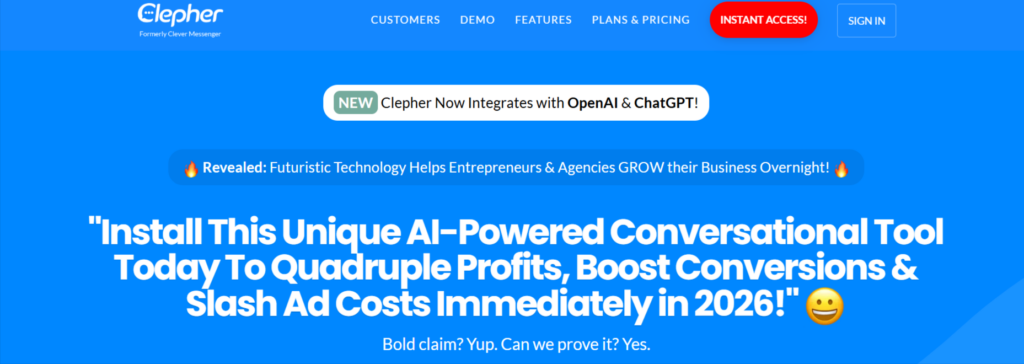
Here’s your number one ManyChat alternative — and yes, this is grounded in factual capabilities, not marketing fluff.
Clepher isn’t a bloated “all‑things to all channels” platform that promises every future feature under the sun. But what it does do, it does very well: it gives businesses a powerful, no‑code conversational automation system focused on Messenger and Instagram, with real subscriber growth, automation logic, and integration power that ManyChat users often wish they had.
Clepher also leverages ChatGPT and OpenAI models to make conversations smarter and more natural. This allows your Messenger and Instagram bots to generate dynamic, context-aware responses, automate customer support and lead qualification, and handle FAQs without pre-writing every reply.
Here’s What Clepher Actually Brings to the Table
Strong Messenger & Instagram Automation
Clepher’s core strength is building interactive two‑way chatbots for Facebook Messenger and Instagram Direct Message — with a drag‑and‑drop visual flow builder that lets marketers design
engaging nurture sequences, lead qualification paths, and broadcast messaging without any coding.
Built‑in Growth & Engagement Tools
It includes reliable tools to:
- Capture and grow your audience with chat widgets and subscriber tools
- Send unlimited broadcasts to Messenger/IG subscribers
- Use tags, custom fields, and behavioral logic to segment and personalize conversations
- A/B split test flows and messages for optimization
- Live chat handoff so humans can step in when the bot needs help
These are features many marketers actually use in campaigns — not just buzzwords on a feature page.
Deep (and Growing) Integration Ecosystem
Clepher integrates natively with 50+ tools. The range starts from email marketing services to CRMs and webinar platforms so you can pull chat leads into your other systems and trigger email/SMS follow‑ups via tools like Zapier or Make. This means your Messenger/IG automation can be part of a broader growth stack, even if the platform itself doesn’t send email or SMS directly out of the box.
Practical Marketing Features — Not Vanity Metrics
You get:
- Behavioral tagging
- Conditional logic
- Persona flows
- GDPR compliance tools
- Unlimited pages and accounts without per‑page fees
- Custom fields and AI keyword triggers to automate context‑aware responses
This isn’t surface‑level chatbot noise — these are the features real marketers rely on for lead generation and nurture automation.
Clepher vs ManyChat (Factual Positioning)
While ManyChat has long been known for Messenger first, Clepher matches or exceeds ManyChat on many core marketing automation needs:
✔ Natively supports Messenger and Instagram with strong automation logic
✔ Unlimited broadcasts without rigid contact tiers
✔ Easier visual builder for non‑technical teams
✔ Deep third‑party integrations for CRM/email/SMS follow‑ups
✔ Tagging, segmentation, and personalization built in
It doesn’t claim native WhatsApp bots or direct email/SMS sending — but by integrating through your existing tools, Clepher lets you orchestrate multi‑touch engagement workflows from a single conversation trigger, something many ManyChat users end up cobbling together themselves.
Customers.ai (Formerly MobileMonkey):
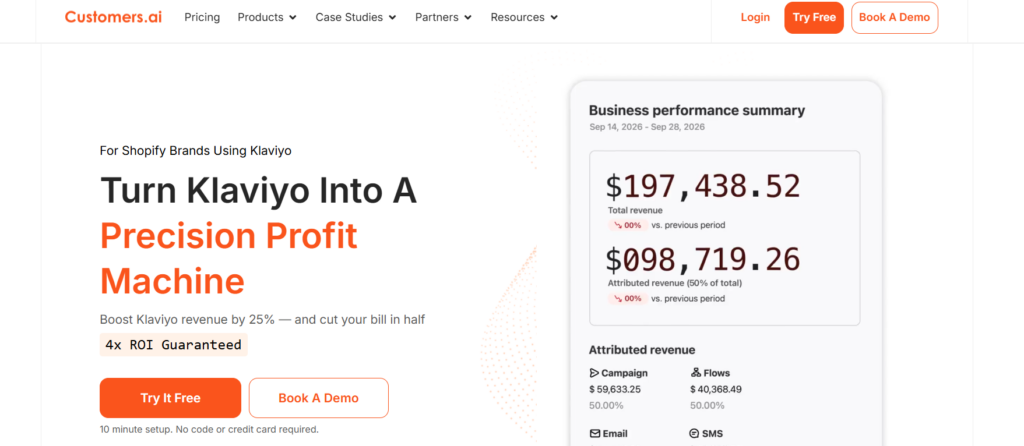
I’m sure you’ve heard of Customers.ai. It’s a well-established player in the chatbot space, and after testing it hands-on, we’re placing it second to Clepher. Why? Because it’s reliable, easy to use, and covers multiple messaging channels without fuss, but it doesn’t quite have the deep automation and integration flexibility that makes Clepher our top pick.
After testing Customers.ai myself, it earned the second spot because it’s reliable, multi-channel, and easy to implement — just not as deep in automation and AI as Clepher.
Why Customers.ai works:
- Multi-platform support for Messenger, Instagram, SMS, and web chat
- Automated drip campaigns that keep conversations flowing naturally
- Live chat takeover so humans can step in when needed
- Integrations with popular CRMs like Salesforce and HubSpot
- Web chat widgets to engage visitors on your actual website
- Lead qualification tools like quizzes and surveys
- Simple social media engagement automation
Pricing:
- Free Plan: Basic features included
- Pro Plan: $19.99/month annually, $29/month monthly
- Business Plan: $49/month annually, $79/month monthly
Customers.ai vs ManyChat:
ManyChat keeps you tied to Messenger and Instagram, but Customers.ai lets you reach customers across multiple channels from a single platform. It’s straightforward, functional, and a solid alternative if you want multi-channel reach without overcomplicating automation — which is why we put it in second place.
Chatfuel

If you’re looking for a ManyChat-style platform with a little more AI built in, Chatfuel is worth considering. I tested it hands-on, and here’s the honest take: it’s very similar to ManyChat in core functionality, but it gives marketers an edge with slightly more polished AI-driven responses.
You get all the basics you’d expect: a visual flow builder, broadcast sequences, live chat handover, conditional logic, and tagging. It supports Facebook, Instagram, and WhatsApp, and it integrates with tools like Shopify, Make, and Mailchimp, letting you connect chat data to your marketing stack.
Why Chatfuel works:
- Built-in ChatGPT integration with pre-built templates for lead qualification and first-line support
- Visual drag-and-drop builder for easy bot creation without coding
- Live chat handover so humans can step in when needed
- Supports multiple channels (Facebook, Instagram, WhatsApp)
- Integrates with Shopify, Make, Mailchimp, and more
- Analytics that give insight into AI interactions
What to know:
- AI is limited to ChatGPT integration — no custom knowledge base or actions
- You need separate messages per channel (Instagram vs WhatsApp)
- Flow builder is slightly slower and less intuitive than ManyChat
- Multi-language support and translations can be challenging
Pricing:
- Free plan: Available for testing
- Pro Plan: $14.99/month annually, $19/month monthly for Facebook & Instagram, including 1,000 conversations and all features
Chatfuel vs ManyChat:
Chatfuel is similar to ManyChat but with a cleaner interface and better AI integration. ManyChat has more bells and whistles for advanced marketing automation, but if you want a platform that works out of the box with AI support and simple flows, Chatfuel is a solid choice.
Tidio
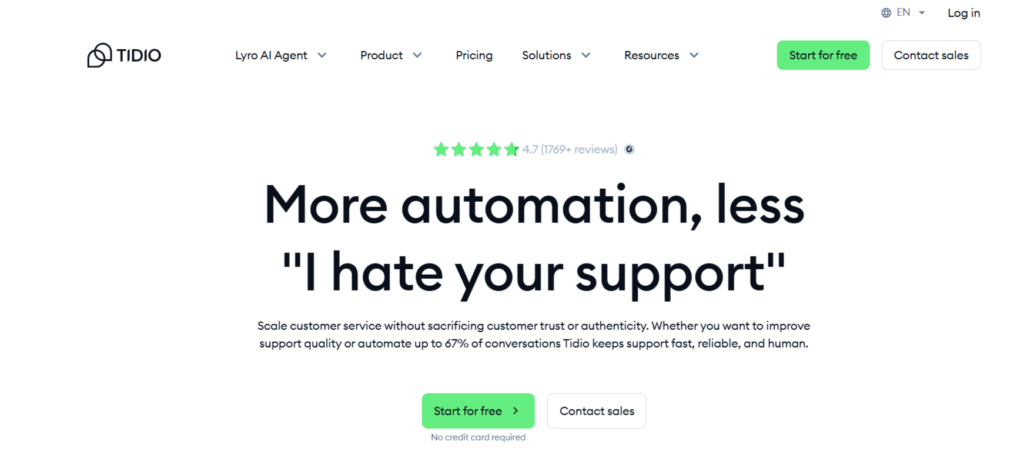
Tidio is a combined live chat and chatbot platform that works well for small to mid-sized businesses. I tested it, and it’s reliable if you want to unify support and automation in one place.
Why Tidio works:
- Live chat + chatbot automation in a single dashboard
- AI-powered responses (Lyro) for FAQs and simple lead handling
- Visual flow builder for no-code automation
- Unified inbox for website chat, Messenger, Instagram, email, and WhatsApp
- Integrates with Shopify, WooCommerce, Mailchimp, and Zapier
What to know:
- Higher-volume automation may require paid plans
- Analytics and customization are functional but simpler than enterprise platforms
Pricing:
- Free Plan: Basic chat and starter AI
- Paid Plans: ~$24–$49/month for more automation, conversations, and analytics
Tidio vs ManyChat:
ManyChat is great for social messaging automation, but Tidio combines live support and AI chat in one tool. If your priority is real-time engagement and support, Tidio is a practical alternative.
Intercom
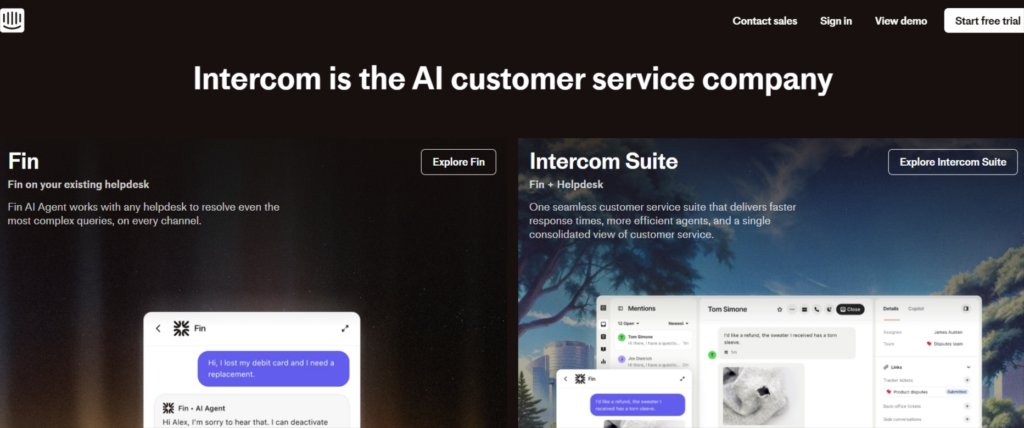
Intercom is well known as a comprehensive customer messaging, support, and automation platform that blends live chat, AI‑powered chatbots, and customer engagement tools into a single system — making it a common choice for businesses that want both support and conversational automation from one place.
What Intercom does well:
- Unified messaging: Live chat, email support, in‑app messaging, social channels, and more all come together in a shared inbox, keeping conversation context intact even if users switch channels.
- AI‑powered automation: Intercom’s Fin AI Agent uses machine learning to answer routine customer questions and reduce manual workload, with automated workflows that escalate complex inquiries to humans when needed.
- Proactive engagement: You can send targeted messages, product tours, and in‑app announcements to users based on behavior — helpful for onboarding and customer success.
- Support and help center tools: Ticketing, knowledge base management, automated workflows, and analytics are all part of the platform, which helps teams manage support at scale.
- Integrations: Intercom connects with CRMs, Slack, Salesforce, and other key tools, letting you integrate messaging with your broader stack.
Things to know (Key Considerations):
- Pricing is seat‑based, meaning you pay per user using the platform, starting around $39–$139 per seat per month depending on plan and features.
- AI capabilities like Fin’s automated resolution can add variable usage costs on top of the base subscription, which increases billing unpredictably at high volumes.
- Because it’s designed for support and engagement teams, the learning curve and cost may be overkill if you’re only focused on simple chatbot automation and broadcast campaigns.
Intercom at a glance:
- Live chat + chatbot automation + help desk ticketing combined
- AI‑driven responses with Fin agent
- Shared inbox for multi‑channel support
- Proactive customer messaging and workflows
- Extensive integrations with marketing and CRM tools
Intercom vs ManyChat:
While ManyChat focuses primarily on chat automation and audience engagement on social channels, Intercom’s strength is customer support and lifecycle engagement across web, mobile, and messaging platforms. It’s more than a chatbot platform — it’s built as a conversational support ecosystem that adds automation, analytics, and team collaboration on top of messaging.
HubSpot Chatbot Builder
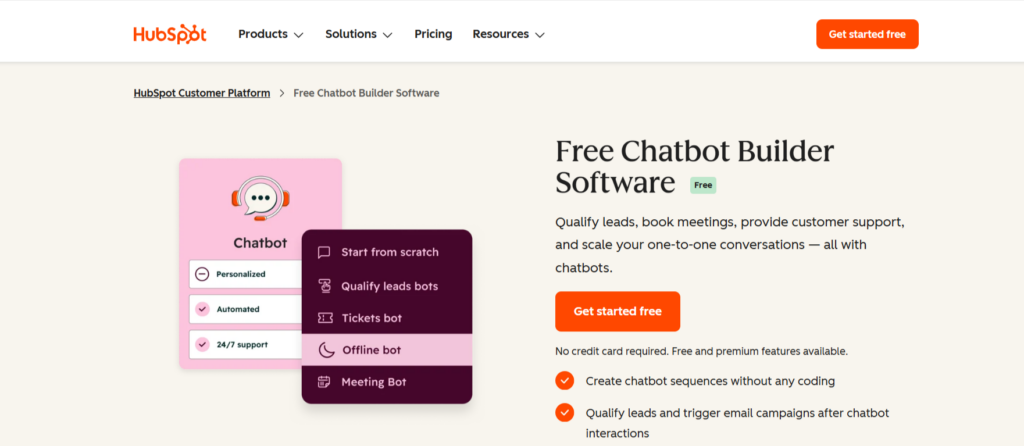
HubSpot’s chatbot builder is part of the broader HubSpot CRM and Conversations suite, designed to help businesses automate website chat interactions while tying conversations directly into sales and support workflows. It’s not a standalone chatbot platform, but for teams already using HubSpot, it provides a simple way to qualify leads, book meetings, and automate responses within the CRM.
What HubSpot offers:
- Drag-and-drop chatbot builder for no-code setup
- Rule-based automation to qualify leads, schedule meetings, create support tickets, and trigger workflows
- Native integration with HubSpot CRM so chat interactions become part of contact histories
- Live chat handoff to sales or support teams when needed
What to know:
- Functionality is tied to HubSpot’s CRM ecosystem, not a standalone bot-first platform
- Advanced automation or deeper AI responses generally require paid Marketing, Sales, or Service Hub tiers
- Conversational depth and analytics are more limited than standalone chatbot platforms
Pricing:
- Free tier: basic chatbot builder and CRM sync
- Paid plans: start around $20/month per seat for live chat and basic flows, with Professional and Enterprise tiers unlocking more customization and automation
HubSpot Chatbot Builder vs ManyChat:
HubSpot is great if you want chat automation tied directly to your CRM and sales workflows. It’s simple to set up, integrates smoothly, and keeps all your contact data in one place. It’s not focused on full-scale marketing automation, but for CRM-driven chat, it gets the job done.
Drift
Drift is built for one thing: turning website visitors into sales conversations. Its AI-powered bots don’t just collect info—they qualify leads and can automatically book meetings, reducing the back-and-forth that slows sales teams down.
Key Features:
- AI bots for lead qualification and meeting booking
- Playbooks for personalized engagement
- Smart routing based on visitor behavior
- Integrations with CRMs and scheduling tools
- Analytics to track real impact on sales pipelines
- Customizable chat experiences
Pricing:
- Standard Plan: $2,500/month annually
- Pro Plan: $3,000/month annually
- Premium Plan: Custom pricing
Drift vs ManyChat:
Drift is focused on B2B sales and website engagement, not broad social messaging or marketing automation. If your goal is to convert high-value leads into meetings quickly, it’s built for that workflow.
Your Next Step: Decide Your Marketing Automation Tool!
After testing all these platforms firsthand, it’s clear that the right tool depends on your goals. If you want advanced Messenger and Instagram automation with AI-powered bots and deep CRM integration, Clepher stands out. For teams looking for omnichannel chatbots that cover SMS, web chat, and social, Customers.ai is a practical option. Chatfuel, Tidio, Intercom, HubSpot, and Drift each have their strengths — from marketing automation tools to WhatsApp automation and B2B sales workflows.
Here’s how I’d approach it: define your primary business priorities — lead generation, multichannel engagement, automated customer support, or sales qualification. Pick the platform that aligns, run a small test, and track which one delivers real results.
Ready to Scale Your Automation Game? Try Clepher!

Founder Clepher