
Marketing automation for ecommerce isn’t about complex software—it’s about using smart tools to handle repetitive marketing tasks so you can have personal, timely conversations with customers without manually hitting “send” every time.
Think of it as your best salesperson and support agent working 24/7, ensuring no customer ever feels like just another order number.
What Is Ecommerce Marketing Automation
Ecommerce Automation Efficiency
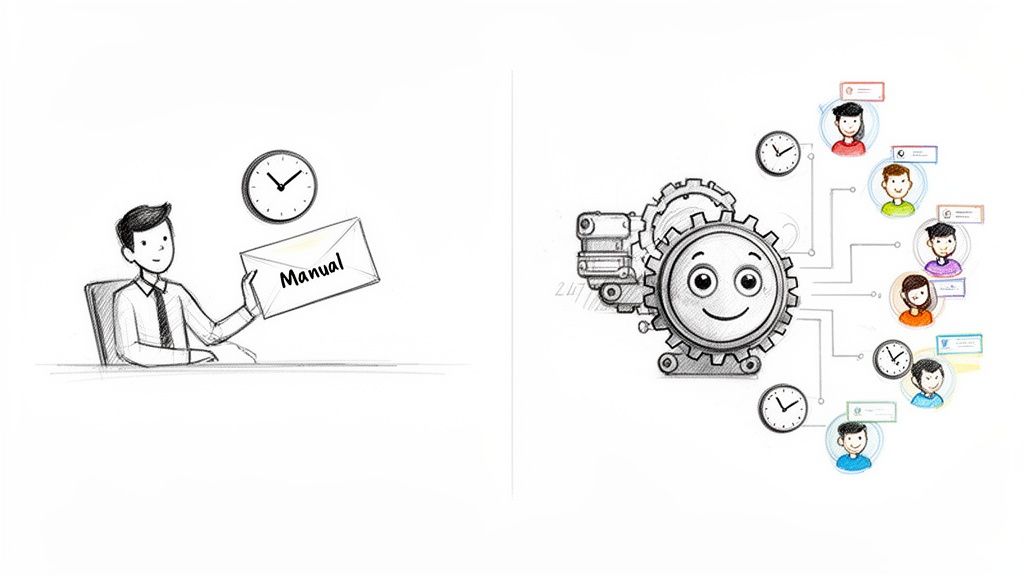
Imagine trying to personally message every person who browses a product, adds an item to their cart, or makes a purchase. It’s impossible.
That manual grind—sending one generic email blast to your whole list and hoping someone clicks—is slow, impersonal, and a terrible way to build relationships.
Now, picture a system that does all that for you, but intelligently. That’s the power of marketing automation for ecommerce. It’s about building a smart engine that reacts to what your customers actually do in real time. When a shopper views a specific pair of boots or ditches their cart, the system automatically triggers a relevant, helpful message. You move from shouting at everyone to having thousands of meaningful, one-on-one conversations at scale.
From Repetitive Tasks To Revenue Growth
To see the transformation, let’s compare the old way with the new, automated approach for common marketing tasks.
Manual Effort vs Automated Workflows
| Marketing Task | Manual Approach (The Grind) | Automated Approach (The Growth Engine) |
|---|---|---|
| Abandoned Cart | Notice a few abandoned carts, maybe send a one-off email if you have time. | A timed sequence of emails, SMS, and DMs automatically kicks in to recover the sale. |
| New Subscriber | They get a generic “welcome” email. That’s it. Maybe you add them to a monthly newsletter list. | An entire welcome series is triggered, nurturing them with brand stories, social proof, and an exclusive offer. |
| Post-Purchase | Send a standard order confirmation and hope they come back someday. | A flow follows up asking for a review, suggests related products, and offers a loyalty reward. |
| Browse Recovery | Someone looks at a product and leaves. You have no idea who they were or what they wanted. | If they’re a known contact, they get a gentle reminder about the item they viewed. |
This isn’t just about efficiency; it’s about building a system that drives revenue while you sleep. The true power is in taking high-impact, repetitive jobs off your plate and letting software handle them with perfect timing. Instead of your team spending hours pulling a list for a generic newsletter, they can focus on big-picture strategy.
Practical Example: Think of marketing automation as a set of “if-then” recipes. If a customer adds shoes to their cart but doesn’t buy, then send them a helpful message an hour later with a link back to their cart. Stacking these simple rules across the entire customer journey creates a powerful growth engine.
Why Automation Is No Longer Optional
In a crowded market, personalization is everything. Customers expect brands to understand them. Manual marketing can’t deliver that tailored experience consistently—it’s too slow and generic.
Automation makes it possible by using data to guide every conversation. Here’s why it’s a must-have:
- It Saves You Countless Hours: Automation frees your team from tedious tasks like exporting CSVs. They can focus on creative campaigns that actually move the needle.
- It Builds Real Relationships: Sending the right message at the right time makes customers feel seen. That’s how you build loyalty that lasts.
- It Recovers Lost Sales: Simple flows like abandoned cart reminders are a license to print money. They recapture revenue you would have otherwise lost, directly boosting your bottom line.
In the end, marketing automation isn’t a complex, enterprise-level luxury. It’s a fundamental tool for any ecommerce brand serious about scaling. For a deeper look, you can learn more about how comprehensive e-commerce automation can reshape your entire business.
The Four Core Automation Workflows That Drive Sales
Now that you know the “why,” let’s dive into the “what.” While you can automate nearly anything, four specific workflows are responsible for the lion’s share of revenue. Think of these as the non-negotiable foundations for your ecommerce store.
These aren’t theories; they’re battle-tested campaigns that engage customers at critical moments. When you master these, you’re not just putting tasks on autopilot—you’re building a system that actively recovers lost sales, boosts customer lifetime value, and creates loyal fans.
Recover Lost Sales with Abandoned Cart Workflows
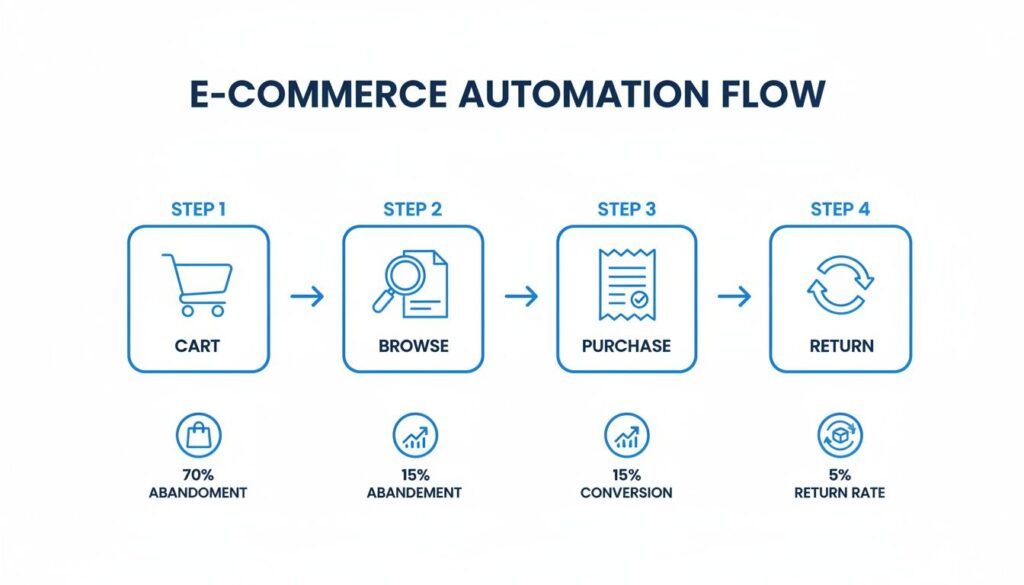
Cart abandonment is the silent killer of ecommerce profits. A staggering 70% of online shopping carts are left behind. An abandoned cart workflow is your single best tool for plugging that leak. It’s not about being pushy; it’s about being helpful.
The trigger is simple: a shopper adds an item to their cart and then leaves. Instead of losing that sale forever, your automation jumps into action.
A powerful sequence isn’t just one email. It looks more like this:
- 1 Hour Later (Email/DM): A friendly, no-pressure reminder. “Hey [FirstName], still thinking it over? Your items are saved and ready when you are.” This gentle nudge is perfect for catching people who got distracted.
- 12 Hours Later (Email/SMS): Add urgency or solve a problem. “Your cart is about to expire! Worried about shipping? We offer free shipping on all orders over $50.” This handles a common objection before they even ask.
- 24 Hours Later (Email): Bring out an incentive. “We don’t do this often, but here’s 10% off to help you complete your order. This code is good for the next 24 hours.” A time-sensitive discount can be the final push they need.
The goal is to gracefully escalate from a helpful reminder to an irresistible offer, turning hesitation into a confident purchase.
Re-engage Window Shoppers with Browse Abandonment
What about people who browse product pages but never add anything to their cart? That’s where browse abandonment automation comes in. It’s a powerful way to re-engage people who showed interest but didn’t commit.
This automation targets known contacts (like past customers or email subscribers) who viewed a specific product and then left. It shows you’re paying attention to what they like without being creepy.
Practical Example: An effective browse abandonment message feels less like a sales pitch and more like a personal shopper. It says, “I noticed you were looking at this. Is there anything I can help you with?” This conversational approach builds trust and keeps your brand top-of-mind.
A simple, effective browse abandonment flow could be:
- Email 1 (4 hours after browsing): Put the exact product they viewed front and center. “Did this catch your eye? The [Product Name] is one of our best-sellers.” Include great images and a direct link back to the product.
- Email 2 (2 days later): Add social proof or related items. “Others who viewed the [Product Name] also loved these…” This introduces them to other products and builds confidence with customer reviews.
This workflow is so effective because it starts the conversation much earlier in the buying cycle, nurturing that initial spark of interest before it fades.
Build Loyalty Through Post-Purchase Follow-Ups
The sale is just the beginning of the relationship, not the end. Your post-purchase workflow is where you turn one-time buyers into repeat customers and brand advocates. It’s all about reassuring them they made a great decision and setting the stage for their next purchase.
This automation triggers the moment an order is completed. Instead of just a boring receipt, you can create a sequence that provides real value.
Here are the essential parts of a solid post-purchase series:
- Order Confirmation: Go beyond the basics. Include order details, but also add a personal thank you from the founder and links to your social media.
- Shipping Notification: Keep them in the loop. Proactive shipping updates reduce “where’s my order?” support tickets and build excitement.
- Review Request (7-14 days after delivery): Timing is key. Once they’ve had a chance to use the product, ask for their thoughts. “How are you loving your [Product Name]? We’d be grateful for a review!” This generates priceless social proof.
- Cross-Sell/Up-sell (21-30 days later): Suggest a complementary product. “Since you bought the coffee machine, you might need some of our best-selling espresso beans.”
These automated touchpoints show you care about their experience even after you have their money—the foundation of true brand loyalty.
Nurture Customers with Lifecycle Campaigns
Finally, lifecycle campaigns are automated sequences designed to engage people at key stages of their journey with your brand. They aren’t tied to a single action like a purchase but to their overall status. The goal is to keep them engaged for the long haul.
Research shows that automated emails drive a massive 37% of all email-generated sales, despite making up just 2% of total email volume. Why? Because their timing and relevance are spot-on.
Two of the most important lifecycle campaigns are:
- Welcome Series: This is your first impression. A 3-5 part series can introduce your brand story, highlight best-sellers, and offer a small welcome discount to new subscribers.
- Re-Engagement (Win-Back) Campaigns: This flow targets customers who’ve gone quiet (e.g., haven’t purchased in 90 days). It might start with a “We miss you!” message and escalate to a special offer to bring them back.
By setting up these four core workflows, you build an automated engine that works around the clock to maximize the value of every visitor and customer. To get your creative juices flowing, explore these actionable marketing automation workflow examples that get real results.
Your Step-By-Step Roadmap to Implementing Automation
Jumping into marketing automation for ecommerce can feel overwhelming. The good news? It’s manageable when you break it down into a clear, step-by-step process.
This roadmap will guide you from setup to optimization, turning a big idea into a series of simple actions.
Ecommerce Automation Flow
Step 1: Connect Your Data Sources
Customer data is the fuel for your automation engine. Without it, you’re just guessing. The first, most critical step is to connect your automation platform directly to your ecommerce store, whether it’s Shopify, WooCommerce, or BigCommerce.
This integration is what makes real-time, behavior-based marketing possible. When a customer buys a product or abandons their cart, that event data instantly flows into your automation tool, ready to trigger a workflow. A solid connection ensures your messages are always based on what a customer just did.
Step 2: Master Customer Segmentation
Once data is flowing, you can start grouping customers into meaningful segments. This is where you stop blasting generic messages and start having relevant conversations. Segmentation is simply dividing your audience into smaller groups based on shared traits or actions.
Here are a few practical examples:
- High-Spenders: Group customers who have spent over $500 and send them exclusive VIP offers or early access to new products.
- One-Time Buyers: Create a segment for customers who’ve only purchased once. Target them with a campaign designed to encourage a second purchase.
- Category Interests: Segment people based on the product categories they’ve browsed, like ‘viewed running shoes’ or ‘purchased skincare’.
- Inactive Subscribers: Find contacts who haven’t opened an email or bought anything in the last 90 days. Target them with a win-back campaign.
Good segmentation ensures the right message hits the right person, which dramatically lifts engagement and conversion rates.
Step 3: Design Your First Conversational Flow
With your data connected and segments defined, it’s time to build your first automation. The abandoned cart workflow is the perfect place to start because it delivers a quick, measurable return.
Think of it like creating a simple recipe with “if-then” logic.
The Core Logic: If a customer adds an item to their cart AND doesn’t complete the purchase within one hour, THEN trigger the abandoned cart sequence.
Your flow doesn’t need to be complex. A simple, effective sequence could look like this:
- Wait 1 Hour: Send a gentle nudge via email or Messenger. “Still thinking it over? We saved your cart for you.”
- Wait 23 Hours: Follow up with a message that adds social proof. “Did you know the [Product Name] has over 200 five-star reviews?”
- Wait 2 Days: Send one last message with a small, time-sensitive incentive. “Complete your order in the next 24 hours and get 10% off.”
Modern visual flow builders make this easy. You just drag and drop triggers, delays, and messages to map out the conversation without touching a line of code.
Step 4: Test and Launch Your Automations
Before you unleash your new automation, test it. Most platforms let you send test versions to yourself to check for typos, broken links, or formatting issues. Once you’re confident everything works perfectly, set the workflow live.
But launching isn’t the end. The best marketers are always testing. This is where A/B testing becomes your best friend.
Here are a few ideas to test:
- Offers: Does a 10% discount work better than free shipping?
- Timing: Does a reminder sent after one hour beat one sent after four?
- Copy: Is a playful tone more effective than a direct one?
By running these tests, you let data—not your gut—drive your strategy. It’s the key to continuous improvement.
Step 5: Analyze and Optimize Performance
Once your automations are running, the final step is to monitor their performance. This is where you close the loop, using analytics to sharpen your approach over time.
Focus on the key metrics that tell you what’s working. Look at open rates, click-through rates, and most importantly, the conversion rate and total revenue generated by each workflow. If a message has a low open rate, test a new subject line. If a flow isn’t generating sales, revisit your offer or timing. This constant cycle of analysis and optimization is what turns a good automation setup into a powerful, revenue-generating machine. For a more detailed strategy, you can learn how to automate your sales process.
How to Choose the Right Automation Tools and Integrations
Ecommerce Integrations
Building your automation tech stack isn’t about finding one “perfect” tool or chasing every list of the best marketing automation tools. It’s about creating a system where your platforms talk to each other so data flows freely. The goal is a unified view of your customer that fuels smarter marketing everywhere, often powered by the right ecommerce marketing automation software working behind the scenes.
Your marketing automation for ecommerce platform should feel like an extension of your team, not a technical project. If you need a developer just to launch a simple campaign, you’ve already lost. Prioritize tools that let you build, test, and launch on your own — whether you’re evaluating the best marketing automation tools or choosing scalable ecommerce marketing automation software — so you can stay agile.
Core Features That Matter Most
It’s easy to get distracted by a long list of features. Instead, focus on the core functions that actually drive results for ecommerce brands.
Here are the non-negotiables:
- No-Code Visual Builder: You need to see your customer journeys. A drag-and-drop builder is essential for mapping out and editing your automation flows without writing code.
- Multi-Channel Support: Your customers are everywhere, so your marketing should be too. Your tool must support the channels they use, like email, Messenger, Instagram, and WhatsApp.
- Deep Segmentation Capabilities: This is the engine behind personalization. The ability to filter customers by purchase history, site behavior, and custom tags is what separates a generic blast from a message that feels personal.
Actionable Insight: Think of your automation platform as your marketing’s central nervous system. It needs to receive signals from your store, ads, and support desk, and trigger the right response instantly. This seamless communication creates a truly connected customer experience.
The Critical Role of Integrations
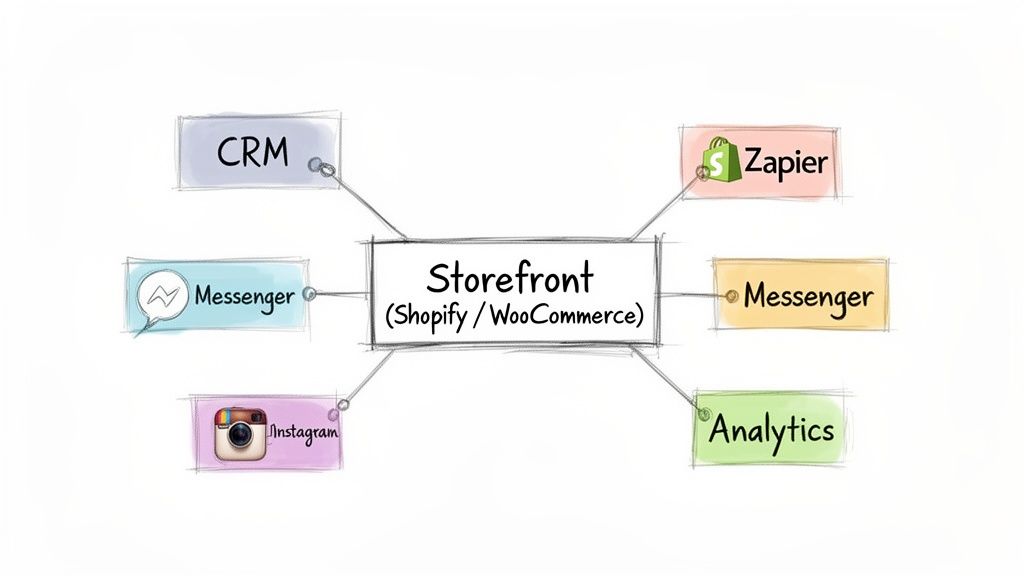
A platform can have all the bells and whistles, but if it can’t connect to your e-commerce store, it’s useless. Native, one-click integrations with platforms like Shopify, WooCommerce, and BigCommerce are a must-have. This direct link enables real-time triggers for things like cart abandonment and post-purchase follow-ups.
This connection ensures your data is accurate and fast—critical for timely, behavior-based messaging.
Beyond your storefront, consider the rest of your marketing ecosystem. Look for integrations with your email service provider, CRM, and analytics tools. For everything else, a tool like Zapier acts as a universal translator, connecting thousands of other apps. For instance, you might use a dedicated e-commerce feedback automation tool to gather reviews. The goal is a tech stack where data isn’t trapped in silos. For more on picking the right platform, check out our deep dive into the top AI marketing automation tools on the market.
Key Metrics to Measure Your Automation Success
So, your workflows are built. How do you know if your marketing automation for ecommerce is actually working? The answer is in the data. Forget vanity metrics and focus on the numbers that prove you’re getting a tangible return on investment (ROI).
These KPIs show your automation is a revenue driver, not just an expense. Tracking them tells you what’s working, where to make changes, and helps you prove the direct impact of your efforts on the bottom line.
Cart Recovery Rate
This is a critical metric for any ecommerce store. The Cart Recovery Rate is the percentage of abandoned carts your automated sequences manage to win back. It’s a direct measure of your ability to plug the biggest leak in your sales funnel. A high recovery rate means your reminders, timing, and offers are working. Aiming for 10-15% is a solid goal, and top brands often push past 20%.
Customer Lifetime Value
Customer Lifetime Value (CLV) is the total amount of money a customer is expected to spend with your brand. Good automation is a massive lever for boosting this number through smart post-purchase follow-ups, re-engagement campaigns, and personalized product recommendations. When you see your average CLV climbing, it’s a clear signal that your automation is successfully turning one-time buyers into loyal, repeat customers.
Business Impact: The real power of automation is its ability to systematically increase the value of every customer. It’s not just about rescuing one cart; it’s about building a relationship that pays off for months or even years.
Repeat Purchase Rate
Closely linked to CLV, the Repeat Purchase Rate tracks the percentage of customers who come back to buy again. This is a vital sign of customer satisfaction and brand loyalty. A great welcome series and an effective post-purchase flow are your best tools for encouraging that all-important second purchase. A healthy rate—usually over 20-30% for an established store—proves your brand experience keeps people coming back.
Revenue Per Recipient
Finally, Revenue Per Recipient (RPR) shows you exactly how much money each person in a specific workflow is generating. Just divide the total revenue from a campaign by the number of people who received the messages. This metric is fantastic for A/B testing. The numbers tell a powerful story: for every dollar spent on marketing automation, brands see an average return of $5.44. Top-tier email workflows can generate an incredible $16.96 per recipient. You can discover more insights about these ecommerce statistics to see the direct financial impact.
By focusing on these four core metrics, you can confidently measure your strategy’s success and make data-driven decisions that fuel real, measurable growth.
Advanced Automation Strategies and Best Practices
Once your core automation flows are running and profitable, it’s time to go from good to great.
This is where you shift from just automating tasks to creating memorable customer experiences. The strategies that follow are what separate the brands that simply use automation from the ones that master it. The key is to layer in more sophisticated tactics that make your brand feel less like a machine and more like a helpful, attentive friend.
Go Beyond First-Name Personalization
Using a customer’s first name is table stakes. Real hyper-personalization digs deeper by using the custom data you’ve collected, like their birthday, favorite product category, or their last purchase.
Practical Example: Imagine sending a message that says, “Hey [FirstName], since you loved the [Previous Product Purchased], we thought you’d want to be the first to know about this new [Related Product].” That level of detail shows you’re paying attention.
Key Takeaway: The goal of advanced personalization is to make every automated message feel like a one-on-one conversation. Use the data your customers give you to provide real value and prove you understand their needs.
Maintain the Human Touch
Just because a message is automated doesn’t mean it has to sound robotic. Your copy should always reflect your brand’s unique personality. Use conversational language, add emojis, and keep the tone friendly.
A huge part of maintaining the human feel is knowing when to let a real person step in.
- Set Clear Handoff Points: Always include an easy option in your flows for a user to talk to a human, like a simple “Talk to an agent” button.
- Trigger Live Agent Alerts: Set up rules that notify your support team if a customer asks a complex question, shows frustration, or types keywords like “help” or “agent.”
This hybrid approach gives you the efficiency of automation with the irreplaceable empathy of human support.
Test Everything and Create Seamless Experiences
How do you know what works best? You test. Relentlessly. Don’t just set your automations and forget them. Constantly run A/B tests on every component to see what resonates with your audience.
- Offers: Does a 15% discount convert better than free shipping? Test it.
- Timing: Is a 1-hour cart reminder more effective than a 4-hour one? Find out.
- Copy: Does a clever subject line get more opens than a straightforward one? The data will tell you.
Finally, remember your customer’s journey isn’t linear. A truly advanced strategy connects the dots. If someone abandons their cart on your website, follow up with an email, then maybe send a gentle reminder through an Instagram DM a day later. This cohesive, cross-channel approach meets customers where they are, creating a powerful and consistent brand experience.
Common Questions About Ecommerce Automation
Jumping into marketing automation always brings up a few questions. Let’s tackle the big ones so you can move forward with confidence.
Ready to turn conversations into conversions? With Clepher, you can build powerful, no-code automations for your website, Messenger, Instagram, and WhatsApp to recover sales and build lasting customer loyalty. Start automating your ecommerce marketing today.

Related Posts
How to Create a Survey on Facebook for Maximum Engagement
March 28, 2026Social Media Marketing Automation: Your Ultimate Guide
March 27, 2026
Founder Clepher