
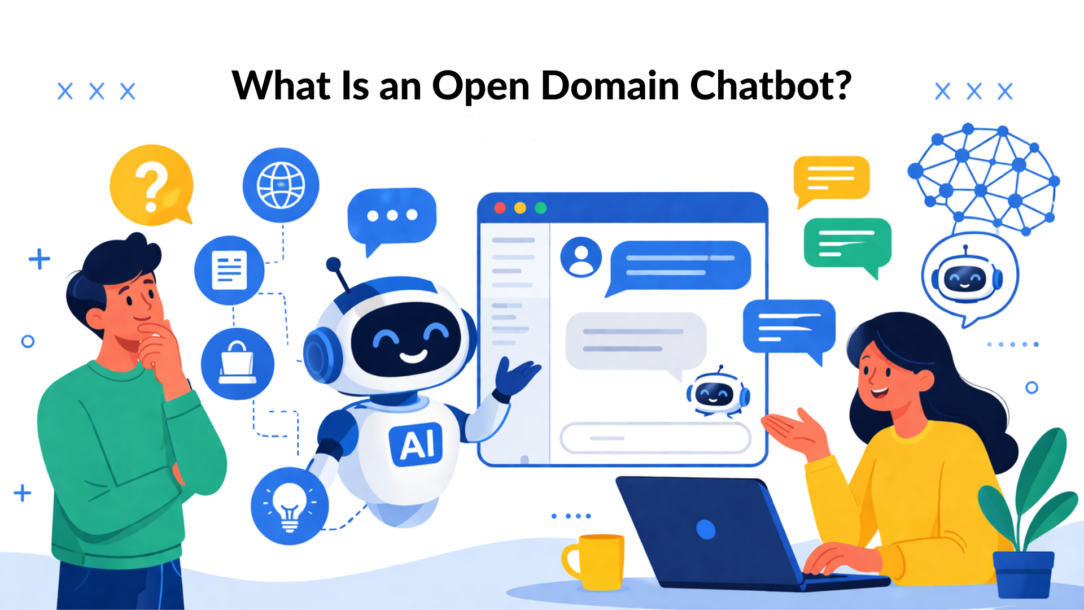
An open-domain chatbot is the conversational AI you actually want to talk to. It’s designed to handle free-flowing, natural conversations on just about any topic, much like a real person. Instead of being stuck on a tight script, it understands context, fields unexpected questions, and can pivot between subjects without missing a beat.
This isn’t just about better tech; it’s about creating genuinely helpful customer experiences that go way beyond simple, pre-programmed tasks. The transformation from a robotic Q&A tool to a smart conversational partner is a game-changer for any business.
The Future of Customer Conversation Is Here
Chatbot Interaction
Think about this common scenario: a customer lands on your website and asks your chatbot about a specific feature mentioned in a blog post from two years ago.
Your standard, closed-domain chatbot hits a wall. It’s a specialist, trained only on a rigid set of FAQs or basic product details. The moment the conversation deviates, it serves up the dreaded, “I’m sorry, I don’t understand.” For the customer, it’s a frustrating dead end.
This is exactly where an open-domain chatbot changes the game entirely. It’s a generalist, ready for anything. It understands the user’s real intent—even when the question is out of left field—and pulls from your entire knowledge base to give a smart, relevant answer.
A Specialist vs. A Generalist
To really get the difference, let’s use a simple analogy. A closed-domain bot is a highly trained specialist, like an assembly line robot that does one task perfectly. An open-domain bot is a knowledgeable generalist, like a versatile project manager who can handle anything that comes up.
Here’s how they stack up in a business context:
Open Domain vs Closed Domain Chatbots at a Glance
| Feature | Closed Domain Chatbot (The Specialist) | Open Domain Chatbot (The Generalist) |
|---|---|---|
| Primary Goal | Execute a specific task (e.g., book an appointment, track an order). | Engage in a natural, free-flowing conversation to solve problems. |
| Knowledge Scope | Limited to a predefined set of rules, scripts, or FAQs. | Can access and discuss a vast range of topics from your knowledge base. |
| Flexibility | Rigid. Fails when a user goes “off-script.” | Highly adaptable. Can handle unexpected questions and context shifts. |
| Example Use Case | An airline bot that only handles flight check-ins. | A travel bot that can recommend destinations, compare flight prices, and suggest hotels. |
| Complexity | Relatively simple to build and maintain. | Complex. Requires advanced AI like Large Language Models (LLMs). |
The specialist is great for repetitive, predictable jobs. The generalist, however, is what you need for dynamic, human-like interactions that build real rapport with customers and drive business results.
More Than Just a Technical Upgrade
Moving from a rigid specialist to an adaptive generalist isn’t a minor improvement; it’s a fundamental shift in your communication strategy. An open-domain chatbot transforms a clunky, robotic exchange into a conversation that feels genuinely helpful and human, delivering tangible business outcomes.
Instead of hitting a brick wall, your customer gets the information they need instantly. That positive experience directly impacts their journey and can be the difference between a bounce and a purchase. This is how chatbots evolve from a simple cost-cutting tool into a strategic asset for growth.
The core difference is adaptability. A closed-domain bot is a one-trick pony that does a single job well. An open-domain chatbot is a versatile conversational partner, ready for whatever your customers throw at it.
This adaptability unlocks a new level of automation that feels personal and engaging. Businesses can now deploy AI that not only answers questions but also nurtures leads, recommends products, and provides support with a nuance that was once impossible. That, in turn, frees up your human team to focus on high-value interactions that truly require a human touch.
For modern businesses, embracing this technology translates to clear results:
- Improve Customer Delight: Instantly answer a wider range of questions, eliminating frustration and showing customers you value their time. This builds loyalty and positive word-of-mouth.
- Boost Sales and Conversions: Guide users through complex buying journeys, offering information and recommendations at the precise moment of need, directly impacting revenue.
- Increase Team Efficiency: Automate a huge portion of inbound conversations, allowing your sales and support staff to focus on more complex, revenue-generating issues.
In short, the open-domain chatbot is the next logical step in customer communication. It’s an intelligent assistant that doesn’t just follow a script but actively participates in the conversation, ready to help your business connect with customers on a much deeper level.
How We Moved from Rigid Scripts to Rich Dialogue
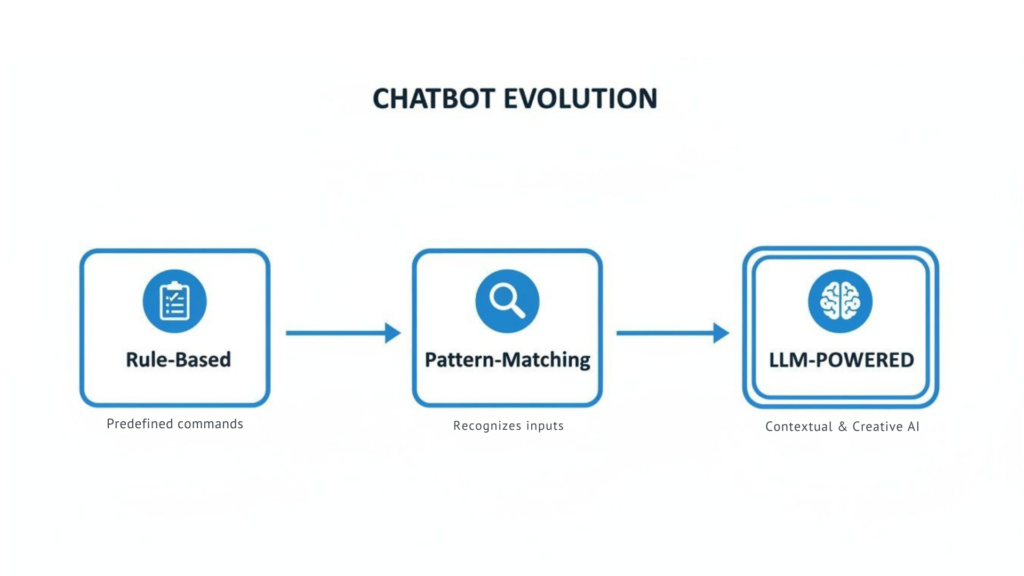
The idea of a talking machine isn’t new, but the first attempts were a world away from the smooth, natural conversations we have today. Early chatbots were basically just glorified flowcharts, stuck on a pre-programmed script. If you didn’t type the exact right phrase, the bot would hit a wall. It was a dead end for users.
The Era of Rigid Rules
This was the age of rule-based systems. Imagine a customer service bot that only understands “track my order.” If you asked, “where is my package?” or “check order status,” the conversation would break. It was a stiff, unforgiving system that forced the user to learn the bot’s language, not the other way around.
The next small step forward was pattern-matching bots. One of the most famous examples was ELIZA, a program from the 1960s that mimicked a therapist by spotting keywords and turning them back into questions. If you said, “I am feeling sad,” ELIZA might reply, “Why are you feeling sad?”
It was clever, but it didn’t understand a thing. For a business, this meant a bot might see the word “shipping” and just drop a link to the shipping policy—no matter if you were asking about cost, delivery times, or international options. This created frustrating loops for customers instead of solving their problems.
The real problem with these early bots was a complete lack of contextual understanding. They could spot a word, but they had no idea about your intent, the history of the chat, or any kind of nuance.
A bot that can’t adapt is a liability, not an asset. It creates frustration, not loyalty. You can dig deeper into how modern AI overcomes these old limits in our guide to conversational AI.
The Dawn of Language Models
The game completely changed with the arrival of machine learning and, ultimately, Large Language Models (LLMs). Instead of being programmed with if/then rules, these new models were trained on colossal amounts of text from across the internet. By analyzing trillions of sentences, they absorbed the patterns, grammar, and flow of human language.
This was a massive leap. For the first time, AI could generate entirely new, coherent sentences instead of just spitting out pre-canned responses. It learned to predict the next logical word in a sentence, which is the key to creating conversations that feel natural and aware of what was just said. This was the breakthrough that made modern open-domain chatbots possible.
We saw just how powerful this could be in 2020 when Google introduced Meena, a 2.6 billion parameter open-domain chatbot. It was trained on an incredible 341 billion words and scored a 79% for sensibleness and specificity in conversations—getting surprisingly close to the 86% scored by humans. You can read the full research paper on Meena’s capabilities and findings for a deeper dive.
This evolution marked the end of robotic keyword-spotting and the beginning of real conversational ability. For businesses, this meant you could finally automate interactions that actually build rapport, moving from frustrating scripts to rich dialogues that truly engage customers.
Understanding Your Chatbot’s Core Technology
To really get what a modern open-domain chatbot can do, you have to look under the hood. The tech is complex, but the core concepts are surprisingly straightforward when you see how they work together to deliver business value.
The Brain: Large Language Models (LLMs)
At the core of every smart chatbot today is a Large Language Model (LLM). Think of the LLM as the bot’s brain—one that’s read a huge chunk of the internet. It’s been trained on books, articles, and endless conversations, so it understands grammar, context, and even sarcasm. This is what lets it chat about almost anything, but by itself, that general knowledge isn’t enough for your business.
The Library: Retrieval-Augmented Generation (RAG)
To make the chatbot truly yours, you need a process called Retrieval-Augmented Generation (RAG). If the LLM is the brain, think of RAG as its personal, searchable library filled only with your company’s information.
You connect the chatbot to your own data, such as:
- Product catalogs and inventory levels
- Help center articles and FAQs
- Internal policy documents and website pages
When a customer asks, “Do you offer a warranty on the Model X-100, and is it in stock in blue?” the RAG system first digs through your private library for the right documents. It then hands those specific facts to the LLM.
RAG grounds the chatbot in reality. It transforms a creative storyteller (the LLM) into a knowledgeable expert on your business, ensuring its answers are not just fluent but also factually accurate and specific to your operations.
This process massively cuts down the risk of the chatbot “hallucinating” or making things up. By forcing it to base answers on your approved data, you get the LLM’s conversational skill combined with the hard facts from your own documents. Explore the basics of chatbot natural language processing to learn more.
The Personality: Fine-Tuning
Your chatbot is now smart and knowledgeable. But does it sound like your brand? The final piece is fine-tuning, which is like giving your bot a personality and style coach.
Fine-tuning takes a pre-trained LLM and trains it a bit more, but this time on a small, hand-picked dataset of conversations that capture your brand’s ideal voice, like chat logs from your best customer service agents.
Chatbot Evolution
For example, a fun e-commerce brand might fine-tune its bot using chat logs full of emojis and casual slang. A financial services firm, on the other hand, would use formal, professional conversations. The result is a bot that delivers the right answers in a tone that strengthens your brand with every interaction.
Together, LLMs, RAG, and fine-tuning create an open-domain chatbot that can discuss anything while staying factually accurate and sounding uniquely like you.
Building a Chatbot You Can Trust
An all-knowing, open-domain chatbot sounds incredible, but with great conversational power comes great responsibility. How do you ensure your AI assistant is a reliable brand representative and not a generator of misinformation? The reality is, even sophisticated AI can get things wrong, a problem known as “hallucination.”
Grounding Your AI in Reality
The most effective way to build trust is to ground the AI in a specific, verified knowledge base. This is like giving a brilliant but easily distracted employee a crystal-clear set of instructions and an approved company manual. Instead of letting the bot pull answers from the wild, you force it to look at your content first.
A grounded bot bases every answer on your:
- Help Center Articles: For accurate, step-by-step support.
- Product Catalogs: For correct details on features, pricing, and stock.
- Policy Documents: Citing your official return and shipping policies.
When a bot is grounded, it becomes a true expert on your business. If the answer isn’t in your approved materials, a well-designed bot will simply say, “I don’t know,” and offer to connect the user to a human—a far better outcome than giving a wrong answer. Our guide on whether AI chatbots can make mistakes dives deeper into this.
Actionable Insight: Grounding is a foundational safety net. It turns your chatbot from a potential liability into a trustworthy assistant by strictly limiting its source of truth to your own verified information.
Setting Clear Conversational Boundaries
Factual accuracy is just one piece of the puzzle. You also need to control your bot’s personality and behavior. An open-domain chatbot can talk about anything, but you don’t want your business bot weighing in on politics or giving unqualified financial advice.
You establish these guardrails using custom instructions or a system prompt. This is the bot’s core mission statement, defining its role, tone, and what it should never do.
A business can instruct its bot:
- “You are a friendly and helpful customer support agent for Brand X.”
- “Your tone should always be professional, positive, and encouraging.”
- “Never express personal opinions or discuss sensitive topics.”
- “If a user asks a question outside your scope, politely decline and offer to find a human team member.”
These instructions act like a behavioral fence, keeping the conversation on-brand and productive. However, consistency is still a major challenge. A 2021 study found that leading AI models contradicted themselves in 15-25% of conversations, highlighting how crucial strong rules are. You can check out the full findings on chatbot consistency for a closer look.
By combining factual grounding with firm behavioral guardrails, you can confidently use a powerful open-domain chatbot without sacrificing the trust and safety your brand depends on.
Putting Your AI to Work with Practical Use Cases
Chatbot Customer Touchpoints
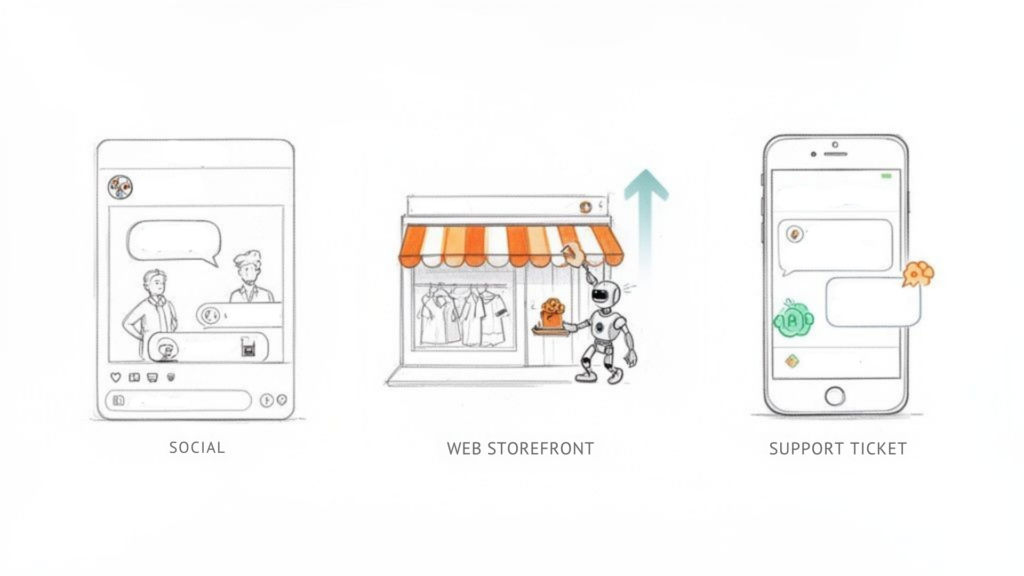
Theory is great, but where the rubber really meets the road is seeing how an open-domain chatbot drives real business results. It’s about turning manual, slow interactions into automated systems that generate revenue. Let’s look at three high-impact scenarios where this technology offers a clear, measurable return.
Transform Social Media Engagement into Qualified Leads
Your Instagram campaign is a hit. Comments are blowing up with questions: “How much?” “Do you ship to Canada?” “Is this available in blue?”
- Before AI: Your social media manager is drowning, manually replying to comments. Leads get lost, response times drag, and interested customers move on.
- After AI: An open-domain chatbot connects to your Instagram DMs. It automatically invites users into a private chat, answers their questions, qualifies their interest, and points them to the right product page to buy. What was passive engagement is now an active lead qualification funnel that runs 24/7.
Actionable Insight: An AI-powered chatbot on social media acts as your always-on sales development rep. It captures buyer intent the moment it appears, dramatically shortening the path from interest to conversion.
Create an AI-Powered Personal Shopper for Your Website
Cart abandonment often happens because a shopper has a last-minute question or feels overwhelmed by choices. A static FAQ page just doesn’t cut it.
- Before AI: A potential customer is on your site, stuck between two products. They can’t find a quick answer to a specific question. Frustrated, they leave. Sale lost.
- After AI: An open-domain chatbot becomes your 24/7 personal shopper. Trained on your entire product catalog, it can handle highly specific questions like, “Will this camera lens fit my Canon R5, and is it better for low-light video than the other one?”
The chatbot guides the customer with expert advice, just like a top-tier sales associate. This proactive support builds trust and can slash cart abandonment rates, directly growing your revenue.
Automate and Elevate Your Customer Support
Support inboxes become a black hole of tickets, leading to long waits. Many questions are repetitive but still require a nuanced answer that a basic, keyword-driven bot can’t handle.
An open-domain chatbot on WhatsApp or Messenger can instantly resolve a massive chunk of these requests. By connecting to your backend systems, it can handle tasks like:
- Checking an order status.
- Initiating a return.
- Explaining how to use a specific feature.
This frees up your human agents to focus on the complex, high-value cases where their expertise is truly needed. Businesses using this approach often see up to 80% of support tickets resolved instantly by the AI, leading to a huge jump in customer satisfaction and team efficiency.
Your Blueprint for Launching an Open-Domain Chatbot
Bringing an open-domain chatbot into your business doesn’t require a team of AI experts. With modern no-code platforms, you just need a smart plan. This blueprint gives you a practical roadmap to get your first intelligent AI assistant up and running, moving from idea to a live bot that gets results.
Step 1: Define One Clear Goal
Start small. Don’t try to build a bot that “does everything.” Instead, focus on one high-impact task. For example, your goal might be: “Capture 20% more qualified leads from our website this month.” A clear target will shape every decision you make.
Step 2: Feed Your Bot a Curated Knowledge Base
With your goal set, give your chatbot its brain—a curated knowledge base. This grounds your AI in your business’s reality. If your goal is lead generation, gather documents like:
- Product Spec Sheets: To answer detailed feature questions.
- Pricing Pages: To clarify costs and plans.
- Customer Testimonials: To provide social proof at the right moment.
- Key Blog Posts: To explain the real-world value of what you sell.
This content becomes the bot’s single source of truth, ensuring it represents your brand accurately.
Step 3: Design and Test the Conversation
Now, design the conversational flow. This isn’t a rigid script; it’s about mapping the user’s journey. Think in outcomes: what information does a user need to provide to be “qualified”? Design prompts to naturally gather this info—like their role or company name—without sounding robotic.
Then, test it relentlessly. Run simulations with all kinds of questions. Does the bot stay on track? Does it steer the conversation back to its goal? This phase is where you iron out the kinks.
Step 4: Deploy and Integrate for Maximum Impact
With your bot ready, launch it on your highest-traffic channels, like your website’s homepage. But deployment isn’t the finish line. To multiply your results, integrate the chatbot with your other tools:
- CRM: To automatically create new lead profiles.
- Email Marketing Platform: To add new subscribers to a nurture sequence.
- Slack or Team Chat: To ping your sales team about a hot lead in real time.
This integration turns your chatbot from a standalone gadget into the command center of an automated growth engine. As of 2026, Large Language Models (LLMs) are now part of 45% of new chatbot studies. But here’s the catch: only 47% of those studies actually validated the bot’s effectiveness, highlighting a big gap between building the tech and proving it drives business results. Integration is what closes that gap.
You can read more about these findings on chatbot efficacy. For a detailed guide on building, deploying, and scaling AI agents, explore these chatbots development services.
Frequently Asked Questions
Thinking about an open-domain chatbot for your business? You probably have a few practical questions about cost, control, and what they can really do. Let’s get you some straight answers.
Ready to see how an open-domain chatbot can transform your customer conversations? With Clepher, you can build, launch, and manage intelligent AI assistants on your website, Messenger, and Instagram without writing a single line of code. Start turning casual chats into loyal customers today.
Related Posts
What Is an Open Domain Chatbot?
April 11, 2026Conversational AI for Sales: Your 2026 Guide to Boosting Revenue
April 10, 2026Transform Your Sales Game with an AI Powered Sales Assistant
April 9, 2026
Founder Clepher