
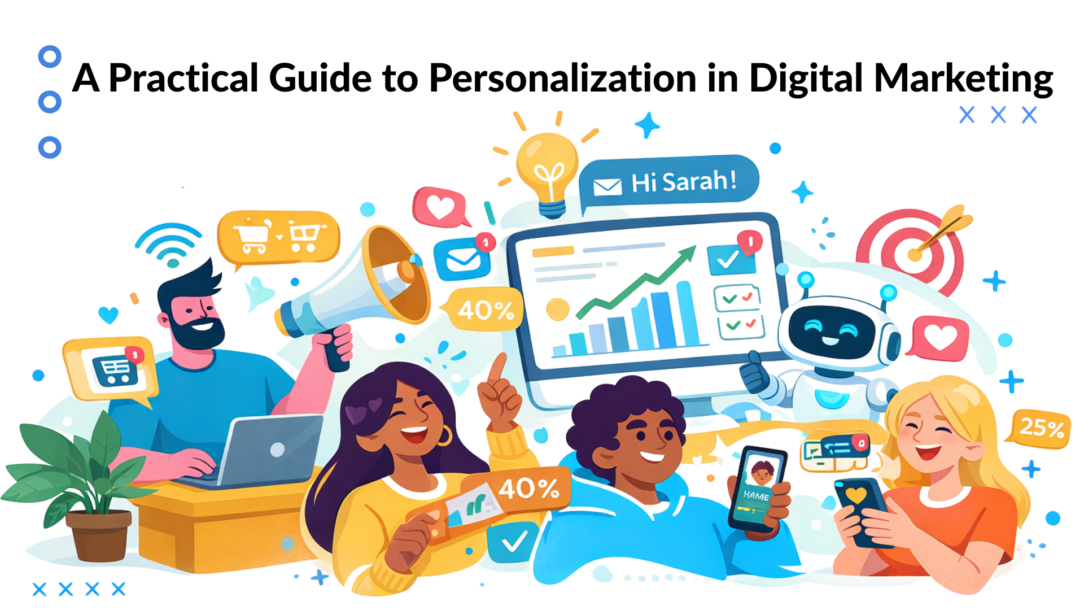
What exactly is personalization in digital marketing? Think of it as using customer data to create experiences that feel genuinely one-to-one rather than mass-produced. This approach—often called marketing personalization—highlights the power of personalization in digital marketing, where messages are tailored to individual behavior instead of broadcast to everyone. It’s the difference between shouting a generic message and having a relevant, helpful conversation across your digital channels.
Through personalized digital marketing, brands can show returning visitors products based on past browsing behavior or send emails that address specific interests users have already shown. Rather than turning marketing efforts into a one-way monologue, personalization transforms it into a meaningful dialogue that builds trust, engagement, and long-term relationships.
Why Personalization in Digital Marketing Is No Longer Optional
Ever walk into your favorite local coffee shop? The barista knows your name, remembers your usual order, and asks how your week is going. That warm, familiar feeling is exactly what personalization in marketing aims to recreate in the digital world. It’s about moving away from mass communication and treating every customer like an individual.
Today, this isn’t a “nice-to-have”—it reflects the importance of personalization in digital experiences. Audiences are overwhelmed with ads and messages, making them experts at ignoring anything that feels generic or irrelevant. To earn attention, brands must deliver value, not noise. This shift has been powered largely by AI and machine learning, which analyze behavior, preferences, and intent to make personalization possible at scale.
To see just how much marketing has evolved, let’s compare the traditional approach with the modern standard driven by personalization.
The Shift from Mass Marketing to Personalization
This table breaks down the fundamental differences between the spray-and-pray approach of the past and the targeted, intelligent marketing that wins customers today.
| Attribute | Mass Marketing (The Old Way) | Personalized Marketing (The New Standard) |
|---|---|---|
| Approach | One-to-many broadcast | One-to-one conversation |
| Messaging | Generic, one-size-fits-all | Tailored to individual needs and behaviors |
| Customer View | Anonymous audience segments | Known individuals with unique histories |
| Goal | Reach as many people as possible | Build a relationship with each person |
| Data Usage | Basic demographics (age, location) | Behavioral, transactional, and contextual data |
| Result | Low engagement, high customer fatigue | High engagement, strong loyalty, better ROI |
The takeaway is clear: while mass marketing was about shouting the loudest, personalized marketing is about listening first, then speaking directly to the individual.
The Expectation for Tailored Experiences
Modern customers don’t just like personalization; they demand it. The data is overwhelming: a staggering 71% of consumers expect companies to deliver personalized interactions, and 76% get frustrated when this doesn’t happen.
This isn’t about being clever; it’s about making the customer’s life easier. When you recommend a product that perfectly matches someone’s recent browsing history, it feels less like a sales pitch and more like a helpful suggestion. If you want to dig deeper, you can explore more data on these consumer expectations to see just how critical this has become.
“Personalization is no longer about just using a first name in an email. It’s about creating a cohesive and relevant experience across every single touchpoint, from the first ad a person sees to the post-purchase follow-up.”
The Business Case for Individualized Marketing
Beyond making customers happy, personalization is a powerhouse for business growth. When you tailor messages and offers, you see dramatic improvements in the metrics that matter most.
Here’s how this strategy directly impacts your bottom line:
- Higher Conversion Rates: When an offer feels like it was picked just for them, a customer is far more likely to click “buy.”
- Increased Customer Loyalty: A personalized experience signals that you value your customers, which encourages them to return.
- Improved Engagement: Content that speaks directly to a user’s interests grabs their attention, leading to higher open rates, better click-throughs, and more time spent on your site.
Ultimately, personalization is the engine for modern growth. It’s how you cut through the digital noise, forge real relationships, and build a brand that people truly connect with.
The Data Fueling Your Personalization Engine
Great personalization is built on a foundation of high-quality data. Think of data as the fuel for your marketing engine—without it, you’re not going anywhere. It’s what turns marketing from a guessing game into a precise science.
Understanding different data types is the first step toward building a strategy that’s not only effective but also respects customer privacy. Not all data is created equal, and knowing what to collect and how to use it makes all the difference.
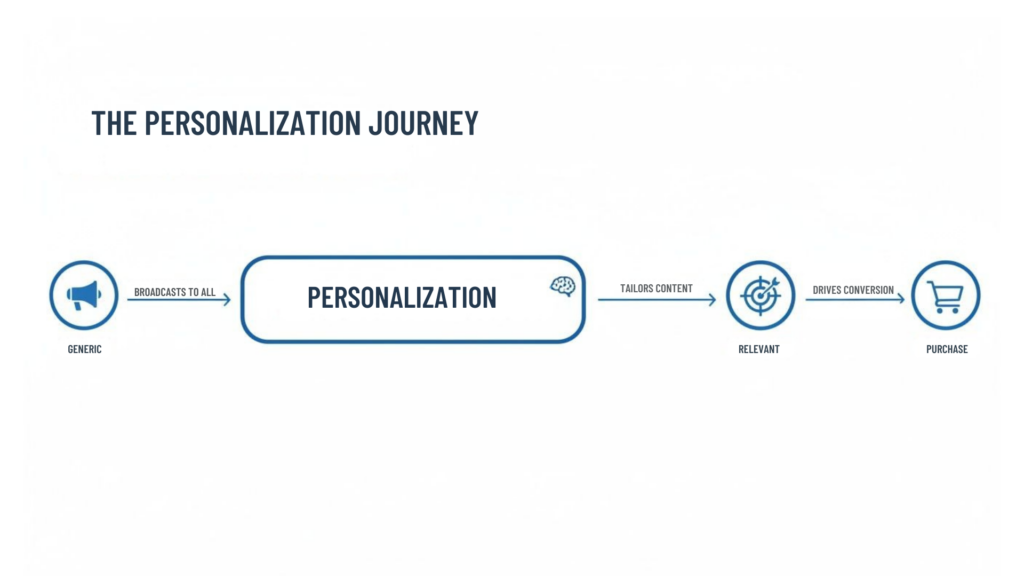
This graphic shows exactly how the right data can guide a customer from seeing a generic message all the way to making a purchase.
Personalization in Digital Marketing
As you can see, data-driven relevance is the bridge between casting a wide net and actually getting conversions.
First-Party Data: The Gold You Already Own
First-party data is the information you collect directly from your audience. This is your most valuable asset because you own it, you know it’s accurate, and your customers provided it willingly. It’s the ultimate ground truth.
You’re likely already sitting on a goldmine of this data from sources like:
- Website Analytics: Tracking which pages a visitor views, how long they stay, and what they click on.
- CRM Systems: Storing purchase history, support tickets, and direct conversations.
- Chatbot Conversations: Gathering direct feedback, questions, and interests from chats on your site or social media.
- Email and SMS Subscribers: Collecting info from sign-up forms and tracking engagement.
Because it comes straight from the source, first-party data gives you an unfiltered look into your customers’ needs. It’s the bedrock of any solid personalization strategy.
Second and Third-Party Data: Filling in the Gaps
While first-party data is your core, other types can help paint a fuller picture. Second-party data is another company’s first-party data that you acquire directly from them. For example, a hotel chain might partner with an airline to share audience data for targeted travel promotions.
Third-party data is collected by companies that have no direct relationship with the consumer. It’s gathered from many sources, packaged, and sold. Think of data brokers that offer broad demographic or interest segments.
Heads up: Reliance on third-party data is declining due to privacy regulations like GDPR and the end of third-party cookies. This shift makes your first-party data more critical than ever.
Turning Raw Data into Actionable Insights
Collecting data is only half the battle. The real magic happens when you organize it into meaningful audience segments. This is where tools like tags and custom fields come in, letting you label users based on their actions and preferences.
For example, if a user tells your chatbot they’re interested in “skincare for sensitive skin,” you can apply an interest_sensitive_skin tag to their profile.
From there, you can build powerful segments:
- Tag-Based Segments: Group everyone with the
interest_sensitive_skintag to send them targeted tips and product recommendations. - Behavioral Segments: Create a segment of users who viewed a specific product more than three times but didn’t buy.
- Lifecycle Segments: Separate new subscribers from loyal, repeat customers to tailor your onboarding and loyalty campaigns.
This process of organizing user data from multiple touchpoints into a single profile is crucial. For those looking to nail this, learning about AI-powered customer identity resolution can provide a major edge. By turning a pile of raw data into clear, actionable segments, you build the framework for personalization that works.
Proven Personalization Tactics for Every Channel
Now for the fun part: putting your data to work. The real impact comes from applying these insights across the channels where your customers are active. It’s all about creating a connected, cohesive experience that feels personal at every touchpoint.
This isn’t about a massive, budget-draining overhaul. It’s about making smart, targeted moves that make customers feel understood—whether they’re on your website, opening an email, or sliding into your DMs.
Dynamic Website Personalization
Your website is your digital storefront. Why treat it like a static, one-size-fits-all brochure? Think of it as a living space that adapts to each visitor. This is where dynamic content shines.
Dynamic content is any element of your website that changes based on who’s looking. It uses data—like location, purchase history, or browsing behavior—to show them the most relevant information possible.
Here are a few powerful ways to get started:
- Personalized Banners: Show a visitor from a cold climate a banner for winter coats, while someone from a sunny region sees your swimwear line.
- Targeted Pop-Ups and CTAs: If someone has visited your pricing page three times, trigger a pop-up offering a free demo or a special discount. This uses behavior to prompt action.
- Product Recommendations: Display “You might also like…” sections based on what a user has previously viewed or purchased. This simple tactic can significantly lift average order value.
The foundation for all of this is a solid understanding of user behavior. If you want to go deeper, our guide on what is behavioral segmentation is the perfect place to start.
Behavior-Triggered Email Marketing
Email is still a personalization powerhouse. The days of “batch-and-blast” are over. Today, it’s about automated, behavior-triggered campaigns that arrive at the exact moment a user is most engaged. They feel less like marketing and more like helpful nudges.
A personalized email is more than just using a first name. It’s about sending the right message at the right time, based on an action the customer just took.
This approach is killer for building relationships and driving sales. The trick is to map out critical moments in the customer journey and build automated emails around them.
Actionable Email Automation Examples:
- Abandoned Cart Reminders: This is the quintessential personalized email. When a user adds items to their cart but doesn’t check out, send a friendly reminder 2-4 hours later. You can even include a small discount to nudge them over the finish line.
- Welcome Series for New Subscribers: Create a three-part series that introduces your brand, shows off your best-sellers, and offers a special “first-time buyer” discount.
- Post-Purchase Follow-Ups: After a customer buys something, follow up with an email asking for a review or suggesting complementary products. This keeps the conversation going.
The impact here is undeniable. The fastest-growing companies generate 40% more revenue from personalization, and tailored product recommendations can drive up to 30% of sales on e-commerce sites.
Conversational Social Media Messaging
Channels like Instagram DMs, Facebook Messenger, and WhatsApp are powerful marketing channels for building direct, personal connections at scale. The conversational, one-on-one nature of these platforms makes them perfect for personalization.
The key is to use automation to start conversations that feel human. Instead of just waiting for users to message you, you can proactively engage them based on their actions.
Top Social Messaging Tactics:
- Interactive Quizzes: Run a quiz in your Instagram Stories (“What’s your skincare type?”) and use the answers to segment users. Then, follow up in their DMs with personalized product recommendations.
- Personalized Broadcasts: Send targeted messages to specific audience segments. For instance, send a special offer to everyone who bought something in the last 30 days.
- Automated Lead Qualification: Use a chatbot to ask qualifying questions when a new lead messages you. Based on their answers, the bot can route them to a sales rep or add them to a specific nurturing sequence.
By applying these kinds of tactics, you turn each channel from a simple broadcast tool into a dynamic engine for building real customer relationships.
Personalization Ideas for Your Marketing Channels
To make this even more practical, here’s a quick-reference table with ideas you can start using right away.
| Channel | Beginner Tactic | Advanced Tactic (with AI/Automation) |
|---|---|---|
| Website | Use a visitor’s name on the homepage after they log in. | Display dynamic product recommendations that change in real-time based on browsing behavior. |
| Create a simple 3-part welcome series for new subscribers. | Trigger post-purchase emails that suggest complementary products based on their specific order. | |
| Social Media | Run a poll in your stories to gather audience preferences. | Use a chatbot to run an interactive quiz and send personalized product suggestions via DM based on results. |
| SMS/Text | Send a “Happy Birthday” text with a special discount code. | Send automated shipping alerts and follow up with a request for a product review a week after delivery. |
| Paid Ads | Retarget website visitors with a generic ad for your brand. | Run dynamic retargeting ads on Facebook that show the exact products a user viewed or added to their cart. |
This table is just a starting point. The real power comes from mixing and matching these ideas to create a seamless journey that feels uniquely tailored to each individual customer.
How AI Is Powering Hyper-Personalization
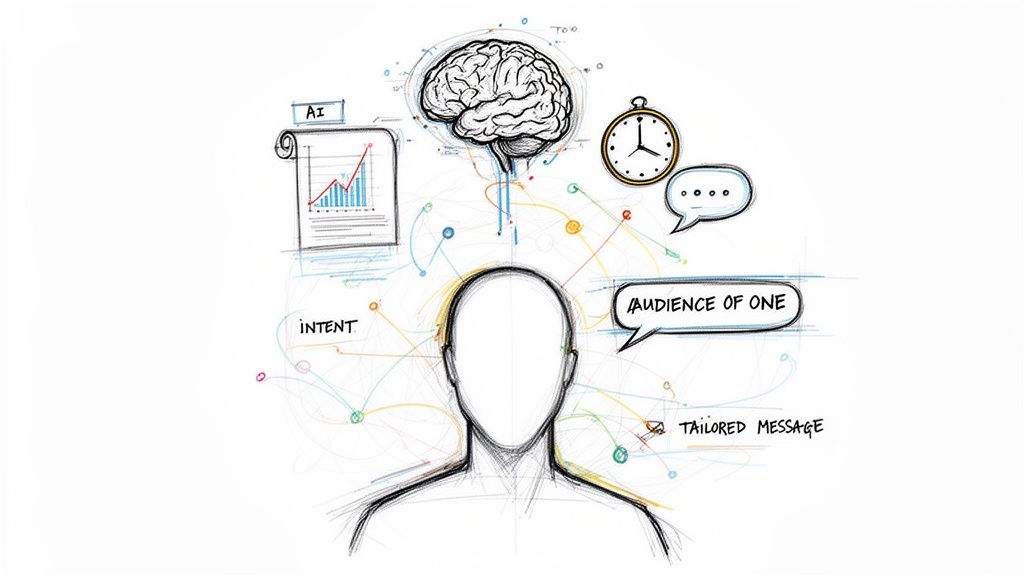
If personalization is a good conversation, then hyper-personalization is knowing what someone needs before they ask. This is the next frontier, moving beyond broad segments to speak to an “audience of one.” And it’s all made possible by Artificial Intelligence.
AI doesn’t just look at past purchases. It analyzes subtle, real-time behaviors—like how fast someone scrolls or where their mouse hovers. By processing thousands of these micro-signals instantly, AI can predict user intent with startling accuracy.
Hyper-Personalization in Digital Marketing
This predictive power flips marketing from reactive to proactive. Instead of just responding to what a customer did, you can anticipate their needs and deliver the perfect message at the perfect moment.
From Segments to Individuals
Traditional segmentation lumps people together. Hyper-personalization, powered by AI, gets far more specific. It understands that Jane, an individual, not only bought running shoes but also browses trail-running blogs and lives in a rainy climate.
This opens the door for incredibly specific interactions:
- Predictive Product Recommendations: Instead of showing Jane more running shoes, an AI might suggest waterproof running jackets, knowing the weather in her area.
- Real-Time Website Adaptations: As Jane browses, the main banner could dynamically change to feature a trail-running event in her region.
- Conversational AI That Understands Nuance: If Jane asks a chatbot, “What gear do I need for a muddy race?” an AI-powered agent understands the context and can recommend specific shoes, socks, and cleaning kits.
Trying to manage this level of detail manually is impossible. AI makes it scalable, turning millions of data points into unique, one-to-one experiences that drive results.
AI-Driven Results in the Real World
The shift toward AI-powered personalization is a proven revenue driver. Already, 79% of marketers are using AI to create dynamic campaigns. Brands that tap into their first-party data for this see engagement boosts between 30-50%.
Why? Because shoppers are 77% more likely to buy from relevant recommendations, and 73% of consumers globally now expect brands to understand their unique needs.
Hyper-personalization uses AI to create moments of serendipity, where the right offer appears exactly when a customer needs it most. It’s the closest digital marketing has ever come to reading someone’s mind.
To pull this off, businesses are leaning on a new generation of smart tools. Platforms that mix AI with automation are critical for executing these strategies. You can explore some of the top AI marketing automation tools to see how they’re making this a reality for businesses of all sizes.
Staying Ahead of the Curve
AI’s role in marketing just keeps growing. As algorithms get more advanced, the possibilities will only multiply.
To get the most out of AI, marketers should keep a close eye on the future of AI in marketing to understand what’s coming next. By embracing these advancements, you can ensure your personalization strategy doesn’t just meet customer expectations but consistently exceeds them.
Measuring Your ROI and Avoiding Common Pitfalls
A slick personalization strategy is great, but it’s only as good as its results. You have to ask the tough question: is it actually growing the business?
Proving the value of your efforts means looking past surface-level stats and focusing on what truly impacts the bottom line. It’s not about chasing vanity metrics. It’s about drawing a straight line from your personalization efforts to tangible business outcomes.
Key Metrics for Proving Personalization ROI
To get a clear picture of your success, zero in on a handful of high-impact metrics. These numbers tell the real story.
- Conversion Rate: This is your most direct measure of success. Pit a personalized experience (like a targeted pop-up) against a generic control version to measure the lift.
- Average Order Value (AOV): Are your personalized product recommendations encouraging customers to add more to their carts? A rising AOV is a clear sign your suggestions are hitting the mark.
- Customer Lifetime Value (CLV): This is the long game. Great personalization builds loyalty, which means repeat purchases and a higher CLV.
- Reduced Cart Abandonment Rate: Track how many shoppers complete their purchase after getting a personalized abandoned cart email. This directly ties your campaign to recovered revenue.
Navigating Privacy and the Creepy Factor
As powerful as personalization is, it comes with responsibility. There’s a razor-thin line between a helpful, tailored experience and one that just feels creepy. Crossing that line is the fastest way to shatter trust.
It’s no surprise that 79% of consumers are more likely to trust a company if it’s upfront about how it uses their data. Transparency isn’t just a legal checkbox; it’s a tool for building loyalty.
The goal is to be helpful, not invasive. Personalization should feel like a thoughtful recommendation from a trusted friend, not like someone is watching your every move.
To strike the right balance, stick to these ground rules:
- Be Radically Transparent: Clearly state what data you’re collecting and how you’re using it in your privacy policy, using simple language.
- Give Users Control: Make it easy for customers to manage their data preferences and opt out of certain types of personalization.
- Focus on First-Party Data: Prioritize data that customers have given you directly. It’s far less invasive than using data scraped together by third parties.
By measuring the right things and putting ethical data practices first, you can build a personalization strategy that’s both effective and respectful.
Your Step-By-Step Personalization Launch Plan
Turning strategy into action can feel daunting, but launching your first personalization campaign is easier than you think. The trick is to start small. Aim for one quick, clean win and build momentum from there.
This simple plan gets you started today, without the overwhelm. Focus on one clear goal and nail it. This is how you learn the ropes and build a solid foundation.
Define Your First Goal and Channel
Before touching any tools, decide what you’re trying to achieve. A specific, measurable goal is your north star. Avoid vague targets like “increase sales.”
A great starting point is something high-impact but low-effort. For example: “Reduce shopping cart abandonment by 10% in the next 30 days.” This target is clear, measurable, and tied directly to revenue.
Once you have your goal, pick the one channel best suited to hit it. For cart abandonment, email is the classic choice because it’s direct and effective.
Map the Customer Journey
Next, put yourself in your customer’s shoes. What steps does someone take before they abandon their cart? They find a product, add it to their cart, maybe start checkout… and then they’re gone.
Understanding this flow shows you the perfect moment to intervene. The trigger for your campaign becomes obvious: a user adds an item to their cart but doesn’t complete the purchase within a set time, like two hours.
Your first personalized campaign should feel like a helpful nudge, not an aggressive sales pitch. It’s about re-engaging a high-intent user at the exact moment they might need encouragement.
Build and Launch Your Campaign
Now it’s time to build your first automated campaign. This is where choosing the right marketing automation platforms is critical. The right tools make the technical side manageable.
Your simple cart abandonment campaign should include these core pieces:
- A Clear Trigger: The automation kicks in when a cart is abandoned for a set period.
- Personalized Content: Use the customer’s name and dynamically insert images of the exact products they left behind.
- A Compelling Call-to-Action: Include a direct link that takes them right back to their pre-filled cart.
Launch the campaign and let the automation do its thing. Now for the most important step: watch the data.
Test, Measure, and Iterate
After a few weeks, dive into the results. Did your abandonment rate drop? What were the open and click-through rates?
Use these insights to make small adjustments. Maybe you can test a different subject line or try offering a small discount. This cycle of testing, measuring, and iterating is how you turn a simple campaign into a powerful growth engine.
Common Questions, Answered
Jumping into personalization can feel like a big step. Let’s clear the air on the most common questions so you can move forward with confidence.
Ready to build powerful, personalized conversations that drive sales? With Clepher, you can design AI-powered chatbots for your website, Messenger, and Instagram in minutes. Start your free trial today and see how easy it is to automate your growth.
Related Posts
How an API Chat Bot Transforms Your Business (And How to Build One)
March 31, 2026How to Create a Survey on Facebook for Maximum Engagement
March 28, 2026
Founder Clepher