
Think about all the repetitive tasks on your social media to-do list. Scheduling posts, sending welcome DMs, replying to the same questions over and over. What if you could put those tasks on autopilot?
That’s social media marketing automation in a nutshell. It’s not about turning your brand into a robot. It’s about building a smart system that works around the clock to engage your audience, so you can ditch the busywork and focus on what really matters: strategy and growth.
What Is Social Media Marketing Automation?
Imagine a digital assistant that never sleeps. It instantly greets every new follower, answers common questions in your DMs, and even turns post comments into qualified leads while you’re busy running your business. That’s the real power of social media marketing automation—especially when powered by a reliable social media management tool.
It’s a strategic shift from manually doing everything to building smart systems that do the work for you. With the help of advanced social media management tools, businesses can automate responses, manage conversations, and streamline engagement across platforms. Instead of typing out the same welcome message again and again, automation handles it instantly and consistently.
This isn’t just about scheduling posts; it’s about creating interactive, real-time experiences that guide customers, nurture relationships, and drive measurable results.
The Shift From Manual Work to Smart Systems
The difference between managing social media manually versus with automation is night and day. One is reactive and limited by your hours. The other is proactive, scalable, and relentlessly efficient.
Let’s look at a real-world use case: a local restaurant.
| Task | Manual Approach (The Old Way) | Automated Approach (The Smart Way) |
|---|---|---|
| Welcoming New Followers | Manually sending a DM… when you remember. | An instant, personalized welcome message is sent every time. “Hey [Name], thanks for following! Did you know we have a 2-for-1 special every Tuesday?” |
| Replying to Comments | Checking notifications and typing individual replies. | Keywords trigger instant DM conversations. A comment with “menu” gets a DM with a link to the online menu. |
| Capturing Leads | Spotting a “reservation” comment and manually reaching out. | A system automatically DMs users who comment “reserve” with a booking link. |
| Answering FAQs | Answering “What are your hours?” repeatedly. | A chatbot instantly provides the answer 24/7. |
| Posting Content | Logging in daily to publish posts. | Scheduling a month’s worth of content in one sitting. |
See the transformation? You move from a state of constant reaction to one of strategic control.
Tools like Clepher make this possible, acting as the command center for this digital team. They give you the power to build these automated conversations and workflows without needing to write a single line of code.
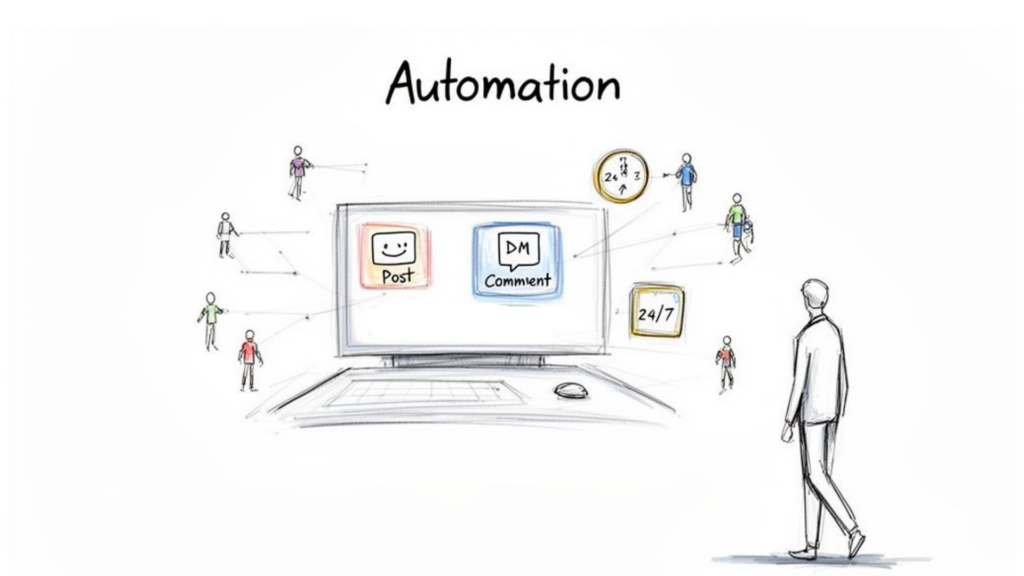
Social Media Marketing Automation
This setup shows how a central platform can juggle all your key social tasks—posts, DMs, comments—around the clock. It turns your manual to-do list into a hands-off, automated engine.
This isn’t just a trend. The social media marketing automation market hit USD 4.5 billion in 2024 and is projected to reach USD 12.8 billion by 2033. Already, 50% of marketers are using automation to manage their social media because it delivers tangible results.
Automation isn’t here to take marketers’ jobs. It’s here to free them from mind-numbing repetition so they can focus on strategy, creativity, and building real relationships.
To see the bigger picture, it helps to understand concepts like programmatic advertising, which applies similar automated logic to ad buying. It’s all part of a larger shift in marketing toward building smart, scalable systems that deliver better results with a fraction of the manual effort.
How Automation Actually Changes Your Business
Let’s move past definitions and talk about what really matters: results. Social media marketing automation isn’t just another tool—it’s a transformation that saves time, improves lead quality, and boosts your bottom line. With the right social media automation tools, businesses can streamline repetitive tasks and create more efficient workflows across different social networks.
Think about all the repetitive social media tasks you handle every week—answering DMs, sending welcome messages, tracking comments. It’s a major time drain. Automation gives those hours back, allowing you to shift focus from manual execution to high-impact strategy across the best social media platforms for your audience.
Reclaim Your Most Valuable Asset: Time
Time is the one thing you can’t get more of. Automation acts as a force multiplier, helping you achieve more without extending your working hours.
Practical Example:
An e-commerce store manager spends half their day answering DMs about order tracking, stock availability, and return policies. By implementing one of the many social media automation tools—like a chatbot that handles the top five most common questions—they can instantly resolve up to 90% of these inquiries.
That single workflow can free up 10+ hours per week, giving them time to focus on product launches, optimize campaigns across key social networks, and grow their presence on the best social media platforms for their business.
Generate a Flood of Qualified Leads
Lead generation is the lifeblood of any business. Automation doesn’t just help you capture more leads—it helps you qualify them instantly, so your sales team focuses only on high-intent prospects. With the best social media automation tool, businesses can streamline conversations, segment audiences, and manage multiple social accounts without missing opportunities.
Practical Example:
A business coach runs an Instagram ad for a new program. Instead of relying on manual replies, they build a simple automation:
Trigger: Someone comments “COACH” on the ad.
Action: A message is instantly sent through a social inbox.
Conversation: The bot asks qualifying questions like “What’s your biggest business challenge?” or “What’s your current monthly revenue?”
Based on the responses, leads are segmented in real time. High-quality prospects get a booking link, while others receive helpful resources. Integrated workflows—often powered by tools like Zapier—can connect this process with CRMs and email systems, creating a seamless all-in-one social media funnel.
The real power of automation is its direct link to business outcomes. It’s not just about efficiency—it’s about better targeting, higher conversions, and improved customer experience. Platforms like Sprout Social combine social media scheduling, engagement tracking, and analytics into one social media scheduling tool, making it easier to manage campaigns at scale.
The numbers support this shift. Businesses using marketing automation report a 14.5% increase in sales productivity and a 12.2% reduction in marketing overhead. Even more compelling, companies that nurture leads effectively see up to a 451% increase in qualified leads—proof that automation isn’t just a convenience, it’s a growth engine.
Drive More Sales and Make Customers Happier
A great customer experience leads to more sales and loyalty. Automation lets you be there for customers in the moments that count, offering instant support and personalized interactions you could never manage manually.
For instance, an automated system can:
- Recover Abandoned Carts: Send a friendly nudge via Messenger or Instagram DM to shoppers who left items in their cart. You can even toss in a small discount to seal the deal.
- Onboard New Customers: Walk new users through your product with a series of helpful, automated messages, ensuring they see value from day one.
- Gather Feedback: Automatically follow up after a purchase to ask for a review. This builds social proof and helps you improve your products.
Each automated touchpoint builds a stronger customer relationship. It answers questions before they become frustrations and creates a smoother path to their first purchase—and their next one. This is how automation becomes a core engine for business growth.
Essential Automation Workflows You Can Start Today
Theory is great, but let’s get practical. The real magic happens when you build specific, goal-oriented “Flows” that do the heavy lifting for you.
These aren’t complex projects. They’re actionable workflows you can build in minutes with a no-code tool like Clepher. Each one follows a simple logic: a trigger kicks off the automation, an action takes place, and it all serves a specific goal.
Here are some of the most powerful automations you can implement right now.
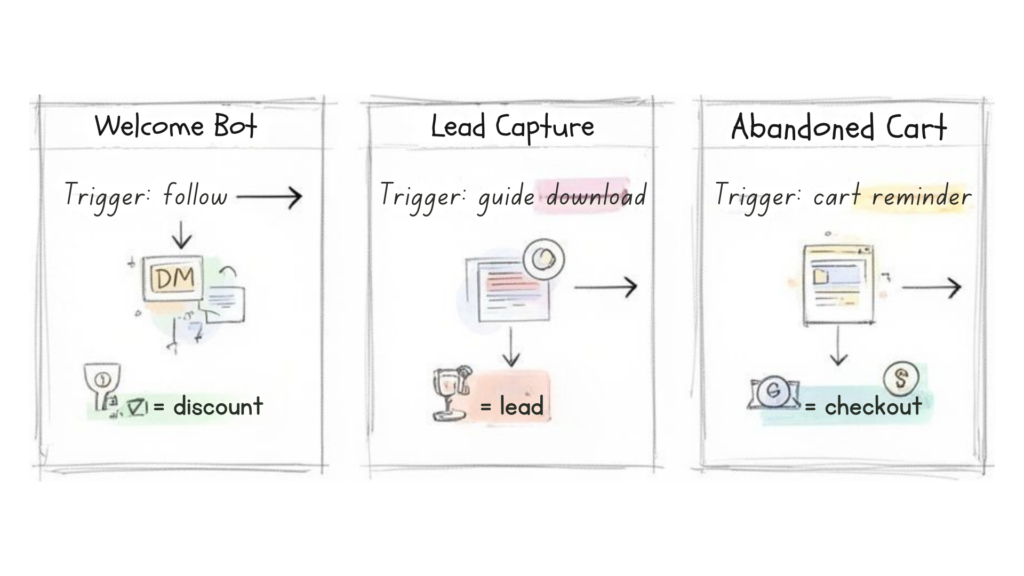
1. The Instant Welcome and First Impression Bot
That first interaction with a new follower is a golden opportunity. Instead of letting it go to waste, create a memorable first impression that builds an instant connection.
- Goal: Welcome new followers, build immediate rapport, and offer an incentive.
- Trigger: Someone follows your Instagram or Facebook Page.
- Action: The system automatically sends them a personalized Direct Message.
Example Message: A new follower gets this DM seconds after hitting “Follow”: “Hey [First Name]! Thanks for following. We’re thrilled to have you here! As a small thank you, here’s a 15% discount on your first order. Use code WELCOME15 at checkout.”
This simple flow does more than say hello. It makes the new follower feel seen, valued, and gives them a reason to check out what you’re selling.
2. The Interactive Lead Capture Bot
Your content gets tons of comments, but are they turning into leads? A lead capture bot can transform your comments section into an automated lead-gen machine.
- Goal: Convert engaged commenters into qualified leads.
- Trigger: A user comments on your post with a specific keyword, like “GUIDE” or “INFO”.
- Action: Your bot instantly replies publicly and sends a private DM to start a conversation.
Example Flow: A real estate agent posts a “5 Tips for First-Time Homebuyers” graphic and tells people to comment “TIPS” to get the full guide. When someone does, the bot publicly replies, “Just sent it to your DMs!” and privately messages them: “Hey [First Name], ready for your free guide? Just confirm your email address below, and I’ll send it right over!”
This workflow is powerful because it meets people where they are. You’re not making them hunt for a link; you’re bringing the value straight to their inbox, completely friction-free.
Once they provide their email, your automation can add them to your CRM and deliver the guide. You’ve just captured a warm lead with zero manual effort. Our complete guide on Instagram DM automation has even more strategies.
The chart below shows the clear business results from automations like these.
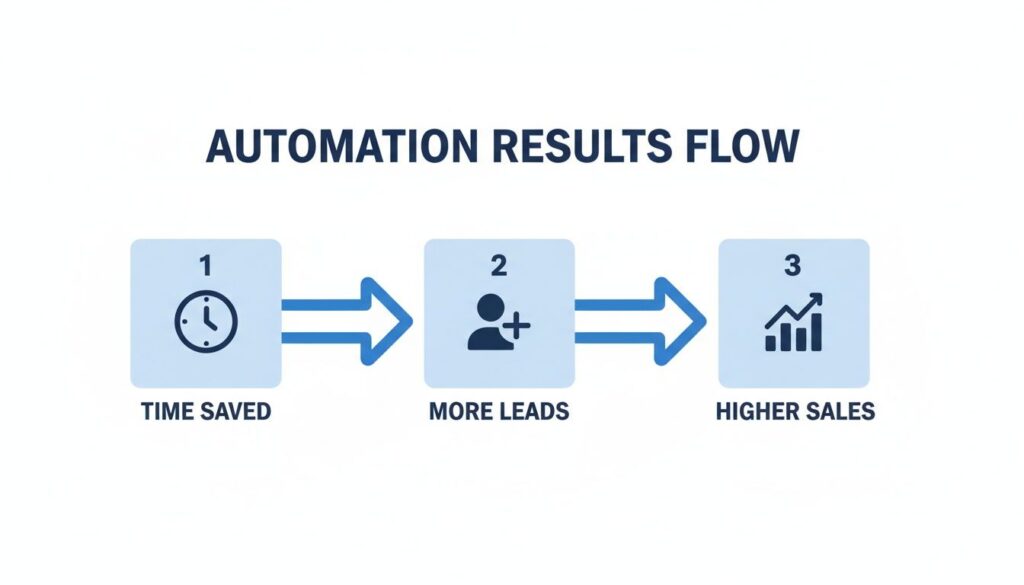
Automation Results Flow
It’s a simple progression: automation saves you time, which you can then use on strategies that generate more leads, ultimately leading to higher sales.
3. The Abandoned Cart Recovery Bot
If you run an e-commerce brand, you know the pain of abandoned carts. Nearly 70% of all shopping carts are left behind—a huge pile of lost revenue.
An abandoned cart bot for Messenger or WhatsApp can recover a significant chunk of those sales with a friendly, timely reminder.
- Goal: Recover lost sales by reminding users about items they left behind.
- Trigger: A user adds items to their cart but doesn’t complete the purchase.
- Action: After a set time (e.g., 1 hour), the system sends a reminder via Messenger or WhatsApp.
Example Message: “Hey [First Name], looks like you left something behind! Your items are still waiting for you. Need any help checking out?” To make it even more effective, program a follow-up 24 hours later with a small incentive, like free shipping or a 10% discount.
4. The 24/7 Customer Support and FAQ Bot
Your customers have questions at all hours. An FAQ bot acts as your frontline support, giving instant answers to common questions and freeing up your human team for complex issues.
- Goal: Provide instant support and reduce the volume of repetitive questions.
- Trigger: A user sends a DM with a keyword like “shipping,” “returns,” or “hours.”
- Action: The bot instantly replies with a pre-written, helpful answer.
Example Interaction: If someone messages, “What is your return policy?” the bot can respond immediately with a clear explanation and a link to the full policy page. Modern tools use AI-powered keywords to understand variations like “how do I return,” ensuring the correct answer is always delivered. This is a game-changer for customer satisfaction.
Choosing the Right Automation Tools for Your Stack
Picking the right tool for social media marketing automation is critical. The only thing that matters is finding a platform that solves your specific problems and helps you achieve your goals.
The right tool isn’t just software; it’s the command center for your entire marketing ecosystem. It needs to be powerful enough for complex tasks but simple enough for you to launch a campaign in minutes.
Social Media Marketing Automation Workflow Diagram
Core Features That Truly Matter
Don’t get distracted by a long list of shiny features. Your success with social media automation comes down to a handful of critical capabilities.
- Supported Channels: Does the tool work where your customers are? You need native support for Instagram, Facebook Messenger, and WhatsApp.
- Ease of Use: You shouldn’t need a developer to build a bot. A true no-code, drag-and-drop builder is essential. This lets you map out conversations visually and launch workflows in minutes.
- AI-Powered Capabilities: This is what separates a bot from a smart assistant. Look for AI agents and intelligent keyword triggers that understand user intent. It’s the difference between a bot that only recognizes “PRICE” and one that understands “how much is this?” and “what does it cost?”
As you compare options, check out our guide on other powerful AI marketing automation tools to see how they fit into the bigger picture.
Your automation tool shouldn’t be another silo. It should be the glue that holds your entire marketing stack together, creating a unified view of every customer interaction.
This is why integrations are non-negotiable.
Why a Connected Stack Is Non-Negotiable
A standalone social media bot is a huge missed opportunity. Its real power is unleashed when it talks to your other marketing tools—your email platform (like Mailchimp) and your CRM (like HubSpot).
Think about it. A new lead from an Instagram DM should automatically land in your email list without you lifting a finger. No more manually exporting messy spreadsheets.
Here’s how that works in practice:
- A user DMs your Instagram page for a free guide.
- Your Clepher bot captures their email address in the chat.
- An integration immediately sends that contact to your ActiveCampaign list.
- ActiveCampaign automatically starts a welcome email sequence.
This entire sequence happens in seconds. It prevents data silos and ensures every part of your marketing machine works from the same playbook. Look for tools with strong native integrations or flexible webhooks. Getting expert advice on choosing your marketing automation platform from the start is a smart move.
Best Practices for Automation That Feels Human
The biggest strength of social media marketing automation is also its greatest risk. Clumsy automation can make your brand feel cold and robotic.
The secret is to automate tedious tasks, not relationships. Your goal is to use automation to amplify human connection, not replace it.
Always Provide an Escape Hatch
No matter how smart your chatbot is, it will never replace real human empathy. When a customer is frustrated or has a unique problem, forcing them to talk to a bot that doesn’t understand will only make things worse.
Every automation needs an “escape hatch”—a clear, easy way for a user to talk to a person.
- Trigger Keywords: Set up keywords like “agent,” “human,” or “support” that instantly pause the automation and notify your team.
- Menu Options: Always include a “Talk to a Person” button in your bot’s menu.
- Human Handoff: Ensure the bot is set up to notify your team when a user asks for help, allowing a real person to jump into the chat seamlessly.
Giving people this option builds trust and shows you’re there to help.
Use Personalization to Build Connections
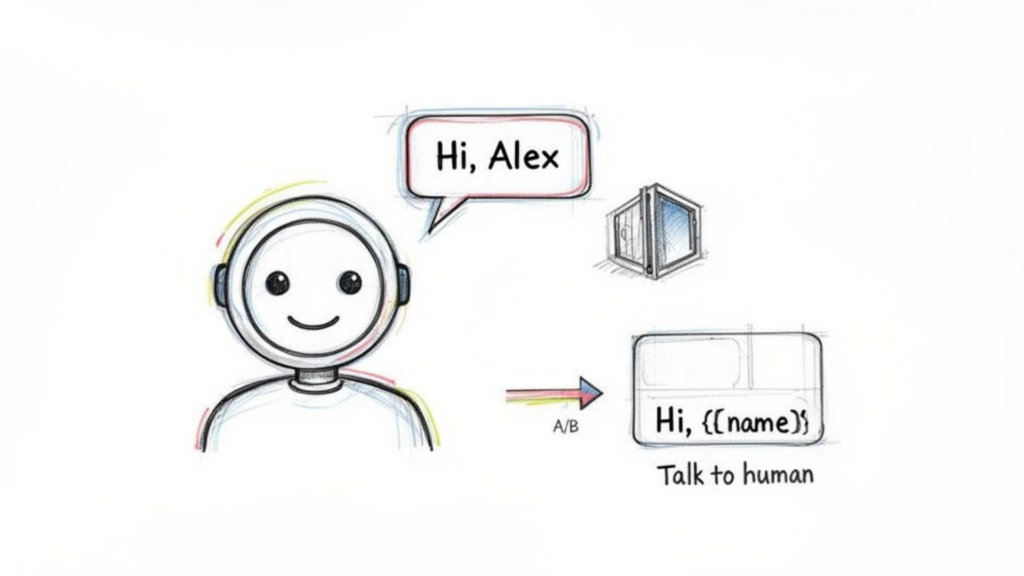
Nothing screams “AUTOMATED” louder than a generic message. The fastest way to make your automations feel personal is to use the data you have to customize the conversation.
This goes beyond just using a first name.
The best automation feels like a personal assistant, not a broadcast. It uses what it knows about a person to deliver a uniquely relevant and helpful experience.
Real personalization means using details from a user’s profile or past actions. For example, instead of a boring “Thanks for your purchase,” an automated message could say:
“Hey [First Name], your order for the [Product Name] has shipped! We hope you love it. Since you’re interested in [Product Category], you might also like this guide we wrote on how to get the most out of it.”
That level of detail proves you’re paying attention. It turns a simple notification into a genuinely helpful touchpoint. Dig deeper into this concept with our article on what conversational marketing is.
A/B Test Everything and Respect the Rules
Your first bot message is almost never the best one. Treat your automated copy like ad copy—test it relentlessly.
- Test different greetings: Does “Hey” work better than “Hello”?
- Vary your calls to action: Does “Shop Now” get more clicks than “See the Collection”?
- Experiment with tone: Does a playful voice resonate better than a formal one?
Platforms like Clepher make it easy to run A/B tests inside your flows to see what gets the best results.
Finally, always play by the rules. Facebook Messenger, for example, has a strict “24-hour window” policy for promotional messages. Following these rules isn’t just about avoiding a penalty; it’s about respecting your audience’s inbox and ensuring your brand stays welcome there.
Your 7-Step Automation Implementation Checklist
Diving into social media marketing automation doesn’t have to be overwhelming. The secret is to break it down into small, concrete steps that get you results fast.
This checklist is your roadmap from zero to your first live workflow.
Chatbot Personalization
Follow these seven steps to launch your automation strategy with confidence.
Getting Started The Right Way
Start small, prove the concept, and then scale what works. Your first bot should solve one specific, high-impact problem.
-
Define Your #1 Goal: What’s the single biggest win you’re after? Is it cutting DM response time? Capturing leads from comments? Welcoming new followers? Pick one clear, measurable goal.
-
Pick Your First Channel: Where does your audience engage most? Start on the platform where a small change will make the biggest splash, likely Instagram DMs or Facebook Messenger.
-
Map the Conversation on Paper: Before touching any software, sketch out the user’s journey. What’s the trigger? What questions will your bot ask? What are the possible replies? A simple flowchart on a notepad is perfect.
The most effective automations are planned offline first. Mapping the flow visually helps you spot gaps and create a better user experience before you write a single line of bot copy.
-
Choose Your Automation Tool: With a goal and a flow, it’s time to pick your platform. You’ll need a no-code builder with features matching your goal, like keyword triggers and integrations.
-
Build and Test Your First Bot: Bring your paper map to life in the tool. Once built, test it relentlessly. Get your team to try and break it to catch awkward phrasing or dead ends before your customers do.
-
Promote Your Bot: An automation is useless if no one knows it exists. Use clear calls to action in your posts, Stories, or even on QR codes to tell people about it.
-
Measure, Analyze, and Optimize: Your job isn’t done at launch. Monitor your bot’s performance. Are users dropping off? Are they getting the right answers? Use this data to constantly refine your flow.
Frequently Asked Questions About Automation
It’s normal to have some doubts about automation. Let’s tackle the big questions head-on.
Ready to put these ideas into practice? Clepher gives you all the tools to build powerful, human-first automations for Instagram, Messenger, and WhatsApp. Launch your first bot in minutes.
Related Posts
Social Media Marketing Automation: Your Ultimate Guide
March 27, 2026Unlock Growth with Conversational AI for Customer Support
March 26, 2026Your Ultimate Guide to Instagram Chat Bots
March 25, 2026
Founder Clepher