
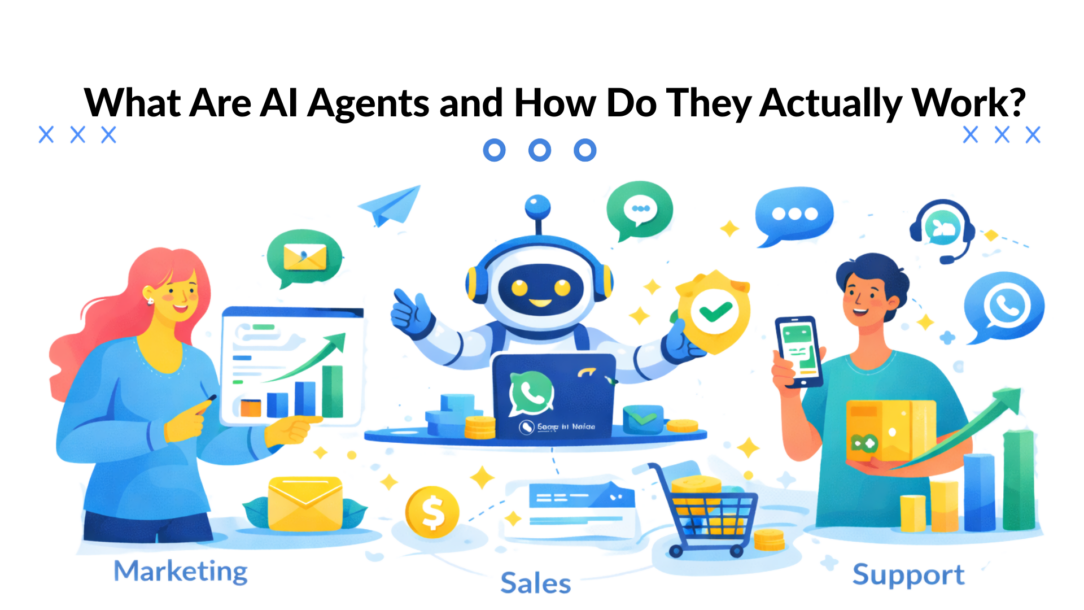
Forget everything you think you know about chatbots. When we talk about an AI agent, we’re talking about a proactive, autonomous digital team member. This isn’t software that just follows a script; it’s a system designed to understand a goal, create a plan, and take action to achieve it.
Think of an AI agent as a virtual employee you can hire to handle complex, multi-step tasks. You don’t need to micromanage it. You just give it a job to do—like qualifying leads or recovering abandoned carts—and it gets to work, completely on its own.
From Answering Questions to Achieving Goals
The big shift here is from reactive Q&A to proactive problem-solving. A traditional chatbot is great at answering simple questions like “What are your business hours?” but its usefulness stops there. It’s stuck on a rigid script and gets confused by anything outside its programming.
An AI agent, however, is given a business objective. For example: “Turn this website visitor into a qualified sales lead” or “Help this customer complete their return.” The agent then figures out the best way to accomplish that goal and executes the plan from start to finish. This is the core idea behind practical AI automation.
This capability is exactly why the AI agent market is set to explode from $7.84 billion in 2025 to over $52.62 billion by 2030. Businesses aren’t just experimenting; they’re investing in this technology as a core part of their future operations.
AI Agents vs. Traditional Chatbots
So, what’s the real-world difference? One is a passive help desk, and the other is an active member of your team. Understanding what AI agents really mean means grasping this distinction, especially if you’re in marketing, sales, or support.
At its core, the difference is autonomy. A chatbot answers; an agent acts. This transition from passive response to active execution is what unlocks new levels of efficiency and scale for businesses.
Let’s break it down with a simple comparison to see just how different these tools are in practice.
AI Agents vs. Traditional Chatbots at a Glance
| Capability | Traditional Chatbot | AI Agent |
|---|---|---|
| Primary Function | Follows pre-defined scripts to answer questions. | Achieves a specific goal by planning and acting. |
| Task Complexity | Handles simple, single-turn queries (e.g., “What are your hours?”). | Manages multi-step, complex tasks (e.g., “Book a demo call.”). |
| Decision Making | Limited to its script; cannot reason or adapt. | Reasons through problems and makes independent decisions. |
| System Integration | Rarely connects to other tools. | Connects to external systems like CRMs or calendars. |
| Business Example | Provides a link to the returns policy page. | Processes the entire return, updates inventory, and emails the customer. |
As you can see, AI agents are not just an upgrade. They represent a fundamental shift in how automation can drive business growth, moving from basic information delivery to executing entire operational workflows.
How AI Agents Understand and Execute Tasks
To understand how an AI agent works, don’t get lost in the technical jargon. Instead, think of a simple, three-step process that mirrors how a human expert solves a problem: it understands the goal, it creates a plan, and it takes action.
This straightforward “sense, think, act” cycle is what allows an agent to tackle complex jobs without human intervention.
Imagine a top-tier customer support specialist. They don’t just follow a script. They listen to the customer’s problem, figure out the real goal (like getting a refund for a broken product), and then execute the steps to make it happen. An AI agent operates on the same principles.
The Three Stages of an Agent’s Workflow
Every task an AI agent performs follows this logical, three-part flow. This structure is what makes them so reliable for automating critical business processes.
- Perception (Understanding the Goal): First, the agent uses natural language processing to figure out what the user truly wants. It looks past the words to identify the intent. For our support specialist, this is like reading a frustrated email and realizing the customer needs a quick refund, not a lengthy repair process. To learn more, see our guide on natural language processing in chatbots.
- Reasoning (Creating a Plan): Once the goal is clear, the agent maps out the most efficient path to achieve it. It accesses its knowledge base and connected tools to create a step-by-step plan. Our specialist does this by checking the warranty, looking up the order in the system, and calculating the correct refund amount.
- Action (Executing the Plan): Finally, the agent carries out the plan by interacting with other software. It calls the APIs of your other business systems to get the job done. In our example, the specialist processes the refund in the payment gateway, updates the CRM, and sends a confirmation email. An AI agent does the exact same tasks, just instantly.
This diagram shows the simple, goal-driven process AI agents use.
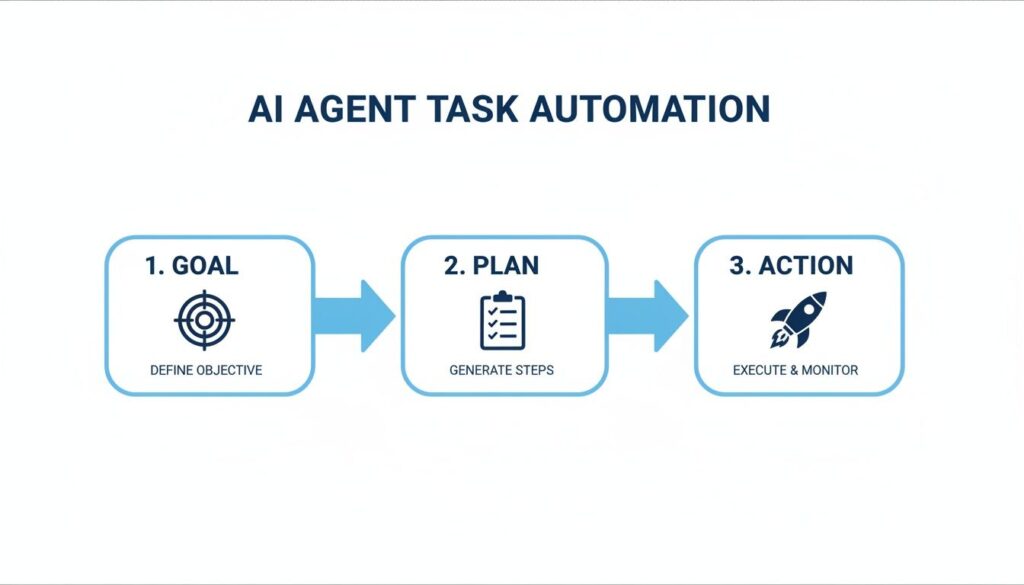
AI Agent Process
The key takeaway is that an agent’s true power comes from its ability to connect understanding to action. It turns a user’s request into a series of completed tasks that directly impact your business operations.
Real-World AI Agents Driving Serious Growth
Theory is nice, but results are better. Let’s move beyond the “what are AI agents” question and look at how they are making a real, measurable impact for businesses right now. These are practical applications you can implement to drive revenue and efficiency.
The goal is to automate entire business functions, not just small tasks. When you give an AI agent a clear objective and the right tools, it becomes a 24/7 digital employee focused on solving specific problems and delivering a clear ROI.
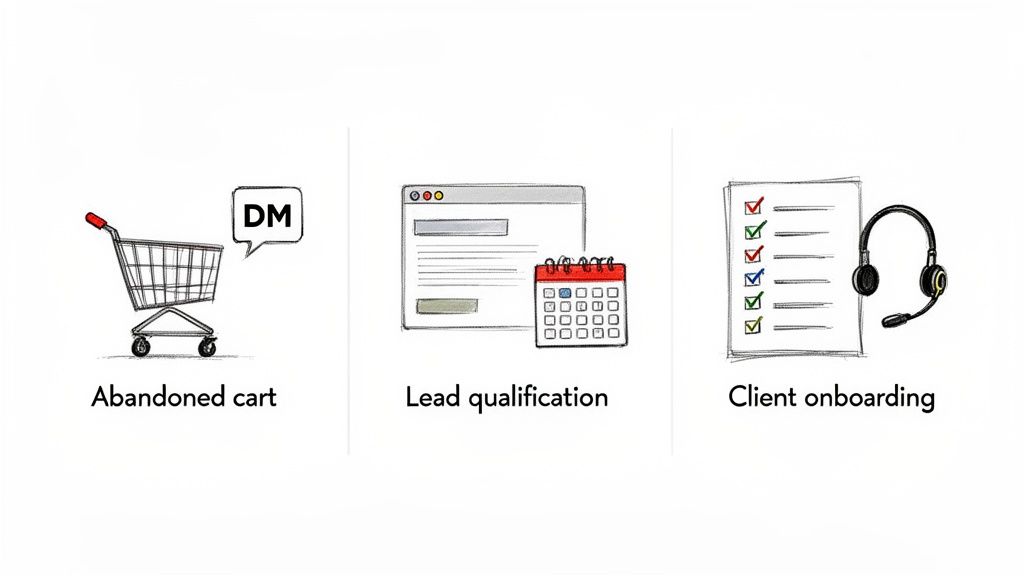
AI Agent Business Process
Recovering Lost Sales for E-commerce Brands
Abandoned carts are a huge source of lost revenue. A simple chatbot might ask, “Can I help?” but an AI agent takes a far more direct and effective approach.
- The Problem: A customer adds products to their cart but leaves your site without buying. Hours later, they’re scrolling through Instagram.
- The Agent’s Solution: The AI agent, connected to your e-commerce platform, detects the abandoned cart in real-time. It then uses its Instagram integration to send a personalized DM: “Hey [Name], noticed you left something behind. Any questions I can help with? Here’s a 10% discount to complete your order.”
- The Business Impact: This proactive, personalized outreach can increase cart recovery rates by 15% or more. You’re not just waiting for customers to return; you’re actively winning them back.
Qualifying and Booking Leads for Agencies
For service-based businesses, lead response time is critical. An AI agent transforms your website into a lead qualification and booking machine that works around the clock.
- The Problem: A promising lead visits your website at 10 PM. They fill out your contact form, but your team is offline. By morning, the lead has already found a competitor.
- The Agent’s Solution: The agent engages the visitor instantly. It asks key qualifying questions like, “What’s your monthly budget?” and “What’s your biggest challenge?” If the lead is a good fit, the agent accesses your sales team’s calendar and books a demo on the spot.
- The Business Impact: This immediate engagement can slash lead response times by up to 40%. You capture leads at their peak interest, which directly translates to higher conversion rates. We cover this strategy in our guide to using an AI agent for sales.
Automating Client Onboarding for Coaches
A clunky onboarding process creates a poor first impression and wastes valuable time. An AI agent can automate the entire workflow, from scheduling to document collection.
An AI agent automates these repetitive, high-touch interactions, freeing up experts to focus on delivering value rather than getting bogged down in administrative tasks. This is where you see the shift from manual work to scalable systems.
This type of autonomous operation is becoming the new standard. By 2029, agentic AI is projected to handle 80% of common customer service interactions without human help. This trend is fueled by massive investment, with annual AI spending expected to grow by 31.9% between 2025 and 2029.
Other use cases of AI agents
Beyond common consumer examples, AI agents and agentic AI systems enable a wide range of use cases across industries. Enterprises deploy AI agents to automate workflows, analyze large datasets, and coordinate multiple AI agents in compound AI systems that interact with each other and with human agents. Advanced AI agents can be used to optimize supply chains, perform predictive maintenance, and manage complex simulations where agents operate semi-autonomously.
In research and development, developers build AI agents and create ai agents to experiment with autonomous agent behaviors, from simple reflex agents and model-based reflex agents to goal-based agents and sophisticated, agentic AI systems. Generative AI and AI models, including large language models (llm) based agents, power AI assistants that draft content, generate code, and summarize findings. AI agents also act as AI coding tools that help teams make ai agents faster and reduce repetitive tasks.
Healthcare and finance benefit from AI agents that analyze medical records or transaction patterns, flag anomalies, and provide decision support—agents can make decisions or recommend actions while remaining auditable. In customer service, AI agents are built to triage requests and escalate to human agents when needed; agents can work alongside humans to improve response times and outcomes. Autonomous AI agents are also used in robotics and IoT to monitor environments, execute maintenance tasks, and adapt to changing conditions.
Other examples of AI agents include virtual trainers that personalize learning, research assistants that scour literature, and creative collaborators that leverage generative AI models for design and media. As AI agents continually learn and interact across systems, the deployment of AI agents across platforms becomes essential for scaling capabilities. While agents are built with different architectures and types of agents, ensuring that your AI systems are safe and aligned remains a core concern during development and deployment.
Autonomy of AI Agents
AI agents are autonomous by design: AI agents are designed to perceive environments, AI agents analyze data, and AI agents can make decisions without continuous human input. Although AI agents can be supervised, an AI agent that wants to complete a goal will plan, prioritize, and act on its own, so AI agents often operate independently. Agents that interact with users or systems use sensors and models as components of an AI agent to decide when to intervene.
This approach to AI means AI agents can perform tasks, ai agents can handle unexpected situations, and ai agents can provide responses or services across contexts. You can deploy AI agents across devices and platforms, and expect AI agents to adapt as conditions change. Because agents are AI tools that can understand signals, and AI agents interact with each other, AI agents even coordinate, collaborate, or compete; agents can work together or alone. As capabilities grow, expect AI and agents to become essential for AI-driven workflows, and agents may take on more complex responsibilities over time.
How to Build Your First AI Agent
Building your first AI agent sounds intimidating, but it’s surprisingly simple if you start with a clear, focused goal. The key is to resist the temptation to automate everything at once.
Instead, pick one repetitive, high-impact task. This “quick win” approach allows you to prove the concept, see immediate results, and build momentum for more complex projects.
Here is a practical, four-step plan to get your first AI agent live—no coding required.
Step 1: Identify a High-Impact Task
Start by finding a bottleneck. What repetitive task consumes your team’s time but is crucial to your business? Look for the sweet spot between importance and simplicity.
Good starting points often involve the customer journey:
- Answering the same 10-15 pre-sale questions repeatedly.
- Qualifying website leads before they talk to a sales rep.
- Guiding new customers through the first steps of using your service.
Automating common customer questions is an excellent first project. It’s a well-defined task that delivers immediate value by freeing up your team and improving customer experience.
Step 2: Define the Goal and Provide Knowledge
Once you have a task, give your agent a crystal-clear objective. A vague goal like “improve support” is useless.
Be specific. For example: “Your goal is to answer questions about our shipping, returns, and product features to help customers complete their purchase.”
Next, provide the agent with the information it needs to succeed. This knowledge base can be built from existing resources:
- Your website’s FAQ page.
- Transcripts of past customer support chats.
- Product documentation and help articles.
The agent will use this information to provide accurate, context-aware answers, becoming a specialized expert on that one topic. For a deeper dive, read our guide on how to create AI agents.
Step 3: Build and Train on a No-Code Platform
With a clear goal and knowledge base, it’s time to build. Modern no-code platforms like Clepher are designed for business users, not developers.
Using a visual, drag-and-drop builder, you’ll design the conversation flow and connect your agent to its knowledge sources.
This is also where you “train” the agent. This involves testing it with various questions and refining its responses to ensure they are accurate and align with your brand voice. It’s an iterative process that guarantees a reliable and helpful user experience.
Step 4: Test, Deploy, and Integrate
Before going live, test your agent thoroughly. Ask it a wide range of questions to identify any awkward responses or broken workflows.
Once you’re confident in its performance, deploy it to your website, social media channels, or wherever it’s needed most.
The final, crucial step is integration. Connect your agent to your core business systems, like your CRM or email platform. This transforms it from a simple Q&A tool into a powerful automation engine. It can now create leads, update customer records, and trigger marketing campaigns, turning conversations into measurable business outcomes.
Hooking Up AI Agents to Your Business Tools
An AI agent working in isolation is like a brain without a body. Its true power is unlocked when it connects to and controls the other software you rely on every day. This integration is what transforms an agent from a conversational partner into an operational command center.
This is what allows an agent to move beyond just talking about a task to actually doing it. It’s the bridge between understanding a user’s intent and making it a reality within your existing workflows.
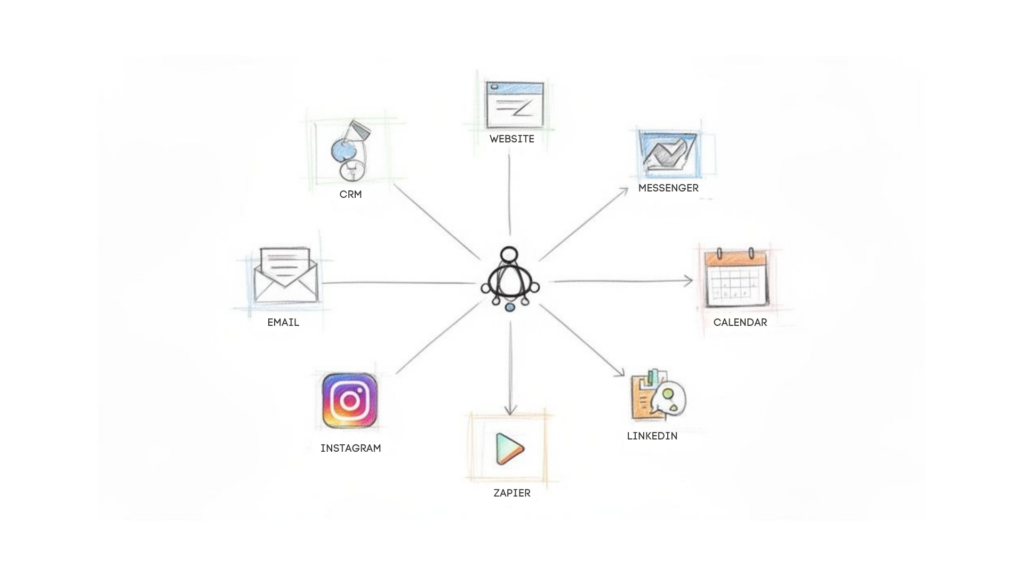
AI Agent Integrations
Creating a Hands-Off Automation System
Think of the small, manual tasks that bog down your team. An integrated AI agent can automate them, creating a seamless, hands-off system that frees up hundreds of hours.
Here’s what that looks like in practice:
- CRM Integration: When an agent qualifies a lead on your website, it doesn’t just send an email notification. It logs into your CRM, creates a new contact, updates their status to “Qualified,” and assigns them to the right sales rep—all in a matter of seconds.
- Email Platform Integration: After a customer discusses a product with your agent, the agent can add a specific tag to their profile in your email marketing tool. This can instantly trigger a personalized email sequence with more information or a special offer.
This level of deep integration is becoming the standard. Already, 53% of US businesses in the IT sector use AI agents for operations, and 97% of telecom companies have adopted them. Dig into more of these AI agent statistics.
An integrated AI agent acts as the central nervous system for your business. It takes in information from one place, processes it, and then triggers actions across a dozen other systems without a human ever lifting a finger.
Giving Your Agent Superpowers
What if you rely on a niche tool without a direct integration? No problem. Connector platforms are the solution.
Services like Zapier, Make, or Pabbly act as universal translators, enabling your AI agent to communicate with thousands of other applications. This opens up nearly limitless automation possibilities. For example, your agent could take customer feedback from a chat, use it to create a task in your project management software, and post a notification in your team’s Slack channel simultaneously.
The takeaway is simple: a well-connected agent handles the busywork so your team can focus on strategic growth.
The Future of AI Agents
Looking ahead, agents in AI will play a central role across industries, handling complex coordination, decision-making, and personalization. As capabilities grow, AI agents may take on tasks that require long-term planning and multi-step problem-solving.
In collaborative settings, AI agents can work alongside humans and other software to increase productivity and creativity. Trust and safety research will be essential for AI deployments, ensuring reliable behavior and alignment with human values. With advances in perception and reasoning, agents can understand context, intent, and emotion more deeply, enabling richer interactions.
Over time, agents will become more autonomous, adaptable, and widely integrated into daily life, transforming how we learn, work, and solve global challenges.
Choosing the Right AI Agent Platform
You understand what AI agents are and what they can do. The next logical step is choosing the right tool to build one.
This isn’t just about selecting a piece of software; it’s about choosing an operational partner for your business. You need a platform that is powerful, easy to use, and can scale with you. The right tool makes building and deploying sophisticated automation feel simple.
As you evaluate your options, focus on a few key features that separate truly effective platforms from those that create more headaches than they solve.
What to Look for in an AI Agent Platform
The ideal platform strikes a perfect balance between power and simplicity. An advanced tool is useless if it requires a team of developers to manage. The whole point is to make automation accessible to everyone.
Here’s a checklist of must-have features:
- A User-Friendly No-Code Builder: This is non-negotiable. You should not have to write a single line of code. Look for a visual, drag-and-drop interface that allows you to design, test, and launch AI agents quickly.
- Multi-Channel Support: Your customers interact with you on your website, Instagram, WhatsApp, and Facebook Messenger. Your AI agent should be present and consistent across all these channels, providing a seamless experience.
- Robust Analytics: You can’t improve what you don’t measure. A quality platform provides a clear dashboard to track agent performance, conversation outcomes, and user engagement, giving you the insights needed to optimize.
This screenshot from Clepher shows a perfect example of an intuitive, no-code flow builder.
A visual interface like this lets you map out entire automated workflows, making complex processes understandable and manageable for anyone on your team.
The best AI agent platform makes advanced automation feel simple. It empowers you to build, deploy, and scale powerful agents that work across all your marketing channels without requiring a technical background.
A platform like Clepher is built on these core principles. It provides a drag-and-drop builder, native integrations with essential business tools, and multi-channel capabilities to serve as the foundation for your automation strategy.
This allows you to focus on your business goals, not the technical complexities of implementation. That’s how you ensure your investment delivers a real return.
Common Questions About AI Agents
Many business owners have practical questions before they dive into AI agents. Let’s tackle some of the most common concerns about cost, complexity, and capabilities so you can move forward with confidence.
Conclusion
Building and utilizing intelligent AI agents can transform your business by automating routine tasks, improving decision-making, and enabling new AI applications. To achieve this, teams create AI agents using large language model (LLM) foundations and other AI models, then deploy AI agents tailored to specific use cases—whether simple reflex agents for rule-based processing or more sophisticated model-based reflex agents, goal-based agents, and autonomous agent designs for complex workflows.
Start by identifying the agents that can be used to address priority pain points and select the appropriate types of AI agents: reflex agents, simple reflex agents, goal-based agents, and advanced AI agents that combine generative AI and traditional AI and machine learning methods. Agents are often built to interact with existing systems, and agents interact with other agents or human agents to form AI systems that operate collaboratively. Multiple AI agents can coordinate; agents act independently when needed, and agents also escalate to humans for oversight, ensuring safer deployment of autonomous AI agents.
The development and deployment of AI agents require careful planning: AI agents require clear objectives, data pipelines, evaluation metrics, and governance. Pre-built AI agents and AI tools can accelerate time-to-value, while custom-created AI agent efforts let you craft an AI agent’s behavior for industry-specific workflows. Agents include monitoring, explainability, and retraining loops so AI agents improve over time; agents can improve customer experience, optimize operations, and analyze large datasets—AI agents analyze trends and generate actionable insights.
Ultimately, whether you choose to deploy AI agents for customer support, sales enablement, predictive maintenance, or internal automation, the benefits of using AI agents are clear: agents can perform repetitive tasks, make decisions, and work with other agents or human teams to multiply productivity. By combining generative AI and advanced AI capabilities, developing agentic AI systems, and responsibly deploying AI agents, businesses gain scalable, intelligent agent solutions that deliver measurable ROI and open new possibilities for innovation.
Ready to put a proactive digital team member to work for your business? With Clepher, you can build and launch powerful AI agents that qualify leads, recover sales, and support customers 24/7. Start automating your growth today.
Related Posts
No-Code AI Agent Builder: Your 2026 Growth Playbook
April 8, 2026Your Guide to the Facebook Page URL in 2026
April 7, 20265 Best Chatfuel Alternatives in 2026 You Need to Try!
April 6, 2026
Founder Clepher