
Imagine a digital team member who can understand and respond to thousands of customer conversations at once, 24/7. That’s the power of conversational AI. It’s the smart technology that lets computers chat with people in a natural, helpful way—powering the chatbots and voice assistants we use every day.
This guide will break down exactly what conversational AI is, how it works, and how you can use it to transform your business. We’ll focus on practical examples and actionable insights, not just theory.
A Simple Look at Conversational AI
At its core, conversational AI is technology that allows software to understand, process, and reply to human language—whether typed or spoken—in a way that feels natural. Think of it less like a rigid script and more like a clever conversation partner.
Instead of forcing people to click specific buttons or type exact commands, this technology figures out what they actually mean. It’s the engine behind the helpful website bot guiding you to the right product, the voice assistant queuing up your favorite playlist, and the automated system answering your DMs on Instagram.
Moving Beyond Basic Chatbots
While people often use the terms interchangeably, conversational AI is a massive leap forward from older, rule-based chatbots. A basic chatbot is like a flowchart; it can only follow a pre-planned script. If a customer asks a question in an unexpected way, the script breaks, and the conversation hits a dead end.
For a deeper dive, you can check out our guide on the differences between chatbots and conversational AI.
Conversational AI, on the other hand, is built for real-world conversations. It’s designed to solve problems and get things done through genuine dialogue. The goal is to create a smooth, efficient, and satisfying experience that builds trust and delivers results.
The Business Impact and Market Growth
This shift toward more human-like automated chats isn’t just a cool trend; it’s a major market force. Businesses are adopting this technology to upgrade customer service, qualify leads, and drive sales more effectively.
The proof is in the numbers. The global conversational AI market was valued at around USD 17.3 billion in 2025 and is projected to explode to USD 106.8 billion by 2035. That explosive growth shows this is no longer a niche tool—it’s a must-have for any modern business looking to scale.
How Conversational AI Understands and Responds
So, what’s happening behind the scenes? Conversational AI isn’t magic, but it is a clever three-step process that turns everyday human language into a fast, automated response: listen, think, and reply.
At the heart of this process is Natural Language Processing (NLP). This is the branch of AI that gives computers the ability to understand how humans actually talk. Think of NLP as both the ears and the brain of the system—it figures out what someone is asking and then decides on the best way to answer.
This flow diagram breaks it down visually.
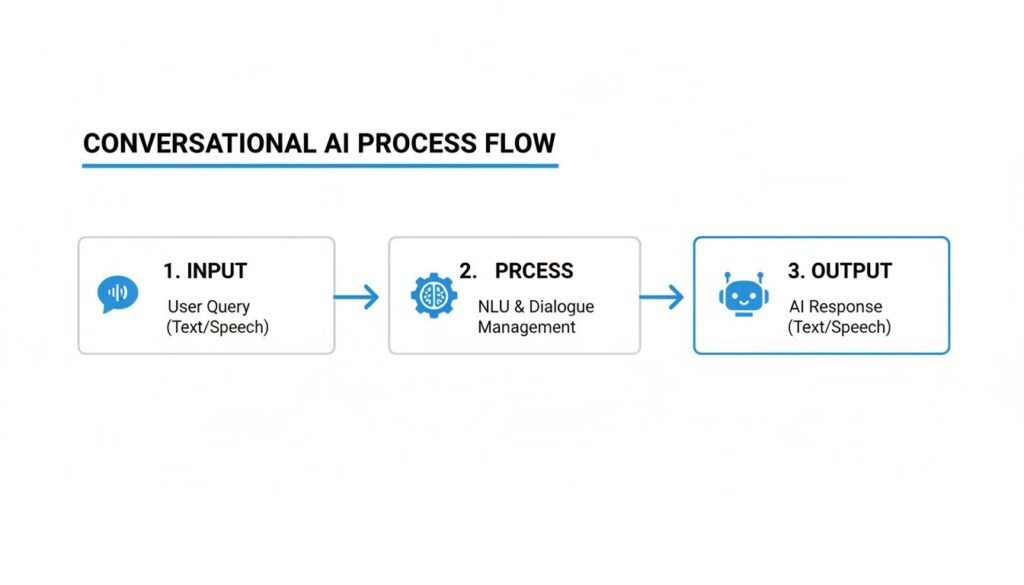
Conversational AI Process
Every conversation follows this path—from a user typing a message to the AI delivering an intelligent reply, all powered by smart processing that happens in an instant.
The Two Core Components: NLU and NLG
Natural Language Processing is split into two key jobs that work together:
- Natural Language Understanding (NLU): This is the “listening” part. NLU takes messy, unstructured human language—typos, slang, and all—and figures out the user’s intent. It gets to the goal behind the words.
- Natural Language Generation (NLG): This is the “replying” part. Once the AI knows what the user wants, NLG constructs a natural, human-sounding response. It turns structured data into conversational text.
Much of this is made possible by techniques like semantic analysis, which helps the AI grasp not just keywords, but the actual context and meaning of a sentence.
Let’s walk through a practical e-commerce example.
Customer Message: “yo where are my new sneakers?? i ordered them last week”
Here’s how a conversational AI platform breaks that down in seconds:
- Input & NLU: The system receives the message. NLU identifies the core intent as an “order status inquiry.” It also extracts key details (entities) like “sneakers” and “last week” for context.
- Processing: The AI connects to the store’s backend (like Shopify) to find the customer’s recent order containing “sneakers.” It then pings the shipping carrier’s API to get live tracking information.
- Output & NLG: Instead of a robotic “QUERY PROCESSED,” NLG crafts a friendly, helpful message: “Hey! Your sneakers are on their way. They’re currently out for delivery and should arrive today before 5 PM. You can track the package here: [link].”
The customer gets an instant, accurate answer without a human agent ever getting involved. That’s the transformative power in action.
For a deeper technical look, check out our guide on how NLP powers modern chatbots.
Rule-Based vs. Machine Learning Models
Not all conversational AI is created equal. There are two main approaches businesses use, each with its own strengths.
1. Rule-Based Systems (The Scripted Approach)
A rule-based bot operates on a strict set of if/then rules that you define. You map out the conversation flow, and the bot follows your script precisely.
- Best for: Simple, predictable tasks like booking appointments, answering basic FAQs, or routing customers to the right department.
- Business Use Case: A local restaurant uses a rule-based bot to take reservations. The bot asks for the date, time, and party size in a structured, step-by-step manner.
2. Machine Learning-Powered Systems (The Adaptive Approach)
This is the more advanced model. These systems use AI to learn from conversations and get smarter over time. They don’t need rigid scripts. Instead, they analyze vast amounts of data to understand a user’s intent, even if they’ve never seen that exact question before.
- Best for: Complex, dynamic conversations like technical support, personalized product recommendations, and qualifying sales leads.
- Business Use Case: An online course creator uses an ML-powered bot to answer nuanced questions about course content and payment plans, tailoring its answers to each person’s goals.
The best platforms today offer a hybrid model, blending the reliability of rules for simple tasks with the intelligence of machine learning for everything else.
Conversational AI Use Cases That Drive Real Results
This is where theory meets reality. Let’s look at how conversational AI solves everyday business problems and drives growth. The real power isn’t just answering questions; it’s delivering tangible results.
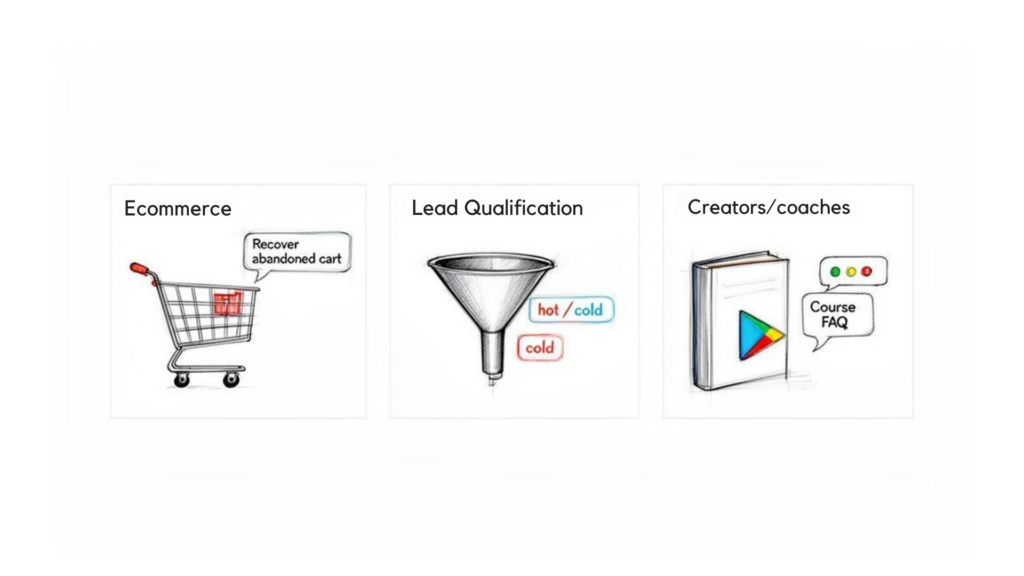
Conversational AI Use Cases
We’ll break down practical applications for marketing, sales, and support, showing the clear transformation that comes from smart automation. This isn’t about replacing people; it’s about making your business faster, smarter, and more efficient at scale.
E-commerce: Winning Back Lost Sales
For any online store, the abandoned cart is a major source of lost revenue. A customer adds items, starts to check out, and then disappears. Conversational AI turns this dead end into a revenue recovery opportunity.
- Before AI: You rely on a generic abandoned cart email sent hours later, which often gets ignored or buried in a crowded inbox. It fails to address the reason the customer left.
- After AI: An AI-powered chatbot on Messenger or Instagram messages the customer minutes after they abandon their cart. It can ask a simple, direct question like, “Hey, noticed you left a few things behind. Any questions about shipping?”
This single, proactive message can instantly uncover the friction point—maybe they were confused about shipping costs or a discount code failed. The bot can immediately provide a shipping estimate or offer a small discount to close the deal, all within the app they are already using.
The Transformation: A passive, one-size-fits-all email is replaced by an interactive, real-time conversation that solves problems and directly recovers lost sales.
Digital Agencies: Qualifying Leads on Autopilot
Digital marketing agencies juggle multiple clients and a constant flood of inquiries. The challenge is sifting through them all to find qualified prospects worth a sales call. Manually qualifying every lead is a huge time-sink.
An intelligent chatbot can be deployed on a client’s website or social media to act as a 24/7 lead qualifier. It engages visitors, asks critical filtering questions (like budget, timeline, and needs), and segments leads automatically.
- Hot Leads: Prospects with a solid budget and an immediate need are automatically booked into a sales rep’s calendar.
- Warm Leads: Those still exploring options are added to an email nurture sequence.
- Cold Leads: Inquiries that aren’t a good fit are politely informed, saving the sales team from wasting time.
The impact is significant. North America has become the dominant region for this technology, accounting for 33.62% of the global market revenue, largely because companies are using AI to build leaner, more effective sales and marketing processes.
Coaches and Creators: Delivering Instant Value
Coaches, consultants, and course creators often get buried under repetitive questions about pricing, course content, and refund policies. This administrative work steals time away from creating content or serving high-value clients.
A conversational AI bot, powered by generative AI, acts as an always-on front desk for their brand. With a conversational interface, it can be trained on all course materials and FAQs to provide instant, accurate answers around the clock, showcasing the benefits of conversational AI in reducing workload and improving customer experience.
Before AI: A potential customer asks, “Does your course cover Facebook ads?” and has to wait hours, or even days, for a reply. By then, their initial interest may have faded.
After AI: The bot instantly responds: “Yes, our course has three dedicated modules on Facebook ads, covering everything from campaign setup to scaling. Would you like to see the full curriculum?”
This does more than just answer a question; it builds trust and moves the prospect forward. Different types of conversational AI, from rule-based chatbots to advanced generative AI assistants, can guide users to the right resources, share success stories, and even handle enrollment. This lets creators focus on what they do best while delivering a seamless, automated experience through an intuitive conversational interface.
How to Measure the Success of Your Conversational AI
So, you’ve launched a conversational AI. How do you know if it’s actually working?
If you can’t measure its impact, you can’t justify the investment or improve it over time. You need to know if your bot is pulling its weight. Tracking the right key performance indicators (KPIs) is what separates a “cool feature” from a measurable business asset.
Essential KPIs For Conversational AI Performance
To understand your bot’s performance, track metrics that align with your business goals. Whether you want to generate leads, close sales, or improve support, there’s a KPI that can tell you how you’re doing. This table breaks down the most important ones.
| Business Goal | Key Performance Indicator (KPI) | What It Tells You |
|---|---|---|
| Marketing | Interaction Rate | Are people actually talking to your bot? A high rate means your welcome message is engaging. |
| Marketing | Lead Capture Rate | How many conversations result in a new lead (email, phone)? This shows its lead gen power. |
| Marketing | Click-Through Rate (CTR) | Are users clicking the links your bot shares? This proves your content is relevant. |
| Sales | Sales Conversion Rate | The big one: what percentage of bot conversations lead to a sale? This proves direct ROI. |
| Sales | Conversation Length | How long are your sales chats? Longer conversations can indicate deeper engagement. |
| Support | Resolution Rate | How many issues does the bot solve without needing a human? This measures efficiency. |
| Support | Fall-Back Rate (FBR) | How often does the bot say, “I don’t understand”? A high FBR means it needs better training. |
Tracking these KPIs isn’t just about data collection; it’s about turning that data into actionable insights to continuously improve your bot’s performance.
Metrics for Customer Engagement
An AI that no one talks to is a wasted investment. Engagement metrics tell you if your bot is capturing—and holding—your audience’s attention.
- Interaction Rate: The percentage of visitors who see your bot and start a chat. A strong rate means your initial prompt is effective.
- Conversation Length: The average number of messages in a chat. For sales, longer chats often signal genuine interest. For support, shorter chats can mean faster problem resolution.
- Fall-Back Rate (FBR): This tracks how often your AI fails to understand a user. A high FBR is a clear sign that your AI’s training needs to be improved or its conversation flows are confusing.
Metrics for Sales and Conversions
For most businesses, the goal is to drive revenue. Conversion metrics show you the direct financial impact of your conversational AI and prove its ROI.
Monitoring conversion KPIs is non-negotiable. It proves that your bot is a revenue generator, not just a cost center.
- Lead Capture Rate: The percentage of conversations that successfully collect a user’s contact information. This is a primary KPI for lead generation.
- Sales Conversion Rate: For e-commerce, this measures how many bot interactions lead directly to a completed purchase.
- Click-Through Rate (CTR): This KPI tracks how often users click on links your bot shares. Research shows ads in conversational formats can achieve 73% higher click-through rates than traditional search ads, making this a powerful metric.
Focusing on these KPIs helps you make data-driven decisions to continuously optimize your automated conversations for better business outcomes.
Choosing the Right Platform and Getting Started
Ready to put conversational AI to work? The key is choosing the right tools and starting with a clear, focused plan. A modern platform can turn complex automation into a simple, visual process. The best platforms are built so you don’t have to be a developer to create amazing automated conversations.
Must-Have Features in a Modern Platform
When evaluating options, a few features are non-negotiable. These separate a basic tool from a true business growth engine.
- No-Code Visual Builder: This is essential. A drag-and-drop interface lets you map out conversation flows visually, making it easy to design and modify how a user moves from one step to the next.
- Multi-Channel Capabilities: Your customers are on your website, Facebook, Messenger, and Instagram. Your AI needs to be there too, delivering a consistent experience everywhere.
- Seamless Integrations: Your AI must connect to your other tools—like your email platform, CRM, and e-commerce store—to pull data and trigger actions.
This is what a clean, visual workflow builder looks like.
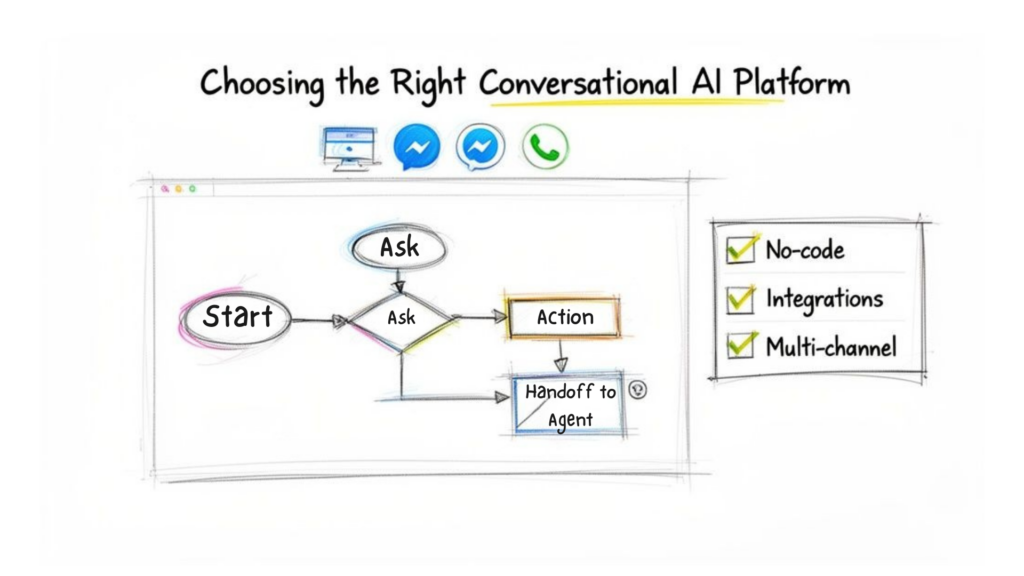
Conversational AI Workflow
This visual approach is a game-changer, letting you focus on strategy instead of getting stuck in code.
Your First Implementation: A Step-By-Step Guide
Once you’ve picked a platform, aim for a quick win. Don’t try to build a bot that does everything at once. Instead, solve one specific, high-impact problem first to build momentum.
-
Define One Clear Goal: Start with a single, measurable objective. Are you trying to capture more leads, reduce common support questions, or recover abandoned carts? Pick one. A great first goal for an e-commerce store is to answer the top five most-asked questions about shipping.
-
Design a Simple Conversation Flow: Map out the simplest possible conversation to achieve that goal. Keep it direct and to the point. For more advanced strategies, you can learn how to create AI agents that handle more complex tasks.
-
Create a Smooth Human Handoff: Automation isn’t foolproof. The most critical part of any AI strategy is knowing when to bring a person into the conversation. Ensure there’s always a clear and easy way for a user to ask to speak with a human.
The best conversational AI systems don’t replace humans; they make them more effective. A good handoff process frees up your team to manage high-value conversations that need a human touch.
This hybrid approach gives you the efficiency of automation without sacrificing your customer experience. Your bot acts as the first line of defense, resolving what it can and seamlessly passing tougher issues to the right person.
What’s Next? Risks, Privacy, and the Future of AI Chat
As conversational AI becomes more integrated into business, it’s crucial to be aware of potential risks and future trends. This isn’t just about compliance—it’s about building trust with your audience.
Handling user data responsibly is non-negotiable. Regulations like GDPR set clear rules for how businesses can collect and use personal information. For AI chat, this means being upfront about what data you’re collecting and why. Always get explicit consent from users before starting a chat or collecting their data.
Finding the Right Human-AI Balance
While automation is powerful, over-automation is a real risk. A cold, robotic experience can leave customers frustrated. The goal is to assist people, not build a wall between them and your team.
The solution is a seamless handoff process. Your AI should handle repetitive questions, but there must be an obvious way for a user to say, “I need to talk to a person.”
A well-designed system doesn’t replace human agents—it makes them more effective. It’s about balancing automation for speed with human empathy for complex issues.
This hybrid approach ensures customers get instant answers for simple queries while still having access to a real person when needed. It’s the best of both worlds.
The Future of Conversational AI
The technology behind conversational AI is advancing rapidly. We’re moving from reactive AI to proactive, deeply personalized experiences.
Here’s a look at what’s on the horizon:
- Proactive Engagement: Imagine an AI that notices a customer struggling on a checkout page and proactively offers help or a discount code, solving a problem before the user has to ask.
- Hyper-Personalization: The next generation of AI will use purchase history, browsing habits, and past chats to deliver tailored recommendations and support that feel truly one-on-one.
- Emotional Intelligence: AI is getting better at detecting user sentiment—like frustration or excitement—and adjusting its tone accordingly. This will make automated conversations feel more empathetic and human.
Keeping these trends in mind helps you view conversational AI not just as a tool for today, but as a long-term strategic advantage.
Your Top Questions About Conversational AI, Answered
Let’s wrap up by tackling some of the most common questions business owners have about conversational AI.
Ready to see how AI can transform your customer conversations? With Clepher, you can build, launch, and manage powerful AI chatbots on your website, Messenger, and Instagram in minutes—no coding required. Start your free trial and automate your growth today.
Related Posts
No-Code AI Agent Builder: Your 2026 Growth Playbook
April 8, 2026Your Guide to the Facebook Page URL in 2026
April 7, 20265 Best Chatfuel Alternatives in 2026 You Need to Try!
April 6, 2026
Founder Clepher