
Spam isn’t just a “Nigerian prince” email anymore. It shows up as irrelevant offers, confusing bots, unexpected messages, or pushy DMs that erode trust and get your business blocked. Today, deceptive tactics like text message scams and phishing attempts exploit moments when people receive a text asking for personal information, making it easy to cross the line from helpful to harassing. One misstep can tank engagement, damage your reputation, and even violate platform rules.
This guide breaks down modern spam with 10 real-world examples across email, SMS, and social DMs—including unsolicited messages and misleading offers designed to trick recipients. For each scenario, you’ll see why it fails and learn how campaigns asking for sensitive data or mimicking scams undermine credibility instantly.
No filler. You’ll discover how to spot risky copy, rewrite messages that feel relevant, and build strategies that engage your audience—without sending anything that feels like a fake text or a deceptive spam example.
1. Unsolicited Promotions and Third-Party Offers
This is the classic “unwanted ad.” It happens when a business sends promotional messages or third-party affiliate offers to users who never asked for them. This is a prime example of spam messages because it ignores consent, often involves selling or sharing customer data, and destroys trust from the get-go.
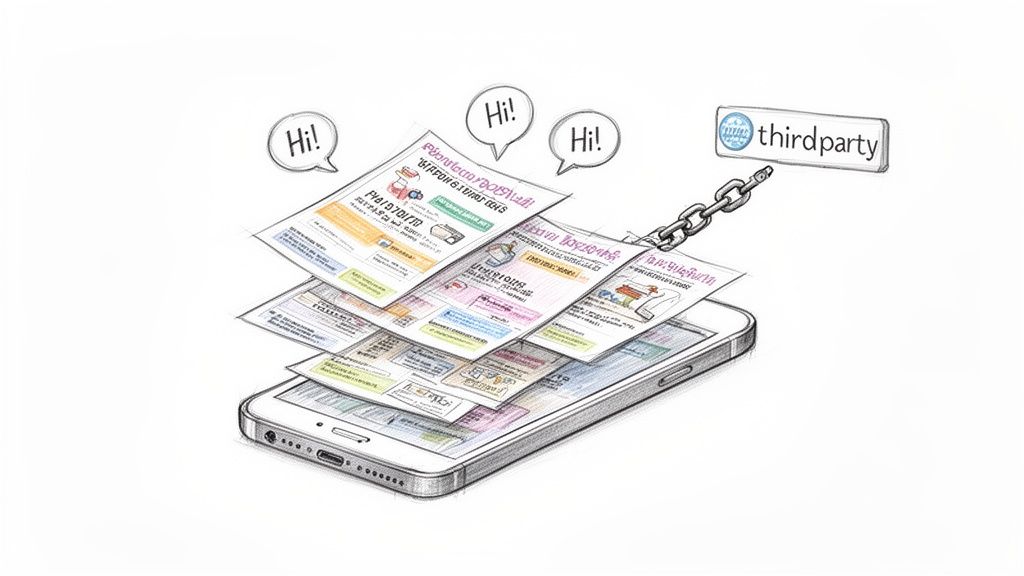
Third Party Spam
Real-world example: An e-commerce store that sells pet supplies suddenly starts sending its customers DMs promoting a friend’s cryptocurrency course. The customer agreed to hear about dog toys, not high-risk investments. This action damages the pet store’s reputation and leads to high block and complaint rates, which hurts their ability to message customers in the future.
What Makes It Spammy?
- Generic, urgent language: Messages like “Hey! Check out our AMAZING 70% OFF sale NOW!!!” that lack any personalization.
- Irrelevant offers: Sending promotions that have nothing to do with what the user signed up for.
- Missing consent: The core problem—the user never gave explicit permission for that specific type of message.
Key Takeaway: Consent isn’t transferable. A customer who opts into your brand’s newsletter hasn’t agreed to get DMs from your business partners.
How to Fix It:
Instead of blasting your entire list, focus on relevance. Use segmentation to target only subscribers who have shown interest in similar offers. Before promoting a third-party product, get explicit consent, ideally through a preference center where users can choose what they want to hear about. Turning spam into strategy starts with personalizing promotions to ensure your messages are welcomed, not marked as junk.
2. Fake Prize or Lottery Scam Messages
These messages trick people by claiming they’ve won a prize, a lottery, or an exclusive reward for a contest they never entered. This is a dangerous example of spam messages because its only goal is to fool people into clicking malicious links, giving up personal info, or sending money. These scams use excitement and urgency to bypass critical thinking.
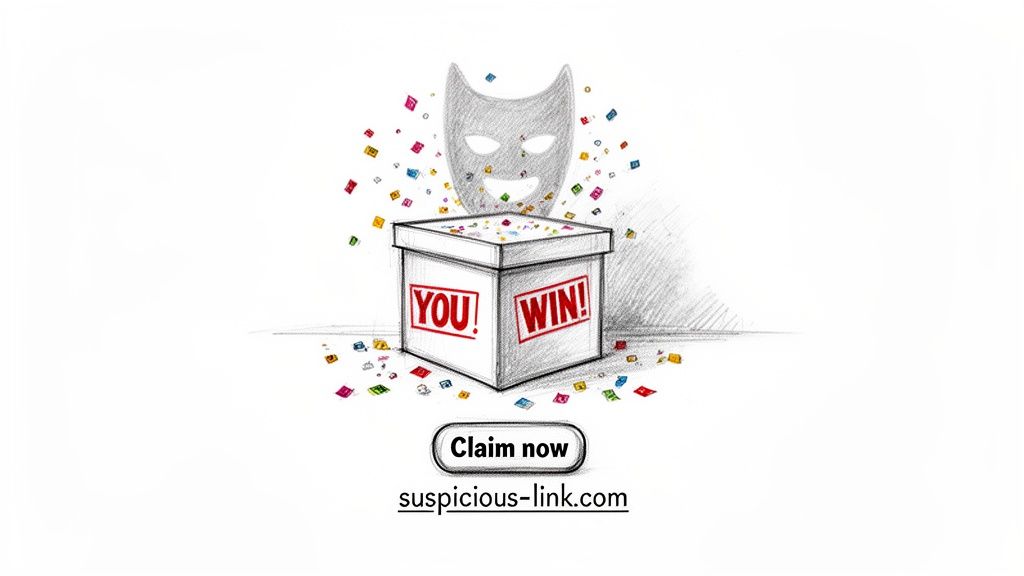
Suspicious Links
Real-world example: An SMS that says, “Congratulations! You’ve been selected to win a $1,000 gift card! Claim it now: [shady-link.net].” The link leads to a phishing site designed to steal credit card details. This not only breaks communication laws like the CAN-SPAM Act but also makes it impossible for that user to ever trust a message from that sender again.
What Makes It Spammy?
- Unexpected winnings: The main giveaway—notifying someone they’ve won something they never signed up for.
- Urgent calls to action: Phrases like “Claim Now!” or “Offer Expires in 24 Hours!” create pressure to act without thinking.
- Requests for personal or financial data: Legitimate companies don’t ask for bank details or passwords to claim a prize.
Key Takeaway: Real prizes don’t require a fee or sensitive info to claim them. If an offer appears out of thin air, it’s a scam.
How to Fix It:
If you run a legitimate giveaway, require a clear action (like a form submission) for entry. Never use lottery language for users who haven’t actively participated. Always include your verified brand name and official contact info in your messages, and be transparent about the terms and conditions.
3. Phishing and Credential Harvesting Messages
This malicious spam tries to trick users into revealing sensitive information like passwords, credit card numbers, or login details. Attackers do this by impersonating trusted brands (like your bank or Amazon) and creating a false sense of urgency or fear. This is a harmful example of spam messages because it directly leads to fraud and identity theft.
Real-world example: A message pretending to be from Netflix says, “Your account is on hold due to a payment issue. Please update your details here: [fake-netflix-billing.com].” The link directs to a convincing but fake login page built to steal credentials. These attacks destroy customer trust and can have serious legal consequences.
What Makes It Spammy?
- Urgent threats and warnings: Language like “account suspension,” “unauthorized login,” or “your payment has failed” is used to make you panic and act fast.
- Mismatched links: The link text might say “Netflix.com,” but the actual URL points to a suspicious domain.
- Requests for sensitive info: Real companies will never ask you to provide a password or full credit card number through an SMS or email link.
Key Takeaway: Never ask customers for sensitive information directly in a chat or email. Guide them to your official app or a verified web portal for any account updates.
How to Fix It:
Always use secure, branded channels for authentication requests. Your branding and contact info should be consistent so users can spot fakes. For sensitive data, responsible handling is key. Using built-in features like Clepher’s GDPR tools helps you manage user data securely and maintain compliance, building a foundation of trust.
4. Irrelevant or Context-Free Messages
This happens when a message is sent with zero relevance to the recipient’s interests, behavior, or conversation history. It’s a classic case of common spam that comes from lazy marketing—poor segmentation, broken chatbots, or a “one-size-fits-all” approach. The problem is a total disregard for context, which makes the message feel intrusive and often triggers complaints when users start reporting spam.
Real-world example: A clothing brand sends a “20% off winter coats!” promotion to customers in Florida who have only ever bought bikinis. Or, a chatbot for a software company sends a new trial user tips about advanced enterprise-only features, creating confusion instead of helping them convert. These messages are not just annoying—they resemble a fake text message or suspicious text that users might flag. They illustrate why marketers need to recognize spam text message examples, avoid sending fake text promotions, and understand the pitfalls of common spam text that claims offers or deals without relevance.
The key takeaway: ignoring user data transforms messages into spam text message examples that erode trust and reduce conversions.
What Makes It Spammy?
- Wrong context: The message clashes with the user’s known location, purchase history, or past interactions.
- Poor timing: Sending a message at an illogical time, like “welcome” tips sent weeks after a user signed up.
- No personalization: The message shows no sign of knowing who the recipient is beyond their name or phone number.
Key Takeaway: Relevance is the currency of modern marketing. If your message doesn’t align with the user’s context, it’s not helpful—it’s noise.
How to Fix It:
Use segmentation to create targeted audience groups based on purchase history, location, and engagement. Implement conditional logic in your chatbot flows to tailor the conversation based on user data. You can also use AI-powered keyword triggers to respond to what users are actually asking for, ensuring every message adds value.
5. Repeated or Excessive Messaging Sequences
This is when a user gets the same message over and over again in a short time. This is a clear example of spam messages because it overwhelms the user and shows your automation is broken. It’s often caused by poorly configured chatbots or overlapping marketing campaigns, leading to subscriber fatigue and high complaint rates.
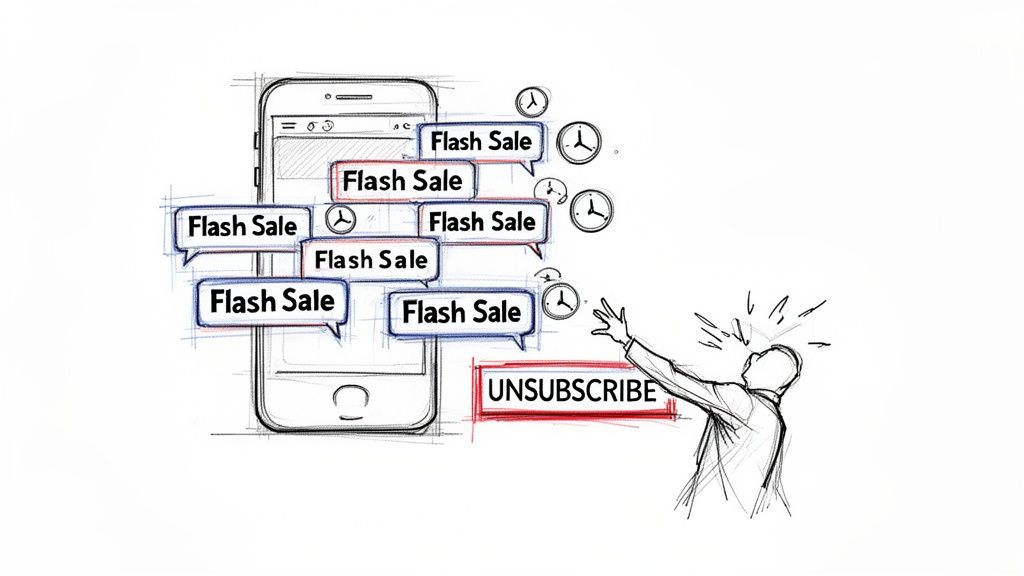
Spam Notification
Real-world example: A user clicks a “Notify Me” button for a sale and gets stuck in a loop. Three different automations send them the same “Flash Sale!” alert within a single day. Another is an Instagram DM sequence that sends the same promo message every six hours, regardless of whether the user replied. This aggressive approach is guaranteed to get you blocked or reported.
What Makes It Spammy?
- High frequency: Getting more than one identical promo message within a 24-48 hour window.
- No logic: The messages don’t stop even after the user takes action (or doesn’t respond), signaling broken automation.
- Identical content: The messages are exact copies, showing no awareness of previous sends.
Key Takeaway: Good marketing is a conversation, not a bombardment. Sending the same message repeatedly signals your system is broken and you don’t respect the user’s time.
How to Fix It:
Implement frequency capping to set a hard limit on how often a single user can receive messages. Use conditional logic in your automation to prevent a user from entering a new sequence if they’re already in one. Regularly audit your flows for overlaps. Mastering how to properly schedule messages and space out your campaigns is essential for keeping a healthy subscriber list.
6. Bait-and-Switch Offers and False Claims
This deceptive practice lures users with an amazing deal that turns out to be fake or completely different from what was advertised. Bait-and-switch is a classic example of spam messages because it intentionally misleads people, creating frustration that destroys your brand’s credibility. The problem is a mismatch between the promise and the reality.
Real-world example: A message screams “50% OFF EVERYTHING!” but the link reveals the discount only applies to a few obscure, low-value items. Another is sending a message that claims “An exclusive offer just for YOU!” when it’s a generic promo sent to thousands. These messages manipulate users into clicking but ultimately lead to disappointment and spam complaints.
What Makes It Spammy?
- Exaggerated discounts: Headlines promising massive, site-wide discounts that are heavily restricted in the terms.
- Fake exclusivity: Using phrases like “Just for you” or “Your private offer” in a mass-broadcast message.
- Hidden terms: The offer’s major limitations are buried in fine print, making the initial claim misleading.
Key Takeaway: Be transparent. An offer’s true value is in its honesty. If the headline makes a promise the fine print takes away, you’ve broken trust.
How to Fix It:
Ensure your promotions are truthful. If an offer has limits, state them upfront, such as “on select items” or “up to 50% off.” Use genuine personalization to make offers feel truly exclusive by targeting segments based on loyalty status or past purchases. Before sending, test every link to confirm the offer works as advertised and complies with advertising guidelines.
7. Malware or Malicious Link Distribution
This spam sends messages with links designed to install malware, spyware, or ransomware on a user’s device. These messages often impersonate trusted brands to trick people into clicking. As a dangerous example of spam messages, it goes beyond annoying you—it actively tries to compromise your security, steal your data, or cause financial harm.
Real-world example: A message reading, “Your account has a security alert. Update your Instagram security now: [bit.ly/fake-link]” creates panic to trick the user into clicking a malicious URL. Once clicked, the link could download malware or lead to a fake login page. This not only harms the user but also ruins the reputation of the legitimate brand being impersonated.
What Makes It Spammy?
- URL shorteners for sensitive topics: Legitimate companies rarely use generic shorteners like Bitly for security updates; they use their own branded domains.
- Urgent security threats: Messages that create panic, like “account suspension,” are classic tactics to make you act without thinking.
- Impersonation of major brands: Scammers pose as well-known companies (banks, social media) because their names inspire instant trust.
Key Takeaway: A malicious link’s main weapon is deception. It relies on your instinct to react to an urgent request without first checking the source or the link’s destination.
How to Fix It:
Always use your own branded, SSL-secured domains for links instead of generic shorteners. Regularly monitor link safety to ensure your domain hasn’t been compromised. Educate your customers on how to spot phishing, advising them to log in directly through your official website or app to verify any alerts instead of clicking links in messages.
8. Bot-Generated Gibberish or Poorly Written Messages
This category covers low-quality, automated messages full of grammatical errors, weird phrasing, or robotic language. This is a classic example of spam messages because it screams “unprofessional” and immediately makes people suspicious. Messages like “Hello customer person! Your cart has items in it! Click to buy now!!!” are often the result of poorly configured bots or spammers who don’t care about quality.
Even if the intent isn’t malicious, these messages make you look untrustworthy and damage your brand. They suggest you’re either careless or trying to run a scam. For a real business, this is an easily avoidable mistake that leads to high block rates and gets your messages sent directly to the spam folder.
What Makes It Spammy?
- Grammar and spelling errors: Obvious mistakes like “Price down is happening now, go fast” are immediate red flags.
- Unnatural phrasing: Using awkward words like “customer person” or “click to buy” instead of natural language.
- Lack of context: The message feels generic and random, disconnected from any user action.
Key Takeaway: Professionalism matters. Bad copy, whether from a bot or a human, destroys trust and makes your message look like junk.
How to Fix It:
Instead of using unvetted automated copy, create clear brand voice and copywriting guidelines. Have a human review all automated messages before they go live. Using conditional logic to create well-written, contextual responses will make your bot feel more natural and professional. For more tips on crafting great automated messages, check out the principles of effective chatbot copywriting.
9. Account Farming and Engagement Manipulation Spam
This tactic uses messages designed to artificially boost engagement by telling users to like, comment, share, or tag friends. This is a common example of spam messages because it manipulates platform algorithms for fake visibility instead of building a real community. The goal is to trick the system into thinking your content is more popular than it is.
Real-world example: Posts that say “Like and tag 3 friends to enter our giveaway!” or “Comment ‘YES’ if you agree!” on low-effort content. While giveaways are fine, making entry conditional on tagging and sharing turns your audience into a tool for artificial growth. This tactic attracts low-quality followers who only want the prize, not your brand, leading to a diluted audience and poor long-term results.
What Makes It Spammy?
- Transactional engagement: The interaction is a transaction: “Do this (like, tag) to get this (entry, prize).”
- Low-effort prompts: Asking for a simple “YES” comment or a tag without encouraging any real discussion.
- Chain-mail style commands: Using language like “Share this to 5 groups or you’ll have bad luck!”
Key Takeaway: Real engagement comes from value, not from instructions. Forcing users to interact for algorithmic gain cheapens your brand.
How to Fix It:
Focus on creating content so valuable or entertaining that people want to share it naturally. Instead of demanding tags, run a giveaway where users enter by sharing something meaningful, like their favorite product from your store and why. Use segmentation to deliver relevant content that sparks real conversation and build a loyal community instead of a list of prize-hunters.
10. Cross-Platform Spam and Channel Abuse
This happens when a business sends the same message across multiple channels like Messenger, WhatsApp, Instagram DMs, and SMS all at once. This approach ignores user preferences and the specific culture of each platform, creating a harassing experience. It’s a clear example of spam messages because it prioritizes volume over consent, leading to annoyance and high complaint rates everywhere.
Real-world example: A customer who bought a product gets an identical promotional message on their WhatsApp, Instagram DM, and Messenger within minutes. This aggressive tactic feels invasive and leads to the user blocking the business on all three platforms. It shows a complete disregard for the customer’s communication preferences.
What Makes It Spammy?
- Identical, rapid-fire messages: Sending the same content across different channels in a short time.
- Ignoring channel context: Sending a formal, email-style promo via a casual channel like Instagram DM looks spammy.
- No preference management: The business gives the user no way to choose which channel they prefer.
Key Takeaway: A user’s consent on one channel doesn’t mean you have consent on all channels. Respect that a customer might want SMS for order updates but prefer to keep their Instagram DMs for personal chats.
How to Fix It:
Instead of blasting every channel, create a channel-aware strategy. Use a unified platform to manage communications so you can see the customer journey holistically while respecting individual channel rules. Optimize your messages for each platform’s culture—a concise SMS is different from an engaging Instagram DM. Use smart scheduling to space out messages, and always honor unsubscribe requests across all channels.
Comparison of 10 Spam Message Types
| Spam Type | Complexity (🔄) | Resource Needs (⚡) | Expected Outcomes (📊) | Ideal Use Cases (💡) | Key Advantages / Risks (⭐) |
|---|---|---|---|---|---|
| Unsolicited Promotions and Third-Party Offers | Low (bulk blasts) | Large lists, partner access, basic automation | Low engagement, high complaints, regulatory exposure | None — use only opt-in, related offers | No legitimate advantage; high GDPR/fine & reputation risk |
| Fake Prize or Lottery Scam Messages | Low (simple templates) | Spoofed branding, fake landing pages, short URLs | Fraud, identity theft, legal penalties | None — only verifiable rewards to opt‑in participants | No advantage; criminal liability and permanent trust loss |
| Phishing and Credential Harvesting Messages | Medium (cred spoofing required) | Fake domains, crafted pages, impersonation assets | Severe financial fraud, account takeover, criminal charges | None — use secure verified auth channels instead | High harm; platforms ban accounts and legal prosecution |
| Irrelevant or Context‑Free Messages | Low (poor targeting) | Broad lists, generic templates, no segmentation | Low open/click rates, unsubscribe surge, wasted spend | Use targeted segmentation and behavior triggers instead | No benefit; trains users to ignore brand communications |
| Repeated or Excessive Messaging Sequences | Medium (automation conflicts) | Multiple automations, scheduling, and cross-rule logic | High unsubscribe/blocks, platform throttling, complaints | Use frequency caps and preference centers | No advantage; immediate audience fatigue and penalties |
| Bait‑and‑Switch Offers and False Claims | Low–Medium (creative deception) | Promo assets, misleading copy, hidden T&Cs | Refunds, chargebacks, regulatory action, backlash | None — be transparent about real offers | Short-term clicks only; long-term legal & trust damage |
| Malware or Malicious Link Distribution | Medium (malicious hosting) | Obfuscated links, compromised sites, spoofing tools | Device compromise, data theft, criminal charges | None — always link to verified owned domains | Extremely harmful; civil/criminal liability and bans |
| Bot‑Generated Gibberish or Poorly Written Messages | Low (automated generation) | Cheap AI or templates, no human review | Low credibility, reduced conversions, brand erosion | Use human review and quality copywriting instead | No advantage; undermines professionalism and trust |
| Account Farming & Engagement Manipulation Spam | Medium (campaign coordination) | Multiple accounts, incentive mechanics, tracking | Platform suppression, account restrictions, fake metrics | Build authentic engagement with valuable content | Temporary metric lift only; long-term bans & audience loss |
| Cross‑Platform Spam and Channel Abuse | Medium–High (multi‑channel orchestration) | Multi‑channel tooling, poor preference sync | Multiplatform bans, severe user harassment, and wide reach harm | Use unified channel management and channel preferences | No real benefit; multiplatform reputation collapse and loss of access |
From Spam to Strategy: Building Trust with Every Message
We’ve looked at many examples of spam messages, from deceptive scams to lazy marketing. While the tactics differ, they all share one thing: a total disregard for the recipient’s consent, context, and time. Spam is more than an annoyance; it’s a breach of trust that can ruin your brand, get you blocked, and lead to serious penalties.
The fix isn’t just to avoid a list of “don’ts.” It’s to shift your mindset from broadcasting interruptions to having real, permission-based conversations. Every spam example we explored was a failure to connect on a human level. The solution is to build your messaging strategy on a foundation of respect.
Your Action Plan for Trust-Based Messaging
Turn your outreach from a potential liability into a powerful asset. Here are the core principles to implement right away:
- Prioritize Explicit Consent: Always get clear, unambiguous opt-ins for every channel and message type. No pre-checked boxes or hidden consent in your terms.
- Segment with Precision: Go beyond generic lists. Use audience data to create dynamic segments. A new customer needs a different message than a loyal one.
- Make Relevance Your North Star: Every message should answer the question: “Why should I care?” Personalization is more than a first name; it’s about delivering content that aligns with the user’s interests and actions.
- Provide Value Before You Ask: Great marketing gives more than it takes. Lead with a helpful tip, an exclusive guide, or a useful update. This is a core part of effective Content Marketing Best Practices that builds trust over time.
- Respect the Exit: Make unsubscribing easy. A clear, one-click opt-out isn’t just a legal requirement; it’s a sign of respect that keeps the door open for users to re-engage later.
By adopting these strategies, you stop seeing your audience as a list to be spammed and start treating them as partners. This approach doesn’t just keep you compliant—it builds the brand loyalty and customer lifetime value that drive sustainable growth.
FAQ: Examples and Identification of Spam Messages
Ready to turn these principles into a powerful, automated strategy? Clepher gives you the tools to build sophisticated, trust-based messaging flows on channels like Facebook Messenger, Instagram DMs, and WhatsApp. Stop guessing and start creating personalized, segmented conversations that your customers will actually welcome.
Related Posts
Unlock Growth with Conversational AI for Customer Support
March 26, 2026Your Ultimate Guide to Instagram Chat Bots
March 25, 2026How to Create a Killer Poll Game on Instagram to Boost Engagement and Leads
March 24, 2026
Founder Clepher