
If you’re looking for a simple way to turn passive scrollers into active participants, a poll game on Instagram is your answer. These aren’t just for fun; they’re a powerful tool that taps into basic human curiosity, skyrockets your engagement, and tells the algorithm your content is worth showing to more people.
This isn’t about getting a few extra likes. It’s about starting real conversations that build a loyal community and, ultimately, drive sales.
Why Poll Games Are Your Secret Marketing Weapon
Let’s be clear: when you post a poll, you’re not just asking a question. You’re creating a powerful marketing touchpoint. Every single vote is a signal of interest and a piece of zero-party data that helps you understand your audience on a much deeper level.
This simple interaction does more than just entertain—it builds serious momentum for your brand.
Instagram Poll
The real magic of a poll game is its simplicity. It asks for minimal effort from your followers—just one tap. This tiny action dramatically lowers the barrier to engagement, which is a huge win. That tap signals to the Instagram algorithm that your content is compelling, often leading to better reach for your Stories and profile.
From Passive Views to Active Participation
Think about the difference between someone who silently watches your Story versus someone who actively votes in your poll. That one tap instantly transforms them from a passive viewer into an active participant.
This creates a micro-commitment. They are now invested, even in a small way, and are far more likely to watch your next Story to see the results or continue the game. For any business, this is the crucial first step in guiding a follower down the sales funnel.
A poll game is an open invitation for your audience to co-create your brand’s narrative. Each vote helps you tailor your content, products, and offers to what people actually want, not just what you assume they want.
Actionable Insight: An e-commerce brand, for example, could run a “Which dress should we stock?” poll to gauge product demand before committing to a large inventory order. Likewise, a business coach could use a “What’s your biggest struggle?” poll to pre-qualify leads for a new program, effortlessly segmenting their audience based on their needs.
Backed by Cold, Hard Engagement Data
The impact of polls on engagement isn’t just a theory; it’s backed by data. Since Instagram introduced them, polls have become a go-to feature for driving interactive conversations. One study even found that Instagram Stories with polls can see up to 20% higher engagement compared to static Stories.
For business accounts, this can translate to an average of 15% more replies and shares.
This proves that building an effective poll game isn’t just a fun trend—it’s a data-driven strategy for turning your audience into a community and your community into customers. As you’ll see, the trick is to connect these interactive moments to a larger marketing goal. If you’re looking for more inspiration, you’ll want to check out our guide on the top Instagram Story games.
Crafting a Poll Game People Can’t Resist
This is where your strategy comes to life. Forget the generic ‘This or That’ posts that get swiped past in a heartbeat. A great Instagram poll game isn’t just about asking questions—it’s about creating a miniature journey that pulls your audience from casual curiosity to genuine interest.
For example, an e-commerce store can do so much more than just “Red Dress or Blue Dress?” Instead, create a “Build Your Perfect Date Night Outfit” game. Each poll adds another piece to the puzzle—shoes, accessories, a jacket—turning passive viewers into active players who are now invested in the final look.
Writing Prompts That Spark Curiosity
The heart of any killer poll game is the prompt. Your goal? Make tapping that answer feel completely irresistible. Ditch the basic questions and frame them around identity, preferences, and solving a real problem. People love sharing their opinions, especially when it tells them something about themselves.
Here are some practical examples:
- Identity-Based: “Which emoji is your Monday mood?” or “Are you Team Early Bird or Team Night Owl?” These are simple, but they work because they ask people to define themselves.
- Problem/Solution-Focused: A consultant could ask, “What’s your biggest business bottleneck?” with options like “Lead Gen” or “Closing Sales.” Right away, you’ve segmented your audience by their specific pain points.
- Aspirational Choices: “Dream vacation: Tropical Beach or Mountain Cabin?” This taps into your audience’s desires and connects your brand with those positive feelings.
The best prompts deliver a small hit of dopamine. They’re quick, fun, and give the user a tiny sense of self-expression with every single tap.
Choosing the Right Interactive Features
The poll sticker is just one tool in your box. The most engaging poll games mix multiple Instagram Story features to create a richer, more dynamic experience. Think of it like composing a song—each sticker adds a different note to keep things interesting.
The most addictive poll games feel less like a survey and more like a conversation. Blend different stickers to keep the momentum going and surprise your audience from one Story to the next.
For instance, you could kick things off with a standard two-option poll sticker to gauge a basic preference. On the next slide, follow up with the quiz sticker to test their knowledge about the winning choice. Finally, drop in a question sticker (“What else do you want to know about [Topic]?”) to invite open-ended replies and kickstart real conversations. This multi-sticker strategy prevents your game from feeling flat and repetitive.
Using these features smartly is what separates average engagement from incredible results. While Instagram polls contribute to the platform’s average engagement rate of 0.48%, brands using them strategically can easily push that to 1.2% or higher. For SaaS companies, polls that test feature preferences can lead to 22% better onboarding retention when followed up with personalized DM sequences. Read more about these powerful Instagram statistics and see how to apply them to your own strategy.
Turning Voters Into Leads With DM Automation
A successful poll game on Instagram gets you a ton of interaction, but high engagement alone doesn’t pay the bills. The step most marketers miss is turning that playful tap into a real business outcome, like a lead or a sale. This is where DM automation becomes your superpower.
Imagine someone votes for “Product A” in your Story poll. Instantly, they get a personalized DM with a direct link to that exact product, maybe even with a small, exclusive discount. This isn’t some far-off marketing dream; it’s a practical strategy you can set up today. That immediate, one-to-one conversation is what turns a simple vote into a warm, qualified lead.
This simple three-step process is how you take your poll game from a fun idea to an automated lead-generating machine.
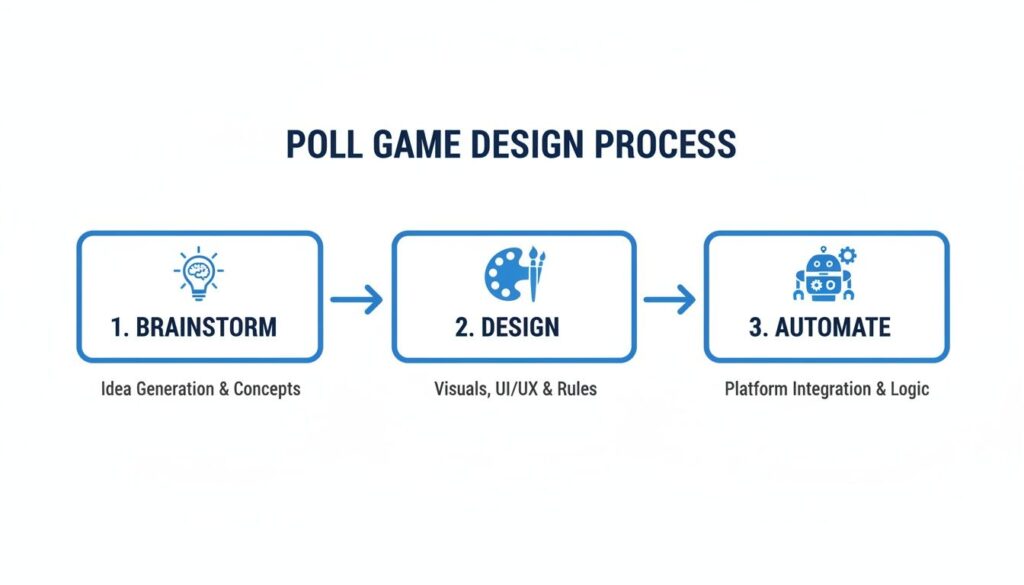
Instagram Poll Game Design Process
The key here is that automation isn’t an afterthought. It’s a core part of the design process from the very beginning, connecting your creative spark directly to tangible results.
Capitalizing on Real-Time Intent
The magic of this strategy is its immediacy. When someone votes in your poll, their interest is at an all-time high. If you wait hours or days to follow up manually, you’ve already lost the moment. DM automation lets you strike while the iron is hot, shifting the conversation from a public Story to a private, direct message where you can actually build a relationship.
First, you need to understand what DMing means in the context of smart, modern outreach. It’s not about spamming inboxes. It’s about delivering instant value based on an action someone just took.
The data backs this up. 50% of users engage with brands on the platform every single week, and polls are a huge driver of that interaction. By using tools to automate DMs based on poll answers, subscription businesses can recover up to 19% of lost sales, and coaches can capture 32% more emails for their funnels. Your audience is literally asking for this; stats show 44% of users want more polls from brands.
Setting Up Your Automated Follow-Up
You don’t need to be a developer to make this work. Tools like Clepher let you build these conversational flows with an intuitive, no-code interface. The whole thing hinges on setting up triggers based on poll votes.
Here’s a simple, real-world example:
- The Poll: You run a poll asking, “Which new flavor should we launch?” The options are “Spicy Mango” and “Cool Cucumber.”
- The Trigger: Inside your automation tool, you create a rule to listen for votes on that poll. A vote for “Spicy Mango” becomes a specific trigger.
- The Automated DM: The moment a user votes for “Spicy Mango,” they instantly get a message like, “Hey [First Name]! Great choice—Spicy Mango is in the lead! As a thank you for helping us decide, here’s a 15% discount on our current bestsellers. Enjoy!”
The goal is to make the automated message feel like a VIP concierge service. It should be helpful, personal, and deliver immediate value, transforming a simple tap into a meaningful brand interaction.
This method also unlocks incredible segmentation. By tagging users based on their poll answers, you create hyper-specific audiences for future campaigns. Someone who voted for “Spicy Mango” can get a direct notification when it launches, while the “Cool Cucumber” crew gets a different, tailored message. This is how you build a powerful and automated poll game on Instagram that nurtures leads 24/7.
To really get this working for you, learn more about Instagram DM automation and how to build these flows step-by-step.
Promoting Your Poll Game for Maximum Reach
You’ve built the perfect poll game. Now what? If you just launch it without a plan, all that creative effort might go to waste. A great game needs a great audience, and that doesn’t happen by accident. You need to build hype and drive as much attention as possible to your Stories the second your game goes live.
Think of your promotion plan as the final step that turns a cool idea into a real business result. It’s how you make sure the effort you poured into the design and automation actually pays off with huge participation.
Build Hype Before You Launch
Don’t just drop your poll game unannounced. Treat it like a mini-event. Instagram gives you all the tools you need to create buzz and get your followers excited for what’s coming.
Start dropping hints a few days before you go live. The countdown sticker in your Stories is a fantastic tool for this. It creates a real sense of urgency and, even better, lets people tap to get a notification the moment your game starts.
Here’s an actionable plan:
- A Feed Post: Post a graphic that poses the core question of your game. Your caption could be something like, “We’re settling the debate this Friday. Pick a side, and you might just get a surprise in your DMs. Turn on notifications so you don’t miss out!”
- A Quick Reel: Film a short, energetic video teasing the choices. A boutique owner could hold up two outfits, pointing back and forth with a text overlay saying, “Big decision in our Stories tomorrow. Which one will win?”
This isn’t just about making noise; it’s about priming your audience and making them feel like they’re in on something special.
Drive Traffic from Every Angle
Your poll game happens in your Stories, but your promotion shouldn’t be limited to them. Use every other part of your Instagram profile as a signpost pointing straight to the main event.
After all, a user who sees a Reel is 85% more likely to engage with your brand later. That makes Reels the perfect vehicle to funnel people over to your Stories.
And timing is everything. To give your promotional content the best shot at being seen, you need to know when to post on Instagram for your specific audience. Posting when your followers are most active gives you that critical initial burst of visibility.
Don’t silo your promotion. The goal is to create multiple pathways that all lead back to your Story poll. The more touchpoints you create, the higher your participation rate will be.
Don’t stop at Instagram, either. Fire off a quick email to your subscribers, giving them a heads-up about the game. This kind of cross-promotion not only boosts your numbers but also strengthens the bond between your different marketing channels. If you’re looking for more cross-channel strategies, check out our guide on how to improve social media engagement.
Analyzing Your Results to Optimize Future Games
Running your first poll game is great. But the real money is made by digging into the results. This isn’t about chasing vanity metrics like views or votes. It’s about finding the numbers that actually grow your business.
Think of it this way: every poll game you run is a test. The data you get back tells you exactly what to do next time to get better results.
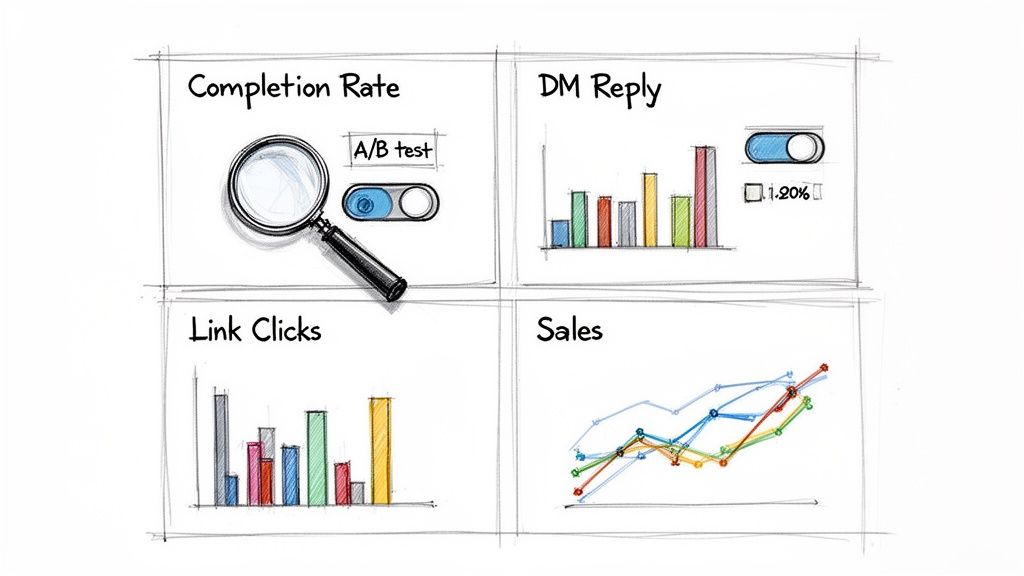
Instagram Poll Game Analytics Dashboard
When you turn that engagement data into business intelligence, you get a clear roadmap showing you where people are hooked and where they drop off.
Key Metrics That Drive Real Growth
Don’t get lost in a sea of numbers. A few key metrics will tell you if your poll game is actually working. These are the ones that connect directly to your bottom line.
Here’s what you should be tracking:
- Completion Rate: What percentage of people who started your game actually finished it? A high rate means your game was sticky. A sudden drop-off on a specific slide tells you exactly which part was boring or confusing.
- DM Reply Rate: Of all the automated DMs you sent out, how many got a real human reply? This is a huge indicator of how well your messages are sparking actual conversations.
- Link Click-Through Rate (CTR): What percentage of people who got a DM with a link actually clicked it? This is a direct measure of their interest and the first real step toward a conversion.
- Sales or Conversions: The ultimate goal. How many of those link clicks from your automated DMs turned into a sale, a signup, or whatever action you were aiming for?
Using Data to Refine Your Strategy
This feedback is where the magic happens. By jumping into the analytics inside a tool like Clepher, you can see exactly which questions got the best responses and which automated DMs drove the most clicks.
Your data isn’t just a report card on your last game; it’s the instruction manual for your next one. Every metric tells a story about what your audience wants and how they behave.
Let’s say your “This or That” game had a 90% completion rate, which is fantastic. But the follow-up DM had a low click-through rate. That tells you the game itself was fun, but your offer in the DM missed the mark. Maybe a discount code would work better next time than a link to a generic blog post.
A Simple Framework for A/B Testing
Once you have your first round of data, you can start optimizing. A/B testing is how you take the guesswork out of improving your results.
First, form a hypothesis based on what you saw. It’s just an educated guess. For example: “I bet if I change the DM from a question to a direct call-to-action, our CTR will go up.”
Next, test one single thing. Run your poll game again, but this time, send Version A of your automated DM to half the voters and Version B to the other half. Don’t change anything else—the poll questions, the visuals, the offer—keep it all the same.
Finally, analyze and iterate. After the game ends, compare the CTR for both versions. Whichever one did better is your new winner. It becomes the new “control” for your next test, where you can try to beat it by tweaking something else.
This cycle of testing and refining is how you turn a fun Instagram experiment into a predictable machine for generating leads and sales.
Common Questions About Instagram Poll Games
Once you start building your first poll game, you’ll inevitably run into questions. That’s a good sign—it means you’re thinking like a strategist, not just a content creator. Let’s tackle some of the most common hurdles marketers face so you can get your strategy dialed in from day one.
Conclusion
Whether you’re looking for poll ideas or ready-made story templates, a poll game on Instagram is one of the best Instagram tools to create engaging story posts that boost engagement and get people talking. Use Instagram polls, emoji sliders, a sliding scale, and poll or quiz formats to ask your followers, gather feedback, and gauge interest in an upcoming product or service. Instagram users say story polls and quizzes are a great way to get feedback and collect valuable insight in real time.
Results in real time help you use polls as a marketing tool and analytics tool to inform your marketing strategy and product launch. You can customize stickers from the stickers menu, create your own fun templates, and ask anything from market research questions to followers to rate or followers to guess answers for a giveaway. Using Instagram for social media marketing lets you engage your audience, engage with your content, and create engaging content that resonates with your target audience and turns casual viewers into loyal fans.
From creative ways to increase Instagram engagement to best ideas for Insta Story interaction, story templates, and like polls give you countless content ideas to make followers vote, pick the correct answer, or slide to express preference. In short, whether you’re an individual creator or a brand or product team, create a poll directly to Instagram to build buzz around launches, gather feedback, and use this simple, effective marketing tool to boost visibility, drive engagement, and collect valuable insights that shape your next campaign.
Ready to turn your poll voters into leads and customers? Clepher gives you the power to create these automated DM conversations in minutes. Build your first poll game automation and start capturing leads 24/7. Get started with Clepher today!
Related Posts
How to Create a Killer Poll Game on Instagram to Boost Engagement and Leads
March 24, 202612 Fresh Social Media Content Ideas That Convert in 2026
March 23, 2026Elevate Your Customer Experience with Conversational AI for Customer Engagement
March 22, 2026
Founder Clepher