
Marketing attribution asks one simple question: which of your marketing efforts actually brought in a sale? It’s how you stop guessing what works and start knowing which ads, emails, and social media posts are making you money.
Think of it as the difference between hoping for results and engineering them. With attribution, you’re not just throwing things at the wall to see what sticks; you’re building a predictable engine for growth.
Why Marketing Attribution Is Your Most Important Compass
Imagine your business is a soccer team, and a sale is the game-winning goal. Who gets all the credit? Is it only the striker who tapped the ball into the net? Or do you also credit the midfielder who made the killer pass, and maybe even the defender who started the whole play?
Without marketing attribution, you’re only crediting the striker—the very last thing a customer clicked before buying. You completely ignore the Instagram ad that first caught their eye or the helpful chatbot that answered their questions a week ago.
This is the exact problem attribution solves. It’s your game-day analysis, showing you every single touchpoint that influenced a customer’s decision to buy, so you know which players on your team are creating the most opportunities.
From Guesswork to Growth with Attribution Strategy
Marketing attribution transforms your strategy from thinking you know what’s working to proving what drives real results. It’s the difference between blindly throwing money at ads and strategically investing in the channels that give you the highest return.
This shift is critical, especially when you’re juggling multiple channels at once, like:
- Facebook Ads: To get your brand in front of new faces.
- Instagram DMs: To nurture leads with automated conversations.
- Email Campaigns: To announce a final, can’t-miss sale.
Attribution ties these separate activities into one clear story, showing you precisely how they work together to create a customer.
The Business Impact of Knowing “Which Half” Works
Over a century ago, a famous merchant said, “Half the money I spend on advertising is wasted; the trouble is I don’t know which half.” For decades, this has been the core challenge for marketers, especially as businesses run multiple channels, platforms, and marketing campaigns at the same time.
Marketing attribution is the modern answer to this age-old problem. It gives you the data-backed clarity to stop wasting your budget and double down on the marketing tactic that truly moves the needle.
Key Takeaway: Marketing attribution isn’t just about assigning credit. It’s about understanding the entire customer journey so you can make smarter decisions, prove your marketing ROI, and scale your business with confidence—something particularly important in B2B marketing, where sales cycles are longer and involve multiple interactions.
What started as simple “last-click” models has evolved into a sophisticated discipline with several types of marketing attribution. Modern approaches include the multi-touch attribution model, which evaluates several interactions across the buyer journey, and time decay attribution, which gives more credit to touchpoints that occur closer to the final conversion.
The importance of attribution continues to grow as marketing becomes more data-driven. In fact, the global market for marketing analytics and attribution technology is expected to reach $5.8 billion in 2026 and is projected to exceed $8.5 billion by 2030, highlighting how essential attribution tools have become for modern marketing teams.
This guide will walk you through exactly how to set up and use marketing attribution, helping you move from guessing which marketing tactic works to building a predictable growth engine powered by data.
Choosing Your Marketing Attribution Model
Alright, you’re sold on the why of marketing attribution. Now for the fun part: figuring out how to assign credit for a sale.
Think of attribution models as different pairs of glasses. Each one gives you a unique view of the customer journey, highlighting different touchpoints. The right model for you depends entirely on what you’re selling and how your customers buy.
This is the basic flow: people interact with your marketing, you use a model to figure out what worked, and you connect those efforts directly to revenue.
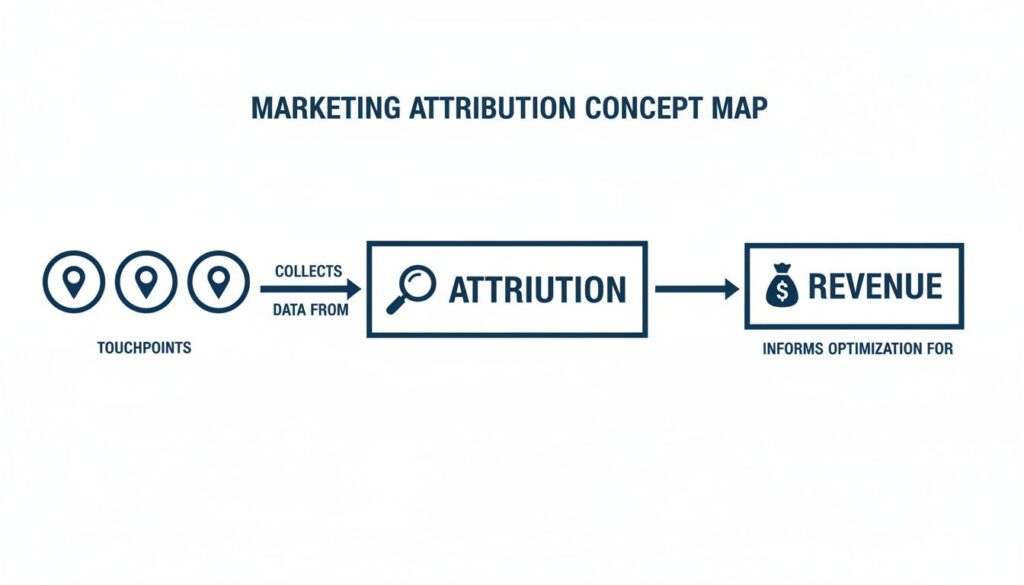
Marketing Attribution Concept Map
As you can see, it’s all about tracking interactions, applying a model to make sense of them, and then linking it all back to the money you’ve made.
The Simplicity and Pitfalls of Single-Touch Models
Single-touch models are the easiest to understand because they give 100% of the credit to just one interaction. They’re simple to set up, but they can be seriously misleading because they only tell a tiny piece of the story.
Here are the two you’ll see most often:
- Last-Click Attribution: This gives all credit to the very last thing a customer did before buying. If they clicked a link in a promo email and checked out, that email gets 100% of the credit.
- First-Click Attribution: The opposite of last-click. This credits the very first touchpoint that brought someone to your brand. If a customer first found you through a Facebook ad and then bought two weeks later, that initial ad gets all the glory.
The problem? Last-Click ignores all the hard work you did to build awareness, while First-Click misses the bottom-of-funnel nudges that actually closed the deal.
It’s wild, but 41% of companies still lean on Last-Click attribution, mostly because it’s the default setting in many analytics tools. This is a recipe for bad budget decisions, as it almost always undervalues your awareness campaigns. You can dig into more marketing attribution stats and trends.
Embracing the Full Story with Multi-Touch Models
To get a real, honest look at what’s working, you need a multi-touch model. These models spread the credit across several touchpoints, recognizing that most sales aren’t the result of a single click.
Building a strong presence across different platforms is the foundation here, which is why we put together a guide to a winning multi-channel marketing strategy.
Let’s break down the most popular multi-touch models.
Linear Model
Imagine you’re splitting a pizza evenly with four friends. That’s the Linear model. It takes the credit for a sale and divides it equally among every single touchpoint.
Practical Example: If someone read a blog post, saw a Facebook ad, chatted with your Messenger bot, and then clicked an email before buying, each of those four touchpoints gets 25% of the credit.
Best for: Businesses with longer sales cycles where you believe every interaction plays a roughly equal role in the final decision.
Time-Decay Model
This model works on a simple idea: the closer an interaction is to the sale, the more important it was. It gives the most credit to the final touchpoint and less and less to the ones that came before it.
Practical Example: A customer clicks a Google Ad on Monday. On Wednesday, they open a newsletter. On Friday, they click a flash sale email and buy. The Friday email gets the most credit, the Wednesday newsletter gets less, and the Monday ad gets the least.
Best for: Brands running short, intense campaigns like a Black Friday sale. In those scenarios, the most recent interactions are almost certainly the ones driving the final purchase.
Position-Based (U-Shaped) Model
The Position-Based model gives you the best of both worlds. It gives most of the credit to the very first touchpoint (the “discovery”) and the very last one (the “decision”).
Typically, it assigns 40% of the credit to the first touch, 40% to the last touch, and splits the remaining 20% among all interactions in between.
Practical Example: An agency is running a campaign for a new client.
- A prospect first discovers the brand through a Messenger bot (first touch, gets 40% credit).
- Over the next few days, they see a retargeting ad on Instagram and open a newsletter (middle touches, share 20% credit).
- Finally, a promotional broadcast in Messenger convinces them to buy (last touch, gets 40% credit).
Using this model, the agency can prove the value of both their initial lead generation (the bot) and their final sales push (the broadcast). It’s a powerful way to show a client that their full-funnel strategy is firing on all cylinders.
How AI Is Revolutionizing Attribution
While rule-based models like Linear and Position-Based are a huge step up from guesswork, they still rely on you telling the system what you think is important. The real gold standard of marketing attribution flips that script. It uses artificial intelligence to discover what actually drives conversions.
This is where data-driven attribution comes in. It’s not a fixed model; it’s a dynamic, learning algorithm.
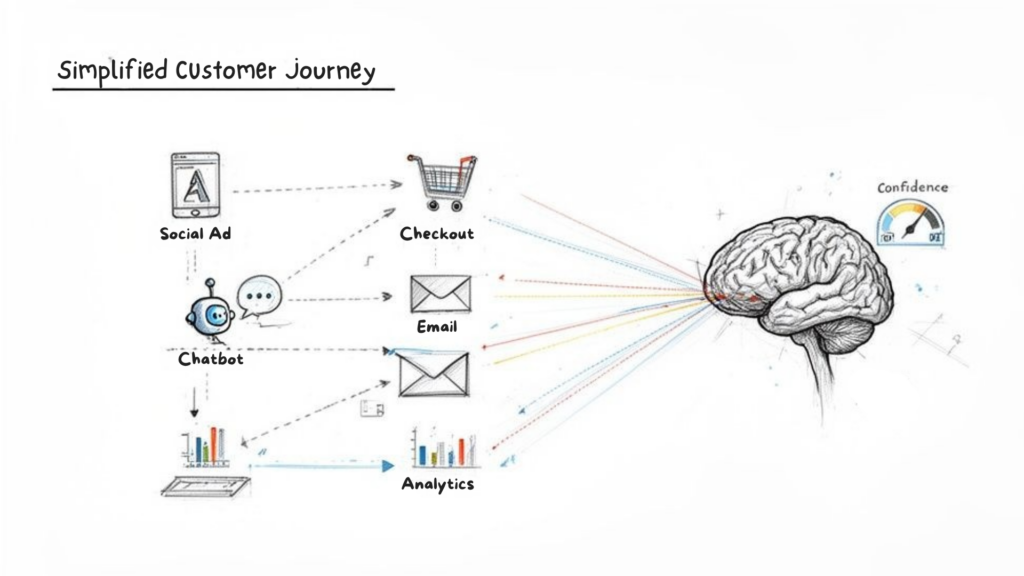
Marketing Attribution Customer Journey
Instead of just following rules, AI-powered attribution sifts through thousands—or even millions—of unique customer journeys. It compares the paths of people who converted with those who didn’t, finding the specific touchpoints that had the biggest statistical impact.
Moving Beyond Rigid Rules
Think of a rule-based model like following a pre-written recipe. It works, but it can’t adapt. Data-driven attribution, powered by machine learning, is more like an expert chef who tastes the dish as it cooks, adjusting ingredients on the fly to get the flavor just right.
The AI might discover that for your business, an Instagram Story view followed by a website visit within 24 hours has a massive impact on sales. It might find that a specific conversational flow inside your Messenger bot is the unsung hero of your entire funnel. These are insights a pre-set model would almost certainly miss.
Key Insight: Data-driven attribution doesn’t guess. It uses machine learning to calculate the actual contribution of each marketing touchpoint, giving you a far more accurate and actionable picture of what’s truly driving revenue.
The global shift to AI-powered attribution is happening fast. The market is expected to grow from $4.74 billion in 2026 to an incredible $10.10 billion by 2030. This boom is driven by machine learning models that assign credit dynamically—a technology seeing a 67% year-over-year adoption rate. You can read the full research about these market trends and see how quickly businesses are adapting.
Making AI Attribution Accessible and Actionable
In the past, this kind of analysis was only for huge companies with their own data science teams. Not anymore. Today, AI-powered attribution is becoming accessible to smaller businesses, with tools like Google Analytics 4 offering a free data-driven model right out of the box.
Here’s a practical example of how this technology creates clear opportunities for growth:
- Scenario: A SaaS company uses an AI chatbot to onboard new trial users.
- Challenge: They aren’t sure which part of the onboarding sequence actually convinces users to upgrade to a paid plan.
- AI Attribution Solution: A data-driven model analyzes thousands of user journeys. It finds that users who engage with a specific chatbot flow explaining “Feature X” are 3x more likely to convert.
This isn’t just a theory; it’s a direct, actionable insight. The company now knows to promote that specific conversational flow more heavily in their welcome emails and in-app messages. They can even use this new knowledge to learn how to use AI for marketing more effectively across all their campaigns.
By turning complex data into a clear directive, AI transforms attribution from a simple reporting tool into a powerful engine for business growth.
A Practical Guide to Implementing Attribution
All the theory in the world doesn’t mean a thing without action. So, let’s get our hands dirty. This is your roadmap for moving from knowing what marketing attribution is to actually doing it.
Building a system that ties your ad spend to actual revenue isn’t as complicated as it sounds. You don’t need a data science degree or a massive budget to get started. We’ll break it down into four straightforward steps.
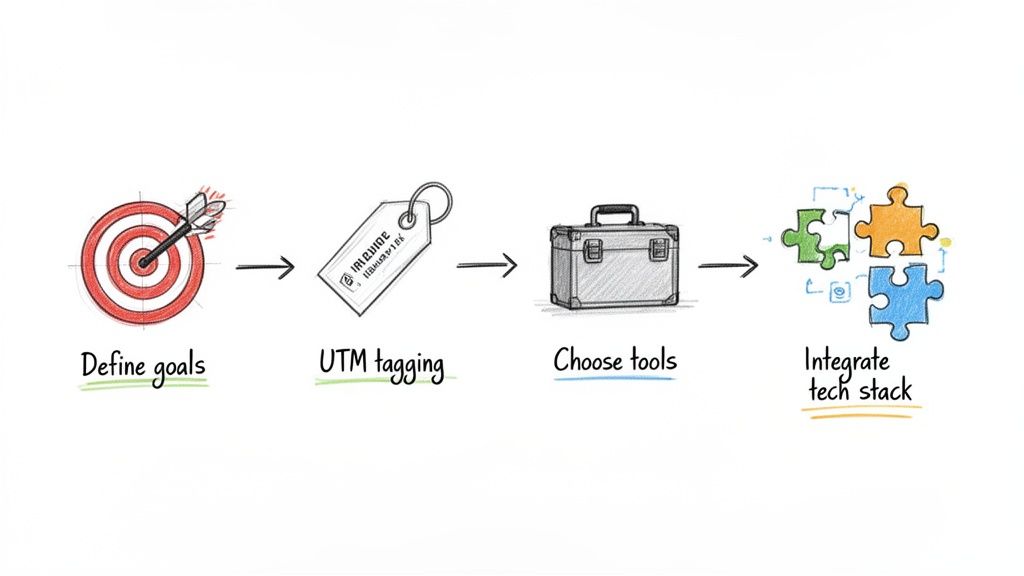
Marketing Attribution Marketing Process
Step 1: Define Your Conversion Goals
Before you track a single click, you need to know what a “win” looks like. What action do you want people to take? This is your conversion goal. A goal could be the final sale, but it can also be a smaller, critical step along the way. Without clear goals, your attribution data is just noise.
Common conversion goals include:
- A completed purchase on an e-commerce store.
- A lead magnet download (like an ebook or checklist).
- Booking a discovery call through a scheduling link.
- Starting a free trial for a SaaS product.
- Subscribing to your Messenger or WhatsApp list.
Actionable Tip: Pick goals that are directly tied to revenue or represent a major step in your sales funnel. Everything else you do will build on this foundation.
Step 2: Master Your Data Collection with UTMs
This is where most attribution efforts either succeed or fail. UTM parameters are simple tags you add to the end of your URLs. They act like a breadcrumb trail, telling your analytics tools exactly where each visitor came from.
Think of it like this: without UTMs, all your traffic gets dumped into one bucket, making it impossible to know if your Facebook ad, your email newsletter, or your guest post drove the sale. A consistent UTM strategy is non-negotiable.
There are five standard UTM parameters to know:
- utm_source: The platform where the traffic came from (
facebook,google,instagram). - utm_medium: The marketing channel (
cpc,social,email). - utm_campaign: The specific campaign name (
black-friday-2024,new-course-launch). - utm_term: Used to track specific keywords in paid search ads.
- utm_content: Helps differentiate links within the same ad or email (
blue-button-advs.video-ad).
The Golden Rule of UTMs: Be obsessively consistent. Decide on a naming structure and stick to it. Using
FBwill create three different sources in your reports, turning your data into a complete mess.
Step 3: Choose the Right Attribution Tools
Once your data is flowing in cleanly, you need a tool to make sense of it all. You don’t have to jump straight to expensive, enterprise-level software. Many businesses can get incredible insights from the tools they already have.
- Native Analytics Platforms: Tools like Google Analytics 4 are free and surprisingly powerful. GA4 even offers a data-driven attribution model, giving you a sophisticated look at what’s working without spending a dime.
- Dedicated Attribution Software: As you grow, you might look into a Salesforce Marketing Attribution platform for more advanced cross-channel features.
- Chatbot and CRM Platforms: Don’t sleep on the data hiding in your other marketing tools. A platform like Clepher tracks every interaction inside your Messenger and Instagram bots, showing you which conversations and flows actually lead to clicks and sales.
Actionable Tip: Start with a tool that matches your current needs and budget. You can always level up later as your marketing gets more complex.
Step 4: Integrate Your Tech Stack
The last piece of the puzzle is to connect all your tools to create a single, unified view of the customer journey. Why? Because customers don’t live in a single platform. They might see a Facebook ad, talk to your chatbot, get an email, and then finally buy.
Integrating your tech stack makes sure the data from each of those touchpoints is connected. For instance, when a user subscribes to your Messenger bot, Clepher can pass that lead data over to your CRM. This connects their first touch on social media to a final purchase on your website.
You stop seeing isolated snapshots and start seeing the full story. For more on this, our guide on how to track website visitors gives you some practical next steps.
Common Attribution Pitfalls to Avoid
So you’ve set up attribution. Don’t celebrate just yet. The real work is making sure the data you’re collecting is actually telling you the truth.
Plenty of well-meaning marketers fall into common traps that turn their attribution reports into a confusing mess of bad data. Let’s walk through the most common mistakes so you can build a system you can actually trust for making big-budget decisions.
Over-Reliance on a Single Model
This is probably the biggest mistake: picking one attribution model and never looking back. Every model tells a different part of the story. A Last-Click model is great for seeing what closes the deal, but it tells you nothing about what got people in the door.
Actionable Insight: Smart marketers don’t marry a single model; they compare several. Run your reports using Last-Click, First-Click, and a multi-touch model like Position-Based. The magic happens when you see where they agree—and where they don’t.
If your Facebook ads get tons of credit in a First-Click model but almost zero in a Last-Click report, that doesn’t mean your ads failed. It means they’re incredible for awareness, but another channel is better at sealing the deal. That’s a powerful insight, not a failure.
Inconsistent and Messy UTM Tagging
We’ve mentioned this before, but it’s so critical it’s worth saying again: messy UTMs will kill your attribution efforts. When one person on your team uses facebook, another uses Facebook, and a third uses FB as the source, your analytics tool sees three entirely different channels. Your data becomes fractured and worthless.
Actionable Tip: The fix is simple. Create a standardized spreadsheet for generating UTM links and make it mandatory for your entire team. No exceptions.
Attribution Red Flags Checklist:
- Inconsistent Naming: Are your
utm_sourceandutm_mediumvalues all over the place (e.g.,emailvs.Email)? - No Campaign Tag: Are you running ads without a specific
utm_campaignto identify them? - Vague Parameters: Are your tags too generic, like
utm_content=button? Which button? - Forgetting Offline: Are you ignoring offline marketing? Flyers and events need unique URLs or QR codes to be tracked.
If you nodded “yes” to any of these, it’s time for a data cleanup.
Ignoring the Cross-Device and Cross-Channel Problem
Today’s customer journey is chaos. Someone might see your ad on their Instagram feed (phone), do some research on their work laptop, and then finally buy on their tablet after chatting with your bot. That’s the cross-device challenge.
Most basic analytics tools can’t connect these dots. They rely on cookies, which don’t follow a user from their phone to their laptop. This creates massive data gaps and often makes your tool think one person is actually several different people.
Actionable Steps to Mitigate This:
- Encourage Logins: Give users a reason to create an account. A logged-in user can be tracked across every device they use, stitching their journey back together.
- Use People-Based Tools: This is where platforms like Clepher shine. They identify a user by their Messenger or Instagram ID, connecting all their interactions within those apps, no matter what device they’re on.
- Integrate Your Stack: When your chatbot, CRM, and email platform are all talking to each other, you can start matching user data—like an email address or phone number—across systems. This helps you build a single, unified profile for each customer.
Actionable Use Cases for Your Business
Theory is great, but let’s talk about revenue. Knowing your attribution data is one thing; using it to justify your budget and make smarter decisions is the real game-changer. These real-world examples show exactly how attribution connects your marketing moves to measurable results.
Ultimately, the point of all this is to stop guessing and start knowing. Learning how to properly measure marketing ROI helps you pinpoint exactly what’s working, so you can double down on it.
Each of these scenarios shows you how to go from “I think this works” to “I know this drives X% of our revenue.”
For the E-Commerce Brand
Imagine you run an online store. You’ve got a Messenger bot with Clepher to hit up shoppers who abandon their carts, offering a discount to bring them back. At the same time, you’re running Facebook retargeting ads to that same audience.
The Challenge: A sale comes through. What gets the credit? The bot? The ad?
Attribution in Action:
A multi-touch model reveals the full story:
- First Touch: A customer clicks your Facebook retargeting ad but gets distracted. No sale yet.
- Second Touch: An hour later, your automated Messenger bot pings them with a reminder and a 10% off code.
- Conversion: They click the link in the message and finally complete their purchase.
A basic Last-Click model gives 100% of the credit to the Messenger bot. But a smarter, multi-touch view reveals the truth: the Facebook ad and the bot worked together.
The Result: You can confidently keep investing in retargeting ads and your cart recovery bot, knowing they’re a profitable tag team. You’ve gone from hoping it works to building a proven system that brings back lost sales.
For the Marketing Agency
You’re managing Instagram accounts for clients, using DM automation to grab and qualify leads. Your client pays a retainer for results, but they can’t always connect a simple “DM conversation” to a paying customer.
The Challenge: How do you prove your DM strategy is generating valuable leads and not just “engagement”?
Attribution in Action:
You set up tracking that follows the lead from Instagram all the way to a conversion:
- A potential customer DMs your client’s Instagram page using a keyword.
- Your automated flow instantly qualifies them and sends a link to book a discovery call.
- The user clicks the link (with UTM tags) and books a time.
Your attribution report makes it crystal clear: “Instagram DM” is a top source for qualified leads. You can now walk into a client meeting and say, “This month, our DM automation generated 15 qualified sales calls, which turned into 3 new clients.” That’s how you justify your retainer with cold, hard data.
For the Course Creator
You sell a high-ticket online course. Your funnel starts with a free guide, offered via a chatbot on your website. After that, you nurture leads with WhatsApp broadcasts to close the sale.
The Challenge: How do you connect the dots between a curious website visitor and a student who paid for your course weeks later?
Attribution in Action:
By connecting your tools, you can trace the entire customer journey. A visitor lands on your site, chats with your bot, and gives their contact info to get the free guide. A week later, they get a WhatsApp broadcast about a limited-time offer, click the link, and enroll.
Attribution ties that very first chatbot interaction to the final sale. It proves the bot isn’t just a cool website feature—it’s the critical first step in your sales funnel, responsible for bringing paying customers through the door.
You’ve got the theory down. But when it’s time to actually do attribution, the real questions start cropping up. Let’s clear up the common hurdles that come with putting attribution into practice.
Ready to connect your conversations to your conversions? Clepher gives you the tools to track exactly how your chatbots on Messenger, Instagram, and your website contribute to sales. Start building a smarter, data-driven marketing engine today.

Related Posts
Website Facebook Messenger: Setup & AI for Sales in 2026
April 1, 2026How an API Chat Bot Transforms Your Business (And How to Build One)
March 31, 2026
Founder Clepher