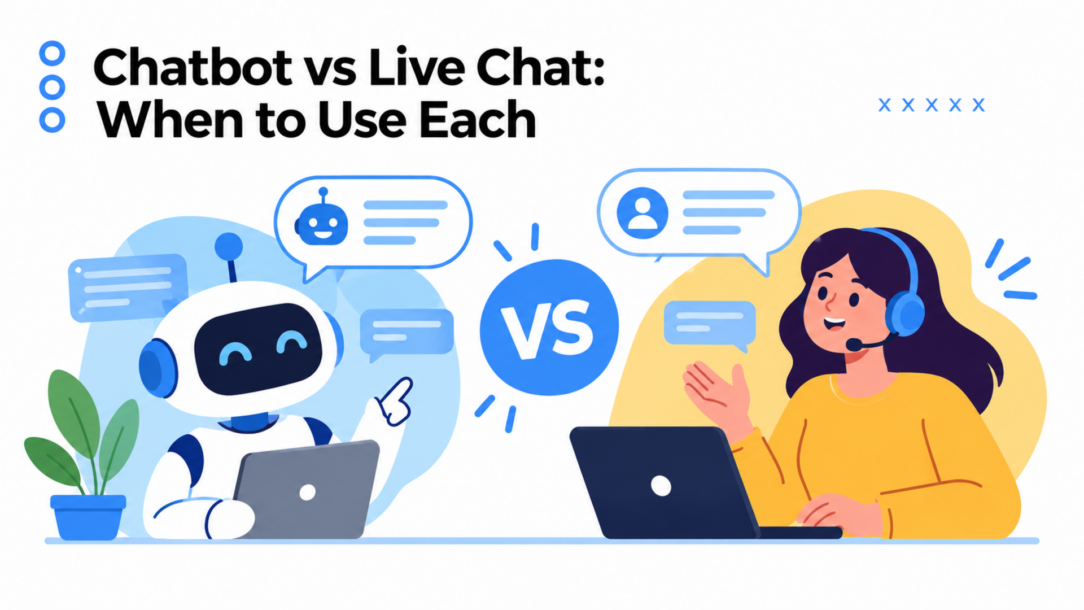
The popular advice on chatbot vs. live chat is simple: choose a chatbot for efficiency or live chat for quality. That framing creates poor support systems. A chatbot can answer a routine question immediately, while a live agent can prevent a frustrated customer from abandoning a purchase. The hard operational problem isn’t choosing one channel. It’s deciding which conversations automation should own, when a human should take over, and whether the handoff preserves trust.
For most e-commerce, SaaS, agency, and creator businesses, chatbots and live chat work best as a coordinated service model. Automation handles predictable demand, collects context, and keeps response coverage available. Human agents handle judgment, exceptions, complaints, and conversations where the customer needs reassurance rather than another scripted answer.
| Business need | Chatbot | Live chat | Practical choice |
|---|---|---|---|
| Order status, FAQs, availability | Strong fit | Useful when the data is unclear | Start with automation |
| Lead capture and qualification | Strong fit | Valuable for high-intent prospects | Qualify first, alert sales |
| Refunds and complaints | Limited | Strong fit | Escalate early |
| Product advice and complex troubleshooting | Can gather context | Strong fit | Use confidence-based routing |
| After-hours coverage | Strong fit | Depends on staffing | Bot first, human follow-up |
| Emotional or sensitive conversations | Weak fit | Strong fit | Make human transfer visible |
Why Chatbot vs Live Chat Is the Wrong Question
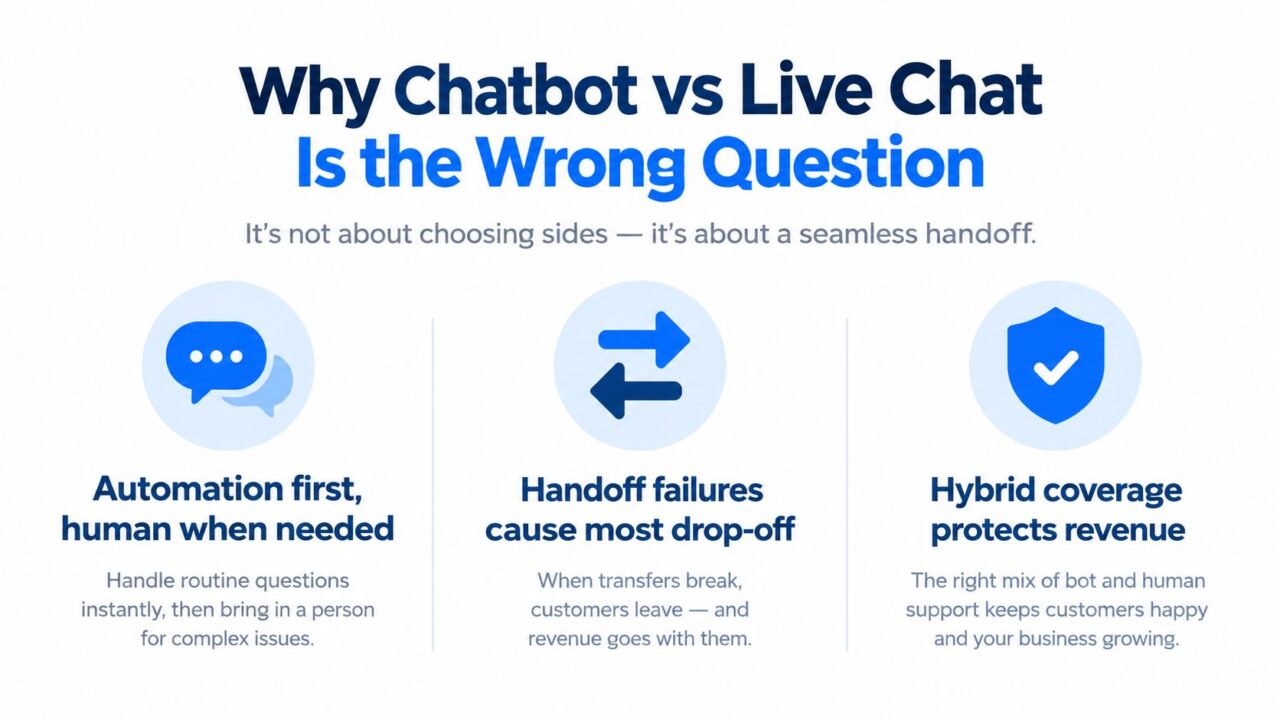
A chatbot and a live agent should not compete for the same work. The operational decision is which conversations automation should complete, which it should qualify, and when a human should take over. That model protects agent capacity without forcing customers through a bot that cannot handle judgment, exceptions, or emotion.
A 2021 global customer-service report found satisfaction of 64.2% for chats and 64.7% for chatbot-handled conversations, a gap of just 0.5 percentage points in that context. The result does not make bots suitable for every interaction. It shows that a well-built bot can manage routine requests without creating a meaningful satisfaction gap. (See the comparative customer-service data)
The broader operating picture supports a hybrid model. A 2025 benchmark covering more than 220 million live-chat interactions reported average live-chat CSAT of 79.9% in 2024, while chatbot automation resolved approximately 46% of incoming chats. Automation absorbs repeatable demand. Human support handles ambiguity, complaints, and cases where reassurance matters. (Review the 2025 live-chat benchmark)
Chatbot vs Live Chat Hybrid Support
Deflection and first-response time do not show whether the customer reached a resolution. Survey findings indicate that 72% of consumers are open to AI interactions when escalation to a human is available, while 55% of shoppers have needed to escalate an AI-handled issue to a person. Another 45% said the AI did not understand their problem. (Read the consumer trust findings)
Practical rule: Automation earns the first turn. The customer decides whether the experience succeeds.
Measure containment alongside transfer rate, repeat explanations, resolution, and satisfaction after escalation. A strong handoff passes the conversation history, intent, and relevant customer data to the agent, so the customer does not have to start again.
Chatbot vs Live Chat: Core Differences
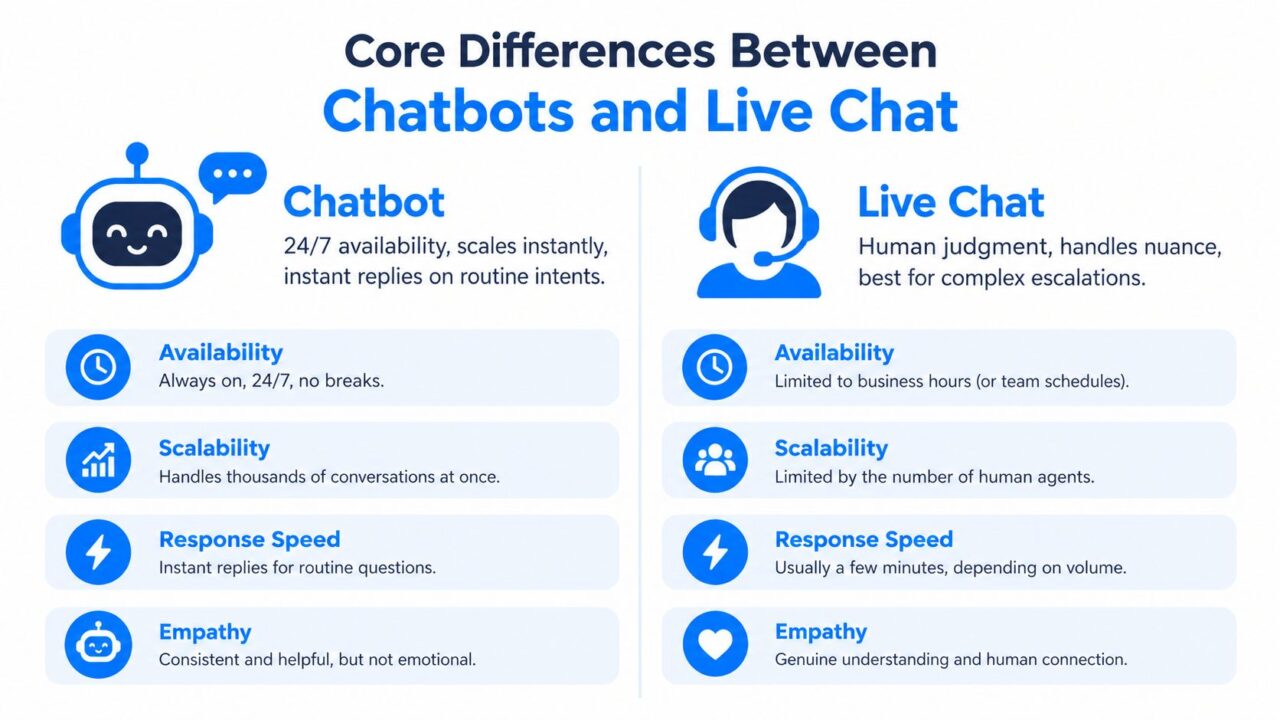
Chatbots and live chat differ less by interface than by the type of judgment they can apply. A chatbot follows configured logic, retrieves approved information, asks qualifying questions, and performs defined actions. A live agent interprets incomplete information, notices frustration, negotiates exceptions, and adapts the conversation to the customer.
Compare the work, not the widget
| Criterion | Chatbot | Live chat |
|---|---|---|
| Availability | Immediate coverage across service hours and after-hours periods | Available when trained agents are scheduled |
| Scalability | Handles many simultaneous routine conversations | Capacity grows with staffing and workload |
| Response speed | Instant for supported intents | Fast when the queue is healthy |
| Consistency | Repeats approved answers consistently | Quality varies with context and agent skill |
| Complexity | Strong with structured, predictable requests | Strong with ambiguous or multi-step problems |
| Empathy | Can recognize configured signals but has limited judgment | Can respond to emotion, nuance, and trust concerns |
A bot is a good fit for “Where is my order?” when it can query current order data. It becomes a poor fit when the customer says the order is late, the item was needed for an event, and the tracking information conflicts with the carrier record. The words may look similar to the system, but the service risk is different.
Live chat also has limits. A human agent can’t provide unlimited concurrent coverage without staffing, training, queue management, and clear operating hours. Bots provide scale, but they need maintenance, current knowledge, and strong exit paths. Neither channel fixes a broken process by itself.
Chatbot vs Live Chat Comparison
Handoff is a product capability
Human escalation shouldn’t sit at the bottom of a chatbot settings page as an optional fallback. A recent consumer survey found that 98% of respondents considered transfer to a human agent important or very important, making it the highest-rated chatbot capability in that research. (Review the chatbot capability findings)
That changes how teams should evaluate tools. Ask whether the system can preserve the transcript, pass captured fields, show the customer’s intent, identify failed turns, and give an agent ownership of the conversation. For a practical overview of the human support model, see this guide to live chat support.
A chatbot that answers fewer questions but transfers cleanly can create a better experience than one that claims high resolution while trapping customers in loops. The distinction is operational: containment is valuable only when the customer reaches the desired outcome.
When to Choose Chatbots for Your Business
Chatbots earn their place when speed matters and the task has defined boundaries. A shopper checking jacket availability, a customer asking for an order update, or a visitor from an Instagram promotion exploring product fit can often get a useful first response without waiting for an agent.
Use automation when the business can define the intent, verify the answer, and complete the next action through structured information. Suitable assignments include:
- Product questions: Explain features, compatibility, sizes, ingredients, or available options from an approved knowledge base.
- Order and shipping requests: Retrieve status information without placing the customer in an agent queue.
- Lead capture: Ask for contact details, interests, budget range, or preferred service before notifying sales.
- Appointment requests: Collect required information and send the request to the appropriate calendar or team.
- Qualification: Distinguish product researchers from high-intent buyers and pass useful context to an agent.
- Subscriber growth: Capture consent and audience details through website, Messenger, Instagram, or WhatsApp conversations.
Speed matters most at the point of intent. A Velocify analysis of more than 3.5 million leads found that responding within one minute increased conversion rates by 391% compared with responding after two minutes. (Read the lead-response analysis) The finding does not guarantee the same result from every bot. It shows why an automated qualification message can protect a narrow window while a salesperson prepares the next response.
Use structure as the safety test
A safe automated intent has a clear answer and a clear completion condition. “What are your delivery options?” is usually structured. “My delivery was promised yesterday and nobody is helping me” is a service recovery case, even though it contains a delivery topic.
Well-built bots can match live chat satisfaction on routine intents, as shown earlier. The useful test is not whether automation wins an average comparison. It is whether the flow completes the customer’s task, recognizes uncertainty, and hands off before frustration grows.
That makes containment an operational measure, not a vanity metric. Count a conversation as contained only when the customer reaches the intended outcome without needing to repeat the request.
For lead workflows, a dedicated chatbot for lead generation can ask qualifying questions before a human joins. Configure the flow to offer a human connection without forcing the visitor to start again. Preserve the transcript and captured fields, show the handoff option clearly, limit failed turns, and route uncertainty involving payment, privacy, account access, or a high-value purchase to an agent.
When Live Chat Should Take Over
Some conversations fail when a business keeps optimizing the bot after the customer has already asked for judgment. Refund requests, payment problems, account access, complaints, complex product advice, and emotionally sensitive situations need a human path that customers can see and use.
A 2025 survey of 1,500 respondents found that 68% of users receiving AI-chatbot assistance reported being helped, compared with 79% for human assistance. Mean satisfaction was 3.9 out of 5 for chatbots versus 4.5 out of 5 for humans. (Review the survey results) The figures don’t make automation useless. They show why the bot should recognize when the conversation has moved beyond a deterministic task.
Route by confidence and consequence
Use three routing states instead of a binary bot-or-agent switch:
- High confidence, low risk: Answer automatically when the intent is clear and the response comes from validated information.
- Moderate confidence: Ask one clarifying question, then reassess. Don’t keep asking if the customer is repeating the same information.
- Low confidence or high consequence: Transfer to a human, especially after a failed answer, negative sentiment signal, payment issue, access problem, or explicit request for an agent.
The routing signal should combine confidence, intent, customer value, emotional tone, and business risk. A high-value prospect asking for a product comparison may need a salesperson even if the bot understands the words. A complaint should receive earlier intervention than a basic availability question.
When a transfer happens, pass the transcript, captured contact details, intent, relevant order data, and any failed answers to the agent. The customer shouldn’t explain the same problem again. Teams that want agents to work with better context can also evaluate real-time agent assistance as part of the support workflow.
For teams comparing platforms, a practical shortlist of best live chat software for websites can help evaluate routing, transcript continuity, agent availability, and reporting rather than focusing only on the chat bubble’s appearance.
Building a Hybrid Chatbot and Live Chat Strategy
The strongest operating model is tiered. A chatbot captures the initial intent, resolves low-risk requests, gathers useful information, and transfers conversations that need judgment. A live agent then continues from the existing context instead of starting a second conversation.
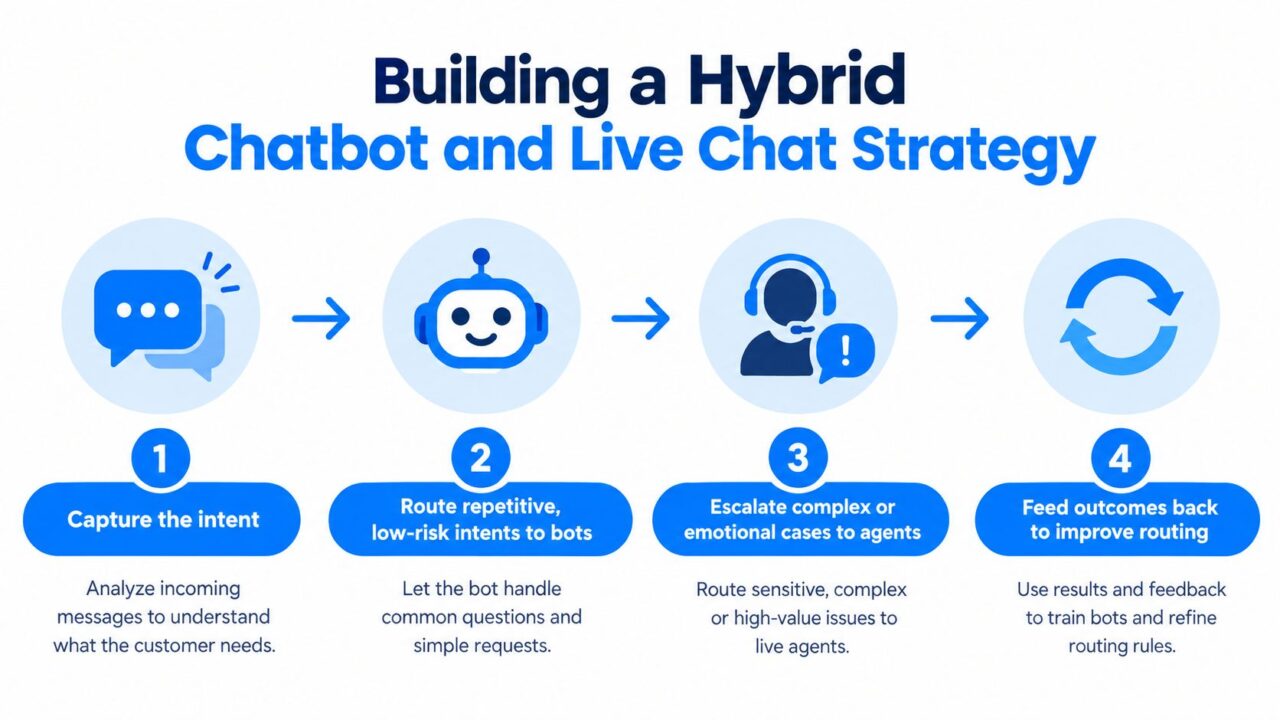
Chatbot vs Live Chat Hybrid Strategy
A practical flow looks like this:
- Capture the intent. Start with the customer’s language, channel, campaign source, and any known account or order context.
- Automate routine work. Route FAQs, order status, appointment requests, and basic qualification to the bot.
- Escalate with context. Transfer complex, emotional, high-value, or unresolved conversations to an agent.
- Improve from outcomes. Review failed turns, successful resolutions, escalations, repeat contacts, and sales outcomes to update routing.
The important metric isn’t chatbot usage. It’s automation containment, defined as the percentage of conversations completed without agent intervention. Segment it by intent, channel, language, and customer value. A single blended number can hide the fact that order-status containment is healthy while complaint containment is damaging satisfaction.
Measure the handoff as part of the resolution, not as an exit from the bot.
Track these operational signals:
- Containment: Did the customer complete the task without an agent?
- Escalation rate: Which intents and channels transfer most often?
- Fallback frequency: How often does the bot fail to understand or answer?
- Turns to resolution: How much conversational effort does each outcome require?
- Human-transfer latency: How long does the customer wait after requesting help?
- Repeat-contact rate: Did the customer return because the first interaction ended prematurely?
- Post-chat CSAT and conversion: Did the support experience protect satisfaction, revenue, or lead quality?
Watch the relationship between metrics. High containment with declining CSAT usually signals premature closure, weak intent recognition, or missing escalation paths. Low containment with strong CSAT may indicate that the bot is doing useful qualification before a human completes the work.
You can browse customer experience management platforms when you need broader visibility across conversations, feedback, and service operations. For implementation, compare bot-only, live-only, and hybrid routing with the same intent mix and service hours. Otherwise, the hybrid model may seem superior just because it receives easier requests.
Cost, ROI, and Measuring Success
The cheapest interaction isn’t automatically the most profitable one. A chatbot can handle volume without adding a proportional number of agent hours, but a human may protect a high-value sale or resolve a complaint that would otherwise become a repeat contact. ROI depends on what the conversation is worth and whether the customer reaches a useful outcome.
Start with a decision matrix:
| Situation | Primary channel | Why |
|---|---|---|
| High volume, predictable questions | Chatbot | Scale and consistency |
| Immediate lead response | Chatbot first | Capture intent while interest is active |
| Complex sales decision | Live chat | Judgment and tailored advice |
| Refund or complaint | Live chat | Ownership and service recovery |
| Mixed support demand | Hybrid | Route work by risk and complexity |
| After-hours inquiries | Chatbot with follow-up | Maintain coverage without pretending to be human |
Customer preference varies by task. 87% of consumers prefer a human for quick company interactions when given a choice, while 25% are indifferent as long as they reach the desired outcome, according to Intercom’s cited research. (Review the customer preference findings) The operational implication is clear: give customers a visible choice, then make the automated route useful enough to complete simple work.
Build a multi-objective score
Don’t optimize first-response time in isolation. Score the experience across:
- response latency,
- resolution accuracy,
- escalation quality,
- post-chat CSAT,
- repeat-contact rate,
- lead or purchase conversion,
- revenue per conversation,
- agent time saved without harming outcomes.
For e-commerce and DTC teams, report containment by intent, channel, language, and customer value. A bot that contains a low-value FAQ and a bot that contains a high-value purchase conversation shouldn’t carry the same business interpretation. Pair containment with CSAT and repeat contact so premature closures become visible.
The cost model should also include maintenance. Knowledge updates, flow testing, escalation coverage, agent training, transcript review, and integration work all affect the actual operating cost. Live chat requires staffing and quality management, while chatbot operations require governance and continuous correction. A channel that looks inexpensive at the platform level can become costly if it creates repeat contacts or lost conversions.
Your Next Steps for Implementation
Don’t replace your support stack overnight. Start with a focused pilot around a small group of intents where the expected outcome is easy to define.
Map risk before choosing the channel
Create an intent inventory from existing chats, tickets, sales questions, and social messages. Assign each intent a complexity and risk level:
- Automate first: Product discovery, order status, appointment booking, shipping information, availability, and FAQs.
- Qualify then route: High-intent product comparisons, consultation requests, wholesale questions, and campaign-driven leads.
- Escalate early: Refunds, complaints, account access, payment issues, privacy-sensitive requests, and high-value purchases.
For each automated intent, write the completion condition. “The bot answered” isn’t a completion condition. “The customer received the correct tracking status and had no unresolved follow-up” is closer to one.
Design the transfer before launching
Put the human option where customers can find it. Set explicit triggers for low confidence, repeated failed turns, negative sentiment, sensitive topics, and direct requests for an agent. Transfer the transcript and collected fields, including consent status, campaign source, customer segment, intent, and relevant account context.
Then test routing policies, not just copy. One policy might transfer after a single failed turn. Another might ask one clarifying question first. Compare bot-only, live-only, and hybrid handling against the same intent mix, service hours, and customer segments. Keep guardrails around regulated, payment-related, privacy-sensitive, and account-access requests.
Review the numbers that explain the experience
Live chat became a major digital customer-service channel during the 2010s, and chatbot deployment accelerated after Facebook opened Messenger to chatbot developers in 2016. Consumer preference data reports that 41% of users prefer live chat over email, phone, or social messaging, rising to 56% among customers aged 18 to 34. The same data attributes an 88% average satisfaction rating to live chat through the American Customer Satisfaction Index. (Review the live-chat history and preference data)
Use those benchmarks as context, not as targets you can copy without examining your audience and intent mix. Your dashboard should show containment, escalation quality, CSAT after transfer, repeat-contact rate, transfer latency, resolution accuracy, and revenue or lead conversion by channel.
Run the pilot long enough to see routine demand and difficult edge cases. Remove flows that create loops, improve answers that cause repeat contacts, and expand automation only when the human path remains clear. A hybrid system earns trust when customers can move from speed to judgment without losing their history.
Clepher helps businesses build chatbot flows for marketing, sales, and support on Facebook Messenger, Instagram, and your website, with live chat and notifications that alert your team when a conversation needs personal attention. Visit Clepher to design a practical hybrid workflow that captures intent automatically and brings your team into the conversation when it matters.