
Only 25% of marketing leads are sales-ready when they’re first generated, while about 79% never convert without stronger nurturing and qualification, highlighting the need for better alignment between marketing efforts and the sales funnel, according to B2B marketing-qualified lead benchmarks. That gap isn’t a minor reporting problem. It’s where sales capacity disappears, follow-up slows down, and acquisition spend produces activity instead of pipeline.
Lead qualification marketing fixes that gap by deciding, in real time, which enquiries deserve immediate human attention, which need nurturing, and which should be disqualified. The strongest systems don’t rely on a static form or a salesperson’s instinct alone. They combine fit, behavior, conversational answers, score decay, and fast routing into one operating process.
Why Lead Qualification Marketing Matters in 2026
A typical B2B funnel may convert 31% of leads into MQLs, 13% of MQLs into SQLs, and about 59% of SQLs into opportunities. One 2026 benchmark dataset puts the combined MQL-to-SQL rate at 9.8%, and the full-funnel lead-to-closed-won rate at 0.94% is the average conversion rate from MQL to SQL, indicating the importance of refining the decision process, as reported in Lead quality benchmarks should be established based on the performance of the marketing and sales teams.. Those figures show why lead qualification marketing sits between acquisition and sales. Lead volume enters at the top, but qualification determines whether that volume becomes a sales conversation.
Qualification is a routing decision
A visitor who downloads an educational guide shouldn’t automatically receive a sales call. A buyer who returns to pricing, asks about implementation in chat, and shares a near-term timeline probably shouldn’t sit in a generic newsletter sequence.
A practical qualification system makes three decisions:
- Route hot demand: Send high-fit, high-intent enquiries to the right salesperson immediately.
- Nurture early interest: Keep relevant but premature leads in a sequence matched to their problem and buying stage.
- Disqualify poor fit: Suppress spam, competitors, students, and contacts outside your market instead of consuming sales time.
This matters more as acquisition becomes noisier. AI-generated content can increase low-intent form activity, privacy restrictions can reduce the reliability of attribution signals, and expensive paid traffic makes a low-quality MQL increasingly costly. A volume target can look healthy in a dashboard while sales rejects most of the records.
Replace MQL volume with conversion quality
The MQL rate benchmark summarizes a healthy B2B range as roughly 15% to 30%, with SaaS and technology often around 15% to 25% and professional services around 20% to 35% is the range of conversion rates that sales and marketing teams should aim for in the sales funnel.. Those ranges aren’t universal targets. They show why a scoring model must account for channel intent. A demo request behaves differently from an ebook download, and an ungated article usually provides weaker buying evidence than a direct product question.
Practical rule: Ensure that the marketing and sales teams collaborate on a checklist for effective lead qualification. Treat the MQL as a decision threshold, not a trophy. If sales rejects the lead, the model needs a reason code related to the lead qualification process and the decision criteria, not another volume target.
Start by defining what sales-ready means for each motion. Then capture the signals that support that definition, route them quickly, and review the outcomes against accepted opportunities. That process turns qualification from a subjective handoff into a measurable control point.
The Core Concepts Behind Lead Qualification
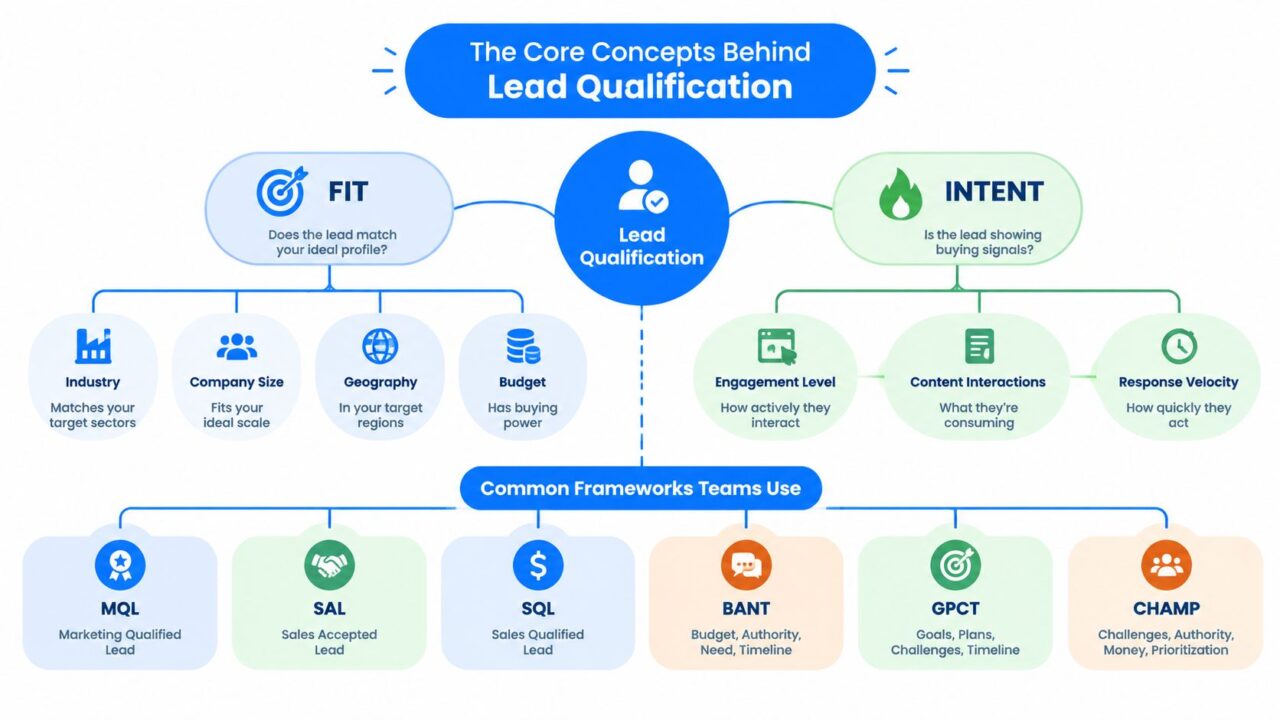
Lead qualification has two operating lenses: fit and intent. Fit asks whether the account belongs in your ideal customer profile, based on factors such as industry, company size, geography, role, and commercial suitability. Intent asks whether the person is showing a credible reason to buy now through behavior, conversation, or a direct request.
Fit is the right address on an envelope. Intent is whether the recipient has been hovering over the mailbox all morning.
Lead Qualification Marketing
Fit and intent need separate scores
A company can match your ICP but have no active project. Another contact can show intense curiosity but work for an organization you can’t serve. Combining both signals into one unexamined score hides that difference.
Use separate fields first:
- Fit: Industry, company size, geography, role, and stated budget.
- Intent: Pricing visits, repeat sessions, demo activity, email replies, and chat answers are essential metrics for evaluating lead quality benchmarks in the sales funnel.
- Timing: Whether the problem is active, planned, or merely exploratory.
Then decide how those fields create an operational stage. An MQL is marketing-qualified and ready for a defined next step, often nurture or a controlled sales review. A SAL is accepted by sales for follow-up. An SQL A marketing qualified lead that has survived sales interaction and meets the criteria for active opportunity pursuit.
The labels matter only when teams attach actions to them. “MQL” should tell sales what the person did, why the account fits, and what happens next. “SQL” should reflect a validated business conversation, not merely a high engagement score.
Use BANT as a conversation filter
BANT, covering Budget, Authority, Need, and Timeline, remains useful because it gives a rep or chatbot a compact way to structure discovery. The BANT qualification framework defines an accepted lead through those four checks.
Don’t turn BANT into an interrogation. Ask one question that fits the conversation, then use the answer to branch:
- “What problem are you trying to solve?”
- “Who else will be involved in choosing a solution?”
- “Is this something you’re evaluating now or later?”
- “Have you set aside budget, or are you still building the case?”
A contact doesn’t need to answer every question in a form. The system should gather what it can from behavior, ask only for missing context, and let a human handle ambiguity.
How Lead Scoring Models Actually Work
Lead scoring converts profile and behavior data into a routing signal for marketing qualified leads. The model can be simple, but it must be auditable. If a sales rep can’t understand why a lead crossed the threshold, the score becomes a mysterious badge rather than a useful operating tool.
Start with explicit fit data
Explicit scoring uses information the lead provides or the business already knows:
- Job title or seniority
- Company size
- Industry
- Geography
- Self-reported budget for potential sales leads.
- Existing platform or business model
These fields are easy to inspect, but they can be incomplete or misleading. A senior title doesn’t prove buying intent, and a company-size match doesn’t mean the problem is urgent.
Implicit scoring adds behavior. Pricing-page visits, repeat sessions, demo requests, email replies, and chat interactions can reveal interest more clearly than a form field. The weight should reflect your own closed-won and lost-deal patterns, not a generic template.
Predictive scoring adds another layer by learning from historic won and lost records. Most mature teams blend explicit fit, observed behavior, and predictive probability, then place guardrails around the result. A strong model can still fail if spam, internal traffic, or old engagement is allowed to accumulate forever.
A worked routing example
Suppose a SaaS visitor returns to the pricing page, replies to a case study email, and has a title that matches your target buyer profile:
- Pricing-page return visit: +10
- Case study email reply: +15
- Title match: +20
- Total: 45 points
If immediate SDR routing begins at 40 points, the lead routes at once. The score doesn’t claim that the person will buy. It says the combination of fit and intent justifies a fast human conversation.
| Signal Type | Example Signal | Points in the lead qualification process. | Routing Effect |
|---|---|---|---|
| Explicit fit | Target title match | +20 | Raises account priority |
| Implicit behavior | Pricing-page return visit | +10 | Adds active buying intent |
| Conversational intent | Case study email reply | +15 | Signals willingness to engage |
| Threshold | Combined score should reflect both marketing efforts and sales feedback to improve the decision-making process. | 40+ | Routes to SDR review |
Document the model, test rejected and accepted leads, and review weights against actual outcomes. The SubmitMySaaS best practices guide is a useful reference for thinking through automation design, while this lead scoring best practices guide Lead scoring can help structure implementation decisions in the sales process, enhancing the decision-making process for the marketing and sales teams.
A score should also lose value when signals age. A pricing visit from a recent session deserves more attention than the same visit followed by months of silence. Score decay protects sales from stale records that look active only because historical points never expire.
Designing Chat-Driven Qualification Flows
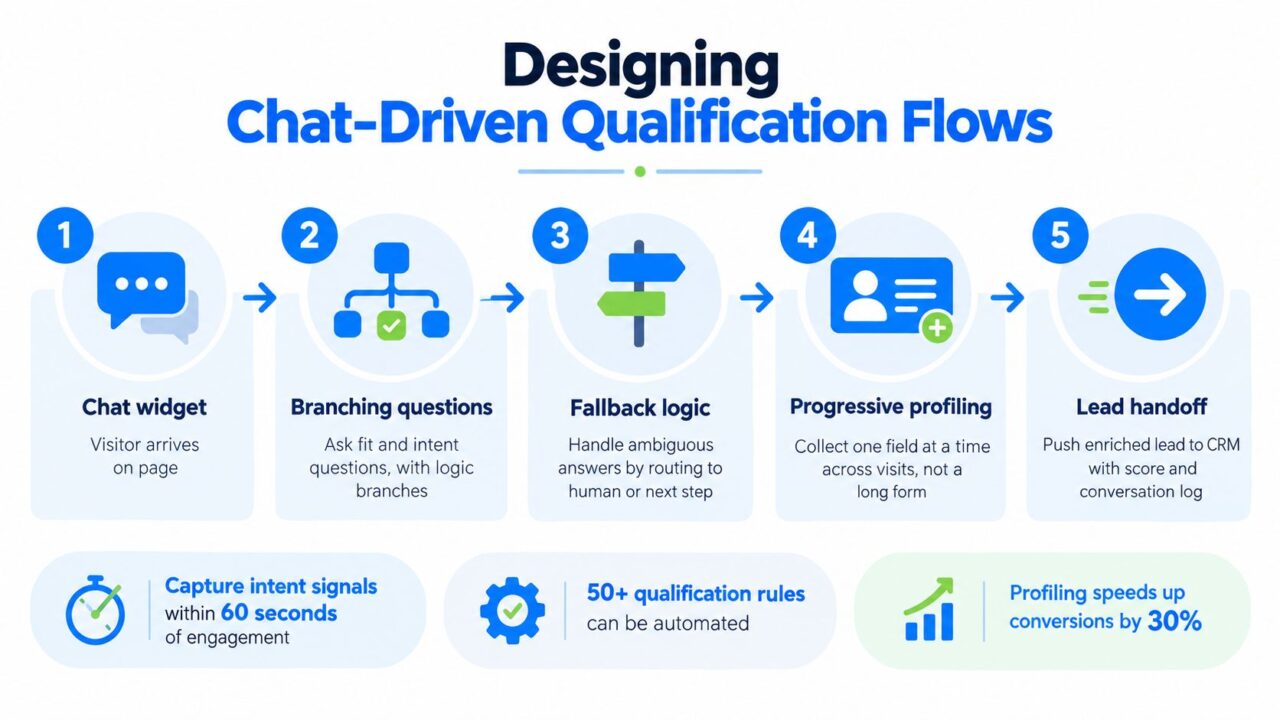
Chat changes qualification because it captures context while the visitor is engaged. A form asks for data once. A conversational flow can ask a follow-up question, interpret the answer, and route the person without waiting for a manual review.
Lead Qualification Marketing Flows
Ask only questions that change the route
Start with three fields: role, company size, and timing. Each answer should trigger a useful branch.
A copy-ready flow might look like this:
-
Role: “Which best describes your role?”
- Decision-maker or operational owner: continue.
- Agency, partner, or unclear role: ask what they need.
- Student, competitor, or unrelated role: disqualify or suppress.
-
Company size: “How large is your team?”
- Within your supported segment: apply positive fit points.
- Smaller or larger than your service model: route to a self-serve or enterprise path based on the pain points identified during the decision process.
- “Not sure”: keep the lead in review instead of forcing a false answer.
-
Timing: “When are you hoping to address this?”
- Active evaluation: route to sales.
- Exploring: nurture with educational content to support the lead qualification framework.
- No current project: retain only if fit is strong.
The questions should feel like assistance, not a qualification wall. Use progressive profiling across sessions so the visitor doesn’t repeat information already stored in the CRM.
Build fallback logic before adding AI
Rule-based chat works well when the questions and branches are predictable. AI-assisted prompts help when visitors answer in their own words, but the system still needs boundaries. If the visitor says, “We need something soon but haven’t agreed on budget,” the flow can save the response, mark budget as unknown, and send the record for human review.
Pass the captured variables into the score directly. Store the role, size, timing, transcript, source, and current score in the CRM. The salesperson should receive context, not a blank contact record that requires another discovery form.
A platform such as Clepher’s chatbot lead generation workflows can support conversational capture and routing across channels. The important design choice isn’t the widget itself. It’s whether each answer produces a documented next action, a score change, or a deliberate decision to wait.
Show the visitor what happens next. A qualified buyer can receive a booking option, an early-stage contact can receive a relevant resource, and an unqualified lead can reach a useful self-serve answer without entering a sales queue.
Segmentation and Broadcasts That Nurture the Right Leads
A raw list tells you who entered the database. A useful segment tells you what to say next. Lead qualification marketing works better when broadcasts use three layers together: source, behavior, and score band.
Compare the three segmentation methods
| Segmentation Type | Primary Signal | Best Broadcast Use |
|---|---|---|
| Source-based decision criteria should be established by the marketing team to enhance lead qualification. | Search, paid social, partner, chat, or referral origin | Match message to the promise that generated the lead |
| Behavior-based | Recent page visits, replies, clicks, and product actions | Trigger education or buying guidance around observed interest |
| Score-based | Fit and intent threshold or score band | Separate sales-ready, nurture-ready, and low-priority contacts |
Source segmentation protects message relevance. Someone who arrived through a product comparison needs a different sequence from someone who downloaded a general educational guide. Behavior segmentation adds recency. A person who engaged yesterday should not receive the same broadcast as someone who interacted months ago.
Score bands make the operational distinction visible. A high-score contact can receive a direct booking prompt, a middle band can receive objection-handling content, and a low band can remain in a quiet educational sequence.
Use recency and suppression rules
A segment should include time boundaries. Define what counts as recent for each behavior, then remove contacts who have entered an active sales conversation. Continuing promotional broadcasts after a rep has started a live exchange creates conflicting messages and can make the brand appear disconnected.
Useful controls include:
- Source-specific sequences: Continue the topic implied by the original offer.
- Behavior triggers: Follow a product-page visit with product education, not a generic newsletter.
- Score-based priority: Promote contacts when fit and intent combine, not when one weak signal spikes.
- Conversation suppression: Pause broadcasts while a salesperson or support agent is actively engaged.
- Frequency caps: Reduce low-value sends when a lead has already received a meaningful interaction.
For a deeper framework on building these audiences, see customer segmentation strategies. The practical test is simple: can a marketer explain why this person received this message today? If not, the segment is probably too broad.
Handoff Rules That Stop Leads Going Cold
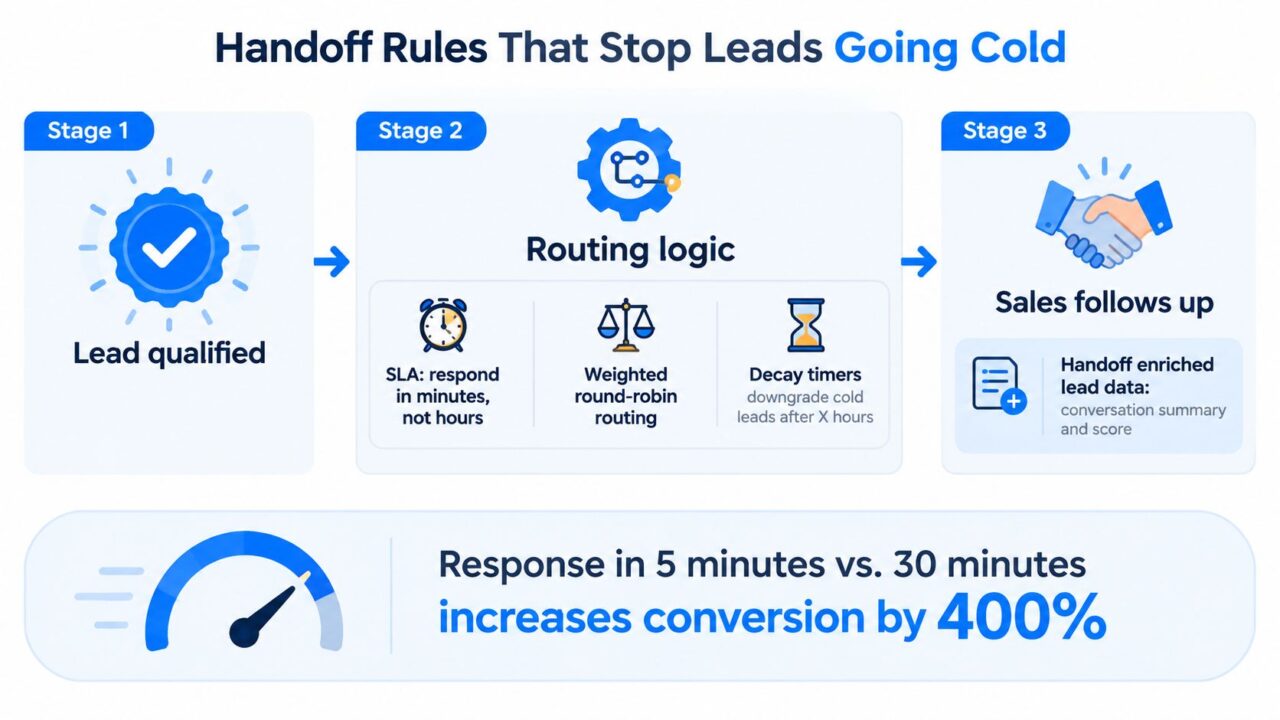
A qualified lead can lose value between the score threshold and the first sales contact. Handoff design therefore needs an SLA measured in minutes, routing logic that prevents ownership confusion, and enough context for the rep to continue the conversation.
Lead Qualification Marketing Routing Logic
Speed is part of qualification
Industry benchmark data links a response in under five minutes with a 32% close rate, compared with 12% when the wait reaches 24 hours or longer, according to lead qualification metrics. Another industry-cited study reports that contacting an inbound lead within five minutes makes it 21 times more likely to qualify than waiting 30 minutes, while a response within an hour is 60 times more likely to qualify than a response after 24 hours or longer, as detailed in speed-to-lead research coverage.
The exact benchmark will vary by motion, but the operational conclusion is stable: don’t create a handoff process that requires a daily spreadsheet review. Send the lead, score, source, transcript, and last touchpoint into the CRM immediately.
Route, decay, and review
Weighted round-robin routing can assign leads according to territory, segment, capacity, or product expertise. Add an acknowledgement rule so an unclaimed lead returns to the queue rather than remaining attached to an unavailable rep, improving the decision process for the marketing team.
Use three safeguards:
- Minute-level SLA: Define how quickly hot chat and demo leads require contact.
- Decay timer: Reduce scores after inactivity so old engagement doesn’t trigger urgent routing.
- Borderline review: Send ambiguous records to a human queue instead of forcing an automatic accept or reject.
Explicit disqualification criteria are just as important. A contact outside your service geography, a competitor, or a clearly unsupported use case should return to suppression or a suitable nurture path. A lead that isn’t ready for sales today isn’t necessarily worthless, but it shouldn’t occupy active SDR capacity.
The handoff record should contain a short conversation summary, score breakdown, triggering event, stated timeline, and unresolved question. Sales should be able to open the record and respond to what the buyer just said, not restart qualification from zero.
Common Misconceptions About Qualifying More Leads
More MQLs don’t automatically create more revenue. A peer-reviewed review of lead-scoring research reports that only about 1% to 6% of leads ultimately become customers, while the average prospect-to-qualified-lead conversion is about 10%. The same review says stronger qualification can raise that prospect-to-qualified-lead rate to roughly 15% to 20%, which is why criteria affect downstream outcomes, not just dashboard totals. See the Conduct a peer-reviewed lead-scoring review within the sales team. for the underlying analysis.
Anti-patterns that inflate activity
The most common broken funnels make qualification look easy:
- Route every form fill: Sales receives educational downloads, spam, and accidental submissions alongside real enquiries.
- Reward MQL volume alone: Marketing celebrates database growth while ignoring whether sales accepts the records.
- Treat chat engagement as intent: A long chat can reflect curiosity, support needs, or confusion rather than buying readiness.
- Keep stale leads active forever: Historical clicks continue adding points even after the buyer has disappeared.
- Avoid disqualification: Teams fear shrinking the funnel for sales-qualified leads, so reps spend time on accounts that can’t become customers.
Consider two internal reports. Team A celebrates 2,000 MQLs and 30 booked meetings. Team B reports 300 MQLs and 45 booked meetings. The second team has created the stronger qualification system, even though its top-line MQL count is smaller.
The practical rule is to tighten qualification when SDR time becomes the constraint. A narrower, better-evidenced queue protects follow-up quality, improves the buyer experience, and gives marketing a clearer signal about which campaigns attract commercial demand.
Putting It All Together Into a Repeatable System
A working system connects four components: chat capture, scoring, segmentation, and handoff. Run them as a weekly operating rhythm instead of treating automation as a one-time setup.
Give each day a job
Monday: Review the previous week’s MQL-to-SQL conversion, sales rejection reasons, response times, and disqualification categories. Look for patterns by source and score band.
Tuesday: Adjust scoring weights using closed-won and lost-deal evidence. Remove points that don’t correlate with useful conversations in the sales process, and add fields that sales repeatedly asks for during discovery.
Wednesday: Refresh chat branches around new objections. If visitors repeatedly ask about integrations, onboarding, pricing structure, or implementation, let the flow capture that concern and route it correctly.
Friday: Audit broadcast segments for marketing qualified lead effectiveness. Confirm that active sales conversations are suppressed, recent high-intent contacts receive timely messages, and early-stage leads aren’t pushed into an aggressive sales sequence.
This cadence keeps the system close to actual buyer behavior. Every chat transcript, lost-deal note, reply, and accepted handoff becomes feedback for the next model revision.
Track outcomes that expose quality
Over a 90-day window, set operational targets such as:
- Hot-chat speed can enhance sales and marketing alignment. Keep response time under 5 minutes, using the decision-making process to align marketing efforts with sales objectives. Use the speed-to-lead benchmark as a reference for urgency.
- MQL-to-SQL conversion: Aim above 25% when your sales motion and data volume support that threshold.
- Demo show rate: Target above 70% for booked demonstrations.
- Disqualification rate: Treat appropriate disqualification as a positive quality signal in the lead qualification framework, not an automatic failure.
The broader benchmark context matters. One industry source places average MQL-to-SQL conversion around the benchmarks established by the sales and marketing teams. 13%, while typical B2B ranges are reported at 13% to 27%, and MQL-to-SAL acceptance often runs 70% to 85%, according to MQL and SQL benchmark guidance. Use those figures as diagnostic context, not as a substitute for your own funnel evidence.
Start next Monday with one chat flow, one score threshold, one disqualification list, and one sales process to streamline the sales team’s efforts. Then improve the system from the conversations your buyers have.
Clepher helps teams build conversational qualification flows, capture answers, apply segments, and route enriched leads across website and social messaging channels. Visit Clepher to see how its no-code chatbot automation can support faster qualification, targeted broadcasts, and cleaner sales handoffs.

Related Posts
Lead Qualification Marketing: A Practical 2026 Guide
October 9, 2026Customer Experience Optimization Playbook
October 8, 2026Automated Checkout Bot: Build and Launch Guide
October 7, 2026
Founder Clepher