
Poor customer experiences are expensive. PwC’s 2025 Customer Experience Survey found that 52% of consumers stopped using or buying from a brand after a bad product or service experience, while 29% left because of poor customer experience online or in person, highlighting critical pain points.. For DTC, e-commerce, SaaS, and service businesses, every confusing checkout, unanswered message, and irrelevant recommendation can weaken retention.
Customer experience optimization is the operating discipline that fixes those moments. It combines journey mapping, behavioral data, personalization, automation, human support, and continual testing so customers can move from discovery to purchase and renewal with less effort. The shift is practical: stop treating feedback as a report and start turning real customer conversations into actions.
The Revenue Impact of Customer Experience Optimization
Customer experience optimization is often placed inside support, but its commercial impact reaches much further. It means systematically removing friction and creating relevant, consistent interactions across the website, product, checkout, social inbox, email, and post-purchase experience.
The retention case is direct. The PwC survey found that more than half of consumers had abandoned a brand after a bad product or service experience, and 29% had left because of poor online or in-person customer experience. Those customers don’t need a complicated reason to switch. A competitor with clearer information, faster answers, or a smoother purchase path can win them immediately.
Practical rule: Treat every high-friction interaction as a retention risk, not merely a support issue.
For a DTC brand, friction might appear as uncertainty about sizing, delivery, returns, or product compatibility. For SaaS, it often appears during onboarding, integration, billing, or feature adoption. In both cases, the customer is asking the same underlying question: “Can this business help me reach my goal without making me work too hard?”
CX is a measurable operating discipline
Forrester’s 2025 Global Customer Experience Index shows how seriously businesses now measure that question. In the United States, 25% of brands saw their customer experience rankings decline for the second consecutive year, while only 7% improved. In Europe, 7% improved, 2% declined, and 90% remained statistically unchanged. Across Australia, Singapore, and India, 37% of brands’ CX scores fell, and 58% remained unchanged.
The important lesson isn’t that one region has solved CX. It’s that experience performance is being tracked, compared, and revisited. Optimization isn’t a launch project with a finish line. Teams need operating routines that identify friction, deploy changes, and check whether those changes improved behavior.
A useful foundation is a documented customer experience management approach. It connects customer signals to owners, workflows, and business outcomes instead of leaving insights inside a customer service dashboard.
Where revenue leaks first
Start with moments that influence conversion, repeat purchase, expansion, and churn:
- Pre-purchase uncertainty: Answer product, pricing, delivery, and compatibility questions before hesitation becomes abandonment.
- Checkout friction: Reduce unnecessary steps, clarify policies, and preserve context when a shopper moves between channels.
- Onboarding failure can significantly impact customer retention and overall cx optimization. Guide new users toward their first meaningful outcome instead of exposing every feature at once.
- Support delays: Acknowledge requests quickly, route complex issues correctly, and make escalation easy.
- Post-purchase silence: Provide useful updates and proactive help so customers don’t need to chase the brand.
Personalization strengthens these interventions. An empirical model found that personalization had the largest effect on customer experience, with β = 0.41 and p < 0.001, while perceived relevance measured β = 0.28 and p < 0.001, and interaction quality measured β = 0.22 and p = 0.002. The model explained the importance of customer data in understanding customer expectations. 58% of the variance R² = 0.58. These findings support a practical approach: use customer context to make the next interaction more relevant, then improve the conversation itself.
Moving Beyond Survey Fatigue and Execution Gaps
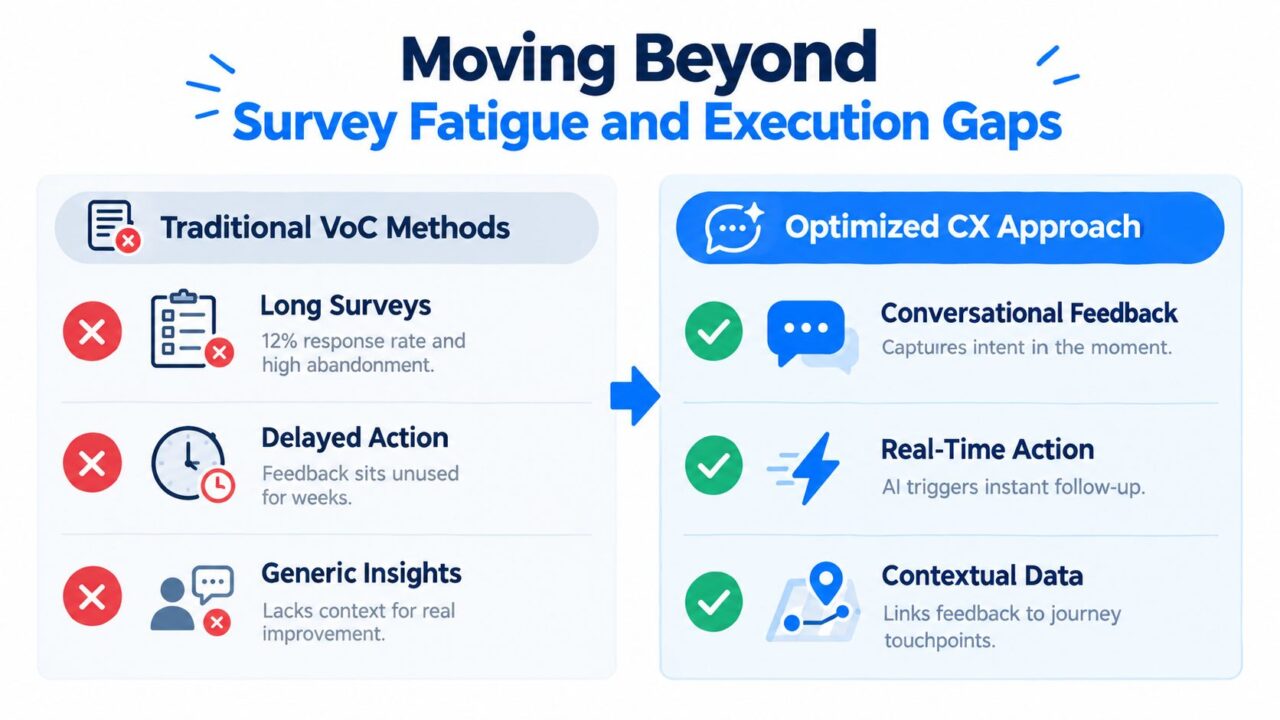
Many CX programs still operate as if the main problem is insufficient feedback, neglecting the need to refine their approach. They send an NPS survey, collect CSAT after a ticket, review the dashboard, and schedule a meeting. That process can produce useful signals, but it often captures a narrow group of customers at a delayed moment.
Survey fatigue makes the gap worse. Medallia reports that most consumers now question whether reporting a negative experience is worth their time, while a separate 2026 CX trend report cited survey response rates falling from 30% to 18% in about six months. Those figures are linked to the Medallia discussion of the hard truths behind customer experience. A low-response survey doesn’t represent every customer equally, so teams shouldn’t mistake a clean score for a complete view.
Customer Experience Optimization Comparison
Feedback has value only after someone acts
The execution gap is more damaging than the collection gap. Medallia reports that only 1 in 3 CX teams say they have visibility into the full customer experience, highlighting the need for better customer data, and 30-40% of departments take no action after receiving customer insight. The underlying problem is operational. Marketing sees campaign responses, support sees tickets, product sees usage data, and social teams see comments, but no shared workflow turns those signals into a coordinated change.
A stronger system captures feedback during the interaction to refine the overall customer experience. A shopper asking an Instagram question reveals intent, product confusion, and the exact point in the journey where help is needed. A SaaS user asking how to connect an integration may be signaling an onboarding blocker before they ever submit a cancellation request.
Conversational AI can classify those messages, summarize themes, identify urgency, and trigger a next step. The next step might be a product guide, a human handoff, a tagged audience update, or a follow-up message. The goal isn’t to automate every response. It’s to ensure that useful context creates movement.
Replace periodic listening with active loops
A practical conversational feedback loop has four parts:
- Capture: Collect questions, objections, complaints, and intent from web chat, comments, DMs, and support interactions.
- Interpret: Use AI to group messages by topic, sentiment, product, journey stage, and urgency.
- Route: Optimize customer experience by ensuring all touchpoints are efficient. Send the customer to the right answer, agent, workflow, or escalation path.
- Learn: Review outcomes and update content, automation rules, product messaging, or training.
Visual content can support this transition when customers need to understand a product before buying. For fashion brands, an AI model outfit e-commerce resource can complement conversational flows by helping teams present product context more clearly.
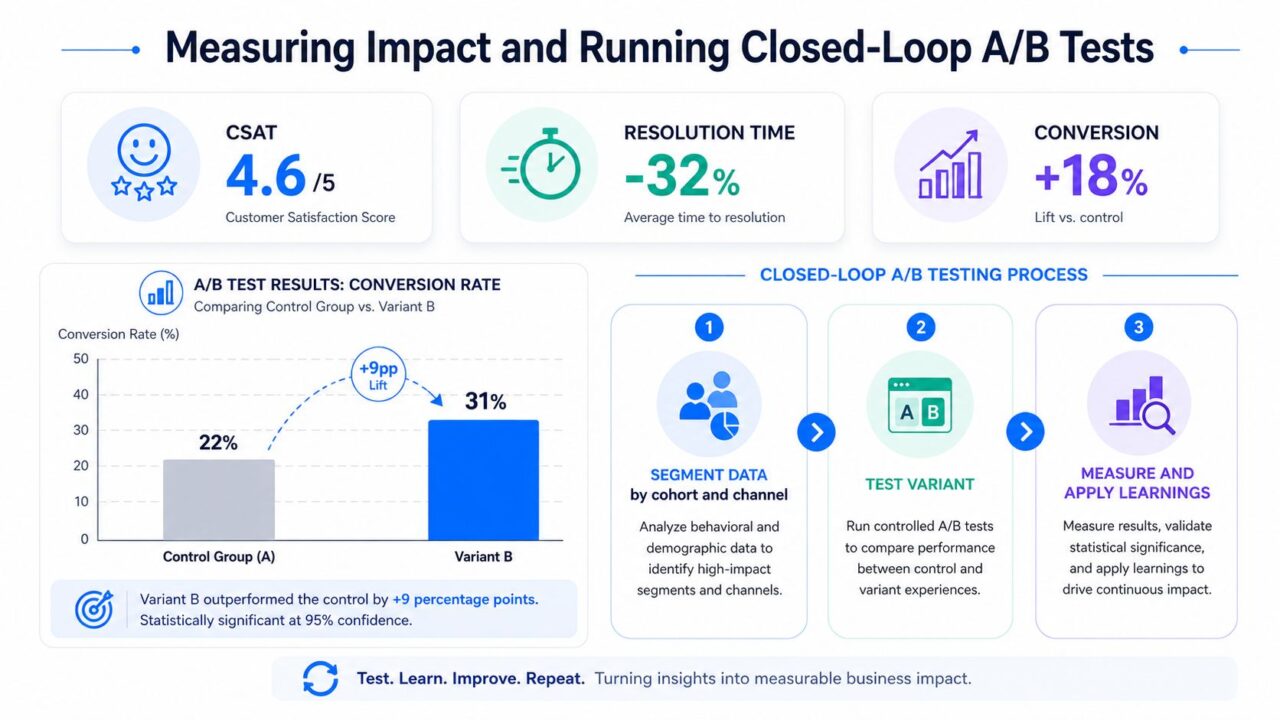
Benchmarking still matters, but it should run as a closed loop. Standard metrics such as NPS, CSAT, CES, and task completion become more useful when segmented by cohort, channel, and market, then connected to contact center, digital, social, review, and survey data. The CX benchmarking research on unified measurement supports this approach: measure, intervene, and measure again.
A Step-by-Step Framework for Experience Design
A useful CX audit starts with the customer’s task, not the company’s org chart. Customers don’t care whether marketing, sales, product, or support owns a touchpoint; they just want a seamless experience across all touchpoints. They care whether they can find information, complete an action, and get help without repeating themselves.
1. Map every meaningful touchpoint
List the actual journey across web and messaging:
- Discovery content and paid landing pages
- Product pages and pricing screens should be designed to optimize customer satisfaction.
- Website forms, chat widgets, and pop-ups
- Facebook Messenger, WhatsApp, and Instagram Direct Messages
- Checkout, confirmation, delivery, and onboarding
- Renewal, support, review, and referral moments
Add the customer’s goal, likely question, business owner, current response, and evidence of friction. Don’t map an ideal journey for cx optimization. Use session recordings, support transcripts, search terms, abandoned forms, and social conversations to document what people really do.
2. Locate the drop-off zones
Look for repeated effort and missing context. A shopper who visits a product page, opens shipping information, returns to the product, and then leaves may need delivery clarity. A trial user who repeatedly visits integration documentation may need a guided setup path rather than another promotional email to meet customer expectations.
Rank issues by customer impact and implementation effort. High-impact, low-effort problems should move first. Don’t begin with a complete platform rebuild if a clearer answer, better routing rule, or timely message can remove the barrier.
3. Design a specific intervention
Each intervention needs a trigger, a customer context, a response, and a success condition.
For example:
- A visitor spends time on a pricing page, indicating potential pain points in their decision-making process.
- A chat prompt offers help comparing plans.
- The flow asks about team size and intended use.
- The system recommends relevant information or routes a qualified lead.
- The team measures progression, conversation quality, and eventual conversion.
Keep the first response narrow. A bot that tries to answer everything usually creates generic interactions. A flow designed around one job, such as sizing help, plan selection, or order status, is easier to test and improve.
4. Deploy consistently across channels
The customer should receive the same core answer whether they ask on a website, in an Instagram comment, or through Messenger. Adapt the format to the channel, but preserve product facts, tone, eligibility rules, and escalation logic.
Response speed deserves its own metric. One benchmark states that 89% of customers expect a reply within one hour to optimize customer experience., while the average email first response time is 12 hours and 10 minutes. The figures are reported in Customer service response-time benchmarks are essential for improving customer retention.. Use automation to acknowledge the request immediately, collect context, and set a clear next step when a human response is required.
5. Iterate on behavior, not opinions
After launch, inspect where customers stop, repeat questions, request an agent, or complete the intended action. Update the flow, knowledge content, segmentation, and handoff rules based on those patterns.
Zendesk defines first response time as the elapsed time until the first reply, calculated as Total first response time divided by total resolved tickets is an important metric for measuring optimization efforts in customer service. Its first reply time guidance is useful for standardizing the metric across teams.
Channel-Specific Tactics for Web and Social Messaging
A customer who arrives on a pricing page needs a different conversation from someone replying to an Instagram post. Treating every channel as a broadcast surface produces bland automation. Treating each channel as a job creates useful interactions.
Customer Experience Optimization Chatbot Platform
Website conversations should capture intent
Use a web chat widget on pages where uncertainty blocks action to improve customer interactions. A product page can offer help with fit, delivery, or compatibility. A pricing page can ask what the visitor is trying to accomplish and direct them to the right plan information. A support page can identify whether the customer needs a self-service answer or a human, enhancing the overall customer journey.
Capture only the information needed for the next step. Asking for a long form before providing help increases effort. A better exchange might collect an email after answering the initial question, then pass the conversation and relevant tags to the sales or support team.
For SaaS, an AI agent can qualify a visitor by use case, team structure, current tool, and implementation concern. For e-commerce, it can branch by product category, budget range, shipping destination, or purchase urgency. The interaction feels more useful when the flow reflects the page the customer is already viewing.
Social DMs need short, contextual paths
Instagram and Facebook conversations often begin with a comment or reaction, not a formal support request, which can impact customer interactions. Use keywords and comment triggers to deliver a relevant DM, then ask one question at a time.
A product launch flow could work like this:
- Comment trigger: A customer comments a keyword under a product post.
- Contextual reply: The brand sends product details, availability information, or a link.
- Preference question: The flow asks about size, color, use case, or timing.
- Personalized branch: The customer receives the most relevant content.
- Human handoff: An agent takes over when the customer has a nuanced question.
Don’t hide the fact that automation is involved when a customer needs a person. Typing indicators, natural pacing, personalization tags, and concise messages can make automated conversations easier to follow, but they shouldn’t be used to disguise a limitation.
A unified omnichannel customer experience preserves the conversation as customers move between web, Messenger, WhatsApp, Instagram, email, and live chat. The key is shared context, which is vital for effective customer interactions. If a customer already explained the problem in a DM, the human agent shouldn’t ask them to start again, respecting the customer journey.
Teams can build these flows with no-code tools such as Clepher, which supports web chat, Facebook Messenger, WhatsApp, and Instagram Direct Message automation alongside AI agents, live chat handoff, audience tags, segmentation, personalization fields, conditions, analytics, and testing features.
The social flow should also respect customer intent. A public comment may need a public answer when the information benefits other shoppers. A sensitive order or account issue belongs in a private conversation to maintain customer loyalty. Good channel execution balances speed, privacy, relevance, and human judgment to optimize customer experience.
Measuring Impact and Running Closed-Loop A/B Tests
CX measurement fails when teams track a large dashboard without deciding what each metric should change. Start with the business outcome, then select the experience signal that explains movement toward it.
Useful measures include:
- NPS: Whether customers are willing to recommend the brand.
- CSAT: How customers rate a specific interaction can provide valuable customer feedback and insights into pain points.
- CES: How much effort customers report.
- Task completion: Whether the customer completed the intended job.
- First response time is crucial for optimizing customer satisfaction and improving the net promoter score. How quickly the team acknowledged the request.
- Conversion and repeat purchase: Whether experience changes affect commercial behavior.
Aggregate scores hide important differences. Segment results by cohort, channel, and market. A strong overall CSAT score can conceal poor onboarding for new SaaS users. A healthy conversion rate can conceal a weak mobile product page or a high-friction Instagram path.
Build a test around one decision
A closed-loop A/B test should change one meaningful element at a time. Test the opening question, response tone, number of steps, recommendation logic, offer structure, or human handoff condition.
For example, a DTC team might compare a product recommendation flow that starts with category selection against one that starts with intended use. A SaaS team might compare an immediate demo prompt with a qualification-first conversation. Random path distribution helps assign comparable visitors to each experience while reducing selection bias.
The test record should include:
- Hypothesis: What customer problem might this change solve?
- Audience: Which cohort and channel receive the test?
- Primary outcome: What business behavior determines success?
- Guardrail: Implement measures to monitor real-time customer effort scores. What must not worsen, such as escalation quality or unsubscribe behavior?
- Action: What will the team change if the variant performs better?
Customer Experience Optimization AB Testing Process
The A/B testing framework for marketing is most valuable when results feed directly into the next iteration. Don’t declare a winner and archive the test. Update the live flow, document what changed, monitor downstream behavior, and identify the next friction point.
Personalization deserves close measurement because maturity affects outcomes. Deloitte’s 2024 personalization research reports 54% conversion for personalization leaders compared with 38% for low-maturity brands. The Deloitte personalization report supports a practical conclusion: personalization should be measured as a business capability, not judged by whether a message feels more relevant.
Quick Wins and Automation Checklist for Immediate Impact
Start with problems customers already repeat. The fastest gains usually come from automating predictable questions and protecting high-intent moments, not from launching a broad transformation program.
Launch these fixes first
- After-hours acknowledgment: Tell customers their message arrived, answer what you can immediately, and explain the next step without promising an unrealistic response time.
- FAQ routing: Build focused answers for shipping, returns, pricing, billing, integrations, and account access. Add an escalation option when the answer doesn’t resolve the issue.
- Abandoned-cart recovery: Use social DM or messaging flows to ask whether the customer needs product information, delivery clarification, or checkout help.
- Lead qualification: Ask one or two useful questions on high-intent web pages, then route qualified prospects to sales and less-ready visitors to relevant education.
- Order-status support: Let customers find tracking or delivery guidance without waiting for an agent.
- Failed-flow alerts are essential for identifying gaps in the customer journey. Tag conversations that end in repeated questions, agent requests, or abandonment so the team can review them.
Prioritize by effort and risk
Choose the first automation that combines frequent demand, clear rules, and a measurable next action. Avoid automating disputes, sensitive account changes, or nuanced complaints until escalation is reliable.
Review transcripts regularly. Remove answers that create more questions, rewrite confusing prompts, and keep the human handoff visible. A small flow that solves a real problem is more valuable than a large bot that merely adds another interface.
Clepher lets teams build no-code conversational flows for web chat, Facebook Messenger, WhatsApp, and Instagram Direct Message, with AI agents, segmentation, live chat handoff, personalization, analytics, and testing features. Visit Clepher to turn recurring customer questions and high-intent conversations into faster, more consistent experiences.
Related Posts
Customer Experience Optimization Playbook
October 8, 2026Automated Checkout Bot: Build and Launch Guide
October 7, 2026AI Agent Framework: Architecture, Tools, and Use Cases
October 6, 2026
Founder Clepher