
Most companies don’t have a promo code problem. They have a campaign-goal problem.
A code like WELCOME15, SHIPFREE, or BOGO50 looks simple on the surface, but the structure behind it changes customer behavior in very different ways. If you want more first purchases, the wrong code can erode margin without removing the barrier. If you want larger carts, a flat offer may underperform a threshold-based one. If you want urgency, a generic discount often lands softer than a short-lived code with clear eligibility and timing.
That gap matters more now because promo codes aren’t occasional add-ons anymore. Nearly 400,000 retailers issued an average of nine unique promo codes in the first half of 2024, or about 1.5 codes per month, a 31% increase from the same period in 2023, according to a SimplyCodes retailer promo code study. In practice, that means your offer has to be intentional, not just present.
The promo code examples below are organized by outcome: acquisition, conversion, average order value, referrals, inventory movement, and cart recovery. Each one includes realistic copy ideas, segmentation angles, usage controls, and what to track after launch. When conversational delivery fits the campaign, Clepher can support targeted promo conversations through website widgets, Messenger, WhatsApp, and Instagram Direct Message. If you want a broader framing for coupon strategy before building flows, the ViralRef smart coupon guide is a useful companion.
1. Percentage Discount Codes
Percentage discounts work when you need a broad, easy-to-understand offer. Customers instantly recognize SAVE20 or SUMMER25, which makes this format useful for seasonal pushes, first-order nudges, and annual-plan upgrades.
Typical examples include:
- WELCOME20 for a first order from a DTC fashion brand
- SUMMER25 for a seasonal storewide sale
- ANNUAL30 for a SaaS annual billing push
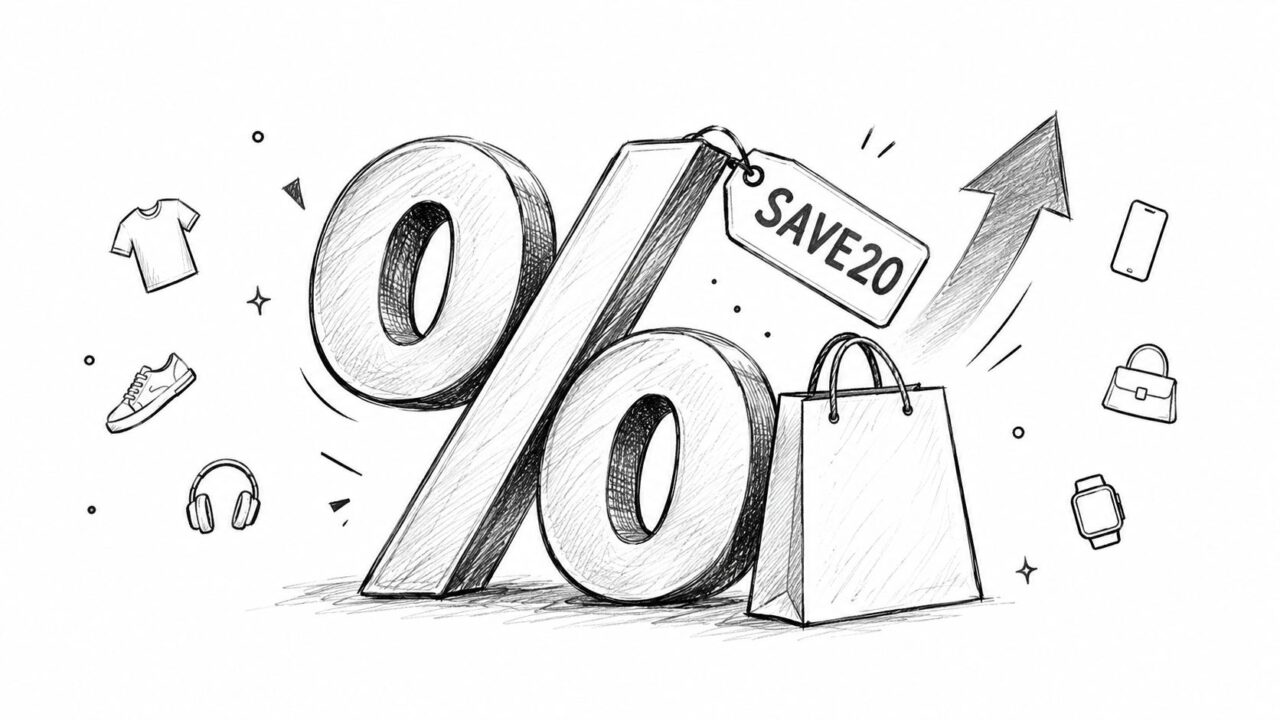
Promo Code Examples Percentage Discount
Percentage-based promo code examples are strongest when the catalog has varied prices. A shopper buying a $30 item and another buying a $130 item both understand the same rule. That keeps the message simple across ads, email, social, and chat.
The trade-off is margin drift. If you apply one percentage to every segment, you may discount high-intent buyers more than necessary.
Best fit and execution
Use this format when you need one code to serve a wide audience but still want room for segmentation behind the scenes.
- New visitors: Show 10% to 15% off after email capture or chat opt-in.
- Loyal buyers: Offer a deeper percentage only to tagged repeat customers.
- Annual-plan prospects: Test a code like ANNUAL30 only on users who reached pricing pages multiple times.
A useful operational detail is speed. A study of 90 merchants and 4,124 promotions found that 44.1% of non-batch redemptions happened within the first hour of issue, and the median time to redemption was 10 hours in Blippr’s summary of Uniqodo coupon stats. That supports short-lived percentage offers delivered at the moment of intent, such as a Messenger follow-up after a cart visit or a website widget shown after product-page depth.
Practical rule: If you use a percentage code for acquisition, put the expiration and exclusions in the first message, not the fine print.
Good controls include one use per customer, category exclusions for low-margin items, and audience-based code variants. In Clepher, you can tag first-time visitors separately from repeat purchasers, then route each group into different discount paths and compare behavior after redemption.
2. Fixed Dollar Amount Discount Codes
Need to raise average order value without making shoppers do math? Fixed dollar codes do that well.
A dollar-off offer gives the buyer a concrete target. “$10 off” or “$25 off” is easy to scan in email, paid social, SMS, and onsite prompts. That clarity matters most when the campaign goal is to remove friction on a first order, push a cart past a minimum, or make a higher-ticket plan feel closer to reach.
A few workable templates:
- WELCOME10 for $10 off a first order over $60
- 25OFFBUNDLE for a course or product bundle with stable pricing
- 100OFFANNUAL for an annual SaaS plan sold against a monthly option
The campaign objective should determine the setup. For first-purchase conversion, keep the discount modest and pair it with a minimum spend. For basket growth, set the threshold just above current median order value so customers have a reason to add one more item. For plan upgrades, apply the code only to annual billing or selected packages where the margin can absorb the discount.
Thresholds do most of the work here. A fixed discount with no floor often gets redeemed on the smallest possible order. The same offer tied to a minimum spend changes behavior. “$15 off $75” can act as a cart-building prompt, especially if the site shows progress in the cart or at checkout.
Where fixed-dollar codes fit best
These codes are useful when the offer needs to stay consistent across channels, but the audience and qualifying rules can still change behind the scenes.
- Lower-ticket ecommerce: A visible amount-off message feels more concrete than a percentage on smaller carts.
- Local and service brands: “$20 off your first cleaning” or “$10 off delivery over $40” is easy to understand fast.
- Digital products and SaaS: A larger fixed amount can frame annual plans or bundles as a better deal without discounting every product.
Code naming is crowded, so the surrounding context matters more than clever wording. An IBTimes analysis of promo code patterns found that WELCOME10 appeared frequently across a large sample of codes. The practical takeaway is simple. Distinguish the campaign through audience rules, expiration, product scope, and channel timing, not just the code string itself.
A stronger setup is specific: “$10 off orders over $60, valid on starter bundles through Sunday.“
Implementation is usually straightforward. Put the threshold in every touchpoint where the code appears. Include it in the email subject or preview text, the SMS, the onsite banner, the cart drawer, and the coupon field helper text. If the code only applies to one collection, subscription term, or bundle, say that before the click. That reduces support tickets and cuts failed redemptions.
Use a few controls from the start:
- one use per customer
- minimum order value
- collection or SKU exclusions for low-margin items
- expiration tied to the campaign window
- audience-specific variants for acquisition, win-back, or upgrade flows
This code type works best when the customer sees a clear savings amount and a clear path to qualify. That combination improves conversion while keeping the discount tied to a measurable objective.
3. BOGO Promo Codes
Need to raise units per order without cutting price across the whole catalog? BOGO codes are one of the cleanest ways to do it.
BUY1GET1, BOGO50, and BUY2GET1 work best when the campaign goal is basket expansion. They give shoppers a reason to add a second or third item, which makes them useful for replenishable products, giftable items, and categories with obvious pairings. They are much less effective on high-consideration products where customers only planned to buy one.
Here are three practical formats:
- BUY1GET1 for low-cost accessories, coffee, socks, or personal care
- BOGO50 for higher-margin collections where a free second item would cut too far
- BUY2GET1 for supplements, cosmetics, or snack bundles where customers already buy multiples
The decision is not the code string. It is the pairing logic.
A strong BOGO setup makes the eligible products obvious before the shopper reaches the cart. “Buy one, get one 50% off on all winter boots” is clear. “BOGO on select items” usually creates friction, especially if the selection spans unrelated SKUs or hides exclusions until checkout.
Match the offer to the objective
BOGO can support different campaign goals, but each version needs different controls.
If the goal is to move aging inventory, pair slower SKUs with products customers already understand. For example, add BOGO50 to a seasonal accessories collection instead of giving away leftover items no one wanted in the first place.
If the goal is to increase average order value, set the offer on categories where shoppers naturally buy in pairs or sets. Skincare, basics, pantry items, and refill products tend to hold up well here.
If the goal is to cross-sell a second product, keep the relationship intuitive. A shampoo plus conditioner offer makes sense. A laptop sleeve plus scented candle does not.
How to run it without creating checkout confusion
Execution matters more with BOGO than with simple discounts because the customer has to understand how to qualify.
Use these controls:
- limit the offer to one category or collection
- show only eligible items on the landing page or collection page
- add cart messaging such as “Add one more eligible item to apply BOGO50”
- exclude low-margin or oversized SKUs that break the economics
- cap redemptions per customer if the goal is trial rather than stock-up
- keep the expiration short enough to prompt action, but long enough for email and SMS traffic to convert
Clepher can support this with conditional prompts tied to cart contents. If a shopper adds one qualifying item, trigger a specific nudge based on audience segment. Returning customers may respond to “Add your refill and get the second at 50% off.” First-time buyers usually need simpler copy such as “Pick any two from this collection.”
One caution is margin compression. BOGO often looks stronger than a standard discount because the shopper focuses on the added item, but the cost can climb fast if the qualifying products are already discounted, frequently bundled, or expensive to ship. Check contribution margin by SKU before pushing the offer through paid channels.
An independent review of 15 e-commerce studies reported that promo codes increased short-term transactions in 13 cases, according to Castfox’s summary of promo code effectiveness research. For BOGO campaigns, the useful KPI set is straightforward: units per order, attach rate of the second item, average order value, and gross margin after redemption.
4. Free Shipping Promo Codes
Free shipping codes solve a different problem from discount codes. They reduce friction instead of lowering the sticker price.
That makes SHIPFREE, FREESHIP15, and GIFTSHIP particularly useful in two moments: abandoned cart recovery and low-consideration purchases where delivery cost feels like the final obstacle. For local businesses, a variant like PICKUP or LOCALDROP can also reframe fulfillment as a convenience benefit instead of a checkout surcharge.
Why shipping offers often feel bigger than they are
Customers process shipping fees differently from product pricing. A product can feel acceptable in-cart, then suddenly feel overpriced when delivery appears. Free shipping promo code examples work because they remove that late-stage resistance.
This format is also one of the safer ways to preserve product pricing while still giving the buyer a reason to complete checkout.
- Abandoned carts: Send SHIPFREE shortly after cart abandonment.
- Regional campaigns: Use geography tags to limit the code to zones where shipping costs are manageable.
- Gift purchases: Apply it to gift subscriptions or curated bundles where delivery friction is common.
A cross-merchant coupon benchmark found a 3.47% issued-to-redeemed rate across 51.6 million issued codes and 1.79 million redemptions, while validated-to-redeemed performance varied by sector, according to the Journal of International Conference Proceedings benchmark download. That matters because shipping offers are often compared unfairly against standard discounts. If one campaign is measured on issued codes and another on validated codes, you can reach the wrong conclusion about what worked.
Free shipping is often the cleaner test when you suspect price isn’t the real objection.
Execution matters here. Trigger the code from an abandoned cart flow, show the qualification threshold in the cart, and keep the redemption path simple. If a customer has to hunt for the field, copy the code manually, and guess whether their region qualifies, the offer loses most of its force.
5. Tiered Discount Codes
Need a promo code that raises average order value without cutting every order to the same discounted price?
Tiered discount codes do that job well because they tie the reward to a higher spend target. The practical goal is simple. Give the shopper a reason to move from a good cart to a slightly bigger one.
A basic ladder looks like this:
- Spend $50, save 10%
- Spend $100, save 20%
- Spend $150, save 30%
That structure only works if the next step feels close enough to reach. If a shopper is sitting at $92 and sees a 20% discount at $100, adding one accessory feels reasonable. If the next threshold is too far away, the ladder stops motivating and starts looking artificial.
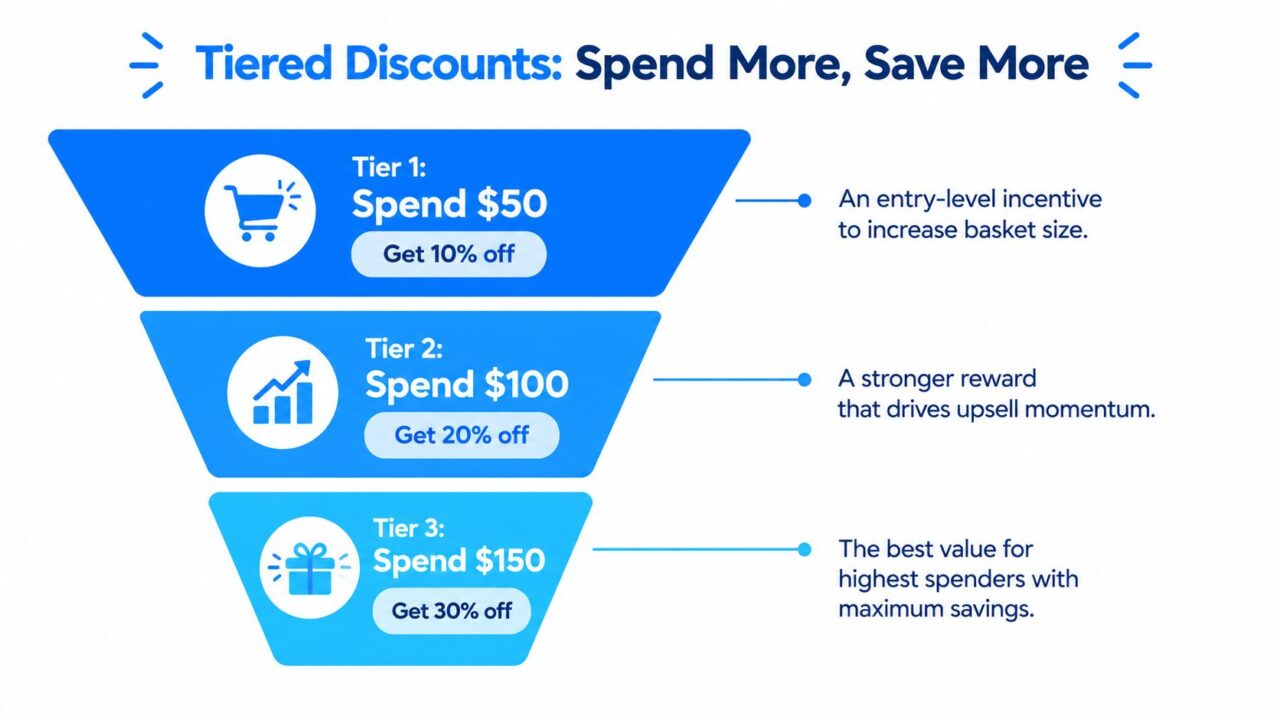
Promo Code Examples Tiered Discounts
The strongest use case is an AOV campaign aimed at shoppers who already show purchase intent. That usually means cart visitors, returning customers, or paid traffic landing on product collections with natural add-ons. A broad sitewide blast can work, but it often gives away margin to buyers who would have converted at the first tier anyway.
AOV-focused campaigns need visible progression. This guide on ways to increase average order value is useful if you’re building the surrounding cart and upsell logic, not just the code itself.
Build the ladder around cart math, not round numbers
Start with your catalog, not the coupon field.
Review current order values, common product pairings, and margin by category. Then set thresholds that can be reached with one realistic addition. For a beauty brand, that might be cleanser plus serum. For apparel, it could be one more basic tee or accessory. For subscriptions, it may be a longer prepaid term or a bundle upgrade.
Three controls matter here:
- Audience segmentation: Give higher thresholds to loyal buyers with larger historical baskets. Keep entry tiers lower for colder traffic.
- Channel execution: Show the ladder on collection pages, in cart drawers, and in retargeting emails where shoppers can act on it immediately.
- Redemption rules: Exclude low-margin SKUs, cap one use per order, and decide whether the code stacks with free shipping or points.
A segmentation study in the Journal of the Academy of Marketing Science found that the same $0.50 coupon could produce redemption probability anywhere from 30% to 80% depending on segment membership, NPR, and loyalty characteristics in Springer’s article on coupon targeting. That finding matters for tiered codes because one threshold ladder rarely fits every segment.
What to measure besides redemptions
Redemption rate can look healthy while profit per order gets worse.
Track average order value by exposed audience, margin by redeemed order, and the share of customers who moved from one threshold band to the next. Also check whether the campaign changes item mix. If shoppers only add discounted filler products to cross the line, the code is doing less than it appears.
In Clepher, this is a natural fit for conditions and random path testing. Show different threshold ladders to comparable audiences and compare not just redemptions, but final order value and repeat behavior after the campaign ends.
6. First-Time Customer Welcome Promo Codes
Welcome codes should reduce first-purchase friction, not become your default pricing policy.
That sounds obvious, but many brands hand out WELCOME20 to everyone, forever. Once that happens, the code stops functioning as an acquisition tool and starts training customers to wait for a discount. Better promo code examples for new-customer campaigns are tied to a trigger, an audience, and a short decision window.
Examples include:
- WELCOME20 after email capture
- FIRST15 in a site popup or chat widget
- STARTTRIAL when a SaaS trial user is ready to convert
- NEWBIE25 for a first-month subscription offer
What a useful welcome code flow looks like
The strongest welcome offer is usually part of a capture sequence, not a standalone banner. If you want subscribers before the first order, the code should be the reward for taking that step.
This resource on building an email list fits especially well here because welcome promo code examples usually work best when paired with subscriber capture and follow-up.
A 2024 analysis found the average promo code discount rose to 17.6%, while the average dollar amount off increased from $27.26 to $33.25, based on SimplyCodes coupon statistics for 2026. The lesson isn’t that every welcome code should be deeper. It’s that discounting has become more standardized, so a generic first-order code isn’t enough on its own. Your targeting, delivery timing, and exclusions matter more than they used to.
- Gate the reward: Reveal the code after email or chat opt-in.
- Limit eligibility: One use per new customer, first purchase only.
- Set a deadline: Keep the code available for a short post-signup window.
- Follow up across channels: Website widget first, then Messenger, Instagram DM, or email based on consent and behavior.
Field note: Welcome codes work better when the first post-signup message reminds the buyer what to do next, not just what they’ll save.
If you use Clepher, tag that subscriber immediately as a first-time prospect. That makes it easier to suppress the code after purchase and move the customer into a different lifecycle campaign.
7. Referral Program Promo Codes
Referral codes are one of the few promo structures that can support acquisition and retention at the same time. The referee gets a reason to try the brand. The referrer gets a reason to keep talking about it.
The code format matters more here than in most campaigns. Generic referrals are harder to track and easier to abuse. Named or unique codes such as SARAH_REFERRAL25 or COACHJAMIE25 make the connection clearer for both sides.
Examples:
- Give a friend a discount, get store credit after their first order
- A subscription customer shares a code for a discounted first month
- A course creator offers both referrer and buyer a credit toward future products
Build referrals around customer milestones
Referral asks land better after a positive experience, not before one. Trigger them after a delivery confirmation, a repeat purchase, or a loyalty milestone.
A broader loyalty framework helps. If you’re connecting referrals to repeat purchase behavior, customer loyalty program ideas and implementation guidance can help shape the sequence around the code.
There’s also a governance angle many referral campaigns ignore. Consumer code-copy activity reached about 48.8 million in 2025, roughly 2.5x the prior year, while UK fraud losses still exceeded £1 billion in 2024, according to the SimplyCodes state of coupon codes report. If you’re issuing referral codes, that’s your warning to use unique generation, attribution rules, and abuse controls from day one.
Practical controls include:
- Unique code assignment: One referrer, one code, one attribution trail.
- Reward delay: Credit the referrer only after the referred order is valid.
- Eligibility rules: Block self-referrals, duplicate accounts, and repeat use by the same buyer.
- Channel support: Make sharing easy through Messenger or Instagram DM, but keep claim logic strict.
A referral program breaks when sharing is easy, but validation is loose. Make both sides explicit before launch.
8. Seasonal and Flash Sale Promo Codes
Seasonal and flash promo code examples aren’t just discount wrappers. They’re timing systems.
BLACKFRIDAY30, CYBER30, FLASH50, and ENDOFSEASON are designed to compress attention into a short window. That makes them useful for holiday revenue pushes, clearance campaigns, and reactivation plays where speed matters more than broad nurture.
Examples marketers use all the time:
- BLACKFRIDAY30 for a sitewide holiday event
- CYBER30 during a short online-only window
- FLASH50 on selected SKUs for a few hours
- ENDOFSEASON for inventory cleanup
Urgency works best when the rules are plain
The most common failure in flash sales isn’t weak discounting. It’s confusing mechanics. Customers need to know what the code applies to, when it expires, whether quantities are limited, and whether it stacks with anything else.
Digital coupon performance also shows how easy it is to overestimate volume. Capital One Shopping reported that the average digital coupon redemption rate was 5.92% in 2024, while only 1.64% of all coupons issued in 2024 were redeemed in its 2026 coupon statistics report. Distribution alone won’t carry a flash campaign. The message has to be visible, credible, and fast to use.
For seasonal naming, stick with what customers instantly understand. Seasonal discounts already dominate many code sets, as noted earlier, so clarity beats cleverness.
If you’re planning a short-burst event, the next point digital flash sale guide is a useful operational reference for timing and offer presentation.
- Reactivation segment: Send early access to dormant or lapsed customers.
- Inventory segment: Tie each code to a collection you need to move.
- Timing control: Schedule reminder waves before expiry, not only at launch.
- Final-day test: If response is soft, adjust offer framing or eligible products before deepening the discount.
Short-lived codes create urgency. Clear expiration, visible stock context, and a simple redemption path are what turn urgency into orders.
8 Promo Code Types Compared
| Promo Type | Implementation Complexity 🔄 | Resource Requirements ⚡ | Expected Outcomes 📊⭐ | Ideal Use Cases | Key Advantages & Tips 💡 |
|---|---|---|---|---|---|
| Percentage Discount Codes | 🔄 (Low) | ⚡⚡ (Low–Medium) | ⭐⭐⭐⭐, boosts conversions; measurable ROI | Seasonal sales, DTC, broad broadcasts | Easy to communicate; segment audiences & A/B test percentages |
| Fixed Dollar Amount Discount Codes | 🔄🔄 (Low–Medium) | ⚡⚡ (Low–Medium) | ⭐⭐⭐, clear, predictable savings; can increase AOV with thresholds | Price-conscious shoppers; minimum-spend promos | Tangible value; use min‑spend rules & personalization |
| BOGO (Buy One Get One) Promo Codes | 🔄🔄🔄 (High) | ⚡⚡⚡ (High) | ⭐⭐⭐⭐, increases units per order and AOV; higher margin impact | Inventory clearance, bundling, cross‑sell | High perceived value; use conditional flows and inventory checks |
| Free Shipping Promo Codes | 🔄🔄 (Low–Medium) | ⚡⚡ (Low–Medium) | ⭐⭐⭐⭐, reduces cart abandonment; often improves conversion | Abandoned-cart recovery; low-cost items | Removes purchase friction; segment by region and combine with recovery flows |
| Tiered Discount Codes (Spend More, Save More) | 🔄🔄🔄 (High) | ⚡⚡⚡ (High) | ⭐⭐⭐⭐, strong AOV uplift; encourages incremental spend | Upsells, checkout incentives, bundles | Drives upsell momentum; display progress and use dynamic messaging |
| First-Time / Welcome Promo Codes | 🔄🔄 (Low–Medium) | ⚡⚡ (Low–Medium) | ⭐⭐⭐⭐, effective acquisition; captures emails | New-customer acquisition, lead capture | Reduces barrier to first purchase; gate via capture and set expirations |
| Referral Program Promo Codes | 🔄🔄🔄 (High) | ⚡⚡⚡ (High) | ⭐⭐⭐⭐, scalable acquisition; higher retention and LTV | Viral growth, loyalty programs | Leverages word‑of‑mouth; require robust tracking and fraud controls |
| Seasonal & Flash Sale Promo Codes | 🔄🔄🔄 (High) | ⚡⚡⚡ (High) | ⭐⭐⭐⭐, large short-term revenue spikes; margin trade-offs | Holidays, flash events, clearance sales | Drives big bursts of sales; schedule broadcasts and tightly manage inventory |
Turn a Code Into a Measurable Campaign
The best promo code examples aren’t the cleverest names. They’re the ones matched to a specific commercial outcome.
Use percentage discounts when you need broad appeal across a varied catalog. Use fixed-amount codes when a concrete savings message is easier to understand. Use BOGO when you want more units per order or product discovery. Use free shipping when friction is fulfillment cost, not product price. Use tiered offers when raising basket size matters more than maximizing order count. Use welcome codes to reduce first-purchase hesitation. Use referral codes to turn satisfied customers into acquisition channels. Use seasonal and flash codes when urgency or inventory movement matters most.
There’s also a measurement discipline that separates useful promotions from expensive habits. A study of 90 merchants and 4,124 promotions found that 15.29% of validated coupon codes converted to a redemption in H1 2026 in Blippr’s write-up of Uniqodo platform data, which is a good reminder that redemption is a trackable event, not a fuzzy signal. But redemption alone still isn’t enough. A code can redeem well and still train bad purchasing behavior, pull forward demand, or squeeze margin harder than it should.
Launch with a compact operating checklist:
- Audience: Who should see the offer, and who should be excluded
- Channel: Website widget, email, Messenger, WhatsApp, Instagram DM, or a coordinated mix
- Expiration: A visible end date or short-lived window when urgency matters
- Eligibility: First-time customers, certain products, specific regions, or minimum cart values
- Exclusions: Sale items, bundles, subscriptions, or low-margin categories
- Usage limits: Single use, per-customer caps, or unique code assignment
- Attribution: Which campaign, segment, and channel produced the order
- Follow-up: What the buyer receives after redemption, including retention or referral prompts
If you’re running campaigns across conversational channels, Clepher can support the mechanics that make these offers easier to test properly: segmented audiences, personalized tags, conditional flows, broadcasts, and A/B testing. That setup helps marketers compare redemption, conversion, average order value, and repeat behavior instead of judging a campaign by coupon usage alone. That’s the difference between offering discounts and running a promo system.
Clepher gives marketers a practical way to deliver promo codes through website widgets, Messenger, WhatsApp, and Instagram Direct Message, then segment audiences and test which offer changes buying behavior. If you want to turn these promo code examples into targeted flows, broadcasts, and measurable follow-up campaigns, visit Clepher.

Related Posts
8 Promo Code Examples for Smarter Campaigns
October 20, 2026Revenue Optimization: A Practical Playbook for Growth
October 19, 202610 Lead Capture Software Tools Compared for 2026
October 18, 2026
Founder Clepher