
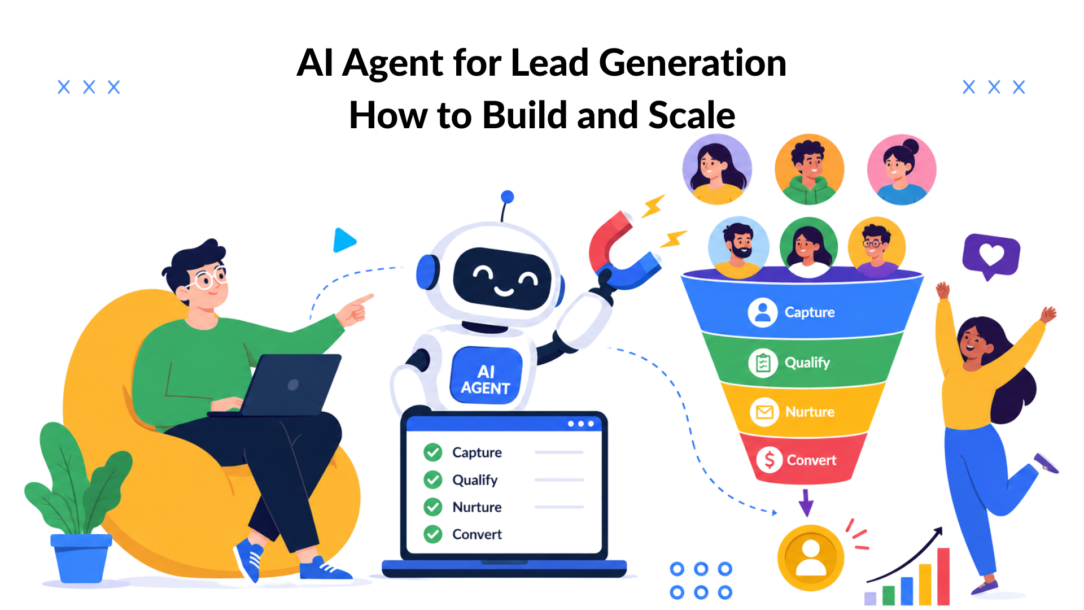
Responding to a lead within 5 minutes can make that lead about 21 times more likely to qualify than responding after 30 minutes, according to Marqeable’s lead-response data. Yet a large lead-response panel reported a median first-touch response time of b2b lead generation. 1 hour 42 minutes, with only 14.6% of leads receiving a response within five minutes, as documented by Visionary Marketing’s 2026 lead-response analysis.
That gap explains why an AI agent for lead generation has become more than a website widget. The useful systems respond immediately, identify buying intent, ask relevant questions, enrich records, and route qualified prospects with enough context for a human rep to continue naturally. The hard part isn’t launching the conversation. It’s preventing the agent from filling your CRM with contacts that look active but never become qualified pipeline.
Why AI Agents Are Reshaping Lead Generation
Speed changes the economics of inbound demand. A prospect who submits a form while comparing vendors may be ready to talk now, not after an SDR returns from a meeting or checks a queue. In a separate 10,000-conversation study, AI chatbots had a median first response time of 1.8 seconds, compared with 2 minutes 34 seconds for human agents, while even the fastest human teams averaged 45 seconds, according to LoopReply’s chatbot conversation study.
That doesn’t mean every fast response creates revenue. It means the first interaction happens while intent is still available to capture. A conversational agent can acknowledge the visitor, answer a product question, establish fit, and offer a relevant next step before the prospect moves to another tab or vendor.
From scripted bots to contextual agents
Early rule-based chatbots followed narrow paths. They asked a question, waited for a button click, and often failed when visitors used unexpected language, highlighting the need for ai lead generation. Those systems could collect basic details, but they also created friction and discarded useful intent signals.
Modern language-model agents can interpret context across a conversation. They can distinguish a pricing question from a support request, recognize that “we’re evaluating tools this quarter” signals more intent than “just browsing,” and adjust the next question accordingly. The agent still needs defined rules, approved messaging, and escalation boundaries. Better language understanding doesn’t remove the need for operational design.
The commercial case is no longer theoretical. A 2025 B2B field study involving more than 16,000 participants found that moving from static landing pages to conversational chatbots produced significantly more leads and higher-quality leads, based on controlled experiments published in the Journal of Business Research record.
Speed is only the entry point
Industry data also places chatbot use inside mainstream B2B demand generation. 58% of B2B companies use chatbot software in some capacity, and 55% of businesses using chatbots report more qualified leads, according to AI lead generation tools. Click Vision’s AI lead-generation statistics.
| Response Time | Qualification Rate | Revenue Impact |
|---|---|---|
| Within 5 minutes | About 21 times more likely to qualify than a response after 30 minutes, according to Marqeable | More intent is captured while the buying conversation is active |
| Typical human queue | Median first touch of 1 hour 42 minutes, according to Visionary Marketing | Delayed conversations create more opportunity for drop-off |
| AI-assisted first response | Median response time of 1.8 seconds in a 10,000-conversation study, according to LoopReply | Immediate engagement without adding shifts or regional coverage |
The operational distinction matters. Generating interactions is easy. Generating pipeline requires qualification, feedback, and a reliable handoff.
What an AI Agent for Lead Generation Actually Does
Consider a SaaS company running LinkedIn ads to a product landing page. In the old workflow, a visitor fills out a form, waits for an SDR email, and may never reply. The form records contact details, but it doesn’t explain whether the visitor has the right use case, authority, urgency, or budget for effective ai lead generation.
In the improved workflow, the visitor lands on the page and the agent opens a contextual conversation. It might ask about team size, the tool currently in use, and the implementation timeline, but it frames each question around a useful answer, comparison, or resource rather than presenting an interrogation.
AI Agent for Lead Generation Business Case
The three jobs inside the workflow
Signal detection comes first. The agent combines page context, campaign information, previous interactions, and conversational language. Someone arriving from a pricing ad and asking about implementation is different from someone reading an educational article and requesting a glossary for lead gen purposes.
Qualification turns those signals into a decision. The agent can use BANT or a custom framework, but it should ask only questions that change routing or follow-up. If a visitor has a clear use case and near-term timeline, the agent can offer a meeting. If the visitor is researching, it can deliver an appropriate resource and keep the person in nurture.
Routing determines what happens next. A high-intent prospect might receive a scheduling option and a notification to the assigned rep. A lower-intent visitor might receive education, a product guide, or a later re-engagement path.
Practical rule: Every question should have an operational purpose. If the answer won’t change the next action, remove the question.
The agent shouldn’t replace an SDR on a complex enterprise deal, negotiate unusual procurement terms, or handle nuanced stakeholder politics. It also shouldn’t become your post-sale support system by accident. For a broader explanation of how these systems fit into business processes, see this AI agent workflow automation guide.
The implementation usually sits between traffic and CRM, not outside the sales process. Clepher’s AI agents overview provides useful context for understanding that layer.
The Business Case Backed by Conversion Data
Procurement teams don’t approve conversational software because it sounds modern. They want evidence that the system captures better demand, reduces wasted sales effort, or improves the economics of qualification.
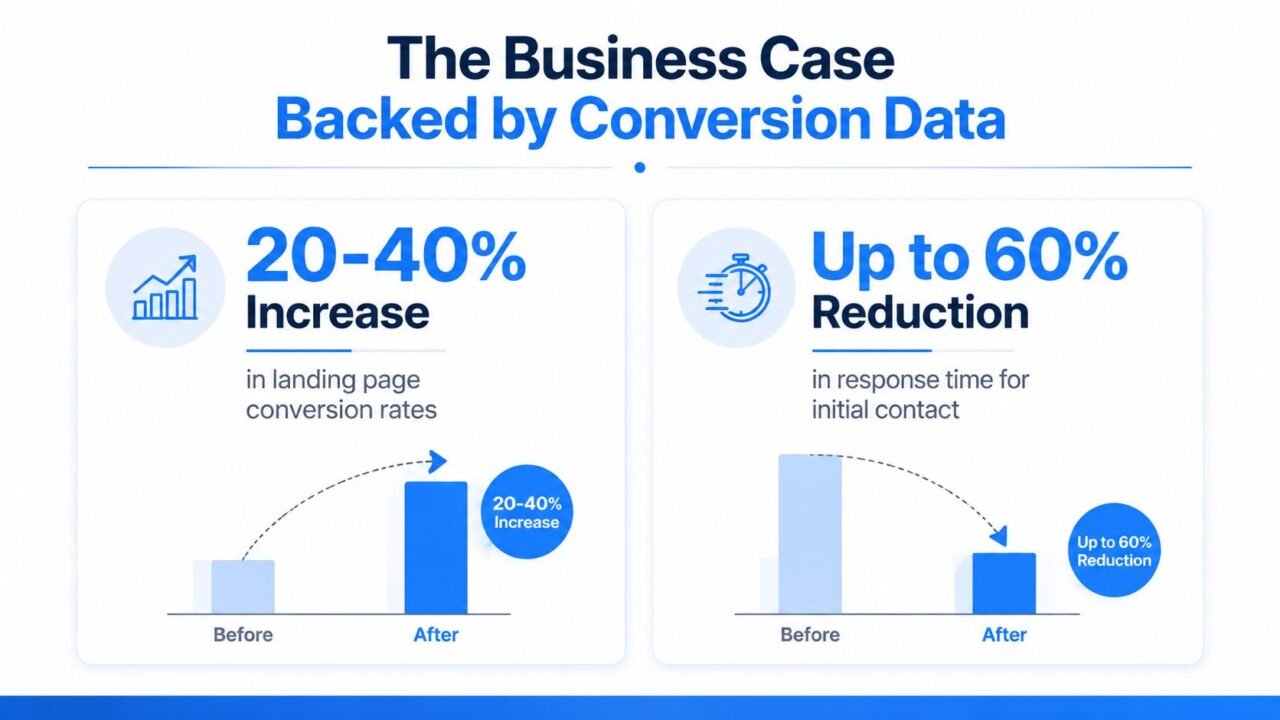
The strongest evidence comes from controlled B2B experimentation. The 2025 field study with more than 16,000 participants found that conversational chatbots generated significantly more leads and higher-quality leads than static landing pages in the tested setting, as reported in the b2b lead generation study. Journal of Business Research listing.
Industry benchmarks point in the same direction. 55% of businesses using chatbots report more qualified leads, while chatbot-generated leads can convert at roughly three times the rate of traditional sign-up forms in published benchmark summaries, according to Click Vision. The same source reports that 26% of B2B companies using live chat or chatbots see a 10–20% increase in lead volume, and that real-time chatbot interaction has boosted B2B conversion rates by up to 20%.
AI Agent for Lead Generation Marketing Flowchart
Why conversational capture can outperform forms
A form asks the visitor to provide information before receiving value. An effective agent reverses that exchange. It can answer a product question, explain fit, recommend an asset, or clarify pricing while it gathers qualification signals.
That distinction addresses the common objection that bots merely shift work from form-filling to bot-ignoring. A weak bot does exactly that. A useful agent gives the visitor a reason to continue, then uses the conversation to determine whether sales involvement makes sense.
The economic case also depends on coverage. An agent can engage visitors outside a rep’s working hours and preserve the first response without adding a human shift for every time zone. But coverage alone doesn’t create qualified opportunities. The workflow must write structured data back to the CRM, record the reason for a score, and expose outcomes to the people responsible for improving the system.
Where the business case fails
The biggest mistake is evaluating the agent only by conversations started or leads created. If the sales team receives incomplete records, vague intent labels, or meetings without fit, automation has increased administrative work.
A reliable business case connects four layers:
- Capture: Did the agent engage the right visitors?
- Qualification: Did it separate fit and intent from curiosity?
- Handoff: Did sales receive useful context at the right moment?
- Outcome: Did accepted leads progress toward opportunity and revenue?
Teams should also treat benchmark results as directional, not guaranteed. Performance depends on traffic quality, offer clarity, data accuracy, qualification rules, and sales follow-up. The agent is part of an operating system, not a conversion-rate shortcut.
How AI Lead Agents Fit Into Your Marketing Stack
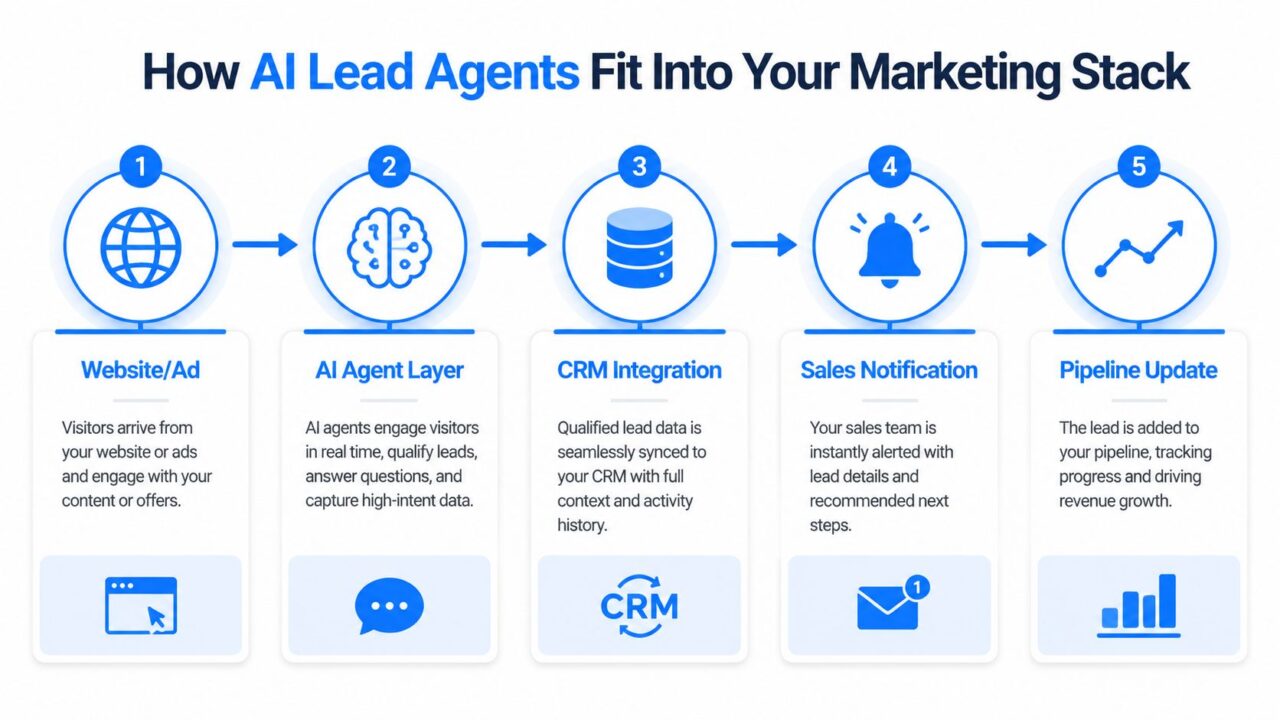
Most teams bolt an agent onto a website and then wonder why pipeline doesn’t move. The problem is usually architectural. A conversation has value only when the surrounding systems know why it started, what the prospect said, and what should happen next.
Start with contextual inbound capture
The first layer is the trigger. A Flow can start a conversation based on the page a visitor is viewing, the campaign or UTM context attached to the visit, or a behavioral signal such as returning to a pricing or integration page.
A visitor arriving from a product comparison ad shouldn’t receive the same opening as someone downloading an introductory guide. Page context lets the agent begin with relevance instead of “How can I help?”
The capture layer should also define what the agent may collect. Email, role, company, use case, and timeline can be useful, but collecting every possible field creates friction. Capture the minimum information needed to make the next decision.
Add qualification before CRM creation
The qualification layer turns conversation into structured intent. AI keywords, phrase detection, and model-based interpretation can identify signals such as an active evaluation, an implementation deadline, a current vendor problem, or a request for a demo using ai tools.
Don’t send every conversation to the CRM as a sales lead. Create separate outcomes for:
- Sales-ready: Fit and buying intent meet the threshold for human follow-up.
- Marketing-qualified: The person matches the audience but needs education or timing.
- Unqualified: The use case, company profile, or request falls outside the offer.
- Human review: The agent lacks confidence or encounters an edge case.
This is also where teams working with LinkedIn prospecting can enhance Sales Navigator with AI, provided the enrichment and outreach rules remain aligned with consent, relevance, and the actual ICP.
AI Agent for Lead Generation Performance Metrics
Route with segmentation and warm handoffs
Segmentation determines what happens after qualification. High-intent visitors can receive a booking option and a sales alert. Lower-intent visitors can enter a nurture sequence based on role, use case, or product interest. Unqualified visitors should exit gracefully rather than receive persistent follow-up.
The handoff needs more than a name and email address. Pass the conversation summary, key answers, intent signals, campaign source, unanswered questions, and the recommended next action. A rep should understand the context before sending the first message.
A cold transfer sounds like this: “Someone from sales will contact you.” A warm handoff sounds like this: “You mentioned replacing your current platform before the next planning cycle. I’m connecting you with a specialist who can address migration and implementation.”
Finally, write the outcome back to the CRM. If the agent can’t receive accepted, rejected, progressed, and closed outcomes, it can’t improve its judgment. That missing feedback loop is where many otherwise polished deployments begin to deteriorate.
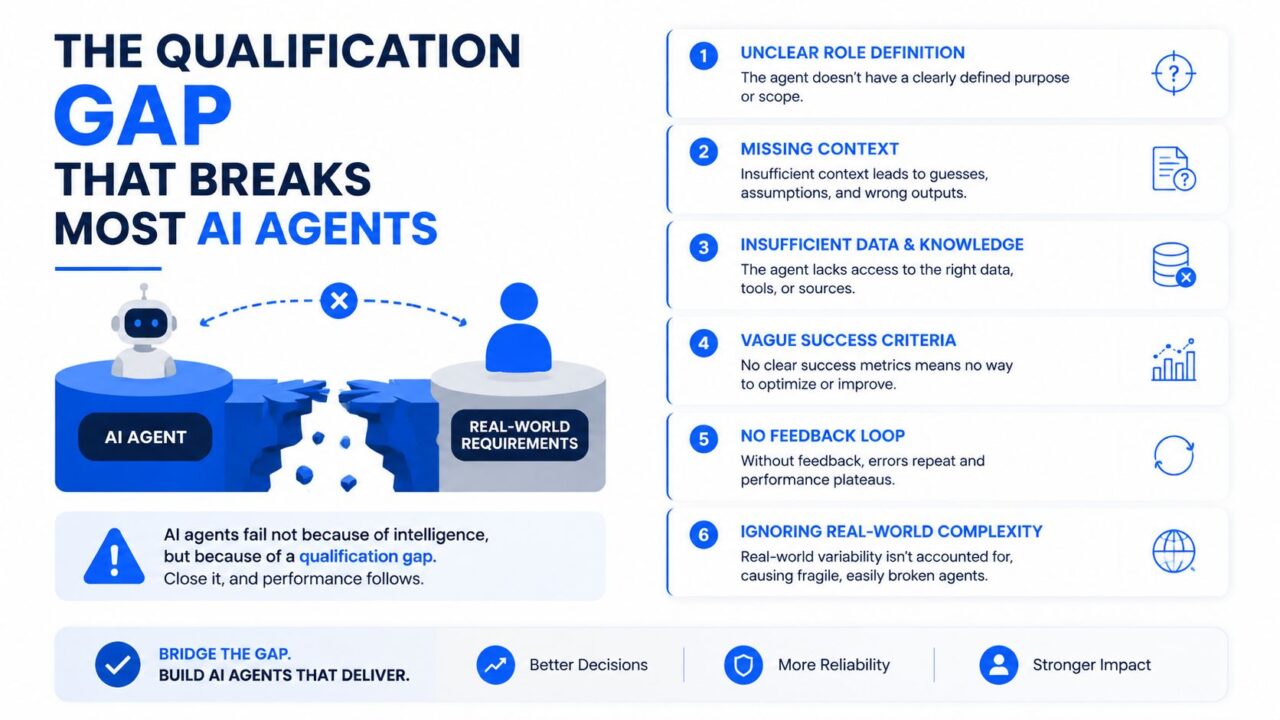
The Qualification Gap That Breaks Most AI Agents
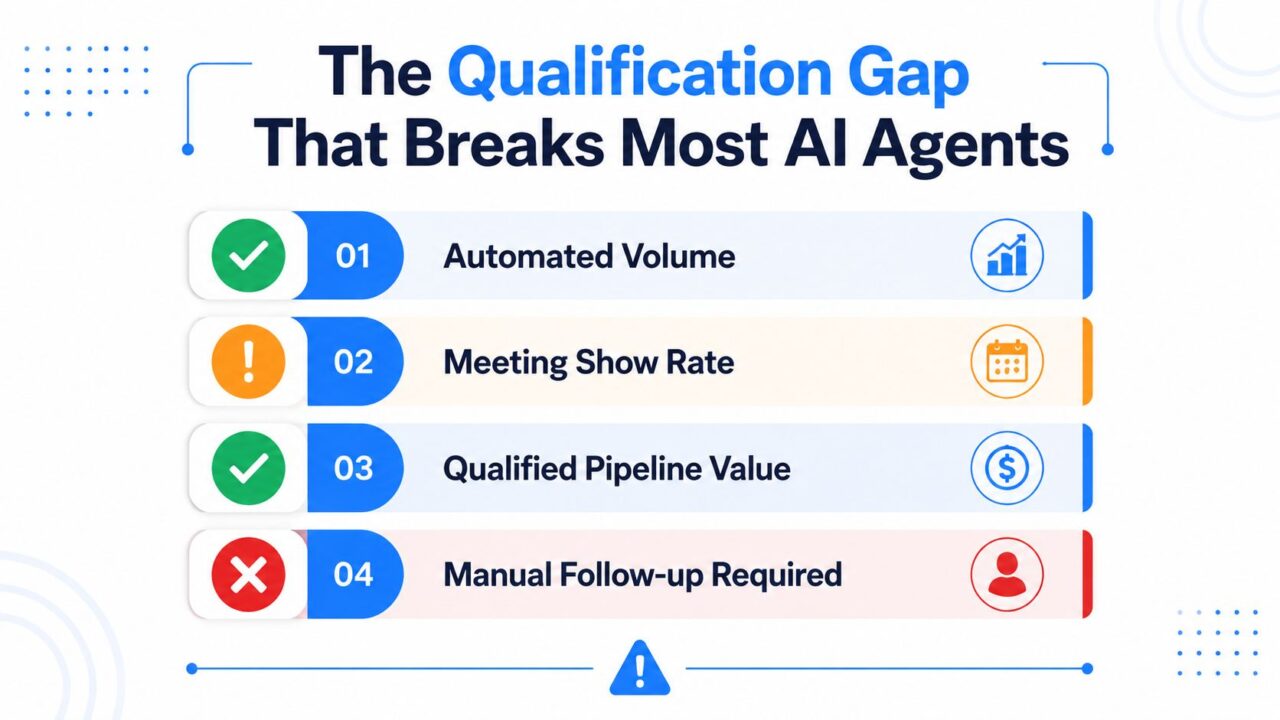
The failure mode rarely appears in a vendor demo. The agent books meetings, the dashboard reports healthy activity, and the CRM fills quickly. Then sales reports that prospects don’t understand the offer, don’t have authority, or never intended to attend.
That isn’t a lead-generation success. It’s automated volume without automated judgment.
A qualification system needs three controls. Each one addresses a different source of pipeline noise.
Score signals, not just profile fields
Firmographic fit matters, but it shouldn’t carry the decision alone. Company size or industry may indicate eligibility, while behavior and language reveal timing.
Useful signals include:
- Behavioral depth: Repeated visits to pricing, integrations, implementation, or comparison content.
- Conversational intent: Questions about timing, migration, cost, security, or internal approval.
- Business fit: The use case, company profile, geography, and technical environment match the offer.
- Trigger context: A campaign response or interaction occurs near an identifiable business need.
The agent should increase conversation depth only when signals justify it. Asking for budget in the first exchange can feel invasive. Waiting until after a long sequence to discover there’s no fit wastes the prospect’s patience and the rep’s capacity.
Teach the agent to disqualify
A well-designed agent can politely end an unsuitable conversation. That might mean recommending a self-serve resource, explaining that the product doesn’t support the requested use case, or placing the contact into a relevant educational path.
Disqualification protects sales capacity and improves the meaning of every accepted lead. It also prevents the agent from promising a meeting just because a visitor answered enough questions.
Clepher’s lead qualification process is a useful reference for structuring these decisions around explicit criteria, routing, and follow-up rather than treating qualification as a single score.
Close the loop with CRM outcomes
The agent needs feedback from what happens after booking to enhance lead score accuracy. Did the prospect attend? Did the rep accept the lead? Was there a real project? Did the opportunity progress, stall, or close?
A qualification study found that chatbots can match human reps on explicit BANT criteria such as budget, timeline, and company fit within 4–5 percentage points, but bots performed far worse at hesitation detection, scoring 34% accuracy versus 91% for experienced reps, according to lead score metrics. LiveHelpNow’s chatbot qualification analysis. The same study reported conversion of 41% for leads routed to a human within two bot exchanges, compared with 11% for leads left in a fully automated flow.
Audit question: If a rep marks a lead as poor fit, where does that feedback change the agent’s next decision?
Review conversation logs regularly, inspect false positives and false negatives, and revise the rules when buyer language changes to improve lead quality. The system should become more selective, not more active.
AI Agent for Lead Generation AI Gap
Real-World Scenarios That Show What Works
The clearest contrast is between signal-led prospecting and indiscriminate automation.
In the first scenario, a B2B SaaS team focused its agent on visitors showing meaningful product interest. The agent monitored documentation pages, recognized repeated high-intent behavior, and began conversations tied to the specific feature or implementation question that brought the visitor there.
The workflow didn’t treat every visitor as a meeting opportunity. It used the documentation visit as a reason to investigate context, asked focused questions, and routed only conversations that matched the company’s qualification criteria. When the agent encountered an integration question outside its approved knowledge, it offered a human handoff with the unanswered question included rather than improvising.
Weekly conversation review mattered. The team inspected confusing replies, revised disqualification paths, and compared accepted leads with meetings that progressed. Signal quality shaped conversation depth, and conversation outcomes improved the next round of routing.
A second startup took the opposite approach. It launched an aggressive agent across all landing pages, used a broad invitation, and measured success primarily by lead volume. Without a feedback loop, the agent couldn’t learn that many conversations came from poor-fit visitors or that booked meetings lacked urgency.
The operational symptoms appeared quickly. Sales reps received incomplete context, prospects asked questions the agent couldn’t handle, and no one reviewed the logs consistently enough to correct the pattern. The system created activity, but the sales team had to perform the judgment manually after the handoff.
The practical difference wasn’t the language model. It was the operating design:
- Focused deployment: Start with pages and signals associated with a real buying motion.
- Explicit boundaries: Define what the agent can answer and when it must escalate.
- Outcome review for the effectiveness of AI tools in lead generation: Compare booked, attended, accepted, and progressed conversations.
- Human continuity: Give the rep the transcript and reason for the handoff.
For teams evaluating the channel itself, a chatbot for lead generation should be judged by qualified conversations and downstream sales acceptance, not by raw interaction counts.
KPIs That Prove Your Agent Is Working
Meetings booked are easy to inflate. A broad invitation, weak qualification, and aggressive routing can make the dashboard look healthy while sales capacity disappears into no-shows.
Meeting show rate is a better operational signal because it tests whether the prospect understood the value of the meeting and had enough intent to attend, thus improving lead quality. The next layer is sales acceptance, followed by progression into a real opportunity. If those metrics fall while booking volume rises, the agent is likely passing curiosity downstream.
For outbound or trigger-driven lists, one benchmark presents 85–92% email match rates, an under 2% bounce rate, 8–15% reply rates, and 1–2% meeting rates as realistic outcomes when waterfall enrichment, verification depth, and signal personalization are used, according to SyncGTM’s AI lead-generation agent benchmark. Treat those figures as reference points for data quality and list construction, not promises for every channel.
| KPI | What It Measures | Benchmark Range for lead quality. | When to Investigate |
|---|---|---|---|
| First response time | How quickly the agent engages a new lead | Median 1.8 seconds in a 10,000-conversation study, according to LoopReply | Engagement is delayed or triggers fail |
| Match and bounce quality | Whether contact data is usable | 85–92% match rate and under 2% bounce rate in the cited benchmark, according to SyncGTM | Bounces rise or enrichment fields remain incomplete |
| Reply rate | Whether the message and signal are relevant | 8–15% in the cited trigger-driven benchmark, according to SyncGTM | Replies are generic, negative, or unrelated |
| Meeting rate | Whether qualified conversations create a next step | 1–2% in the cited benchmark, according to SyncGTM | Booking rises without sales acceptance |
| Show and progression quality | Whether meetings become useful sales conversations | Track internally by source, segment, and agent version | No-shows or poor-fit meetings increase |
GTM-Bench reflects the direction of mature evaluation. It tests whether agents can infer an offer, build an ICP, retrieve matching accounts and contacts, and support records with evidence across 72 tasks, 11 task types, 15 market categories, and 59,881 real prospecting queries, as described by BlackPearl’s GTM-Bench overview.
The operator’s job is to connect these metrics to CRM outcomes. A drop in reply rate may indicate weak personalization. A stable reply rate with falling show rate points toward qualification or expectation-setting. A healthy show rate with poor opportunity progression may indicate sales positioning, not agent behavior.
Deciding When to Deploy Your First AI Agent
An AI agent won’t repair an undefined ICP, inconsistent sales criteria, or a neglected CRM. It will scale those problems.
Start with a go or no-go review across four areas.
Process readiness
You should be able to describe a qualified lead in observable terms. “Good fit” isn’t enough. Define the industries, use cases, buying triggers, exclusions, required fields, and handoff conditions that distinguish a sales-ready conversation from a marketing contact.
Document what happens after routing. If sales has no owner, response expectation, or feedback path, the agent will produce records that disappear into an operational gap.
Data readiness
The agent needs reliable source information. Review contact fields, lifecycle stages, ownership, duplicate handling, consent status, and historical outcomes. Incomplete or contradictory CRM data makes both scoring and reporting unreliable for lead quality assessments.
Also decide where the agent may write. A clean summary, qualification fields, source details, transcript, and next action are more useful than a large collection of unstructured notes.
Capacity readiness
More qualified conversations still require human attention. Confirm that sales can respond, hold the meetings, and follow up with the context the agent collected. If the team is already missing handoffs, fix ownership and routing before expanding automation.
Pilot readiness
Start with a limited surface area, such as one high-intent landing page, one product line, or one inbound channel. Set conservative escalation rules and review conversations frequently. Expand only after the team can explain why the agent accepts, rejects, and routes leads.
The broader adoption gap reinforces the need for restraint. One 2026 dataset cited by MeetRep says 79% of enterprises have adopted agentic AI in some form, but only 11% run it in production, according to MeetRep’s analysis of AI lead-generation tools. Adoption doesn’t equal operational readiness.
Use this final checklist:
- ICP: Qualification and disqualification criteria are written down.
- CRM: Ownership, lifecycle stages, and feedback fields are dependable.
- Handoff: Sales receives context and has the capacity to automate lead follow-ups.
- Measurement: Show rate, acceptance, progression, and source quality are visible.
- Governance: Human escalation, compliance rules, and review ownership are defined.
If several boxes remain unchecked, fix the funnel first. If the foundation is sound, a focused AI agent for lead generation can remove response delays and improve qualification without turning your CRM into a noise archive.
Clepher provides no-code conversational Flows, AI keyword triggers, segmentation, live chat, and lead qualification across websites, Facebook Messenger, WhatsApp, and Instagram Direct Message. Use Clepher to pilot one focused acquisition workflow, connect qualified handoffs to your existing stack, and measure what reaches sales rather than counting conversations alone.
Related Posts
Customer Journey Automation: The Practical Guide
October 10, 2026Lead Qualification Marketing: A Practical 2026 Guide
October 9, 2026Customer Experience Optimization Playbook
October 8, 2026
Founder Clepher