
You open Instagram to answer one product question and find a queue of unread messages. Messenger has another customer asking about delivery, your website chat contains a lead who wants a recommendation, and email holds a support issue that nobody has tagged correctly. By afternoon, you’ve answered the same questions several times, but still can’t tell which conversations created sales or which ones needed a human response.
An AI bot development platform can turn that scattered work into repeatable customer journeys. The useful question isn’t which platform has the longest feature list. It’s which conversations should be automated first, which controls protect the customer experience, and whether the resulting workflow saves time or creates measurable commercial value.
Why Small Teams Need a Smarter Way to Handle Conversations
A small business often grows across channels before it grows a support team. A customer discovers a product through Instagram, asks a question in Messenger, visits the website, and later replies to a promotional message on WhatsApp. Each interaction may live in a different inbox, even though it belongs to the same buying journey.
That fragmentation creates three practical problems:
- Slow replies: The owner or marketer keeps switching between tabs and prioritizing messages manually.
- Inconsistent answers: Different channels may provide different information about products, delivery, pricing, or next steps.
- Lost learning: Conversations disappear into inboxes instead of becoming useful tags, segments, customer fields, or campaign insights.
An AI bot development platform gives the team a shared place to design those interactions. You can create a product-qualification Flow once, connect it to the relevant channels, and let the same logic collect answers, apply tags, and route exceptions. A visitor who asks an unusual question can still reach a person instead of being pushed through a rigid script.
AI adoption has moved into ordinary business operations. McKinsey’s 2024 Global Survey on AI found that 65% of respondents said their organizations were regularly using generative AI in at least one business function, nearly twice the share reported only ten months earlier (McKinsey’s 2024 AI survey). The opportunity for a small team isn’t to automate everything. It’s to remove repetitive conversation work while preserving judgment where customers need it.
The operational shift
Instead of asking, “How do we answer more messages?” ask:
- Which questions repeat often?
- Which answers can come from approved information?
- Which conversations indicate buying intent?
- Which situations require a person?
- What evidence would show that the workflow is worth maintaining?
A useful chatbot for small business should help you answer those questions, not merely add another inbox.
The rest of the buying process becomes clearer once you define the workflow first. You’ll be able to separate scripted automation from AI interpretation, identify features that earn their keep, test realistic use cases, and run a narrow pilot before committing to a large automation project.
What an AI Bot Development Platform Actually Does
Start with a simple mental model. An AI bot development platform is the kitchen where your conversational operations are prepared and served.
- Flows are the recipes. They define the planned sequence, such as asking about a customer’s needs, showing options, collecting contact details, or sending a follow-up.
- AI Agents are the chefs. They interpret natural language, handle variations, and decide which part of the conversation should happen next.
- Integrations are the delivery handoff. They move information into a CRM, email system, calendar, support tool, or payment workflow.
- Analytics are the order board. They show where customers enter, where they stop, which paths generate qualified leads, and where people request help.
- Broadcasts are the service window. They let you send relevant messages to opted-in segments instead of starting every interaction manually.
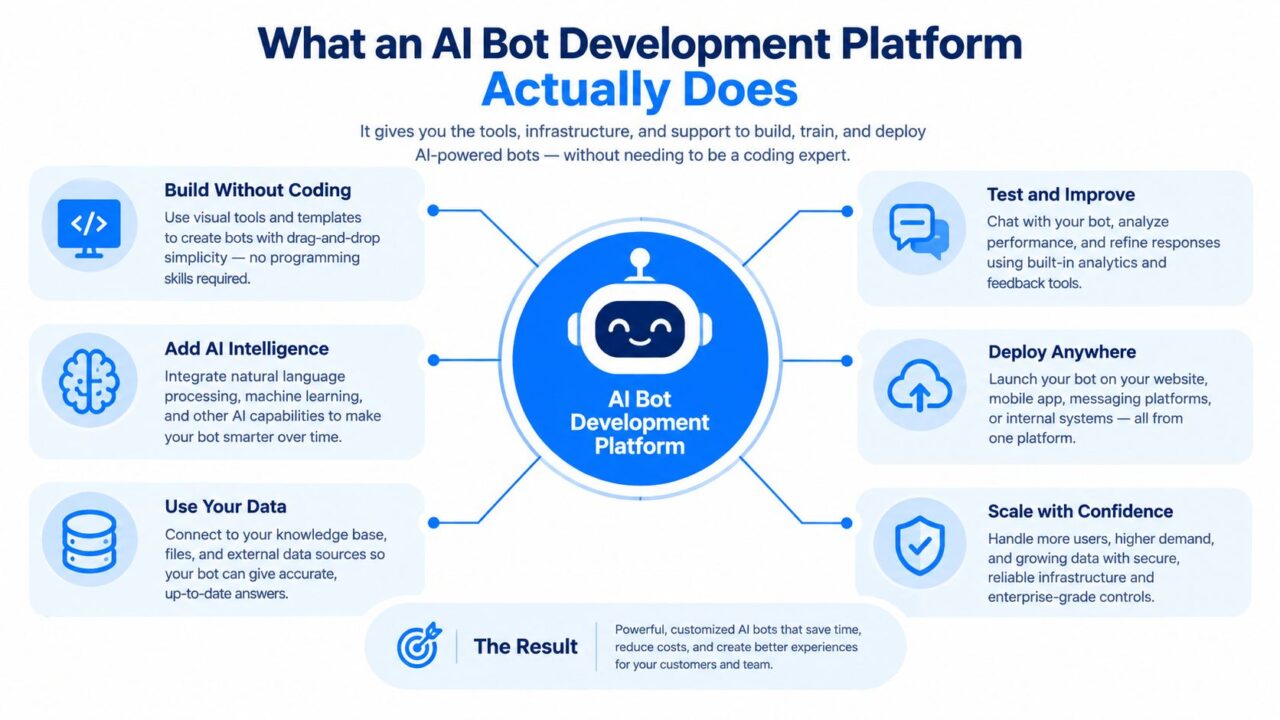
AI Bot Development Platform Infographic
How the pieces connect
Suppose a customer messages, “I need a lightweight jacket for rainy commuting.” The platform can identify the intent, ask about size and budget, save the answers to custom fields, and recommend a product Flow. If the customer asks about a policy the bot doesn’t know, the system can provide a controlled fallback or transfer the conversation to an agent.
That combination is important. A scripted Flow gives the team control over important steps, while an AI Agent handles the many ways customers express the same need. The integration then turns the conversation into an operational action, such as creating a lead, adding a tag, or starting an email sequence.
The history of conversational AI helps explain why current platforms look different from older rule-based bots. ChatGPT’s release on November 30, 2022 marked a shift from rule-based bots toward scalable, context-aware conversational systems. Today’s approach of combining scripted workflows with model-based reasoning grew out of that transition (history of conversational AI).
What to look for in the workspace
A practical builder should let a marketer see the conversation visually. You should be able to inspect the trigger, message, condition, customer field, integration, and handoff without opening a development environment.
The strongest setup also keeps automation boundaries visible. A Flow can handle predictable work, an AI Agent can interpret intent, and a human can take over when the request is sensitive, ambiguous, or commercially important. That division is more useful than treating every customer message as a free-form AI conversation.
For a broader look at how agent capabilities fit into business automation, explore these AI agent platforms.
Core Features That Earn Their Keep
Feature depth matters only when it changes a weekly workflow. A platform earns its place when it helps your team qualify more relevant leads, recover buying intent, answer routine questions, or send a better-timed message without adding operational friction. The rest of this section walks through the features that do that work, in the order a small team would use them.
Start with intent and conversation control
Natural-language understanding and AI keyword triggers help the bot recognize that “where is my order?” and “can you track my package?” belong to the same support intent. You can see how intent recognition works in practice, and why it matters for routing. Keyword triggers also provide predictable entry points for campaigns, such as asking customers to send a word from an Instagram post.
Drag-and-drop Flows turn the response into a visual sequence. A marketer can map a welcome journey, add questions, insert conditions, and connect an integration without writing code. The business outcome is easier maintenance, because the person responsible for the campaign can inspect and update it directly.
Condition logic, custom fields, and global fields make the conversation specific. A customer who selects “enterprise plan” can receive a different route from someone who selects “starter plan.” Tags and fields preserve that context for future conversations and broadcasts.
Personas, typing indicators, personalization tags, and random path distribution shape the experience. Personas give different campaigns a defined voice, typing indicators make the exchange feel less abrupt, and path distribution can send audiences through different variants when you want to compare approaches.
For background on how systems generate human-like text, this 2026 natural language generation guide offers useful context. The practical distinction remains simple: fluent wording is helpful, but it doesn’t prove that the bot completed the right business action.
Measure and improve the commercial path
A/B testing lets you compare message wording, offer framing, or qualification sequences. Analytics should show more than delivery. Look for entry points, completion rates, drop-off locations, handoff volume, and the actions taken after the conversation.
Broadcasting with segmentation turns stored context into useful follow-up. An e-commerce team might send a product reminder to people tagged as interested in a category, while excluding customers who already purchased. A creator might send a live-session reminder only to subscribers who selected the relevant topic.
Connect the bot to the rest of the stack
Native app integrations reduce the number of manual handoffs. Connections through Zapier, Make, n8n, and Pabbly extend the workflow into other marketing and operations tools.
Many platform evaluations go wrong here. The Berkeley Function Calling Leaderboard evaluates whether language models select and invoke tools accurately while reporting cost and latency, showing that real automation depends on successful end-to-end task completion, not just conversational fluency (Berkeley Function Calling Leaderboard).
Practical rule: Test whether the bot chooses the right action, sends valid information, respects permissions, handles failure, and confirms the result. A polished reply is not enough if the CRM record is wrong.
A bot that creates duplicate records, exposes restricted customer details, or triggers an unintended promotion can cost more than a bot that hands the conversation to a person. Server-side validation, least-privilege access, confirmation gates, tool-call logs, and separate latency measurements should be part of the platform conversation.
Business Use Cases Worth Automating First
The best first automation usually follows a repeated customer journey with a clear next action. It doesn’t need to solve every support question. It needs to handle one meaningful job consistently.

AI Bot Development Platform Business Icons
An e-commerce brand recovers buying intent
A shopper leaves after viewing products or asking about delivery. The brand sends an opted-in Messenger broadcast to a segment based on purchase intent, then uses a Flow to ask whether the shopper needs help with size, availability, or shipping.
The important design choice is segmentation. Someone who asked about price shouldn’t receive the same message as someone who asked about delivery. The Flow can route each answer to the relevant product information, apply a tag, and send a human handoff when the customer has a complex concern.
A 2024 Kantar-commissioned study across 13 markets found that 74% of consumers wanted to communicate with businesses in the same way they communicate with friends and family, while 85% of messaging shoppers used Messenger, Instagram, and/or WhatsApp (WhatsApp’s business messaging research). That supports meeting customers in the channels where they already begin conversations.
A creator onboards course buyers
A creator can use a website or messaging Flow to identify whether a visitor wants a free resource, a self-paced course, or premium support. After purchase, the bot delivers the welcome sequence, points the buyer to the correct lesson, and routes premium customers toward live office hours.
The measurement should include completion of the onboarding steps, support questions, and requests for human help. If many buyers ask the same question after the welcome message, the issue may be a content or product problem, not a prompt problem.
A local business runs a promotion
A café, salon, or fitness studio can invite people to message a keyword on Instagram or WhatsApp. The bot asks about timing or service preference, applies a segment, and sends a personalized offer with a clear redemption path.
The same pattern works for a local event. A customer can ask for availability, choose a preferred time, and receive a confirmation or human follow-up. The business gains a structured lead instead of an unclassified message.
Across all three examples, the platform is doing the same underlying work: capturing intent, storing useful context, sending a relevant next message, and identifying when automation should stop.
The Evaluation Checklist Every Buyer Should Run
A polished demo can hide weak foundations. Evaluate every platform against the same workflow, using your own customer questions and business systems rather than a vendor’s prepared script.
Use a simple scorecard and write down evidence for each criterion.
- NLP quality: Test varied wording, spelling mistakes, short replies, and ambiguous intent. The bot should recognize meaning without treating every phrase as a new use case.
- No-code Flow builder: Ask a non-technical team member to create a small qualification sequence. Visual editing should remain understandable after conditions and integrations are added.
- Omnichannel coverage: Confirm support for the channels your customers use, such as website chat, Messenger, WhatsApp, and Instagram Direct. Check whether channel-specific constraints are visible during setup.
- Unlimited Pages and IG accounts: Agencies and multi-brand teams should verify how the platform handles multiple properties, permissions, and separate audiences.
- Broadcasting and segmentation: Look for consent-aware sending, audience filters, exclusion rules, tags, and a record of what each subscriber received.
- Native and extended integrations: Check the exact CRM, email, SMS, calendar, and support connections you need. Then test Zapier, Make, n8n, or Pabbly for the remaining handoffs.
- Analytics and A/B testing: Require conversation-level reporting, drop-off visibility, handoff tracking, and experiment comparison. A sent-message count isn’t a business dashboard.
- Installation speed: Build one real workflow from account setup to live test. Time-to-value includes permissions, channel connection, testing, and publishing.
- GDPR tools: Ask how the platform supports consent, data minimization, retention, access requests, and human escalation. Don’t accept a generic privacy statement as an implementation plan.
- Transparent pricing: Understand whether charges depend on seats, contacts, channels, usage, or features. Model the cost of the workflow you expect to operate.
The small-business adoption problem is often relevance rather than access. The U.S. Small Business Administration reported that about 82% of businesses with fewer than five employees that weren’t planning to adopt AI viewed it as irrelevant to their business, while about 7% cited lack of knowledge or privacy concerns as the primary barrier (SBA research on AI in small firms).
That finding changes the evaluation question. Don’t ask which platform can do the most. Ask whether it can make one important workflow relevant, manageable, and measurable for your team.
Implementation Considerations and the 14-Day Pilot
A narrow pilot gives you better evidence than a broad launch. Choose one workflow with a visible starting point, a defined next action, and a clear human fallback.
A useful pilot might handle product questions from one channel, qualify inbound leads, or deliver a welcome sequence after sign-up. Keep the first Flow small enough that the team can inspect every branch and review real conversations without creating a new operations department.
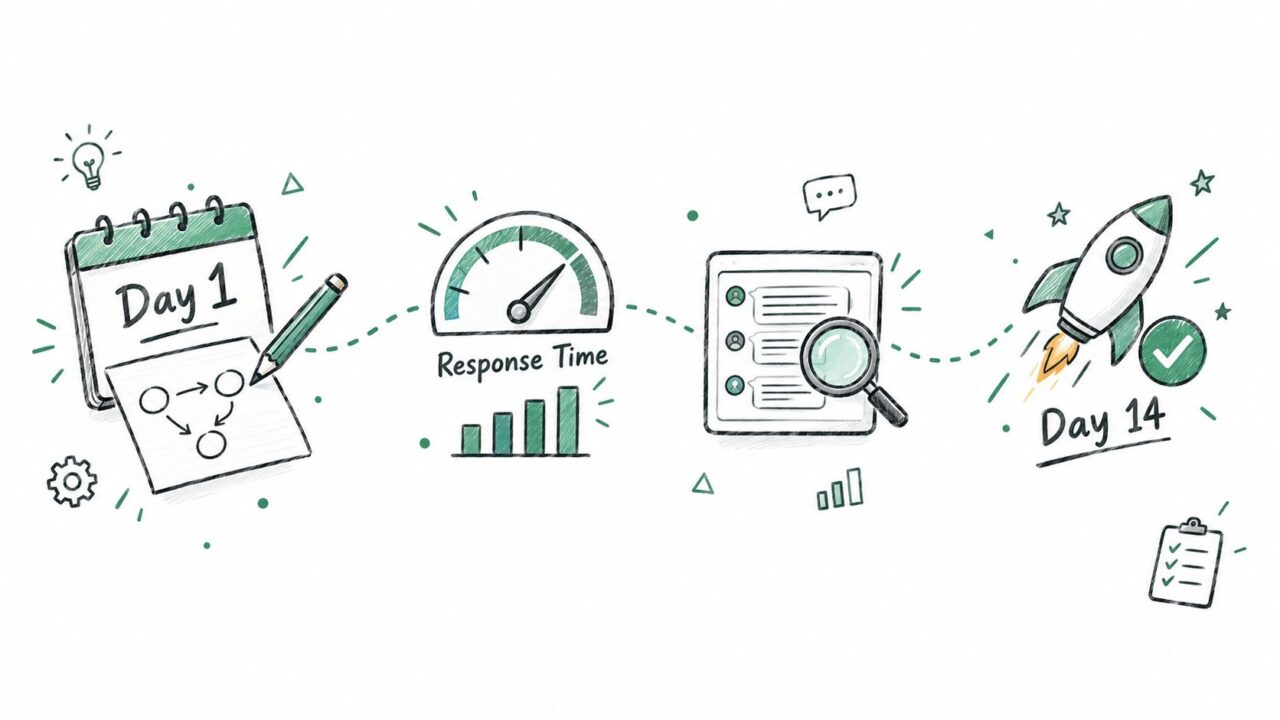
AI Bot Development Platform Timeline
A practical pilot sequence
- Days 1 to 3: Choose the use case, document the approved answers, define the escalation rules, and capture the current baseline.
- Days 4 to 6: Build the Flow, configure intent recognition, connect the required integration, and create test conversations.
- Days 7 to 9: Run internal tests for normal questions, unclear requests, sensitive information, opt-outs, and failed integrations.
- Days 10 to 12: Launch to a controlled audience and review conversations daily.
- Days 13 to 14: Compare outcomes, record failure patterns, and decide whether to refine, expand, or stop.
Capture baseline measures before the bot goes live. Depending on the workflow, these may include response time, lead capture, qualified leads, recovered carts, support deflection, escalation rate, and customer satisfaction. Use only the measures connected to the business job. A product-recommendation pilot doesn’t need the same scorecard as a support-routing pilot.
Keep people in control
Automating FAQs, lead qualification, appointment routing, and product recommendations is different from automatically denying credit, terminating a service, or rejecting an application. Under GDPR, individuals are generally protected from decisions based solely on automated processing when those decisions have legal or similarly significant effects, subject to defined exceptions and safeguards (UK GDPR guidance on automated decisions).
The European Data Protection Board advises that organizations using automated decision-making should regularly monitor and test systems, allow employee review on request, and provide a transparent explanation of the relevant logic and criteria (European data-protection guidance for small businesses).
Build that discipline into the pilot. Review misclassified leads, failed handoffs, correction requests, and cases where a person overturned an automated outcome. Keep records of the customer input, retrieved information, response, policy decision, tool call, and final action so the team can diagnose failures instead of guessing.
Choosing the Right Platform and Getting Started
The right platform depends on the workflow you need to improve.
- E-commerce and DTC teams should prioritize product discovery, cart recovery, segmented broadcasts, personalization fields, and integrations with commerce and marketing tools.
- Agencies need multiple Pages and Instagram accounts, reusable Flows, permissions, reporting, and connections that make client handoffs manageable.
- Creators and local businesses usually need fast installation, keyword campaigns, lead capture, simple onboarding, human handoff, and clear audience segmentation.
A no-code workspace that combines AI Agents, visual Flows, unlimited Pages, broadcasts, and native integrations can support all three profiles, but the buying decision still needs to start with one workflow. A long feature list won’t compensate for unclear ownership, weak consent practices, or missing measurement.
Trust is a major adoption constraint. A 2025 multi-market consumer study found that 54% of consumers were likely to engage with an AI chatbot, but only 33% trusted companies with data collected through AI, making controllable behavior and visible human handoff important adoption levers (2025 consumer adoption of AI report).
Questions buyers usually ask
How should pricing be compared?
Compare the cost of the specific pilot, including channels, contacts, seats, integrations, and usage. Avoid selecting a plan before you know which workflow will run.
How quickly can a team launch?
A small Flow can go live quickly when the team already has approved content, channel access, and a clear fallback. Integration and testing usually deserve more attention than the first visual draft.
How should GDPR be handled?
Define consent, minimize collected fields, explain automation, provide opt-out and human escalation paths, and retain the records needed to review decisions.
When should a human take over?
Use handoff for uncertainty, sensitive information, complaints, high-impact decisions, and requests that require judgment. The bot should make that transition visible rather than pretending it has solved the issue.
For additional comparison material, this SubmitMySaas no-code agent roundup can help you survey the wider category before testing a shortlist. Treat any roundup as a starting point, then validate each option with your own customer conversations and integrations.
Clepher is a no-code chatbot platform for Facebook Messenger and Instagram Direct, with visual Flows, AI-powered conversations, broadcasts, segmentation, and live chat handoff. Start with one measurable workflow, test it with your real audience, and visit Clepher to see how the platform can fit that pilot.
