The strongest argument for fixing your company greeting message is simple. Welcome emails average a 63.91% open rate and a 14.34% click-through rate, according to Sword and the Script’s review of welcome email benchmarks. That’s far above typical promotional email performance, and it proves something often underestimated. The first message gets attention.
1. Welcome Series Greeting with Immediate Value Proposition
Many businesses bury the benefit. They open with pleasantries, then hope the visitor sticks around long enough to discover why the brand matters.
That’s backward.
A strong company greeting message should answer the visitor’s silent question within seconds: “What’s in this for me?”
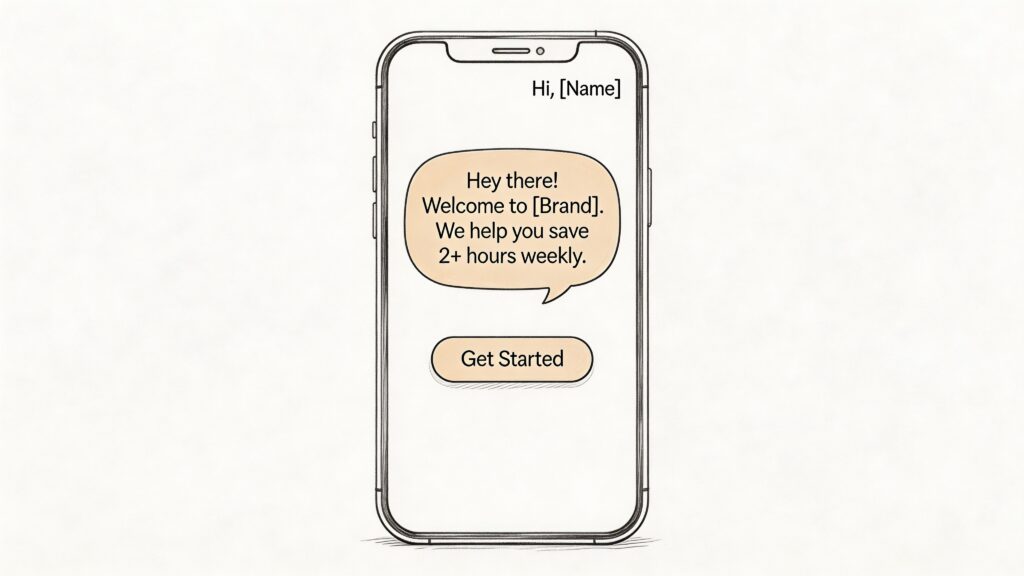
Company Greeting Message Welcome Screen
Try messages like these:
- E-commerce example: “Hey there! 👋 Welcome to Northlane. Need help finding your fit, or want a first-order offer?”
- SaaS example: “Welcome! 🎯 I can show you how Acorn automates client follow-up in a few quick steps. Want the short version?”
- Coach example: “Hi! 👋 Glad you’re here. Want help choosing the right next step for your goals?”
What works in practice
Short wins here. On mobile, long intros feel like work.
Keep the opening under roughly one screen. Lead with the outcome, then offer two clear paths. One path should serve buyers ready to act. The other should serve people who still need guidance.
Practical rule: If your greeting could fit any business in any industry, it’s too generic.
The psychology is basic but powerful. Relevance lowers friction. Specificity creates confidence. Choice increases response because the visitor doesn’t have to compose the next step from scratch.
How to build it in Clepher
Use personalization tags if you have the name. If you don’t, don’t force it. A clean message beats awkward fake familiarity every time.
Set up:
- A value-first opener: Put the core outcome in the first sentence.
- Two reply paths: “Show me options” and “Claim offer” works better than one broad CTA.
- A follow-up sequence: If they don’t click, send a light nudge later on the same channel.
For brands already using email as part of the customer journey, this pairs well with stronger visual onboarding. If you’re refining that side too, these ideas on animations for emails can help keep the first impression cohesive across channels.
2. Segmented Greeting Based on Traffic Source
A visitor from Google behaves differently from a visitor who clicked an Instagram story. Treating them the same is one of the easiest ways to lower response quality.
If someone arrives from a paid ad, they already carry the message context. Your company greeting message should continue that conversation, not restart it.
Welcome messages should be tailored accordingly, based on the visitor’s source. For example:
- A Google search visitor: “Hi, welcome! Looking for [Product]? How can we assist you today?”
- An Instagram story click: “Thanks for stopping by! Saw something on our story? Let’s chat about it!”
For business hours information, let visitors know when to expect a response if it’s after hours: “We’re currently closed, but leave a message, and we’ll get back to you during business hours.”
Ensure your business voicemail greeting is aligned with your brand’s tone and easy to understand: “Thanks for calling [Company Name]. Please leave your name and message, and we’ll get back to you during business hours.”
This keeps messaging aligned with user intent while enhancing the overall customer experience.
Source-specific examples
- Google search traffic: “Hi! 👋 Looking for help with product comparison or pricing? I can point you to the right place.”
- Facebook ad traffic: “Welcome! 🎉 Here for the bundle offer from our ad? I can get you there fast.”
- Email click traffic: “Hey [Name]! 👋 Back for that resource? I’ve got it ready.”
- Organic social traffic: “Welcome! 🙌 Great to have you here. Want our most popular picks or the latest launch?”
This works because source signals intent. Search traffic often wants clarity. Paid traffic often wants fulfillment of a promise. Email traffic usually needs continuity. Social traffic responds well to discovery.
Implementation pattern
In Clepher, pass UTM parameters into the flow and route users with conditions. Don’t overcomplicate the first version. Start with three buckets:
- Cold traffic: People from paid ads or broad search terms
- Warm traffic: People from email or remarketing campaigns
- Community traffic: People from social content, creators, or referrals
Then write one opening message per bucket.
The trade-off is maintenance. A segmented greeting system performs better than one universal opener, but only if marketing teams keep campaign naming clean. If the UTM structure is sloppy, routing breaks, and the greeting feels random.
Generic campaigns create generic greetings. Clean attribution creates useful first messages.
For agencies, this matters even more. If you manage multiple campaigns for multiple clients, traffic-source greetings help preserve the promise made in the ad creative, landing page, and first chat interaction.
3. Conversational Greeting with Immediate Question-Based Routing
Some greetings try too hard to explain everything. They read like mini landing pages.
A better company greeting message often asks one smart question and lets the user sort themselves.
Examples:
- “Hey! 👋 Are you shopping for yourself or for a gift?”
- “Welcome! Are you exploring options, or are you ready to get started?”
- “Hi there! Which sounds most like you: new to this, switching from another tool, or just researching?”
- “Welcome! 👋 Are you looking for paid social, email retention, or help choosing the right service?”
Why does this convert better
Questions create micro-commitment. The visitor isn’t buying yet. They’re identifying themselves. That small action is easier than writing a custom message, and it gives your system the data needed to route correctly.
The key is to use buttons, not open text, whenever possible. Open text creates effort. Buttons create motion.
A clean setup looks like this:
- One question only: Don’t stack three qualifiers in the greeting.
- Three to four options: Enough to segment, not enough to overwhelm.
- One escape hatch: Add “Not sure” or “Tell me more.”
- Immediate branch logic: Each answer should trigger a distinct next message.
If you want the bot to understand broader language variation after that first click, Clepher’s approach to chatbot natural language processing is the right layer to add after the primary routing question.
A real-world scenario
A coaching business can start with: “What’s your main focus right now, career growth, confidence, or relationships?” Each response can lead to different proof, offers, and booking prompts.
A DTC skincare brand can ask: “What are you shopping for today, acne support, hydration, or sensitive skin?” That feels helpful, not salesy, because it mirrors how a human associate would guide the conversation.
What doesn’t work is asking a vague question like “How can we help?” That sounds polite, but it pushes all the thinking onto the customer.
4. Personalized Greeting with Dynamic Content Blocks
Personalization works best when it feels useful, not intrusive.
A company greeting message should reflect what the business knows and can act on. Name, company, past purchase, cart state, or viewed product can all help. Randomly inserting personal details just because the system can is where teams get into trouble.
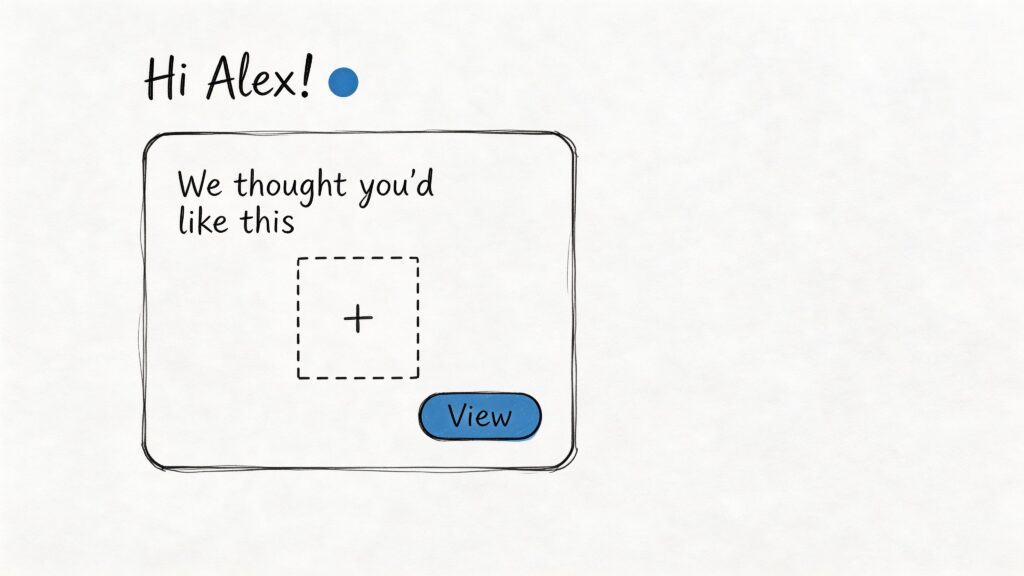
Company Greeting Message UI Card
Examples:
- “Hey Maya! 👋 Welcome back. Your last order was the linen set. Want to see new arrivals in the same collection?”
- “Hi Chris at BrightPath! 👋 Saw you checking out our onboarding tools. Want a quick walkthrough for teams?”
- “Welcome back, Nina. That cart with the black sneakers is still here if you want to finish checkout.”
- “Hi Alex! 👋 We picked a few options based on what you browsed last time.”
Where personalization helps most
Returning visitors respond well to continuity. You’re reducing search time and showing memory.
For SaaS, the company and role context can improve routing quality. For e-commerce, product and cart context usually matter more than name alone. For local businesses, simple return-visit recognition often beats elaborate personalization.
The useful test is this: if the detail helps the visitor make a decision faster, keep it. If it only proves that you track them, remove it.
To deepen this kind of relevance across touchpoints, Clepher’s guide to personalization in digital marketing is worth reviewing while you map your data fields.
How to implement without making it weird
Use custom fields and fallback text. If the system doesn’t know the name, it should still produce a clean greeting. If product history is incomplete, switch to category-level messaging.
A solid build includes:
- Known customer fields: Name, company, last product viewed, last order, or lead source
- Fallback blocks: Generic but still relevant copy when data is missing
- Behavioral triggers: Fire the greeting after product-page engagement, not instantly on page load. Many teams overdo it. The
Personalization should feel like service. If it feels like surveillance, the greeting has already failed.
One more useful reference before you build advanced variants:
5. Time-Triggered Contextual Greeting
Timing changes relevance. The same words can feel helpful at 9 a.m. and annoying at 9 p.m.
A time-aware company greeting message adapts to when the user shows up, not just who they are.
Examples:
- “Good morning! ☀️ Want today’s top picks before they sell through?”
- “Quick lunch-break browse? ☕ I can show you the fastest options.”
- “Evening check-in. Need help finishing your order or comparing options?”
- “Weekend mode? 🎉 Here are our easiest starters.”
- “[Name], welcome back. We’ve added a few new arrivals since your last visit.”
The psychological trigger
This approach works because it matches the customer’s mental context. Morning visitors often want efficiency. Evening visitors may be more open to browsing. Inactive subscribers may need novelty or a re-entry point.
In B2B, timing can also change the channel strategy. The welcome series performance shows this sharply. One benchmark cited in Sword and the Script notes that in B2B, regular emails saw open rates around 18%, while welcome series reached 63% in 2024, which reinforces how much timing and first-contact context shape engagement.
That lesson carries into chat. The first relevant touch performs better than the tenth generic one.
How to use it without overengineering
Ask for timezone when it makes sense, or infer region if your stack allows it. Then build simple windows:
- Morning
- Midday
- Evening
- Weekend
- Reactivation after inactivity
Don’t create different greetings for every hour. Most brands don’t need that level of complexity.
What does work is matching the ask to the moment. In the morning, invite action. In the evening, offer support. In a reactivation flow, lead with what’s new, not with guilt.
6. Multi-Channel Brand-Consistent Greeting
Most brands don’t have one company greeting message. They have five versions of it, spread across the website, Messenger, WhatsApp, Instagram DM, and support chat.
The problem isn’t inconsistency by itself. The problem is that each version sounds like a different company.
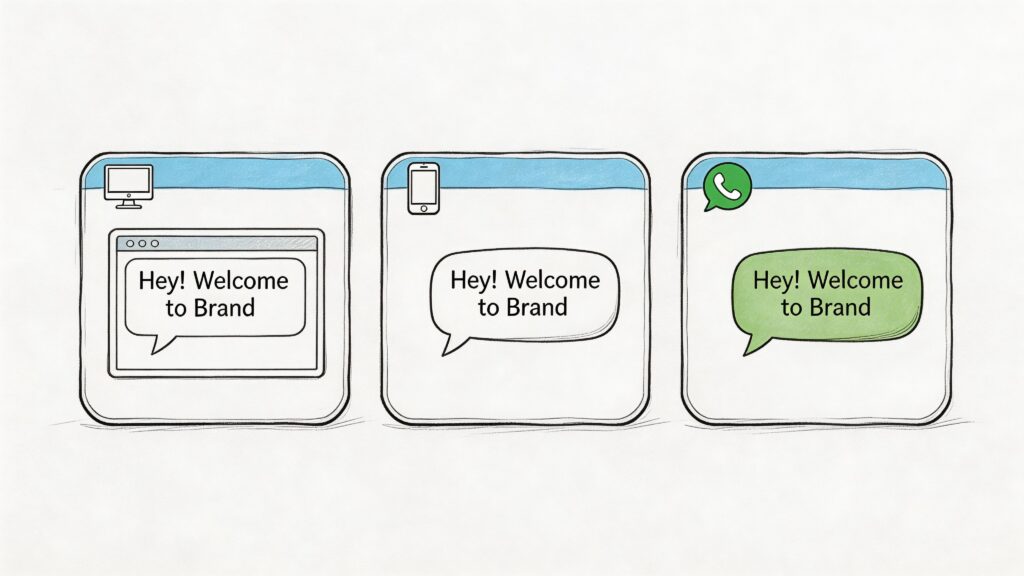
Company Greeting Message Communication Channels
What consistency means
Consistency doesn’t mean copy-pasting the same message into every channel.
It means preserving:
- Voice: Friendly, direct, premium, playful, or expert
- Core promise: The same benefit should appear everywhere
- Next step: The action should feel familiar across channels
Examples:
- Website chat: “Hey! 👋 Welcome to Formwell. Need help choosing the right plan?”
- Messenger: “Hey! 👋 Welcome to Formwell. Want pricing, a demo, or support?”
- WhatsApp: “Hi there. Welcome to Formwell. Reply with pricing, demo, or support.”
- Instagram DM: “Hey 👋 Glad you’re here. Send ‘demo,’ and we’ll guide you.”
These are similar, but they respect platform norms. Messenger supports quick replies well. Instagram DM often needs shorter, more native language. WhatsApp benefits from blunt clarity.
For teams building this out across touchpoints, Clepher’s framework for a multi-channel marketing strategy can help you decide what should stay constant and what should change by channel.
One important market signal
Messaging isn’t a side channel anymore. WhatsApp alone has 2 billion active users, according to the business messaging roundup at ChatMaxima, which is one reason customers increasingly expect fast, conversational entry points instead of formal email-style intros.
That doesn’t mean every brand should force every customer into chat. It does mean your first message needs to feel native where it appears.
7. Value-First Greeting with Social Proof Integration
Trust is fragile in the first interaction. Visitors don’t yet know whether your claims are real, whether your support is responsive, or whether your product is any good.
That’s why a company greeting message can benefit from a small dose of proof. Not a wall of testimonials. Just enough evidence to reduce doubt.
Examples:
- “Welcome! 👋 Teams use Northline to simplify onboarding. Want to see the setup?”
- “Hi! I’m Sara. I help founders tighten their offer and messaging. Want to see how the process works?”
- “Welcome to Oak & Thread 👋 Our bestsellers are easy to browse if you want a quick place to start.”
- “Hey! 👋 We’ve worked with brands that need cleaner acquisition reporting. Want to talk through your setup?”
What kind of proof belongs in a greeting
The answer is less than often assumed.
Use:
- A customer type: “Built for multi-location clinics” or “Used by DTC teams.”
- A credibility cue: A review theme, recognized partner, or known use case
- A directional outcome: Better onboarding, faster setup, fewer support tickets
Avoid turning the greeting into a stats dump. If you have strong verified metrics, use them later in the flow or on the page itself unless they directly sharpen the opening message.
One useful reference point from the email world is conversion. DollarPocket analysis cited by Sword and the Script puts average welcome email conversion rates at 3.02%, which is a reminder that first-contact messages can do real commercial work when they combine clarity and trust.
The best proof in a greeting is the proof that helps the visitor decide what to do next.
A practical scenario
A SaaS product for agencies might open with: “Welcome! 👋 Built for teams managing multiple client conversations. Want a quick look at routing and reporting?” That’s better than “We’re the best platform for growth” because it names the buyer and the use case.
8. Contextual Offer-Based Greeting with Scarcity and Urgency
Urgency works when it’s earned. It fails when it feels fake.
If you run promotions, launches, or seasonal campaigns, your company greeting message can lead with the offer. But the offer has to match the context the customer came from.
Examples:
- “Welcome! Your bundle offer is still available today. Want to claim it now?”
- “🎉 Trial bonus is live for new signups. Want the fast start link?”
- “Pre-launch pricing is open right now. Want the details before standard access opens?”
- “Holiday gift set is live. Need help choosing the right option?”
The right way to use urgency
Real urgency needs real constraints. Limited-time access, seasonal timing, or campaign-specific bonuses are all fair game. Empty pressure language isn’t.
Good urgency says:
- What the offer is
- Who it’s for
- What happens next
Bad urgency says:
- “Hurry!!!”
- “Last chance” with no context
- “Only for a few people” when that isn’t true
The strongest example in the provided research comes from retail operations, not chatbot copy. In a Valentine’s Day campaign, American Greetings used Walmart’s Scintilla Channel Performance tool and saw OPD sales rise 141% year over year, while pre-sub rate improved by 15 percentage points, according to Walmart Data Ventures’ American Greetings case study. The practical lesson is that timely, channel-aware action matters most during seasonal demand spikes.
How to apply that in Clepher
Set up offer greetings by segment:
- First-time visitor: Intro offer or starter bundle
- Returning visitor: Reminder tied to viewed products
- Abandoned cart visitor: Completion prompt with clear benefit
- Seasonal campaign traffic: Offer matched to ad or landing page language
Keep the message clean. One offer. One CTA. One follow-up if they don’t convert.
8-Point Company Greeting Message Comparison
| Greeting Type | Implementation 🔄 | Resources ⚡ | Expected Outcomes 📊⭐ | Ideal Use Cases 💡 | Key Advantages ⭐ |
|---|---|---|---|---|---|
| Welcome Series Greeting with Immediate Value Proposition | Low – drag-and-drop setup, quick launch | Minimal – copy, basic personalization tags, mobile optimization | +15–25% conversation starts; +20–30% lead qualification | E‑commerce, SaaS, DTC brands onboarding new visitors | Immediate engagement; lowers bounce; easy to A/B test |
| Segmented Greeting Based on Traffic Source | Medium – requires UTM/segment logic and routing | Moderate – UTM setup, analytics, conditional rules | +25–50% segment engagement; better paid ROI | Agencies, paid campaigns, multi-channel marketers | Highly relevant messaging by source; improved campaign insights |
| Conversational Greeting with Question-Based Routing | Medium–High – NLU training and branching flows | Moderate–High – AI keyword training, flow testing, persona design | 2x engagement; +40–60% lead quality improvement | Agencies, coaches, SaaS needing fast qualification | Qualifies leads quickly; gathers first‑party data; more human feel |
| Personalized Greeting with Dynamic Content Blocks | High integrations and data mapping required | High – CRM/commerce integrations, data hygiene, syncs | +50–80% response; 2–3x conversions for returning visitors | E‑commerce repeat customers, B2B SaaS with CRM data | 1:1 personalization at scale; strong trust and conversion lift |
| Time-Triggered Contextual Greeting | Medium – time-zone and scheduling logic | Moderate – timezone capture, scheduling tools, broadcasts | +30–45% open rates; +25–40% CTR improvement | Flash sales, onboarding, creators targeting engagement windows | Messages at peak times; improves urgency and re‑engagement |
| Multi-Channel Brand-Consistent Greeting | Medium – channel-aware templates and sync | Moderate – channel testing, cross‑platform sync, training | +25–35% consistent engagement; +40–50% retention lift | Global brands, agencies managing multiple platforms | Smooth omnichannel experience; consistent brand voice |
| Value-First Greeting with Social Proof Integration | Medium – source/testimonial management and display | Moderate – review/testimonial integrations, periodic updates | +30–50% trust/engagement; +20–40% conversion lift | SaaS, coaches, high‑ticket offers where trust matters | Rapid trust building reduces signup hesitation |
| Contextual Offer-Based Greeting with Scarcity & Urgency | Medium – offer rules, timers, segmentation | Moderate – offer creation, countdowns, redemption flows | +50–100% conversion uplift during campaigns; higher CTRs | E‑commerce promotions, course launches, trials | Drives immediate action; excellent for time‑bound revenue goals |
From Greeting to Growth
A company greeting message isn’t a formality. It’s your first conversion asset.
The gap between an ignored chat widget and a productive conversation usually comes down to relevance. Generic greetings ask the visitor to do all the work. Strong greetings remove effort. They give context, narrow choices, and create momentum.
That’s why the best-performing approaches in this list share a few traits. They’re specific. They reflect where the visitor came from, what they likely want, or what the business already knows. They don’t try to explain everything at once. They move the customer one step forward.
If you’re deciding where to start, don’t redesign every greeting across every channel today. Pick the version that matches your biggest bottleneck.
If your lead quality is poor, use question-based routing. If conversion stalls on product pages, use a value-first welcome or cart-aware personalization. Suppose campaigns bring mixed traffic, segment by source. If your brand feels fragmented across channels, standardize the message and adapt the format.
There are also real trade-offs. Personalization can improve response quality, but only if the data is accurate. Source-based greetings can outperform generic welcomes, but only if your campaign tagging is disciplined. Offer-led greetings can increase action, but only if the urgency is legitimate. The tactic matters less than the fit.
One of the clearest strategic shifts is channel behavior. Messaging now sits at the center of business communication for many buyers, and greetings need to behave like conversation starters, not static announcements. That means short copy, stronger routing, and cleaner handoffs between automation and live support.
For teams using Clepher, this is a practical build problem, not a theoretical one. The drag-and-drop flow builder, conditions, tags, custom fields, broadcasts, and A/B testing make it possible to turn a simple company greeting message into a structured qualification and conversion path. Start with one flow. Test one variable. Improve the opening line, the CTA, or the routing question. Then scale what gets replies.
The conversations are already happening on your site, Messenger, WhatsApp, and Instagram. A better first message gives them direction.
If you want to turn your company greeting message into a working lead capture and conversion flow, Clepher gives you the tools to build it across your website, Facebook, Messenger, WhatsApp, and Instagram DM without code.