
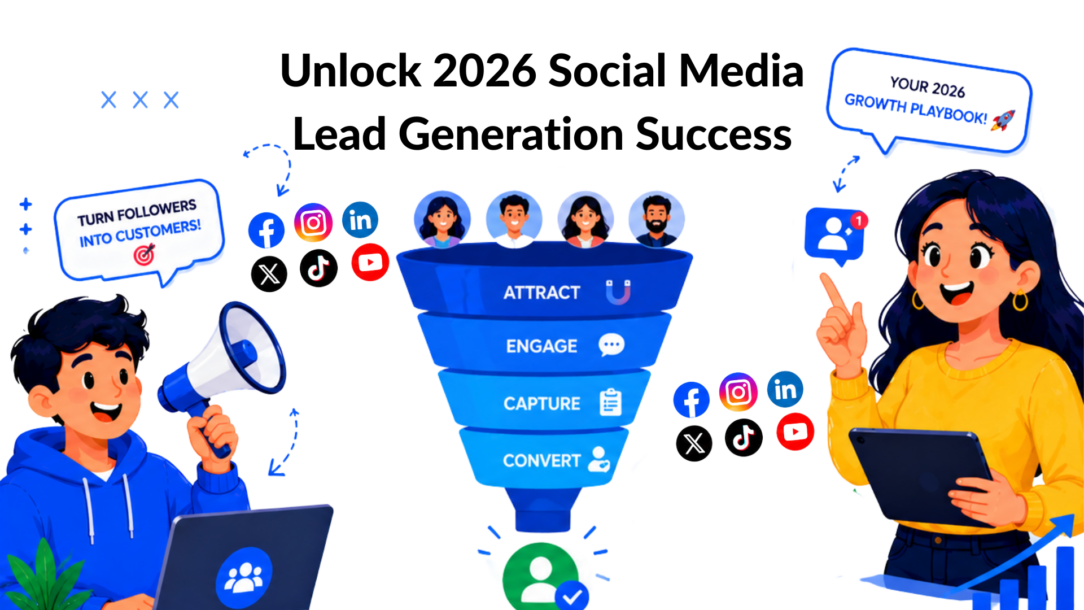
Social media lead generation stops being a soft metric the moment it feeds pipeline. 68% of marketers report that social media marketing has helped them generate more leads, and that number rises to 72% among marketers with five or more years of experience, according to Exploding Topics’ lead generation statistics roundup. The gap between average results and strong results usually isn’t platform choice alone. It’s process.
A lot of teams still treat social like a content channel and lead generation like a separate funnel. That split is expensive. A post gets attention, a Story gets replies, a comment thread gets momentum, and then the prospect hits a generic link, lands on a cold form, and disappears. The problem isn’t reach. The problem is friction.
The practical shift is simple. Instead of pushing every social interaction into a static landing page, build a path that captures intent while it’s still warm. That means native lead ads, DM automation, chat flows, and follow-up logic that carries the conversation forward instead of resetting it.
Why Social Media Lead Generation Is a Core System in 2026
Social media drives lead generation at a meaningful scale. As noted earlier, experienced marketers report stronger lead results from social than less experienced teams do, which points to a process advantage, not luck.
In practice, that process starts inside the platform. Social is now a working lead capture channel across discovery, qualification, and follow-up. A prospect watches a Reel, taps a Story sticker, comments on an offer post, or submits a native lead form. The next step should gather buying context while attention is still high, often through DMs, Messenger, or a chatbot flow that asks one or two useful questions before handing the lead to sales or sending the right offer.
Teams with repeatable results build around that handoff. In agency work, that often means turning ad engagement into a short qualification chat about budget, timeline, and service fit. For e-commerce brands, it usually means helping shoppers choose faster through product quizzes, back-in-stock alerts, bundle recommendations, or discount delivery inside DMs. For creators, it can be as simple as using an auto-reply on a keyword comment to send a resource and segment people by interest. For local businesses, Messenger and Instagram DMs are often the fastest route from inquiry to booked appointment.
Three shifts explain why this matters more in 2026:
- Attention moves fast across surfaces: People switch between feed posts, Stories, comments, DMs, and messaging apps in a single session.
- Delayed capture loses intent: Sending every click to a cold form or generic landing page adds friction right when interest is highest.
- Conversation improves qualification: Short automated exchanges can identify fit, urgency, location, product interest, or service need before a human steps in.
A strong social presence requires more than a profile and a posting calendar.
It requires a system that connects engagement to conversion. That system can include native lead ads, comment-to-DM automations, chatbot screening, instant coupon delivery, appointment routing, and CRM syncing. The exact setup changes by business model, but the job stays the same: capture intent in context, qualify quickly, and continue the conversation without forcing the prospect to start over.
Content quality still matters because weak creative produces weak intent signals. If you want a practical refresher on format selection, consistency, and creative execution, ClipCreator.ai’s best practices pair well with the conversion-focused systems covered here.
The Foundation: Your Audience and Your Offer
Most social campaigns fail before the first ad runs or the first post goes live. The failure happens in positioning.
If you can’t define who the lead is, what problem they’re trying to solve, and what action they should take next, every tactic feels noisy. Better creative won’t fix a blurry offer. This is why understanding your target audience and crafting a clear, compelling offer is crucial for success.
Using the right social media platform for your audience is essential. Whether it’s Facebook, Instagram, or LinkedIn, choosing the platform that aligns with your lead generation strategies ensures you’re reaching the right people. For B2B lead generation, LinkedIn may be more effective, while Facebook and Instagram might be better for consumer-focused campaigns.
Focusing on attracting high-quality leads and qualified leads ensures you’re not wasting time or budget on unqualified traffic. By clearly defining your offer and guiding potential leads through a well-structured funnel, you can maximize your chances of converting them into customers.
Start with an operating definition of your audience
Forget vague audience descriptions like “small businesses” or “women aged 25 to 44.” For social media lead generation, your audience definition has to help you write messages, choose channels, and qualify responses.
Use these filters:
- Who buys: The person with budget, authority, or direct influence.
- Who feels the pain: The person actively dealing with the problem.
- What triggers action: A launch, a missed target, wasted ad spend, low bookings, abandoned carts, or slow sales follow-up.
- What they need to believe: Why your offer is relevant now, not eventually.
For a B2B agency, the actual audience may not be “marketing teams.” It may be a founder at a small SaaS company who needs pipeline but doesn’t want to hire in-house. That changes everything. The ad angle, the lead magnet, and the qualifying questions all become more precise.
For an e-commerce brand, the audience might not be “skincare shoppers.” It might be first-time buyers looking for a routine with low decision fatigue. That points you toward quizzes, DM product recommendations, and starter offers.
Build a practical ICP, not a slide deck
A useful ICP is short enough to use every day. I prefer a one-page version with prompts like these:
- What is this person trying to improve right now?
- What are they frustrated with?
- What would make them reply, click, or opt in today?
- What objection will show up first?
- What information do we need before we route them to sales or nurture?
Here are simple examples by business type:
- E-commerce brand: New visitors interested in a product category but unsure what fits their needs.
- Agency: Decision-makers who know they need demand generation help but haven’t decided between freelancer, agency, or internal hire.
- Creator or coach: Followers consuming advice regularly but not yet committed to a paid program.
- Local business: Nearby prospects showing intent around an offer, booking window, or seasonal need.
A strong audience definition makes channel decisions easier. A weak one forces you to guess at every step.
Match the offer to the buying moment
Your offer doesn’t need to be elaborate. It needs to fit the temperature of the lead.
Cold social traffic rarely wants the same thing as a warm follower. Someone who just discovered your account may trade contact information for a checklist, quiz result, buyer’s guide, or first-order incentive. Someone who has watched multiple videos and replied to a Story may be ready for a consult, demo, quote, or direct booking.
A few offer examples that work in practice:
- E-commerce: “Get a personalized bundle recommendation in DM.”
- Agency: “See the audit checklist we use before scaling paid social.”
- Creator: “Reply with a keyword to get the workshop notes.”
- Local business: “Message us for this week’s service offer and available times.”
Pressure-test your value proposition
Before launch, ask one hard question. Why should this person act on social instead of waiting?
Your answer should be specific and immediate. Faster clarity. Easier comparison. A customized recommendation. A better incentive. Less work. More confidence.
If your post promises one thing and your form asks for too much too soon, conversion drops. If your ad targets everyone, the wrong people fill out the form. If your offer attracts curiosity but not intent, your sales team gets stuck sorting weak leads.
The foundation isn’t glamorous. It is where profitable social media lead generation starts.
Channel-Specific Playbooks for Organic and Paid Leads
Different platforms reward different buyer behaviors. The mistake is copying the same campaign structure everywhere.
For B2B, LinkedIn usually deserves first priority. For visual products, community-led brands, creators, and local businesses, Instagram and Facebook often create faster conversational entry points. The smartest approach is to choose the platform that matches intent, then tailor both the content and the capture method.
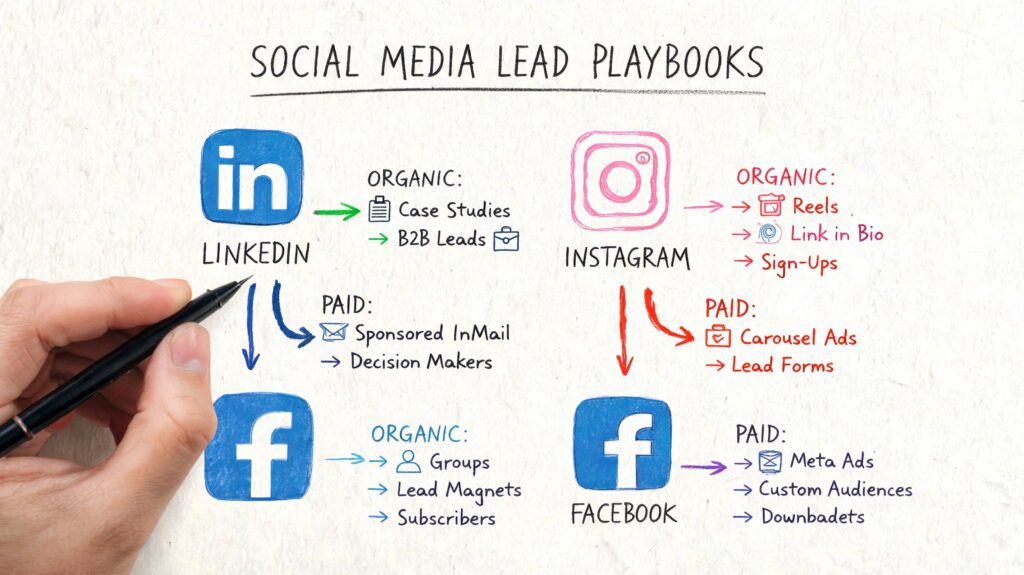
Social Media Lead Generation Playbooks
LinkedIn for agencies SaaS and B2B services
For B2B organizations, LinkedIn usually isn’t optional. 62% of B2B marketers say LinkedIn generates leads for them, and it’s described as 277% more effective for lead generation than Facebook and X combined in Cirrus Insight’s lead generation statistics roundup.
That doesn’t mean “post thought leadership” is enough. It means LinkedIn works when content and conversion are tightly connected.
Organic approach
- Teach the problem clearly: Post short analyses, teardown posts, carousels, or founder commentary aimed at one buyer pain point.
- Invite low-friction response: End with a question, offer a checklist in comments, or ask readers to message for a template.
- Use profile real estate well: Headline, banner, featured section, and CTA should all point to one core offer.
Paid approach
- Use lead gen forms for webinar registration, audits, or guides.
- Retarget profile visitors and prior engagers with stronger commercial offers.
- Segment campaigns by role or pain point instead of sending every audience to one generic asset.
A demand gen agency, for example, might run founder-focused content organically and use paid lead forms to offer an audit for companies already engaging with those posts.
Instagram and Facebook for e-commerce creators and local brands
Instagram and Facebook are strong when the buying decision has a visual, personal, or local context. These platforms are built for impulse, familiarity, and repeated touchpoints.
Organic approach
- Stories for intent capture: Use polls, questions, and quick reactions to identify warm leads.
- Reels for problem awareness: Show transformation, demos, objections, or before-and-after use cases.
- Comments and DMs as the handoff: Move from public interest to private conversation fast.
Paid approach
- Lead ads work well for offers that don’t require a full site visit first.
- Retargeting is useful when people engage with content but don’t act.
- Local businesses should keep geographic targeting tight and offers immediate.
An esthetician might run a local Instagram promo and send respondents into a DM flow for treatment interest and appointment preference. A creator might use a Reel to pitch a free resource, then trigger delivery through Instagram DM. Brands exploring this route can see how Instagram DM automation workflows support that handoff from engagement to qualification.
How to choose your main channel
Use this quick filter.
| Business type | Best starting channel | Best organic motion | Best paid motion |
|---|---|---|---|
| B2B agency | Expert content and direct engagement | Lead forms and retargeting | |
| SaaS | Education around use case or pain point | Demo or guide lead campaigns | |
| E-commerce | Instagram and Facebook | Reels, Stories, UGC-style product education | Lead ads, retargeting, and offer campaigns |
| Creator or coach | Instagram and Facebook | Short-form teaching and DM prompts | Lead ads for workshops or resources |
| Local business | Facebook and Instagram | Community posts, offers, Stories | Geographic lead ads and booking prompts |
Don’t ask one platform to do every job. Use the platform for what users already do there, then build capture around that behavior.
Designing Irresistible Lead Magnets and Capture Flows
The offer gets attention. The capture flow decides whether that attention turns into a lead.
Most brands don’t have a traffic problem here. They have a conversion design problem. They ask for too much, too early, in the wrong format. A social user taps because the action feels easy. Then they hit a form that feels like work.
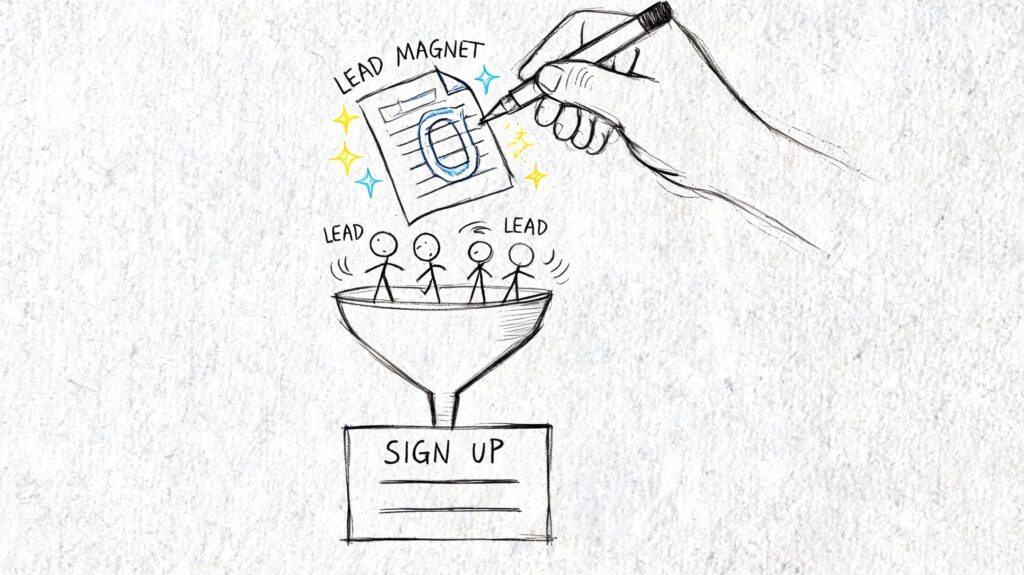
Social Media Lead Generation Funnel
Lead magnets that fit the platform
A good lead magnet is narrow, fast to consume, and directly tied to the next purchase step.
Here are practical examples by business model:
- E-commerce: Shade finder, bundle recommendation, restock alert, first-order incentive, or quiz result
- Agency: Audit checklist, short benchmark deck, diagnosis call, or service fit worksheet
- Creator: Mini lesson, prompt pack, resource library, challenge, or workshop replay
- Local business: Service menu guide, booking incentive, seasonal checklist, or quote request helper
The right lead magnet often answers one immediate question. Which option fits me? What should I do first? Is this worth booking? How much work is this going to be?
Native capture beats extra clicks
Many teams leave performance on the table. Platform-native lead gen ads, such as Facebook Lead Ads and LinkedIn Lead Gen Forms, can reduce cost-per-lead by about 50% and create the potential for double the lead volume compared with standard ads that send users to an external landing page, according to Driftrock’s analysis of lead generation challenges.
That finding matches what practitioners see repeatedly. Social users respond better when the path stays inside the app. Pre-filled fields reduce effort. Momentum stays intact.
But native forms aren’t always enough on their own. If you only collect name and email, you may scale junk leads. If you ask for too much detail, conversions drop. The better approach is to capture the lead with minimal friction, then qualify through conversation.
For teams refining the form itself, lead form best practices are worth reviewing before you launch or rebuild a campaign.
Lead Capture Method Comparison
| Method | Friction Level | Lead Quality | Scalability | Best For |
|---|---|---|---|---|
| Native lead ad | Low | Moderate to high, depends on follow-up | High | Paid campaigns, fast capture |
| Landing page form | Medium to high | Moderate to high, depends on the offer match | High | Webinar, audit, longer sales cycles |
| Instagram or Facebook DM keyword | Low | High when paired with a qualification | Medium to high | Creators, e-commerce, local businesses |
| Chatbot conversation | Low to medium | High when flow is designed well | High | Businesses that need segmentation before sales |
| Manual inbox handling | Medium | High for small volume | Low | Early-stage testing |
The best capture flow feels like a continuation of the social interaction, not a switch into admin work.
A conversational path can start with a comment trigger, a story reply, or an ad click. The first message delivers the promised asset or offer. The next message asks one useful question. That’s where quality starts improving without increasing front-end friction.
This video gives a useful visual frame for how that exchange can work in practice:
Build the capture flow in the right order
Use this sequence:
-
Make the promise obvious
The user should know exactly what they get and why it matters. -
Reduce the first action
Click, reply, or submit. Don’t pile on decisions. -
Deliver the value quickly
If you promised a guide, send it immediately. If you promised a code, don’t delay it. -
Ask one qualifying question
Product type, budget range, timeframe, company size, or goal. -
Route based on intent
Warm leads get a sales path. Early-stage leads get nurtured.
One mention is enough here. Platforms like Clepher let teams build these conversational flows across Messenger, WhatsApp, website chat, and Instagram DM without coding, which is useful when your lead capture depends on immediate response and branching logic.
Automating Lead Qualification and Nurturing Workflows
A lead isn’t valuable because it entered a form. It’s valuable if your team can identify intent, respond appropriately, and keep the conversation moving.
That sounds obvious, but most social media lead generation systems break after capture. Some studies show that 80% of new leads never translate into a sale, while nurtured leads can generate purchases that are 47% larger than non-nurtured leads, according to DesignRush’s lead generation statistics roundup. That’s not a traffic issue. It’s a follow-up issue.
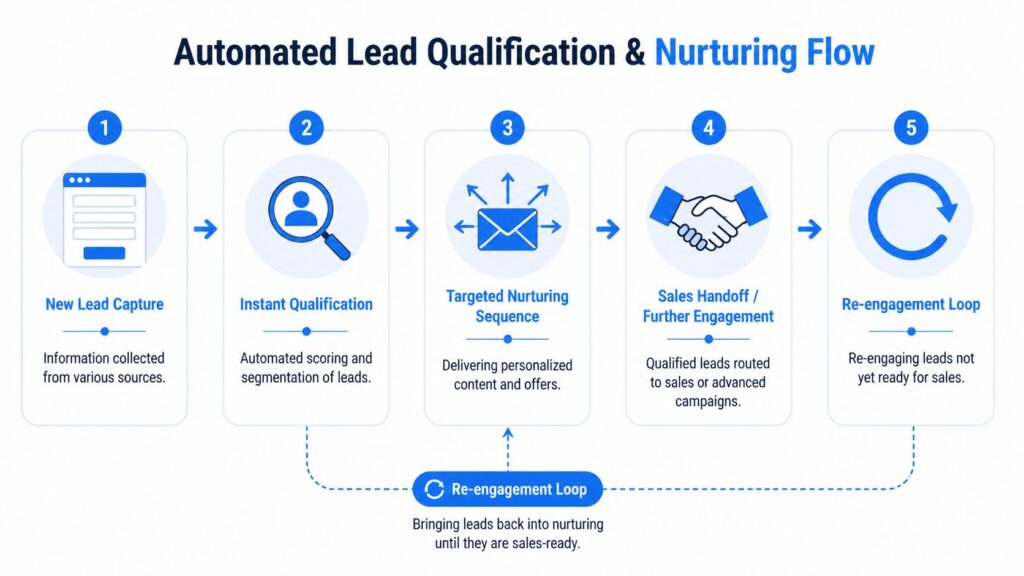
Social Media Lead Generation Automated Nurturing Flow
What a strong post-capture journey looks like
Take a simple example. A prospect responds to an Instagram Story about a free audit.
They shouldn’t enter a dead end where the team promises to get back “soon.” They should enter a system that does four things immediately:
- Confirms the request
- Asks a useful qualifier
- Tags the lead by intent
- Triggers the right next action
For businesses that want that process inside messaging channels, chatbots for lead generation can structure qualification before the sales handoff.
Scenario one for an e-commerce brand
A shopper responds to a Story about a product bundle.
The flow can send the offer first, then ask what they’re shopping for. Based on the answer, the shopper gets a personalized recommendation, a follow-up message with social proof or product education, and a reminder if they don’t click through. If they show high purchase intent, the system can send a stronger offer or hand them over to live chat.
The key detail is tone. The messages should feel like a guided shopping conversation, not a support ticket.
Scenario two for an agency or consultant
A prospect clicks on a lead ad for a performance audit.
The first follow-up message acknowledges the request and asks one or two practical questions. What channel are you spending on now? What’s the main bottleneck? Depending on the answers, the lead gets tagged as fit, poor fit, or nurture. Fit leads receive a booking link. Nurture leads get a short sequence with examples, common mistakes, and a lighter CTA.
Respond to behavior, not just identity. Job title matters less than what the person just did and what they need next.
The workflow components that matter
A useful automation stack doesn’t need to be complicated. It needs to be intentional.
Qualification layer
Ask for information that your team will use. Good examples include product interest, timeline, budget range, company size, or service need. Bad examples are questions added only because a form builder allows them.
Segmentation layer
Apply tags or fields based on answers and source. A lead from a giveaway should not get the same sequence as a lead who asked for a quote. A creator subscriber is different from a local service inquiry.
Nurture layer
Follow-up should continue the original reason for engagement. If someone wanted a discount, don’t immediately switch to generic brand storytelling. If someone wanted a strategy resource, don’t jump straight to “book a call” unless they’ve shown buying intent.
Handoff layer
When a lead meets your threshold, route them to the right human or campaign. Sales should receive context, not just an email address.
What doesn’t work
Three patterns repeatedly underperform:
- Instant hard sell: The user asked for a resource and gets pushed to buy before trust is built.
- One-size-fits-all sequences: Every lead gets the same messages regardless of source or answers.
- Slow human response with no automation: Warm intent cools while the team catches up.
The best nurturing workflows feel responsive because they reflect the lead’s actual signals. That’s the difference between collecting names and building a pipeline.
Measuring What Matters and Optimizing Your Funnel
If you’re serious about social media lead generation, stop evaluating campaigns by engagement alone. Reach, likes, saves, and comments help diagnose attention. They don’t tell you whether the system is producing revenue.
The useful metrics are the ones that reveal where the funnel is leaking.
Watch the full path, not one isolated metric
Start with a small set of questions.
- Are you generating enough leads?
- Are those leads qualified?
- Are they moving forward after capture?
- Which step creates the biggest drop-off?
- Which source produces the best downstream outcome?
Attribution matters. If you only credit the last click, you’ll undervalue the content, retargeting, and conversational touchpoints that warmed the lead before conversion. Teams trying to clean this up should understand how marketing attribution works before they make budget decisions.
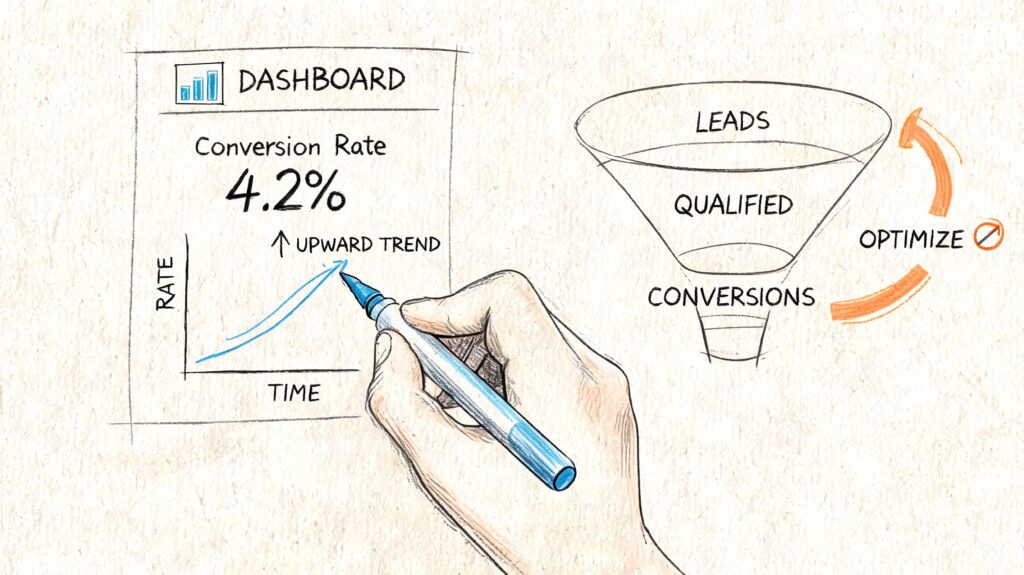
Social Media Lead Generation Conversion Funnel
Diagnose by funnel symptom
You can usually spot the problem by pairing one metric with observed behavior.
| Symptom | Likely issue | What to test |
|---|---|---|
| Strong engagement, weak lead volume | Offer or CTA mismatch | New lead magnet, clearer CTA, native capture |
| Lots of leads, weak sales outcomes | Poor qualification | Better questions, segmentation, and routing |
| Good lead quality, weak booking or purchase rate | Follow-up friction | Faster response, stronger nurture, simpler handoff |
| Paid campaigns spend efficiently but stall downstream | Attribution or nurture gap | CRM tracking, source-based sequences, and tighter retargeting |
Optimization isn’t one task. It’s a set of smaller decisions made in the right place.
A practical testing rhythm
The easiest way to waste time is to test everything at once. Keep one control, change one meaningful variable, and measure the downstream effect.
Useful test areas include:
- Creative angle: Problem-led versus outcome-led messaging
- Offer type: Discount, guide, audit, quiz, or consultation
- Capture method: Native form versus DM trigger versus landing page
- Qualification prompt: One question versus two, broad versus specific
- Follow-up sequence: Educational first versus sales first
Better optimization comes from tracing friction. Find the step where intent drops, then change that step before you touch the rest of the funnel.
A common example: an ad performs well and generates cheap leads, but booked calls stay low. Often, teams blame traffic quality immediately. Sometimes they’re right. But often the problem is the transition after capture. The lead expected a fast, relevant next step and got a generic email, a delayed response, or a scheduling page with no context.
Keep reporting tied to decisions
Don’t create dashboards that no one acts on. Build a review habit around decisions your team can make:
- Which audience should get more budget
- Which offer should be retired
- Which qualification question is filtering out good prospects
- Which nurture sequence needs a rewrite
- Which platform deserves a larger share of effort
When social reporting is connected to pipeline behavior, optimization gets much easier. The team stops arguing about vanity metrics and starts fixing conversion bottlenecks.
Turn Your Social Followers into a Predictable Sales Engine
The difference between noisy social activity and dependable growth is structure.
Businesses that win with social media lead generation don’t rely on constant improvisation. They build a system. The audience is defined clearly. The offer matches buyer intent. The platform fits the business model. The capture flow reduces friction. The follow-up is automated enough to be fast and personal enough to feel relevant. Then the team measures where leads stall and improves that step.
That framework works across business types because the mechanics are stable even when the content changes.
- E-commerce brands need quick recommendations and recovery flows.
- Agencies and consultants need better qualifications and cleaner sales routing.
- Creators need ways to turn attention into subscribers and offer pathways.
- Local businesses need immediate conversational capture tied to real availability and offers.
Your followers are not the asset. The asset is the system that turns attention into qualified conversations and qualified conversations into customers.
The biggest missed opportunity is still the same one. Teams invest in content and ads, then treat capture as a form and follow-up as an afterthought. That’s where momentum dies.
If you’re a creator working on that handoff from click to conversion, it’s worth taking a look at how landing-page friction affects results. For that angle, read taap.bio’s guide for creators.
Audit your current process with five questions:
- Do we know exactly who we’re trying to attract?
- Is our offer strong enough for the traffic temperature?
- Are we capturing leads inside the platform when possible?
- Does our follow-up change based on intent?
- Can we identify where leads drop out?
If the answer to any of those is no, that’s your next project. Fix the system before you ask for more reach.
If you want to put this into practice, Clepher helps businesses build conversational lead generation flows across website chat, Facebook, Messenger, WhatsApp, and Instagram DM so social engagement doesn’t die at the handoff. It’s a practical way to capture, qualify, segment, and nurture leads inside the channels where the conversation has already started.
Related Posts
Automated Checkout Bot: Build and Launch Guide
October 7, 2026AI Agent Framework: Architecture, Tools, and Use Cases
October 6, 2026Master Lead Generation Automation for Business Growth
October 5, 2026
Founder Clepher