
What exactly is a conversational AI chatbot? Think of it as a smart digital assistant, built to have natural, human-like conversations. It goes way beyond basic commands by using advanced tech like Natural Language Processing (NLP) to understand what you mean, learn from every chat, and provide genuinely helpful answers.
It’s the difference between a simple FAQ bot that just parrots pre-written text and a savvy assistant that can think on its feet.
Beyond Basic Bots: The New Standard of Customer Interaction
Conversational AI Chatbot Interaction
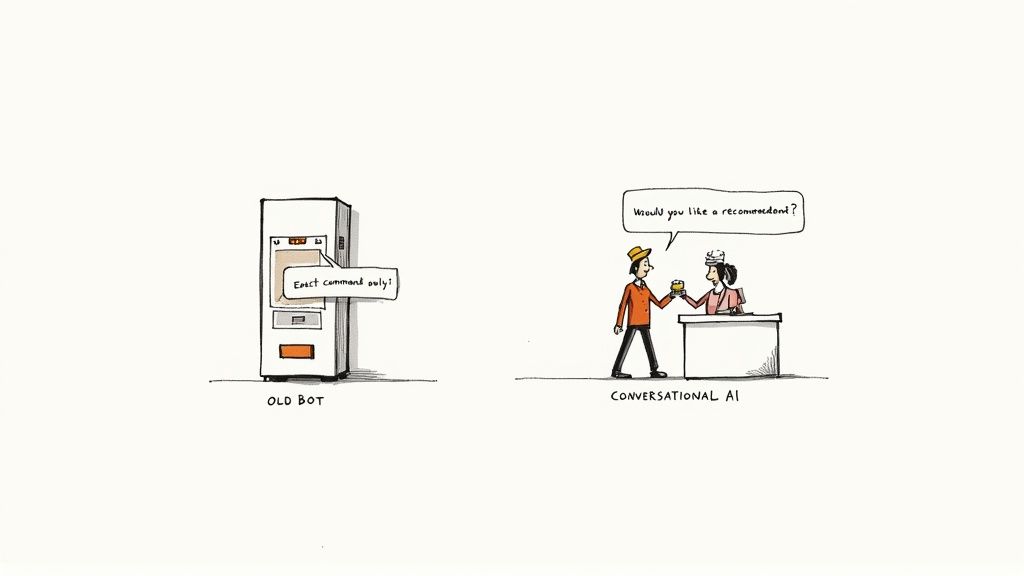
If your only experience with chatbots involves clunky, rule-based systems that constantly reply with “I don’t understand,” it’s time for a reset. Those old bots are like basic vending machines; they only work if you punch in the exact code (“B4”).
A conversational AI chatbot, on the other hand, is like a skilled barista. You can say, “I need something to wake me up, but not too bitter,” and they’ll know exactly what to recommend. This new generation of AI doesn’t just scan for keywords; it understands context, remembers what you said earlier, and gets smarter over time.
The goal isn’t just to answer a question. It’s to create a dynamic, helpful, and valuable conversation.
What Really Separates AI from Old-School Chatbots
The huge leap is from simply reacting to truly understanding. An old bot is stuck on a rigid script, completely lost if you go off-piste. A conversational AI chatbot is built for flexibility, translating into a massive upgrade for both your customer experience and your bottom line.
Here’s what that change looks like in practice:
- From Rigid Scripts to Fluid Dialogue: Instead of forcing users down a narrow path, AI chatbots adapt to the user’s words and intent. They can handle unexpected questions and complex problems without breaking.
- From Keyword Matching to Intent Recognition: An old bot hears “price” and sends a generic link. An AI bot understands the difference between “What’s the price of your premium plan?” and “Can you explain your pricing model?” and responds accordingly.
- From Static Responses to Personalized Engagement: By connecting to your business data, a conversational AI chatbot can offer tailored recommendations, look up an order status, or provide account-specific support, making every interaction feel personal.
A modern conversational AI doesn’t just respond—it participates. It anticipates needs, guides users to the right solution, and acts as a true extension of your brand. It’s on the job 24/7, ready to build loyalty and drive growth.
The Business Impact of Smarter Conversations
This technological jump isn’t just cool; it drives real, measurable business results. When conversations are more natural and effective, you move beyond simple Q&A and start hitting core business goals automatically. You’re turning a passive website visitor into an engaged lead or a happy, paying customer.
For an e-commerce store, a conversational AI chatbot can act as a personal shopper, guiding customers to the perfect product and recovering sales that might have been lost. A marketing agency can qualify leads around the clock, ensuring the sales team only talks to the most promising prospects.
This isn’t just about saving time. It’s about creating new opportunities for revenue and building stronger customer relationships at a scale you could never achieve manually.
How Conversational AI Actually Works
Conversational AI Chatbot Flow
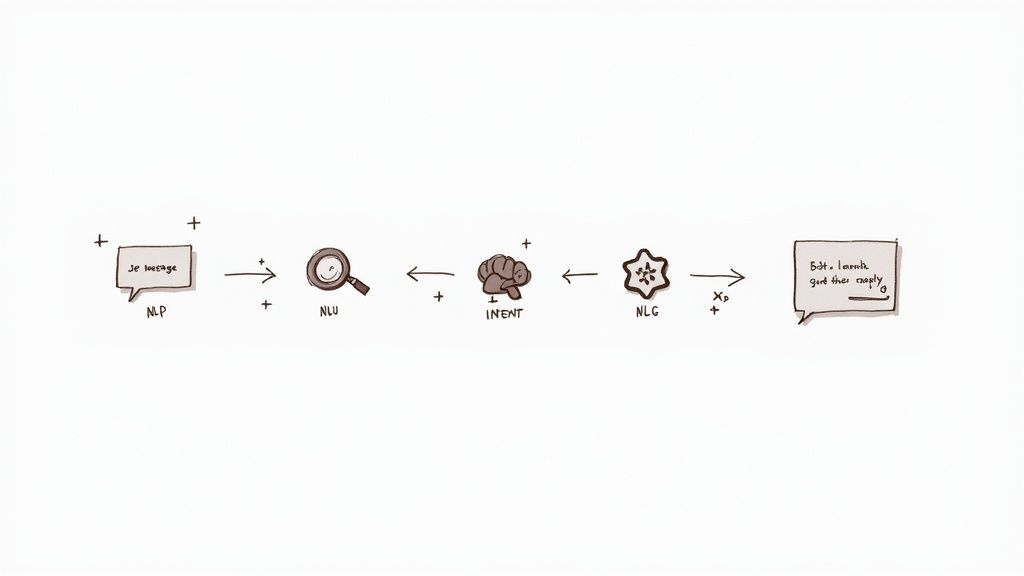
To really get what a modern AI chatbot can do for your business, it helps to peek under the hood. The tech is complex, but the process boils down to three simple stages that turn a user’s message into a smart, helpful reply.
Think of it like a highly efficient digital brain built just for conversation. Each part has a specific job, and they all work together in seconds to create a seamless experience.
Step 1: Understanding the Words You Type
The first challenge for any chatbot is making sense of human language. This is where Natural Language Processing (NLP) comes in. It’s the engine that takes raw text—typos, slang, and all—and breaks it down into a structured format the machine can analyze.
This is the foundational step that turns a messy sentence into clean, usable data. We’ve covered Natural Language Processing Basics in more detail, and you can also see how natural language processing powers chatbots.
Think of this phase as a translator, quickly turning spoken words into written text so the next part of the brain can figure out what it all means.
Step 2: Figuring Out What You Really Mean
Once the words are processed, the AI’s next job is to figure out what the user actually wants. This is where Natural Language Understanding (NLU), a specialized part of NLP, takes over.
NLU is the difference between simply recognizing the word “order” and understanding if the user wants to place a new one, check an existing one, or cancel one.
Practical Example: A customer types, “Where’s my stuff?”
- An old, rule-based bot gets stuck. It’s searching for keywords like “order status” or “tracking,” and “stuff” isn’t on its list.
- An AI chatbot using NLU correctly identifies the intent as “check order status” and recognizes “my stuff” as the entity that refers to the user’s recent purchase.
NLU is like a skilled detective, looking past the literal words to uncover the underlying goal. This allows the chatbot to handle countless variations of the same request, which is what makes the conversation feel natural.
Step 3: Crafting a Smart, Human-Like Response
After understanding the user’s intent, the final step is to create and deliver a reply. This is where Natural Language Generation (NLG) shines. NLG takes the structured data from the previous steps and composes a response that sounds human.
Instead of a blunt, robotic reply like “ORDER_STATUS: SHIPPED,” an NLG-powered bot might say, “Good news! Your order has shipped and should be with you in 2-3 business days. Here’s your tracking number to follow its journey.”
This ability to create dynamic, context-aware responses is what makes modern AI so powerful. With generative AI poised for a 25.5% CAGR, the shift toward more creative and sophisticated chatbot applications is accelerating.
Putting Conversational AI to Work in Your Business
Knowing the tech is one thing. Seeing it actually make you money? That’s where things get interesting. This isn’t theory; we’re talking about practical ways to fix the real bottlenecks holding your business back right now.
The real magic is automating the tasks that directly impact your bottom line—from drumming up qualified leads to offering instant, around-the-clock support. With the global chatbot market expected to hit $46.64 billion by 2029 and 987 million people already using them, this tech is no longer a “nice-to-have.” It’s a core business tool. You can dig into more chatbot adoption statistics to see the whole picture.
Let’s break down how different businesses are putting this to work with actionable examples.
For E-commerce: The 24/7 Sales Assistant
Imagine a personal shopper for every single person who lands on your site, any time of day. That’s what a conversational AI chatbot does for e-commerce. It turns passive window-shopping into an active, guided sales conversation.
Before: A visitor adds an item to their cart, gets distracted, and leaves. That sale is gone unless a generic follow-up email saves it from their spam folder.
After (Actionable Insight): The moment the bot senses they’re about to leave, it pops up with a friendly nudge: “Hey, looks like you left something behind! Any questions about the fit or shipping?” That one timely message can recover up to 25% of abandoned carts. It can also act as a recommendation engine, asking, “Who are you shopping for?” to guide users to the perfect product and increase average order value.
For Service Businesses: The Automated Lead Qualifier
If you’re an agency or consultant, your biggest headache is managing new leads. Every minute on a discovery call with a tire-kicker is a minute you’re not closing a deal. An AI chatbot acts as your front-line screener, filtering and nurturing every inquiry.
Before: A potential client fills out your contact form and waits. Your team manually digs through submissions, leading to slow response times and missed opportunities.
After (Actionable Insight): The chatbot engages website visitors instantly. It asks qualifying questions—”What’s your budget?” or “What’s your project timeline?”—and then books the hot leads directly onto your calendar. By responding instantly, you catch people at peak interest, massively increasing your chance to close the deal.
For SaaS Companies: The Instant Support and Onboarding Guide
In the competitive SaaS world, keeping customers is everything. Two of the biggest reasons for churn are clunky onboarding and slow support. A conversational AI chatbot tackles both.
Before: A new user gets stuck and fires off a support ticket. By the time someone replies, they’re frustrated and already looking at competitors.
After (Actionable Insight): The chatbot lives right in your app, ready with contextual help. It can answer common questions (“How do I add a new user?”), walk users through setup with interactive tutorials, and troubleshoot basic problems. This frees up your human agents for high-level issues, reducing churn and boosting lifetime value.
To wrap up, here’s a quick summary of how different businesses get tangible results.
Conversational AI Applications by Business Type
This table breaks down how various businesses leverage conversational AI to solve specific problems and drive growth.
| Business Type | Primary Use Case | Key Business Benefit |
|---|---|---|
| E-commerce | Abandoned Cart Recovery & Product Recommendations | Increased Sales & Higher Average Order Value (AOV) |
| Agencies/Coaches | Automated Lead Qualification & Appointment Booking | More Qualified Leads & a Shorter Sales Cycle |
| SaaS Companies | Instant User Onboarding & 24/7 Support | Reduced Churn & Increased Customer Lifetime Value (LTV) |
| Local Businesses | FAQ Answering & Quote Generation | Fewer Phone Calls & More Efficient Customer Service |
As you can see, conversational AI offers a direct path to better efficiency, happier customers, and a stronger bottom line for any business.
Your Blueprint for a Successful Chatbot Launch
Building a chatbot without a clear plan is like building a house without a blueprint. A great launch doesn’t start with the first conversation flow; it starts with a single, specific goal.
Forget vague aims like “improve customer service.” Get specific. What does success actually look like? Is it generating 20% more qualified leads? Or slashing support ticket response times by 50%? A clear, measurable goal becomes your north star, guiding every decision.
Define Your Bot’s Purpose and Persona
With your main objective locked in, what is this chatbot’s core job? Will it be a lead generator, a 24/7 support agent, or a personal shopper? This purpose dictates its conversational design.
Just as important is giving your bot a personality. A bot persona should feel like a natural extension of your brand’s voice. Are you playful and witty, or professional and direct? This personality should shine through in its language, tone, and even emojis, making the bot feel like part of the team.
Design Intuitive Conversation Flows
This is where you map out the user’s journey. A great conversation flow feels like a helpful, guided chat, not an interrogation. Start by outlining the most common questions and scenarios your bot will face.
Think of it like a flowchart:
- The Greeting: Kick off with a friendly welcome that clearly states what the bot can do.
- Gathering Info: What key details does the bot need to help the user? (e.g., name, email, company size for lead gen).
- Providing Value: This is the core of the interaction—answer questions, offer recommendations, or point users to the right resources.
- Handoff or Resolution: Does the chat end with a booked meeting, a solved problem, or a seamless handoff to a human agent? Make this final step clear.
Whatever you do, avoid dead ends. Always give the user a way to ask something else, go back, or contact a person.
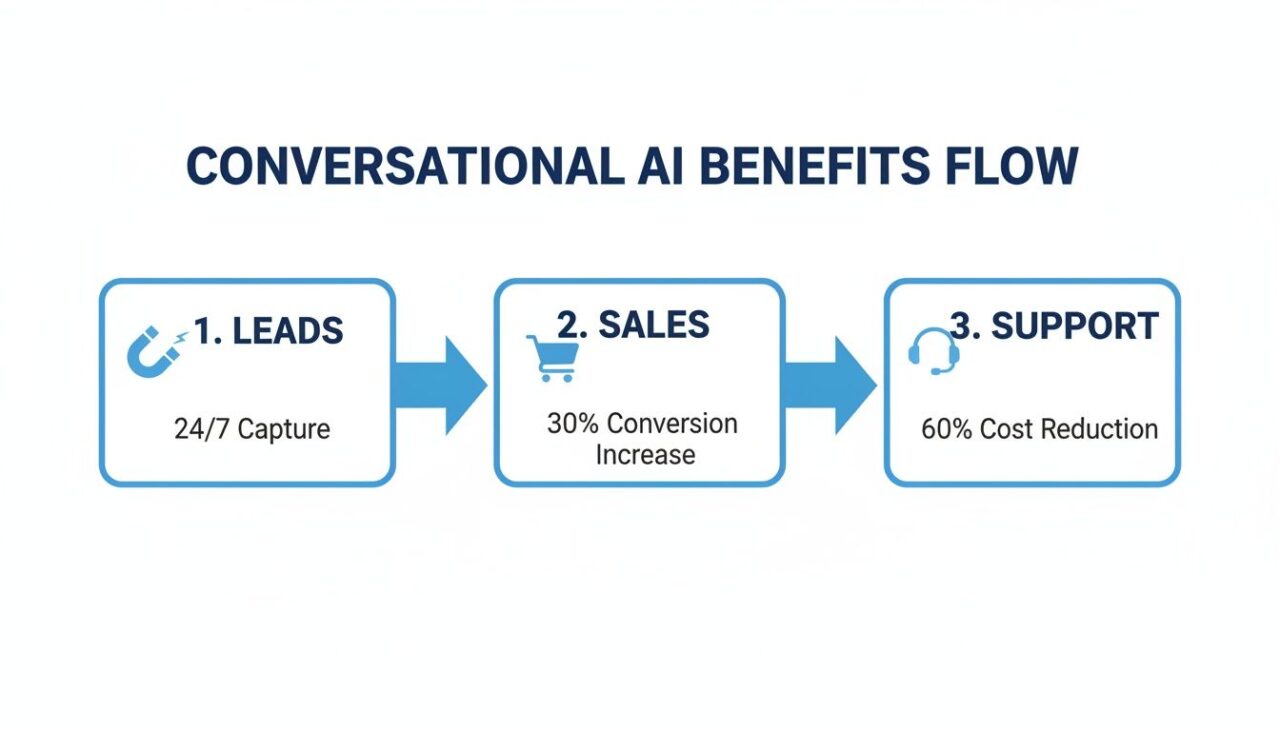
This diagram shows how a well-designed chatbot can streamline core business functions, from lead capture to post-sale support.
Conversational AI Chatbot Benefit Flow
You can see how a single automated tool impacts the entire customer lifecycle—capturing leads, simplifying sales, and making support more efficient.
Train the AI with Your Business Data
A conversational AI chatbot is only as smart as the information it’s given. To provide accurate, relevant answers, it needs to learn from your unique business knowledge. This means feeding it information from all your key sources.
The most effective chatbots aren’t just programmed with generic Q&As. They’re trained on your company’s actual knowledge base, product docs, and past customer conversations. That’s what lets them handle specific, nuanced questions.
To get this right, you need to prepare your data. Learning how to train an AI chatbot is the step that transforms your bot from a generic tool into a specialized expert on your brand.
Test, Deploy, and Iterate
Before you let your chatbot talk to real customers, test it thoroughly. Get your team to actively try to “break” it by asking weird, off-the-wall questions. This is the fastest way to find and fix awkward phrasing, broken paths, and wrong answers.
Once you’re confident, pick your channels. Will the bot live on your website, Messenger, or Instagram? Start where your audience is most active. Remember, a successful launch isn’t the finish line—it’s the starting block. You need to monitor its performance, analyze conversations, and use that feedback to constantly make it smarter.
Choosing the Right Conversational AI Platform
With so many tools out there, picking the right conversational AI platform can feel overwhelming. The real goal is to find the platform that fits your specific business goals, your team’s skills, and your growth plans.
Getting this choice right saves you major headaches later. A platform built for a massive enterprise with a team of developers would be a nightmare for a small e-commerce shop. With the global conversational AI market on track to hit $61.69 billion by 2032, you need the right tool for the job. You can dig into more conversational AI market trends if you’re curious.
Ease of Use and Speed to Launch
The first big decision is choosing between a no-code platform and a developer-heavy framework. Let your team’s technical comfort level be your guide.
- No-Code Builders: Platforms like Clepher are designed with intuitive drag-and-drop interfaces. They’re built for marketers and support teams, not engineers. You can map out complex conversation flows and launch a powerful bot in hours, not weeks.
- Developer-Centric Frameworks: Tools like Google’s Dialogflow are incredibly powerful, but they demand serious coding skills and a significant investment in development resources.
For most businesses, the speed and accessibility of a no-code chatbot builder delivers the fastest return on investment.
Integrations and a Plan for Growth
A chatbot shouldn’t be an island. Its real power is unlocked when it connects to the other tools you already use.
Before you commit, make sure the platform can connect to your essential systems. Does it talk to your CRM? Your email marketing software? A lack of integrations creates data silos and tedious manual work, defeating the purpose of automation.
Think of integrations as bridges connecting your chatbot to the rest of your business ecosystem. Without them, it’s just a solo act, unable to contribute to the bigger picture of your customer’s journey.
Scalability is the other side of that coin. The platform you choose today needs to handle your growth tomorrow. Can it manage a traffic spike during a Black Friday sale? Can you easily upgrade its abilities? Pick a tool that solves today’s problems and has the firepower you’ll need as you grow.
Measuring Success and Optimizing Performance
So, you’ve launched your chatbot. Congrats! But don’t stop there. The real magic—and the real money—comes from treating it like a part of your team that you’re constantly coaching to get better.
To do that, you have to ditch vanity metrics. “Total conversations” looks good on a chart, but it tells you nothing about your ROI. Are you saving time? Generating more qualified leads? Are customers happier? That’s what matters.
Key Metrics That Actually Matter
To get a clear picture of how your chatbot is really doing, zero in on a few high-impact metrics.
- Containment Rate: The percentage of conversations your chatbot handles from start to finish without needing a human to jump in. A high containment rate is a massive win—it means your bot is freeing up your team.
- User Satisfaction (CSAT) Score: How do people feel about talking to your bot? Ask them. A simple, “Did this answer your question?” at the end of a chat gives you a direct pulse on the user experience.
- Conversion Rate: This measures how many people took the action you wanted them to, like signing up for a webinar or booking a call. This is the ultimate proof that your chatbot is driving business goals.
When tracked together, a story emerges. A rising containment rate paired with a solid satisfaction score tells you your bot is an efficient, valued member of your team.
From Data to Actionable Improvements
Your chatbot’s conversation logs are a goldmine. Digging into them regularly is the fastest way to see where people are getting stuck, confused, or frustrated. Look for patterns. Are people constantly asking a question your bot doesn’t understand?
Think of your conversation logs as direct, unfiltered feedback. Each unresolved query is an opportunity to make your chatbot smarter and more aligned with what your audience actually needs.
Once you’ve spotted friction points, get to work. A key part is balancing the AI speed-accuracy trade-off—making sure answers are both fast and correct. You can also run simple A/B tests. Try a different welcome message or rephrase a confusing question and see what gets a better response.
This constant loop of measuring, analyzing, and tweaking is how you turn a good chatbot into an indispensable one.
Frequently Asked Questions About Conversational AI
Even with the clear benefits, diving into conversational AI brings up real-world questions. This section cuts through the noise and tackles the most common concerns we hear from businesses, giving you straightforward answers.
Ready to see how a conversational AI chatbot can transform your business? With Clepher, you can build, launch, and manage powerful automations on your website, Messenger, and Instagram without writing a single line of code. Start turning conversations into conversions today.
Related Posts
10 Lead Capture Software Tools Compared for 2026
October 18, 2026WhatsApp Chatbot for Ecommerce: A Practical 2026 Guide
October 17, 2026What Is Lead Scoring and How It Drives Real Sales Results
October 16, 2026
Founder Clepher