
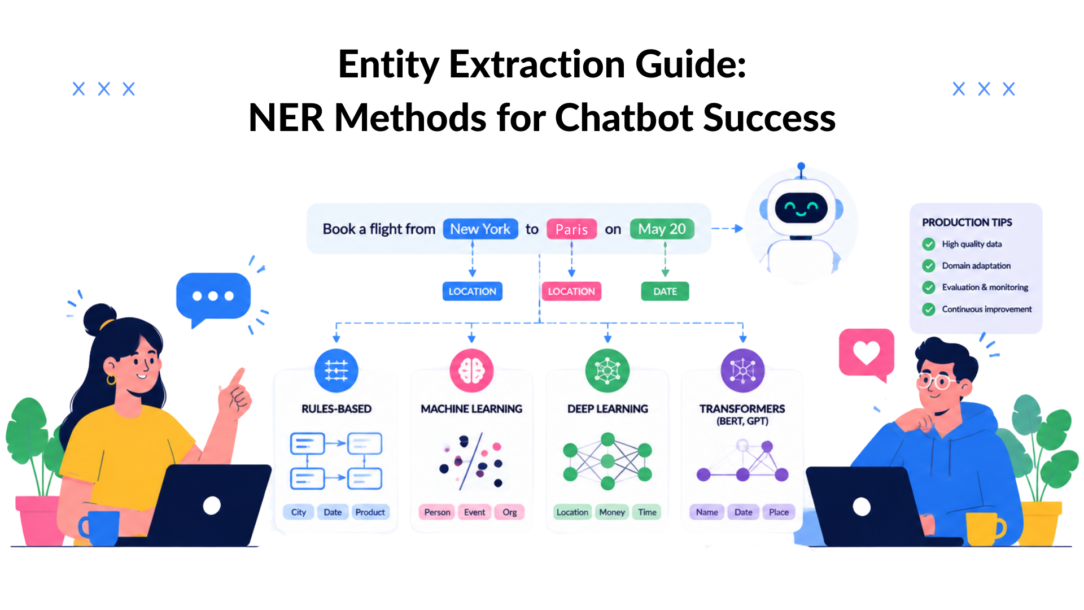
Your chatbot looked fine in testing. It greeted people, classified intent, and sent tidy handoffs. Then real customers started typing, “plz help w/ my order from tues,” or “I need to return those shoes I bought last Tuesday,” and the bot missed the order number, the product, and the date. That gap is where entity extraction earns its keep, because intent alone doesn’t tell your support team what happened, what was bought, or what needs to happen next.
Teams usually notice the problem in two places. A lead-capture bot gets a message like “I’m interested in pricing for the black model, call me tomorrow,” and the system knows it’s a sales inquiry, but it doesn’t reliably capture the product interest, phone number, or timing. A support bot sees “my account got charged twice,” classifies billing, and still fails to pull the transaction reference or the customer’s preferred contact path. In both cases, the bot understood the vibe, but not the business data.
That’s why this topic matters beyond NLP theory. Entity extraction turns messy text into fields your stack can use, and that’s the difference between a chat experience that feels reactive and one that feels operationally competent. If you’re building workflows around support, lead routing, or even logistics and fulfilment, the shape of the extracted data matters as much as the answer you send back. A useful reference point is a practical logistics example like Container Haulage from Felixstowe, because it shows how structured details, like locations, dates, and service types, are what make automation useful in the world.
Why Chatbots Fail on Real Customer Messages
A bot doesn’t usually fail because it can’t classify a message. It fails because the customer didn’t write in the clean, labelled format your training data assumed. One message says, “I need to swap the red one I got on Friday,” and another says, “same issue as before, order still not here,” and both require the system to recover entities that aren’t spelled out neatly.
The bot understands intent, not the payload
A return request, a complaint, and a shipping question are all easy enough to separate. The hard part is extracting the payload hidden inside the complaint, the product mention, the implied order, the date reference, and the recipient. That’s the production reality gap, and it shows up as missed follow-ups, manual triage, and low-confidence handoffs.
Practical rule: If your bot can say what the user wants but not what they’re talking about, you’ve built intent detection, not a usable automation layer.
Business teams get frustrated here. A support operator still has to ask for the order number. A sales rep still has to copy an email address from the transcript. A logistics workflow still has to interpret a route or shipment reference manually. Those aren’t model failures in the abstract; they’re workflow failures in the inbox.
For teams exploring the wider NLP stack, it helps to connect extraction to the rest of the pipeline. A good overview of how those components fit together is available if you want to explore NLP for growth, but the core takeaway is simple. Chatbots don’t need more guesses. They need more precise fields from the text customers already wrote.
Real messages don’t look like benchmarks
Academic examples are usually clean. Real customer messages are abbreviated, sloppy, emotional, and incomplete. They also contain shorthand that only makes sense in context, which is why exact string matching breaks down so quickly.
That matters even more when the entity is implied rather than explicit. A customer might say, “that thing I ordered last week,” and the model has to recover what “thing” refers to, then connect it to the right order. In production, those references are normal. In many demos, they’re invisible.
The fix is not to overfit on clean language. It’s to extract the specific fields your workflow needs, then handle ambiguity with fallback logic, confidence thresholds, and human review where the stakes justify it.
What Is Entity Extraction and How Does NER Work
A customer types, “I’m Maya Chen. I ordered the Pro Kit on Monday, my order number is 12345, and I need it shipped to a different address.” A support agent can read that instantly. A chatbot cannot use it until the text has been split into fields it can act on. Entity extraction, also called named-entity recognition or NER, does that conversion by turning raw text into structured data.
The classic taxonomy covers people, organizations, locations, time expressions, quantities, monetary values, and percentages. That matters because NER became a standard NLP task in the early 1990s era of information extraction research, when the field moved from ad hoc pattern finding into a defined machine-learning problem with a clear output schema (survey on information extraction and NER history).
From sentence to fields
The practical output is a set of fields a workflow can trust, or at least check. In the support example above, the system would separate the message into:
- Customer name: Maya Chen
- Product: Pro Kit
- Date: Monday
- Order number: 12345
- Action: address change request
That structure is what downstream systems need. A chatbot can route the request, prefill a CRM record, trigger follow-up, or attach the transcript to the right case. Babel Street’s definition matches that business view, because it frames extraction as pulling structured values like people, places, organizations, products, dates, email addresses, and phone numbers from text written naturally, not from perfectly formatted forms (Babel Street on entity extraction).
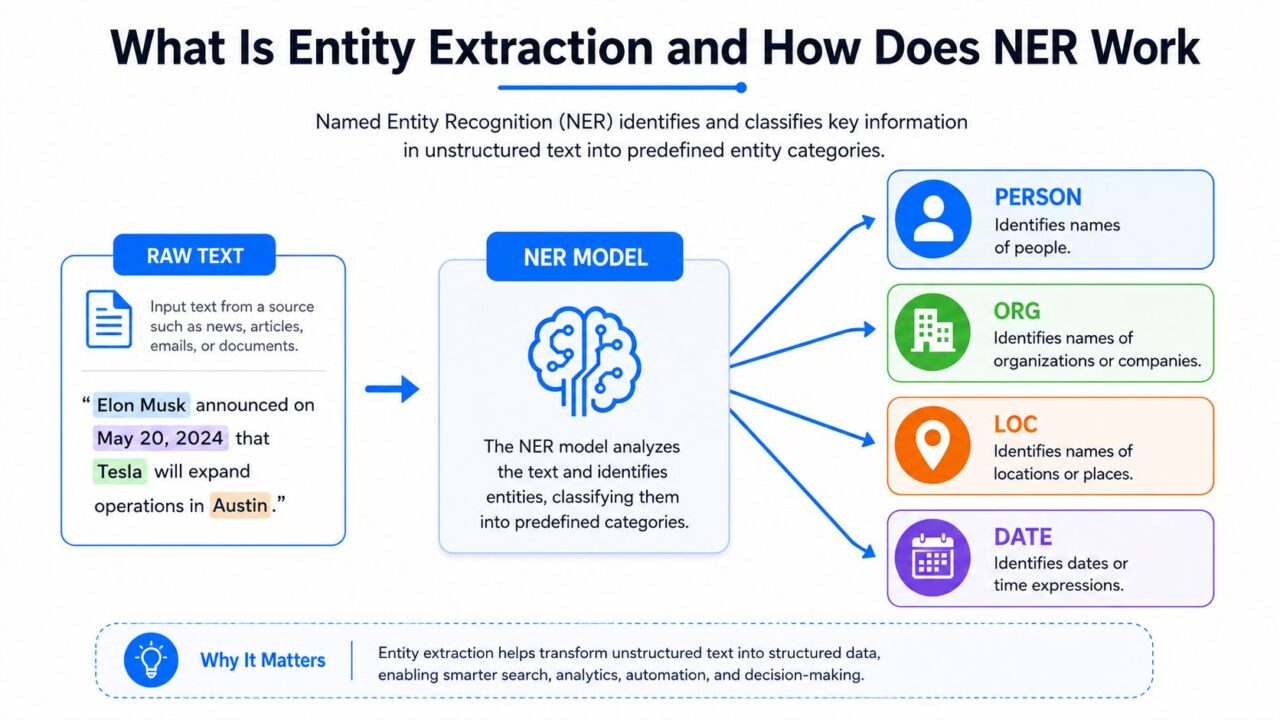
Entity Extraction NER Model
NER does not summarize the whole message. It isolates the relevant pieces and leaves the rest alone. That separation is why it is often used alongside relationship or event extraction in production systems, as described in the Stanford CS224n notes, and in Clepher’s overview of chatbot natural language processing where extraction sits inside the larger conversation pipeline.
Why the distinction matters in a chatbot
A chatbot that only detects “return request” still misses the fields the workflow needs. If it cannot find the order number, product name, or shipping detail, a human has to step in and copy the message by hand. Extraction changes that. It gives the bot enough structure to personalize the reply, route the message, and log the right attributes for later analysis.
The production gap shows up fast with customer text. People write shorthand, leave out obvious subjects, or refer to something only through context, and those messages do not look like benchmark data. A system that works on clean examples can still fail on “that thing I ordered last week,” because the model has to recover the implied reference before it can fill the field.
For chatbot teams, that is the bar. The goal is not to label every noun in the transcript. The goal is to extract the fields the workflow uses, then handle ambiguity with fallback logic, confidence thresholds, and human review where the stakes justify it.
Comparing Entity Extraction Approaches from Rules to Transformers
The gap shows up fast once customers start writing the way they write. A rule set that looks clean in a test tray can fall apart on “plz help w/ my order from tues,” because the message is short, messy, and missing pieces that a model or workflow still has to recover. Production text is full of typos, shorthand, implied entities, and references that only make sense in context.
The old stack and why it still appears
Hand-written regular expressions and pattern rules still earn their keep for narrow, predictable fields. Order numbers, email addresses, and phone formats can often be captured reliably that way, and teams like the control they get from explicit patterns. The limit is coverage. Rules break when wording shifts, when a customer uses aliases, or when the entity never appears directly in the message.
Classical sequence models like HMMs, CMMs, MEMMs, and CRFs improved generalization, and they still show up in systems that need interpretable patterns and controlled output. They work best when the schema is stable, and the team can invest in feature design. That trade-off matters in production, because feature engineering can consume time that should go into fixing workflow gaps, testing fallback paths, and tightening routing logic.
If the entity type is stable and the format is predictable, simple methods are often the cheapest path to a good-enough result.
Deep learning changed the approach by learning representations directly from data. Transformers and large language models brought context handling, ambiguity resolution, and better handling of long-range dependencies, which matters when the entity is implied rather than stated outright. The pipeline view in Google Cloud entity extraction overview matches what works in practice: preprocessing, entity identification, classification, and structured output. For chatbot teams, that mental model is more useful than treating extraction as a search for names in text, and it aligns with how Clepher’s chatbot NLP guidance frames extraction inside the broader conversation flow.
A practical comparison
| Approach | Accuracy | Setup Effort | Latency | Domain Adaptability | Best For |
|---|---|---|---|---|---|
| Rules | Good for fixed formats | Low to medium | Very low | Low | IDs, emails, phone numbers, narrow patterns |
| Statistical NER | Good on common entity types | Medium | Low | Medium | Standard people, orgs, locations, offline use |
| CRF-style systems | Solid with engineered features | High | Low | Medium | Controlled domains with careful feature work |
| Transformers | Strong on context | Medium to high | Medium | High | Messy customer text, multi-entity messages |
| LLM-based extraction | Strong on ambiguity and schema flexibility | Medium | Higher | High | Complex messages, custom schemas, edge cases |
What worked, what didn’t
Rules failed fastest when users shortened words, left out punctuation, or referred to things indirectly. Statistical models held up better, but they still struggled on domain language and underrepresented entities. Transformers handled context better, but they also raised compute cost and deployment complexity, especially when teams needed low latency and predictable failure modes. In production, the strongest systems usually combine methods instead of betting everything on one model type.
That choice depends on traffic, schema size, and the amount of error you can tolerate. For a chatbot, exactness matters more than model elegance. A missed email address is more expensive than a slightly less fashionable architecture.
Evaluation Metrics and Standard Datasets for Entity Extraction
If you don’t measure extraction correctly, you’ll ship a bot that feels smart in a test room and sloppy in production. Precision tells you how many predicted entities were correct. Recall tells you how many of the entities you found. F1 balances the two and gives you a single view of overall performance. For chatbot operators, that means precision protects you from noisy fields, recall protects you from missed handoffs, and F1 gives you a compact way to compare versions.
What the metrics look like in practice
A system with high precision but weak recall might extract only the safest email addresses and miss many product names or dates. That’s fine if you’re using the output for logging, but not if you rely on it to route support or enrich CRM records. A system with high recall but weak precision can flood your downstream tools with garbage entities, which is just as damaging when those fields drive automation.
Benchmark datasets help, but they don’t solve production realism. CoNLL-2003 and OntoNotes 5.0 are standard references in the field, and they’re useful for evaluating common entity categories in relatively curated text. Specialized domain datasets are necessary when your schema includes medical, legal, finance, logistics, or support-specific entities that generic corpora won’t represent well.
The gap is that many benchmarks still overrepresent tidy, well-punctuated language. Real customer text contains typos, abbreviations, code-switching, emoji, shorthand, and half-finished thoughts. That’s exactly where your metrics can look healthier than the bot is.
What to test before production
- Use your own message corpus: Test on the transcripts your customers wrote, not just benchmark text.
- Inspect false positives manually: Find where the model invents entities or mislabels ordinary words.
- Inspect false negatives manually: Find what it keeps missing, especially implied or normalized references.
- Check by entity type: A model can be decent on names and terrible on dates or product SKUs.
- Review end-to-end outcomes: A technically “good” extraction score can still fail if the downstream CRM mapping is wrong.
A useful production habit is to treat benchmark scores as a starting point, not a launch decision. You’re not just measuring model quality. You’re measuring whether the bot can support real business actions without a human cleaning up every transcript.
Production Considerations for Entity Extraction Systems
The hardest part of production extraction isn’t the model. It’s deciding which data matters, how it moves through the system, and what happens when confidence is low. Stanford’s implementation taxonomy, hand-written rules, classifiers, and sequence models, is still useful because it forces the engineering discussion around inputs, outputs, and trade-offs instead of model hype.
Design the schema before you train anything
If you don’t define the business fields first, you end up with a model that extracts interesting entities nobody uses. Good schema design starts with the workflow, not the NLP stack.
- Define target entity types: Decide whether you need names, product codes, dates, order IDs, sentiment markers, or all of the above.
- Map each field to an action: A phone number should trigger a callback path. A product name should drive routing or personalization.
- Keep the schema stable: Changing labels every few weeks creates drift in both training data and automation logic.
- Normalize aliases early: “Acct,” “account,” and “profile” shouldn’t become three separate concepts in your backend.
This is also where training conversations need to stay grounded in the deployment target. A chatbot can only extract useful entities if the team trains it against the fields the business uses, which is why a practical guide like how to train an AI chatbot should sit next to the extraction plan, not after it.
Handle implied and normalized entities explicitly
Customers rarely speak in clean labels. They point backward in the thread, use pronouns, or refer to a previous purchase indirectly. The harder research problem here is recovering entities that aren’t present in the text, or normalizing them to a business schema. That is daily customer chat, especially in support threads where people assume the bot can track context.
The practical answer is to combine extraction with conversation state. Track earlier turns, resolve references to prior messages, and fall back to a clarification question when the confidence is too low. For high-stakes cases like payment data or personal information, use human review instead of forcing automation through uncertainty. In Clepher-style chatbot flows, that often means extracting a partial field, then asking one targeted follow-up instead of restarting the entire conversation.
Build for latency and failure
A fast bot that misses critical fields is still a bad bot, but a slow bot can break the user experience. Batch processing helps when you are processing large volumes of transcripts offline. Real-time routing needs tighter latency control, simpler extraction paths, and clear error handling when the model can’t decide.
Operational rule: If the extractor can’t name the entity cleanly, the workflow should ask a question, not guess.
For teams integrating into customer-facing systems, a no-nonsense deployment checklist matters. Decide which entities are mandatory, define fallback behavior, log failures, and monitor drift as customer language changes. Entity extraction only looks finished when the bot survives bad text, incomplete context, shorthand, typos, and schema updates without falling apart.
Entity Extraction in Clepher Chatbot Use Cases
Entity extraction becomes real when it changes a workflow. A lead form that asks people to retype details is friction. A chatbot that extracts the same details from natural conversation is faster, cleaner, and less likely to lose the lead on the way to the CRM.
Lead capture that writes itself
A visitor says, “Hi, I’m Nina Patel. Interested in your premium plan for my skincare brand. You can reach me at [email protected] or on 555-0199.”
The useful fields are obvious once extracted.
- Name: Nina Patel
- Email: [email protected]
- Phone: 555-0199
- Product interest: premium plan
- Use case: skincare brand
The downstream action is also obvious. The conversation can be tagged as a qualified lead, routed to sales, and stored with the right custom fields for follow-up. Without extraction, the lead exists only as a transcript. With extraction, it becomes a record your team can act on.
Personalization that uses the right memory
A returning customer writes, “I loved the blue hoodie I got last month, show me similar stuff.”
The extracted entities aren’t just the product mention. The useful output includes the prior purchase, color preference, and implied category interest. Once those are captured, the bot can personalize recommendations without forcing the user to repeat themselves.
That kind of response feels better because it’s based on remembered details, not generic intent labels. It also reduces drop-off in long conversations, because the customer doesn’t have to rebuild context every time they message.
Routing that protects your inbox
A message like, “My invoice hasn’t updated, and I need help today,” should not land in the same queue as, “Can someone help me choose the right package?”
One is billing with urgency. The other is sales with low urgency. When extraction captures those attributes, the conversation can go to the right team without manual triage. Value lies not in guessing intent more cleverly; it’s in combining intent with extracted fields so the workflow matches the request.
How to Choose and Integrate Entity Extraction Tools
Choosing a tool starts with the entity types you need, the volume you handle, and the penalty for mistakes. If your fields are fixed and your text is simple, a managed NLP API or rule layer may be enough. If your domain uses shorthand, aliases, or underrepresented entities, a transformer or LLM-based approach becomes more attractive.
When LLMs help, and when they don’t
Recent research on ontology-driven extraction from dementia forums found that LLaMa 3 was more reliable than traditional neural networks and transformer models for detecting underrepresented entities across a 45,216-sentence corpus, which is a strong signal that LLM-based methods can outperform smaller supervised models in low-resource or domain-specific settings (RANLP 2025 study). That doesn’t mean LLMs win everywhere. It means the right question is where they’re better, where they’re inconsistent, and whether your schema control is strong enough to manage the output.
Integration criteria that actually matter
- Cost at scale: Managed APIs are easy to start with, but recurring usage can change the economics quickly.
- Privacy and compliance: If your transcripts contain sensitive data, your handling policy matters as much as the model.
- Fallback logic: Decide what happens when extraction confidence is low or the model returns nothing.
- Schema control: Your automation is only as good as the field mapping downstream.
- Human review paths: High-risk entities should be reviewable, not auto-processed.
The best integration pattern is usually not “one model forever.” It’s a pipeline that lets you start simple, then add sophistication where the business value justifies it. In chatbots, that often means using one layer for obvious entities, another for ambiguous customer language, and a final handoff to human support when the system can’t resolve the text safely.
For teams building on a conversational platform, the goal is to connect extraction outputs into fields, segments, and routing logic without making the flow brittle. Keep the tool choice aligned with the work, not the hype.
If you’re building a chatbot that has to understand messy customer language, Clepher gives you the automation layer to put extraction to work in real flows, not just demos. It’s built for turning conversation into structured action, so you can route leads, personalize replies, and reduce manual cleanup. Visit Clepher to see how entity-driven chatbot workflows can fit into your customer operations.
Related Posts
Client Account Management: A Practical Playbook
October 13, 2026Chat Bot Responses That Convert: A Practical Guide
October 12, 202610 Broadcast Automation Software Platforms Compared
October 11, 2026
Founder Clepher