

Think of Facebook Messenger automation as your always-on sales and support team, living right inside your customer’s favorite messaging app. It’s a powerful system that uses chatbots and smart conversation flows to instantly engage users, answer questions, and guide them toward a purchase—24/7.
Beyond a Simple Chatbot
Trying to manually reply to every message is like running a busy restaurant with one phone line. You’ll miss calls, customers will get frustrated, and potential sales will walk away.
Facebook Messenger automation, on the other hand, is like having a full contact center that never sleeps. It can handle thousands of conversations at once, turning your passive Messenger inbox into an active, revenue-generating machine.
This isn’t just a nice-to-have feature anymore. Modern customers expect immediate answers. Old-school channels like email feel too slow. The goal isn’t just to reply faster; it’s to create automated experiences that turn casual followers into loyal customers.
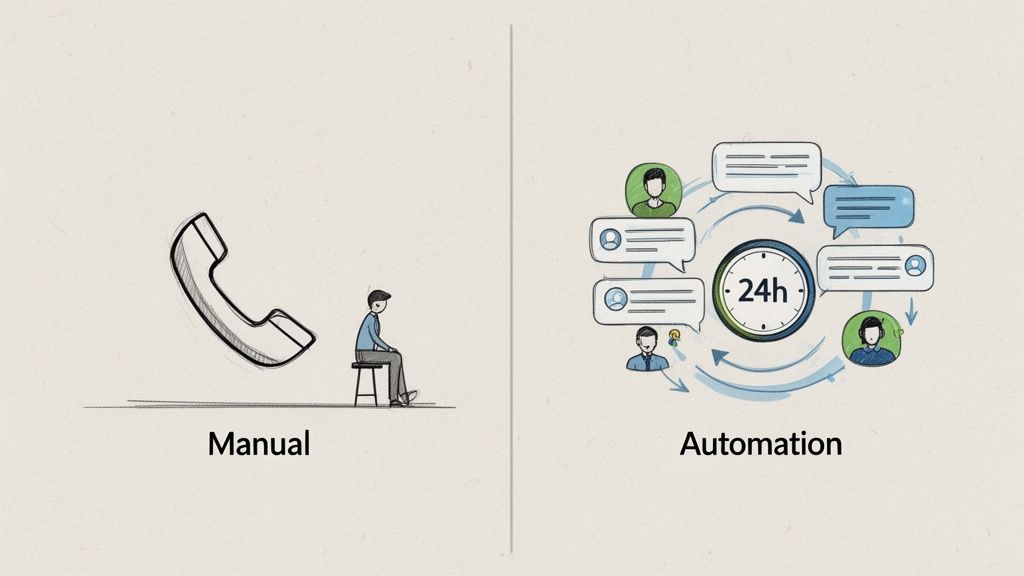
Automation Comparison
A Major Shift in Customer Communication
The move toward automated chat is no passing trend. When Facebook first opened its platform to chatbots in 2016, it was a game-changer for businesses overwhelmed by customer inquiries.
Today, that evolution is in overdrive. Over 375,000 people engage with Messenger bots every day worldwide. This massive adoption signals a fundamental shift in how brands connect with their audience. To see the full scope, you can dig into these Facebook Messenger statistics on Social Media Curve.
This isn’t just about answering FAQs. It’s about proactively guiding the customer journey, from initial interest to post-purchase support, all within a single, seamless conversation. True automation builds relationships at scale.
This guide provides actionable strategies for any business—from e-commerce stores to digital agencies—looking to use automation for real growth. We’ll cover how to build these systems, what mistakes to avoid, and how to get measurable results.
Let’s get practical about what Facebook Messenger automation can do for your business. We’re not talking about saving a few minutes; we’re talking about a fundamental shift in how you generate leads, support customers, and drive revenue.
By bringing automation to Messenger, you meet your audience where they already spend their time. But you do it with an incredible level of engagement that other channels can’t match.
Achieve Open Rates That Dwarf Email
The single biggest win with Messenger automation is its mind-blowing engagement. If you’re happy with a 20% open rate on email campaigns, prepare to be amazed.
Marketing messages sent via Messenger bots often deliver 10-80x better results than a standard email or organic social post. It’s common to see open rates hitting 70-80% within the first hour. When you compare that to email’s average of 5-10%, you understand why this is such a game-changer. For more data, check out these powerful Messenger statistics on AdamConnell.me.
This direct comparison shows just how big the gap is:
Messenger Automation vs Traditional Marketing Channels
| Metric | Facebook Messenger Automation | Email Marketing | Organic Social Media |
|---|---|---|---|
| Open Rate | 70-80% (often within the first hour) | ~21% (average across industries) | ~1-5% (reach vs. followers) |
| Click-Through Rate | 20-30% | ~2.6% (average) | ~0.9% (average) |
| Response Time | Instant, 24/7 | Hours to days | Minutes to hours |
| Interactivity | High (conversational, buttons, quick replies) | Low (static content, link clicks) | Medium (comments, likes, shares) |
The numbers don’t lie. While email and organic social have their place, Messenger automation operates on a different level of direct, immediate engagement.
Recover Lost Sales While You Sleep
If you run an e-commerce store, abandoned carts are a constant revenue leak. Following up manually is impossible at scale, but automation turns this problem into a massive opportunity.
Example: An automated Messenger sequence can trigger the moment a shopper leaves your site without buying. These timely, conversational pings have been shown to recover an incredible 18-20% of abandoned carts. That’s pure revenue injected back into your business, no extra ad spend required.
Generate and Qualify Leads 24/7
Your lead generation shouldn’t stop at 5 PM. Automation works around the clock, capturing and qualifying potential customers when they’re most interested—even in the middle of the night.
Example: Someone comments on your Facebook ad at 2 AM. Instead of that lead going cold, a bot instantly starts a Messenger conversation. It can ask qualifying questions like “What’s your budget?” and even book a sales call on the spot. To see how this works, explore how personalized chatbot technology creates these seamless, sales-driving interactions.
Deliver Instant Customer Support
In today’s market, speed is everything. Customers expect immediate answers, and making them wait for an email response is a great way to lose them to a competitor.
Messenger automation delivers instant, 24/7 support for common inquiries.
- FAQs: Instantly answer questions about shipping, returns, or store hours.
- Order Status: Let customers get real-time updates on their purchases without contacting your team.
- Human Handoff: When a question gets complicated, the bot can seamlessly pass the conversation to a live agent.
This not only improves customer satisfaction but also frees up your human support team to focus on high-value problems where a personal touch truly matters.
Core Automation Playbooks for Every Business
It’s one thing to talk about the benefits of automation, but the real magic happens when you apply Facebook Messenger automation to specific, real-world business goals. A one-size-fits-all approach just doesn’t work.
Let’s break down proven, practical playbooks you can implement today, tailored to your business model. These are battle-tested strategies for turning conversations into conversions.
The E-Commerce Growth Engine
For online stores, Messenger automation is a direct line to higher revenue. It transforms your Facebook and Instagram pages from static product showcases into interactive, 24/7 sales channels.
Just look at the performance metrics e-commerce stores can achieve with a well-tuned automation strategy.

Automation Performance
These numbers prove automation isn’t just for support; it’s a serious sales driver capable of incredible open rates and tangible cart recovery.
Here are the top e-commerce playbooks that get results:
- Abandoned Cart Recovery: A shopper leaves items in their cart. Your automated flow triggers a friendly reminder in Messenger: “Hey [First Name], did you forget something? Your items are waiting!” This simple message can recover up to 20% of lost sales.
- Personalized Product Quizzes: Guide customers to the perfect product with a quiz. Ask questions like, “What’s your skin type?” or “What’s your fitness goal?” to provide tailored recommendations and boost conversion rates.
- Proactive Shipping Updates: Customers hate hunting for tracking numbers. Send automated shipping notifications directly in Messenger to reduce support tickets and build trust.
The Agency Lead Machine
For digital agencies, automation streamlines operations from lead capture to client onboarding. It frees up your team from repetitive tasks so they can focus on high-value strategy and client relationships.
By automating initial touchpoints, agencies can qualify leads in minutes, not days. This ensures your sales team spends their time only with prospects who are a perfect fit, dramatically shortening the sales cycle.
Here are a few key agency playbooks:
- Automated Lead Qualification: When a prospect messages your page, a bot can ask crucial questions about their business type, monthly ad spend, and goals to instantly segment hot leads.
- Instant Service Info Delivery: Set up keyword triggers for “services” or “pricing.” When a user types one, the bot delivers a menu of your offerings, complete with case studies or testimonials.
- Seamless Client Onboarding: Once a contract is signed, trigger an automated onboarding sequence in Messenger. This flow can collect necessary info, share welcome documents, and schedule the kickoff call without a single email.
To ensure your strategy is effective, it helps to understand general marketing automation best practices.
The Creator and Coach Toolkit
If you’re a coach, consultant, or creator, automation helps you build an engaged relationship with your audience at scale. It’s the perfect tool for nurturing your community and guiding followers toward your paid programs.
To drive traffic to these automations, check out our guide on effective Click-to-Messenger ads.
Here are the top playbooks for creators:
- Lead Magnet Delivery: A user comments “GUIDE” on your post. Seconds later, your bot delivers the free PDF to their Messenger inbox. You just built your subscriber list on autopilot.
- Webinar and Challenge Registration: Automate the entire registration process. Your bot can sign people up, send reminders before you go live, and follow up with a replay link—all inside Messenger.
Ready to stop thinking about automation and start doing it? Building your first Facebook Messenger flow is easier than you think, especially with today’s no-code tools. Forget staring at lines of code.
Think of it like building with LEGO blocks. You connect simple pieces—a welcome message, a button—to create a powerful, automated conversation that works for you 24/7.
This isn’t about becoming a developer. It’s about following a simple, five-step framework to get a practical automation live and delivering results. Let’s walk through the process.
Step 1: Define Your Goal First
Before you open any tool, ask yourself: What is the number one thing I want this automation to accomplish? A vague goal like “more engagement” is a recipe for a confusing bot. Get specific.
A clear goal gives your conversation a purpose.
- E-commerce store: “Recover at least 15% of abandoned carts this month.”
- Coach or creator: “Automatically register 100 new attendees for my upcoming webinar.”
- Local business: “Generate 20 qualified leads by asking for their email and phone number.”
Nailing down your goal makes every other decision easier. It clarifies what questions to ask, what buttons to offer, and how to measure success.
Step 2: Map the Conversation on Paper
Seriously, don’t skip this. Grab a pen and paper or a whiteboard tool and sketch out the conversation. This five-minute step will save you hours of headaches.
Think of it like a “choose your own adventure” story. What’s the first message? If they click Button A, where do they go? If they click Button B, what happens? Mapping it visually helps you spot dead ends and create a smooth experience before you build anything.
Once you move into a tool, it will look something like this—a simple drag-and-drop canvas.
This visual style makes it easy to link messages, add delays, and create different paths based on user choices.
Step 3: Build with Drag-and-Drop Blocks
Now it’s time to bring your map to life. Inside a platform like Clepher, you’ll use a drag-and-drop builder to assemble your flow. Each block is a piece of the conversation: a text message, an image, a button, or a question.
You’ll drag these elements onto the canvas and connect them just as you drew them. This is also where you add a human touch with personalization tags like {{first_name}} to make the chat feel genuine.
Step 4: Set Up Your Triggers
Your flow is built, but how do people start the conversation? That’s where triggers come in. Triggers are the specific actions that kick off your automation.
- Keyword Trigger: A user messages your page with a word like “pricing” or “webinar.”
- Comment Trigger: Someone comments on a Facebook post, and the bot instantly sends them a DM. This is a game-changer for delivering lead magnets.
- Click-to-Messenger Ad: A user clicks a button on your Facebook Ad and lands directly inside your automated conversation.
Choosing the right trigger is crucial for getting people into your funnel. To learn more, check out our auto-reply for Facebook Messenger in our guide.
Step 5: Test and Launch
This is the final step. Before you unleash your bot, test it thoroughly. Send the flow to yourself and a few colleagues. Click every button, try every keyword, and follow every path to ensure the conversation feels natural and works as planned.
Once you’re confident it’s bug-free, set it live and watch it get to work.
Advanced Tactics to Maximize Your ROI

AI Strategy
You have basic flows running. Now what? It’s time to build an intelligent marketing machine. This is where you graduate from simple replies and start using data to get exponential results.
These strategies will turn your Messenger presence from a handy tool into a serious competitive advantage.
Treat every interaction as a chance to learn about your audience. When you capture data and understand what a user wants, you can deliver hyper-relevant experiences that feel personal, not robotic. This is the difference between a good Facebook Messenger automation setup and a great one.
Segment Your Audience with Tags
Think of tags as smart labels. You can apply them to users based on their actions or interests. Someone who clicks a link for your “Advanced Course” gets a different tag than someone asking about “Beginner Tips.” This simple act is incredibly powerful.
It allows you to stop blasting generic messages and instead send targeted broadcasts that speak directly to what each user group cares about.
- E-commerce Example: A user clicks a button for your men’s shoe collection. Boom. You automatically tag them with
interest_mens_shoes. The next time you drop a new line of sneakers, you can send a broadcast only to that segment. - Creator Example: Someone downloads your “Social Media Checklist.” Tag them with
interest_social_media. Now, when you host a webinar on Instagram growth, you know exactly who to invite.
This isn’t just better marketing; it’s a better user experience. You respect their inbox by only sending relevant content, which dramatically boosts open rates and conversions.
Leverage AI Keywords to Understand Intent
Basic keyword triggers are a good start, but AI-powered keywords are next-level. Instead of looking for an exact match like “price,” AI can understand the intent behind phrases like “how much does it cost?” or “what are your rates?”
This lets your bot handle a much wider range of questions with the right response. It’s the difference between a bot that follows a rigid script and one that acts like an intelligent assistant.
Integrate with Your Marketing Stack
Your Messenger automation shouldn’t be an island. Its real power is unlocked when you connect it to your other tools, like your CRM or email marketing platform.
For example, when your bot identifies a hot lead, a smooth integration can automatically:
- Create a new contact in your CRM (like HubSpot or Salesforce).
- Add them to an email sequence in a tool like Mailchimp or ConvertKit.
- Notify your sales team on Slack that a qualified lead is ready for a call.
This creates a unified system where every part of your marketing stack works together. To dive deeper, our guide on how to qualify sales leads breaks down a solid framework. By connecting your tools, you build a scalable machine that nurtures leads from their first click to a final purchase.
Common Messenger Automation Mistakes to Avoid
Jumping into Facebook Messenger automation can deliver massive wins, but a few common missteps can turn a powerful tool into a brand-damaging headache. Steering clear of these pitfalls is as important as building the right flows.
Think of your automation as a digital brand ambassador. If it’s robotic, spammy, or unhelpful, that’s how people will see your business. The goal is to build a system that feels genuinely helpful and human.
Building Robotic, Unnatural Conversations
One of the fastest ways to alienate someone is with a bot that sounds like a bot. Stiff, formal language and a lack of personality make the experience feel cold and transactional, causing most people to tune out.
Solution: Inject your brand’s personality into every message. Use a conversational tone, add emojis where appropriate, and use personalization tags like {{first_name}}. Small touches, like a typing delay between messages, make the interaction feel more natural.
Your bot is an extension of your brand’s voice. If your marketing is fun and energetic, your bot should be too. If you’re more professional, that tone needs to carry through the conversation.
Spamming Subscribers with Irrelevant Messages
It’s tempting to blast every promotion to your entire subscriber list. But this is a surefire way to get high unsubscribe rates and even have your page flagged by Meta. Sending irrelevant messages erodes trust and trains your audience to ignore you.
Solution: Use tags and segmentation to send the right message to the right person.
- If a user showed interest in “running shoes,” only send them promotions about new sneakers.
- Tag users who attended a webinar and follow up with an offer related to that topic.
This approach respects their inbox and ensures every broadcast provides value, which will dramatically increase your engagement and conversions.
Forgetting the Human Escape Hatch
No matter how smart your bot is, it won’t have all the answers. Nothing is more frustrating for a customer than being trapped in an automated loop with no way to reach a real person.
Solution: Make it incredibly easy to talk to a human. Include a “Talk to an Agent” button in your main menu and keep it as a persistent option. Also, set up keyword triggers for phrases like “help” or “agent” that immediately notify your team and pause the automation.
FAQs about Messenger Automation
Got a few questions? Let’s clear up some common thoughts that pop up when people start digging into Messenger automation.
Ready to turn those conversations into customers? Clepher gives you the no-code tools to build powerful AI-driven automations for Messenger and Instagram. Start your free trial today and see the difference for yourself.
Related Posts
What is Marketing Attribution? A Practical Guide to Measuring ROI
March 13, 2026How to Sell Online Courses and Build a Profitable Business
March 12, 2026AI Customer Service Automation: Your Guide to Scaling Support
March 11, 2026
Founder Clepher